


-
About
Table of Contents
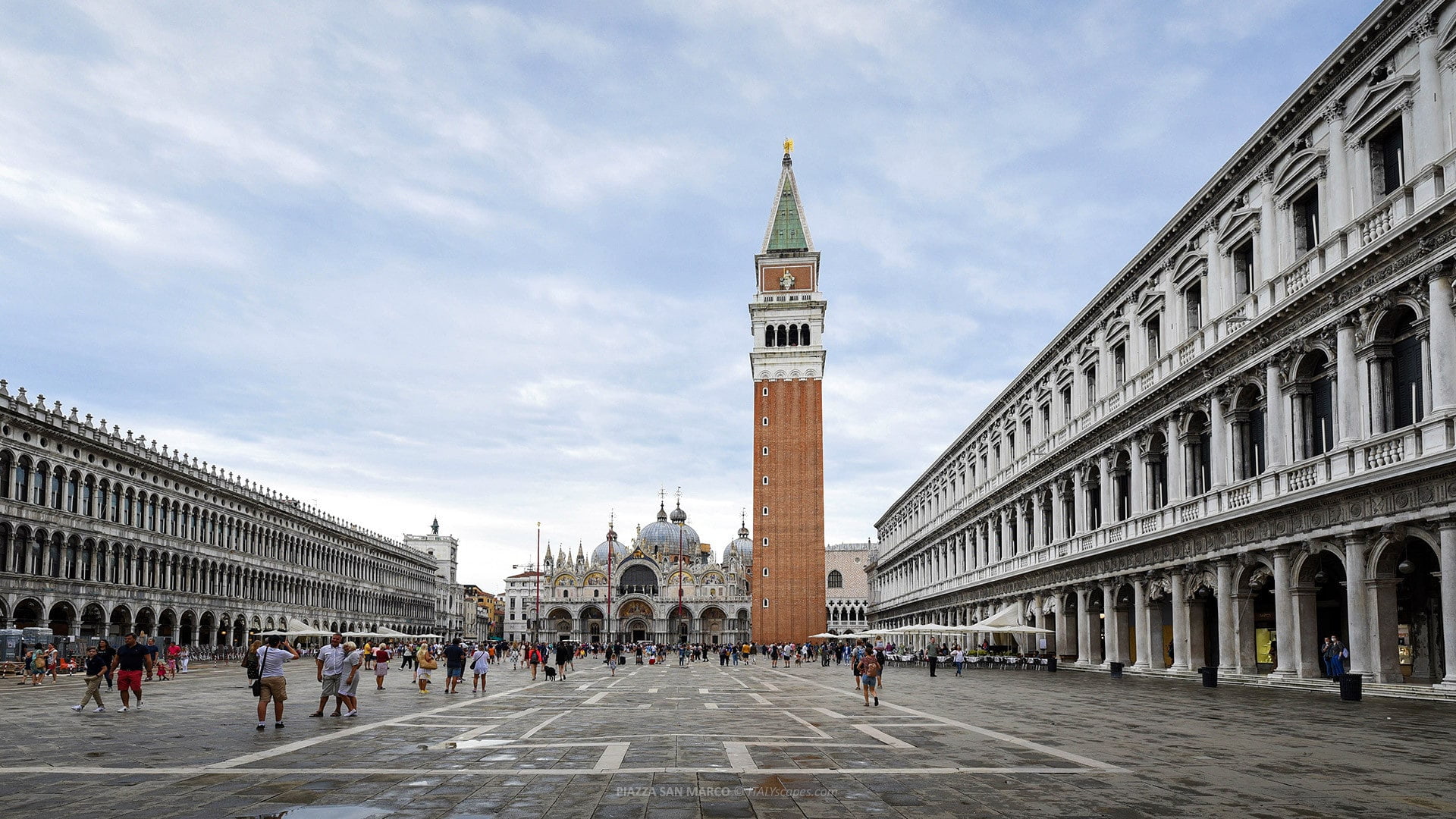
Framed by domes, arcades and the shimmer of the lagoon, St Mark’s Square (Piazza San Marco) is the most famous square in Venice and one of the most celebrated urban spaces in Europe. Often called the heart of Venice, it is the only open space in the city officially given the title “piazza”, while all the others are simply “campi”.
For centuries, processions, proclamations, markets and festivals have unfolded on these stones, while the façades of St Mark’s Basilica, the Doge’s Palace, the Campanile, the Procuratie and the Clock Tower watched silently over the crowds.
Napoleon is said to have described Piazza San Marco as the drawing room of Europe, capturing how the square functioned as Venice’s grand reception hall.
Today, St Mark’s Square is still the focal point of any visit to Venice. At its eastern end rises the glittering Basilica, while to the south the square opens into the lagoon via the Piazzetta, flanked by the Doge’s Palace and Biblioteca Marciana.
On its long sides, the rhythm of arches and windows of the Procuratie Vecchie and Procuratie Nuove, joined by the Ala Napoleonica, create an elegant architectural frame.
Cafés like Florian and Quadri spill out under the arcades, and the constant play of light on the stone pavement makes the square feel like a stage that changes with every hour of the day.
Short History of St Mark’s Square (Piazza San Marco)
From orchard and canals to ceremonial square
In the 9th century, the area where Piazza San Marco now lies was far from the vast paved space we see today. Sources describe it as a patch of land with vegetable gardens and small canals, part of an orchard belonging to the nearby monastery of San Zaccaria.
At that time, a small chapel dedicated to St Theodore served as the doge’s private church. When the relics of St Mark the Evangelist were brought from Alexandria around 828-829, Venice elevated him to patron saint, and a new church of St Mark was built next to the ducal residence.
This first basilica, completed in the 9th century, effectively anchored what would become Piazza San Marco at its eastern end.
Major changes came under Doge Sebastiano Ziani in the 12th century. To create a proper civic space, Ziani had the Rio Batario, a canal that cut across the area, filled in. At the same time, he acquired orchards and buildings, including land from the nuns of San Zaccaria, and cleared structures that obstructed the view of the basilica.
The result was a much larger, more regular piazza extending westward from St Mark’s Basilica and bounded by new ranges of buildings along its north and south sides.
Medieval piazza – markets, processions and power
By the 13th and 14th centuries, St Mark’s Square had become the political and religious centre of Venice. The Procuratie on the north side housed the procurators of St Mark – second only to the doge in prestige – while the Doge’s Palace and basilica formed a monumental complex at the eastern edge.
The piazza hosted markets, public ceremonies, and important state occasions. Processions would move from the basilica across the square, following lines laid into the early brick pavement, which helped organize stalls and ceremonial routes.
The space was narrower than today. Older buildings crowded the west end, and the campanile stood closer to the north and south ranges.
Renaissance remodelling and the Clock Tower
From the late 15th century, Venice began reshaping Piazza San Marco in line with Renaissance ideals of symmetry and monumentality.
In 1493, the Republic commissioned an astronomical clock and decided to house it in a new clocktower facing the piazza, above an archway that would mark the entrance to the Merceria, the bustling shopping street leading to the Rialto.
The Torre dell’Orologio, probably designed by Mauro Codussi and completed in 1499, became a key focal point on the north side of the square.
A fire in the old Procuratie buildings in the early 16th century prompted the reconstruction of the entire south side of the piazza – the future Procuratie Nuove – in a uniform Renaissance style, starting in 1517.
Over the 16th and 17th centuries, architects such as Jacopo Sansovino, Vincenzo Scamozzi and Baldassarre Longhena contributed to the transformation of the square into the coherent, harmonious space we recognize today.
Napoleonic changes and modern era
The fall of the Venetian Republic in 1797 brought dramatic changes. After Napoleon’s troops entered the city, symbols of the old regime were removed. The famous bronze horses of St Mark were taken to Paris, and images of the winged lion were destroyed or defaced.
In the early 19th century, under French and later Austrian rule, the west end of Piazza San Marco was rebuilt as the Ala Napoleonica (Napoleonic Wing).
This Neoclassical façade, inspired by the Procuratie Nuove, completed the square’s enclosure, uniting the north and south ranges and providing space that now houses part of the Museo Correr.
The campanile, originally built between the 12th and 16th centuries, collapsed suddenly in 1902, but was rebuilt and inaugurated in 1912.
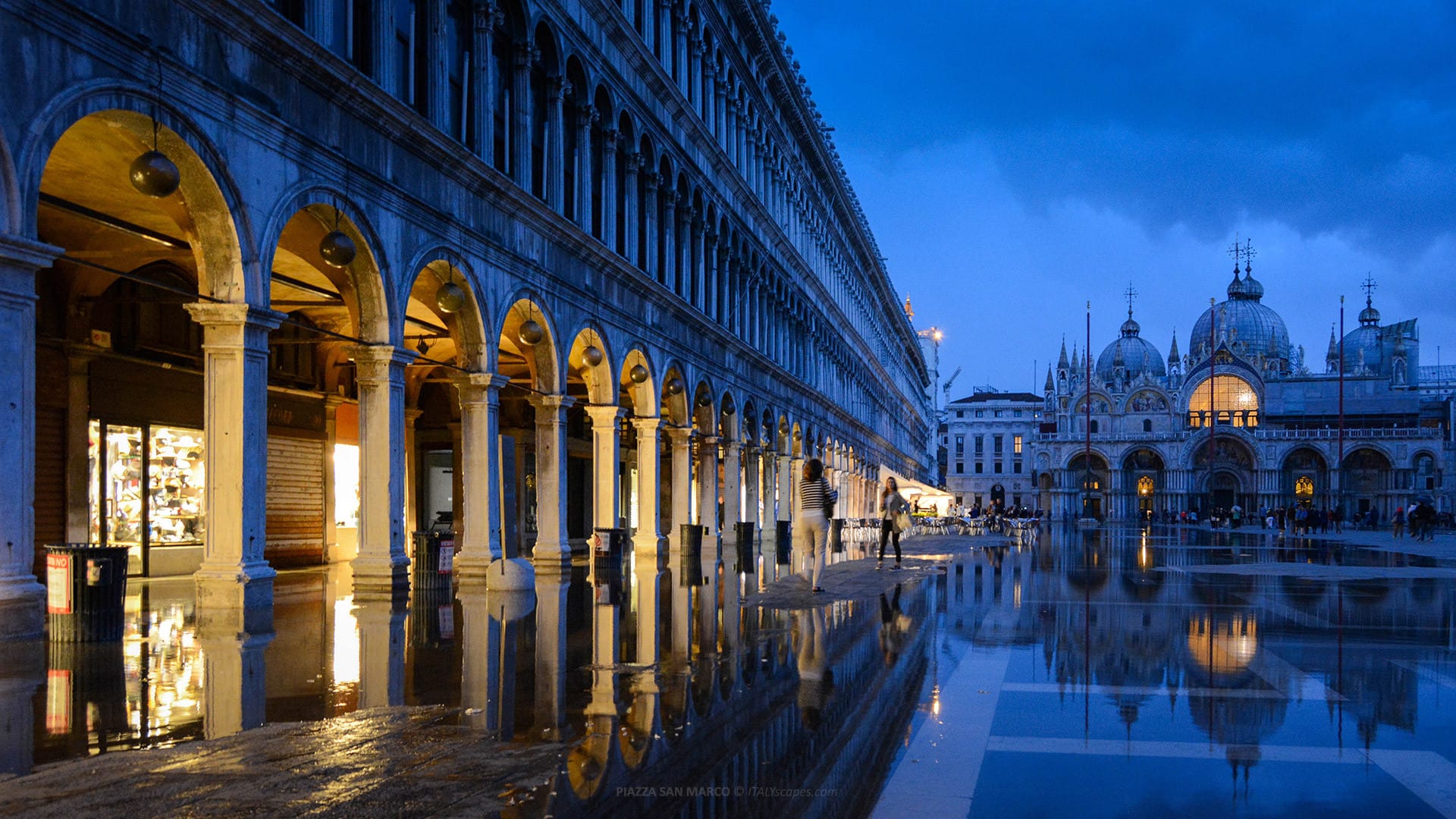
In the 20th and 21st centuries, Piazza San Marco has faced new challenges, especially acqua alta (tidal flooding). Yet it remains the symbolic heart of Venice – a stage for festivals, a magnet for visitors, and a living reminder of the city’s millennial history.

Architecture of St Mark’s Square (Piazza San Marco)
The architecture of Piazza San Marco is less about a single building and more about the composition of an entire urban room.
The square is a long trapezoid (wider at the basilica end), paved in patterned stone and enclosed on three sides by continuous arcades, with the fourth side opening toward the lagoon through the Piazzetta.
The paving and the space
The piazza’s surface, originally brick, was repaved in the early 18th century with a geometric design by architect Andrea Tirali.
Bands of white Istrian stone set into darker trachyte create a network of elongated lozenges and rectangles, guiding the eye toward the basilica and subtly organizing the space.
Three tall flagpoles stand in front of St Mark’s Basilica, with bronze bases by Alessandro Leopardi (1505). In the days of the Republic, they carried banners of St Mark, while today they often display both Venetian and Italian flags, emphasizing the square’s civic role.
St Mark’s Basilica (Basilica di San Marco)
At the eastern end, St Mark’s Basilica dominates St Mark’s Square with its cluster of domes, gilded mosaics and marble-clad façade.
The current church, largely completed by the 11th century and modified over later centuries, is a Byzantine-inspired basilica with a Greek-cross plan, five domes and an extraordinary wealth of spolia – columns, capitals and reliefs taken from Constantinople and other eastern cities.
The western façade, facing the square, is composed of five great arches decorated with marbles, sculpted reliefs and mosaics depicting scenes from the life of St Mark and the translation of his relics.
Architecturally, the basilica provides Piazza San Marco with a dazzling, almost theatrical backdrop – an ornate screen of arches and domes that contrasts with the more regular lines of the Procuratie.
St Mark’s Campanile (Campanile di San Marco) and the Loggetta
Standing free near the centre of the square’s long side is St Mark’s Campanile, a tall brick bell tower about 98.6 metres high.
Originally begun in the 12th century, with its final form reached in the early 16th century, the campanile collapsed dramatically in 1902 and was rebuilt by 1912 “com’era, dov’era” (“as it was, where it was”).
The tower’s simple, almost austere volumes – plain brick shaft, belfry with arched openings, pyramidal spire topped by a golden angel – weigh anchor the visual composition of Piazza San Marco.
At the foot of the campanile stands the Loggetta del Sansovino, a small but richly decorated marble structure with bronze statues, built by Jacopo Sansovino between 1537 and 1546.
Procuratie Vecchie (North Side)
On the north side of Piazza San Marco, a long arcade of arches and windows forms the Procuratie Vecchie (“old procuracies”).
These buildings housed the offices and apartments of the Procurators of St Mark, powerful magistrates responsible for managing state property and the basilica’s finances.
The current structures date mainly from the early 16th century, replacing earlier two-storey Byzantine-style buildings. The design features ground-floor arcades with stilted arches, above which run two regular storeys of rectangular windows framed by pilasters.
At ground level, the arcades house shops and cafés, including Caffè Quadri, opened in the 18th century and historically favoured by Austrian officials in the 19th century.
Clock Tower (Torre dell’Orologio)
Near the centre of the north side rises the Torre dell’Orologio, the Clock Tower, completed in 1499. It frames an archway leading into the Merceria, the main shopping street connecting Piazza San Marco with the Rialto area.
The tower’s façade combines a large blue-and-gold astronomical clock – indicating the time, phases of the moon and zodiac signs – with a relief of the winged Lion of St Mark and, at the top, two bronze figures (the “Moors”) who strike the bell.
Ala Napoleonica (West End)
The west end of Piazza San Marco is occupied by the Ala Napoleonica, or Napoleonic Wing, built in the early 19th century after the demolition of the old church of San Geminiano and other structures.
This Neoclassical façade unifies the north and south Procuratie ranges, completing the square’s enclosure. Its design echoes the language of the Procuratie Nuove, with a regular series of arches and pilasters, but on a slightly grander scale.
Behind the façade, a staircase leads up to the Museo Correr, which presents the art and history of Venice.
Procuratie Nuove (South Side)
Facing the Procuratie Vecchie across the square, the Procuratie Nuove line the south side of Piazza San Marco.
Designed by Jacopo Sansovino in the mid-16th century and completed by Vincenzo Scamozzi and Baldassarre Longhena around 1640, these buildings were intended as a modern expansion of accommodation and offices for the procurators.
The façade displays a more Classical rhythm than the older north side: pairs of columns, pedimented windows and carefully proportioned bays.
As on the north side, the ground floor is occupied by shops and cafés, among them the celebrated Caffè Florian, founded in 1720 and one of the oldest coffee houses in continuous operation in the world.
Today, much of the upper storeys of the Procuratie Nuove and Ala Napoleonica are part of the Museo Correr and related institutions, but the façades still evoke the world of Renaissance and Baroque Venice.

Piazza San Marco seen from the St Mark’s Campanile
Biblioteca Marciana and the Piazzetta
Although technically part of the Piazzetta, which connects Piazza San Marco to the lagoon, the Biblioteca Marciana (also known as the Libreria Sansoviniana) is integral to the architectural ensemble.
Designed by Sansovino and built from 1537, later extended by Scamozzi in the late 16th century, it stands opposite the Doge’s Palace on the south side of the Piazzetta.
Andrea Palladio called it “the most magnificent and ornate structure built since ancient times”. Its façade, with superimposed orders, rich sculptural decoration and deep arcades, serves as a classical counterpoint to the Gothic tracery of the palace.
The library houses the collections of the Biblioteca Nazionale Marciana, including manuscripts and early printed books.
The Piazzetta itself, flanked by the Doge’s Palace and the Biblioteca, is marked by two granite columns brought from the East, bearing statues of St Mark’s lion and St Theodore.
This smaller space works as a ceremonial entrance to Piazza San Marco from the lagoon – visitors arriving by boat in the past would pass between these columns before entering the square.
How to Get to St Mark’s Square (Piazza San Marco)
Whether you arrive at Venice’s Santa Lucia railway station or elsewhere in the city, reaching Piazza San Marco is straightforward. You can either walk, soaking up the atmosphere of the historic centre, or take a vaporetto (waterbus) along the Grand Canal.
Getting to Piazza San Marco on foot from Venezia Santa Lucia
Walking from Venezia Santa Lucia station to Piazza San Marco takes roughly 30-40 minutes, depending on your pace and how many photo stops you make. The route is well signposted with signs pointing “per Rialto” and “per San Marco.”
Getting to St Mark’s Square by vaporetto
If you prefer a more relaxed journey – or are carrying luggage – the vaporetto is the easiest way to get from Venezia Santa Lucia to Piazza San Marco. The public transport company ACTV operates several lines along the Grand Canal and around the lagoon.
The vaporetto stops at the railway station are labelled Ferrovia, right in front of Santa Lucia.
Option 1: Line 1 along the Grand Canal – From Ferrovia, board Line 1 in the direction of San Marco / Lido. Line 1 is the scenic route, stopping at many piers along the Grand Canal.
For Piazza San Marco, get off at San Marco – Vallaresso or San Marco – San Zaccaria, both a short walk from the square.
The journey takes about 30-40 minutes, but it’s effectively a sightseeing cruise past palaces and churches lining the Grand Canal.
Option 2: Line 2 along the Grand Canal (faster, fewer stops) – From Ferrovia, you can also take Line 2 towards San Marco / San Zaccaria. Line 2 uses a more limited-stop pattern, often running via Rialto and then to San Marco – San Zaccaria, usually in around 25-30 minutes.
Piazza San Marco at night during acqua alta
Frequently Asked Questions about St Mark’s Square (Piazza San Marco)
Why is St Mark’s Square so famous?
St Mark’s Square is famous because it has been the symbolic heart of Venice for centuries. It represented the city’s power, wealth, religious identity, and public life during the Venetian Republic.
Is Piazza San Marco worth visiting?
Yes, Piazza San Marco is absolutely worth visiting, because it offers one of the most memorable atmospheres of Venice. The square combines elegant architecture, historic cafés, live music, lagoon views.
What can you see in Piazza San Marco?
In Piazza San Marco, visitors can see St Mark’s Basilica, known for its Byzantine mosaics, the Doge’s Palace, once the seat of Venetian government, and the Campanile di San Marco, the tall bell tower offering panoramic views.
When is the best time to visit Piazza San Marco?
The best time to visit Piazza San Marco is early in the morning or later in the evening, when the square is quieter and more atmospheric. During the day, it can become very crowded, especially in spring, summer, and during major events.
Does St Mark’s Square flood?
Yes, St Mark’s Square is one of the lowest areas of Venice, so it can flood during acqua alta, the high-water phenomenon affecting the lagoon city. Flooding is more common in autumn and winter, but it does not happen every day.
Sources: -
Photos
-
Map
-
Reviews


