Table of Contents
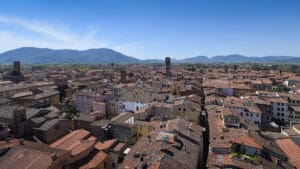
Lucca is widely known as the “City of a Hundred Churches”, a title reflecting the remarkable concentration of religious buildings within its historic walls. The churches of Lucca preserve evidence of the city’s development from the early Christian period through the Romanesque, Gothic, Renaissance, and Baroque eras.
This exceptional religious heritage developed partly because Lucca occupied an important position along the Via Francigena. Medieval pilgrims travelling toward Rome entered the city to pray, rest, and visit sacred places, encouraging the construction of churches, monasteries, hospitals, baptisteries, and confraternity buildings throughout the urban area.
The international importance of the religious heritage of Lucca was strengthened by the presence of the Volto Santo, a monumental wooden crucifix preserved in the Cathedral of San Martino. Its veneration attracted pilgrims from across Europe and transformed Lucca into one of the most important medieval pilgrimage centers in Tuscany.
Religious architecture also became a major expression of the city’s political and economic prosperity. Wealthy merchants, noble families, religious orders, and civic institutions financed chapels, façades, sculptures, paintings, and liturgical furnishings. Consequently, Lucca’s churches contain works by artists such as Nicola Pisano, Jacopo della Quercia, Filippino Lippi, and Tintoretto.
This guide focuses on the most historically, architecturally, and artistically significant churches of Lucca. Together, they illustrate the development of local Romanesque architecture, the expansion of mendicant orders, the influence of Renaissance design, and the theatrical character of Lucchese Baroque art.
Cathedral of San Martino
The Cathedral of San Martino is the religious center of Lucca and the seat of the city’s archbishop. According to tradition, the original church was founded by Bishop Frediano during the sixth century. The present cathedral was inaugurated in 1070 by Anselmo da Baggio, Bishop of Lucca and Pope Alexander II.
The ceremony was attended by Matilda of Canossa, one of the most powerful political figures in medieval Italy. The building was subsequently enlarged during the fourteenth and fifteenth centuries, while the chapels of the Sacrament and the Sanctuary were completed during the sixteenth and seventeenth centuries.
Among the churches of Lucca, the cathedral has the most extensive collection of major sculptures, paintings, sacred objects, and architectural additions.

The façade of the Cathedral of San Martino
Architecture and Medieval Sculpture
The cathedral’s Romanesque façade is immediately recognizable because of its unusual asymmetry. One of the arches in the ground-level portico is smaller than the others because the façade had to be adapted to the pre-existing bell tower. This practical restriction created one of the building’s most distinctive architectural characteristics.
The portico was constructed during the twelfth century. Beginning in 1204, Guidetto da Como worked on the upper façade, adding several levels of open galleries supported by decorated columns. The marble surfaces combine sculpted details, geometric designs, and two-tone inlays associated with the Romanesque architecture of Lucca and Pisa.
The three portals are surrounded by extensive sculptural decoration. Important ensembles include the Cycle of the Months, scenes from the life of Saint Martin, and works connected with Nicola Pisano, including the Deposition and an architrave representing the Annunciation, Nativity and Adoration of the Magi.
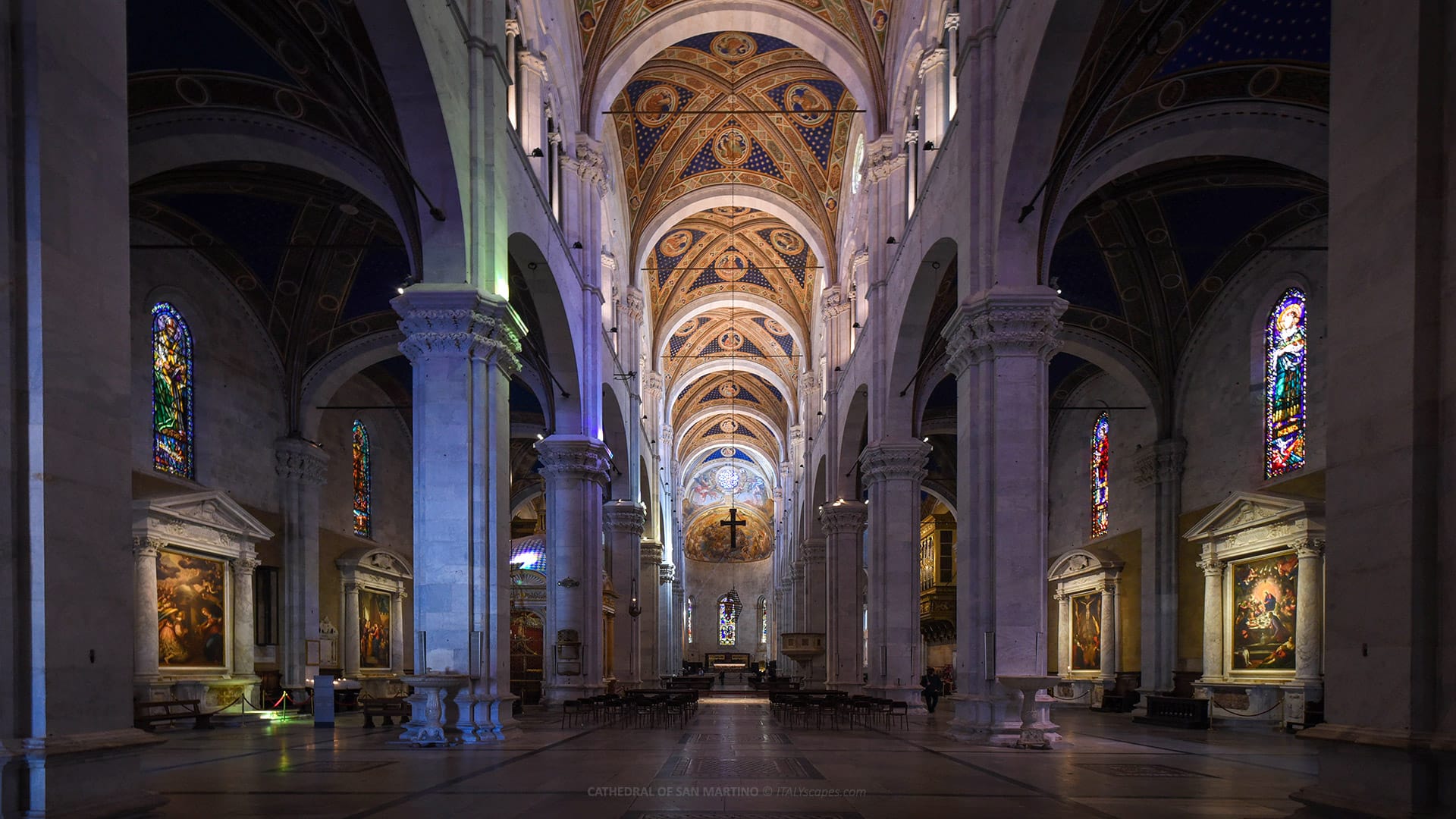
The interior follows a Latin-cross plan with three naves and a transept. The high central nave has a predominantly Gothic appearance, created by its vertical proportions, stained-glass windows, and simulated galleries. These elements are combined with surviving Romanesque structures, producing a space shaped by several construction periods.
The Volto Santo and Cathedral Masterpieces
The cathedral’s most important religious object is the Volto Santo, a large wooden crucifix representing Christ alive on the cross and dressed in a long sleeved tunic. Scientific analysis dates the surviving sculpture between the final decades of the eighth century and the beginning of the ninth century.
The crucifix is housed in an octagonal marble chapel created by Matteo Civitali in 1484. Since the Middle Ages, devotion to the Volto Santo has distinguished the Cathedral of San Martino from the other churches of Lucca and contributed directly to the city’s position on European pilgrimage routes.
The cathedral also contains the Monument to Ilaria del Carretto, created by Jacopo della Quercia between 1406 and 1410. Paolo Guinigi, ruler of Lucca, commissioned the monument after his wife Ilaria died in 1405. The sculpture combines late Gothic elegance with the naturalism of the early Renaissance.
Ilaria is represented lying peacefully on the monument, accompanied by a small dog placed near her feet. The sides of the base are decorated with putti holding garlands, inspired by ancient Roman funerary sculpture. The work is considered one of the principal achievements of fifteenth-century Italian sculpture.
Major paintings inside the cathedral include Domenico Ghirlandaio’s Sacred Conversation, completed in 1479, and Fra Bartolomeo’s Madonna and Child with Saints Stephen and John the Baptist, dated 1509.
Another masterpiece is The Last Supper, painted in 1594 by Jacopo Robusti, known as Tintoretto, with the assistance of his son Domenico. Its diagonal table, dramatic illumination, animated figures, and deep spatial construction reflect the innovative approach associated with the late Venetian Renaissance.
The cathedral’s twelfth-century bell tower rises approximately 60 meters and contains seven bells. Its lower section is constructed from massive stone blocks, while the upper levels are built largely from brick. It is the tallest historic bell tower belonging to the churches of Lucca and provides extensive views across the city.
Church of San Michele in Foro
San Michele in Foro occupies the site of Lucca’s ancient Roman forum, once the political, commercial, and social center of the city. The church was first documented in 795, while construction of the present building began in 1070 under Pope Alexander II, making it one of the principal churches of Lucca.
Piazza San Michele remained politically important during the medieval communal period. Until 1370, it was used for meetings of the Consiglio Maggiore, Lucca’s highest legislative body. The church therefore stood at the center of both religious life and municipal government.
San Michele has a Latin-cross plan, and its bell tower was constructed above the southern transept beginning in the twelfth century. The prolonged building process introduced different stylistic elements, producing a basilica in which Romanesque decoration is combined with later Gothic characteristics.
The most spectacular element is the exceptionally tall façade, which rises above the roof of the church. Its upper section contains several superimposed galleries supported by numerous columns. The varying forms, decorative patterns, and carved capitals make it one of the most elaborate façades among the churches of Lucca.
At the summit stands a large figure of the Archangel Michael defeating the dragon, accompanied by two angels. The composition clearly identifies the church’s dedication while giving the façade a strong vertical conclusion.
Inside, the church preserves a glazed terracotta Madonna and Child by Luca della Robbia. The work displays the clear forms, controlled expressions, and polished surfaces associated with the artist’s distinctive technique and represents an important example of fifteenth-century Florentine sculpture in Lucca.
San Michele also contains Filippino Lippi’s panel Four Saints, which represents Saints Roch, Sebastian, Jerome, and Helen. The painting was produced during the final decades of the fifteenth century and is one of the most important Renaissance works preserved in the historic center of Lucca.
The church has connections with the Puccini family’s musical history. Giacomo Puccini gave organ lessons here to his pupil Carlo Della Nina, continuing the relationship between the composer’s family and Lucca’s ecclesiastical musical institutions. The church remains an important location within the city’s Puccini itinerary.

Church of San Michele in Foro
Basilica of San Frediano
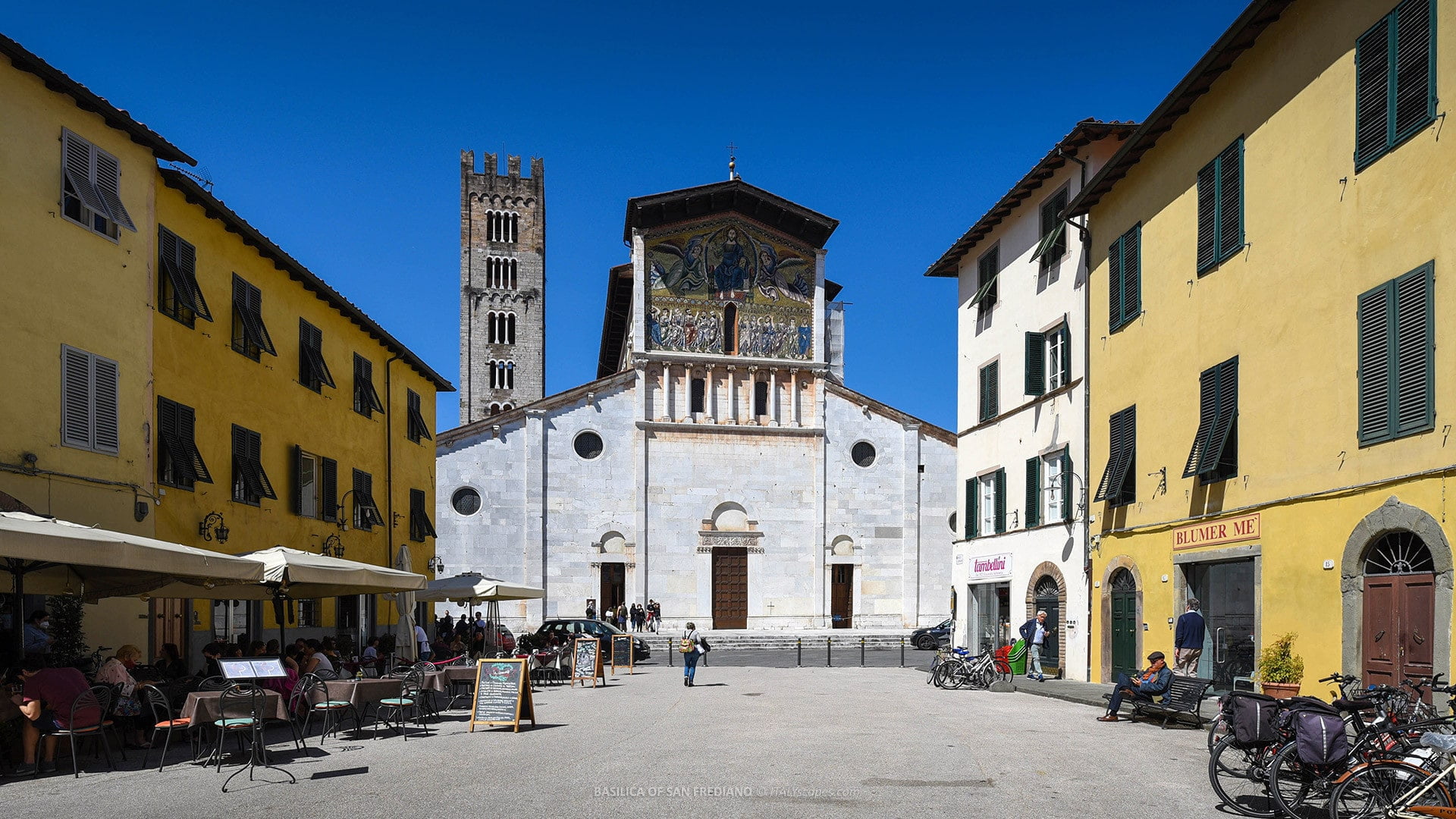
The Basilica of San Frediano is one of the oldest and most recognizable churches of Lucca. According to tradition, it was founded during the sixth century by Bishop Frediano, who was probably of Irish origin. The early building was also dedicated to Saint Vincent and was connected with a religious community.
San Frediano differs from many medieval churches because its façade faces east. The present building preserves its Romanesque basilical arrangement, with a tall central nave, two side aisles, rows of columns, and a wooden roof. This clear internal organization emphasizes the church’s early Christian architectural model.
The façade is dominated by a large thirteenth-century mosaic representing the Ascension of Christ. Christ appears inside a mandorla in the upper section, accompanied by angels, while the apostles occupy the lower register. The mosaic combines Byzantine influences with elements connected to the local Berlinghieri workshop.
Inside, a Romanesque baptismal font is decorated with sculpted scenes and ornamental details. The basilica also contains works by Jacopo della Quercia, sculptures by Matteo Civitali, and a major fresco cycle by Amico Aspertini, demonstrating several important stages in the development of religious art in Lucca.
Aspertini decorated the Chapel of Saint Augustine during the early sixteenth century. His paintings include scenes connected with Saint Augustine, Saint Frediano, and the traditional journey of the Volto Santo. Their animated figures, unusual facial types, and complex compositions demonstrate the painter’s individual Renaissance style.
San Frediano is also closely associated with Saint Zita, who worked as a domestic servant in Lucca during the thirteenth century. Her preserved body is displayed in the Fatinelli Chapel. Devotion to her has made the basilica one of the most important churches of Lucca for local religious traditions.
The basilica’s historic bell dated 1223 is linked by tradition with Saint Zita’s life and death. The main bell tower rises approximately 55 meters and contains numerous single, double, triple, and four-light openings. Its upper levels provide extensive views of the historic center and the surrounding Lucca plain.
Every September 13, the Luminara di Santa Croce begins at San Frediano. The religious procession crosses the historic center and ends at the Cathedral of San Martino, where ceremonies honoring the Volto Santo take place. This event directly connects two of the most significant churches of Lucca.
Basilica of San Frediano
Basilica of Santi Paolino e Donato
The Basilica of Santi Paolino e Donato is dedicated partly to Saint Paulinus, the patron saint traditionally associated with the Christianization of Lucca. Architecturally, it occupies a special place among the churches of Lucca because it is the city’s only church designed entirely in a Renaissance style.
An earlier church on the site was dedicated to Saint George. After relics attributed to Saint Paulinus were discovered in 1261 and the nearby Church of San Donato was destroyed, the building was reconstructed and dedicated to Saints Paulinus and Donatus.
The present church was rebuilt beginning in 1513 according to a design by Baccio da Montelupo. Its façade is restrained and symmetrical, with statues of the two titular saints positioned beside the principal entrance. The balanced composition reflects the preference for order and proportion in Renaissance architecture.
Inside, stone architectural details and a barrel vault define the main space. The church has preserved much of its historic collection of paintings, sculptures, and furnishings.
Several paintings contain valuable representations of Lucca and its defensive walls. Amico Aspertini painted Saint Paulinus holding a model of the city, while Baldassarre di Biagio’s Coronation of the Virgin includes a view of medieval Lucca with its gates, drawbridge, walls, and numerous towers.
Another painting represents the Miracle of Saint Paulinus, associated with an accident during the patron saint’s celebrations on July 12, 1664. According to the religious tradition commemorated by the work, people struck by an accidental cannon discharge were protected from injury through the saint’s miraculous intervention.
The basilica was also the parish church of the Puccini family. Giacomo Puccini presented his motet Plaudite populi here in 1877 for the feast of Saint Paulinus. His later sacred compositions culminated in the performance of his four-part mass with orchestra on July 12, 1880.
Church of Santi Giovanni e Reparata
The Church of Santi Giovanni e Reparata served as Lucca’s first cathedral before that role passed to San Martino. The present Romanesque building was constructed in several phases during the second half of the twelfth century, but the site contains remains from much earlier historical periods.
The building has three naves, a transept, and a wooden ceiling. Columns with composite capitals separate the naves, and several architectural elements were reused from Roman structures. White limestone covers the façade, while sandstone and brick were employed extensively in the walls and transept.
During the late fourteenth century, a large baptistery with a pointed dome was constructed beside the church. Sixteenth-century alterations included raising the façade, replacing medieval openings, and installing a coffered ceiling. A Baroque chapel dedicated to Saint Ignatius was added during the seventeenth century.
Archaeological excavations begun during the 1970s transformed Santi Giovanni e Reparata into one of the most informative churches of Lucca. Visitors can examine multiple layers illustrating the development of the site from the Roman period through the early Christian, Lombard, Carolingian, and medieval eras.
The excavated structures include part of a Roman house dating from the first century BC, Roman baths from the first and second centuries AD, an early Christian basilica and baptistery, Lombard tombs, an early medieval baptistery, and the remains of a Carolingian crypt.

Church of Santi Giovanni e Reparata
Church of Sant’Alessandro Maggiore
Sant’Alessandro Maggiore is one of the oldest surviving examples of Romanesque religious architecture in Lucca. It was first mentioned in a document dated 893 and stands within the Roman street grid, close to Piazza San Michele and the Palazzo Ducale.
In 1071, Pope Alexander II, who had previously served as Bishop of Lucca, transferred relics of Pope Alexander I from Rome to the church. A crypt was constructed for the occasion, although it was subsequently filled and is no longer part of the accessible building.
The church’s design is notable for its restraint, balanced proportions, and close relationship with classical architecture. Carefully cut white limestone blocks from Monte Pisano are arranged in alternating courses. The portals use decorative forms influenced by ancient Roman architectural traditions.
The façade contains a central mullioned window accompanied by two single-light windows. Its limited sculptural decoration differs substantially from the elaborate galleries of San Michele and San Martino. This controlled composition makes Sant’Alessandro one of the most distinctive churches of Lucca for studying early Romanesque classicism.
Inside, the building follows a basilical plan with three naves and a semicircular apse. Variations in stone color, capital design, and architectural proportion organize the space.
Church of San Pietro Somaldi
San Pietro Somaldi stands east of Piazza dell’Anfiteatro, near the line of Lucca’s medieval walls. Its name is connected with Summual, the founder of an early church established in 763. The property later came under the authority of the Lombard king Astolfo.
The present building was reconstructed beginning in the late twelfth century. Work continued into the fourteenth century, when the upper section of the bell tower and the brick apse were completed. This extended chronology produced a combination of Romanesque and later medieval elements.
The façade dates principally from the second half of the thirteenth century. Sandstone walls are interrupted by limited bands of white stone, while a blind gallery with sculpted capitals decorates the upper section. These features connect San Pietro Somaldi with other Romanesque churches of Lucca.
The central portal contains an architrave carved in 1248 by Guido Bigarelli of Como. The relief represents Christ Giving the Keys to Saint Peter, a subject connected directly with the church’s dedication. It is one of the most important surviving examples of medieval portal sculpture in Lucca.
The interior is divided into three naves supported by sandstone pillars. The church also preserves a seventeenth-century organ constructed by Domenico Cacioli. Members of the Puccini family served as organists and choirmasters here, and the young Giacomo Puccini played the historic instrument.
Church of Santa Maria Forisportam
Santa Maria Forisportam is commonly known in Lucca as Santa Maria Bianca because of its pale limestone façade. Its official name means “Saint Mary outside the gate”, referring to its original position beyond the eastern gate of the Roman defensive walls.
A document dated 768 confirms that a church already existed on the site during the eighth century. At that time, the surrounding district lay outside the Roman city. The medieval walls built during the twelfth and thirteenth centuries later enclosed the church within the expanded urban area.
The present façade is an important example of Lucchese Romanesque architecture. Three portals are surmounted by decorated lintels and lunettes, while arches resting on semi-columns articulate the lower level. Two superimposed galleries occupy the upper section, accompanied by sculpted lions and capitals.
A relief representing the Virgin Enthroned with the Child appears in the lunette above the left portal. Classical architectural fragments and reused Roman elements can also be observed in the church, demonstrating the practice of incorporating ancient materials into medieval religious buildings.
The interior has three naves, a transept, and an apse. Columns and capitals separate the central space from the side aisles.
Two important paintings by Giovanni Francesco Barbieri, known as Guercino, are preserved inside. Saint Lucy was completed in 1642, while The Assumption with Saints Francis and Alexander dates from 1643. Both works represent the mature development of Italian Baroque painting.

Church of Santa Maria Forisportam
Church of Santa Maria Corteorlandini
Santa Maria Corteorlandini is one of the finest examples of Baroque decoration among the churches of Lucca, although the site has much older religious origins. Archaeological excavations conducted in 2017 uncovered a sixth-century necropolis, supporting the presence of an important early medieval sacred site.
The church’s name derives from the Curtis Rolandinga, the court or property of the Rolandinghi family. An inscription records that Maestro Guido completely rebuilt the church in 1188. Parts of the southern wall and two lateral apses survive from the medieval structure.
The brick bell tower was constructed during the fourteenth century. The church was extensively altered during the sixteenth century after it became associated with the Clerics Regular of the Mother of God, a congregation founded in 1574 by the Lucchese priest Giovanni Leonardi.
The congregation received Santa Maria Corteorlandini in 1580. It subsequently developed the complex into an important religious and cultural center connected with the Catholic Counter-Reformation. The magnificence of the interior reflects the congregation’s growing influence and its emphasis on education and pastoral activity.
Capitals, arches, painted ceilings, frescoed vaults, stucco decorations, holy-water basins, an octagonal pulpit, and a painted organ gallery create a theatrical Baroque environment. These features contrast markedly with the restrained stone interiors of the Romanesque churches of Lucca.
The Chapel of Our Lady of Loreto was constructed in 1662. It contains a reproduction of the Holy House venerated at the Sanctuary of Loreto in the Marche region. Because of this chapel, the church became popularly known as Santa Maria Nera.
The decorative renovation was completed during the early eighteenth century with frescoes and stuccoes by Pietro Scorsini and Domenico Brugieri. Paintings by several Lucchese artists remain in the church, including works associated with Francesco Vanni, Giovanni Marracci, and Gaspare Mannucci.
Church of San Francesco
The Church of San Francesco is one of the earliest Franciscan foundations constructed in Italy following the death of Saint Francis of Assisi in 1226. Franciscan friars lived in the complex from 1228 until 2003, giving the church an unusually long history of continuous institutional use.
San Francesco is one of the few churches of Lucca designed as a large single-hall building. This arrangement reflects the requirements of mendicant preaching, allowing congregations to see and hear services without the visual divisions created by multiple rows of columns.
Construction continued for several centuries and was substantially completed around 1430. Interior decoration was added between the fourteenth and seventeenth centuries. The upper façade, faced with white limestone and decorated with a large rose window, remained unfinished until its completion in 1930.
The interior consists of an austere rectangular hall terminating in three apses. Side altars articulate the walls, while frescoes and stained-glass windows decorate the eastern section. Behind the principal altar are an inlaid wooden choir, a lectern, and a pipe organ constructed between 1930 and 1940.
San Francesco became privately owned in 1840, and paintings from the church were transferred to different museums in Lucca. The municipality acquired the building again in 1901, and religious services resumed in 1910. A major restoration of the church and convent was completed in 2013.
Numerous tombs and memorial plaques commemorate important people connected with Lucca, including the poet Giovanni Guidiccioni and the musicians Francesco Geminiani, Luigi Boccherini, and Giacomo Puccini. This commemorative function distinguishes San Francesco from several other churches of Lucca.

Church of San Francesco
Church of Santa Caterina
The Church of Santa Caterina is the largest example of religious Baroque architecture among the churches of Lucca. It is also known locally as the Church of the Cigar Makers because women employed in Lucca’s tobacco industry were historically associated with the building.
A religious structure was founded on the site in 1575. Francesco Pini redesigned and substantially rebuilt it between 1738 and 1748. The architect adapted the façade to the corner between Via del Crocifisso and Via Vittorio Emanuele, creating an unusual relationship with the surrounding streets.
The church has an oval plan with the entrance positioned on its minor axis. Interior grilles allowed cloistered nuns to attend services without being seen directly by the congregation.
A central opening in the dome introduces natural light into the interior. Bartolomeo De Santi decorated the dome with frescoes representing angels and saints. Gilded architectural elements and the curved walls strengthen the dynamic spatial effects associated with eighteenth-century Baroque design.
The church’s dedication was represented by Pompeo Batoni’s large oval painting The Ecstasy of Saint Catherine. The work is no longer inside the church and is preserved in the National Museum of Palazzo Mansi
How to Visit the Churches of Lucca
Most of the principal churches of Lucca stand inside the Renaissance walls and can be reached on foot. The Cathedral of San Martino, San Michele in Foro, San Frediano, and Santi Giovanni e Reparata form the essential foundation of a first religious architecture itinerary.
The Cathedral of San Martino and Santi Giovanni e Reparata are located close together in the southeastern part of the historic center. From there, visitors can continue toward San Michele in Foro, Sant’Alessandro, Santi Paolino e Donato, and Santa Caterina without requiring public transportation.
San Frediano, San Pietro Somaldi, and San Francesco are situated farther north and east but remain within comfortable walking distance. Santa Maria Forisportam can be included while exploring the eastern Roman street grid and the area between the cathedral and Porta Elisa.
Travellers arriving by train can walk from Lucca railway station to the cathedral in approximately ten minutes. The station lies immediately outside the southern walls, making San Martino a practical starting point for visiting the churches of Lucca before continuing north through the historic center.
A complete exploration of the churches of Lucca requires more than one day. Visitors interested mainly in Romanesque architecture should prioritize San Martino, San Michele, San Frediano, Sant’Alessandro, Santa Maria Forisportam, and San Pietro Somaldi. Baroque architecture is best represented by Santa Maria Corteorlandini and Santa Caterina.
The interior of Lucca Cathedral
The Religious Heritage of Lucca
The churches of Lucca document more than fifteen centuries of religious, architectural, artistic, and civic history. Early Christian remains, Lombard foundations, Romanesque façades, Gothic interiors, Renaissance monuments, and Baroque chapels survive within a compact urban area protected by the city’s walls.
Each major church has a distinct function within this heritage. San Martino represents the archdiocese and the cult of the Volto Santo. San Michele reflects the Roman forum and medieval government. San Frediano preserves early traditions, while Santi Giovanni e Reparata reveals the archaeological origins of Christianity in Lucca.
Santi Paolino e Donato expresses the city’s Renaissance identity and devotion to its patron saint. San Francesco represents the influence of the mendicant orders, while Santa Maria Corteorlandini and Santa Caterina demonstrate the development of Counter-Reformation and Baroque architecture.
Smaller buildings such as Sant’Alessandro, San Pietro Somaldi, and Santa Maria Forisportam are equally valuable for understanding local architectural development. Their masonry, portals, columns, capitals, sculptures, and reused ancient elements reveal how Lucchese builders created a recognizable regional Romanesque tradition.
Frequently Asked Questions about the Churches of Lucca
Why is Lucca called the City of a Hundred Churches?
Lucca received this name because of the exceptionally large number of churches, monasteries, chapels, oratories, and other religious buildings historically constructed within its walls.
What is the most important church in Lucca?
The Cathedral of San Martino is the city’s principal church because it is the seat of the archbishop and preserves the Volto Santo and major artworks.
Can the main churches of Lucca be visited on foot?
Yes. Nearly all the principal churches stand within Lucca’s historic walls and can be connected through a walking itinerary of several hours or divided across two days.
Do visitors need tickets to enter the churches of Lucca?
Some churches offer free entry, while others charge for museums, archaeological areas, bell towers, or conservation programs. Opening arrangements should be checked before visiting.