Table of Contents
The Chimera of Arezzo is one of the most celebrated surviving works of Etruscan sculpture. Cast in bronze around 400 BCE, it represents a wounded mythological creature at the height of a violent struggle. Its survival, accidental discovery, political appropriation, restoration, and museum history form an unusually well-documented sequence.
The Chimera of Arezzo was created centuries before Rome absorbed the Etruscan city of Arretium, modern Arezzo. It demonstrates that the region supported patrons and workshops capable of producing ambitious large-scale bronzes. Its sophisticated form also reflects the movement of artistic ideas between Etruria, the Greek world, and Greek-speaking communities in southern Italy.
The Chimera of Arezzo is not simply a representation of a fantastic animal. An Etruscan inscription identifies it as a religious dedication connected with Tinia, the leading god of the Etruscan pantheon. Its scale and workmanship indicate that this was a costly sacred object, not an ordinary decorative figure.
The later history of the Chimera of Arezzo is equally remarkable. Workers uncovered the bronze during the construction of new fortifications in sixteenth-century Arezzo. Cosimo I de’ Medici immediately transferred it to Florence, where scholars identified its subject and the Medici court converted the ancient monster into a symbol of political victory.
Important questions remain unanswered. The original sanctuary has not been identified, the reason for the bronze’s burial is uncertain, and the figures that may once have accompanied it have disappeared. Even its serpent tail is largely modern. The statue therefore combines firm historical evidence with carefully defined archaeological uncertainties.
What Was the Chimera?
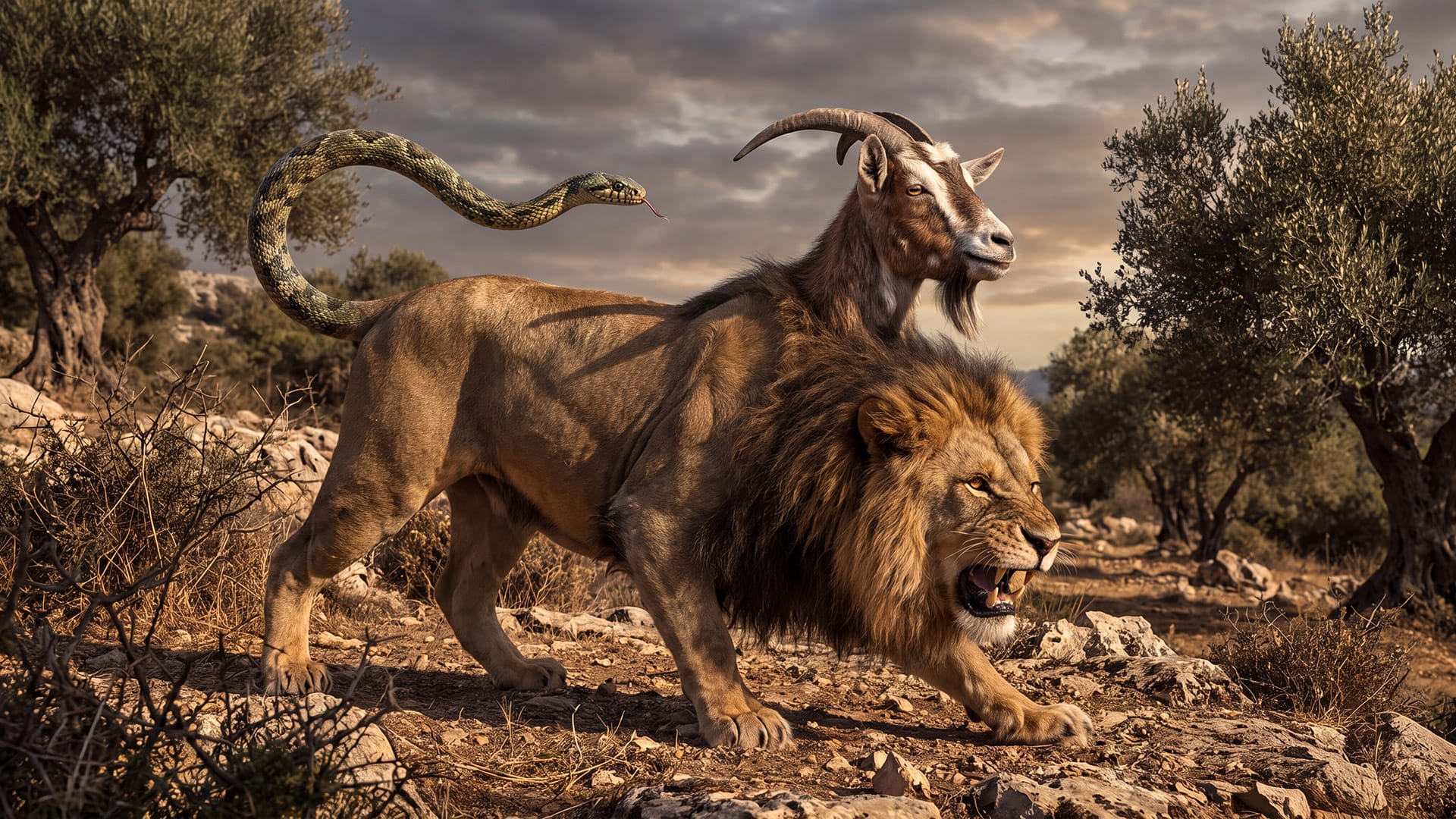
In Greek mythology, the Chimera was a hybrid monster associated with Lycia in Anatolia. Ancient descriptions gave it the main body and head of a lion, a goat’s head rising from its back, and a serpent forming its tail. It was also said to breathe destructive fire.
The creature belonged to a family of monsters born from Typhon and Echidna. Ancient authors connected the same parents with other threatening beings, including Cerberus and the Lernaean Hydra. These genealogies placed the Chimera among the forces of danger and disorder that heroic figures were expected to overcome.
The task of killing the monster fell to Bellerophon. According to the myth, he fought while riding Pegasus, the winged horse. The ability to attack from the air gave the hero an advantage over the creature’s claws, teeth, and flames, turning the battle into one of antiquity’s most recognizable heroic episodes.
Representations of Bellerophon and the Chimera circulated widely on Greek pottery, coins, gems, jewelry, and other objects. Etruscan artists knew these visual traditions and adapted Greek stories for their own audiences. The Chimera of Arezzo belongs to this broader Mediterranean exchange of myths and images.
An Etruscan Masterpiece
The Chimera of Arezzo was cast in bronze through the lost-wax process. A detailed wax model was covered with heat-resistant material, the wax was removed, and molten metal filled the resulting space. Producing a hollow bronze of this size required careful planning, specialist labor, and controlled casting.
The surviving statue measures approximately 78.5 centimeters in height and 129 centimeters in length. It is considerably larger and more complex than the small votive bronzes commonly found at Etruscan sanctuaries. Its dimensions allowed the artist to develop anatomy, movement, surface texture, and wounds with exceptional precision.
The lion forms the main structure. Its forelegs brace against the ground, while its arched back and contracted abdomen suggest force moving through the entire body. The visible ribs, stretched skin, muscles, tendons, and extended claws create an image of extreme physical strain rather than a static animal.
The head intensifies the effect. The ears pull backward, the jaws open, and the mane rises in sharply organized locks. The expression can be read as aggression, pain, and resistance at the same time. The Chimera of Arezzo appears dangerous, yet its face also communicates the approach of defeat.
The goat’s head emerging from the back is not a secondary ornament. Its neck collapses sideways, and the treatment of the wound indicates that it has already been struck. This injured component helps establish the exact phase of the battle and gives the composite body one connected dramatic action.
Another wound appears on the left hindquarter of the lion. Its shape has often been interpreted as the mark of a spear thrust delivered by Bellerophon. Together with the fallen goat’s head, it demonstrates that the bronze was designed to show an injured creature reacting to an attacker outside the surviving sculpture.
The surface was modeled to reward viewing from several directions. From the front, the open mouth and defensive stance dominate. From the side, the contracted torso and goat become clearer. From behind, the wound and reconstructed tail affect the composition. The statue was therefore intended for viewing in the round.
The name of the artist is unknown, and the location of the workshop remains debated. Scholars have identified both Greek-derived forms and connections with the art of central and southern Italy. The safest conclusion is that the bronze reflects Etruscan technical mastery within an interconnected Mediterranean artistic environment.
The Discovery Near Porta San Lorentino
The Chimera of Arezzo returned to view on November 15, 1553. Workers were constructing a new defensive bastion near Porta San Lorentino, on the northwestern side of Arezzo, when they uncovered the bronze. The find was accidental and occurred during military building work, not during an archaeological excavation.
A contemporary municipal record described a large bronze lion with open jaws, an erect mane, a visible injury, and the head of a slaughtered goat on its back. The description captures the object’s appearance immediately after discovery, before later restoration completed the creature’s familiar modern silhouette.
The Chimera of Arezzo was found with a group of smaller bronze objects, including votive figures. Their presence is essential for understanding the deposit. The bronzes were not simply discarded raw material or the contents of a private collection; they belonged to a context with a clear religious character.
From Arezzo to the Medici Collection
Cosimo I de’ Medici, then Duke of Florence, claimed the newly discovered statue and the accompanying bronzes. They were quickly transported from Arezzo to Florence and entered the ducal collection. This transfer reflected the political authority exercised by the Medici over Arezzo and other cities within their Tuscan state.
Cosimo had a strong interest in Etruscan antiquities. The Medici court encouraged the idea that ancient Etruria offered a prestigious historical foundation for the Grand Duchy of Tuscany. The Chimera of Arezzo therefore arrived in Florence as both a remarkable artwork and a useful object of dynastic representation.
Because the serpent tail was missing, the statue was initially described as a lion. Its composite identity became clear through comparison with ancient images of the Chimera of Arezzo. Giorgio Vasari, the Arezzo-born painter, architect, and writer, was involved in the learned environment in which the bronze was examined and interpreted.
The Chimera of Arezzo was displayed in the Sala di Leone X in Palazzo Vecchio. In that setting, its wounded and defeated body could be associated with the enemies overcome by Cosimo. The duke was presented as a new conqueror of monsters, converting an Etruscan offering into a Renaissance political allegory.
Benvenuto Cellini recorded Cosimo’s interest in cleaning the smaller ancient bronzes with goldsmiths’ tools. The account shows that these objects were valued not only as historical remains but also as works of metal craftsmanship. Their treatment belonged to an early culture of collecting, study, and courtly display.
The Inscription Dedicated to Tinia
The most direct evidence for the statue’s original purpose appears on its right foreleg. An Etruscan inscription, written from right to left, is generally read as TINSCVIL. It is commonly interpreted as indicating that the object was given to, or belonged to, Tinia.
Tinia was the principal male deity of the Etruscan pantheon and was associated with the sky, authority, and thunder. Greek and Roman observers compared him with Zeus and Jupiter, although Etruscan religion had its own structures and rituals. The inscription places the Chimera of Arezzo within formal religious practice.
The Chimera of Arezzo was probably a votive offering displayed in a sanctuary. Its large scale and demanding production suggest sponsorship by an aristocratic family, a wealthy community, or another group with substantial resources. No donor’s name survives, so a more precise identification would go beyond the available evidence.
The smaller bronzes found with the statue reinforce this interpretation. One represents Tinia wearing a mantle and holding an offering vessel, while other figures are connected with ritual acts. The objects were created at different times, but together they indicate continued votive activity rather than one isolated dedication.
The inscription also became important in the Renaissance study of the Etruscan language. Early scholars copied its letters and compared them with other ancient texts. The Chimera of Arezzo consequently contributed to the history of epigraphy as well as to the study of Etruscan religion and sculpture.
The Mystery of the Missing Tail
When the bronze was discovered, it lacked the complete serpent tail familiar to modern visitors. Early drawings show the Chimera of Arezzo without this major element, while only a fragment associated with the ancient tail was known. The loss affected both the creature’s identification and the balance of the original composition.
The present tail was added during an eighteenth-century restoration, generally dated to the 1780s. The work has been attributed to Francesco Carradori, although the possible involvement of his teacher Innocenzo Spinazzi has also been discussed. The precise responsibility for the reconstruction is therefore not completely settled.
The restored serpent curves forward and bites one of the goat’s horns. This solution creates a visually compact shape, but it is generally considered unlikely to reproduce the ancient design. Because the goat and serpent belong to the same monster, the action makes the Chimera appear to attack part of its own body.
A more plausible reconstruction would direct the serpent toward Bellerophon or Pegasus. Comparable ancient images sometimes show the tail acting defensively against the hero. However, no complete ancient tail survives, and surviving representations vary, so its original direction cannot be established with absolute certainty.

Was the Chimera of Arezzo Part of a Larger Sculpture Group?
The Chimera of Arezzo is widely interpreted as one element of a larger sculptural group showing the battle with Bellerophon. The missing figures would probably have included the hero and Pegasus. No matching large bronzes were found in the deposit, so the complete arrangement has not survived.
The monster’s posture strongly supports this interpretation. It braces its legs, twists its torso, opens its mouth, and reacts to wounds inflicted from outside its own body. These features are difficult to explain as an isolated image but make sense within an active combat group.
The injury on the hindquarter may indicate the point where Bellerophon’s weapon entered the body. The wounded goat’s neck provides a second sign of attack. The sculptor was not merely identifying a mythological creature; he was representing a specific stage in the monster’s final battle.
The original tail may have extended into the space occupied by another figure, helping connect the monster visually with Bellerophon or Pegasus. Its line could also have balanced the hero’s weapon or the winged horse’s movement. These possibilities are logical, but the precise composition remains a scholarly reconstruction.
Ancient pottery, coins, gems, and mirrors show many versions of the myth. Bellerophon may appear beside Pegasus, mounted upon him, or attacking from a different angle. These images confirm the subject but do not provide an exact blueprint for the lost monumental bronze group from Etruria.
Why Is the Chimera Not in Arezzo?
The original Chimera of Arezzo is not in the city because Cosimo I transferred it to Florence immediately after its discovery. Sixteenth-century antiquities were controlled through princely power rather than modern archaeological legislation or local museum systems. Once claimed by the duke, the Chimera of Arezzo became part of the Medici collections.
After its long display in Palazzo Vecchio, the bronze was moved to the Uffizi during the early eighteenth century. In 1870, it entered the National Archaeological Museum of Florence, housed in Palazzo della Crocetta. The museum remains the statue’s permanent institutional home.
The Chimera of Arezzo has become one of the museum’s defining Etruscan objects. Its importance rests on the quality of the casting, the survival of its inscription, its Renaissance documentation, and its exceptional scale. It is displayed as a major work of ancient Italian art, not merely as a regional curiosity.
Arezzo nevertheless preserves a strong relationship with the statue. The Museo Archeologico Nazionale Gaio Cilnio Mecenate contains a section devoted to its history, including modern reproductions and interpretive material. Located beside the Roman Amphitheatre, the museum provides the most relevant local context for understanding ancient Arretium.
The bronze is also connected with the city through Porta San Lorentino and the Quartiere di Porta del Foro, which uses the Chimera as its emblem in the Giostra del Saracino. These associations have transformed an object kept in Florence into an enduring symbol of Arezzo’s identity.
The Ancient Symbol of Arezzo
The story of the Chimera of Arezzo begins with an Etruscan religious dedication and continues through burial, accidental rediscovery, Medici collecting, political reinterpretation, restoration, and museum display. Each phase left evidence that allows the history of the bronze to be reconstructed with unusual chronological depth.
The sculpture documents several important realities at once: sophisticated Etruscan metalworking, knowledge of Greek mythology, the worship of Tinia, the wealth required for monumental bronze production, and the circulation of artistic ideas across ancient Italy. Its value lies in this combination of technical, religious, and cultural evidence.
Its unknowns are equally significant. The artist, workshop, patron, sanctuary, date of burial, reason for concealment, complete sculptural group, and original tail arrangement cannot be identified conclusively. Responsible interpretation depends on preserving the distinction between documented facts and plausible hypotheses.
For modern Arezzo, the Chimera is more than a famous object discovered within the city walls. Its image survives in replicas, museum displays, civic symbolism, and the traditions of Porta del Foro. The original may stand in Florence, but its historical identity remains inseparable from Arezzo.
The strange story behind the Chimera of Arezzo requires no invented mysteries. A fire-breathing monster from Greek myth became an Etruscan offering, disappeared beneath the ground, resurfaced during Renaissance fortification work, served Medici propaganda, and entered a national museum. That verified sequence is what makes the statue genuinely extraordinary.
Sources:
- Images generated with Nano Banana Pro / Google AI Studio
- MuseoArcheologicoNazionalediFirenze.wordpress.com