Table of Contents
Among the many legends associated with Milan Cathedral, one of the most unusual concerns Carlina, a young bride dressed in black who allegedly disappeared among the monument’s marble spires. According to local folklore, her restless ghost continues to appear near the cathedral, particularly when newly married couples gather to take photographs.
The legend combines a tragic love story, an alleged medieval custom, an unexplained disappearance, and mysterious photographic appearances. Although Carlina’s existence has never been historically established, her story remains part of Milanese folklore, offering a different perspective on one of Italy’s most celebrated religious monuments.
Unlike traditional tales involving haunted castles or abandoned buildings, Carlina’s story unfolds around an active place of worship and one of Milan’s busiest tourist attractions. The legend is particularly associated with the cathedral’s rooftop terraces, the golden Madonnina, and the monumental square immediately in front of the building.
Milan Cathedral – The Setting of Carlina’s Legend
The Cathedral of the Nativity of Saint Mary, commonly known as Duomo di Milano, stands in Piazza del Duomo, in the historic center of Milan. Construction began in 1386, replacing earlier Christian buildings, including the basilicas of Santa Maria Maggiore and Santa Tecla, whose archaeological remains survive beneath the present cathedral.
The construction project developed under the patronage of Gian Galeazzo Visconti, Lord of Milan, who supported the adoption of Gothic architecture and the extensive use of Candoglia marble. Founded in 1387, the Veneranda Fabbrica del Duomo coordinated the monumental building project and continues to oversee its preservation.
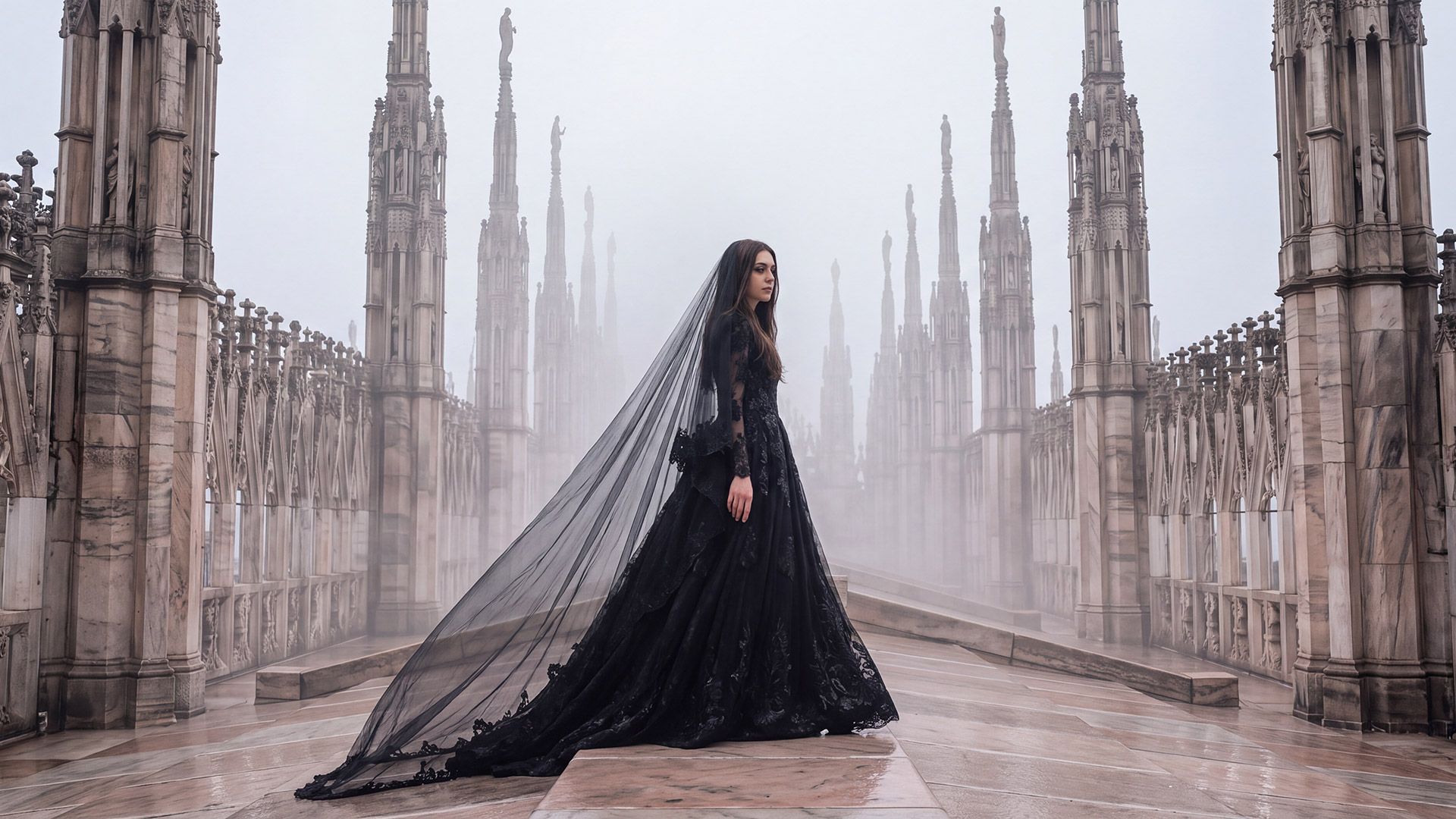
The cathedral is distinguished by its elaborate exterior, which incorporates 135 spires, thousands of sculptures, flying buttresses, and decorative architectural elements. Its monumental dimensions and unusually accessible rooftop terraces distinguish it from many other European cathedrals, allowing visitors to examine the sculptures and architectural details from close range.
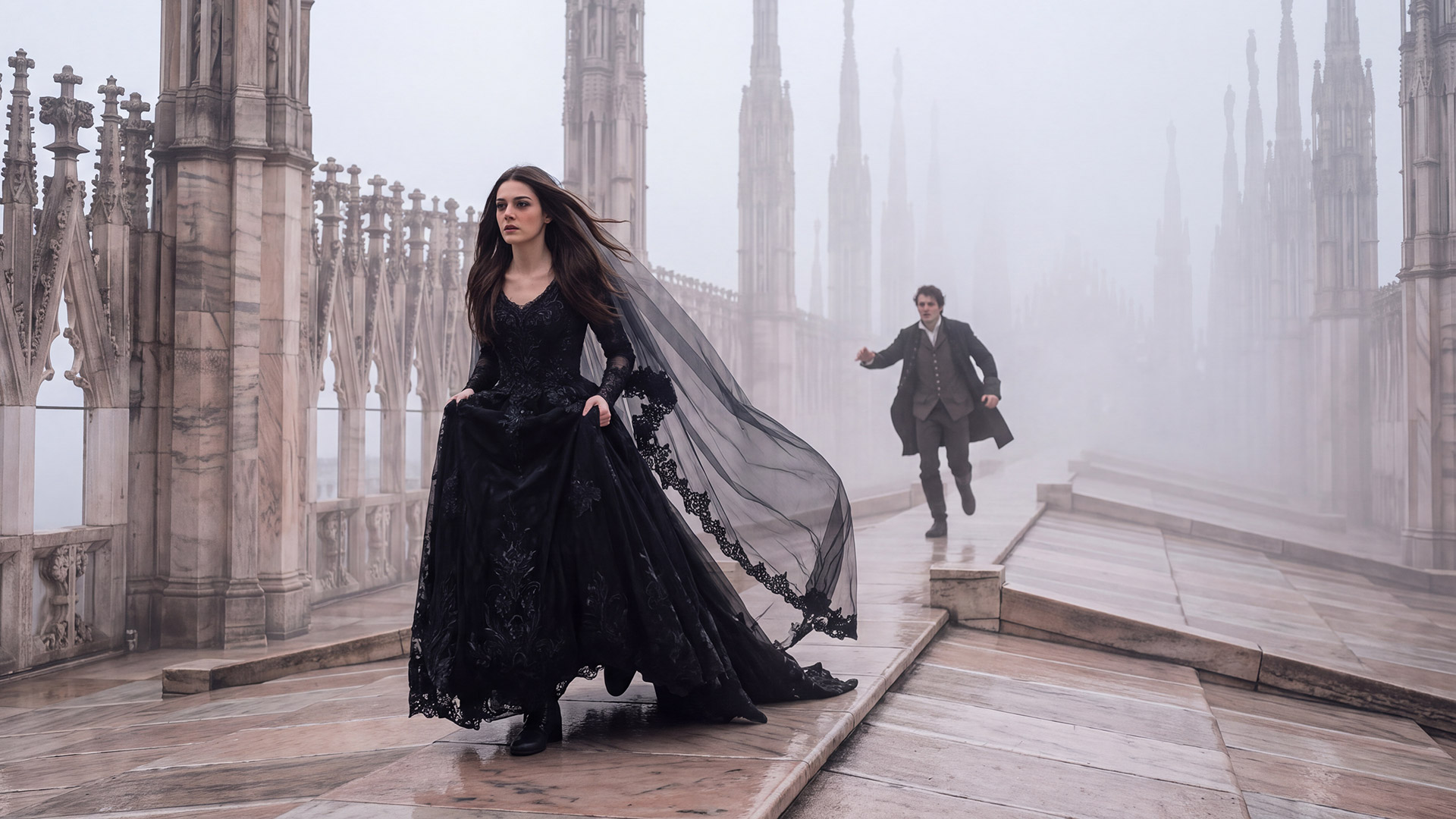
These elevated walkways form the principal setting of Carlina’s story. According to the legend, the young woman became separated from her husband while exploring the upper levels of Milan Cathedral. The combination of narrow passages, marble sculptures, and dense fog provides the distinctive setting for her supposed disappearance.
Who Was Carlina? The Mysterious Bride from Schignano
According to the traditional narrative, Carlina was a young woman from Schignano, a village in the province of Como, situated in the mountainous territory west of Lake Como. The precise period in which she supposedly lived remains uncertain, although some modern retellings place her story around the sixteenth century.
Carlina was engaged to a young man named Renzino, also called Renzo in several versions of the legend. The couple intended to marry and begin their life together, but the young woman allegedly concealed a personal secret that would become central to the events surrounding their wedding.
The story also describes an unusual local wedding custom. Brides from Schignano supposedly wore black wedding dresses, rather than the white gowns associated with modern ceremonies. Within the legend, this clothing tradition was intended to protect young women from the unwanted attention of powerful feudal landowners.
The explanation refers to the supposed ius primae noctis, or right of the first night, under which a feudal lord allegedly claimed sexual access to newly married women. Historians have found no reliable evidence establishing such a legally recognized and exercised right in medieval Europe.
The Wedding of Carlina and Renzino
The most frequently repeated version of the legend places Carlina’s wedding in October, during a period of cold and unsettled weather. She married Renzino wearing the traditional black dress associated with her village, apparently beginning what should have been a happy chapter in their lives.
Following the ceremony, the newlyweds traveled to Milan for their honeymoon. Visiting the city’s cathedral was presented as an important part of their journey, allowing them to admire a monument whose enormous scale and elaborate architecture differed considerably from the buildings of their rural surroundings.
However, the young bride was allegedly troubled by a secret pregnancy. According to the story, she had previously been involved with another man, described in some versions as a mysterious blond stranger whom she had encountered during the summer before her marriage.
Carlina had not revealed the pregnancy to Renzino and feared that he would eventually discover the truth. The legend presents her growing anxiety as the principal cause of the tragedy, connecting her disappearance with the emotional conflict between her recent marriage and her concealed relationship.
The Visit to the Rooftop Terraces
Despite the unfavorable weather, the couple supposedly decided to visit the rooftop terraces of Milan Cathedral. The narrative describes a thick fog covering the city, partially concealing the surrounding buildings and making it difficult to distinguish the individual marble sculptures positioned along the elevated walkways.
The cathedral’s upper architecture contains numerous representations of saints, angels, religious figures, and symbolic creatures. In the traditional story, Carlina became increasingly disturbed by their appearance, interpreting some of the sculpted faces as threatening figures that seemed to observe her movements.
As the couple continued exploring the terraces, Carlina’s anxiety reportedly increased. The legend connects her distress with feelings of guilt over the pregnancy and her fear of revealing the truth. Some versions describe the surrounding sculptures as reminders of the religious judgment she believed she deserved.
The story also places considerable importance on the Madonnina, the golden statue of the Virgin Mary positioned on the cathedral’s tallest spire. Carlina allegedly believed that approaching the statue and asking the Virgin for forgiveness could offer relief from her emotional suffering.
In the familiar version of the legend, the young woman released Renzino’s hand and began running among the spires. Her husband attempted to follow her, but the poor visibility prevented him from keeping sight of her as she moved farther across the rooftop.
The Tragic Disappearance of Carlina
The most widespread version of the story claims that Carlina accidentally fell from the cathedral while attempting to reach the Madonnina. Unable to see clearly through the fog, she supposedly approached an exposed section of the rooftop and fell into the void.
Other retellings leave the circumstances of her disappearance less clearly defined. Rather than describing a confirmed fall, they suggest that she simply vanished among the architectural structures. Some versions also introduce the possibility of a deliberate act, although none establishes a documented historical event.
According to the legend, Renzino desperately searched for his wife after realizing she had disappeared. The search allegedly continued beyond the immediate aftermath, but Carlina’s body was never recovered. This unexplained absence became one of the defining elements of the story.
No verified historical record has been identified establishing the disappearance of a bride named Carlina from Milan Cathedral. The date of the supposed incident, her identity, and the circumstances of her death remain undocumented, placing the narrative firmly within the category of urban legend.
The Ghost of Carlina and the Wedding Photographs
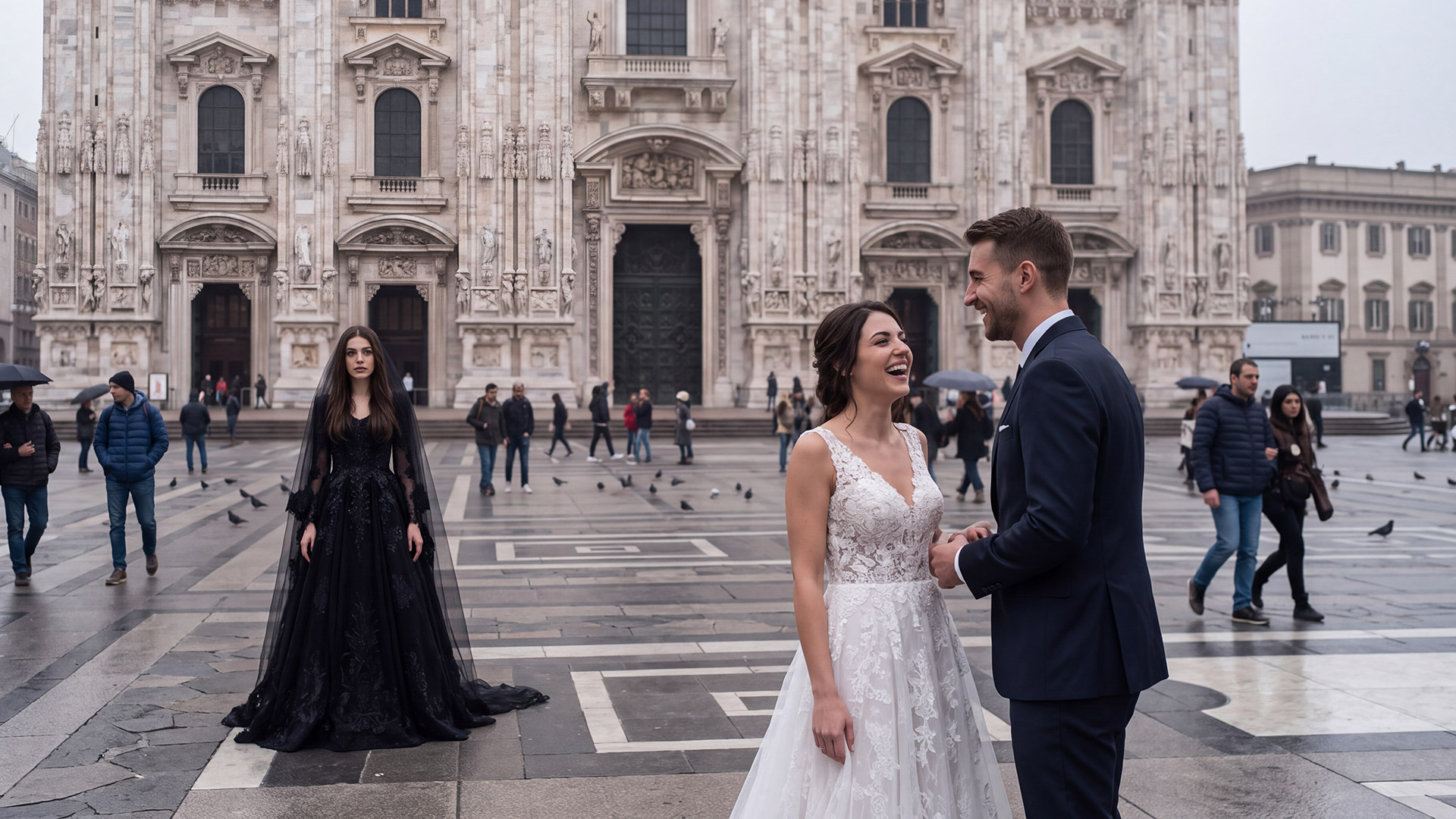
The story continues beyond Carlina’s disappearance through reports of an unidentified woman appearing in photographs taken near Milan Cathedral. According to local folklore, the ghost is particularly associated with wedding photographs, in which the mysterious figure supposedly appears unexpectedly behind newly married couples.
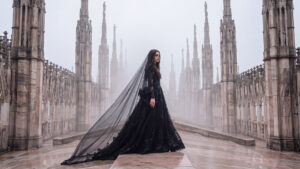
The apparition is generally described as a young woman wearing a long black dress, sometimes accompanied by a dark veil. In certain versions, her face appears unusually pale, while her eyes are described as completely white or lacking visible pupils.
The supposed appearances are associated with Piazza del Duomo, particularly the area surrounding the cathedral’s principal entrance. Couples traditionally use the monumental façade as a photographic background, creating the setting in which the mysterious bride is said to appear.
Some versions extend the sightings to the cathedral’s interior and rooftop terraces, describing an indistinct female figure moving among the sculptures or standing near the religious monuments. These accounts belong to the supernatural tradition surrounding Carlina and have not been independently verified.
Despite the tragic circumstances of her alleged death, Carlina is generally considered a benevolent presence. Rather than threatening newly married couples, her apparition is believed to bring good fortune, wishing others the happiness and married life that she supposedly never experienced.
Historical Problems with the Legend
An important chronological inconsistency concerns the dating of the story. Some versions place Carlina in the sixteenth century, yet the narrative describes her attempting to approach the Madonnina, the golden statue that now dominates Milan Cathedral’s highest spire.
The present Madonnina was designed by sculptor Giuseppe Perego and installed in December 1774, more than two centuries after the period suggested by some versions of Carlina’s story. Consequently, the familiar description involving the completed statue cannot represent an unchanged account originating in the sixteenth century.
This discrepancy does not establish when the entire legend was invented. It demonstrates that its familiar form incorporates architectural elements from different historical periods. A story about a young woman supposedly living in the sixteenth century may have acquired references to later monuments during subsequent retellings.
Another historical difficulty concerns the story’s alleged feudal background. The supposed right of the first night has appeared in European literature and historical traditions for centuries, but scholars have not established convincing evidence of its exercise as a recognized medieval legal entitlement.
How to Visit the Places Associated with Carlina
Visitors interested in the legend can begin at Piazza del Duomo, in the center of Milan. The square provides a clear view of the cathedral’s principal façade, including its monumental entrance portals, sculptural decorations, and the upper structures traditionally associated with Carlina’s photographic appearances.
The cathedral is accessible by public transport, with the nearest metro stop at Duomo, served by lines M1 and M3. The surrounding square is pedestrianized, making it convenient to examine the building’s exterior before visiting the church or proceeding to the terraces.
The rooftop terraces are the most important location associated with the central events of Carlina’s story. Visitors can access them using designated stairways or lifts, depending on their ticket. Access conditions, opening hours, and the availability of particular routes may change during maintenance or religious events.
A visit to the terraces provides an opportunity to examine the marble spires, sculptures, and narrow architectural passages described in the legend. Visitors should follow the designated routes and safety instructions, since the elevated areas form part of a protected historic monument.
Images generated with Nano Banana Pro / Google AI Studio