Table of Contents
Between March 23 and April 1, 1849, Brescia, a city in Lombardy, northern Italy, became the scene of one of the most remarkable uprisings of the Italian Risorgimento. For ten days, its inhabitants resisted Austrian troops, fighting behind street barricades and enduring artillery bombardments before the rebellion was violently suppressed.
The events became known as the Ten Days of Brescia (Dieci Giornate di Brescia). Although the uprising ended in defeat, the determination of its participants earned the city the celebrated nickname Lioness of Italy, later immortalized by Italian poets and incorporated into Brescia’s civic identity.
The rebellion produced several important historical figures, including the patriot Tito Speri and Austrian general Julius Jacob von Haynau. Its memory survives through monuments, paintings, archival documents, and the Museo del Risorgimento Leonessa d’Italia, located inside Brescia Castle, one of the principal military strongholds involved in the conflict.
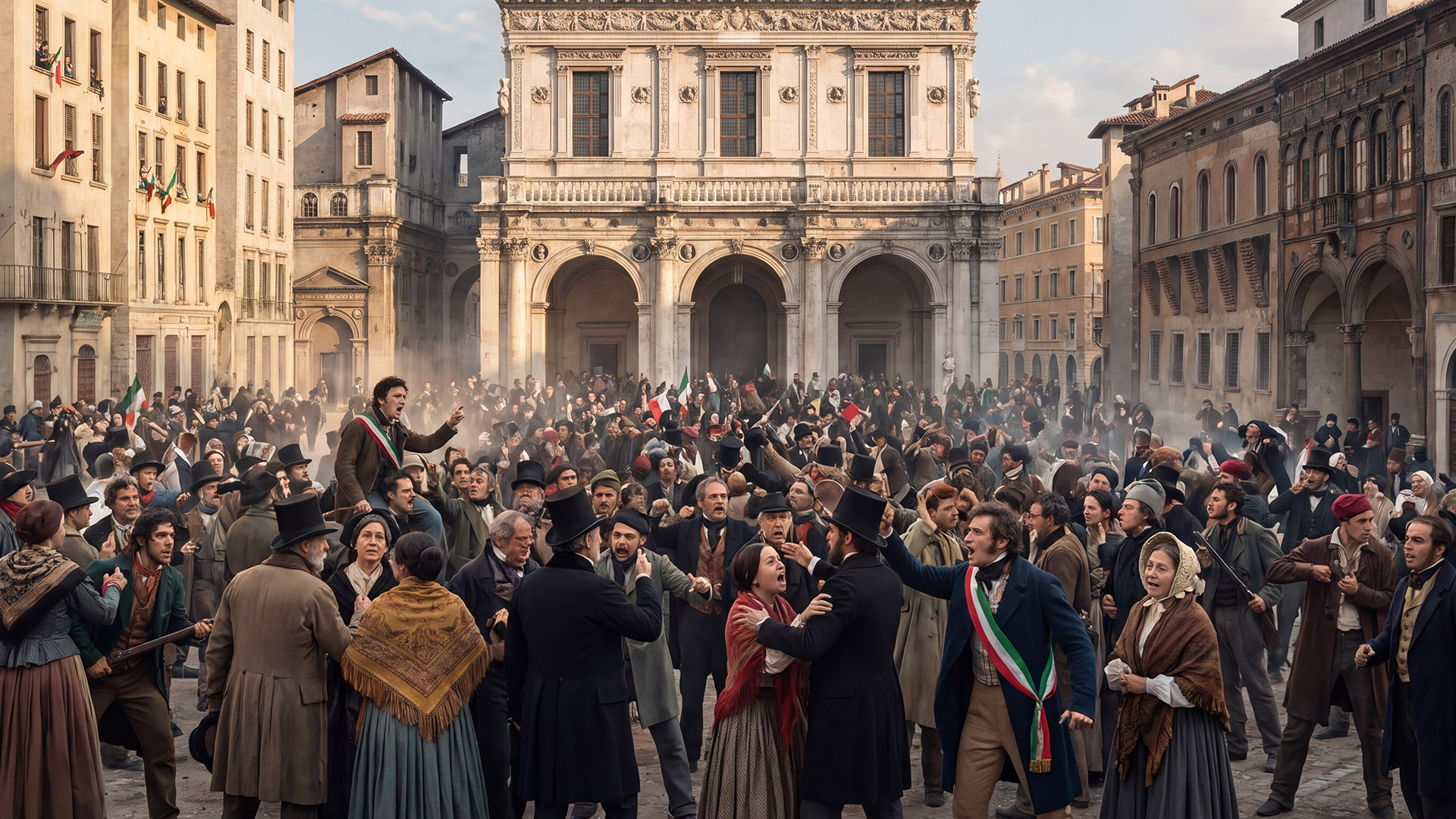
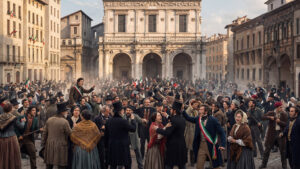
Reconstruction of the uprising in Piazza della Loggia in 1849.
The Historical Background – Austrian Rule and the Italian Risorgimento
During the first half of the nineteenth century, Brescia belonged to the Kingdom of Lombardy-Venetia, established in 1815 and governed by the Austrian Empire. Austrian authorities controlled the principal administrative and military institutions, while political movements advocating constitutional government and Italian national independence gained increasing support.
In 1848, a series of revolutionary movements spread across Europe, challenging established monarchies and demanding political reforms. In northern Italy, the Five Days of Milan, between March 18 and 22, forced Austrian troops to abandon the city temporarily, encouraging similar demonstrations in other Lombard communities.
On March 22, 1848, the Austrian garrison in Brescia capitulated without significant bloodshed, and a provisional government was established under Luigi Lechi. The uprising coincided with the beginning of the First Italian War of Independence, during which King Charles Albert of Sardinia attempted to expel Austrian forces from northern Italy.
The military situation changed after the Austrian victory at the Battle of Custoza in July 1848. The subsequent Armistice of Salasco, signed on August 9, restored Austrian control over much of Lombardy. Brescia Castle was reoccupied by imperial troops on August 16, ending the city’s brief period of revolutionary government.
Why the Uprising Began in March 1849
Following the restoration of Austrian authority, Brescia faced punitive measures intended to discourage further resistance. On January 4, 1849, General Julius Jacob von Haynau imposed a substantial fine of 520,000 Austrian lire on the municipality for its conduct during the previous year’s revolutionary events.
The requirement to pay the remaining portion of the fine created additional tensions between municipal representatives and the population. On March 12, 1849, King Charles Albert terminated the armistice with Austria, reopening hostilities and encouraging supporters of Italian independence to prepare another insurrection.
Two revolutionary currents participated in the preparations: supporters of the Sardinian monarchy and republicans associated with Giuseppe Mazzini. A clandestine committee coordinated resistance, while patriots organized volunteers and gathered weapons. Among the participants was Tito Speri, a young Brescian who had already fought in the independence campaign of 1848.
The political situation became more complicated when the Sardinian army suffered a decisive defeat at the Battle of Novara on March 23, 1849. Communications were slow and contradictory, however, and many inhabitants of Brescia continued believing that the Piedmontese army might achieve victory or provide military assistance.
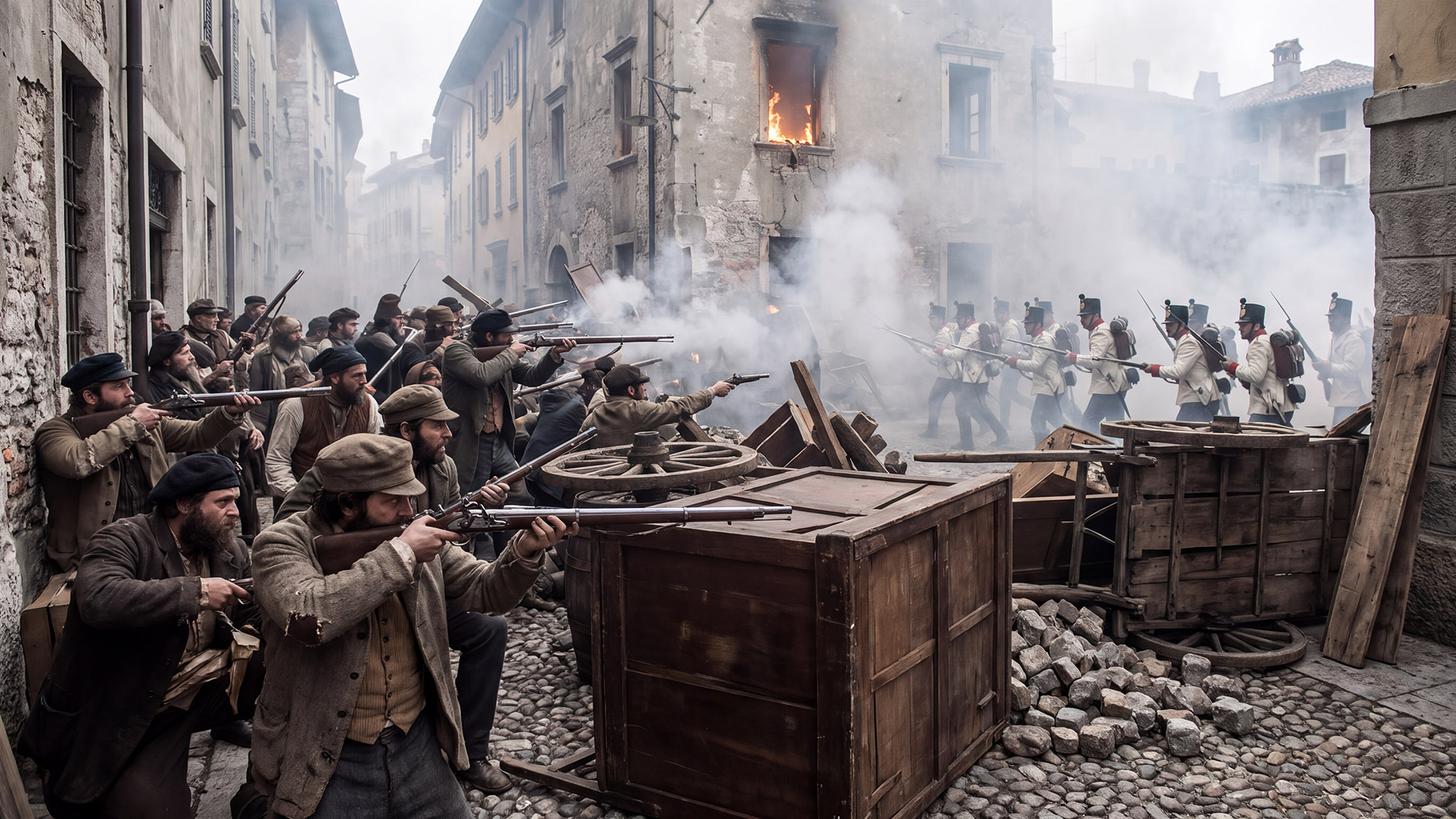
Reconstruction of the Battle of Porta Torrelunga in 1849.
The Ten Days of Brescia – March 23-April 1, 1849
March 23-25 – The Beginning of the Insurrection
The rebellion began on March 23, 1849, when Austrian captain Pomo arrived at the municipal palace to demand payment of the outstanding fine. An angry crowd confronted him, and demonstrations quickly developed into open resistance. Austrian soldiers withdrew toward fortified positions, while insurgents seized supplies and established control over several streets.
The Austrian commander stationed inside Brescia Castle responded by ordering artillery fire against the city. Cannons positioned on Cidneo Hill could reach surrounding residential districts, making the fortress a major military advantage for the imperial garrison. The bombardment continued during the early stages of the uprising.
On March 24, a Committee of Public Defence was established to coordinate the resistance. Engineer Luigi Contratti and physician Carlo Cassola became its principal leaders, organizing the city’s military preparations and helping mobilize volunteers. The committee operated separately from the municipal authorities, whose representatives generally favored a more cautious approach.
On March 25, artillery fire temporarily ceased, but disagreements emerged between the municipality and the revolutionary leadership. Municipal officials feared the consequences of prolonged fighting, while the committee remained committed to resistance. The division of authority complicated efforts to establish a unified political and military strategy.
March 26-29 – Fighting Around the City
On March 26, approximately one thousand Austrian soldiers commanded by General Johann Nugent advanced from Mantua toward Brescia. Their arrival threatened the insurgents with attacks from outside the city while Austrian artillery continued to control the surrounding districts from the castle.
Tito Speri led approximately three hundred volunteers toward Sant’Eufemia, east of the historic center, attempting to confront Nugent’s forces. The insurgents were unable to defeat the advancing troops, but their resistance contributed to delaying Austrian operations while defenders strengthened barricades around the principal urban entrances.
The following day, Austrian artillery resumed bombarding Brescia, and further fighting developed around the Pusterla and the surrounding hills. Volunteers associated with the priest Pietro Boifava participated in the resistance. Nugent remained outside the city, awaiting reinforcements before attempting another major assault.
On March 28, an Austrian maneuver near Porta Torrelunga drew insurgents into exposed positions outside the defenses. The resulting fighting inflicted substantial casualties on the volunteers. By March 29, increasingly reliable reports of the Sardinian defeat at Novara reached the city, undermining hopes of external assistance.
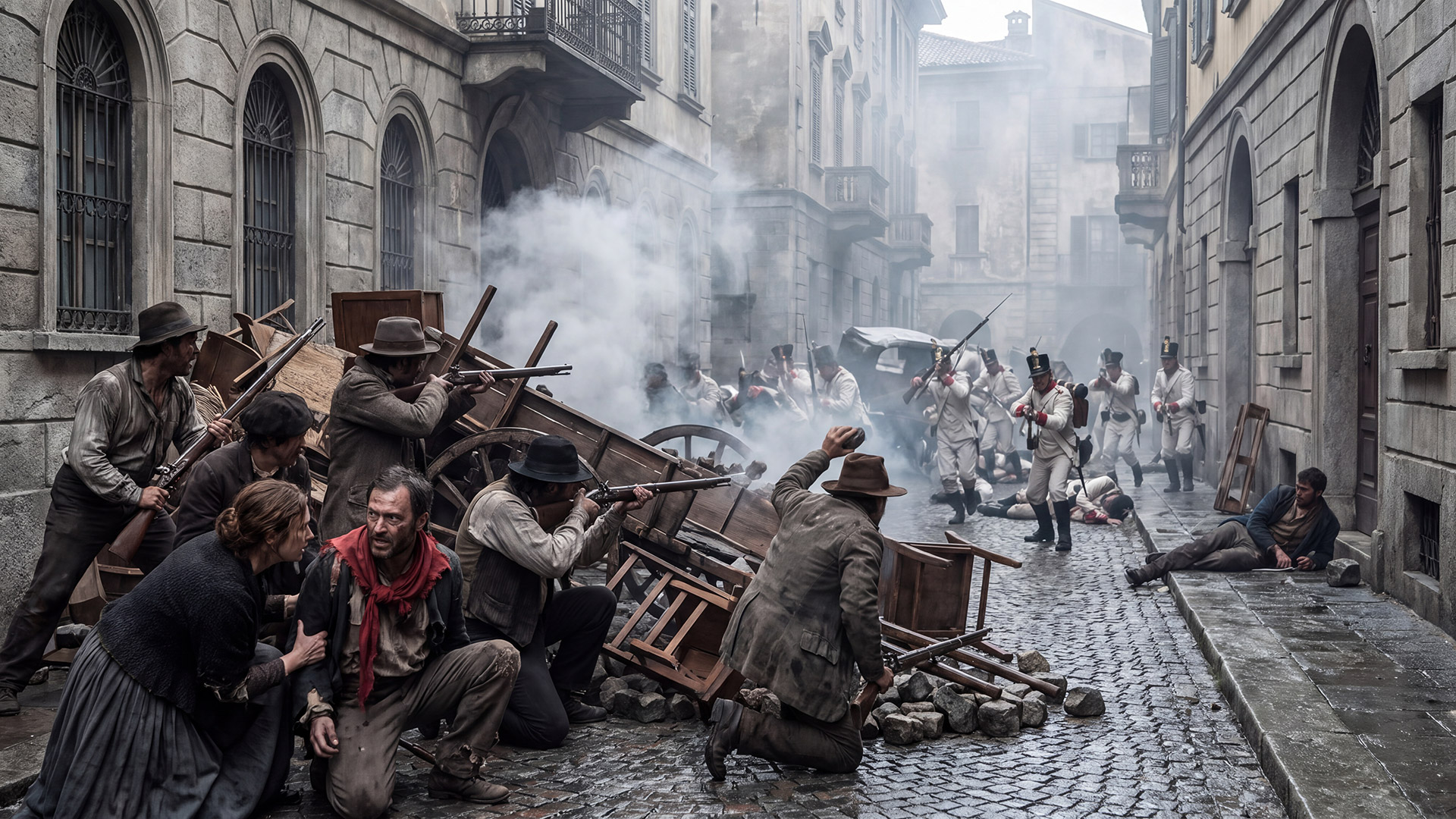
Reconstruction of the Battle of San Barnaba in 1849.
March 30-April 1 – The Final Battles
On March 30, the fighting intensified around several entrances to Brescia, including Porta Pile, San Faustino, San Giovanni, and Porta Torrelunga. Austrian troops attempted to reach the castle from outside the city, while defenders maintained positions along the principal roads and barricaded intersections.
During the night, Austrian soldiers managed to reach the fortress through the Strada del Soccorso, a fortified access route connecting the castle with the surrounding territory. This passage allowed imperial forces to reinforce the garrison without advancing directly through streets controlled by the insurgents.
On March 31, General Julius Jacob von Haynau entered the castle with additional troops and demanded the unconditional surrender of Brescia. The insurgents continued fighting, despite their increasingly unfavorable position. Austrian attacks targeted the city gates, while artillery bombardments supported the advancing infantry.
Particularly intense fighting occurred near Piazza dell’Albera, now Piazzetta Tito Speri, where defenders resisted Austrian soldiers descending from the fortress. Porta Torrelunga eventually fell, allowing imperial troops to penetrate the city. General Nugent was seriously wounded during the fighting and died on April 17.
By April 1, Austrian forces controlled much of Brescia. The municipality sent Franciscan friar Maurizio Malvestiti to negotiate with Haynau, but the Austrian commander demanded unconditional surrender. Although the municipal authorities accepted the terms, isolated resistance continued before the insurrection finally ended.
The Citizens of Brescia and the Barricades
The Ten Days of Brescia involved more than professional soldiers and organized volunteers. Residents constructed barricades from carts, timber, furniture, and other available materials, transforming narrow streets into defensive positions. Their effectiveness depended partly on the dense medieval urban layout, which restricted the movement of larger military formations.
The uprising also involved members of the clergy, artisans, workers, and other civilians. Pietro Boifava, parish priest of Serle, became an important organizer of volunteers, while numerous inhabitants assisted with supplies and the care of wounded combatants. Their participation extended the conflict beyond the original revolutionary committees.
The events were subsequently represented by Faustino Joli, a Brescian painter who witnessed the uprising. His paintings depict gatherings in Piazza della Loggia, confrontations near Porta Torrelunga, and fighting in the San Barnaba district, preserving important visual interpretations of the urban spaces where the rebellion occurred.

Historical reconstruction of Tito Speri, hero of the Ten Days of Brescia.
Tito Speri – The Patriot Who Refused to Surrender
Tito Speri was born in Brescia on August 2, 1825. As a young man, he developed an interest in politics and the Italian independence movement. In 1848, he joined volunteer forces supporting the Sardinian army and participated in military operations, including fighting near Governolo.
During the uprising of 1849, Speri became one of the most recognizable figures associated with the armed resistance. His activities included recruiting volunteers and participating in confrontations with advancing Austrian forces. Although only 23 years old, he had already acquired military experience during the previous year’s revolutionary campaigns.
Following the suppression of the rebellion, Speri escaped from Austrian-controlled territory. He initially sought refuge in Lugano, Switzerland, before continuing to Turin, where he maintained contact with Italian nationalists and republican activists associated with the movement led by Giuseppe Mazzini.
An amnesty allowed Speri to return to Brescia in 1850. However, he continued participating in clandestine revolutionary activities, maintaining connections with the patriotic network organized around the priest Enrico Tazzoli in Mantua. His responsibilities included obtaining weapons and distributing political publications and financial certificates supporting the movement.
Austrian authorities arrested Speri in June 1852 and transferred him to Mantua, where he was prosecuted for his involvement in the conspiracy. He was sentenced to death and hanged at Belfiore on March 3, 1853, becoming one of the patriots remembered collectively as the Martyrs of Belfiore.
The Hyena of Brescia – General Haynau and the Austrian Repression
Julius Jacob von Haynau, born in Kassel in 1786, was an Austrian military commander who gained notoriety for his role in suppressing revolutionary movements. During the Italian revolutions of 1848-1849, he operated in Lombardy under the Austrian military command headed by Field Marshal Joseph Radetzky.
Haynau became known as the Hyena of Brescia, a nickname associated with the severity of the repression carried out under his command. His reputation extended beyond Italy, particularly after his subsequent military involvement in suppressing the Hungarian Revolution of 1848–1849.
Following the defeat of the insurgents, Austrian troops carried out executions, arrests, and reprisals against residents suspected of participating in the rebellion. Contemporary accounts also describe the looting of buildings and violence against civilians. The repression continued after organized resistance had ceased.
The disciplinary measures imposed on Brescia formed part of the Austrian authorities’ efforts to restore control over Lombardy. Numerous participants fled into exile, while others faced imprisonment or prosecution. The violence of the suppression became a central element of the historical memory surrounding the Ten Days.

Historical reconstruction of General Julius Jacob von Haynau.
The Human Cost and the Aftermath of the Rebellion
The fighting caused substantial casualties among insurgents, Austrian soldiers, and civilians. Historical estimates differ, partly because contemporary accounts distinguish inconsistently between deaths during combat, subsequent executions, and civilian victims. Several hundred inhabitants of Brescia lost their lives, while many others were wounded.
The destruction affected residential buildings, streets, and commercial properties, particularly in districts exposed to artillery fire or intense street fighting. The city’s population also faced the consequences of military occupation, including restrictions, financial burdens, and the disruption of ordinary economic activities.
The uprising did not produce immediate independence. Brescia remained under Austrian rule until 1859, when the Second Italian War of Independence brought Lombardy under the control of the Kingdom of Sardinia. Two years later, the proclamation of the Kingdom of Italy established the new unified state.
How Brescia Earned the Name Lioness of Italy
The expression Lioness of Italy emerged from nineteenth-century patriotic literature commemorating the events of 1849. One of its earliest prominent uses appeared in Canti patrii, published in 1857 by the Italian poet Aleardo Aleardi, who associated Brescia with the image of a courageous lioness.
The nickname became widely known through Giosuè Carducci, one of Italy’s most celebrated poets and the recipient of the 1906 Nobel Prize in Literature. In 1877, Carducci referred to Brescia as the Lioness of Italy in Alla Vittoria, a poem included in his collection Odi barbare.
The literary image became closely connected with the city’s identity and its contribution to Italian unification. In 1899, Brescia received a gold medal recognizing its distinguished role in the Risorgimento, on the fiftieth anniversary of the uprising. The title Lioness of Italy continues to appear in local commemorations and civic institutions.
Three Places to Visit in Brescia Related to the Ten Days
Museo del Risorgimento Leonessa d’Italia
The Museo del Risorgimento Leonessa d’Italia is located inside Brescia Castle, on Cidneo Hill, in the Grande Miglio building. Reopened in 2023 after a lengthy closure, the museum explores the Italian unification movement through paintings, historical documents, military objects, and interactive exhibits.
The museum’s exhibition is organized into eight sections, presenting the Risorgimento within a broader European historical context. The Ten Days of Brescia occupy an important place in the collection, allowing visitors to examine the political circumstances, protagonists, and historical consequences of the uprising.
Monumento a Tito Speri
The Monumento a Tito Speri stands in Piazzetta Tito Speri, near the northeastern edge of Brescia’s historic center. The monument was created by sculptor Domenico Ghidoni and inaugurated on September 2, 1888, following a public subscription organized to commemorate the patriot’s life and sacrifice.
The statue represents Tito Speri standing above a stone pedestal, gesturing toward the direction of Brescia Castle. Its location was deliberately chosen because the surrounding square, formerly known as Piazza dell’Albera, had been an important battleground during the final stages of the rebellion.
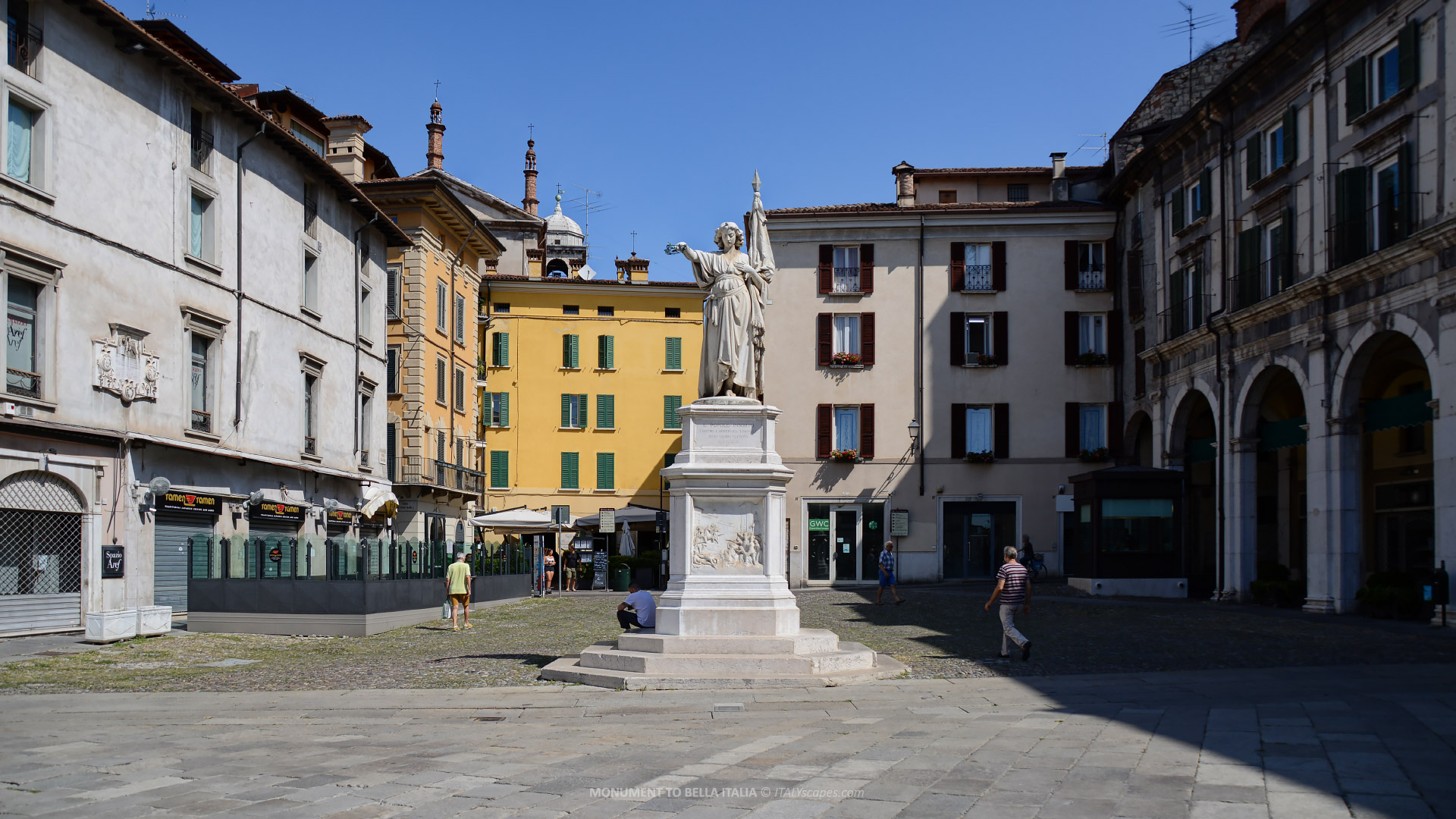
Monumento alla Bella Italia, commemorating the Ten Days of Brescia.
Monumento alla Bella Italia
The Monumento alla Bella Italia, also called the Monument to the Fallen of the Ten Days, stands near the northeastern corner of Piazza della Loggia. Completed in 1864 by sculptor Giovanni Battista Lombardi, the monument was donated to Brescia by King Victor Emmanuel II.
The monument features a female allegorical figure representing Italy, standing above a marble pedestal decorated with reliefs. These illustrate important episodes of the uprising, including street fighting, executions, and the commemoration of the dead. It remains one of the principal public memorials dedicated to the events of 1849.
The Legacy of the Ten Days of Brescia
The Ten Days of Brescia occupy a significant place in the history of the Italian Risorgimento, demonstrating the involvement of urban communities in the struggle against Austrian rule. Although the uprising failed militarily, its participants became associated with the wider movement that eventually achieved Italian unification.
Today, the events are remembered through the city’s museums, monuments, commemorative plaques, and street names, including Via Dieci Giornate. The title Lioness of Italy continues to preserve the memory of the ten-day resistance, connecting Brescia’s modern identity with one of the defining episodes of its nineteenth-century history.
Images generated with Nano Banana Pro / Google AI Studio