Table of Contents
The monster of Lake Como has haunted the imagination of local residents for generations. Known as Lariosauro, or affectionately as Larrie, the mysterious creature has been described as a giant reptile, an enormous eel, and a strange aquatic animal with webbed feet. Its legend began with an extraordinary encounter in 1946.
Lake Como, surrounded by the mountains of Lombardy, provides a remarkable setting for such a story. Its waters reach a maximum depth of approximately 410 metres, concealing an underwater landscape that few visitors ever see. Among the lake’s villages and historic castles, stories of mysterious creatures have become part of local folklore.
What makes this particular legend extraordinary is its connection with Lariosaurus, a prehistoric marine reptile whose fossilized remains were discovered in the mountains above the lake. Long before the first reports of Larrie, scientists had already identified an animal whose name would eventually become inseparable from the region’s most famous aquatic mystery.
The Mysterious Encounter of November 1946
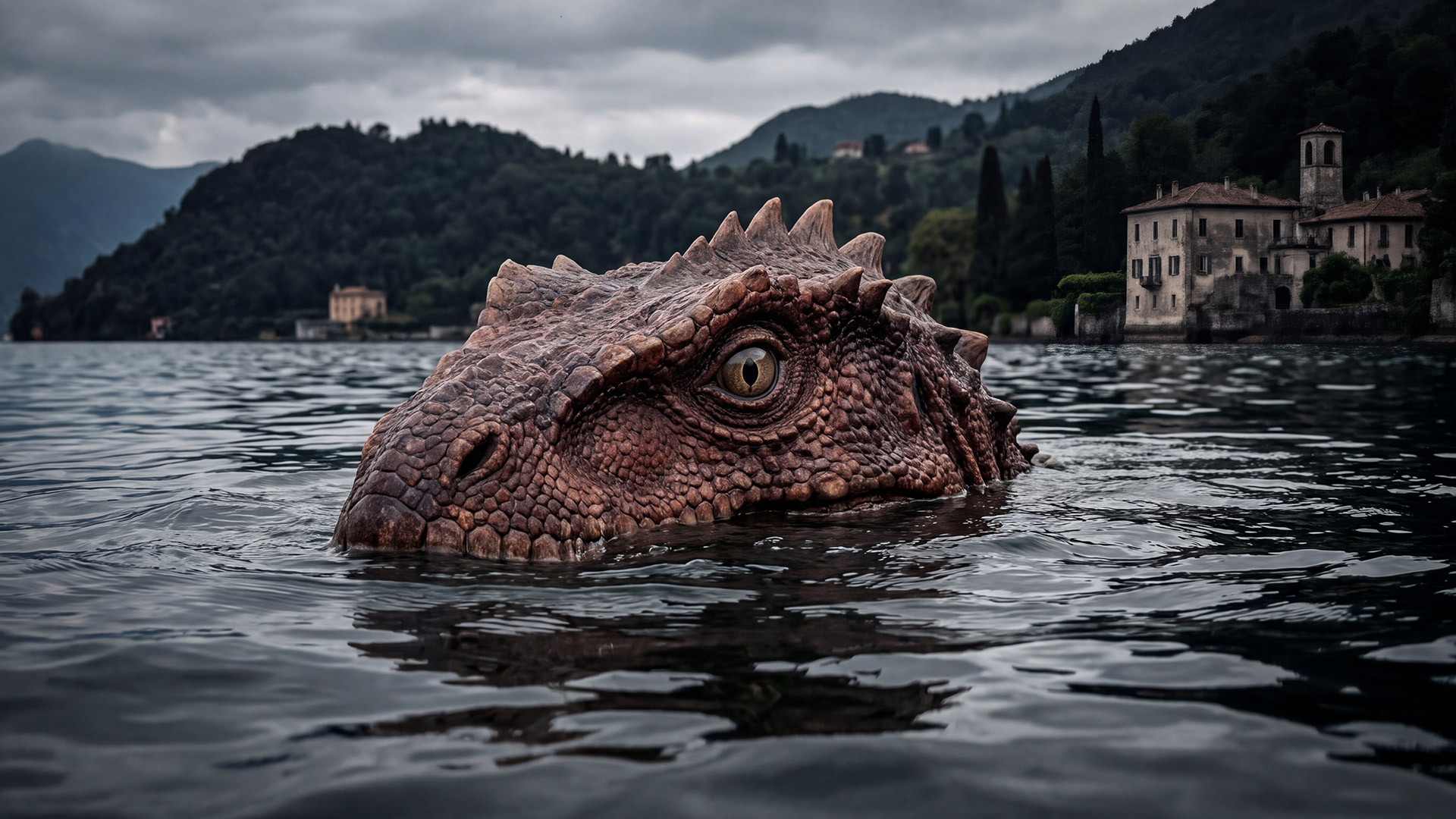
On 18 November 1946, the local newspaper Corriere Comasco published a remarkable account entitled La paurosa avventura di due cacciatori brianzoli. Written by journalist Achille Combi, the article described a frightening encounter involving two hunters from Brianza in the wetlands of Pian di Spagna, at the northern end of Lake Como.
According to the story, the hunters suddenly noticed the head of an unfamiliar creature emerging from the water. It possessed a prominent crest, unusually mobile eyes, and a body covered with hard, reddish-brown scales. The animal was estimated to measure between two and three metres in length.
The description suggested something unlike the ordinary fish and aquatic animals associated with the lake. Its reptilian appearance, particularly the crest and scales, gave the creature a distinctly prehistoric character. The two hunters supposedly raised their rifles, but the mysterious animal disappeared beneath the water before they could shoot it.
The explanation behind this first encounter was eventually revealed. The report had been a journalistic invention, created rather than witnessed. Nevertheless, the fictional animal escaped the boundaries of the original article. Within days, additional stories were circulating, and an invented encounter was beginning its transformation into a lasting local legend.
The Monster That Captured the Newspapers
The story spread through the regional press, attracting increasing curiosity. Another supposed sighting was reported near Varenna, on Lake Como’s eastern shore, describing a similar creature that had allegedly appeared several years earlier. This second account also belonged to the series of fabrications surrounding the original newspaper story.
On 22 November 1946, La Provincia published an article considering whether the creature might have been a sturgeon. The suggestion introduced a more familiar aquatic animal into the mystery, while simultaneously keeping the original story alive. The extraordinary reptile was already becoming a subject of public discussion.
The reports soon reached a wider audience beyond the Como area. The mysterious animal acquired the name Lariosauro, borrowed from a genuine prehistoric reptile discovered nearby during the nineteenth century. With a distinctive appearance, an evocative name, and a recognizable geographical setting, the monster had acquired the essential elements of a legend.
The Strange Creature of Argegno
Eight years after the sensational newspaper reports, another encounter was associated with the monster of Lake Como. In 1954, a father and son reportedly observed an unusual animal near Argegno, a village on the western shore. This time, the creature was considerably smaller than the enormous reptile described in 1946.
According to the account, the animal measured approximately 80-90 centimetres. It possessed a rounded snout, a broad posterior body, and appendages resembling webbed feet. These characteristics distinguished it from the scaly creature of Pian di Spagna, suggesting something closer to an aquatic mammal than a prehistoric reptile.
The description subsequently attracted the attention of researchers investigating Italian lake-monster stories. One particularly plausible identification was the European otter, an animal historically present in the region. Its elongated body, rounded head, and feet adapted for swimming corresponded to several features reported by the witnesses.
The Argegno episode added an important element to the developing folklore. The mysterious creature was no longer associated exclusively with the northern end of the lake. A new sighting had appeared farther south, and the name Lariosauro was gradually being applied to different kinds of unusual aquatic encounters.
The Giant Animal of 1957
In August 1957, another extraordinary report emerged from the waters between Dongo and Musso, two settlements on the northwestern shore of Lake Como. The creature was described as enormous, recalling a gigantic eel moving through the lake rather than the smaller animal reported at Argegno.
The story revived the image of an immense underwater animal, hidden beneath the lake’s surface. Its reported dimensions attracted attention, particularly because the encounter appeared to resemble the sensational descriptions published in the years following the Second World War.
Later investigations classified the Dongo-Musso episode as another probable newspaper hoax. By this point, stories about Lariosauro had developed a recognizable pattern: an extraordinary animal appeared in a particular location, newspapers repeated the encounter, and the creature entered the growing collection of local legends.
The Creature with a Crocodile’s Head
Another unusual account circulated during September 1957, describing an animal with a head resembling that of a crocodile. The story became associated with observations made during an underwater investigation, although later versions differed in their descriptions of the episode.
The crocodile-like appearance introduced yet another form into the legend. Unlike an eel or an otter, a reptilian head suggested a creature with powerful jaws and a distinctive profile. Such a description naturally encouraged comparisons with prehistoric animals, especially those already associated with the geological history of the region.
A large pike has been suggested as an explanation for this encounter. Its elongated head and prominent jaws can create a striking appearance when observed in unfamiliar conditions. The episode nevertheless became another chapter in the changing identity of Larrie, whose reported features varied considerably between sightings.
The Giant Eel of 2003
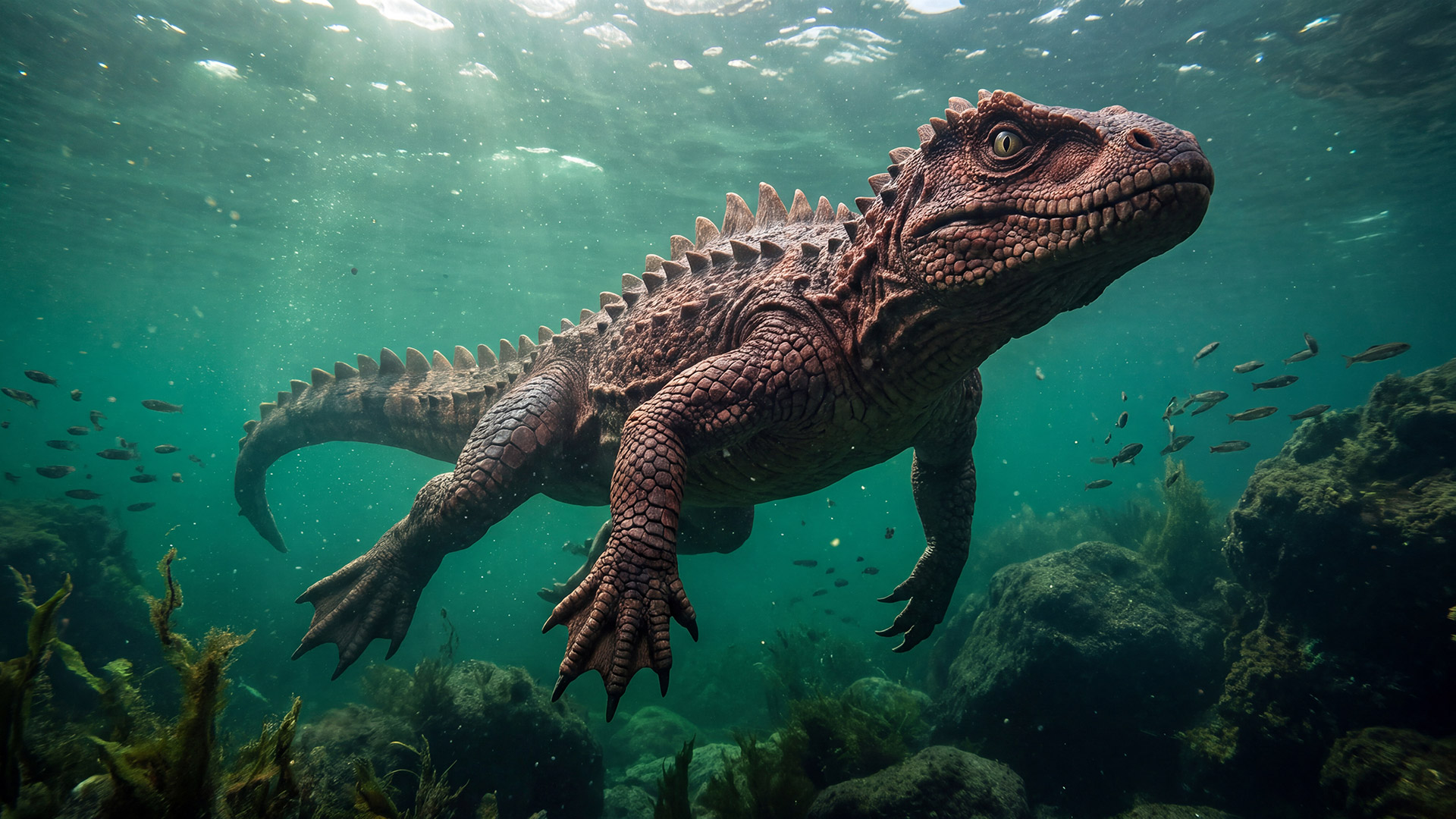
After decades in which the legend survived primarily through older stories, the monster of Lake Como returned to public attention in 2003. An enormous eel-like creature was reportedly seen in the Lecco branch of the lake, reviving memories of the mysterious animals described during the twentieth century.
This time, the creature was estimated to measure between 10 and 12 metres in length. Its supposed dimensions far exceeded those of ordinary European eels, creating the impression of an exceptionally large animal moving beneath the surface. The report soon became another well-known episode in the legend.
One interpretation suggested that the enormous body might have been an optical impression created by several fish swimming close together. Their combined movement could have resembled a single elongated creature. The sighting became part of the popular history of Larrie, extending the legend into the twenty-first century.
The Search for the Real Animal
The succession of strange encounters attracted the attention of Giorgio Castiglioni, an Italian researcher who investigated stories about mysterious animals in lakes and rivers. His examination of the Lariosauro reports focused on their origins, the reliability of the accounts, and the animals that might explain particular descriptions.
His interpretations connected the Argegno creature with an otter and the crocodile-like animal with a possible pike. The giant eel reported in 2003 was considered compatible with a group of fish moving together, while the earliest sensational encounters belonged to the history of newspaper fabrications.
The investigations revealed how the legend had developed from several distinct stories. Different animals, changing dimensions, and dramatic descriptions gradually became associated with a single name. Yet another, much older story lay behind that name: the discovery of an ancient reptile in the limestone mountains overlooking Lake Como.
The Prehistoric Creature Hidden in the Rocks
In 1830, more than a century before the famous newspaper reports, fossilized remains of an unusual reptile were discovered near Perledo, in the mountains above Varenna. The specimen came from geological deposits that preserved evidence of a world profoundly different from the modern landscape of northern Italy.
The fossil attracted the attention of Giuseppe Balsamo-Crivelli, a naturalist from Milan, who described the specimen in 1839. Its preserved anatomy revealed a long body, a relatively small head, four limbs, and a tail. The animal belonged to an ancient group of reptiles adapted to life in water.
The discovery was particularly important because its skeleton preserved recognizable anatomical structures. Scientists could examine the relationships between its bones, reconstruct its proportions, and compare it with other prehistoric animals. The fossil revealed the existence of a reptile that had inhabited ancient waters millions of years before Lake Como existed.
In 1847, geologist Giulio Curioni introduced the scientific name Lariosaurus balsami. The first part derives from Larius, the ancient Latin name of Lake Como, while the second honours Balsamo-Crivelli. Thus, an extinct animal became permanently associated with the region where its remains were discovered.
The Fossils of Varenna’s Black Limestone
The remains came from the Perledo-Varenna limestone, a geological formation that preserves fossils from the Middle Triassic. The surrounding mountains contain deposits formed in ancient marine environments, including dark rocks historically quarried as decorative stone.
The so-called black marble of Varenna was particularly valued for its appearance. Quarrying exposed sedimentary layers containing fossilized animals, transforming commercially important stone deposits into a source of paleontological discoveries. Some specimens preserve extensive portions of the skeleton, while others contain more fragmentary remains.
The discoveries attracted generations of scientists, including researchers studying the fossil reptiles of the southern Alps. Over time, additional specimens helped establish the anatomy and classification of Lariosaurus, turning the area around Perledo into an important location in the history of European paleontology.
A World That Disappeared 240 Million Years Ago
The real Lariosaurus lived approximately 240 million years ago, during the Middle Triassic. At that time, the region occupied by modern Lake Como formed part of an ancient marine landscape associated with the Tethys realm, rather than the freshwater basin familiar today.
These prehistoric environments included coastal waters, shallow marine areas, and restricted basins inhabited by fish, marine reptiles, and numerous invertebrates. Their remains occasionally became buried in sediments, beginning the geological processes that would preserve them for millions of years.
The mountains surrounding Lake Como now expose rocks formed in those vanished environments. Ancient marine deposits were affected by the tectonic processes that created the Alps, while the modern lake basin developed much later through geological and glacial activity.
What Did the Real Lariosaurus Look Like?
The prehistoric reptile was considerably smaller than the enormous creature described in popular stories. Known specimens generally measured approximately 60 centimetres to a little over one metre in length, making Lariosaurus a relatively small member of the nothosaurs, an extinct group of aquatic reptiles.
Its body was elongated, with a comparatively short neck, a narrow skull, and a long tail. The jaws contained sharp, elongated teeth, particularly towards the front, which were suited to capturing slippery aquatic prey. Its appearance was adapted to hunting in the marine environments of the Middle Triassic.
The limbs reveal important characteristics of its aquatic lifestyle. Its front limbs were adapted for movement through water, while the hind limbs retained five toes. Together with the tail, these structures contributed to the animal’s mobility, although the precise way it swam has been the subject of continuing research.
Lariosaurus was a carnivorous animal, feeding on fish and other relatively small aquatic creatures. One exceptional fossil preserved remains of two juvenile Cyamodus, another type of marine reptile, within its abdominal region. This extraordinary discovery provided direct evidence of the prey consumed by at least some individuals.
The Secrets Preserved in Fossil Skeletons
Some fossils have contributed to discussions about the reproductive behaviour of Lariosaurus. Small skeletons preserved in association with larger individuals have been examined in connection with the possibility of live birth, a reproductive strategy known among several groups of extinct marine reptiles.
The discoveries also revealed that Lariosaurus was not confined to the region of Lake Como. Fossils attributed to the genus have been identified in other parts of Europe and Asia, demonstrating that related animals inhabited a much wider geographical area during the Triassic.
Each specimen added information about the reptile’s anatomy and evolution. Yet one important part of its appearance remained particularly difficult to reconstruct: the outer surface of its body. For generations, paleontologists relied primarily on bones when imagining the skin and swimming adaptations of the animal.
The Extraordinary Discovery of 2025
In August 2025, a scientific study revealed a remarkable new chapter in the history of Lariosaurus. Researchers Silvio Renesto, Cinzia Ragni, and Fabio Magnani described an exceptionally preserved fossil of Lariosaurus valceresii, recovered from the Middle Triassic rocks of Monte San Giorgio.
The specimen came from the Meride Limestone, within the UNESCO World Heritage area on the Swiss-Italian border. Almost complete, the fossil preserved something far more unusual than its skeleton: traces of the animal’s skin, visible as a thin carbonaceous film.
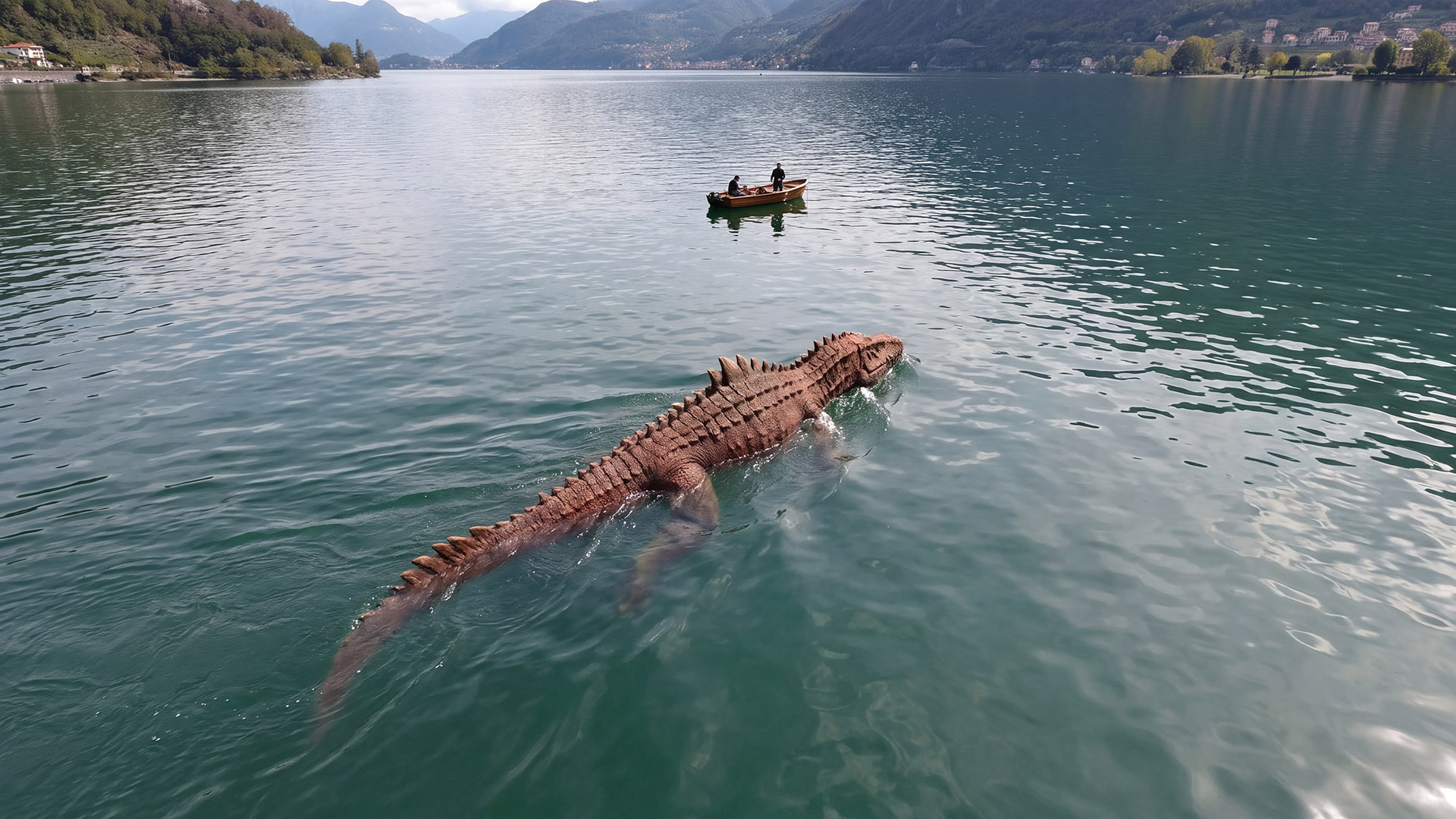
The preserved skin revealed small, generally subrectangular scales, providing new evidence of the reptile’s external appearance. It also outlined the limbs, showing that both the hands and feet were webbed. These details offered scientists the opportunity to reconstruct features previously known mainly through anatomical interpretation.
For an animal that had inspired descriptions of a mysterious lake monster, the discovery was extraordinary. Fossils millions of years old were still revealing previously unknown anatomical details, allowing researchers to move beyond traditional skeletal reconstructions and better understand the appearance of a genuine prehistoric reptile.
The Prehistoric Treasure of Castello di Vezio
Above Varenna, the medieval Castello di Vezio offers visitors an opportunity to discover the real animal behind the legend. The fortress houses a permanent exhibition dedicated to Lariosaurus, connecting the geological history of the surrounding territory with the prehistoric reptiles discovered in its rocks.
The exhibition includes casts of fossil specimens found near Perledo, in the Varese area, and in other regions. Visitors can examine the proportions of the extinct animal and discover how paleontologists reconstruct creatures from bones preserved in stone.
The castle’s elevated position overlooks the central part of Lake Como. From this historic fortress, visitors can explore the connection between the mountains, ancient marine environments, and the fossil discoveries that inspired the legend of Larrie.
Other significant Lariosaurus material belongs to institutional paleontological collections, including specimens associated with the historical Curioni Collection. These fossils preserve the scientific evidence behind an animal whose name eventually entered the folklore of an entire region.
How Larrie Became a Local Legend
Over the decades, the mysterious creature acquired the nickname Larrie, recalling Nessie, the famous monster of Scotland’s Loch Ness. The affectionate name helped distinguish the legendary inhabitant of Lake Como from the prehistoric reptile studied by paleontologists.
The monster also entered regional literature. In 2000, Giovanni Galli published Il Lariosauro: Storia della creatura misteriosa riemersa nel 1946 dalle profondità del lago, a work inspired by the mysterious creature and the stories that emerged during the postwar period.
Other publications, including works by Giancarlo Colombo, explored the relationship between the fossil reptile and the legends surrounding its name. The creature gradually became part of the cultural identity of Lake Como, appearing in local storytelling and representations associated with the region.
The history of Larrie is unusual because it combines two very different forms of discovery. One began with fossils examined by nineteenth-century scientists; the other emerged from sensational newspaper reporting in the twentieth century. Together, they created a story that has continued to attract curiosity long after its first appearance.
The Legend That Refuses to Disappear
Today, the monster of Lake Como remains one of the most distinctive stories associated with the region. Its history stretches from the wetlands of Pian di Spagna to the villages of Argegno, Dongo, Musso, and Lecco, following the changing reports of strange animals across the lake.
Yet its most remarkable connection lies beneath the mountains rather than the water. Fossils discovered near Perledo revealed a genuine prehistoric reptile whose name would eventually inspire the legendary creature. The bones belonged to an extinct species, while the monster became a product of modern storytelling and local imagination.
The story of Larrie has survived because it brings together ancient natural history, unusual encounters, and the fascination surrounding mysterious waters. Almost two centuries after the discovery of the first fossils, Lariosaurus continues to occupy a unique place between scientific discovery and the legends of Lake Como.
Images generated with Nano Banana Pro / Google AI Studio