Table of Contents
Bergamo is one of the most interesting historic cities in Lombardy, with a remarkable architectural heritage divided between Città Bassa and Città Alta. This Bergamo itinerary connects the city’s principal attractions in one day, beginning and ending at Bergamo railway station and including its medieval squares, monumental churches, Venetian fortifications, and panoramic viewpoints.
The route begins in the Lower Town, where twentieth-century architecture and elegant commercial streets contrast with the medieval buildings of Città Alta. A historic funicular provides access to the Upper Town, while a second funicular connects Colle Aperto with San Vigilio, the hill overlooking Bergamo’s fortified historic center.
Designed for visitors arriving by train, this one-day Bergamo itinerary takes approximately eight to nine hours, including indoor visits, lunch, and photography stops. The route combines walking with two funicular journeys, concentrating the most important monuments in the morning and reserving the afternoon for panoramic viewpoints and the Venetian Walls.
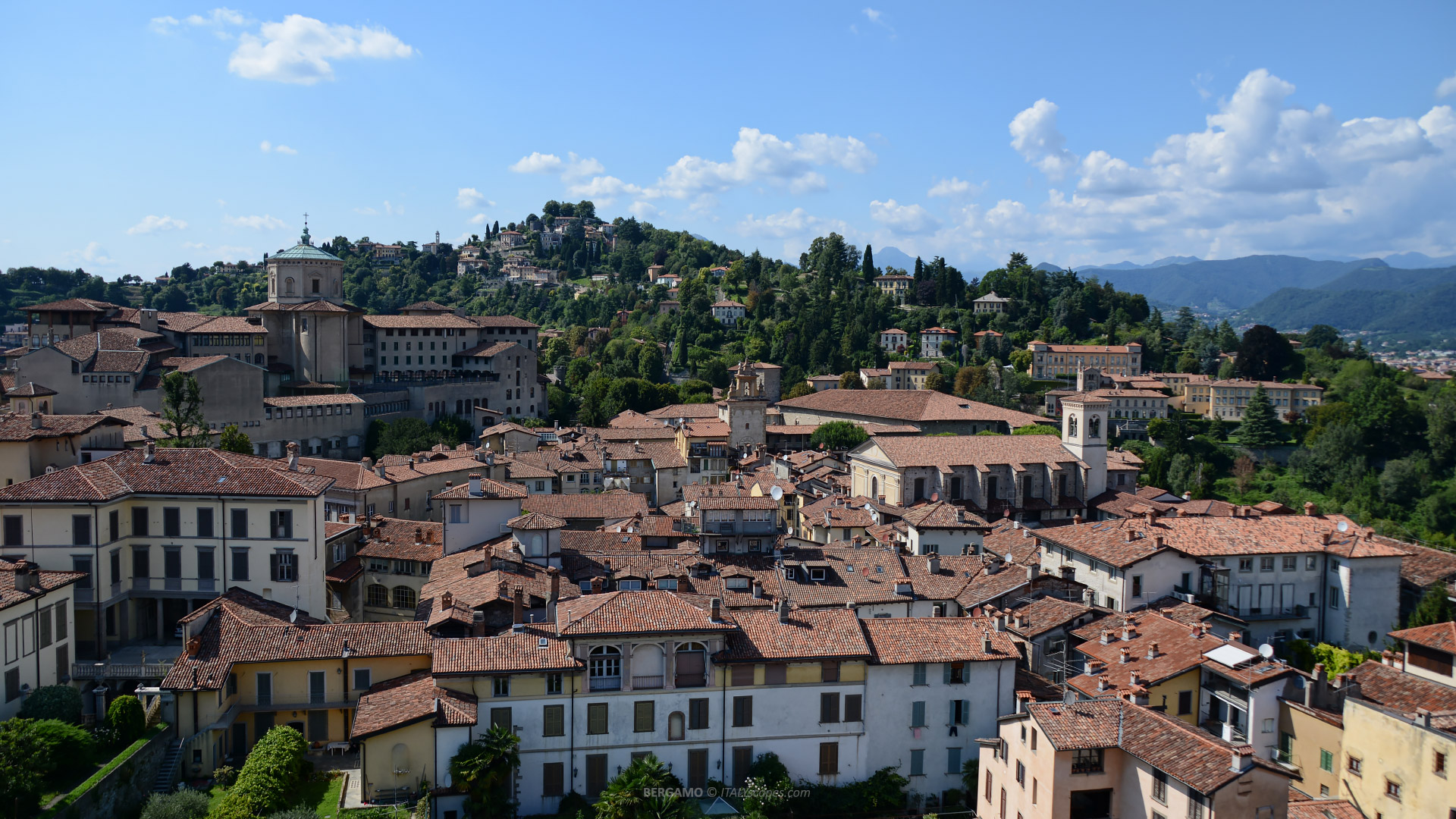
Historic rooftops of Bergamo Alta with San Vigilio in the background.
Why This One-Day Bergamo Itinerary Works
Bergamo’s historic attractions are concentrated in two distinct urban areas connected by public transport. Città Bassa occupies relatively flat terrain, while Città Alta stands on a hill overlooking the Lombard Plain. The funicular eliminates the steepest part of the ascent, allowing visitors to dedicate more time to the principal monuments.
This Bergamo itinerary follows a geographical progression from the railway station toward Piazza Vecchia and Piazza Duomo, before continuing through the western and northern parts of the Upper Town. The afternoon includes the Rocca, San Vigilio, and a section of the Venetian Walls, followed by a descent toward the station.
The schedule is particularly suitable from Tuesday to Saturday, when the principal religious monuments and the Civic Tower generally accept visitors during the morning. Some attractions close on Mondays, while Sunday religious services can restrict tourist access. Opening hours should always be checked before visiting, particularly during religious celebrations.
9:00 am – Start at Bergamo Railway Station
Begin your Bergamo itinerary at Bergamo, the city’s principal railway station, located in Piazzale Guglielmo Marconi. The station is served by regional trains connecting Bergamo with Milan, Brescia, Lecco, and other destinations in Lombardy. The main entrance faces the broad avenue leading toward the historic Lower Town.
Leave the station and proceed north along Viale Papa Giovanni XXIII, one of Bergamo’s principal urban streets. This section of the route is relatively flat and passes hotels, offices, and commercial buildings. Continue toward Porta Nuova, approximately ten to fifteen minutes away on foot, depending on traffic lights and walking speed.
The railway station is also served by ATB urban buses, including Line 1, which connects the railway station with Città Alta. However, walking through the Lower Town provides an opportunity to explore Bergamo’s modern urban center before reaching the historic funicular.
9:20 am – Porta Nuova and Largo Porta Nuova
The first architectural stop is Porta Nuova, one of the most recognizable landmarks of Città Bassa. The monument consists of two symmetrical structures with colonnaded porticoes, constructed in the early nineteenth century as part of the redevelopment of the main entrance to the Lower Town.
Designed by architect Ferdinando Crivelli and inaugurated in 1837, Porta Nuova replaced an earlier urban gateway. Its architectural composition reflects the Neoclassical style, characterized by regular proportions and classical columns. The two structures frame the road leading toward the hill of Città Alta.
From Largo Porta Nuova, visitors can observe the historic skyline of the Upper Town, including the distinctive bell towers rising above its medieval buildings. Continue northeast toward the Sentierone, the principal promenade of Città Bassa, where the next stop of the Bergamo itinerary is located.
9:35 am – Sentierone and Teatro Donizetti
The Sentierone is a broad pedestrian promenade situated between Largo Porta Nuova and Piazza Cavour. Historically used for walking and public gatherings, the avenue became an important urban space during the development of Bergamo’s Lower Town. Its surroundings contain cafés, commercial premises, and buildings from different architectural periods.
Along the promenade stands Teatro Donizetti, named after Gaetano Donizetti, the famous opera composer born in Bergamo in 1797. The theater originated in the eighteenth century and was subsequently enlarged and modified. Its present name commemorates the composer, whose operas include Lucia di Lammermoor and L’elisir d’amore.
Spend approximately fifteen minutes examining the surroundings before continuing toward the funicular station on Viale Vittorio Emanuele II. The walk takes approximately ten minutes. This Bergamo itinerary does not include a theater performance or guided visit, allowing sufficient time for the monuments of Città Alta.

Piazza Vecchia with Palazzo Nuovo and the Contarini Fountain.
10:00 am – Take the Funicular to Città Alta
The Bergamo Funicular, inaugurated in 1887, connects the Lower Town with the fortified historic center. Its lower station is located on Viale Vittorio Emanuele II, while the upper station opens directly onto Piazza Mercato delle Scarpe, one of the oldest public spaces in Città Alta.
The journey takes only a few minutes and climbs the steep hillside through a narrow passage beneath the historic fortifications. The funicular is operated by ATB, Bergamo’s municipal public transport company, and accepts the same integrated tickets used on the city’s urban bus network.
Tickets can be purchased through the ATB Mobile application, ticket machines, and authorized sales outlets. A 24-hour city ticket is particularly convenient for this Bergamo itinerary because it can cover the two funicular services and any additional urban bus journeys during the day.
10:15 am – Piazza Mercato delle Scarpe and Torre del Gombito
After leaving the upper funicular station, enter Piazza Mercato delle Scarpe, a historic square associated with the commercial life of medieval Bergamo. The square takes its name from the shoe market traditionally held here and occupies an important position at the intersection of several narrow streets.
Continue along Via Gombito, one of the principal streets crossing Città Alta. The road leads past medieval buildings, small shops, cafés, and historic residences. Along the way stands the Torre del Gombito, a medieval tower dating from the twelfth century and rising approximately 52 meters above the surrounding streets.
The tower stands near the intersection of Via Gombito and Via Colleoni, marking a strategic point in Bergamo’s medieval street network. Its massive stone structure recalls the period when powerful families constructed fortified residences within the city. Continue north toward Piazza Vecchia, only a short distance away.
10:35 am – Piazza Vecchia and Palazzo della Ragione
Piazza Vecchia is the historical and architectural center of Città Alta. The square developed as the principal seat of municipal government during the Middle Ages and subsequently acquired its present appearance through successive modifications. Its surrounding buildings represent several centuries of political, administrative, and cultural history.
The southern side is dominated by Palazzo della Ragione, constructed during the late twelfth century and recognized as one of the oldest surviving municipal palaces in Lombardy. The building features an open ground-floor loggia, stone columns, and an upper hall historically used for civic and judicial activities.
Opposite stands Palazzo Nuovo, a monumental building with a white marble façade, now housing the Biblioteca Civica Angelo Mai. At the center of the square is the Contarini Fountain, donated in 1780 by Alvise Contarini, a Venetian official. Spend approximately twenty minutes examining the principal architectural elements.
10:55 am – Torre Civica and the Campanone
The Torre Civica, commonly known as the Campanone, rises beside Palazzo della Ragione and dominates the western side of Piazza Vecchia. Originally constructed during the medieval period, the tower reaches approximately 52 meters in height and provides one of the most recognizable architectural landmarks of Bergamo.
Visitors can reach the upper viewing platform using an elevator or stairs, depending on the available facilities and access arrangements. From the top, the panorama includes Piazza Vecchia, the neighboring religious monuments, the historic rooftops of Città Alta, and the surrounding hills and plains.
The Campanone is also associated with an important local tradition: its bell rings 100 times every evening at 10:00 pm. The custom recalls the historical closing of the city gates. Allow approximately twenty to twenty-five minutes for this stop before proceeding to Piazza Duomo.
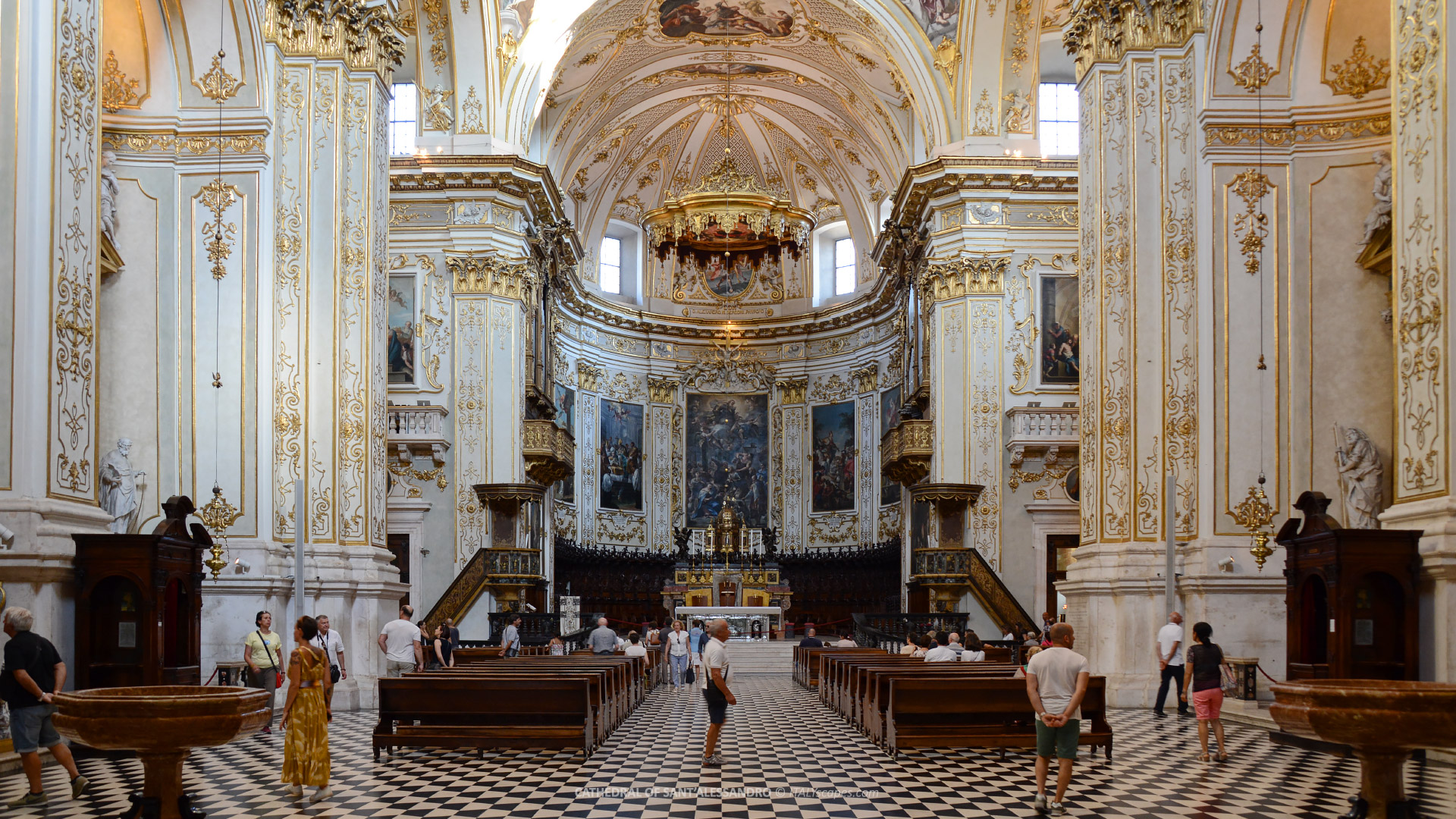
The central nave and high altar of the Cathedral of Sant’Alessandro.
11:25 am – Piazza Duomo and Bergamo Cathedral
Pass beneath the archway of Palazzo della Ragione to enter Piazza Duomo, the religious center of medieval Bergamo. The square contains several important monuments situated within a remarkably small area, including Bergamo Cathedral, the Basilica of Santa Maria Maggiore, and the Cappella Colleoni.
Bergamo Cathedral, officially the Cathedral of Sant’Alessandro, is dedicated to Saint Alexander, the city’s patron saint. The present building developed from an important fifteenth-century reconstruction traditionally associated with architect Filarete. Its exterior and interior were modified during subsequent centuries, incorporating elements of the Renaissance, Baroque, and Neoclassical styles.
The interior contains important religious artworks and decorative elements associated with Bergamo’s artistic history. A focused visit takes approximately fifteen to twenty minutes. On weekdays, morning tourist access generally ends around 12:30 pm, making this an appropriate time to include the cathedral in the Bergamo itinerary.
11:45 am – Basilica of Santa Maria Maggiore
Immediately beside the cathedral stands the Basilica of Santa Maria Maggiore, one of Bergamo’s most important religious monuments. Construction began in 1137, traditionally following a vow made during a plague. The church preserves substantial elements of its medieval architecture alongside decorative additions introduced during later centuries.
The basilica has no conventional principal façade. Visitors enter through monumental side portals, including the Red Lions Porch, designed by Giovanni da Campione during the fourteenth century. The sculptural decorations include columns supported by lions, architectural reliefs, and religious figures characteristic of medieval Lombard craftsmanship.
Inside, the church contains elaborate stucco decorations, tapestries, frescoes, and important wooden intarsia panels executed by Giovan Francesco Capoferri using designs by Lorenzo Lotto. The basilica also contains the tomb of composer Gaetano Donizetti, whose remains were transferred here during the nineteenth century.
12:05 pm – Cappella Colleoni and Bartolomeo Colleoni’s Tomb
Beside the basilica is the Cappella Colleoni, one of the outstanding monuments of the Italian Renaissance. The chapel was commissioned by Bartolomeo Colleoni, a celebrated fifteenth-century condottiere who served the Republic of Venice. Construction began in 1472 under the direction of architect and sculptor Giovanni Antonio Amadeo.
The exterior is distinguished by its elaborate façade of polychrome marble, decorated with geometric patterns, sculptures, reliefs, and a rose window. Inside are the funerary monuments of Bartolomeo Colleoni and his daughter Medea, together with frescoes painted by Giambattista Tiepolo during the eighteenth century.
Admission is normally free, with donations encouraged, but photography is prohibited inside. The chapel generally closes at 12:30 pm before reopening in the afternoon, making this morning stop particularly important. Allow approximately fifteen to twenty minutes for the visit before continuing toward Via Colleoni for lunch.
12:25 pm – Lunch Break in Città Alta
For lunch, continue along Via Bartolomeo Colleoni, traditionally known as the Corsarola. This historic street connects the central squares with the western districts of Città Alta and contains several restaurants, cafés, bakeries, and shops. The surrounding streets also provide additional dining options within a short walking distance.
Bergamo’s traditional cuisine includes casoncelli alla bergamasca, stuffed pasta generally served with butter, sage, and pancetta. Another local specialty is polenta taragna, prepared with cornmeal, buckwheat flour, butter, and cheese. Restaurants may also serve regional cured meats and cheeses from the surrounding valleys.
Allow approximately one hour for lunch, including a short rest. Visitors who prefer a lighter meal can choose a sandwich or another quick option. Bergamo is also associated with stracciatella gelato, created in 1961 by Enrico Panattoni at La Marianna, an establishment near Colle Aperto.
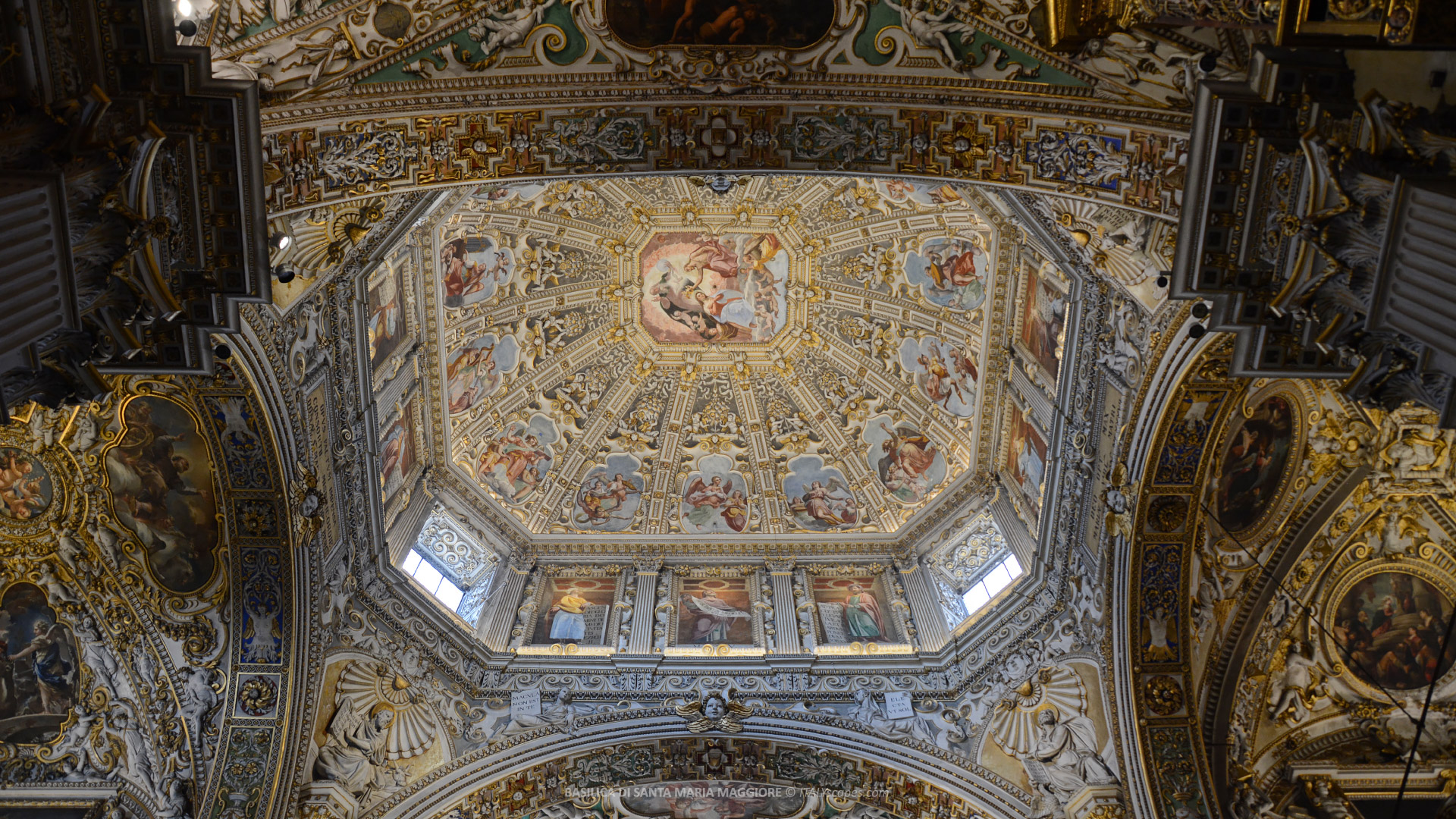
The richly decorated Baroque ceiling of Santa Maria Maggiore in Bergamo.
1:25 pm – Rocca di Bergamo and Parco delle Rimembranze
After lunch, return toward the eastern part of Città Alta and proceed to the Rocca di Bergamo, a medieval fortress situated on the hill of Sant’Eufemia. The present fortifications developed during the fourteenth century, when Bergamo was under the influence of the Visconti rulers of Milan.
The fortress is surrounded by Parco delle Rimembranze, a public green area containing memorials associated with Italian military history. Its elevated position provides views over Città Alta, the Venetian Walls, and the Lower Town. The park can be visited independently of the museum housed within the fortress.
Spend approximately thirty to forty minutes exploring the park and exterior fortifications. The museum’s availability can vary because of temporary closures and restoration work, so this Bergamo itinerary does not depend on entering the exhibition spaces. Afterwards, return west toward Piazza della Cittadella.
2:10 pm – Piazza della Cittadella and Colle Aperto
Continue through the historic streets toward Piazza della Cittadella, situated in the northwestern part of Città Alta. The square occupies part of a fortified complex developed under the Visconti during the fourteenth century, when Bergamo formed part of the political territories controlled by Milan.
Today, the area contains important cultural institutions, including the Civic Archaeological Museum and the Enrico Caffi Natural Sciences Museum. Their collections cover archaeological discoveries, natural history, zoology, and geology. A full museum visit requires additional time, so the Bergamo itinerary concentrates on the architecture of the historic complex.
Continue toward Colle Aperto, a small public square beside one of the historic entrances to the Upper Town. The area provides access to the Venetian Walls and the lower station of the San Vigilio funicular. Allow approximately twenty minutes before continuing toward the hill.
2:35 pm – Funicular to San Vigilio and the Castle
From Colle Aperto, take the San Vigilio Funicular, which connects the Upper Town with the hill of San Vigilio. The railway opened in 1912 and climbs through a residential landscape characterized by gardens, historic villas, and wooded slopes. The journey takes only a few minutes.
At the upper station, continue on foot toward the Castle of San Vigilio, a medieval defensive complex situated on one of the highest hills overlooking Bergamo. The castle occupies a strategic position historically used to control routes approaching the city from the surrounding valleys and countryside.
The surviving fortifications include sections of walls, towers, and accessible open spaces. From the hill, visitors can observe Città Alta from above, together with the surrounding hills and parts of the Lombard Plain. Allow approximately forty to fifty minutes for the funicular journey and exploration.
3:30 pm – The Venetian Walls of Bergamo
Return to Colle Aperto using the funicular and begin walking southeast along Viale delle Mura, which follows part of the historic Venetian defensive system. The walls were constructed during the sixteenth century, when Bergamo formed part of the Republic of Venice and occupied a strategic position near its western territorial frontier.
The fortifications extend for approximately six kilometers around Città Alta and include bastions, gates, defensive platforms, and connecting walls. Construction began in 1561 and continued for several decades, requiring substantial modifications to the existing urban fabric and the demolition of numerous earlier buildings.
In 2017, the Venetian Walls of Bergamo became part of the UNESCO World Heritage Site Venetian Works of Defence between the 16th and 17th Centuries. The itinerary follows an accessible section of the walls, offering views over Città Bassa and the surrounding landscape.

Porta San Giacomo, one of the historic gateways to Bergamo Alta.
4:15 pm – Porta San Giacomo and the Descent to Città Bassa
Continue along Viale delle Mura until reaching Porta San Giacomo, one of the four principal gateways incorporated into the Venetian fortifications. Completed during the sixteenth century, the gate is distinguished by its pale stone façade and position above the steep road connecting the Upper and Lower Towns.
The gateway features architectural elements characteristic of the Renaissance, including a symmetrical composition and a monumental central passage. Its exterior is faced with white Zandobbio marble, giving it a distinctive appearance against the surrounding stone walls and the green slopes beneath the Upper Town.
From Porta San Giacomo, descend along the historic pedestrian route toward Via Sant’Alessandro. The pathway provides additional views of the fortifications before entering the lower districts. Allow approximately twenty to thirty minutes for the descent, particularly if stopping to take photographs along the way.
4:50 pm – Return to Bergamo Railway Station
Continue along Via Sant’Alessandro toward the commercial center of Città Bassa, then follow Via XX Settembre in the direction of Largo Porta Nuova. The street is one of the principal shopping areas in Bergamo and contains numerous retail premises, cafés, and buildings dating from different periods.
From Porta Nuova, follow Viale Papa Giovanni XXIII south toward Bergamo. The final section of the Bergamo itinerary takes approximately fifteen minutes on foot, returning visitors to the same railway station where the day began. The overall schedule allows arrival at approximately 5:15-5:30 pm.
Visitors who prefer to reduce the final walking distance can use ATB urban buses, subject to the available routes and schedules. However, the return route is relatively flat and does not require additional transport. The complete Bergamo itinerary combines the Lower Town, principal monuments of Città Alta, and the surrounding fortifications.
Best Route Summary for First-Time Visitors
The recommended Bergamo itinerary begins at the railway station and continues through Porta Nuova, the Sentierone, and the Lower Town funicular. In Città Alta, the principal morning stops are Via Gombito, Piazza Vecchia, the Campanone, Bergamo Cathedral, Santa Maria Maggiore, and the Cappella Colleoni.
After lunch, the route continues to the Rocca, Piazza della Cittadella, Colle Aperto, and San Vigilio Castle. The final section follows the Venetian Walls to Porta San Giacomo before descending through Via Sant’Alessandro and returning to the railway station via the commercial center of Città Bassa.
The itinerary involves approximately six to eight kilometers of walking, depending on individual detours and the exact route followed within the historic center. Comfortable footwear is recommended because several streets are paved with cobblestones, while access to certain monuments involves stairs and uneven surfaces.
What to Skip With Only One Day
A complete exploration of Bergamo’s museums requires more than one day. Visitors following this Bergamo itinerary should generally skip extensive visits to the Accademia Carrara, GAMeC, the Civic Archaeological Museum, and the Natural Sciences Museum unless they are willing to reduce the number of outdoor stops.
Other attractions outside the central route include the Monastery of Astino, the historic district of Borgo Pignolo, and the former convent complex of San Francesco. These locations are worth exploring on a longer visit but require additional walking or public transport connections beyond the main itinerary.
If time is limited, prioritize Piazza Vecchia, Piazza Duomo, and the Venetian Walls. The visit to San Vigilio Castle can be shortened or omitted, saving approximately one hour. Alternatively, visitors particularly interested in religious architecture can allocate more time to the cathedral complex and omit the Rocca.
Food and Rest Strategy
The most convenient place for lunch is Via Bartolomeo Colleoni and its surrounding streets, situated close to the major religious monuments. Restaurants generally offer regional Italian dishes, while bakeries and cafés provide quicker alternatives. A lunch break of approximately one hour is compatible with the afternoon schedule.
For an additional refreshment stop, visitors can choose a café near Piazza Vecchia or Colle Aperto. Bergamo is known for polenta e osei, a traditional dessert made with sponge cake, buttercream, and marzipan, decorated to resemble a savory regional dish traditionally prepared with polenta and small birds.
Carry drinking water during warmer months, particularly when walking along the fortifications. The itinerary includes several outdoor sections exposed to direct sunlight. Visitors should also consider that public seating and shaded areas are not equally distributed throughout the Upper Town, particularly along the more exposed stretches of the Venetian Walls.
Best Time to Follow This Bergamo Itinerary
The most comfortable periods for this one-day Bergamo itinerary are generally April to June and September to October, when temperatures are usually suitable for walking. Spring and autumn also provide favorable conditions for exploring the Venetian Walls and the elevated viewpoints around San Vigilio.
Summer temperatures can be high, especially during the afternoon, while winter brings shorter daylight hours. Between November and February, visitors should consider moving the outdoor panoramic stops earlier in the day if they wish to explore the walls and castle before sunset.
Tuesday through Saturday provides the most reliable arrangement for the morning religious visits, although religious services, holidays, and exceptional closures can affect access. The Campanone, museums, and individual churches operate separate schedules, making it advisable to confirm opening hours shortly before departure.
Final Advice for One Day in Bergamo
A successful Bergamo itinerary requires careful attention to the opening hours of Cappella Colleoni, Santa Maria Maggiore, and Bergamo Cathedral. Visiting these monuments before lunch allows the afternoon to remain flexible, with fewer restrictions on access to outdoor attractions and panoramic viewpoints.
The route can be completed without a car, using the city’s two historic funiculars and walking between the main attractions. Beginning and ending at Bergamo railway station makes the itinerary suitable for a day trip from Milan, Brescia, or other Lombard destinations with direct railway connections.
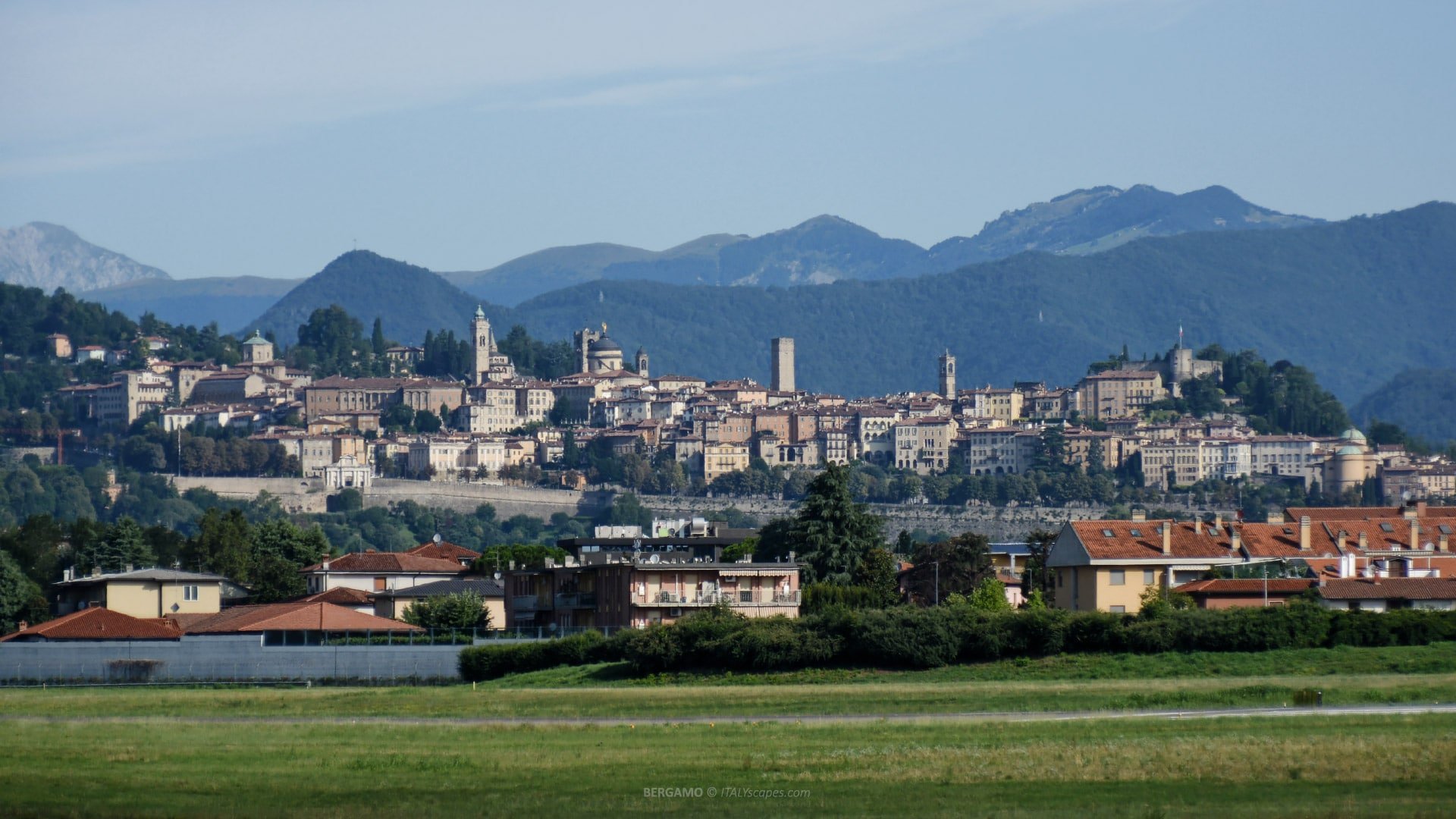
Panoramic view of Bergamo Alta and the Venetian Walls.
Frequently Asked Questions About a One-Day Bergamo Itinerary
Is one day enough to visit Bergamo?
Yes. One day is sufficient to explore Città Alta, its principal monuments, the Venetian Walls, and selected attractions in Città Bassa.
How many kilometers do you walk during this Bergamo itinerary?
The route involves approximately six to eight kilometers of walking, depending on optional detours, the selected pathways, and individual visits.
Can I visit Bergamo without taking the funicular?
Yes. Città Alta can be reached on foot or by ATB Line 1. Walking uphill requires more physical effort and additional time.
Are the Venetian Walls of Bergamo free to visit?
Yes. Walking along the public sections of the Venetian Walls is free, although specific museums and underground defensive structures may require tickets.
Is the Colleoni Chapel free to enter?
Admission is normally free, with donations encouraged. The chapel has restricted visiting hours, and photography is not permitted inside.
Can I visit San Vigilio Castle in one day?
Yes. The San Vigilio funicular provides convenient access to the hill, allowing visitors to explore the castle grounds and panoramic viewpoints.
What traditional food should I try in Bergamo?
Popular local specialties include casoncelli alla bergamasca, polenta taragna, polenta e osei, and stracciatella gelato, which originated in Bergamo.
How do I get to Bergamo from Milan?
Regional trains connect Milan with Bergamo, generally taking approximately 50-60 minutes from Milano Centrale. Journey times depend on the selected service.