-
About
Table of Contents
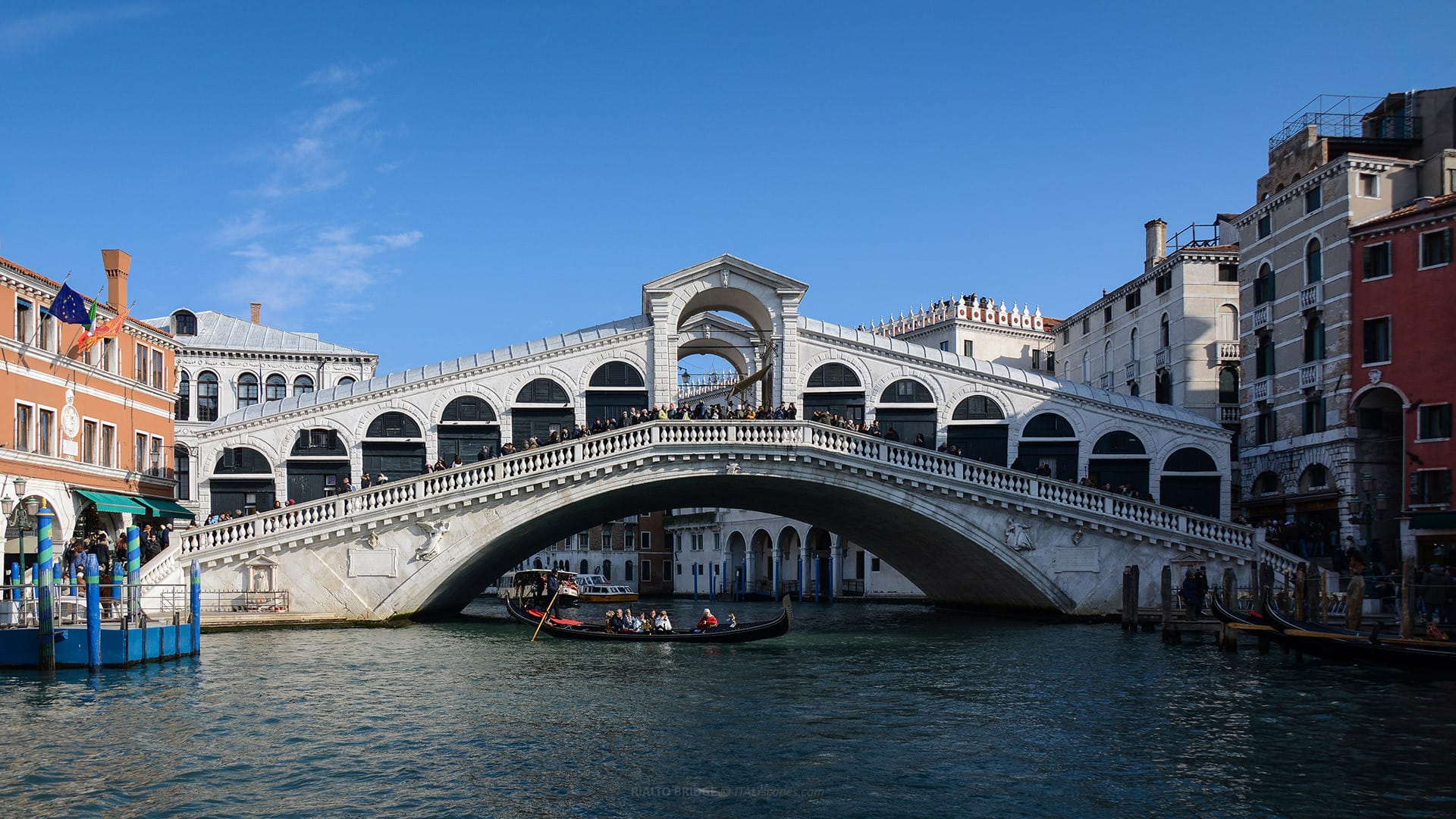
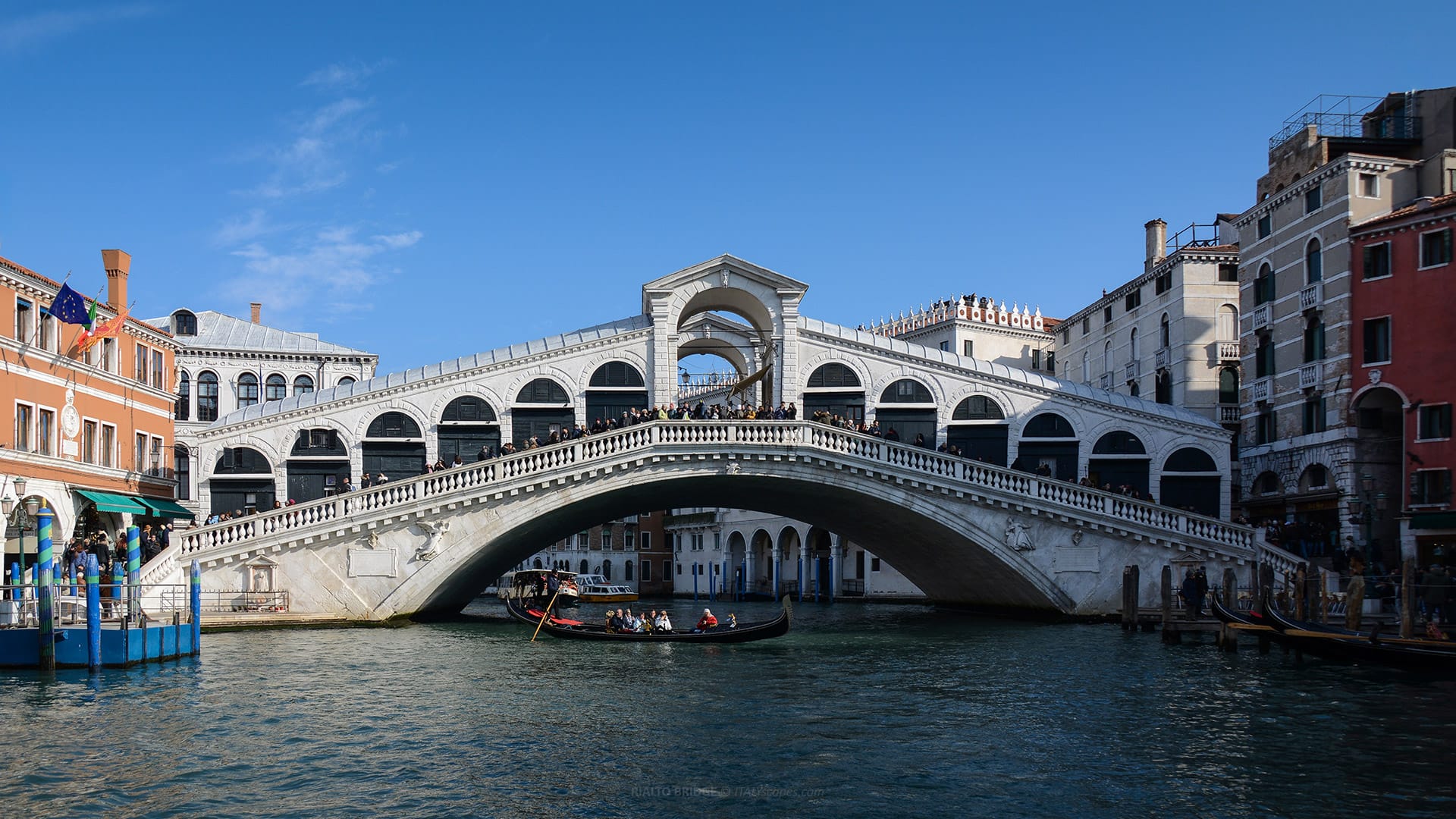
The Rialto Bridge (Ponte di Rialto) is one of those landmarks that instantly says “Venice”. Arching over the narrowest point of the Grand Canal, it links the historic trading district of Rialto with the elegant heart of San Marco and has done so for centuries.
Today, crowds still pour across it from dawn to late evening, photographing the view, browsing the tiny shops on top and watching gondolas and vaporetti glide underneath.
This stone arch bridge is the oldest bridge over the Grand Canal and a symbol of the city’s commercial power during the days of the Venetian Republic. Its story mixes engineering daring, artistic refinement and daily market life, which is why understanding the Rialto Bridge means understanding Venice itself.
Short History of the Rialto Bridge (Ponte di Rialto)
Long before the present stone bridge was built, Venetians needed a dry crossing over the Grand Canal to reach the busy markets on its eastern bank.
The first known structure here was a pontoon bridge, Ponte della Moneta, built in the late 12th century, probably around 1181, near the medieval mint that gave it its name.
From floating to wooden bridge
As the Rialto district became the city’s commercial heart, traffic increased dramatically.
The floating bridge was eventually replaced in 1255 by a wooden drawbridge with two inclined ramps meeting at a central movable section. This could be raised to let tall masted ships pass along the Grand Canal, while still allowing pedestrians to cross.
By the 1400s, the wooden bridge had become more than a simple crossing. Rows of shops lined both sides of the bridge, and the rent paid by merchants helped cover its maintenance. This commercial role made the bridge central to daily life in Venice.
However, wood, heavy traffic, and large crowds proved dangerous over time. The bridge partially burned during Bajamonte Tiepolo’s revolt in 1310, collapsed in 1444 during the Marquis of Ferrara’s wedding procession, and collapsed again in 1524, showing the need for a stronger structure.
Despite these accidents, the location remained non-negotiable: this was the only crossing for centuries and the quickest link between Venice’s banking, trading and political centers.
The dream of a stone bridge
As early as 1503, the idea of rebuilding the bridge in stone was officially raised, and throughout the 16th century the Venetian authorities evaluated various proposals.
Some of the most famous Renaissance architects – Jacopo Sansovino, Andrea Palladio, Vignola, even Michelangelo – were considered. Their designs typically featured multiple classical arches, elegant but not well suited to the tight, heavily trafficked Rialto crossing.
In the end, the commission went to a relatively less famous but very experienced local engineer, Antonio da Ponte. His design took inspiration from the earlier wooden structure, but reimagined it as a single massive stone arch with shops on top and broad steps for pedestrians.
Construction finally began in 1588 and finished just three years later, in 1591. At the time, many contemporaries saw the project as risky and audacious. The critic and architect Vincenzo Scamozzi famously predicted that the bridge would collapse under its own weight.
Instead, the Rialto Bridge has stood for over four centuries, surviving floods, heavy use and the constant vibration of modern boat traffic.
From trade artery to global icon
For centuries, the Rialto Bridge was the only permanent bridge over the Grand Canal, making it indispensable for merchants, bankers and ordinary Venetians.
The surrounding markets – especially the famous Rialto fish and produce market – turned the area into a noisy, colorful hub where goods from across the Mediterranean changed hands every day.
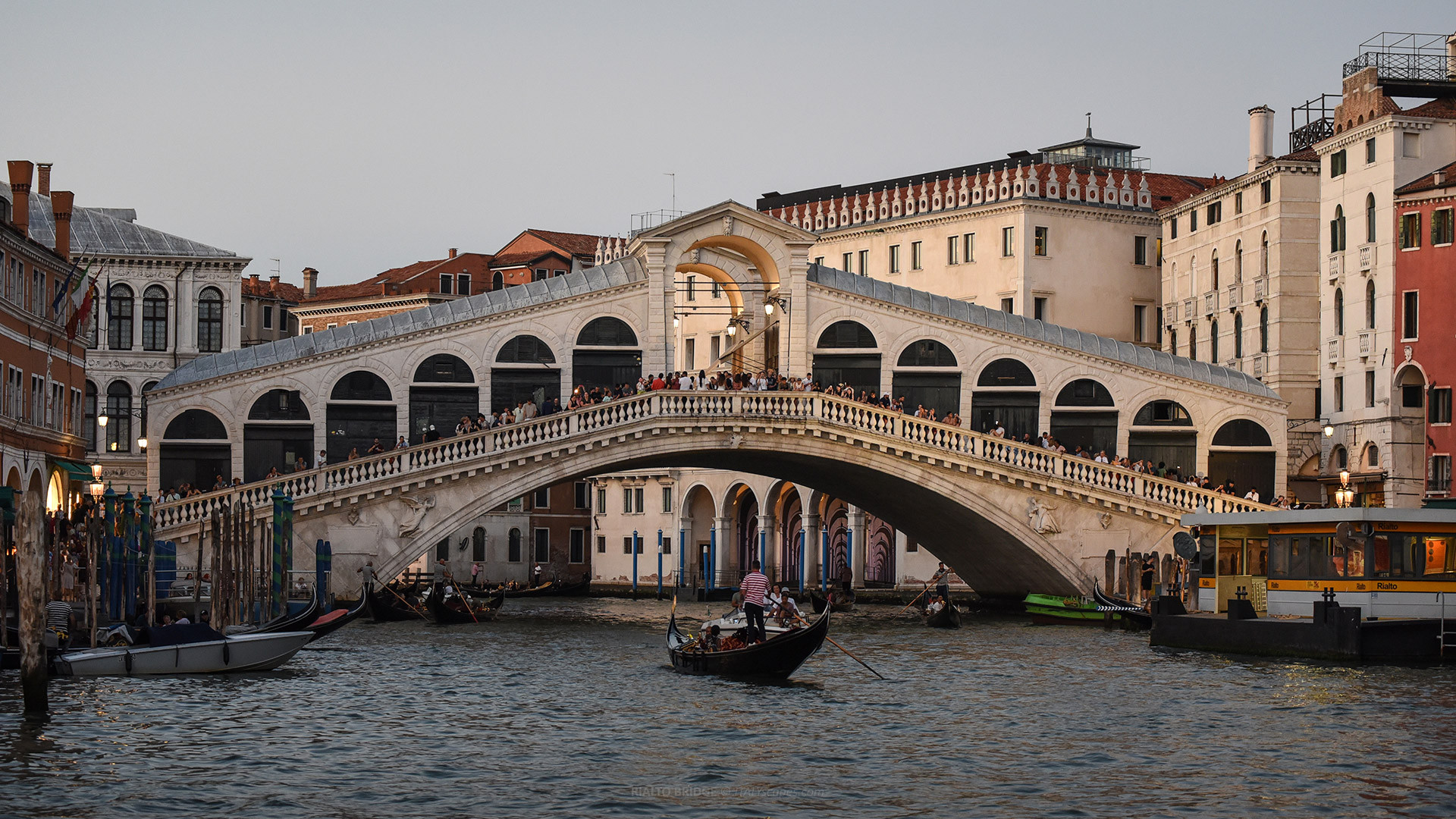
Today, while trade has shifted elsewhere, the bridge remains a vital pedestrian route and one of Venice’s most photographed sights, especially at sunrise and sunset, when the light washes the Grand Canal in gold.
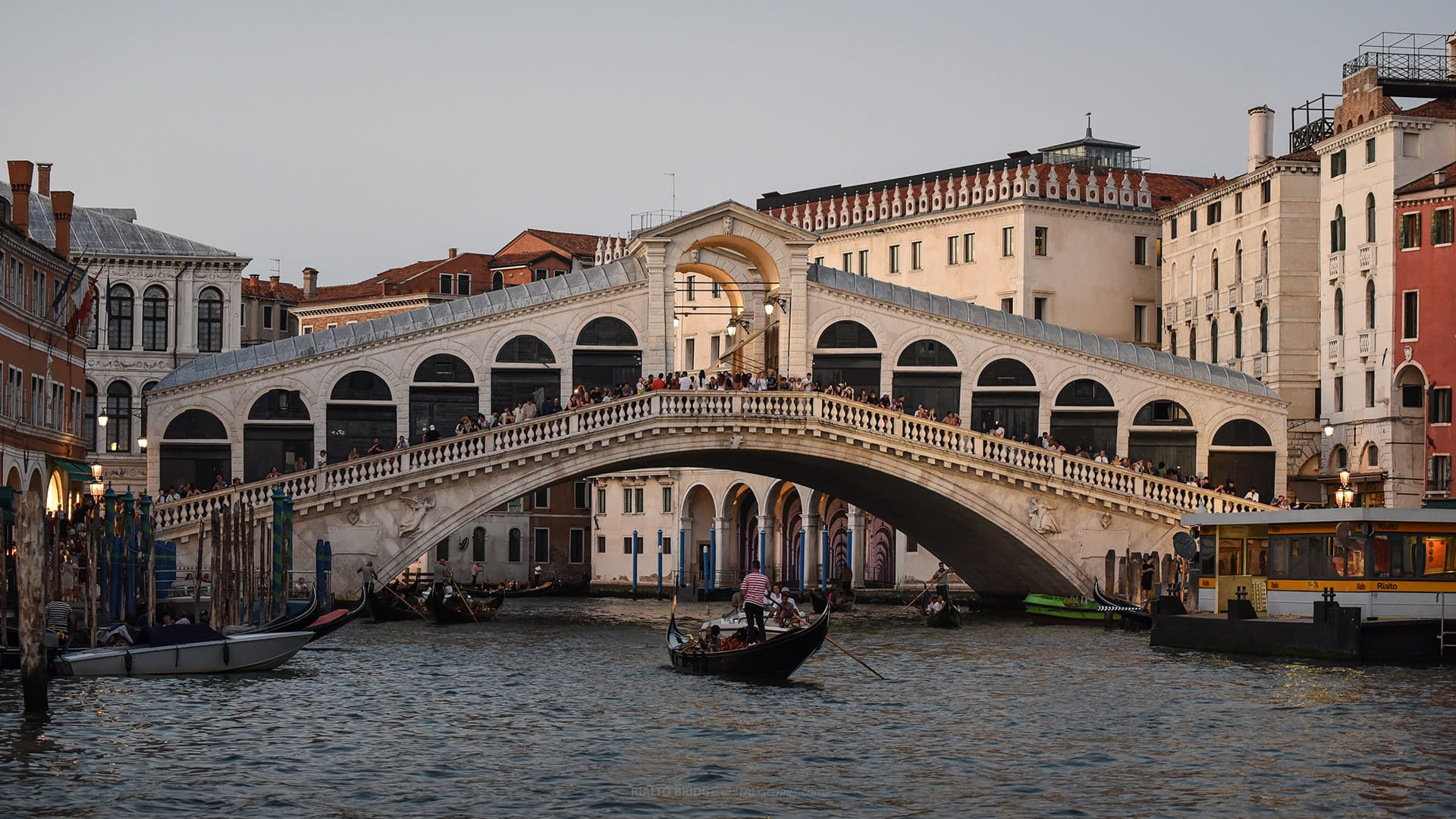
Rialto Bridge at sunset
Architecture of the Rialto Bridge (Ponte di Rialto)
From a distance, the bridge looks elegantly simple: one big white arch curving over the Grand Canal, flanked by historic palazzi. Up close, you notice how carefully engineered and richly detailed Ponte di Rialto really is.
Structure and dimensions
The present bridge is a single-span stone arch supporting a wide rectangular deck crossed by three stairways. Key measurements, which vary slightly by source, but are broadly consistent, include:
- Length: about 48 metres (157 ft);
- Width: about 22 metres (72 ft);
- Height of the arch: around 6-7 metres (21-23 ft) above the water.
The arch itself had to leap a relatively wide canal without intermediate supports. To distribute the enormous weight of the stone, some 6,000 wooden piles were driven under each abutment, for a total of about 12,000 foundation piles hidden beneath the waterline.These piles, driven deep into the lagoon’s alluvial soil, have helped keep the bridge stable for centuries.
Layout and pedestrian experience
The deck of the bridge is divided into three stepped walkways: a central staircase running over the arch, and two outer staircases closer to the balustrades, offering open views over the Grand Canal.
Between the stairways are two rows of small shops, often selling jewelry, Murano glass, souvenirs and leather goods. These “inhabited” bridges – structures that function as both bridge and shopping street – were once more common in Europe, but few examples survive today, making Ponte di Rialto especially distinctive.
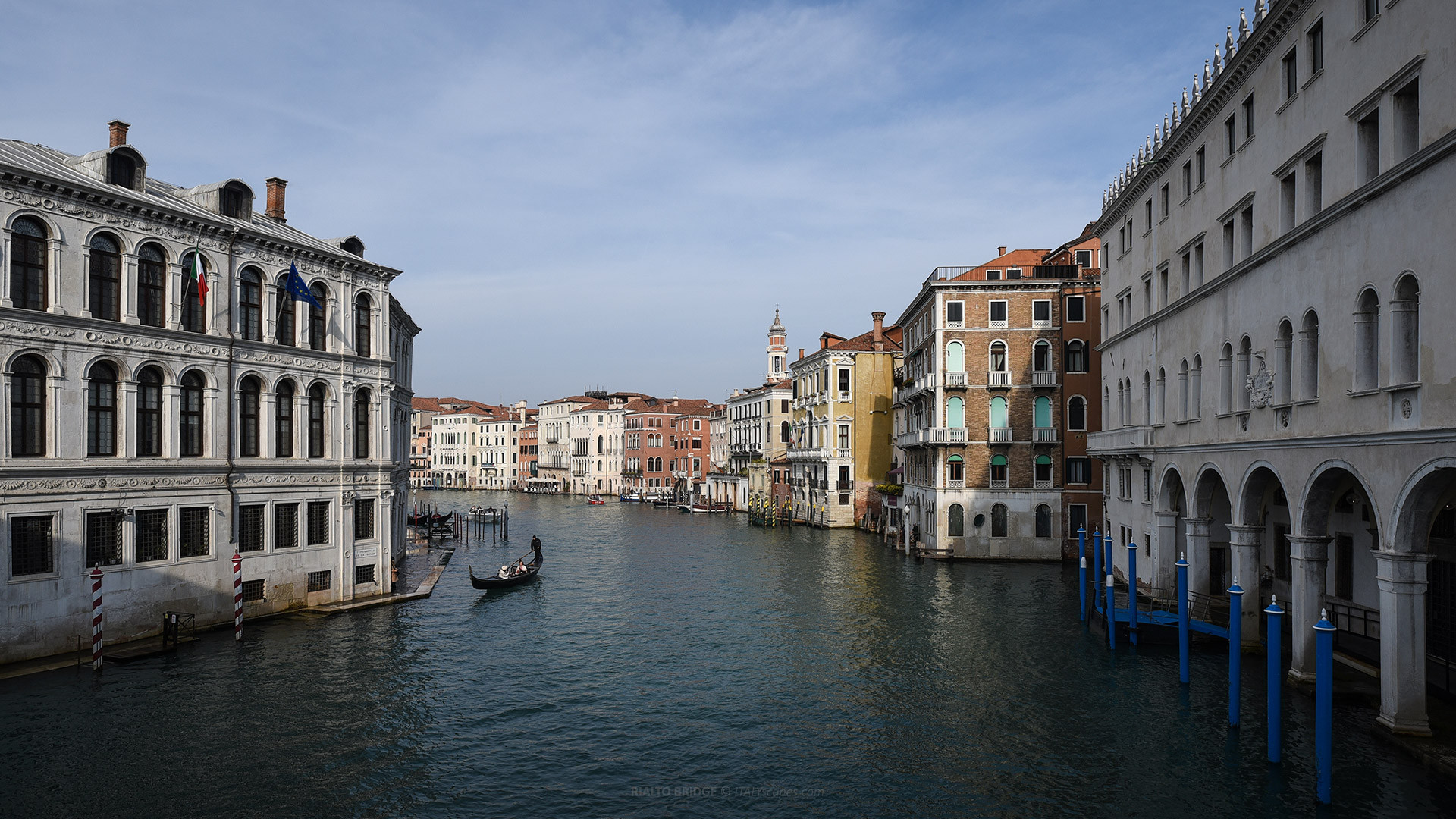
As you climb, the central portico frames a classic postcard view: palaces lining the Grand Canal, gondolas gliding below and the bustle of markets on the San Polo side.
Materials and style
The bridge is built primarily in Istrian stone, a dense, pale limestone quarried in the Adriatic that resists salt and water – ideal for Venetian architecture. The design belongs to the late Renaissance, but it is more functional than flamboyant.
Instead of a forest of columns or decorative arches, Antonio da Ponte opted for a single strong arch to keep the canal open for traffic, clean, geometric balustrades, and modest but expressive relief sculptures near the bases.
The result is a structure that looks both solid and graceful: practical for commerce and movement, yet refined enough to become a symbol of Venice.
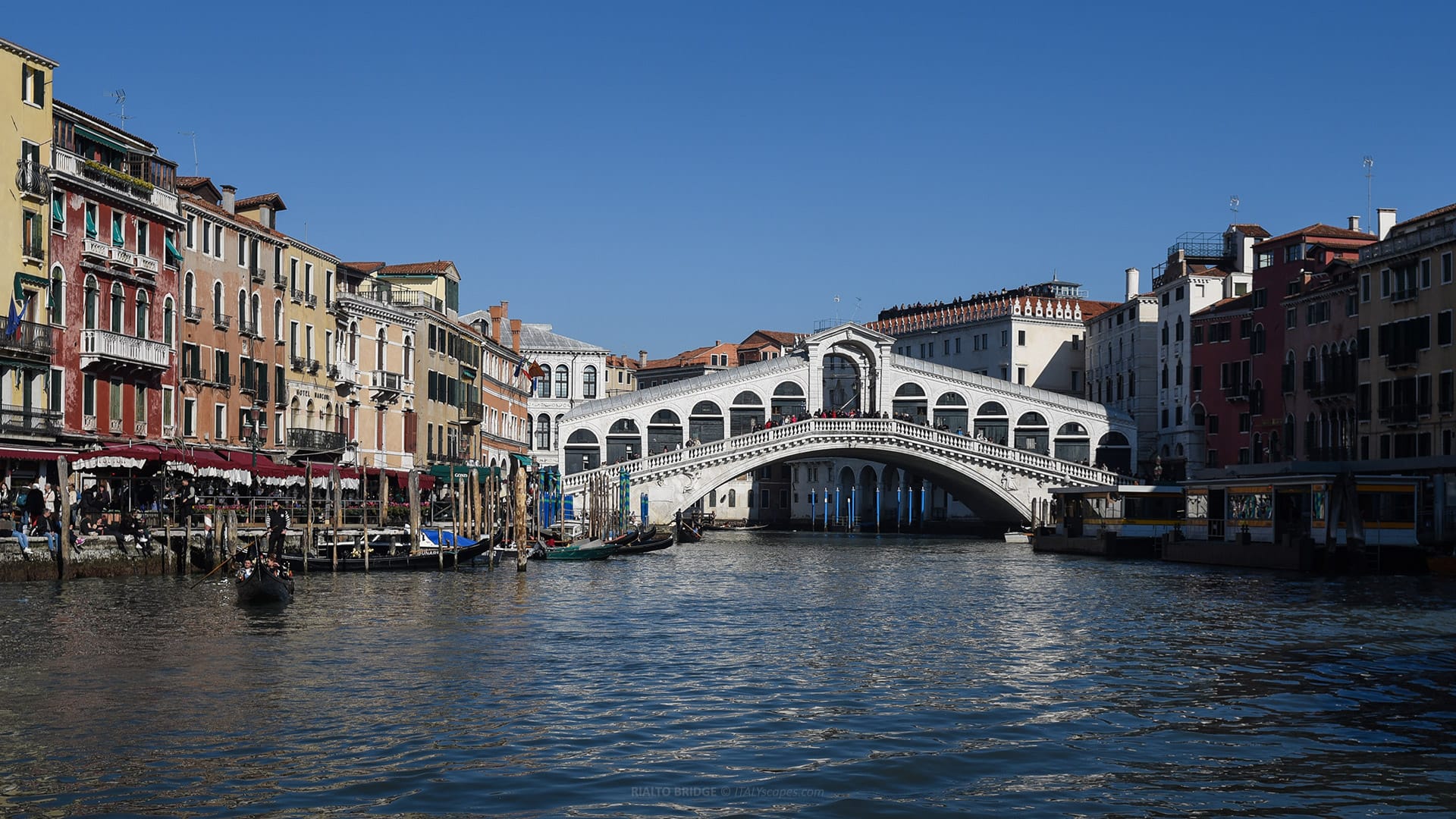
Art of the Rialto Bridge (Ponte di Rialto)
The Rialto Bridge isn’t just an engineering work; it is also an artistic landmark, decorated with religious reliefs and immortalised in some of the most famous paintings of Venice.
Sculptures and reliefs on the bridge
On the south side of Ponte di Rialto, you can see bas-reliefs attributed to Agostino Rubini depicting the Annunciation: the Archangel Gabriel, the dove of the Holy Spirit and the Virgin Mary.
This subject is deeply symbolic in Venice. According to a long-standing local legend, the city was founded on 25 March 421, the feast day of the Annunciation.
On the north side, two other reliefs show Saint Mark, patron saint of Venice, and Saint Theodore (San Todaro), an earlier warrior patron of the city and legendary dragon-slayer.
These sculptures, attributed to Tiziano Aspetti, connect the bridge visually and symbolically with the religious and political identity of the Venetian Republic.
The Rialto Bridge in Renaissance painting
Because the Rialto Bridge area was the city’s commercial heart, artists were naturally drawn to it. One of the most important early depictions is The Miracle of the Relic of the Cross at the Ponte di Rialto (c. 1496) by Vittore Carpaccio.
This large tempera painting, now in the Gallerie dell’Accademia in Venice, shows a religious miracle taking place near the earlier wooden Rialto Bridge, which appears crowded with people and lined with shops.
Canaletto, Guardi and the great vedute
In the 18th century, Venice became a must-see destination for aristocratic travellers on the Grand Tour, and demand grew for souvenir paintings of the city. The Rialto Bridge was an obvious star.
Canaletto (Giovanni Antonio Canal) painted numerous views of the Rialto Bridge from both north and south. Works such as The Rialto Bridge from the North and Grand Canal with the Rialto Bridge, Venice show the bridge in crisp light, with precise architectural detail that appealed to British collectors.
Francesco Guardi, slightly later, offered a more atmospheric style in paintings like The Grand Canal with the Rialto Bridge from the South, where flickering brushstrokes and silvery light capture the movement of water and crowds rather than every stone.
These vedute fixed the image of the Rialto Bridge in the European imagination: a bustling yet harmonious stage where commerce, architecture and everyday life intersect.
Turner and Romantic visions of the Rialto
In the 19th century, the British painter J. M. W. Turner visited Venice multiple times and was entranced by the Grand Canal and the Rialto Bridge.
He produced watercolours such as The Rialto, Venice, The Grand Canal, Venice, with the Rialto Bridge to the East and the vignette Venice (The Rialto – Moonlight), whose shimmering light and blurred forms mark a clear shift towards Romanticism.
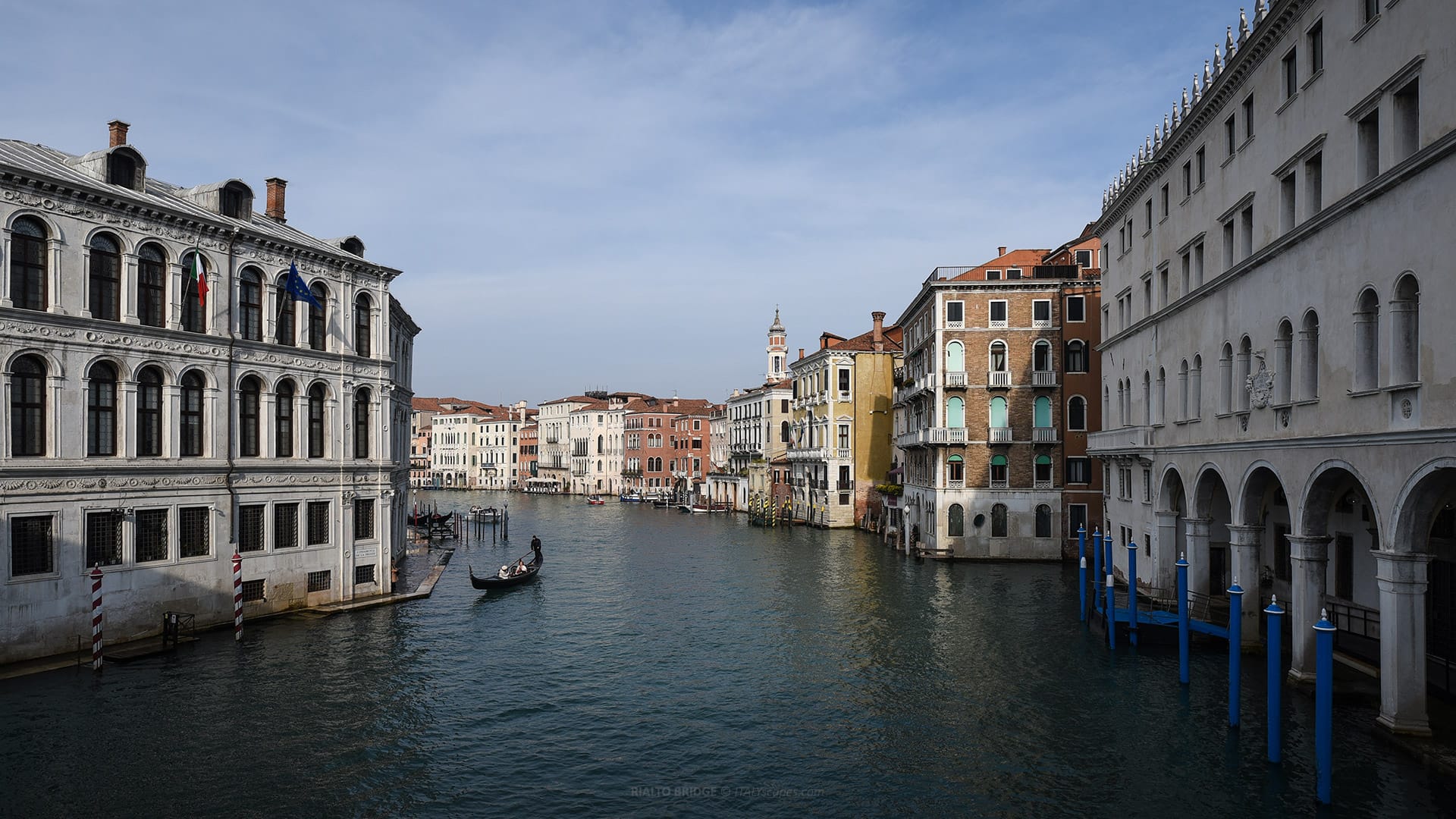
View from the Rialto Bridge
How to Get to the Rialto Bridge (Ponte di Rialto)
Reaching the Rialto Bridge is straightforward whether you prefer to walk from Venezia Santa Lucia railway station or take a vaporetto (waterbus). Below are the main options and the approximate routes.
Getting to Ponte di Rialto on foot from Venezia Santa Lucia
Venice is a city built for walking, and one of the classic first walks is from Venezia Santa Lucia to the Rialto Bridge. Depending on crowds and your pace, it usually takes about 20-30 minutes to cover roughly 1.5-1.8 km.
The most straightforward route follows Strada Nova, a broad pedestrian artery that connects the station area to Rialto and the Santi Apostoli district. From Santi Apostoli, continue following the “per Rialto” arrows through narrower calli (alleys) and over several small bridges.
You’ll eventually emerge into Campo San Bortolomio, just beside the Rialto Bridge, with the Fondaco dei Tedeschi building and the start of the bridge right in front of you.
Getting to the Rialto Bridge by vaporetto
If you prefer to arrive at the Rialto Bridge by water along the Grand Canal, or you have heavy bags, the vaporetto is a great option.
Right outside Venezia Santa Lucia station you’ll find several ACTV waterbus stops labeled Ferrovia. From here you can take Line 1 or Line 2 towards Rialto and San Marco.
Fastest option: Line 2 – The Line 2 ferry from Ferrovia to Rialto takes about 12 minutes, with boats departing approximately every 15 minutes.
Scenic option: Line 1 – The Line 1 is slower, stopping at nearly every station along the Grand Canal (Riva de Biasio, San Marcuola, San Stae, Ca’ d’Oro, etc.) before reaching Rialto.
It’s perfect if you want to enjoy a mini-cruise and see a sequence of palaces from the water.
Frequently Asked Questions about the Rialto Bridge (Ponte di Rialto)
Why is the Rialto Bridge so famous?
Rialto Bridge is famous because it is the oldest bridge across the Grand Canal and one of the strongest symbols of Venice. For centuries, it connected the busy commercial areas of San Marco and San Polo.
When was Ponte di Rialto built?
The current stone Ponte di Rialto was built between 1588 and 1591, replacing earlier wooden bridges that had crossed the Grand Canal in the same area. Its architect was Antonio da Ponte.
What is special about the design of the Rialto Bridge?
Rialto Bridge is special because of its single stone arch, wide central passage, two side walkways, and rows of shops built directly on the bridge.
Can you walk across Ponte di Rialto?
Yes, visitors can walk across Ponte di Rialto for free at any time of day. The bridge is one of the busiest pedestrian routes in Venice, so it is often crowded, especially around midday.
What can you see from the Rialto Bridge?
From Ponte di Rialto, visitors can enjoy one of the classic views of the Grand Canal, with gondolas, vaporetti, historic palaces, and constant movement on the water. The view is especially atmospheric at sunrise, sunset, or in the evening.
Sources: -
Photos
-
Map
-
Reviews