


-
About
Table of Contents
Buy tickets & tours:GetYourGuideSt Mark’s Basilica (Basilica di San Marco) is the cathedral of Venice and one of the most famous religious monuments in Italy. It stands in Piazza San Marco, in the sestiere of San Marco, beside the Doge’s Palace and close to the lagoon-facing Piazzetta.
The Basilica is dedicated to Saint Mark the Evangelist, whose relics are traditionally believed to have been brought to Venice from Alexandria in the 9th century. Its position, decoration and ceremonial role made it one of the main symbols of the Venetian Republic.
For centuries, St Mark’s Basilica was not the official cathedral of Venice, but the palatine chapel of the Doge. It served the political and religious life of the Venetian state, hosting major ceremonies, processions and solemn events connected to the government of the Republic.
Today, Basilica di San Marco is admired for its Byzantine architecture, five domes, golden mosaics, marble decoration, bronze horses, precious treasury and the famous Pala d’Oro. It is one of the essential landmarks for understanding the history, art and identity of Venice.
Mark the Evangelist
Mark the Evangelist is one of the four Evangelists of Christian tradition and is traditionally associated with the Gospel of Mark. His symbol is the winged lion, which became the emblem of Venice and appeared on flags, columns, seals, coins and official buildings of the Republic.
According to Venetian tradition, the relics of Saint Mark were taken from Alexandria, Egypt, by two Venetian merchants in the 9th century. The arrival of these relics gave Venice a powerful patron saint and strengthened the religious prestige of the young maritime city.
Before Saint Mark became the main patron of Venice, the city was closely associated with Saint Theodore, a Byzantine military saint. The replacement of Theodore by Mark reflected Venice’s growing independence and its desire to develop a stronger civic and religious identity.
The lion of Saint Mark became one of the most recognizable symbols in Europe. It represented the Evangelist, but also Venice itself. The winged lion could hold an open book in times of peace or a sword in periods associated with war and defence.
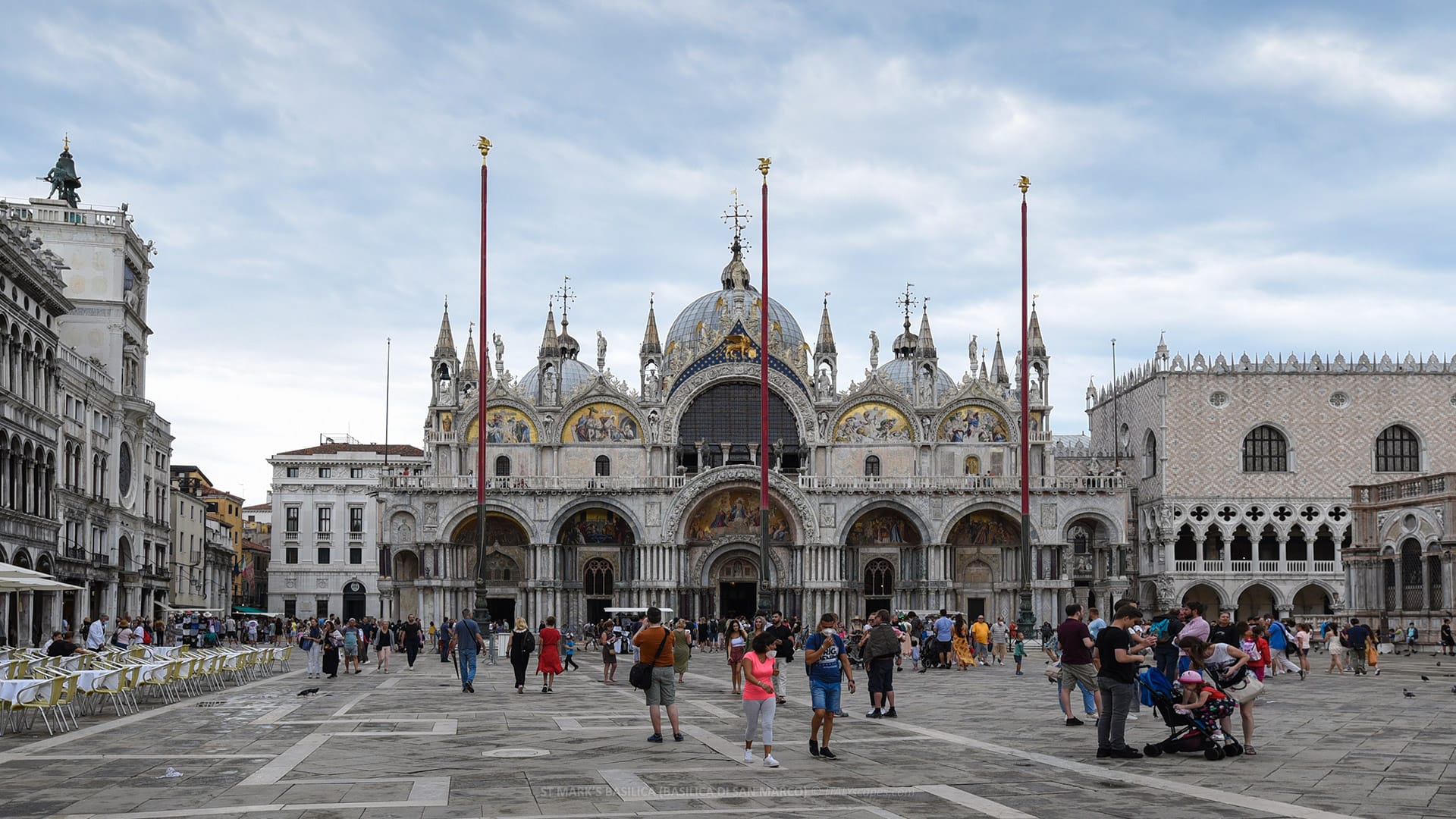
Short History of St Mark’s Basilica (Basilica di San Marco)
The First Church and the Relics of Saint Mark
The first church dedicated to Saint Mark was built in 828, during the rule of Doge Giustiniano Partecipazio. It was constructed beside the Doge’s Palace to house the relics of the Evangelist, which Venetian tradition says had been brought from Alexandria.
This first sanctuary was not originally the cathedral of Venice. It functioned as a ducal chapel, directly connected to the Doge and the political centre of the city. The official cathedral was still the Church of San Pietro di Castello, in the Castello district.
The church replaced the earlier importance of the Chapel of Saint Theodore, Venice’s previous patron. The church dedicated to Saint Mark was consecrated in 832.
Fire, Rebuilding and the 11th-Century Basilica
In 976, during the revolt against Doge Pietro IV Candiano, a fire damaged the ducal complex and destroyed the Church of Saint Mark. The event was one of the major crises of early medieval Venice and required a substantial reconstruction of the sacred building.
The church was rebuilt in 978 under Doge Pietro I Orseolo. This second church restored the cult of Saint Mark and maintained the close connection between the sanctuary, the Doge’s Palace and the political authority of the Venetian state.
The current Basilica was begun in 1063, under Doge Domenico Contarini. The project continued under later doges, including Domenico Selvo and Vitale Falier. The St Mark’s Basilica was consecrated in 1094.
Medieval Decoration and Expansion
By the end of the 12th century, the mosaic decoration had become one of the defining features of the Basilica. The use of gold tesserae created a special visual effect, especially when the interior was illuminated by candles or filtered daylight.
The narthex, or atrium, was added mainly in the first half of the 13th century. It surrounds the western arm of the church and creates a transitional space between Piazza San Marco and the sacred interior of the Basilica.
Also in the 13th century, the external profile of the Basilica changed with the elevation of the domes. The raised outer domes made the building more visible from the square and helped create the famous silhouette of Basilica di San Marco.
Later Additions and Completion
The external decoration of the Basilica continued for centuries. The façades were enriched with marble, columns, arches, reliefs, pinnacles, mosaics and sculptural fragments. Many of these elements came from different periods and regions, giving the building its layered appearance.
The upper parts of the façades were largely completed in the 15th century. By that time, the Basilica had become a complex monument, combining Byzantine forms, Romanesque structures, Gothic details and the decorative taste of medieval and Renaissance Venice.
The Baptistery, the Chapel of Sant’Isidoro, the Sacristy and the Zen Chapel were built or completed between the late Middle Ages and the early Renaissance. These additions expanded the devotional and liturgical spaces of the Basilica.
In 1617, with the arrangement of two internal altars, the Basilica reached a more complete form. In 1807, during the Napoleonic period, St Mark’s Basilica became the Cathedral of Venice, replacing San Pietro di Castello in that role.
Architecture of St Mark’s Basilica (Basilica di San Marco)
Dimensions and General Structure
St Mark’s Basilica measures about 76.5 meters in length and 62.6 meters in width at the transept. The central dome reaches about 43 meters in height. These dimensions make the church large, but its effect depends more on richness and balance than on vertical scale.
The Basilica has a Greek cross plan, with five domes placed over the central crossing and the four arms of the cross. This plan reflects Byzantine influence and differs from the long Latin-cross layout used in many Western medieval cathedrals.
The arms of the cross are divided into aisles by rows of columns. These aisles lead the eye toward the great piers that support the domes. The structure is built mainly in brick, but the brickwork is covered by marble, mosaics and decorative surfaces.
The Main Façade
The main façade faces Piazza San Marco and is organized on two levels. The lower level has five large portals, each framed by arches and marble decoration. These entrances lead into the atrium before visitors reach the main body of the church.
The upper level includes a terrace, blind arches and a central loggia. The famous Horses of Saint Mark stand above the main portal. The sculptures visible outside today are copies, while the original ancient horses are preserved inside the Basilica Museum.
The Five Domes
The five domes are among the most important architectural features of St Mark’s Basilica. One dome rises over the central crossing, while the other four stand over the arms of the Greek cross. Together, they create the building’s famous rounded profile.
Outside, the domes appear taller because of the external wooden and lead-covered structures added over the original masonry domes. These outer shells increased the visual impact of the Basilica and made it more visible from Piazza San Marco and the lagoon area.
The domes connect St Mark’s Basilica with the architectural traditions of the eastern Mediterranean. At the same time, their external form became unmistakably Venetian, helping make the Basilica one of the most recognizable monuments in the city.
Interior Space and Byzantine Influence
The interior of St Mark’s Basilica is deeply influenced by Byzantine church architecture. The Greek cross plan, domes, galleries, marble revetments and gold mosaics create a sacred space that recalls the artistic and religious world of Constantinople and the Eastern Roman Empire.
The interior light is relatively subdued, which makes the mosaics more dramatic. Gold tesserae reflect the available light and create a changing surface. This effect explains why the Basilica became known as the Chiesa d’Oro, or Church of Gold.
The Byzantine character of the Basilica also reflects Venice’s historical position between East and West. Venice traded with the Byzantine world, competed with it, borrowed from it and eventually brought many objects and materials from Constantinople after the Fourth Crusade.
The Presbytery and Iconostasis
The presbytery is raised above the main floor and separated from the rest of the Basilica by an iconostasis, a feature inspired by Byzantine churches. This screen marks the transition between the public area of worship and the sacred space around the high altar.
The iconostasis is formed with eight red marble columns. Above them stand a large crucifix and statues by Pier Paolo and Jacobello dalle Masegne. These sculptural elements belong to the late medieval decoration of the Basilica.
The high altar stands behind the iconostasis and is connected to the veneration of Saint Mark’s relics. Behind the high altar is the famous Pala d’Oro, a masterpiece of goldsmithing, enamel and precious stones.
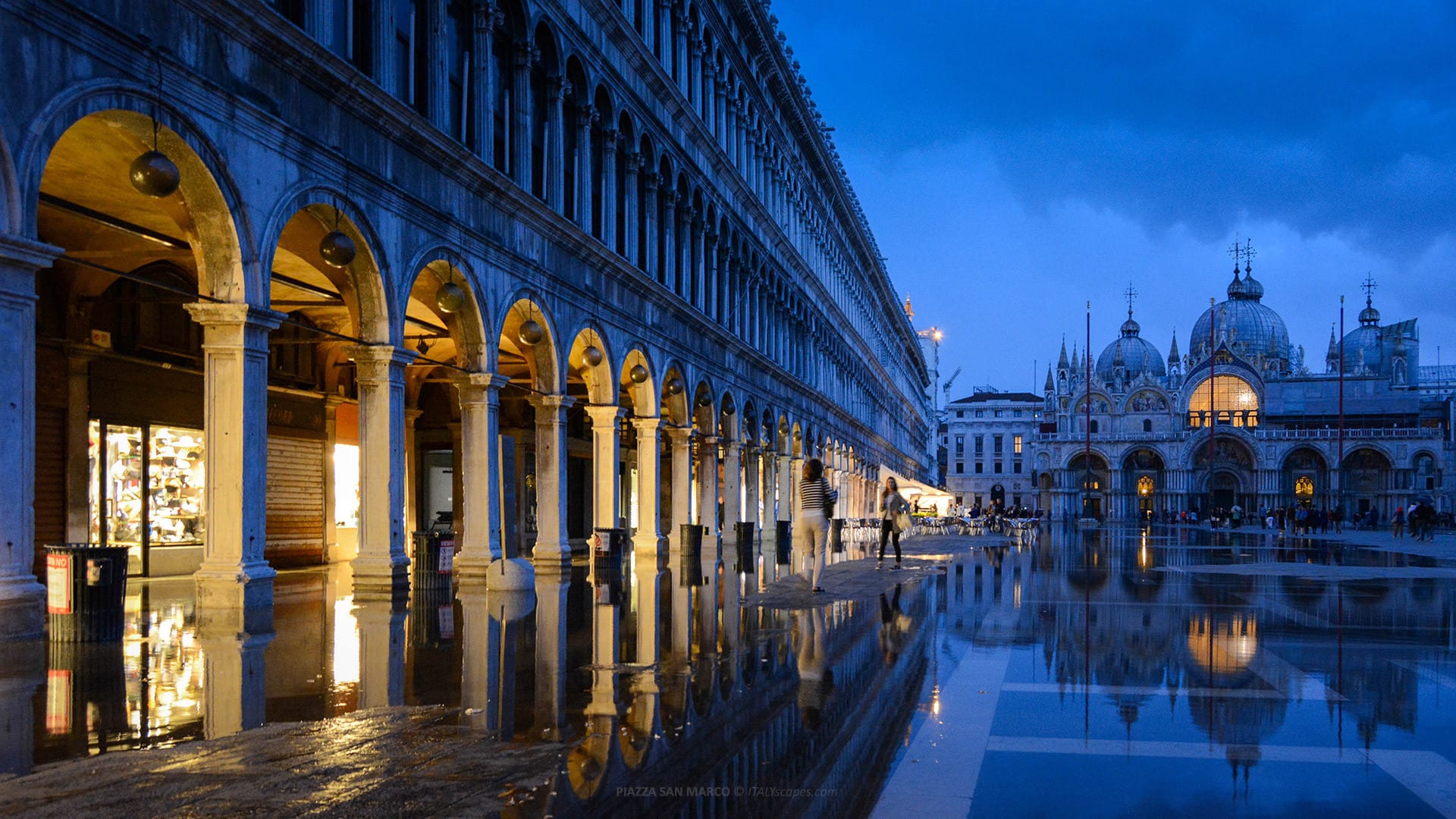
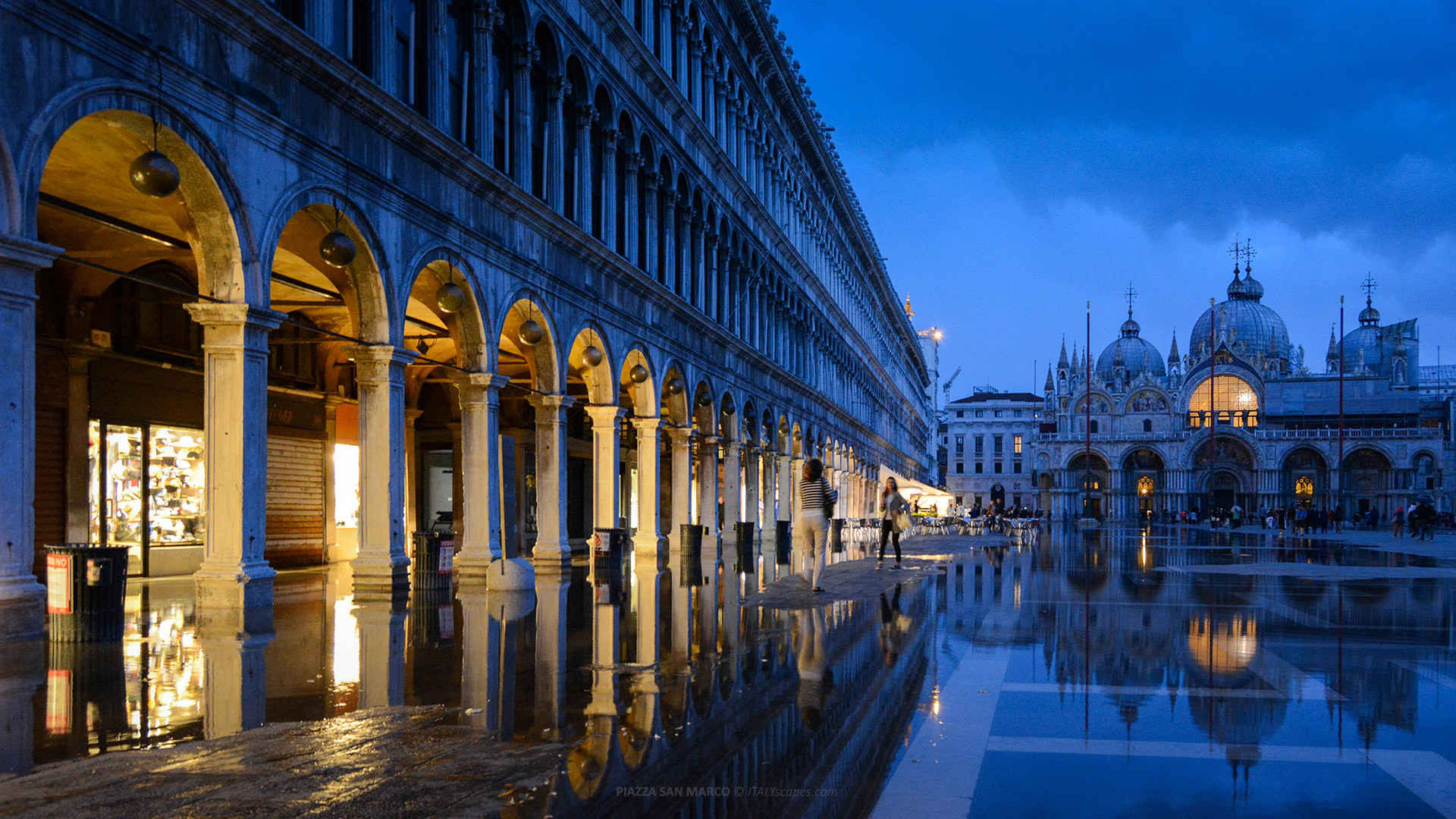
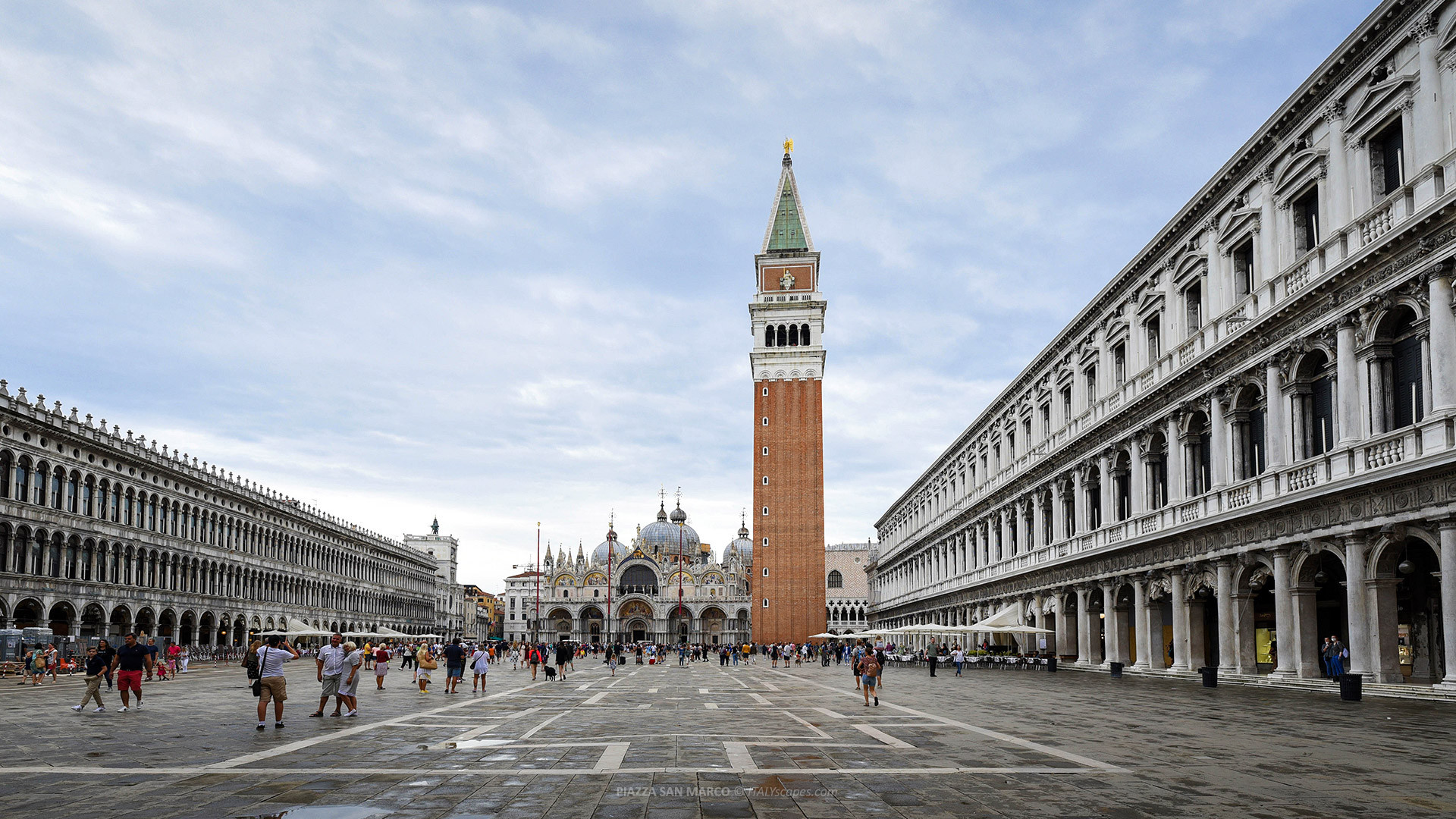
Piazza San Marco, with Basilica di San Marco in the background
Art of St Mark’s Basilica (Basilica di San Marco)
The Golden Mosaics
The mosaics are among the greatest artistic treasures of St Mark’s Basilica. They cover domes, vaults, arches and walls with religious images. Their subjects include scenes from the Old Testament, the New Testament, the life of Christ, the Virgin Mary, saints and prophets.
The mosaics were created over several centuries. Some parts preserve stronger Byzantine influence, while later sections reflect Venetian and Western artistic developments. This long chronology makes the decoration both unified and complex, because different periods coexist inside the same sacred building.
The atrium mosaics are especially important for their Old Testament scenes. They present biblical history before the visitor enters the main church. This arrangement creates a visual and spiritual progression from creation and early sacred history toward the central Christian space of the Basilica.
The Façade Mosaics
The façade mosaics originally formed an important cycle connected to the relics of Saint Mark. Most of the medieval mosaics were damaged or replaced in later centuries, especially between the 17th and 19th centuries, when several exterior images were remade.
The most important surviving medieval façade mosaic is above the Portal of Sant’Alipio, on the left side of the façade. It shows the entrance of the body of Saint Mark into the Basilica and is especially valuable because it preserves an early image of the church.
The other façade mosaics continue the story of Saint Mark and his connection with Venice. Even when remade in later periods, they kept the same basic function: to present the Basilica as the sacred home of the city’s patron saint.
Bronze Doors
The bronze doors of the Basilica belong to different periods. Porta di San Clemente, on the southern side, is Byzantine and dates to the 11th century. It is one of the most important examples of metalwork connected to the church.
The central bronze door dates to the 12th century, while several secondary doors are more recent.
The doors were not only practical entrances. They marked the passage from the public world of the square into the sacred space of the church. Their material, decoration and placement gave ceremonial importance to the act of entering the Basilica.
Sculptural Decoration
The exterior of St Mark’s Basilica includes many sculptures, reliefs, capitals and decorative fragments. These pieces come from different periods and artistic traditions. Some were made specifically for the Basilica, while others were reused from older buildings or brought from elsewhere.
One of the most famous sculptural groups is the Tetrarchs, carved in porphyry and placed near the corner of the Basilica toward the Doge’s Palace. The group represents four imperial figures embracing, and it is closely associated with late Roman imperial art.
The Basilica also contains numerous carved animals, saints, symbolic figures and ornamental details. These sculptures enrich the façades and make the exterior extremely dense. A visitor can walk around the building and discover details from different centuries.
The Horses of Saint Mark
The Horses of Saint Mark are among the most famous artworks associated with the Basilica. The four bronze horses were brought to Venice after the Fourth Crusade and the sack of Constantinople in 1204, when many precious objects reached the city.
For centuries, the horses stood on the loggia above the main portal, facing Piazza San Marco. Their position made them powerful symbols of victory, prestige and connection with the ancient and Byzantine worlds. They became inseparable from the image of the Basilica.
In 1797, Napoleon’s forces took the horses to Paris. After Napoleon’s defeat, they were returned to Venice. Today, the originals are kept inside the Basilica Museum for conservation, while copies stand outside on the façade.
The Pala d’Oro
The Pala d’Oro is one of the greatest treasures of St Mark’s Basilica. It stands behind the high altar and is made with gold, enamel and precious stones. It is one of the most important examples of medieval goldsmithing preserved in Venice.
The altarpiece was created and modified over several centuries. It includes Byzantine enamel panels and later Venetian additions. The Pala d’Oro is closely connected to the high altar and the relics of Saint Mark.
The Treasury
The Treasury of St Mark’s Basilica contains a remarkable collection of liturgical objects, reliquaries, chalices, metalwork, enamels, hardstone vessels and Byzantine pieces. Many objects are connected with the long history of Venice’s relationship with Constantinople and the eastern Mediterranean.
A significant part of the Treasury is traditionally linked to the Fourth Crusade and the capture of Constantinople in 1204. Precious objects brought to Venice became part of the religious and political memory of the Basilica.
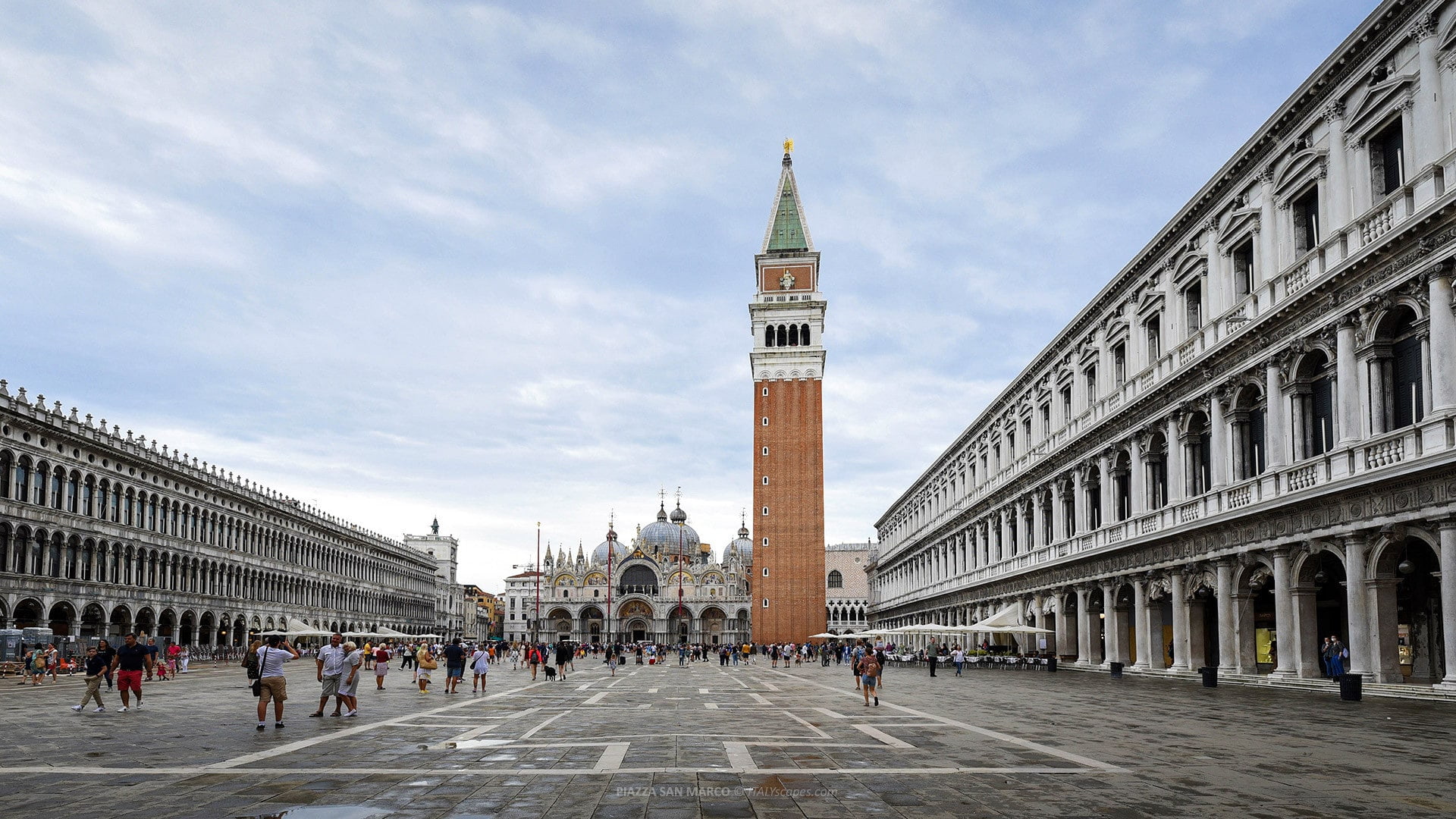
Piazza San Marco, with St Mark’s Basilica in the background
How to Get to St Mark’s Basilica (Basilica di San Marco)
St Mark’s Basilica is located in Piazza San Marco, in the historic centre of Venice. Since cars cannot enter the central city, visitors usually reach the Basilica on foot or by vaporetto, the public waterbus system operating on canals and lagoon routes.
The nearest major arrival point for many visitors is Venezia Santa Lucia railway station, located on the Grand Canal. From there, Piazza San Marco can be reached by walking through the city or by taking a vaporetto from the Ferrovia stops.
Visitors arriving by bus, car or taxi usually reach Piazzale Roma, the main road-access point of Venice. From Piazzale Roma, they can walk to San Marco or take a vaporetto along the Grand Canal toward the San Marco area.
The Basilica is one of the most signposted destinations in Venice. Pedestrian signs reading „per San Marco” appear throughout the historic centre. However, the narrow streets, bridges and irregular layout can still make the route confusing for first-time visitors.
Getting to St Mark’s Basilica on foot from Venezia Santa Lucia
Walking from Venezia Santa Lucia railway station to St Mark’s Basilica usually takes about 30 to 40 minutes. The exact time depends on pace, crowds, photo stops and the route chosen through the historic centre.
The most common route follows signs toward Rialto and then toward San Marco. Many visitors cross or pass near the Rialto Bridge before continuing through narrow streets, small squares and bridges toward Piazza San Marco.
Getting to Basilica di San Marco by vaporetto
The vaporetto is a comfortable option for visitors who prefer a scenic route or who have luggage. From Venezia Santa Lucia, the vaporetto stops are called Ferrovia and are located directly in front of the station on the Grand Canal.
Line 1 is the most scenic route along the Grand Canal. It stops at many piers and passes palaces, churches and bridges before reaching the San Marco area. The journey usually takes around 30 to 40 minutes.
For Piazza San Marco, visitors can get off at San Marco – Vallaresso or San Marco – San Zaccaria. Both stops are within walking distance of the Basilica, although San Zaccaria is also useful for connections toward other lagoon destinations.
Line 2 is generally faster because it has fewer stops along parts of the Grand Canal. From Ferrovia, it usually reaches the San Marco area in about 25 to 30 minutes, depending on direction, timetable and service conditions.
Frequently Asked Questions about St Mark’s Basilica (Basilica di San Marco)
Why is St Mark’s Basilica important?
St Mark’s Basilica is important because it was the spiritual and ceremonial heart of the Venetian Republic. It preserves the relics of Saint Mark and reflects Venice’s historic links with Byzantium, trade, politics and religious power.
When was St Mark’s Basilica built?
The first church dedicated to Saint Mark was built in 828. The current Basilica began in 1063 and was consecrated in 1094, with later additions and decorations completed over several centuries.
Why is St Mark’s Basilica called the “Church of Gold”?
St Mark’s Basilica is called the “Church of Gold” because its interior is covered with extensive golden mosaics. These mosaics decorate domes, vaults and walls, creating a luminous sacred space.
What is the Pala d’Oro?
The Pala d’Oro is a precious golden altarpiece behind the high altar of St Mark’s Basilica. It is decorated with enamel panels and gemstones and is one of Venice’s greatest medieval treasures.
How much does it cost to visit St Mark’s Basilica?
A basic ticket for St Mark’s Basilica costs €10 and does not include access to the Pala d’Oro or the Museum-Loggia dei Cavalli. A timed-entry ticket must be booked in advance.
Sources:Buy tickets & tours:GetYourGuide -
Photos
-
Map
-
Reviews

1 Review on “St Mark’s Basilica (Basilica di San Marco)”
Leave a Review

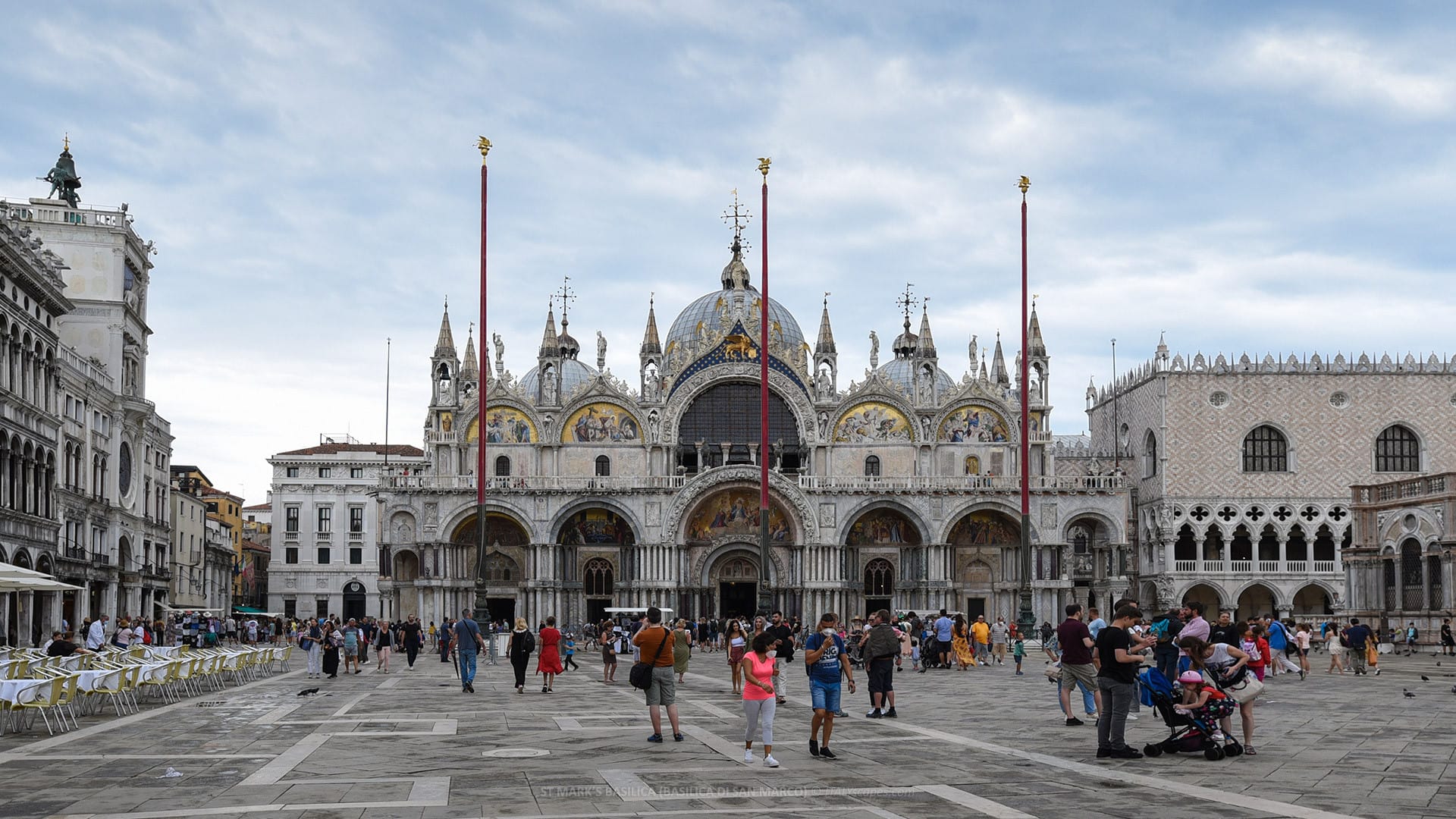
absolutely amazing. takes your breath away