
Table of Contents
Florence on a budget is not a compromise version of the city. It is one of the smartest ways to experience Florence because many of its most important sights are visible from streets, bridges, church squares, riverbanks, and panoramic terraces. The historic center itself is the first free attraction.
Florence rewards visitors who walk, look up, and use the city as an open-air museum. The Duomo, Palazzo Vecchio, Ponte Vecchio, the Arno, Renaissance façades, public sculptures, and medieval streets can be enjoyed without buying a museum ticket. Paid interiors are important, but Florence’s urban landscape is already exceptional.
The city is compact enough for a low-cost visit on foot. From Santa Maria Novella railway station to Piazza del Duomo, the walk is about 800 meters. From the Duomo to Piazza della Signoria, it is about 450 meters, and from there to Ponte Vecchio, roughly 350 meters more.
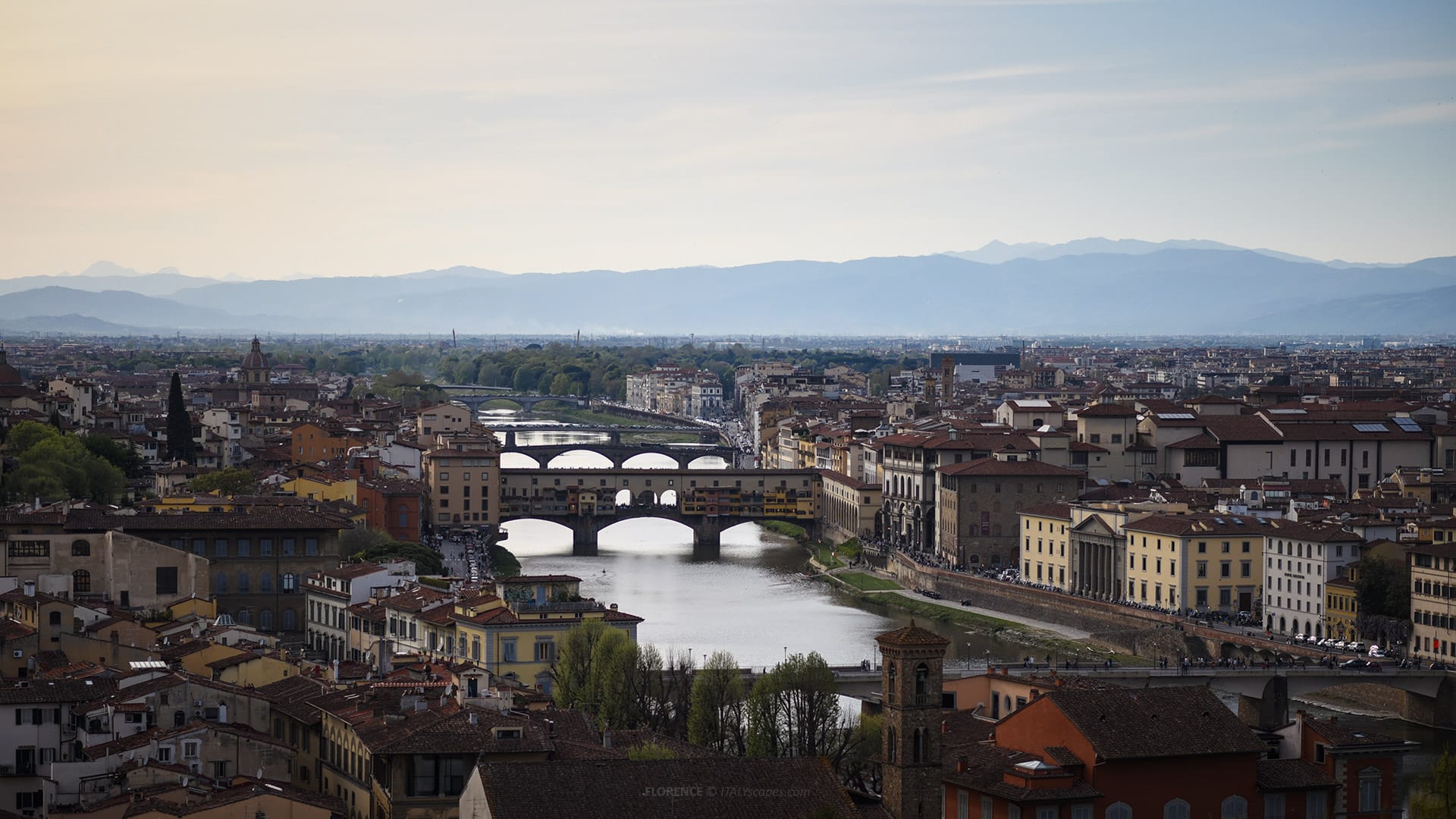
View of Florence from Piazzale Michelangelo
Free Views Over Florence
Piazzale Michelangelo
Piazzale Michelangelo is the classic free viewpoint in Florence. It stands on a hill south of the Arno, above the Oltrarno district, and gives a wide view of the Duomo, Palazzo Vecchio, Santa Croce, Ponte Vecchio, the river, and the surrounding Tuscan hills.
The square was designed by Giuseppe Poggi and built in 1869, during the period when Florence was capital of the Kingdom of Italy. It is dedicated to Michelangelo and includes a bronze copy of David, so visitors can see a public version of the famous statue without entering the Accademia.
Walking from Ponte Vecchio to Piazzale Michelangelo is about 1.6 kilometers, depending on the route. The climb is uphill, but the cost is zero. The best budget strategy is simple: take water, use comfortable shoes, and arrive before sunset to avoid paying for a panoramic terrace elsewhere.
San Miniato al Monte
Above Piazzale Michelangelo, San Miniato al Monte offers another free viewpoint, often quieter and higher. The church stands on one of the highest points in Florence and is one of the finest examples of Florentine Romanesque architecture, with a geometric marble façade visible from far below.
The walk from Piazzale Michelangelo to San Miniato al Monte is about 600 meters uphill. The reward is a view that includes the entire historic center, the Arno bridges, the dome of Santa Maria del Fiore, and the hills around Florence. The cemetery beside the church also offers striking city views.
San Miniato is valuable for travelers on a budget because it combines architecture, religious history, landscape, and photography in one place. Entry to the church is free, although visitors should always respect liturgical services, silence, and dress rules appropriate for a place of worship.
The Arno Riverbanks
The Arno is one of Florence’s best free experiences. Walking along the Lungarni, especially between Ponte Santa Trinita, Ponte Vecchio, and Ponte alle Grazie, gives open views of the river, medieval towers, palace façades, and reflections of the bridges without any ticket.
The best free river views are not necessarily from Ponte Vecchio itself, but from nearby bridges. Ponte Santa Trinita gives one of the clearest perspectives of Ponte Vecchio, while Ponte alle Grazie frames the old bridge from the opposite side and opens the view toward the Oltrarno hills.
Evening is especially useful for budget travelers because Florence becomes visually rich without paid access. Shop shutters close on Ponte Vecchio, the river light changes, and the city’s main monuments remain visible from public space. A free walk can replace an expensive rooftop bar.
Free Bridges and Outdoor Landmarks
Ponte Vecchio
Ponte Vecchio is free to cross and one of Florence’s most important public monuments. The current medieval stone bridge dates from 1345 and crosses the Arno at a historically important narrow point. It is famous for the shops built along both sides of the bridge.
The bridge is about 95 meters long and around 20 meters wide, with three segmental arches. The central span measures about 30 meters, while the two side spans measure about 27 meters each. Its scale makes it easy to study on foot without needing a guided visit.
Ponte Vecchio is also useful for understanding expensive Florence from outside. Above the shops runs the Vasari Corridor, built in the 16th century to connect Palazzo Vecchio, the Uffizi area, Ponte Vecchio, and Palazzo Pitti. Visiting the corridor requires a ticket, but its route is visible from the street.
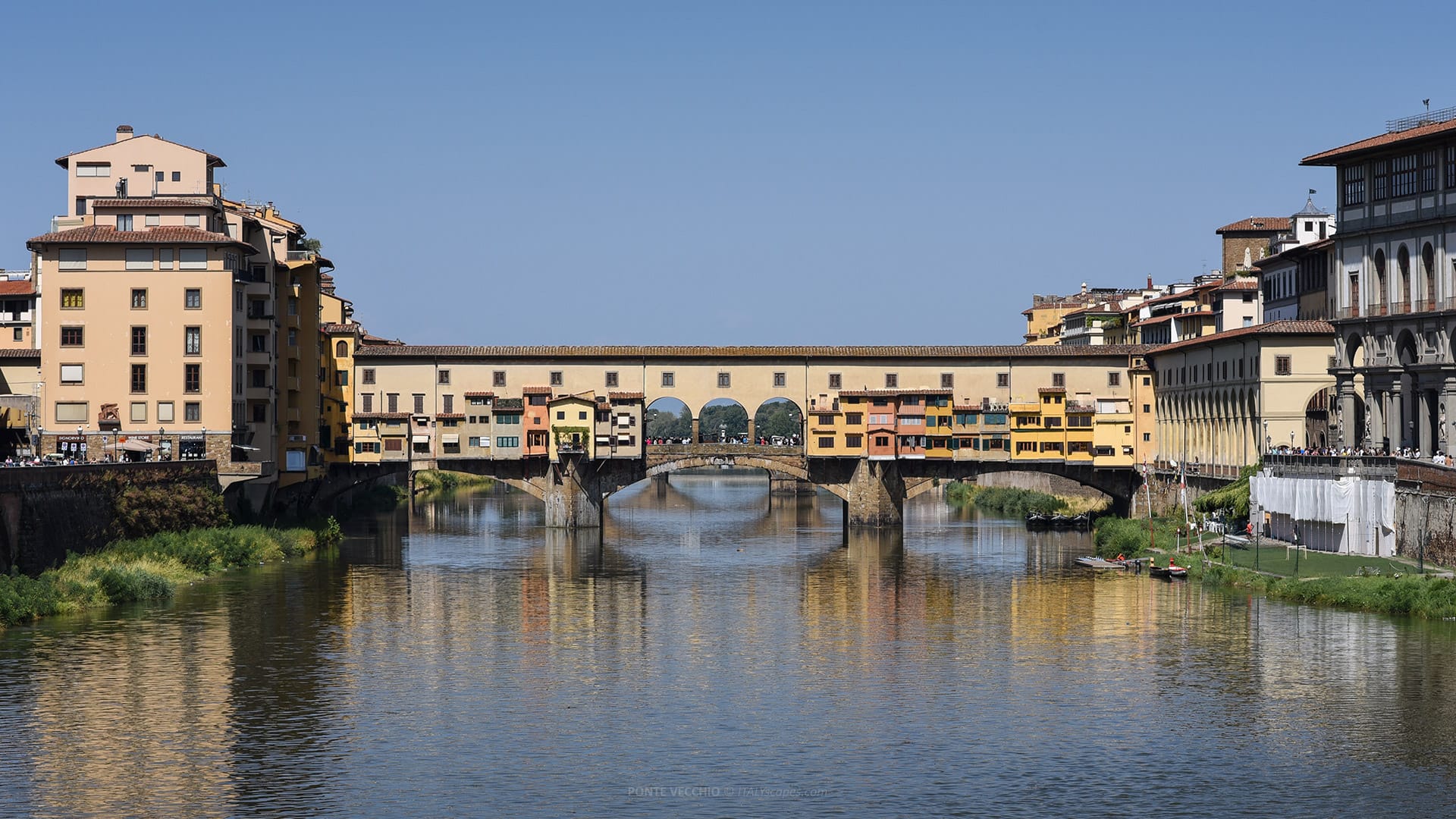
Ponte Vecchio, eastern façade
Ponte Santa Trinita
Ponte Santa Trinita is another important free bridge. It connects the area near Via de’ Tornabuoni with the Oltrarno side and offers one of the best viewpoints toward Ponte Vecchio. The bridge itself is elegant, with shallow elliptical arches and statues marking the seasons.
For budget photography, Ponte Santa Trinita is more practical than crowded Ponte Vecchio. It allows visitors to photograph the old bridge, the river, and the Vasari Corridor from a distance. It also connects two useful low-cost areas: the central shopping streets and the cheaper, more local Oltrarno streets.
Ponte alle Grazie
Ponte alle Grazie is a practical free viewpoint east of Ponte Vecchio. From here, the bridge, the Arno bend, the Uffizi side, and the Oltrarno hillside can be seen together. It is less decorative than Ponte Santa Trinita, but often less crowded.
This bridge is useful if you are walking toward Santa Croce, San Niccolò, or Piazzale Michelangelo. It allows a budget visitor to connect several free attractions without transport: the riverbanks, the eastern view of Ponte Vecchio, the climb to the viewpoints, and the streets below San Miniato.
Free Squares in the Historic Center
Piazza del Duomo
Piazza del Duomo is one of the most valuable free places in Florence. The cathedral complex includes Santa Maria del Fiore, Brunelleschi’s Dome, Giotto’s Campanile, and the Baptistery. Dome climbs, tower climbs, the Baptistery, crypt, and museum require tickets, but the exterior is fully visible from the square.
The Cathedral of Santa Maria del Fiore is about 153 meters long, 90 meters wide at the transept, and about 90 meters high from floor to the base of the lantern. These dimensions are useful because the building’s impact is best understood by walking around it slowly from several sides.
Entry to the cathedral nave is free during the official free-access hours, but the queue can be long and access depends on religious rules, security, and opening times. Shoulders and legs must be covered, and bulky luggage is not accepted. The paid monuments around it require separate ticket planning.
Piazza della Signoria
Piazza della Signoria is Florence’s most important civic square and one of the city’s best free open-air museums. It contains Palazzo Vecchio, the Fountain of Neptune, the equestrian statue of Cosimo I, a copy of Michelangelo’s David, and the Loggia dei Lanzi.
Palazzo Vecchio can be admired from outside without buying a museum ticket. Its Torre di Arnolfo rises about 95 meters above the city and remains one of Florence’s defining skyline elements. The fortress-like stonework, battlements, clock, and asymmetrical tower are visible from the square.
For visitors who cannot pay for the Accademia, the copy of David outside Palazzo Vecchio still explains the statue’s original civic setting. The original stood in this public space before it was moved indoors. The square therefore gives important historical context for free.
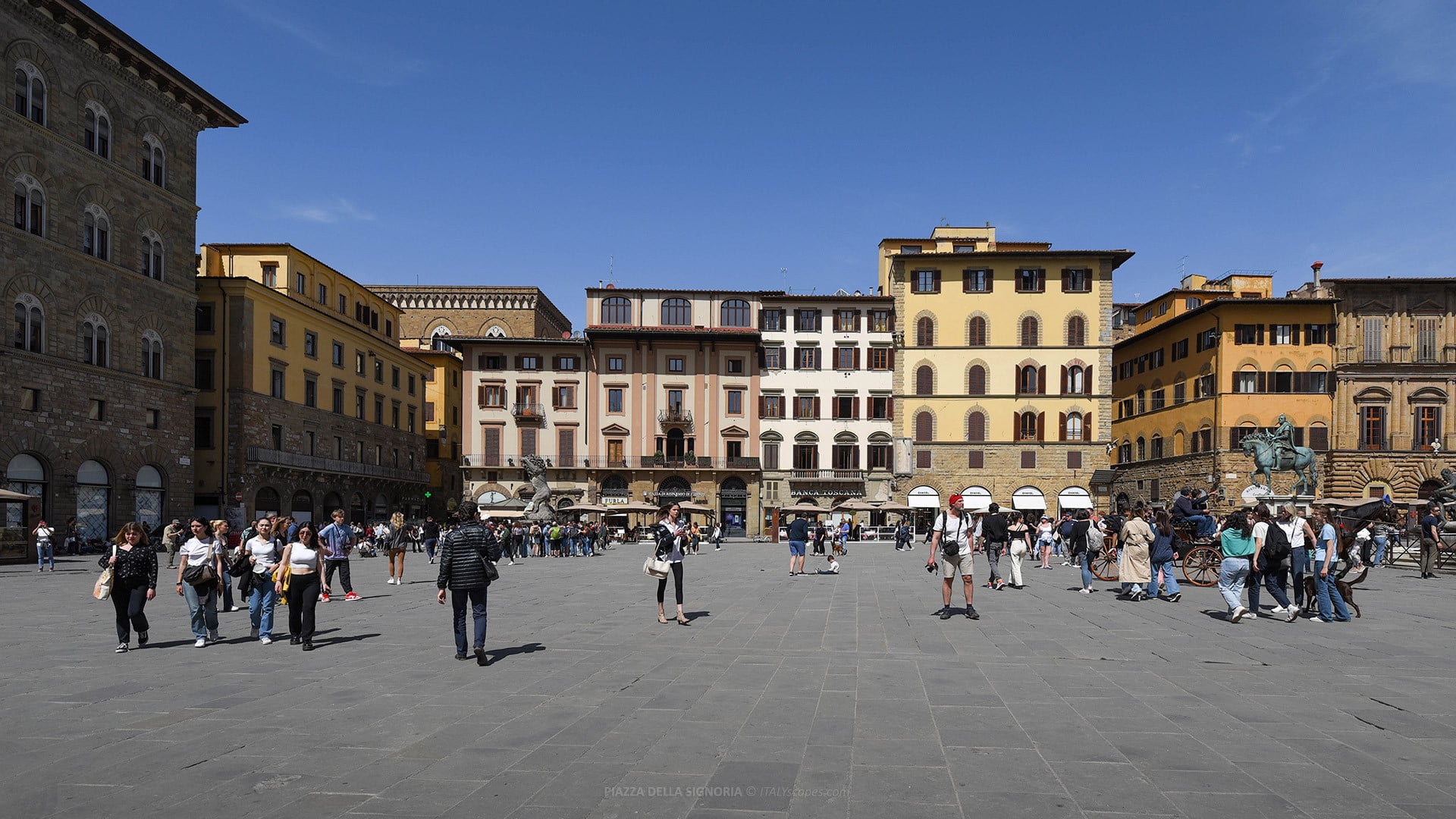
Piazza della Signoria
Loggia dei Lanzi
The Loggia dei Lanzi is a covered open-air sculpture gallery beside Piazza della Signoria. It contains major works associated with Florence’s public art, including sculptures by Benvenuto Cellini and Giambologna. The arches open directly to the square, making the space part of the city fabric.
Since 23 January 2026, entering the Loggia requires a free ticket obtained on site. This keeps the attraction free, but visitors should know that access is now regulated. Even from the square, the sculptures remain visible under the arches, so the Loggia still works for a zero-cost visit.
Piazza Santa Croce
Piazza Santa Croce gives a full view of the Basilica di Santa Croce façade. The basilica interior requires a ticket, but the square itself is one of Florence’s largest historic open spaces and has long been used for civic events.
Santa Croce is important from outside because it shows the scale of a major Franciscan church in Florence. The marble façade, broad piazza, and position east of the central core make it different from the Duomo area. The square is also useful for budget food, with bakeries and simple lunch spots nearby.
Piazza Santa Maria Novella
Piazza Santa Maria Novella is a free public square beside one of Florence’s most important churches. The church interior is paid, but the exterior can be studied from the square, especially the white and green marble façade associated with Gothic and Renaissance phases.
The piazza is close to the main railway station, which makes it useful for travelers arriving by train. It is also a practical first or last stop on a budget visit, because it connects transport, affordable accommodation streets, grocery shops, cafés, and the western side of the historic center.

Piazza Santa Maria Novella
Piazza Santo Spirito
Piazza Santo Spirito is one of the best budget areas in Oltrarno. The square is public, informal, and more local in atmosphere than Piazza del Duomo or Piazza della Signoria. It is surrounded by bars, simple restaurants, artisan streets, and the plain façade of Brunelleschi’s Santo Spirito.
The Basilica di Santo Spirito has free access to the main basilica, except during liturgical celebrations. Some parts of the complex require a paid museum itinerary, but the church itself remains one of the most important free Renaissance interiors in Florence when open for visits.
Churches and Religious Spaces on a Budget
Cathedral of Santa Maria del Fiore
The Florence Cathedral is the most important free church visit in Florence, although not the easiest. Entry to the nave is free in during the free access window, but visitors often face lines, dress checks, and security rules. The dome, bell tower, Baptistery, crypt, and museum are paid.
For a budget visit, the exterior is as important as the interior. The polychrome marble, massive dome, side doors, apses, and campanile can be examined from the square without paying. Walking around the complex also reveals how tightly the cathedral fits into the medieval street network.
Basilica di Santo Spirito
Santo Spirito is one of the best free church options because the main basilica is accessible without a ticket. It stands in Oltrarno, away from the heaviest tourist flow, and is strongly connected with Filippo Brunelleschi, who designed one of Florence’s key Renaissance church spaces.
The plain exterior is part of the experience. Unlike the marble façades of Santa Maria Novella or Santa Croce, Santo Spirito presents a simple front to the square. Inside, the regular geometry, side chapels, and calm proportions make it an important free lesson in Renaissance architecture.

Basilica of Santo Spirito
San Miniato al Monte
San Miniato al Monte combines a free church visit with one of Florence’s greatest panoramas. Its white and green marble façade, elevated position, Romanesque structure, and quiet atmosphere make it especially valuable for travelers who want beauty without a museum ticket.
Because it is above the main center, San Miniato requires effort rather than money. The climb from the Arno or from Piazzale Michelangelo is the price of admission. Visitors should bring water, avoid the hottest afternoon hours in summer, and dress respectfully for the church.
Expensive Churches Seen from Outside
Several famous Florentine churches require paid entry, but their exteriors and squares remain free. Santa Croce, Santa Maria Novella, and San Lorenzo can all be appreciated from outside. Their façades, piazzas, cloisters, and surrounding streets still explain a great deal about Florence’s religious history.
This approach is practical when time or money is limited. A visitor can choose one paid church interior and still see several major churches externally. In Florence, exterior viewing is not a weak substitute: façades, urban placement, bell towers, and piazzas are essential parts of the monuments.
Expensive Museums and Palaces from the Outside
Uffizi Gallery and Vasari Corridor
The Uffizi Gallery is expensive compared with free outdoor sights, but its architecture can be partly enjoyed without entering. The long courtyard between the two wings of the Uffizi is a public urban space linking Piazza della Signoria with the Arno.
The Vasari Corridor is also visible from outside as it runs from the Uffizi area toward Ponte Vecchio and over the bridge. The corridor visit is paid and ticketed, but following its exterior route on foot helps explain how the Medici connected government, art collections, river crossing, and residence.
Palazzo Vecchio
Palazzo Vecchio is a paid museum inside, but the exterior is one of Florence’s strongest free sights. The building has served as Florence’s town hall and civic symbol, and its stone mass dominates Piazza della Signoria. The tower alone gives the square much of its identity.
The façade can be studied without entering: rusticated stone, crenellations, the clock, coats of arms, and the high tower all communicate political power. The statues in front also make the square a free introduction to Renaissance civic art and Medici imagery.
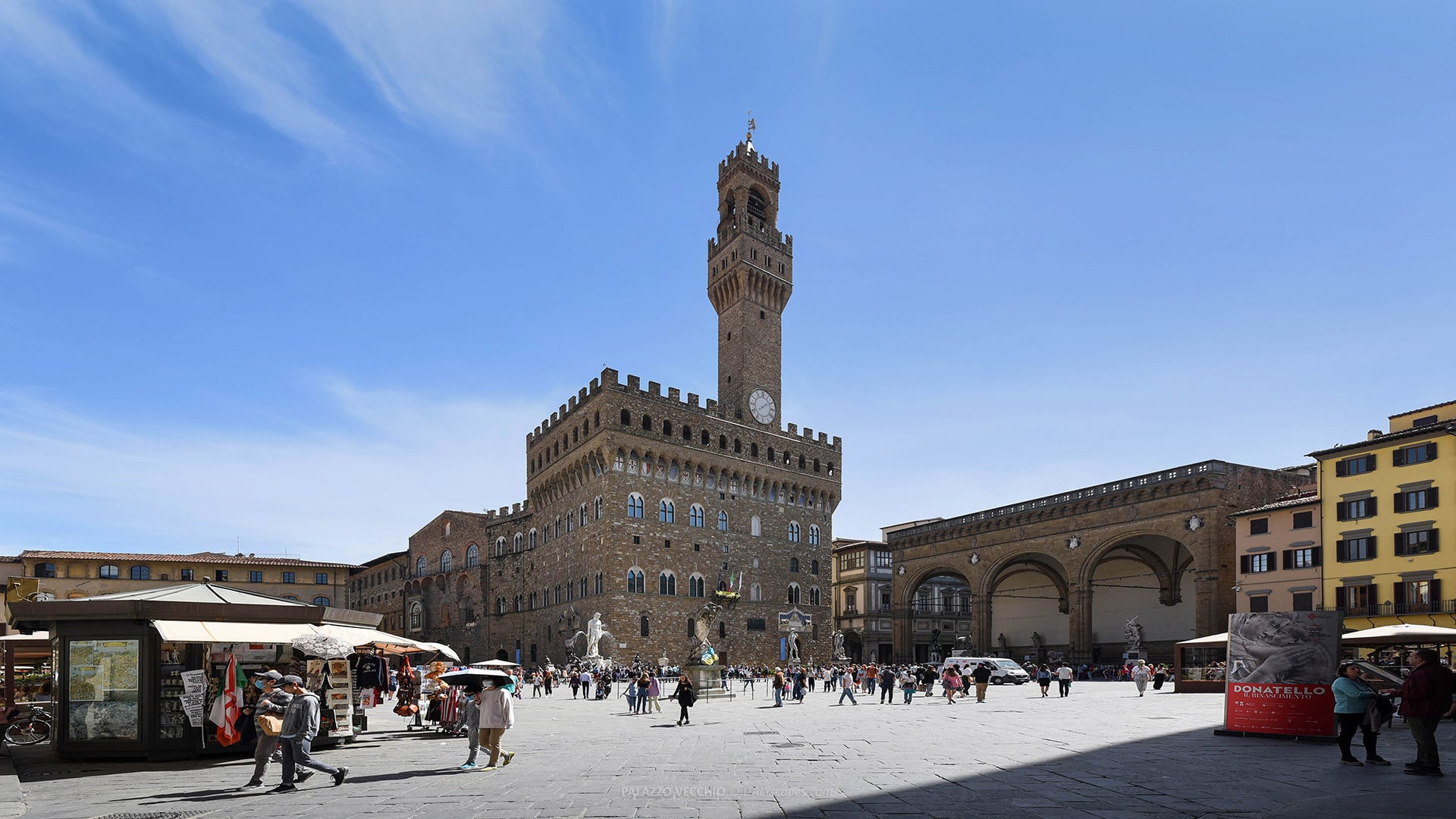
Palazzo Vecchio
Palazzo Pitti
Palazzo Pitti is one of the best examples of an expensive attraction that still works from outside. The palace museums and Boboli Gardens require tickets, but the enormous façade and sloping Piazza Pitti are public and free. The palace sits on the south side of the Arno.
The palace became the Medici grand ducal residence after Cosimo I and Eleonora di Toledo acquired it in the 16th century. Even without entering, its scale shows the shift from the civic world of Palazzo Vecchio to the courtly power of the Oltrarno residence.
Accademia and Michelangelo’s David
The Accademia Gallery is famous because it houses the original David by Michelangelo. Entry is paid and usually benefits from advance booking, but visitors on a strict budget can still see public copies of David in Piazza della Signoria and Piazzale Michelangelo.
The copies do not replace the original, but they help explain the statue’s public meaning. The version outside Palazzo Vecchio is especially important because it marks the place where the original stood for centuries. This is a useful fact for travelers who skip the museum.
Markets and Cheap Shopping
Mercato Centrale
Mercato Centrale is a useful budget stop because entry is free and visitors can compare food prices before buying. The historic market building dates from 1874 and is associated with iron-and-glass market architecture. It stands in the San Lorenzo area, close to the Duomo and train station.
The ground floor is the traditional food market, with produce, meat, cheese, fresh pasta, and local ingredients. The first floor is a food hall with counter-service options and seating. Hours differ by level, so visitors should check current opening times before relying on it for breakfast or dinner.
Mercato Centrale is not always the cheapest place in Florence, but it is practical. A budget traveler can buy fruit, bread, cheese, or simple prepared food instead of sitting in a full restaurant. It is also useful for shelter, toilets, seating, and a food-focused break.
Mercato di Sant’Ambrogio
Mercato di Sant’Ambrogio is more local than Mercato Centrale and often better for budget food culture. It is located in Piazza Lorenzo Ghiberti, east of the historic core, and is generally open Monday to Saturday from 7:00 to 14:00, closing on Sundays and holidays.
The market includes fresh produce, meat, cheese, household goods, and simple places to eat. It is particularly useful at lunchtime. Because it sits outside the densest tourist streets, it gives a more ordinary Florentine market experience while still being walkable from Santa Croce and the Duomo.
Mercato del Porcellino
Mercato del Porcellino, also called Mercato Nuovo, is located near Ponte Vecchio and Piazza della Signoria. It is an open-air market under a historic loggia, with leather goods, souvenirs, scarves, bags, and small items. Visiting the loggia and seeing the Porcellino fountain is free.
This is not always the cheapest place to buy, because the central location attracts tourists. Still, it is useful for comparison shopping. Budget travelers should check prices, inspect leather carefully, avoid impulse purchases, and compare similar items with shops and stalls around San Lorenzo.
San Lorenzo Street Market
The streets around San Lorenzo are known for market stalls selling leather goods, belts, jackets, bags, scarves, notebooks, and souvenirs. Browsing is free, and prices can vary significantly. It is a practical area for low-cost gifts, especially when compared with boutique streets.
San Lorenzo is also useful because it combines shopping with food. Mercato Centrale sits nearby, and the area around Via dell’Ariento has many casual food options. For budget travelers, this means one area can cover lunch, souvenirs, groceries, and a free walk around the basilica exterior.
Santo Spirito and Oltrarno Shopping
Oltrarno is better for slow browsing than quick souvenir buying. Around Santo Spirito, San Frediano, and Via Maggio, visitors find artisan workshops, vintage shops, small galleries, and second-hand possibilities. The area is not always cheap, but it is better for distinctive objects than mass souvenirs.
The budget advantage of Oltrarno is atmosphere. Window-shopping costs nothing, and the streets are less dominated by the main museum crowds. Even without buying, the district shows Florence’s artisan identity through woodwork, restoration, leather, paper, jewelry, and small independent businesses.
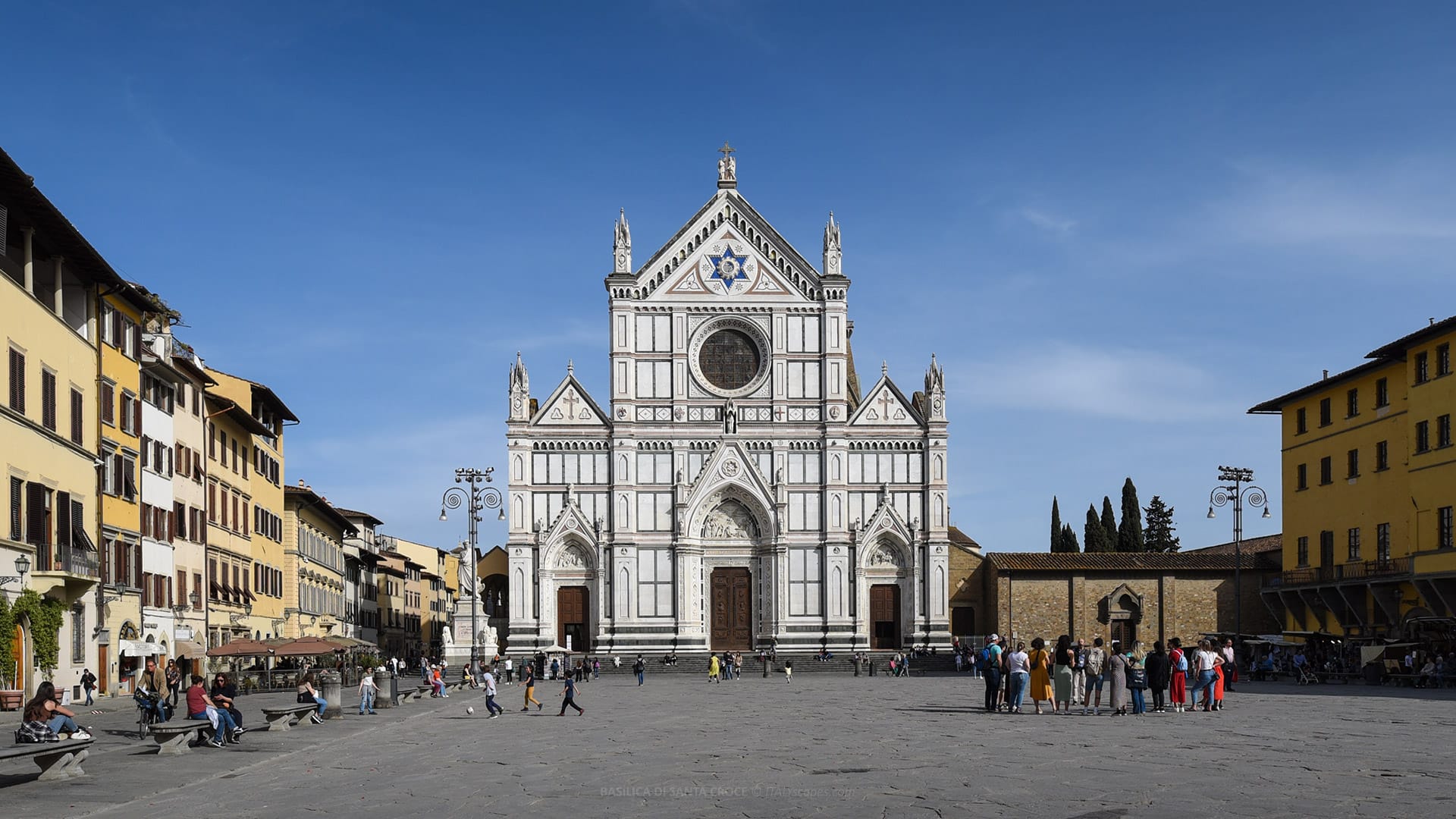
The Basilica di Santa Croce overlooking the square of the same name
Cheap Local Food in Florence
Schiacciata and Panini
The easiest cheap meal in Florence is schiacciata, the Tuscan flatbread often filled with cured meats, cheese, vegetables, sauces, or spreads. It is filling, portable, and cheaper than a seated restaurant meal. Many popular sandwich shops are located near Via dei Neri, the Uffizi, and Santa Croce.
A budget traveler should avoid choosing only the longest queue. Florence has many bakeries, alimentari, and small sandwich counters where prices may be lower and service faster. Schiacciata works well for lunch because it can be eaten in a square, beside the Arno, or before climbing to a viewpoint.
Lampredotto and Trippa
Lampredotto is one of Florence’s most traditional cheap foods. It is made from the fourth stomach of the cow, usually served in a bread roll with salsa verde or spicy sauce. It is sold at street kiosks and market stands, especially around central and working-market areas.
Trippa alla fiorentina is another traditional dish based on tripe, usually cooked with tomato and served hot. These foods are not for every visitor, but they are factual parts of Florentine food culture and often cost less than tourist-menu pasta near the main monuments.
Ribollita and Pappa al Pomodoro
For a cheap local meal without street food, look for ribollita and pappa al pomodoro. Ribollita is a Tuscan bread, bean, and vegetable soup, while pappa al pomodoro uses bread, tomatoes, garlic, olive oil, and basil. Both are traditional, filling, and generally cheaper than steak.
These dishes are especially useful in trattorias, market counters, and lunch menus. They also make sense historically because Tuscan cooking uses bread, legumes, vegetables, and olive oil efficiently. For budget travelers, they offer local identity without paying for expensive meat dishes.
Pizza, Bakeries, and Gelato
Pizza by the slice, simple pizzerias, bakeries, and small gelaterias are practical in Florence. A slice of pizza or a bakery item can replace a restaurant lunch, while a small gelato cup is cheaper than dessert in a seated restaurant. Prices vary heavily by location.
Budget travelers should compare menus before entering and watch for cover charges in restaurants. Sitting down in a central square often costs more than eating at a counter nearby. A simple bakery breakfast, market lunch, and casual dinner can reduce daily food costs significantly.
Markets Instead of Restaurants
Markets are the best way to control food spending in Florence. Buying fruit, bread, cheese, cured meat, or simple prepared dishes lets travelers avoid three restaurant meals per day. Mercato Centrale is convenient; Sant’Ambrogio is better for a more local morning and lunch rhythm.
This strategy works especially well in warm weather. A picnic near the Arno, in a public square, or before the walk to Piazzale Michelangelo can cost far less than a restaurant terrace. Visitors must still respect local rules, avoid church steps when inappropriate, and leave no litter.
Moving Around Florence on Foot
Florence is one of Italy’s best walking cities for budget travel. The main attractions are close together, and many central streets are pedestrian or restricted to traffic. Walking also reveals details that buses miss: tabernacles, coats of arms, workshop windows, small churches, and hidden courtyards.
A simple walking radius covers most major free sights. Santa Maria Novella station to the Duomo is about 10 minutes on foot. The Duomo to Piazza della Signoria is about 5 to 7 minutes. Piazza della Signoria to Ponte Vecchio is usually under 5 minutes.
Public transport is useful for tired travelers, outer accommodation, or hot weather, but it is not essential for the core. Florence buses and trams use the same urban ticket system, and a standard ticket costs money that can often be saved by walking between central sights.
Water is another budget detail. Florence has safe tap water and public drinking fountains, so a reusable bottle reduces daily expenses. This matters in summer, when climbing to Piazzale Michelangelo or San Miniato can require more water than expected.

Piazza della Repubblica
Practical Budget Rules for Florence
The most important rule is to separate must-pay interiors from free exterior value. Paying for every famous museum, church, tower, and garden becomes expensive quickly. Choosing one or two major paid visits while seeing the rest from outside keeps Florence affordable.
The second rule is to use free state-museum days carefully. On the first Sunday of each month, many Italian state museums, including Florence’s major state sites, participate in free admission. The saving can be large, but queues are longer and reservations may not work as usual.
The third rule is to eat away from the most famous views. Restaurants directly beside the Duomo, Ponte Vecchio, or Piazza della Signoria often cost more than similar food a few streets away. Markets, bakeries, sandwich counters, and Oltrarno trattorias are better for budget meals.
The fourth rule is to stay within walking distance if possible. Accommodation in Oltrarno, San Frediano, Santa Croce, or near Santa Maria Novella can reduce transport costs. Oltrarno is especially useful because it connects cheaper food, evening atmosphere, Ponte Vecchio, Palazzo Pitti, and the climb to free viewpoints.
Florence does not need to be cheap to be valuable, but it can be visited intelligently on a limited budget. Its greatest free assets are permanent: bridges, squares, façades, church interiors, markets, viewpoints, and walkable streets. With good choices, the city’s Renaissance identity remains visible without overspending.
Frequently Asked Questions – Florence on a Budget
Can you visit Florence on a budget?
Yes, Florence can be visited on a budget because many major sights are free, including Ponte Vecchio, Piazza del Duomo, Piazza della Signoria, the Arno riverbanks, and Piazzale Michelangelo.
What are the best free things to do in Florence?
The best free things to do in Florence include crossing Ponte Vecchio, visiting Piazzale Michelangelo, walking through Piazza della Signoria, seeing the Duomo exterior, and exploring the Oltrarno district.
Can you enter Florence Cathedral for free?
Yes, entry to the main nave of Florence Cathedral is free during official visiting hours. However, the dome, bell tower, Baptistery, crypt, and museum require paid tickets.
Where can you eat cheaply in Florence?
Cheap food options in Florence include schiacciata sandwiches, lampredotto stalls, bakeries, pizza slices, Mercato Centrale, Mercato di Sant’Ambrogio, and simple trattorias away from the main tourist squares.
Is Florence easy to explore on foot?
Yes, Florence is very walkable. The Duomo, Piazza della Signoria, Ponte Vecchio, Santa Croce, Santa Maria Novella, and many markets are within short walking distance of each other.
What is the best free viewpoint in Florence?
Piazzale Michelangelo is the most famous free viewpoint in Florence. For a quieter and higher view, continue uphill to San Miniato al Monte, another excellent free panoramic spot.
Are Florence markets good for budget travelers?
Yes, Florence markets are useful for budget travelers. Mercato Centrale and Mercato di Sant’Ambrogio offer food, produce, local products, and cheaper meal options than many central restaurants.


