-
About
Table of Contents
Buy tickets & tours:GetYourGuideThe Cathedral of Santa Maria del Fiore is the main church of Florence and one of the most recognizable monuments in Italy. Located in Piazza del Duomo, in the historic center of Florence, it forms a monumental religious complex with Giotto’s Bell Tower, the Baptistery of San Giovanni, and the Opera del Duomo Museum.
Commonly known as Florence Cathedral, the church replaced the older cathedral of Santa Reparata, whose archaeological remains can still be visited below the present building. The cathedral is famous for its vast Gothic structure, its marble exterior, and the revolutionary dome designed by Filippo Brunelleschi in the 15th century.
When the cathedral was structurally completed in 1436, it was among the largest churches ever built. Today, it remains one of the largest churches in the world, with an internal length of 153 meters, a width of 90 meters at the transept, and the largest masonry dome ever constructed.

The Cathedral of Santa Maria del Fiore between the Baptistery and Giotto’s Campanile
Short History of the Cathedral of Santa Maria del Fiore (Florence Cathedral)
From Santa Reparata to a New Cathedral
The site of the cathedral had religious importance long before the construction of the present church. The older cathedral, Santa Reparata, stood here for centuries and served the city before the rise of medieval Florence as a major political, commercial, and artistic power in Tuscany.
By the late 13th century, Santa Reparata was considered too small and too old for the ambitions of Florence. In 1294, the city government decided to replace it with a larger cathedral, designed to express the wealth, power, and civic identity of the Florentine Republic.
The first stone of the new cathedral was laid on September 8, 1296. The project was entrusted to Arnolfo di Cambio, one of the most important architects and sculptors active in Florence at the time, also connected with major civic and religious building projects in the city.
Arnolfo’s design was probably smaller than the final cathedral, but several elements of the present building still reflect his original vision. Work began from the western section and the side walls, allowing parts of Santa Reparata to remain in use for as long as possible during construction.
Arnolfo di Cambio and the First Building Phase
Arnolfo di Cambio designed a vast church with a basilican body and a large eastern area intended to support a dome. He also began the first façade, although this medieval front was never completed and would later be removed in the 16th century.
After Arnolfo’s death in 1302, construction slowed considerably. The death of major patrons and the complexity of the project caused long interruptions. For around 30 years, the building site advanced only slowly, and Florence had to wait for new political and financial energy to revive the cathedral works.
A major turning point came in 1330, when the relics of Saint Zenobius, an important early bishop of Florence, were found beneath Santa Reparata. The discovery increased religious interest in the site and helped encourage the continuation of the cathedral project.
In 1334, the Arte della Lana, the powerful wool guild responsible for supervising the construction, appointed Giotto di Bondone as master builder. Giotto focused mainly on the bell tower, which still bears his name, but he died only three years later, in 1337.
Giotto, Andrea Pisano, and Francesco Talenti
After Giotto’s death, Andrea Pisano continued the works, especially on the bell tower. The project was interrupted again by the Black Death of 1348, which severely affected Florence and temporarily stopped many construction activities across the city.
In 1349, Francesco Talenti became master builder and gave the project new momentum. He completed major parts of the bell tower and modified Arnolfo’s original plan, enlarging the cathedral and shaping the monumental scale that defines the building today.
Talenti reduced the number of bays but made them larger and higher. This decision created the extraordinary spaciousness of the nave. The central nave was covered by 1378, and the side aisles were completed shortly afterward, around 1380.
By the early 15th century, the tribunes and the drum for the future dome were largely ready. Around 1421, the main structural problem remained unsolved: how to cover the enormous octagonal opening above the crossing without using traditional wooden centering.
Brunelleschi and the Construction of the Dome
In 1418, a public competition was launched to solve the problem of the dome. The challenge was exceptional: the opening was huge, the drum was very high, and no traditional wooden framework could safely support a dome of such size during construction.
Filippo Brunelleschi developed the solution that made the cathedral famous. Work on the dome began in 1420 and continued until 1436. Brunelleschi designed a double-shell structure, with an inner and an outer dome, built without full wooden centering.
The dome has an external diameter of about 55 meters and an internal diameter of about 45.5 meters. Its stability depends on an ingenious system of ribs, masonry rings, herringbone brickwork, and carefully organized construction techniques developed specifically for the site.
Brunelleschi also designed machines to lift materials to unprecedented heights. His building site was highly organized and technically innovative. The climb to the lantern today includes 463 steps, passing through the space between the two shells of the dome.
Consecration and Later Completion
The cathedral was consecrated by Pope Eugene IV on March 25, 1436, after the completion of Brunelleschi’s dome. This date marked the structural completion of one of the most ambitious architectural projects of medieval and early Renaissance Europe.
Brunelleschi died in 1446 and did not see the final completion of the lantern. The white marble lantern, about 21 meters high, was finished after his death, while the golden ball above it, designed by Verrocchio, was placed in 1471.
The name “Santa Maria del Fiore” became official during the construction process. The title refers to the Virgin Mary and to the “flower” associated with Florence, whose civic emblem is the lily and whose Latin name, Florentia, evokes the idea of blooming.
The exterior decoration continued for centuries. The present façade is not medieval, but a 19th-century Neo-Gothic façade designed by Emilio De Fabris and completed by Luigi del Moro in 1887. The bronze doors were added later, between 1899 and 1903.
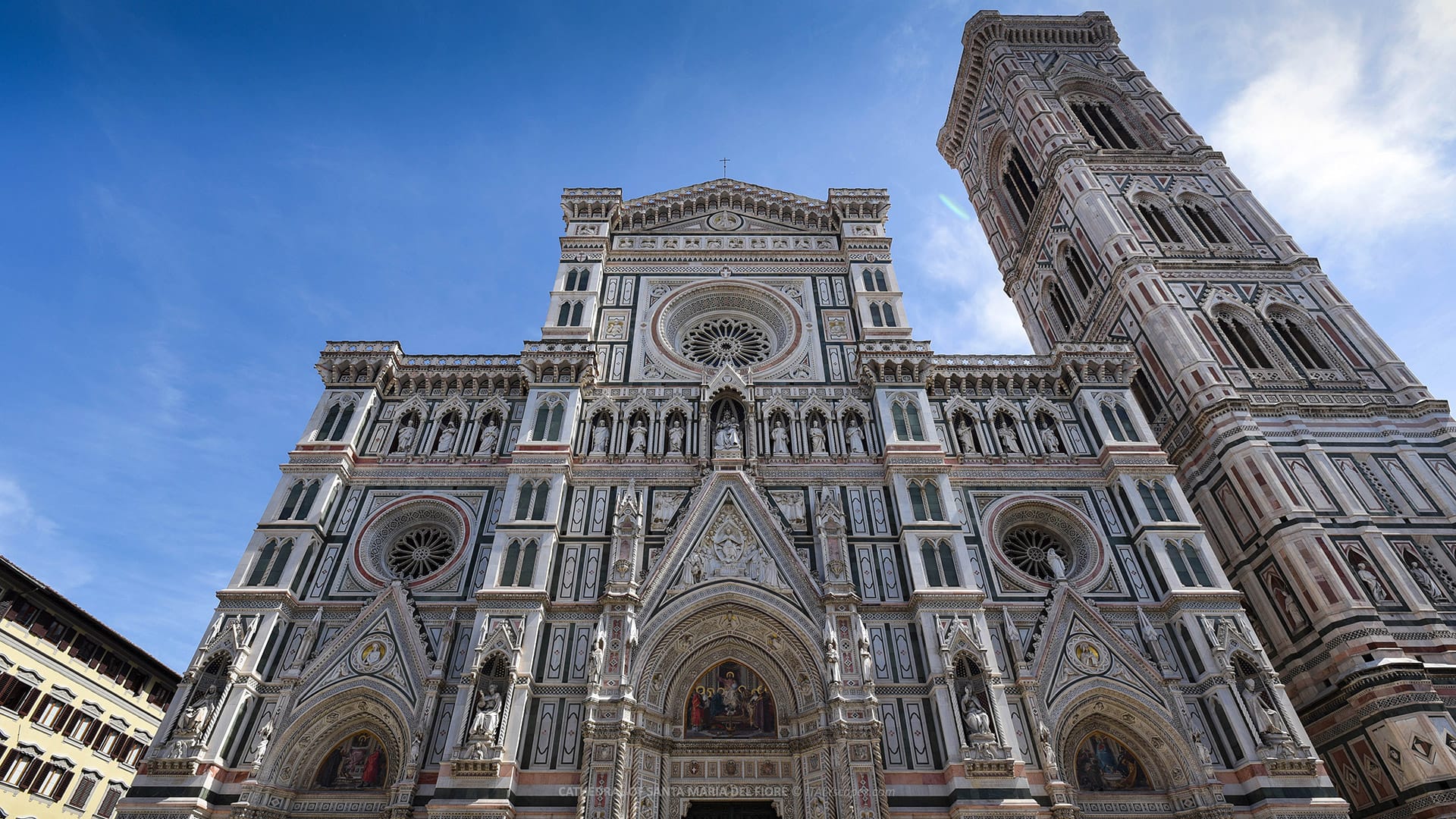
The façade of the Cathedral of Santa Maria del Fiore
Architecture of the Cathedral of Santa Maria del Fiore (Florence Cathedral)
Monumental Dimensions and Plan
The Florence Cathedral has a monumental plan formed by a three-nave basilican body joined to a vast eastern area with three radial apses, or tribunes. The crossing is dominated by Brunelleschi’s great octagonal dome, which remains the defining architectural feature of the building.
The cathedral measures 153 meters in internal length and about 90 meters in width at the transept. The nave is about 38 meters wide, while the vaults rise to approximately 45 meters. The building covers around 8,300 square meters, excluding the underground area of Santa Reparata.
From the floor to the base of the lantern, the height is about 90 meters. The external height of the dome, including the lantern and cross, reaches about 116.5 meters, making it one of the dominant features of the Florentine skyline.
The interior does not follow the dense vertical rhythm of many northern Gothic cathedrals. Instead, its enormous bays and few massive pillars create a wide, open space. This architectural choice gives the nave a sober, austere, and almost civic character.
Exterior Materials and Gothic Structure
The exterior walls are covered with white Carrara marble, green marble from Prato, and red marble from the Maremma area. These colors connect the cathedral visually with the Baptistery and Giotto’s Bell Tower, creating a unified monumental group in Piazza del Duomo.
The decoration includes geometric patterns, stylized flowers, circular windows, mullioned windows, and richly carved portals. Although the cathedral was built over many centuries, the repeated use of colored marble helps the exterior appear more coherent than its long construction history suggests.
The side walls reveal several phases of construction. Some sections preserve the rhythm of Arnolfo’s early design, while later parts reflect Talenti’s larger and more spacious plan. The result is a complex but balanced mixture of Florentine Gothic and later architectural solutions.
The eastern end is formed by three large tribunes arranged around the dome. Above them are smaller semicircular structures connected with Brunelleschi’s engineering solutions. This area shows how architecture, structure, and decorative form worked together to support the enormous dome.
The Neo-Gothic Façade
The original façade begun by Arnolfo di Cambio remained incomplete for centuries. It was dismantled in 1587, leaving the cathedral without a permanent monumental front. For important celebrations, temporary façades were sometimes installed, but no final solution was built until the 19th century.
After long debates and competitions, work on the present façade began in 1871. It was designed by Emilio De Fabris, and after his death the project was continued by Luigi del Moro. The façade was completed in 1887.
The façade uses white, green, and red marble to match the rest of the cathedral complex. Its style is Neo-Gothic, but its iconographic program connects with medieval religious themes, especially the life of the Virgin Mary and the role of Christianity in Florentine history.
The three large bronze doors date from 1899 to 1903. They are decorated with scenes from the life of the Madonna. The central and left doors were made by Augusto Passaglia, while the right door was made by Giuseppe Cassioli.
Portals, Mosaics, and Sculptural Decoration
Above the façade portals are mosaics designed by Niccolò Barabino. They represent Charity among Florentine philanthropic founders, Christ enthroned with Mary and Saint John the Baptist, and Florentine artisans, merchants, and humanists paying homage to the Virgin.
The upper part of the façade includes a gallery with the Madonna and Child by Tito Sarrocchi, surrounded by the Twelve Apostles. Other sculptural elements include figures linked to the history of the Church and to the dedication of the cathedral.
The side portals are also important. The Porta dei Canonici, near the southern tribune, has refined Gothic carving. The northern side includes the Porta di Balla and the Porta della Mandorla, famous for its sculptural decoration and Renaissance connections.
The Porta della Mandorla includes works associated with artists such as Nanni di Banco and a lunette mosaic of the Annunciation by Domenico Ghirlandaio’s workshop. These portals show how the cathedral exterior became a long-term laboratory for Florentine sculpture.
Brunelleschi’s Dome
Brunelleschi’s dome is the architectural masterpiece of Cathedral of Santa Maria del Fiore. It is an octagonal masonry structure composed of two shells, an internal dome and an external dome. The space between them contains the stairway used by visitors who climb to the top.
The dome was built without the full wooden centering traditionally used for large vaults. Brunelleschi solved the problem with a self-supporting system of masonry, including herringbone brickwork, stone and brick ribs, and horizontal chains designed to control the forces of the structure.
The dome has 24 meridian ribs and 10 parallel ribs connecting the two shells. Eight external white marble ribs divide the terracotta-covered surface into the famous segments that shape the skyline of Florence when seen from the hills around the city.
At the top stands the lantern, built in white marble. Its weight helps counterbalance structural forces, while visually completing the dome. Above it, Verrocchio’s golden ball became one of the most recognizable details of the cathedral’s silhouette.
Interior Space and Floor
The interior of the Florence Cathedral is surprisingly restrained compared with its richly colored exterior. The vast nave is divided by large composite pillars and pointed arches. The overall impression is one of scale, order, and controlled emptiness rather than dense decoration.
The marble floor was designed and executed mainly between the 16th and 17th centuries by grand-ducal workshops. Its inlaid patterns add color and geometry to the otherwise sober interior, linking the floor visually with the marble decoration outside.
The nave and transept are illuminated by 44 stained glass windows, one of the richest stained-glass cycles in Italy. The windows were designed by major Florentine artists of the late Gothic and early Renaissance periods, including Lorenzo Ghiberti, Donatello, Paolo Uccello, and Andrea del Castagno.
The circular windows in the drum of the dome include Marian scenes, while other windows represent saints and biblical figures.
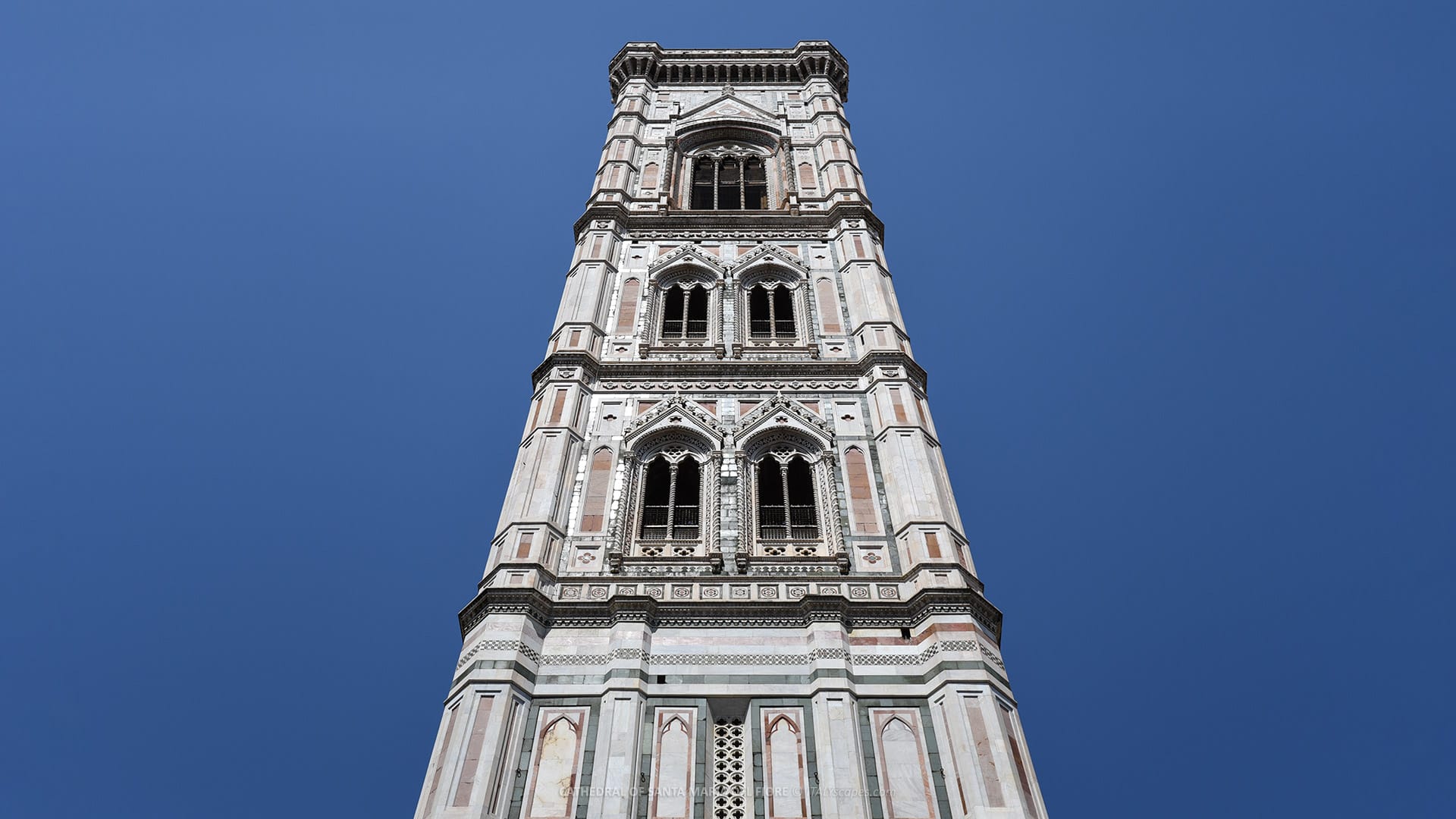
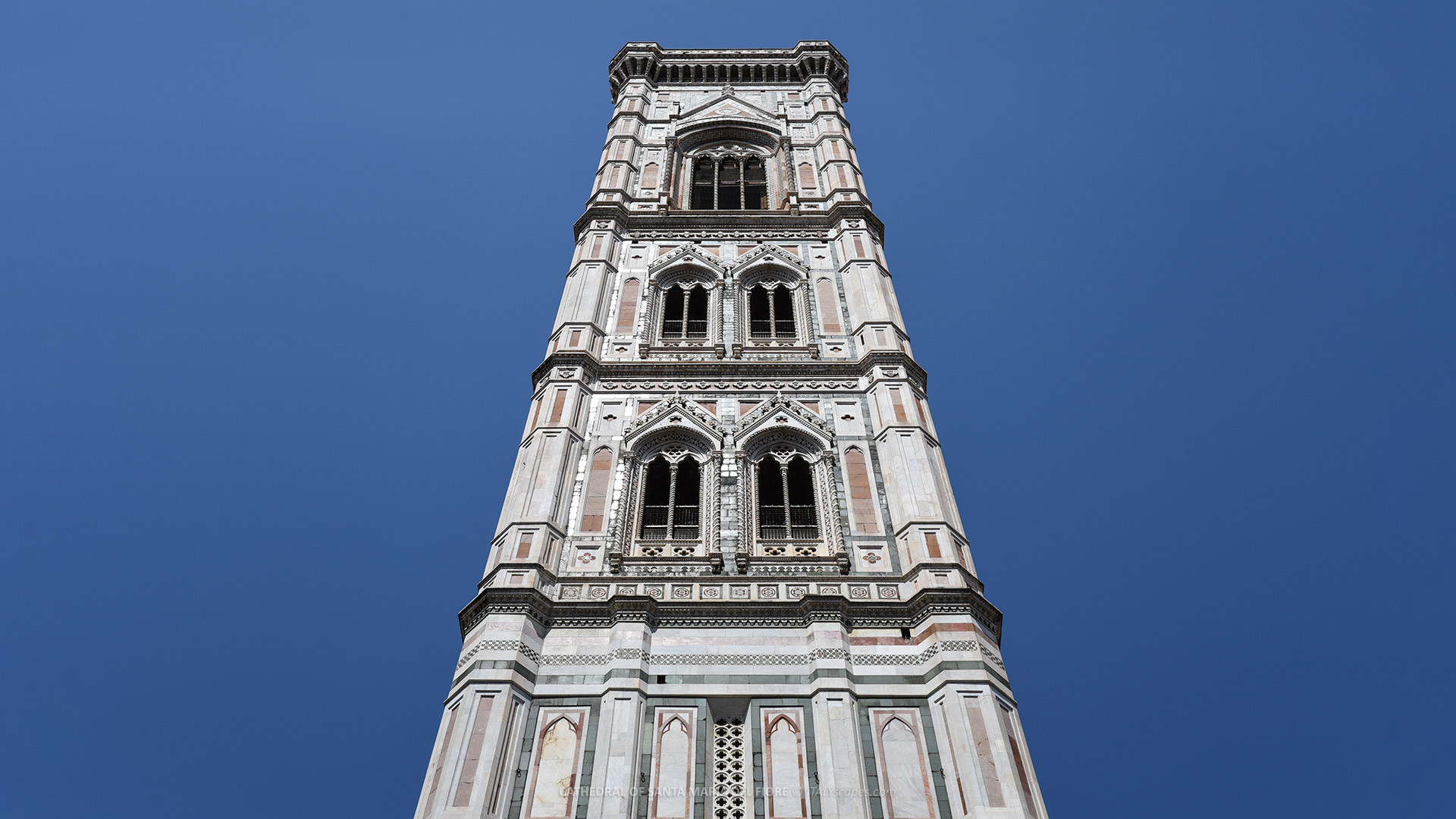
Giotto’s Campanile
Art of the Cathedral of Santa Maria del Fiore (Florence Cathedral)
The Counter-Façade and Paolo Uccello’s Clock
One of the most unusual works inside the cathedral is the liturgical clock painted by Paolo Uccello in 1443. It is located on the counter-façade and is decorated with the heads of the Evangelists in the corners.
The clock uses the hora italica, a historical time system in which the day was divided into 24 hours beginning at sunset or vespers. It is one of the rare surviving clocks of this type still associated with a major religious building.
Near the central portal is a mosaic of the Coronation of the Virgin, traditionally attributed to Gaddo Gaddi. The counter-façade also includes funerary and devotional works, reflecting the cathedral’s role as a civic, religious, and commemorative space.
Civic Monuments in the Nave
Several important works in the nave reflect the public function of the cathedral. In the 15th century, Florence wanted to honor major figures of the city’s history, turning parts of the cathedral into a kind of civic memorial space.
The fresco Dante with the Divine Comedy, painted by Domenico di Michelino in 1465, is one of the best-known works in the church. It shows Dante holding his poem, with Florence, the mountain of Purgatory, and symbolic elements of the afterlife.
The left wall includes two famous equestrian monuments painted in fresco. Paolo Uccello‘s Monument to John Hawkwood dates from 1436, while Andrea del Castagno‘s Monument to Niccolò da Tolentino was painted in 1456.
Stained Glass and Sculptures
The cathedral’s stained-glass windows were produced mainly between 1434 and 1455. They form an exceptional artistic cycle, both for their number and for the importance of the artists involved in their design.
Lorenzo Ghiberti supplied many of the designs, while other windows are linked to Donatello, Paolo Uccello, and Andrea del Castagno. The images include saints, prophets, New Testament scenes, and episodes connected with the Virgin Mary.
Inside the cathedral are also large sculptures placed in aedicules and niches. Many represent apostles, prophets, or biblical figures. Some were originally intended for other parts of the cathedral, including the façade, the bell tower, or the tribunes.
Choir, Sacristies, and Sacred Furnishings
The area beneath the dome contains the choir and presbytery. The 16th-century choir enclosure was designed by Baccio Bandinelli and Giuliano di Baccio d’Agnolo, although it was later altered during 19th-century restorations.
The present high altar dates from the liturgical reorganization of 1973. Behind it are older sacred furnishings, including a wooden episcopal chair and a polychrome wooden crucifix by Benedetto da Maiano, made around 1495.
The two sacristies contain important Renaissance works. The Sacristy of the Masses preserves remarkable wooden intarsia panels with strong perspective effects, linked to artists such as Alesso Baldovinetti, Maso Finiguerra, and Antonio del Pollaiolo.
The sacristies also include glazed terracotta works by Luca della Robbia. One of them, the Sacristy of the Masses, is historically famous because Lorenzo de’ Medici took refuge there during the Pazzi Conspiracy of April 26, 1478.
The Last Judgment Inside the Dome
The interior of Brunelleschi’s dome is covered by the vast fresco of the Last Judgment, painted between 1572 and 1579. The work was begun by Giorgio Vasari and completed after his death by Federico Zuccari and collaborators.
The fresco covers about 3,600 square meters, making it one of the most imposing painted cycles in Florence. Its iconographic program includes Christ in Glory, the Virgin Mary, saints, angels, virtues, gifts of the Holy Spirit, beatitudes, Hell, and the deadly sins.
Vasari died in 1574, after completing only part of the project. Zuccari changed parts of the style and technique, using more dry painting methods and introducing a vivid range of figures, costumes, and contemporary portraits.
The fresco is best understood from two viewpoints. From the floor of the cathedral, the figures appear arranged for distant viewing. During the climb to the dome, visitors can see the distortions and painterly techniques used to make the composition effective from below.
Santa Reparata and the Underground Level
Below the cathedral are the archaeological remains of Santa Reparata, the earlier cathedral of Florence. Excavations carried out between 1965 and 1974 revealed a complex historical sequence, including Roman remains, early Christian pavements, and medieval structures.
The underground area also contains the tomb of Filippo Brunelleschi, located near the entrance to the excavations. His burial inside the cathedral confirms the exceptional honor given to the architect who solved the problem of the dome.
Astronomy in the Cathedral
The Florence Cathedral also contains an important astronomical instrument. In 1475, the astronomer Paolo dal Pozzo Toscanelli installed a gnomonic device using a circular opening in the lantern area, around 90 meters above the cathedral floor.
The hole, about 4 centimeters in diameter, projected an image of the sun onto the floor of the cathedral. This allowed observations connected with the summer solstice and the measurement of the solar year.
In 1755, Leonardo Ximenes updated the system with a graduated bronze meridian line. The instrument was used for scientific observations before more precise and compact astronomical tools made it obsolete.
How to Get to the Cathedral of Santa Maria del Fiore (Florence Cathedral)
Getting to the Cathedral of Santa Maria del Fiore on foot
The Cathedral of Santa Maria del Fiore is located in Piazza del Duomo, in the compact historic center of Florence. From Firenze Santa Maria Novella railway station, the walk to the cathedral usually takes about 10 minutes, following Via Panzani and Via de’ Cerretani.
The walking distance is roughly 800 meters, depending on the exact exit from the station and the route chosen.
From Piazza della Signoria, the cathedral is about 500 meters away. From the Uffizi Gallery, the distance is around 700 meters. From Ponte Vecchio, it is about 850 meters, making Florence Cathedral easy to include in a first-time walking itinerary.
Getting to the Cathedral of Santa Maria del Fiore by bus
The closest bus stops are near the pedestrian area around Piazza del Duomo. The Studio stop is one of the nearest, located only a short walk from the cathedral complex. Urban lines serving the area can include C1, C2, 20, and 23, depending on current routes.
Getting to the Cathedral of Santa Maria del Fiore by Taxi
A taxi can be useful for travelers with luggage, mobility limitations, or accommodation outside the historic center. However, the area around Florence Cathedral is affected by pedestrian restrictions and the ZTL, the limited traffic zone of the historic center.
Taxis can enter some restricted central areas, but they may not always drop passengers directly beside the cathedral. In many cases, the closest practical drop-off points are nearby streets such as Via de’ Cerretani, Piazza San Giovanni, or other permitted points near Piazza del Duomo.
From Firenze Santa Maria Novella station, a taxi ride is short, but walking is often simpler if luggage is light.
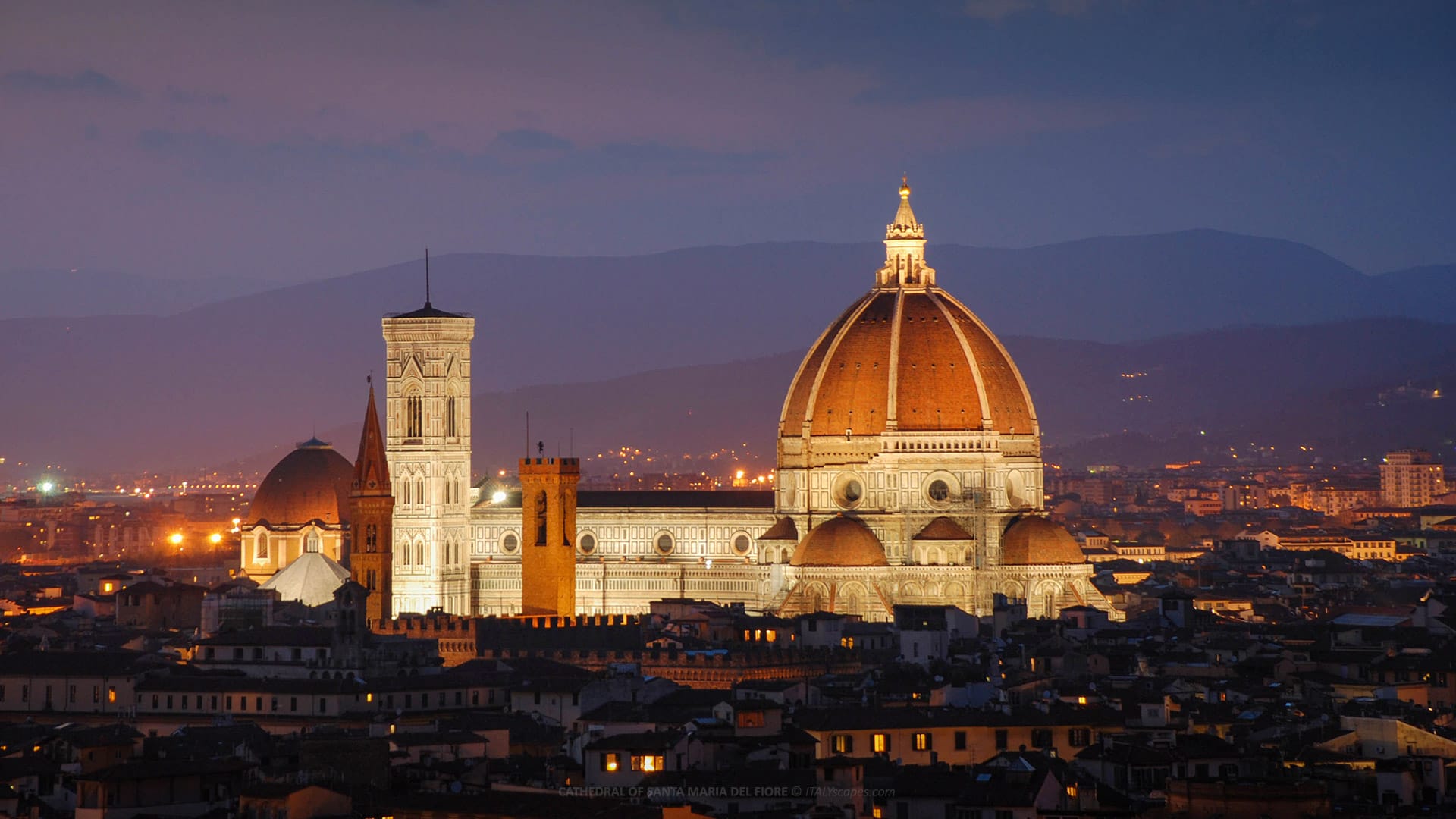
View of the Cathedral of Santa Maria del Fiore from Piazzale Michelangelo
Frequently Asked Questions about the Cathedral of Santa Maria del Fiore (Florence Cathedral)
Where is Florence Cathedral located?
Florence Cathedral is located in Piazza del Duomo, in the historic center of Florence. It stands beside Giotto’s Bell Tower, the Baptistery of San Giovanni, and the Opera del Duomo Museum.
When was the Cathedral of Santa Maria del Fiore built?
Construction began in 1296 under Arnolfo di Cambio. The cathedral was consecrated in 1436, after Brunelleschi completed the dome, while the present façade was finished in 1887.
How tall is Florence Cathedral?
Florence Cathedral reaches about 116.5 meters in height, including Brunelleschi’s dome, lantern, and cross. The dome dominates the skyline of Florence and is visible from many viewpoints.
Can visitors climb the dome of Florence Cathedral?
Yes, visitors can climb Brunelleschi’s dome by following a route of 463 steps. The climb passes between the dome’s two shells and offers panoramic views over Florence.
Why is Florence Cathedral important?
Florence Cathedral is important for its size, artistic value, engineering achievements, and civic meaning. Brunelleschi’s dome became a landmark of Renaissance architecture and a symbol of Florence.
How far is Florence Cathedral from Santa Maria Novella station?
Florence Cathedral is about 800 meters from Firenze Santa Maria Novella railway station. The walk usually takes around 10 minutes through Via Panzani and Via de’ Cerretani.
How much does it cost to visit Florence Cathedral?
Entry to Florence Cathedral is free, without booking or ticket. Tickets are required for the Dome, Bell Tower, Baptistery, Museum, and Santa Reparata, with the full Brunelleschi Pass costing €30.
Sources:Buy tickets & tours:GetYourGuide -
Photos
-
Video
Table of Contents
-
Map
-
Reviews