-
About
Table of Contents
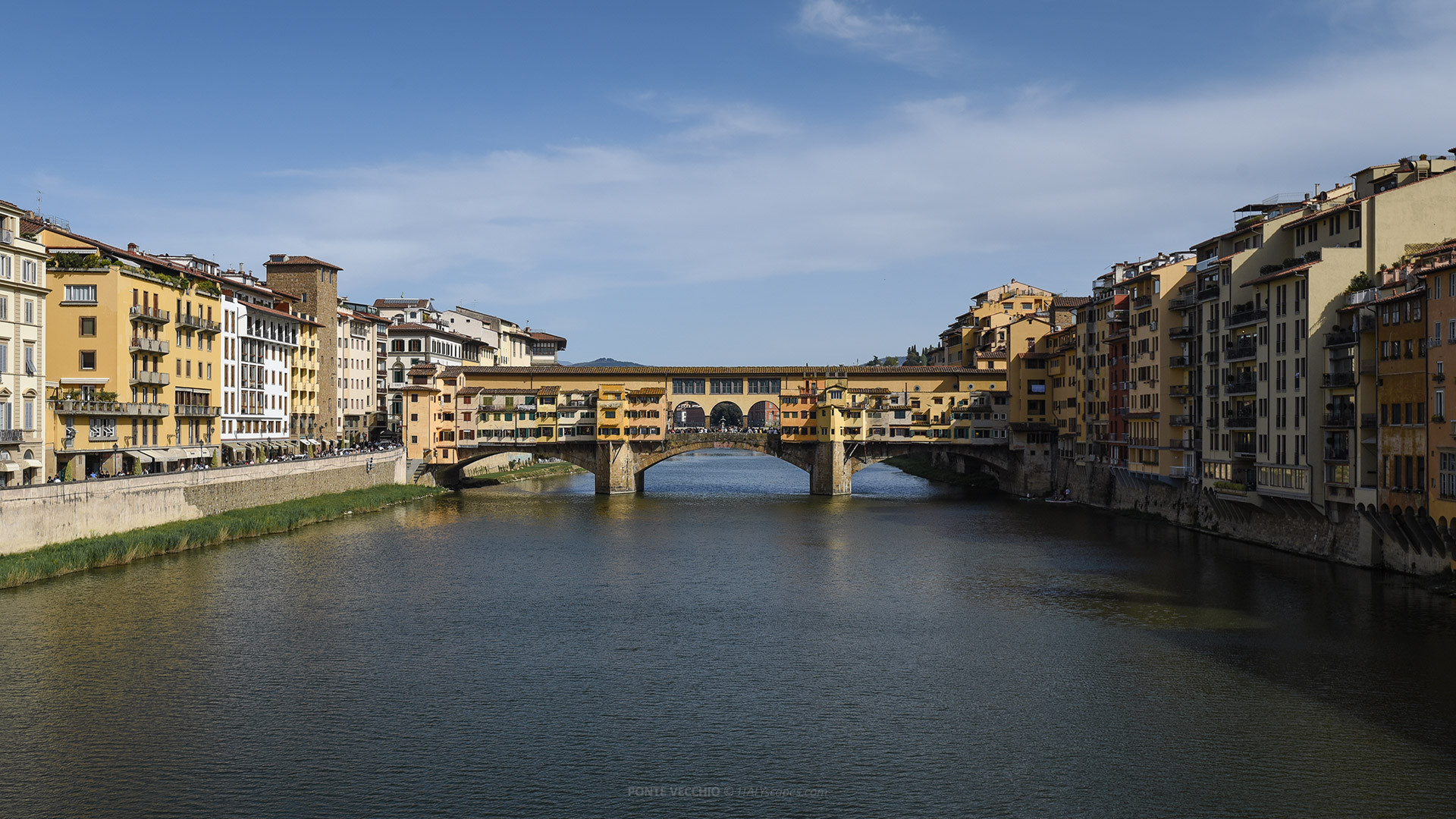
Ponte Vecchio is the oldest surviving bridge in Florence and one of the most famous landmarks in Tuscany. It crosses the Arno River in the historic center, linking the northern side of the city with the Oltrarno district, between Via Por Santa Maria and Via de’ Guicciardini.
The bridge stands close to several major attractions, including Piazza della Signoria, the Uffizi Galleries, Palazzo Pitti, and the riverside streets known as Lungarni. Its position makes it one of the most visited points in Florence and one of the easiest monuments to include in a walking route.
Ponte Vecchio is about 95 meters long and approximately 20 meters wide. It is not only a bridge, but also a built street lined with shops. Its present structure dates mainly from 1345, after earlier bridges in the same area were destroyed by floods.
The bridge is famous for its jewelers, goldsmiths, medieval shops, and the Vasari Corridor above the eastern side. These elements make it different from most European bridges, because it combines transport, commerce, architecture, political history, and urban life in a single monument.
Ponte Vecchio is also important because it survived major disasters, including the flood of 1966 and the destruction of Florence’s other Arno bridges during the Second World War. Today, it remains a pedestrian passage, a commercial landmark, and one of the strongest symbols of Florence.
Short History of Ponte Vecchio
Ancient and Medieval Crossings Over the Arno
The site of Ponte Vecchio was important long before the current bridge was built. The Arno is relatively narrow in this part of Florence, making it a natural crossing point. Ancient routes probably passed near this area, connecting the Roman city with roads leading through Tuscany and central Italy.
Florence developed around the river, and a bridge in this position became essential for trade, movement, and military control. Earlier crossings probably combined stone supports with wooden upper structures. Such bridges were practical, but they were vulnerable to floods, fire, and damage caused by the force of the Arno.
Medieval Florence depended heavily on river crossings. The city expanded on both sides of the Arno, and the bridge connected markets, workshops, religious buildings, and residential quarters. Its position helped link the political center of Florence with the area that later became known as the Oltrarno.
The Flood of 1333 and the Bridge of 1345
The previous medieval bridge was destroyed by the disastrous flood of 1333. This flood damaged large parts of Florence and demonstrated how dangerous the Arno could be. The destruction forced the city to rebuild the crossing with a stronger and more modern structure.
The present Ponte Vecchio was completed in 1345. Historical tradition often connects the design with Taddeo Gaddi, while other studies mention Neri di Fioravante, an important master builder active in Florence. The exact authorship remains debated, but the engineering solution was advanced for its time.
The new bridge used three large segmental arches instead of many smaller semicircular arches. This reduced the number of supports in the river and allowed water to pass more freely beneath the structure. It was a practical response to the repeated flood damage suffered by earlier bridges.
The bridge quickly became more than an infrastructure project. It functioned as a commercial street over the Arno, with shops occupying both sides of the passage. This combination of crossing and marketplace shaped the identity of Ponte Vecchio for centuries and remains visible today.
Butchers, Food Sellers and Medieval Commerce
In the Middle Ages, Ponte Vecchio was occupied by shops connected with everyday trade. Butchers, fishmongers, and food sellers worked on the bridge because the location was practical. Waste could be removed toward the river, keeping unpleasant activities away from more prestigious streets and squares.
In 1442, the Florentine authorities officially assigned many shops on Ponte Vecchio to butchers. This decision strengthened the bridge’s role as a food market. At that time, the bridge was noisy, busy, and functional, very different from the elegant jewelry district visitors see today.
The shops were gradually transformed from simple commercial spaces into permanent built structures. In 1495, many bridge shops were sold to private owners. After that, shopkeepers modified and expanded their premises, especially toward the river, creating the irregular external appearance still visible from the Lungarni.
The Medici and the Vasari Corridor
A major change came in 1565, when Cosimo I de’ Medici commissioned Giorgio Vasari to build an elevated passage through central Florence. This private route, known as the Vasari Corridor, connected Palazzo Vecchio, the Uffizi area, and Palazzo Pitti.
The corridor allowed the Medici family to move safely and privately between the seat of government and their residence across the river. It passed above the shops of Ponte Vecchio, and was approximately 750 meters long.
At the southern end of the bridge, the corridor bends around the Torre dei Mannelli. The Mannelli family refused to allow their tower to be demolished, so Vasari designed the passage around it. This detail remains one of the most interesting architectural compromises in Florence.
From Butchers to Goldsmiths
The Medici later changed the commercial identity of Ponte Vecchio. In 1593, Ferdinando I de’ Medici ordered the removal of butchers from the bridge. Their trade was considered unsuitable for a route used by the ruling family and for the prestigious image of the city.
After the butchers were removed, the shops were assigned mainly to goldsmiths and jewelers. This decision created the identity that Ponte Vecchio still has today. The bridge became associated with luxury craft, precious metals, refined commerce, and the artistic traditions of Renaissance Florence.
Goldsmiths were not random replacements. Florence had a strong tradition of metalwork, jewelry, and decorative arts. The change improved the smell, appearance, and social status of the bridge. It also connected Ponte Vecchio with the city’s broader reputation for craftsmanship and artistic production.
Today, many shops on the bridge still sell jewelry, gold objects, watches, and precious items. Although the commercial context is now shaped by tourism, the presence of jewelers continues a tradition established at the end of the sixteenth century by Medici policy.
War, Floods and Modern Survival
Ponte Vecchio survived one of the most dramatic moments in Florence’s modern history during the Second World War. In 1944, retreating German forces destroyed the other bridges over the Arno in central Florence. Ponte Vecchio itself was spared, although buildings at both ends were demolished.
Another major event was the flood of 4 November 1966. The Arno rose violently and devastated Florence, damaging artworks, archives, churches, shops, and homes. Ponte Vecchio resisted the force of the flood, but the water and mud affected the bridge and its commercial spaces.
The 1966 flood became part of the modern history of Ponte Vecchio. Like many monuments in Florence, the bridge required cleaning, restoration, and conservation work. Its survival confirmed the strength of the medieval structure, but also showed the continuing vulnerability of Florence to the Arno.
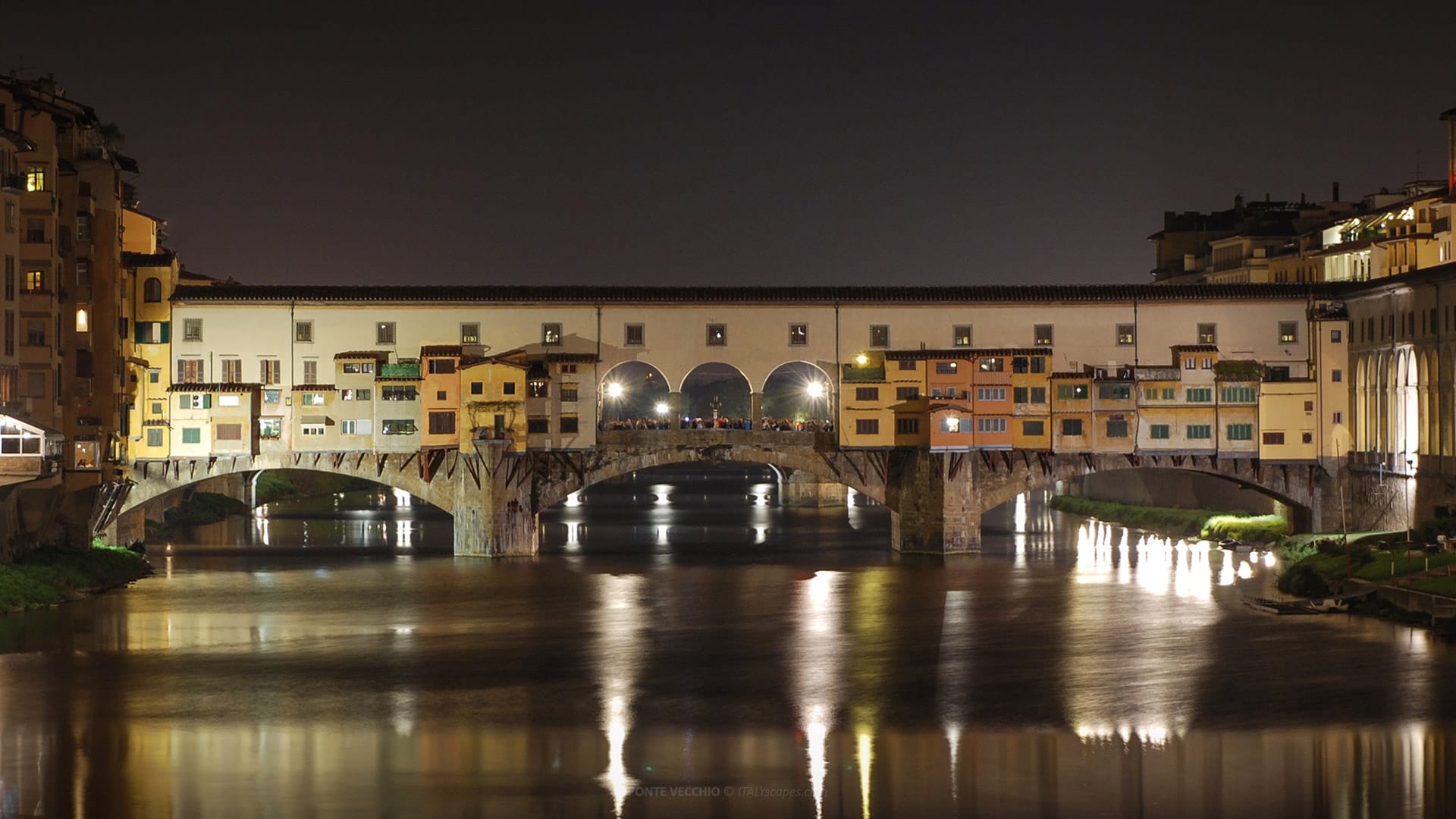
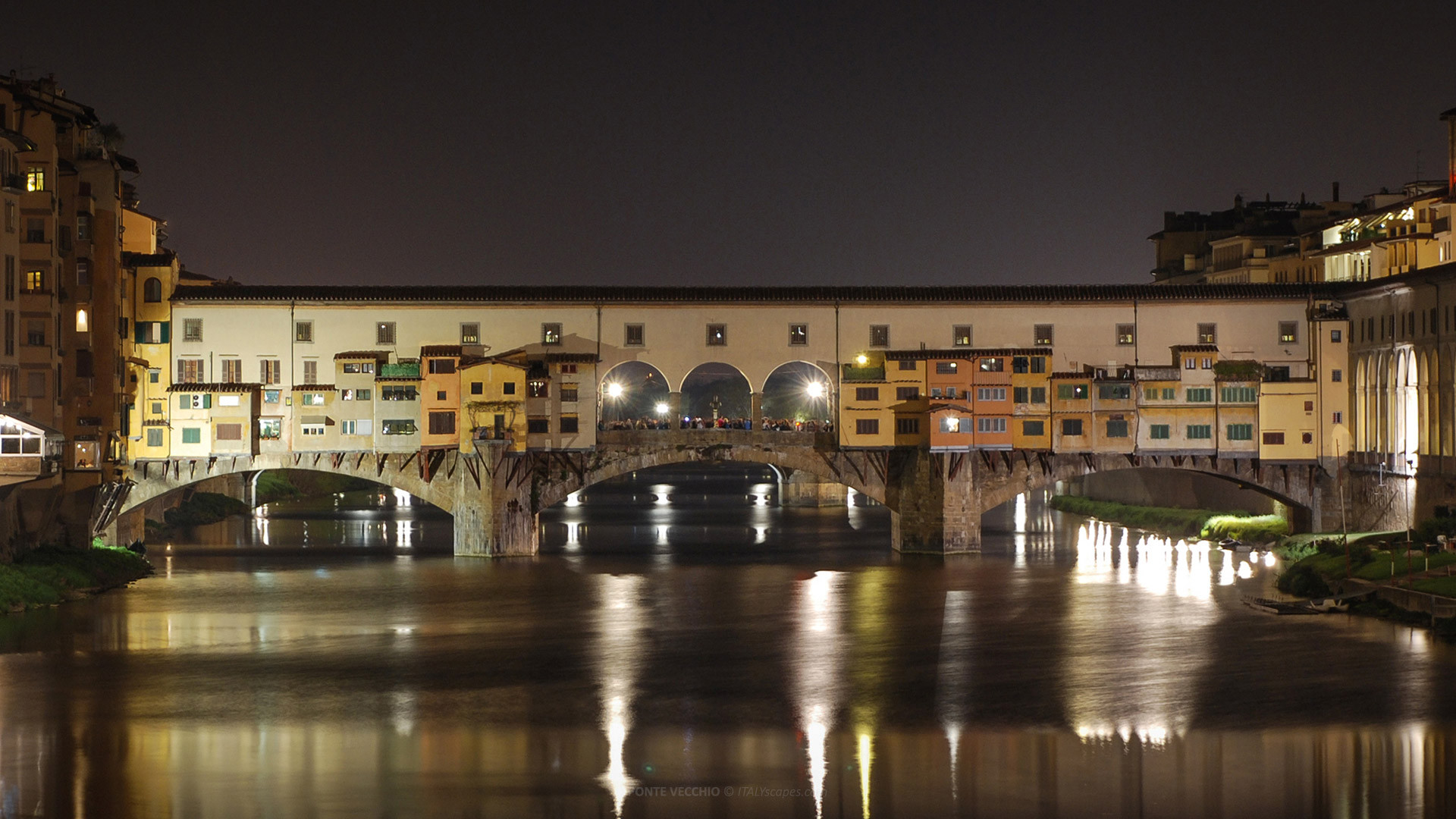
Ponte Vecchio at night
Architecture of Ponte Vecchio
Structure, Dimensions and Materials
Ponte Vecchio is a stone segmental arch bridge built mainly with pietraforte, a strong sandstone used in many Florentine buildings. The bridge measures about 95 meters in length and approximately 20 meters in width, making it short but unusually broad for a medieval crossing.
The bridge has three arches. The central arch spans around 30 meters, while the two side arches span around 27 meters each. This layout reduced the number of supports in the river and improved the passage of water during normal flow and flood conditions.
The arches are not full semicircles. They are segmental arches, which are flatter and wider. This architectural solution allowed the roadway to remain less steep, making the bridge more comfortable for people, animals, and goods moving between the two sides of Florence.
The Bridge as a Built Street
One of the most unusual aspects of Ponte Vecchio is that it functions like a street. Shops line both sides of the passage, leaving a narrow pedestrian route through the middle. Visitors walking across often feel they are inside a small commercial lane rather than on a bridge.
This built-street character developed over time. The shops were originally practical market spaces, then became more permanent and elaborate. Their doors, shutters, display windows, and signs create a dense urban setting above the Arno, unlike the open profile of most bridges.
The central part of Ponte Vecchio opens toward the river on both sides. These openings provide views of the Arno and the nearby bridges, especially Ponte Santa Trinita to the west. They also create a pause in the line of shops and mark the visual center of the bridge.
Shops and Irregular River Façades
From the outside, Ponte Vecchio looks irregular because many shops project over the river. These rear extensions were created as commercial spaces expanded. They differ in size, shape, support, and appearance, giving the bridge a varied façade that contrasts with its simple structural arches.
The rear parts of the shops are especially visible from the Lungarni and nearby bridges. They look like compact rooms attached to the sides of the bridge, sometimes supported by brackets and projecting elements. This layered appearance records centuries of private modifications above the medieval structure.
The difference between the orderly arches below and the irregular shops above is one of the bridge’s strongest visual features. The lower part expresses medieval engineering, while the upper part shows commercial adaptation. Together, they make Ponte Vecchio immediately recognizable from the riverbanks.
The Vasari Corridor
The Vasari Corridor is one of the most important architectural additions to Ponte Vecchio. Built in 1565, it runs above the eastern side of the bridge and forms part of a longer elevated passage between the political and residential centers of Medici Florence.
On the bridge, the corridor is visible as a continuous upper structure above the shops. It is more discreet than the commercial level, but historically very important. Its function was private movement, not public passage, which created a clear division between rulers above and merchants below.
The Monument to Benvenuto Cellini
At the center of the bridge stands the monument to Benvenuto Cellini, one of Florence’s most famous goldsmiths and sculptors. The bronze bust was created by Raffaello Romanelli and installed in 1900, marking the fourth centenary of Cellini’s birth.
The monument is placed in a central opening where visitors can stop and look toward the river. Its location is appropriate because Ponte Vecchio has been associated with goldsmiths and jewelers since the late sixteenth century. Cellini represents this artistic and craft tradition.
Benvenuto Cellini worked as a goldsmith, sculptor, and writer, and he remains one of the most famous figures of Florentine artistic culture.
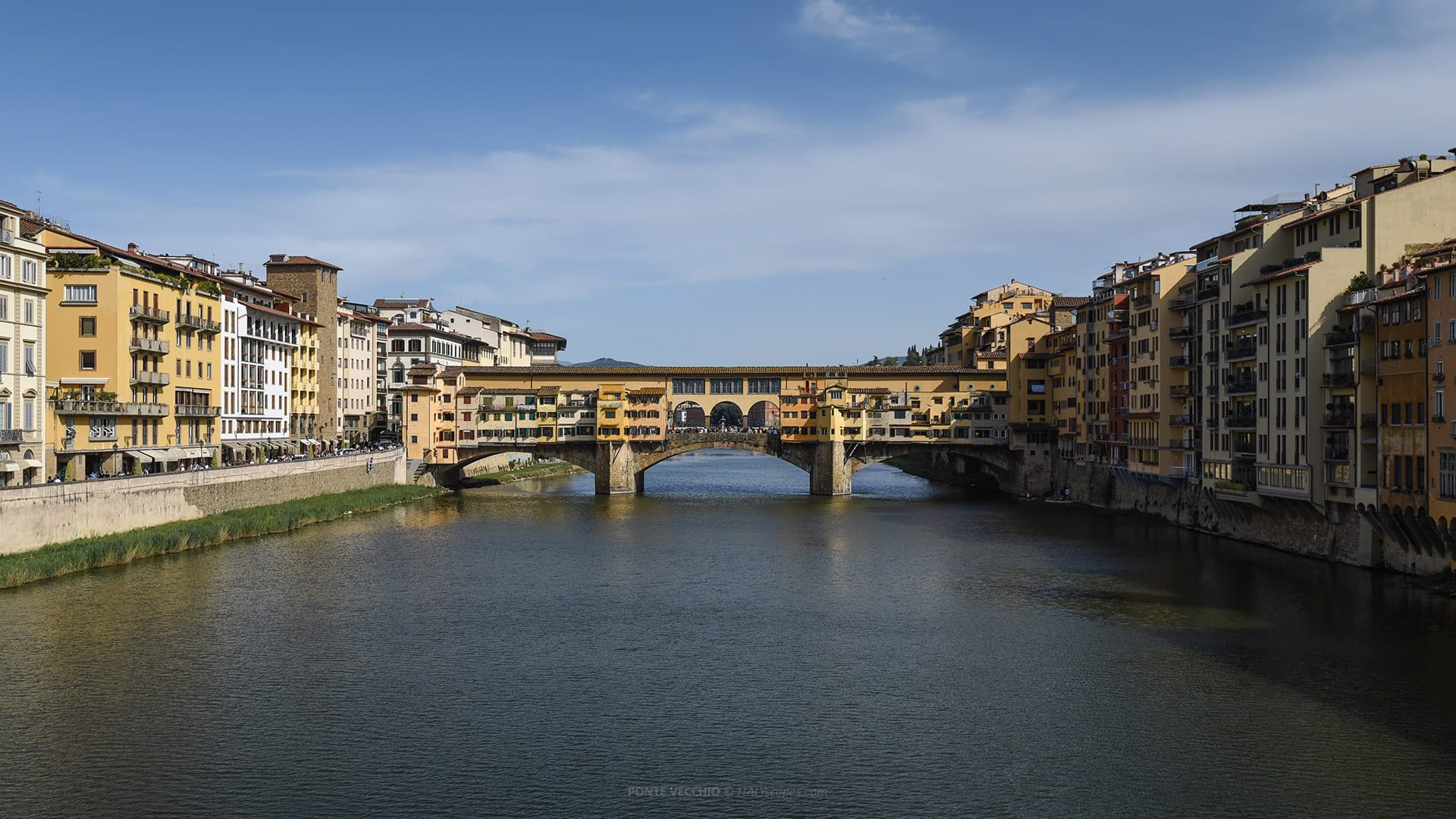
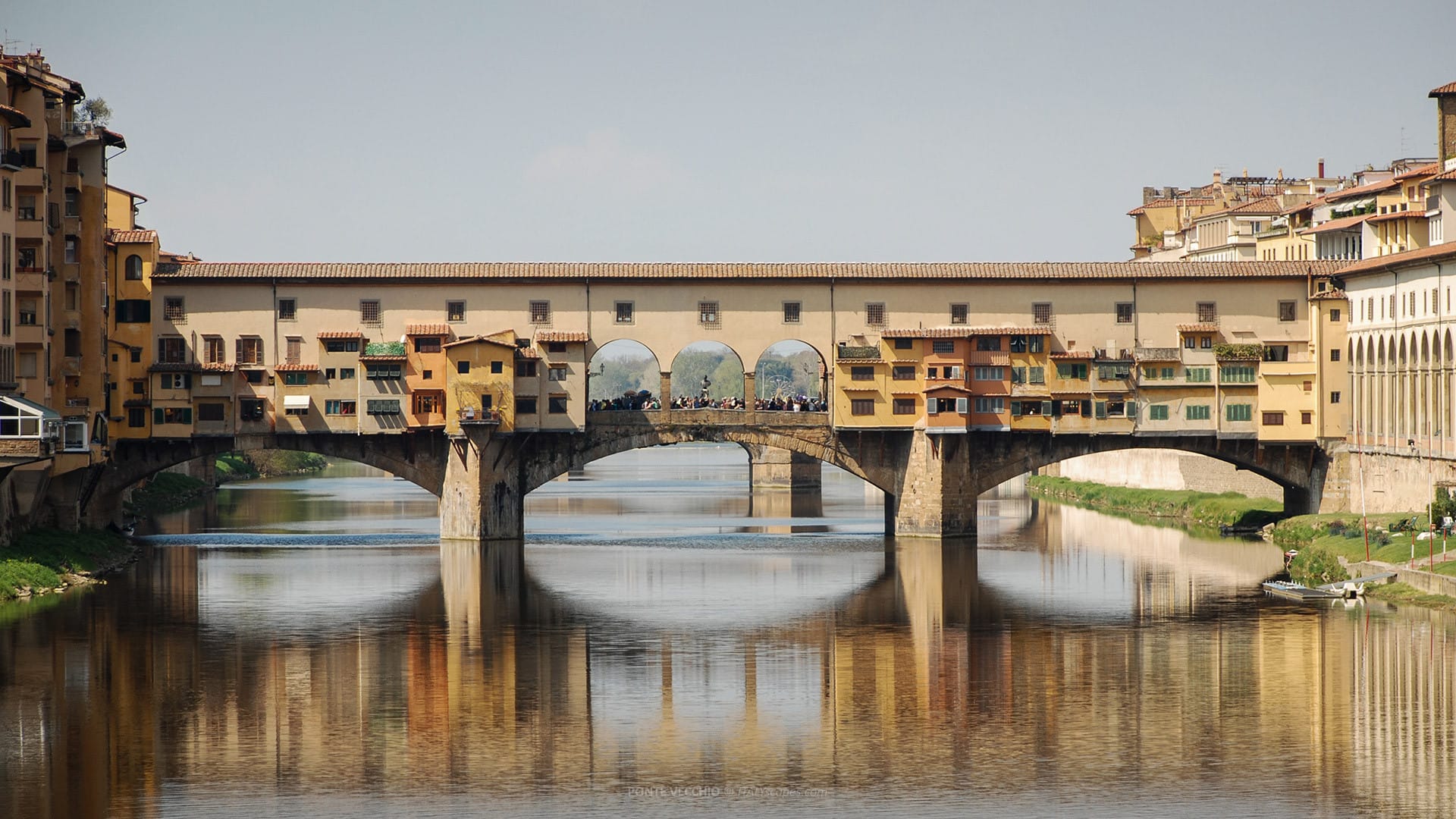
Ponte Vecchio, western façade
How to Get to Ponte Vecchio
Ponte Vecchio is located in the historic center of Florence, crossing the Arno between the central area near the Uffizi Galleries and the Oltrarno district near Palazzo Pitti. Its northern entrance is close to Via Por Santa Maria, while its southern side leads toward Via de’ Guicciardini.
Ponte Vecchio is pedestrianized, so cars and ordinary traffic do not cross it. Visitors usually arrive on foot, even when using buses or taxis for part of the journey.
Getting to Ponte Vecchio on foot from Santa Maria Novella
From Firenze Santa Maria Novella railway station, Ponte Vecchio is about 1 to 1.2 kilometers away, depending on the route. A normal walk takes around 15 minutes, although it may take longer with luggage, crowds, or stops in the historic center.
A practical route starts from the station and continues toward Piazza di Santa Maria Novella. From there, walk toward the central shopping streets, then continue through the historic center toward Via Por Santa Maria, which leads directly to the northern entrance of Ponte Vecchio.
Another useful route passes near Piazza della Repubblica. From the station, walk toward the square, then continue south through the central streets until you reach Via Por Santa Maria. This route is simple, lively, and convenient for visitors who want to see more of central Florence.
Getting to Ponte Vecchio by bus
Florence’s urban buses are operated by Autolinee Toscane. Buses do not cross Ponte Vecchio, but several lines stop within walking distance of the bridge. The best stop depends on your starting point, because central Florence has traffic restrictions and routes may change.
Visitors arriving by bus should look for stops near the Arno, the Uffizi area, Piazza della Repubblica, or the Oltrarno side. From these areas, Ponte Vecchio is usually only a few minutes away on foot. The final approach is almost always pedestrian.
Small central lines, including routes such as C3 and C4, are often useful for moving near the historic center. Other urban lines may also stop close enough, depending on direction and schedule.
Getting to Ponte Vecchio by taxi
From Santa Maria Novella station, the taxi ride to the area near Ponte Vecchio is short, often around 10 minutes, depending on traffic. The distance is small, so a taxi is most useful with heavy luggage, rain, mobility problems, or accommodation near the Oltrarno side.
For the northern side, a useful drop-off point is near the streets leading to Via Por Santa Maria, the Uffizi area, or the Lungarno north of the river. From there, the bridge is reached on foot in a few minutes through the historic center.
For the southern side, ask for a stop near Borgo San Jacopo, Via de’ Bardi, or the area close to Via de’ Guicciardini. These streets are near the Oltrarno entrance to the bridge and are convenient for reaching Palazzo Pitti after crossing.
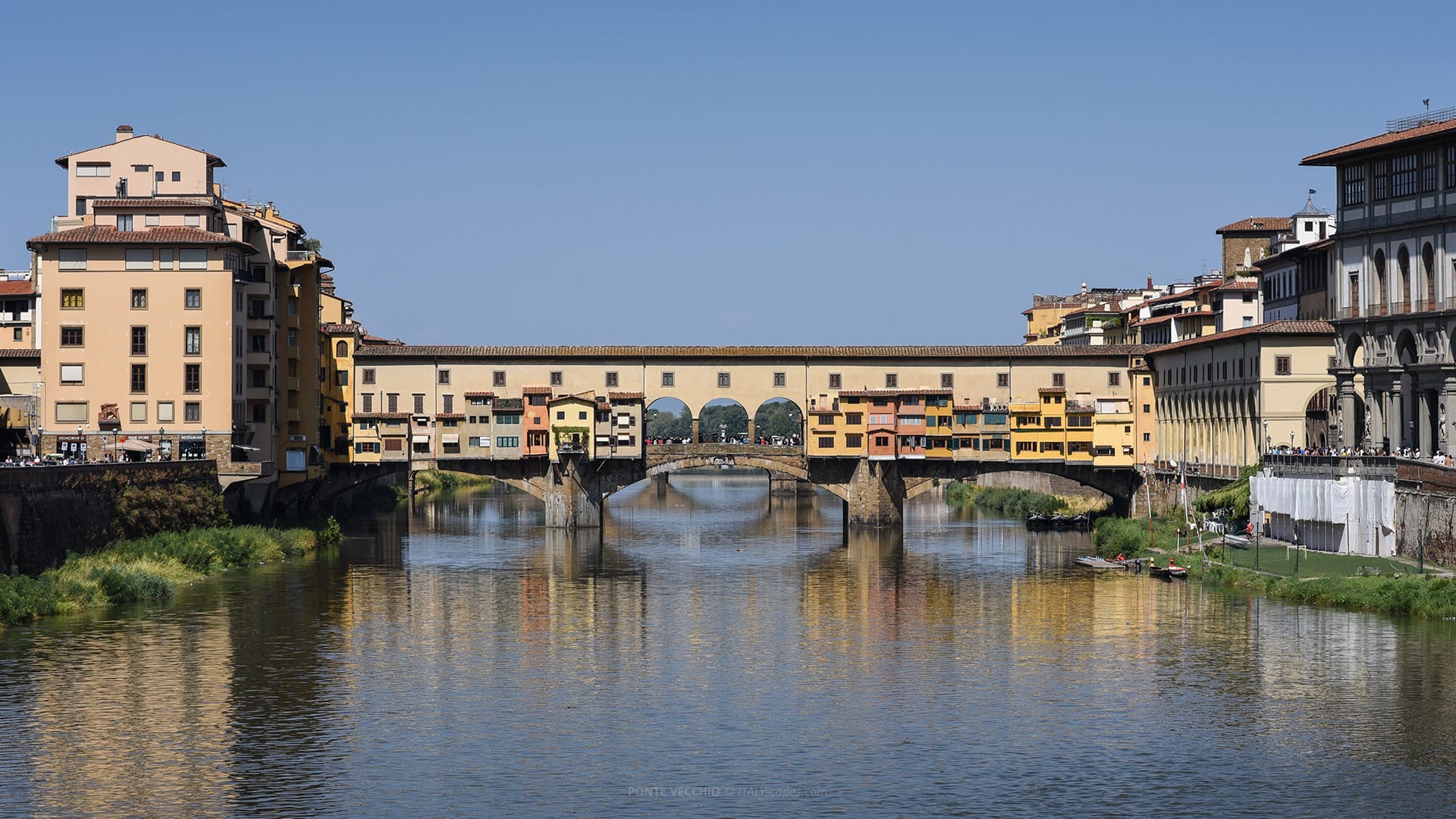
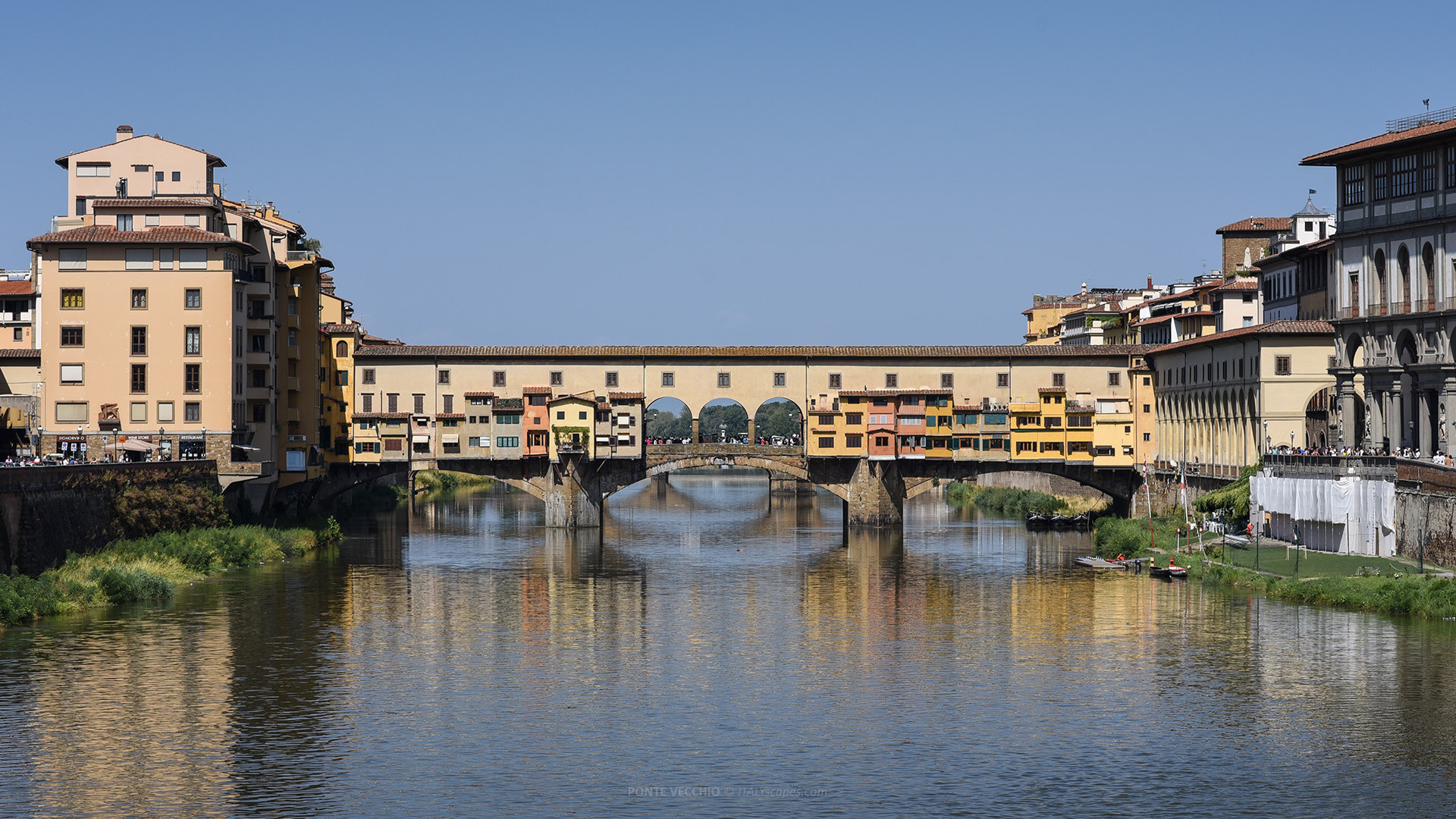
Ponte Vecchio, eastern façade
Frequently Asked Questions about Ponte Vecchio
Where is Ponte Vecchio located?
Ponte Vecchio is located in the historic center of Florence, crossing the Arno River between Via Por Santa Maria and Via de’ Guicciardini, close to the Uffizi and Palazzo Pitti.
What does Ponte Vecchio mean?
Ponte Vecchio means Old Bridge in Italian. The name reflects its status as the oldest surviving bridge in Florence and the traditional crossing point over the Arno.
When was Ponte Vecchio built?
The present Ponte Vecchio was completed in 1345, after an earlier bridge was destroyed by the flood of 1333. Older bridges existed in the same area before it.
How long is Ponte Vecchio?
Ponte Vecchio is about 95 meters long and approximately 20 meters wide. Its compact size contrasts with its major historical, architectural, and commercial importance.
Why is Ponte Vecchio famous?
Ponte Vecchio is famous for its medieval shops, goldsmiths, Vasari Corridor, and views over the Arno River, making it one of Florence’s symbols.
What shops are on Ponte Vecchio?
Most shops on Ponte Vecchio are jewelry shops, goldsmiths, and luxury craft stores. This tradition began in 1593, when butchers were replaced by goldsmiths.
What is the Vasari Corridor?
The Vasari Corridor is a Renaissance elevated passage built in 1565 by Giorgio Vasari for Cosimo I de’ Medici, connecting Palazzo Vecchio, the Uffizi, Ponte Vecchio, and Palazzo Pitti.
How far is Ponte Vecchio from Santa Maria Novella?
Ponte Vecchio is about 1 to 1.2 kilometers from Firenze Santa Maria Novella station. The walk normally takes around 15 minutes, depending on route and crowds.
Sources: -
Photos
-
Map
-
Reviews