-
About
Table of Contents
Buy tickets & tours:GetYourGuideBasilica di Santa Croce (Basilica of the Holy Cross) is one of the most important religious monuments in Florence and one of the major Franciscan churches in Europe. It stands in Piazza Santa Croce, in the eastern part of the historic center, not far from the Arno River, the Uffizi area, and the medieval streets around Borgo Santa Croce.
Basilica di Santa Croce is about 115 meters long and 38 meters wide, making it one of the largest churches in Florence. Its monumental complex covers about 12,000 square meters and includes cloisters, chapels, museum spaces, and convent buildings.
Basilica di Santa Croce is also known as the Temple of the Italian Glories because it preserves or commemorates many important figures in Italian history. Among the people buried or honored here are Michelangelo Buonarroti, Galileo Galilei, Niccolò Machiavelli, Vittorio Alfieri, Ugo Foscolo, and Gioachino Rossini.
The basilica is not only a burial place. It is also one of Florence’s richest artistic sites, with works connected to Giotto, Agnolo Gaddi, Taddeo Gaddi, Donatello, Filippo Brunelleschi, Giorgio Vasari, Bronzino, and Antonio Canova.
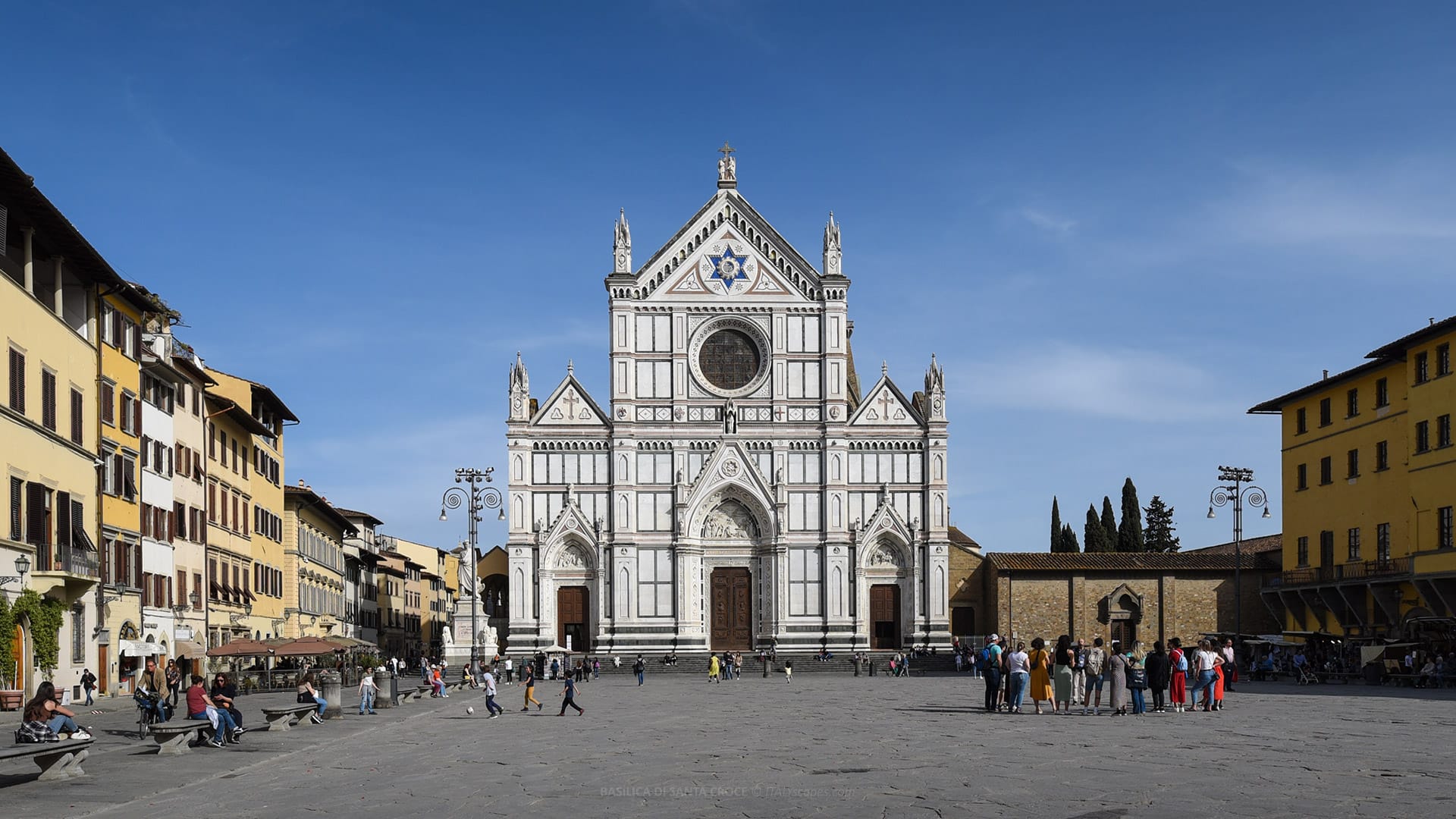
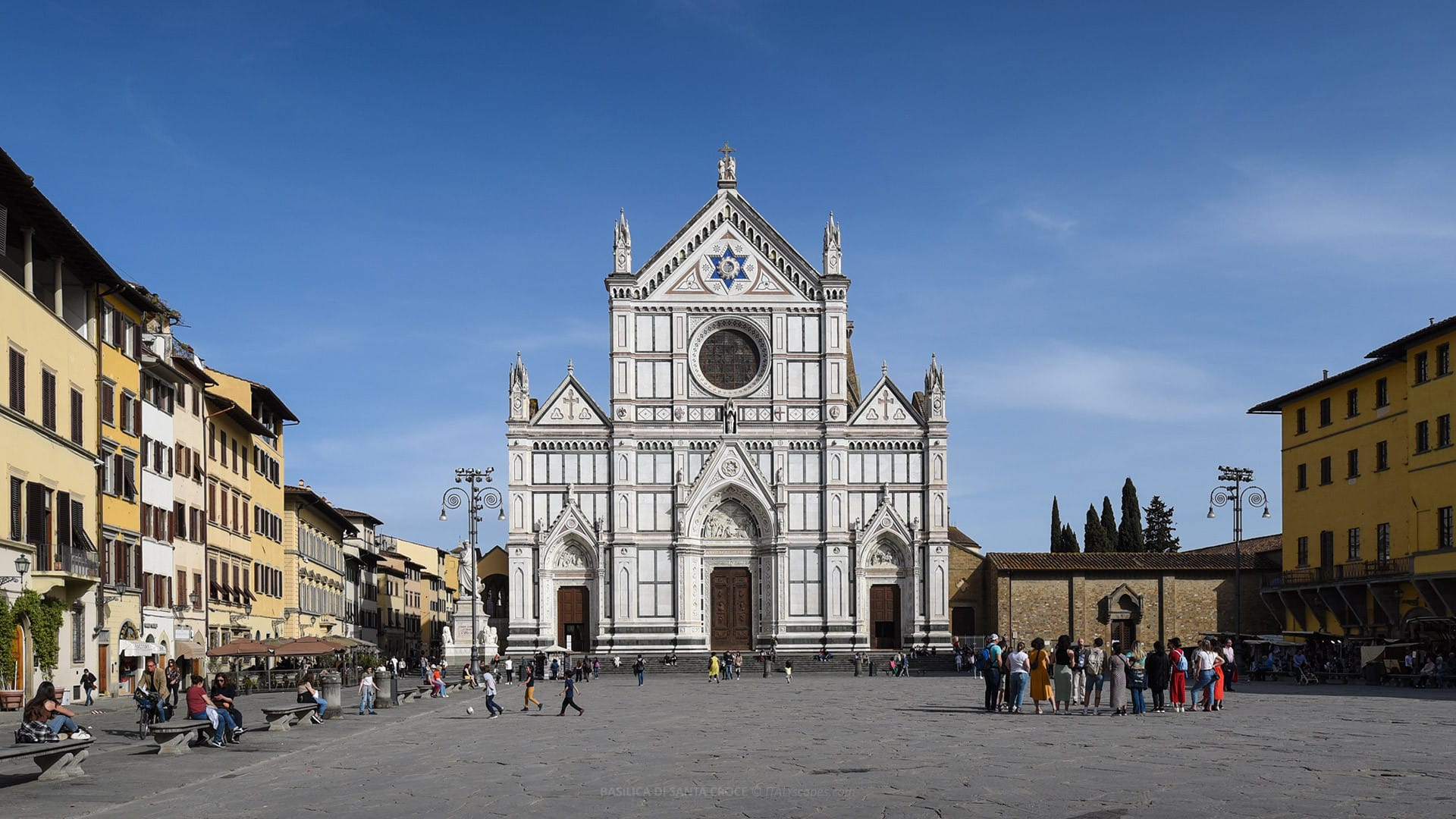
Basilica di Santa Croce overlooking the square of the same name
Short History of Basilica di Santa Croce
The Franciscan Origins
The history of the Basilica di Santa Croce began with the arrival of the Franciscan movement in Florence. According to tradition, the first companions of Saint Francis of Assisi reached the city as early as 1209. They settled in a low-lying area near the north bank of the Arno, outside the oldest urban core.
This district was inhabited by workers, craftsmen, and new arrivals connected with Florence’s expanding wool trade. The Franciscans, like other mendicant orders, often chose areas close to ordinary urban life. The first church of Santa Croce is documented in 1228, the year when Francis was canonized, two years after his death.
The earlier Franciscan church was replaced by a second building between 1252 and 1267. However, that church soon became too small for the growing congregation. Florence was expanding rapidly, and the Franciscan community needed a much larger sacred space for preaching, worship, burials, and public religious life.
The Construction of the Present Church
The foundation stone of the current church was laid on 3 May 1294, according to the Florentine chronicler Giovanni Villani. A plaque inside the basilica gives the date 1295, and modern scholars often consider that year more reliable. The project is generally attributed to Arnolfo di Cambio, the leading Florentine architect of the period.
Arnolfo di Cambio was also linked to some of Florence’s most important civic and religious buildings, including Santa Maria del Fiore and Palazzo Vecchio. At Santa Croce, he designed a large Franciscan church with a broad nave, two side aisles, pointed arches, chapels, and a spacious transept.
The chancel area was almost complete before Arnolfo died, sometime between 1302 and 1310. The transepts were roofed with painted beams in 1314, and the south transept was already in use by 1318. After that, work continued on the nave, side aisles, chapels, and convent spaces.
The church was largely complete by the end of the 14th century, although it was consecrated only in 1443 by Pope Eugene IV.
Vasari’s 16th-Century Renovation
In 1566, Duke Cosimo I de’ Medici commissioned Giorgio Vasari to remodel several Florentine convent churches, including Santa Croce. The aim was to adapt them to the new liturgical requirements of the Counter-Reformation, after the Council of Trent had emphasized visibility, order, and doctrinal clarity.
Vasari removed the medieval rood screen that separated the clergy from the lay congregation. This screen had stood between the fourth and fifth piers and had blocked a direct view toward the high altar. Its demolition changed the spatial perception of the church and opened the nave toward the chancel.
The renovation also led to the construction of fourteen symmetrical stone altars along the aisle walls. Some older frescoes and chapels were eliminated or covered. This intervention created a more uniform interior, but it also altered the medieval appearance of the Basilica di Santa Croce and caused the loss of important early decorations.
Santa Croce as the Temple of the Italian Glories
Basilica di Santa Croce gradually became the main burial place of illustrious Florentines and, later, a national memorial site. In the 15th century, the tombs of Leonardo Bruni and Carlo Marsuppini, both Chancellors of the Florentine Republic, marked an important step in this transformation.
The tradition was revived in 1564, when Cosimo de’ Medici supported the creation of a monumental tomb for Michelangelo Buonarroti. Michelangelo died in Rome, but his body was brought to Florence and buried in the Basilica di Santa Croce, where his monument became a model for later commemorative tombs.
The church later received monuments or tombs connected to Galileo Galilei, Niccolò Machiavelli, Vittorio Alfieri, Ugo Foscolo, and Gioachino Rossini. Dante Alighieri is also commemorated by a large cenotaph, although his remains are still in Ravenna, where he died in exile in 1321.
The phrase “Temple of the Italian Glories” became especially meaningful after Ugo Foscolo’s poem Dei Sepolcri, published in 1807. Foscolo presented the Basilica di Santa Croce as a place where the memory of great figures could inspire civic virtue and national consciousness.
The 19th-Century Facade and Later History
For centuries, Basilica di Santa Croce remained without a finished facade. This was common in Florence, where large medieval churches often lacked completed marble fronts for long periods. The current Neo-Gothic facade was designed by Niccolò Matas, an architect from Ancona, and completed in 1865.
The facade was finished during the celebrations for the 600th anniversary of Dante’s birth. Its white, green, and pink marble decoration recalls the great Gothic churches of Tuscany and Umbria. The design also includes a prominent Star of David, connected with the architect’s Jewish background.
Santa Croce was elevated to the honorific rank of basilica in 1933. In the 20th century, the complex also suffered serious damage during the 1966 flood of the Arno River. Because the Basilica di Santa Croce stands in a lower part of Florence, water and mud entered the church, convent, and museum spaces.
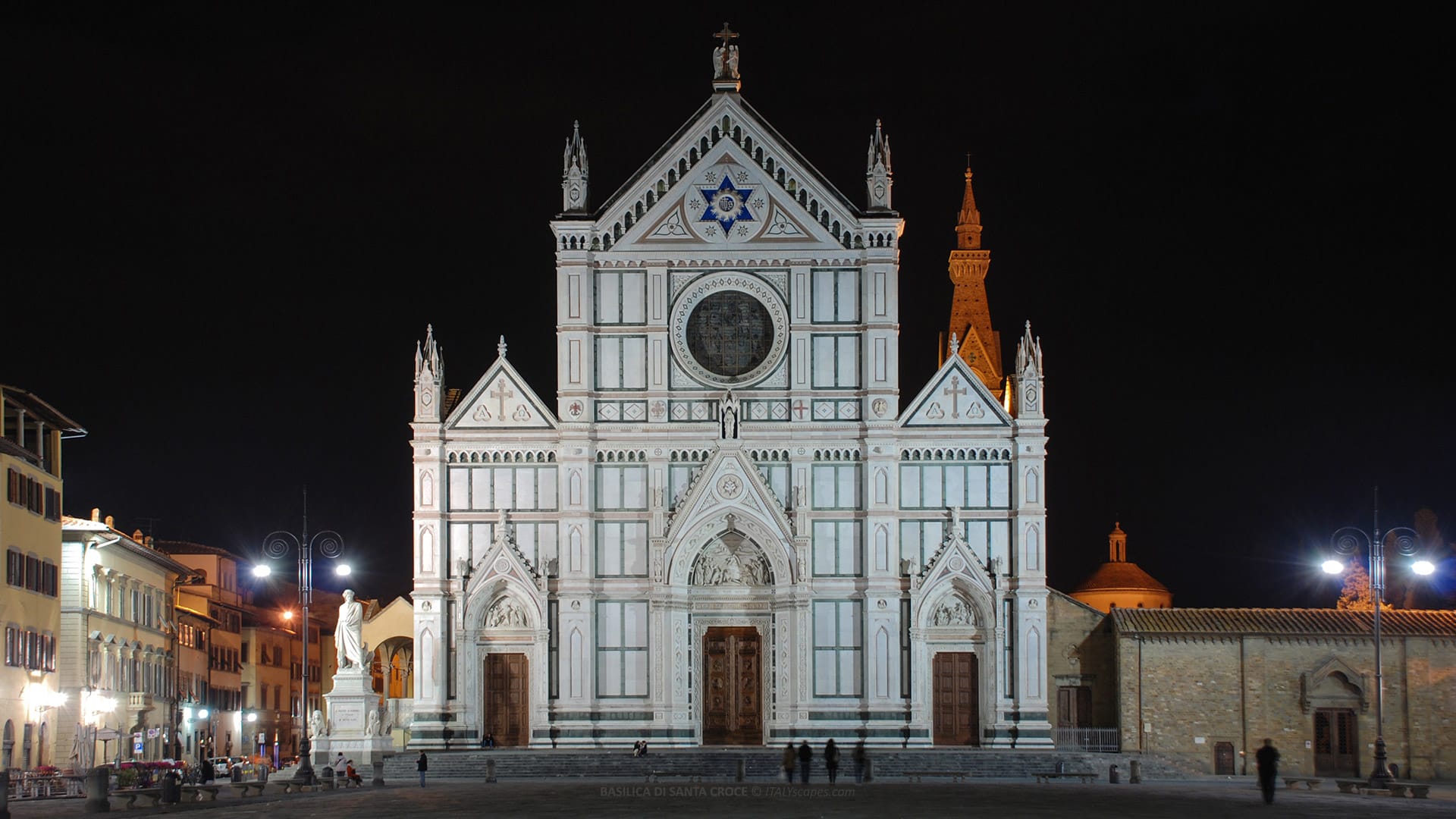
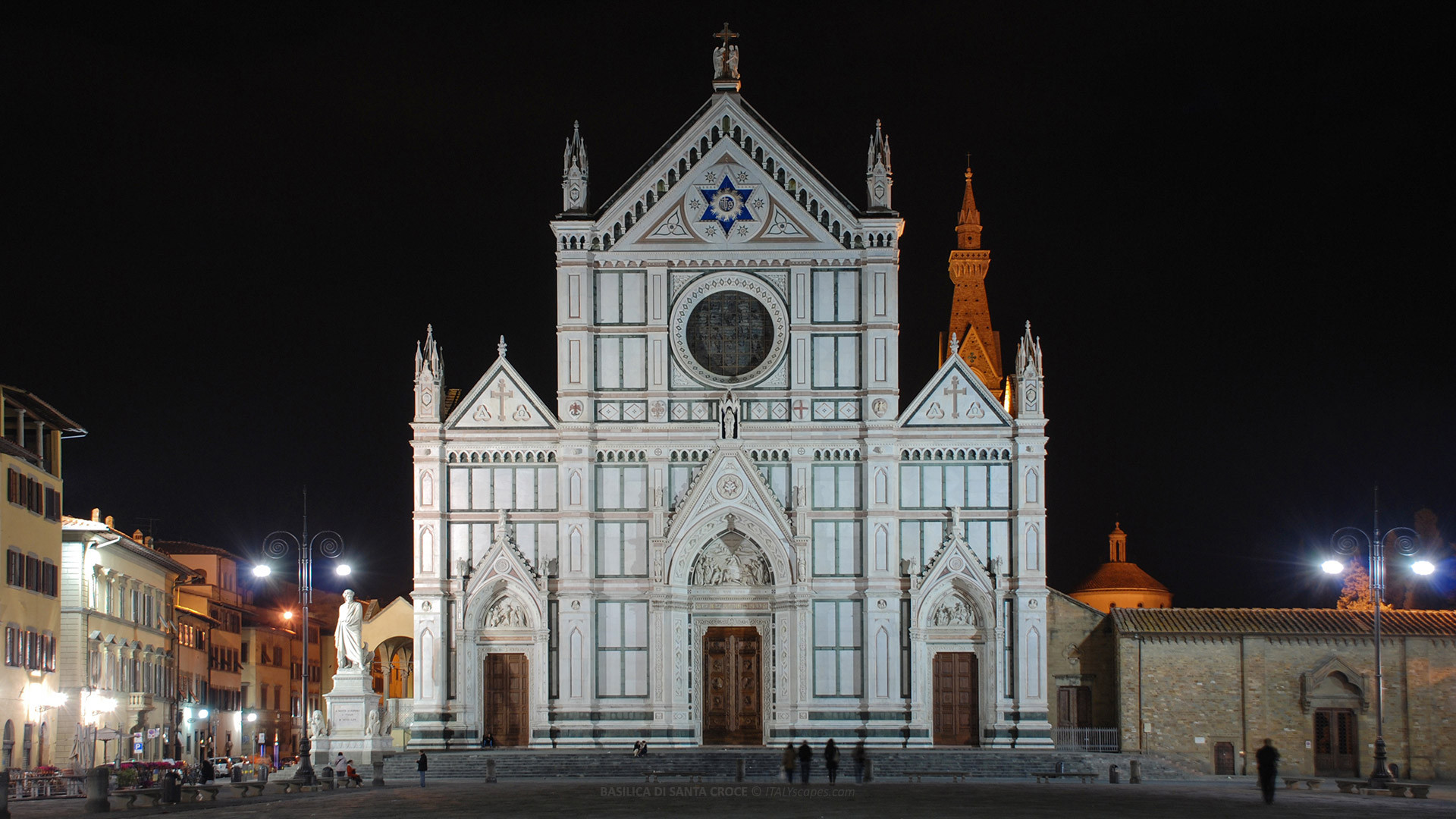
Basilica di Santa Croce at night
Architecture of Basilica di Santa Croce
Exterior and Facade
The facade of the Basilica di Santa Croce is one of the most recognizable church fronts in Florence, although it is much later than the medieval building behind it. Its design combines Neo-Gothic forms, pointed gables, colored marble and sculptural decoration, while trying to harmonize with Florentine medieval and Renaissance architecture.
The three portal lunettes on the facade refer to the dedication of the church to the Holy Cross. On the left is The Finding of the Cross by Tito Sarrocchi, in the center is The Triumph of the Cross by Giovanni Duprè, and on the right is The Vision of Constantine by Emilio Zocchi.
Above the central portal stands the large rose window, one of the key elements of the facade composition. Higher up, the facade includes a Star of David, a symbol that belongs also to Christian decorative tradition. It has sometimes been linked with Matas, but that interpretation is not historically proven.
The central portal has wooden doors that originally belonged to the Cathedral of Santa Maria del Fiore and were moved to the Basilica di Santa Croce in 1903. The facade also reflects 19th-century Florence, when unfinished medieval churches were completed according to modern interpretations of the city’s Gothic past.
Sides, Porticoes and Bell Tower
The sides of the basilica show the older medieval structure more clearly than the facade. They are built in simple stone and rhythmically divided by triangular pediments and tall two-light windows. The decoration is limited, in keeping with the Franciscan spirit and the austere character of the building.
On the left side of the church is the portico known as the Portico delle Pinzochere, dating to the 14th century and later restored. This side area is important for visitors today because the entrance and ticket office are located on the north side, in Largo Bargellini.
The present bell tower is not medieval. It was designed by Gaetano Baccani and built in the 19th century, between 1842 and 1845. Earlier bell tower projects had a troubled history, including a collapse in 1521 and later unfinished attempts.
The bell tower rises to about 78.45 meters and contains six large bells. Although it belongs to the 19th-century phase of the Basilica di Santa Croce, it remains visually connected with the basilica’s Gothic profile and with the later facade completion.
Interior Plan and Dimensions
The interior of the Basilica di Santa Croce is both simple and monumental. The church has a T-shaped Egyptian cross plan, with three naves divided by two rows of large octagonal pillars. This layout is typical of major mendicant churches, built for preaching, visibility and large congregations.
The main nave measures about 115.43 meters in length and 38.23 meters in width, making the Basilica di Santa Croce one of the largest churches in Florence. The transept is also very large, measuring about 73.74 meters, and cuts across the church in front of the polygonal apse.
The central nave is covered by a wooden truss ceiling rather than a stone vault. This structural choice reduces vertical Gothic emphasis and creates a broad, open space. The pointed arches, thin walls and large openings allowed the interior to be decorated with extensive fresco cycles.
A walkway above the arches runs along the nave and also has a structural function. It helps bind together the thin walls and large surfaces of the building.
Chapels and Franciscan Space
The Basilica di Santa Croce does not have only three chapels at the head of the church. Instead, it has eleven chapels around the eastern area, plus other chapels at the ends of the transept. Many were connected with donor families, who used them for burials and commissioned important fresco cycles.
The chapels helped transform the Basilica di Santa Croce into a major workshop of 14th-century Florentine painting. Artists could cover large wall surfaces with biblical, Franciscan and devotional scenes, making the church a visual teaching space for the faithful. This role was especially important in a society where many people were illiterate.
The basilica was connected from the beginning with a large Franciscan convent. Over time, the complex included the sacristy, refectory, cloisters, dormitory, infirmary, library and other spaces. Some areas were later secularized or adapted to new functions, but the religious and artistic identity remained central.
The Pazzi Chapel, located in the first cloister, is usually associated with Filippo Brunelleschi and is one of the most important Renaissance spaces connected with the Basilica di Santa Croce. It belongs to the wider complex, not to the medieval nave itself, and shows the architectural evolution of Florence.
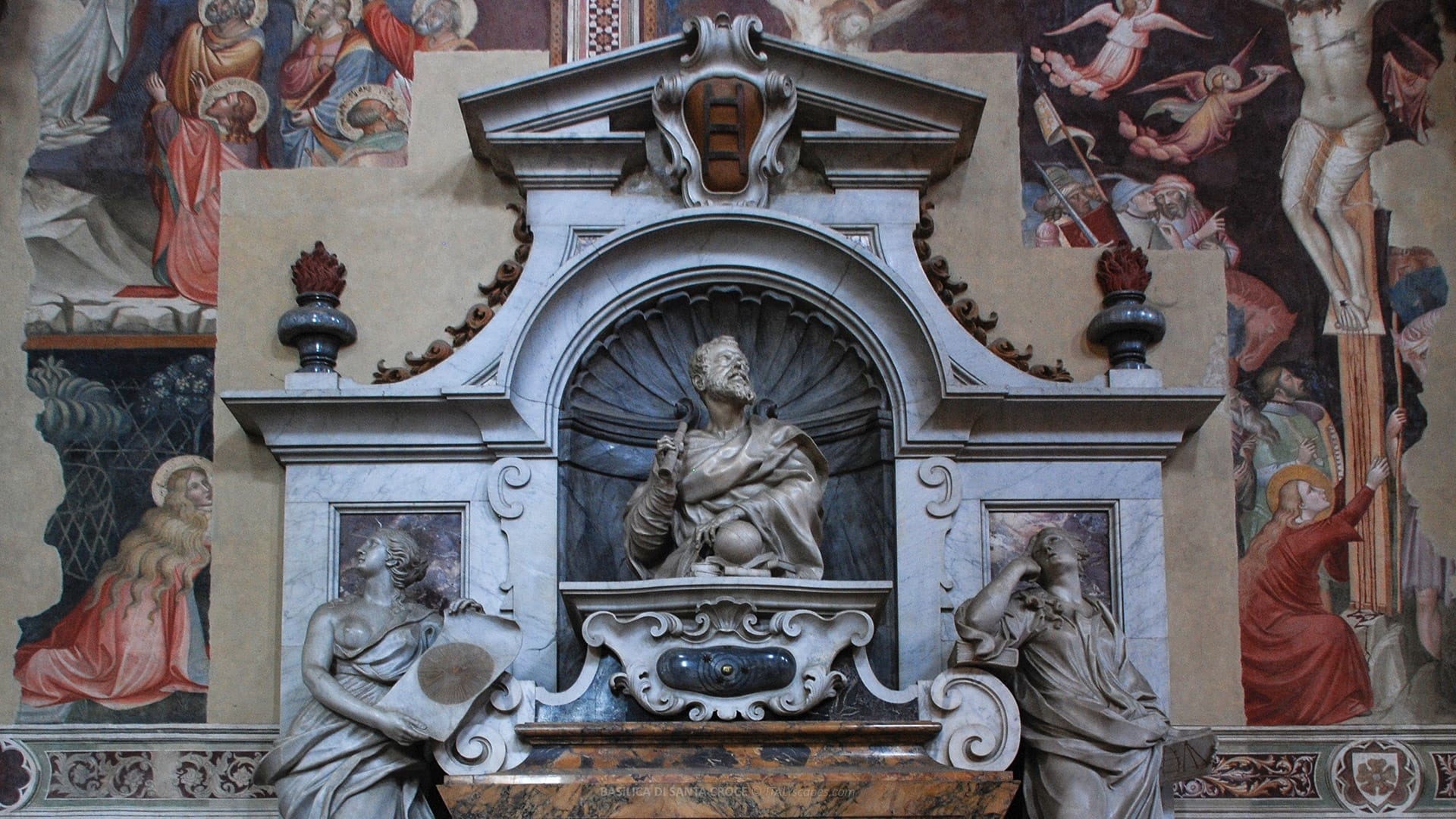
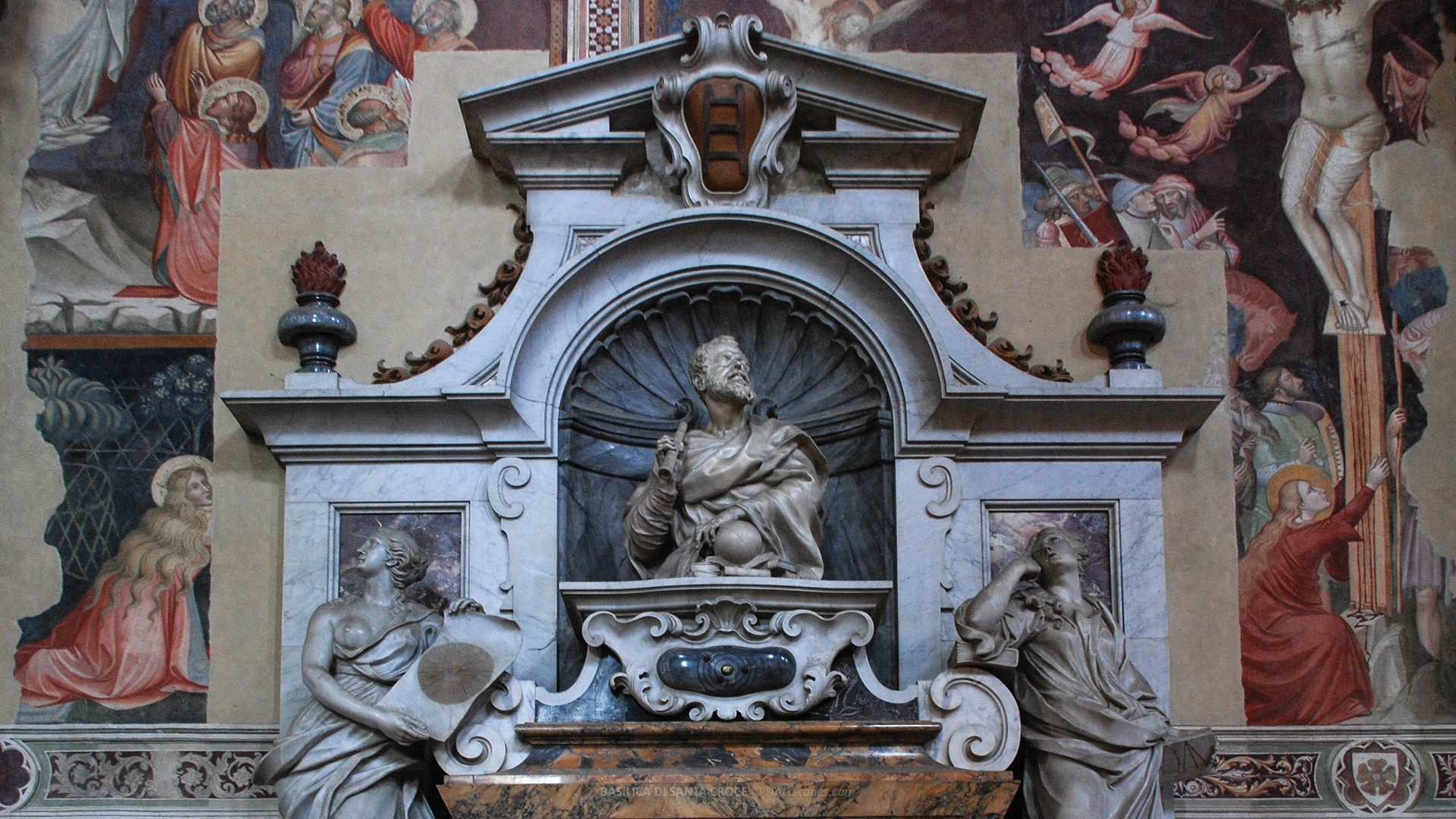
Funerary monument of Galileo Galilei
Art of Basilica di Santa Croce
Frescoes and the 14th-Century Painting Tradition
The Basilica di Santa Croce is one of the richest churches in Florence for medieval and Renaissance art. The complex preserves almost 4,000 works of art, ranging from the 13th to the 20th century. Many works remain in the places for which they were created, which gives the complex exceptional historical continuity.
The main chapel contains frescoes by Agnolo Gaddi illustrating the Legend of the True Cross. This subject is directly connected with the dedication of the basilica. The cycle surrounds the high altar and reinforces the central religious meaning of the church’s name and liturgical function.
The Bardi and Peruzzi chapels are closely associated with Giotto and his workshop. The Peruzzi Chapel shows scenes from the lives of Saint John the Baptist and Saint John the Evangelist. The Bardi Chapel contains scenes from the life of Saint Francis, making it especially important for a Franciscan church.
These fresco cycles are central to the development of Florentine painting. They show a new attention to space, narrative clarity, emotional expression and human presence.
Renaissance Masters and Sculptural Works
The Basilica di Santa Croce also preserves major Renaissance works. One of the most important is Donatello’s Annunciation, also known as the Cavalcanti Annunciation, made around 1435 in pietra serena with gilded details. It stands out for its refined material contrast and expressive treatment of the figures.
Another major work is the marble pulpit by Benedetto da Maiano, made between about 1481 and 1485. It is decorated with relief scenes from the life of Saint Francis and shows masterful use of perspective. Its position and sculptural quality make it one of the key Renaissance works inside the basilica.
The sacristy is another important artistic space. It preserves frescoes and works connected with Taddeo Gaddi, Spinello Aretino and Niccolò di Pietro Gerini. Today, the sacristy is especially known because it houses Cimabue’s large Crucifix, one of the most famous works damaged by the 1966 flood.
The former refectory became part of the museum history of Santa Croce. It housed works such as Donatello’s Saint Louis of Toulouse and Cimabue’s Crucifix during different phases of the museum’s development.
Tombs, Memorials and the Temple of the Italian Glories
The funeral monuments of the Basilica di Santa Croce are among the main reasons for the basilica’s fame. The tomb of Michelangelo Buonarroti stands in the right nave and was created as a monument to painting, sculpture and architecture. It reflects the artist’s role as a universal figure of Renaissance art.
Opposite Michelangelo’s tomb, on the left side of the church, is the tomb of Galileo Galilei. The monument also contains the remains of his disciple Vincenzo Viviani and probably those of his daughter, Suor Maria Celeste. Its position symbolically balances the memory of art and science.
Santa Croce also contains the monument to Niccolò Machiavelli, made by Innocenzo Spinazzi in 1787. The inscription above it declares that no praise is equal to such a name. The monument reflects the 18th-century rediscovery of Machiavelli as a central figure in political thought.
The monument to Vittorio Alfieri was made by Antonio Canova in 1810 and includes a mourning personification of Italy. The cenotaph of Dante Alighieri was made in the 19th century, but Dante’s remains stayed in Ravenna because the city refused to give them to Florence.
Museum, Restoration and Memory
The museum areas of Santa Croce protect works that can no longer remain safely in their original locations. The 1966 flood transformed conservation history in Florence, and Santa Croce became one of the main symbols of restoration after disaster. The damaged Crucifix by Cimabue remains a powerful example.
The former convent spaces have been adapted to preserve artworks, fragments, detached frescoes and sculptures. The museum tells the history of the basilica not only through masterpieces, but also through damaged, moved or restored works that document centuries of artistic change.
How to Get to Basilica di Santa Croce
Getting to Basilica di Santa Croce on foot from Santa Maria Novella
Santa Croce is located in the historic center of Florence, at Piazza Santa Croce 16. From Santa Maria Novella railway station, the walk takes about 20 minutes through the city center. The distance is roughly 1.6 to 1.7 kilometers, depending on the exact route.
A common walking route passes near the Cathedral area, Piazza della Signoria, or the streets leading toward the Arno. Since Florence’s historic center is compact, Santa Croce can be combined easily with visits to the Uffizi Gallery, Palazzo Vecchio, Ponte Vecchio, and the Bargello Museum.
Getting to Basilica of Santa Croce by bus
Santa Croce can also be reached by local buses operating in the historic center. The nearest stops include Magliabechi, Corso dei Tintori, Benci, Salvemini, and Proconsolo, depending on the direction of travel and the line used.
Bus line C3 stops at Magliabechi, very close to the basilica area. Other city buses, including lines such as C1, C2, C4, and 23, may stop within walking distance, depending on the route.
Getting to Basilica di Santa Croce by taxi
Taxis are a practical option for visitors arriving from Santa Maria Novella railway station, hotels outside the historic core, or areas such as Piazzale Michelangelo. The ride from the station is short, but travel time depends on traffic, pedestrian areas, and restricted-traffic regulations.
In Florence, taxis usually wait at official taxi stands or can be booked by phone or app. They cannot always circulate freely through every street of the historic center. For Santa Croce, the driver may drop passengers near Piazza Santa Croce, Largo Bargellini, or another nearby accessible point.
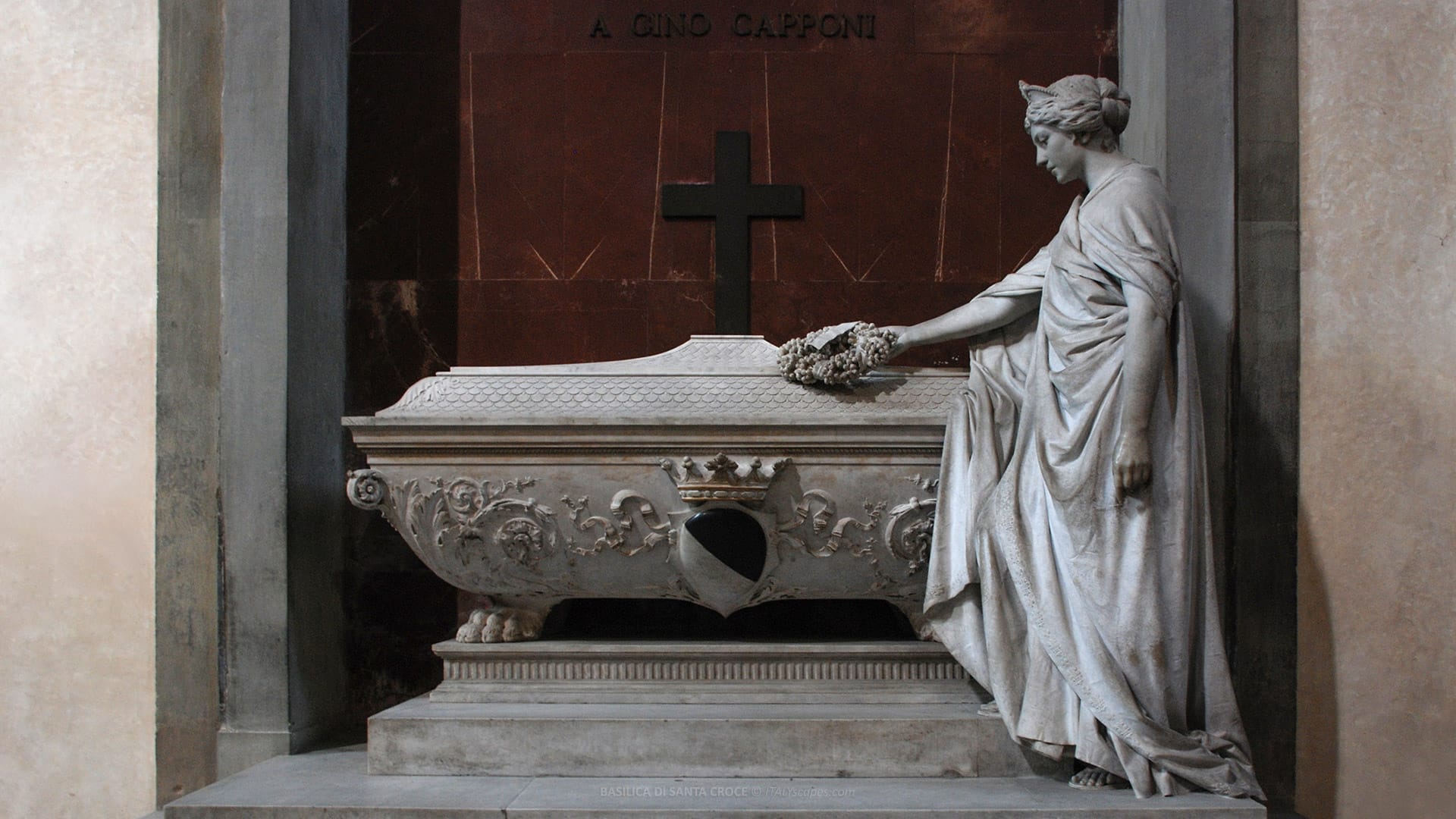
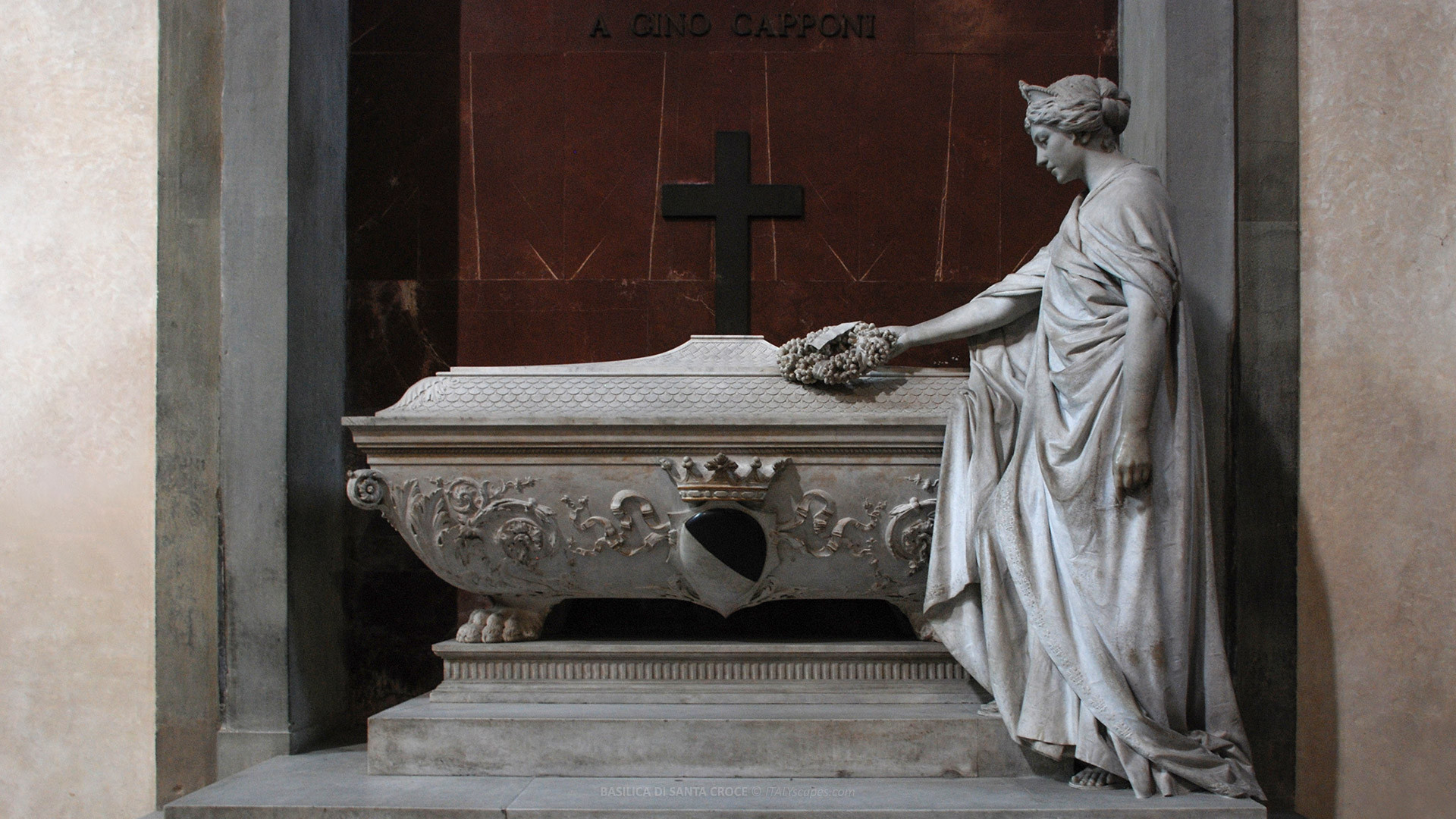
Tomb of Marquis Gino Capponi
Frequently Asked Questions about Basilica di Santa Croce
Where is Basilica di Santa Croce located?
Basilica di Santa Croce is located in Piazza Santa Croce, in the historic center of Florence, close to the Arno River, the National Central Library, and the eastern side of the medieval city.
Why is Basilica of Santa Croce famous?
Basilica of Santa Croce is famous for its Franciscan Gothic architecture, important frescoes, funerary monuments, and tombs of major Italian figures, including Michelangelo, Galileo, Machiavelli, and Rossini.
Who is buried in Basilica di Santa Croce?
The basilica contains the tombs or monuments of Michelangelo Buonarroti, Galileo Galilei, Niccolò Machiavelli, Vittorio Alfieri, Ugo Foscolo, Gioachino Rossini, and other important cultural figures.
When was Basilica of Santa Croce built?
The present church was begun in 1294 or 1295, probably to a design by Arnolfo di Cambio. It was largely completed in the 14th century and consecrated in 1443.
What important artworks are inside Santa Croce?
Santa Croce preserves works by Giotto, Cimabue, Donatello, Agnolo Gaddi, Taddeo Gaddi, Bronzino, and other artists, including frescoes, crucifixes, tombs, and chapel decorations.
What is the Pazzi Chapel?
The Pazzi Chapel is a Renaissance chapel in the Santa Croce complex, traditionally connected with Filippo Brunelleschi. It is known for its balanced proportions and pietra serena architectural details.
How much does it cost to visit Basilica of Santa Croce?
A standard ticket for Basilica of Santa Croce costs €10. Reduced tickets are available for eligible visitors, while children under 12 years old can enter for free.
Sources:Buy tickets & tours:GetYourGuide -
Photos
-
Map
-
Reviews