


-
About
Table of Contents
Buy tickets & tours:GetYourGuideThe Pantheon is one of the most remarkable monuments in Rome, located in Piazza della Rotonda, in the historic center of the city. It stands a short walk from Piazza Navona, the Trevi Fountain, and Largo di Torre Argentina, making it one of the most accessible ancient landmarks in Rome.
With nearly 2,000 years of continuous history, the Pantheon is among the best-preserved buildings of ancient Rome. Originally created as a Roman temple, it later became a Christian church and is still officially known as the Basilica of Santa Maria ad Martyres, or Saint Mary and the Martyrs.
The monument is famous for its extraordinary combination of Roman engineering, religious continuity, and architectural harmony. Its most celebrated feature is the largest unreinforced concrete dome ever built, a structure whose diameter is almost equal to the total interior height of the building.
Today, the Pantheon remains both a place of worship and one of Rome’s most visited monuments. Its survival is closely linked to its conversion into a church in 609 AD, which protected it from the abandonment and systematic spoliation suffered by many other ancient Roman buildings.
Short History of the Pantheon
The Temple of Agrippa
The first temple on this site was built by Marcus Vipsanius Agrippa, the close collaborator, son-in-law, and general of Emperor Augustus. Ancient and modern sources generally place Agrippa’s construction between 27 and 25 BC, during the early years of the Augustan age.
The original building was part of a wider monumental program in the Campus Martius, an area of Rome transformed under Augustus. The temple was probably connected with the dynastic and religious ideology of the Julio-Claudian family, rather than being a simple generic temple to every god.
The famous inscription on the façade still reads: M·AGRIPPA·L·F·COS·TERTIVM·FECIT, meaning that Marcus Agrippa, son of Lucius, made the building during his third consulship. However, the structure visible today is not Agrippa’s original monument, but a later reconstruction.
Agrippa’s temple was damaged or destroyed in the great fire of 80 AD, during the reign of Emperor Titus. Emperor Domitian rebuilt it, but the monument was damaged again by another fire in 110 AD, during the reign of Emperor Trajan.
The Hadrianic Reconstruction
The current building is traditionally attributed to the reign of Emperor Hadrian, between 118 and 125 AD. Hadrian did not place his own name on the monument, but preserved Agrippa’s original inscription on the front, a practice consistent with some of his restoration projects.
Hadrian’s architects radically transformed the earlier temple. The present design combines a classical temple front with a massive circular hall behind it, creating a unique architectural composition. This union of rectangular portico and circular rotunda became one of the most influential solutions in Western architecture.
The reconstruction also changed the orientation and scale of the monument. The new building opened toward a large forecourt, while the enormous rotunda behind the portico created an interior space without precedent in Roman religious architecture.
The building was probably completed around 125 or 126 AD, although exact dating remains debated. What is certain is that the Hadrianic monument represented one of the highest achievements of Roman concrete construction, combining engineering precision with monumental religious architecture.
From Roman Temple to Christian Church
In 609 AD, the Byzantine emperor Phocas gave the building to Pope Boniface IV. The pope consecrated it as a Christian church dedicated to Santa Maria ad Martyres, transforming the ancient temple into a place of Christian worship.
This conversion was decisive for the survival of the monument. Many ancient temples in Rome were abandoned, dismantled, or reused as quarries for building materials. The Pantheon, however, continued to function, and this uninterrupted use helped preserve its walls, dome, and interior space.
The church was also known during the Middle Ages as Santa Maria della Rotonda, a name derived from the circular form of the building. The surrounding square, Piazza della Rotonda, still preserves that historical connection between the monument and the urban fabric around it.
Medieval and Early Modern Changes
Although the Pantheon survived better than most ancient monuments, it did not remain completely untouched. In 663 AD, Emperor Constans II removed bronze elements from the building, including metal roof coverings, which were taken away from Rome.
More changes occurred in the early modern period. Under Pope Urban VIII Barberini, bronze from the portico was removed in the 17th century. This intervention became linked to the famous Roman saying that the Barberini did what even the barbarians had not done.
Two bell towers were added above the ancient façade in the same century. These towers were unpopular with many Romans, who nicknamed them “donkey’s ears”. They were later removed in the 19th century, restoring the ancient front to a simpler and more classical appearance.
Despite these alterations, the essential Roman structure survived. The marble interior, the great dome, the portico, and the circular plan remained legible, making the monument an exceptional case of continuity.
Tombs, National Memory and Modern Status
From the Renaissance onward, the Pantheon became a prestigious burial place. The most famous tomb is that of Raphael, the great painter and architect of the High Renaissance, who died in 1520 and was buried inside the monument.
Other artists associated with the monument include Annibale Carracci, Baldassare Peruzzi, and Arcangelo Corelli. Their burials reflect the Renaissance and early modern admiration for the building as an ideal monument of classical beauty and artistic continuity.
After Italian unification, the Pantheon acquired a national role. The first king of unified Italy, Vittorio Emanuele II, was buried there in 1878. King Umberto I and Queen Margherita of Savoy are also buried inside the building.
Today, the monument is owned by the Italian state and managed in cooperation with ecclesiastical authorities. It remains an active basilica, with religious services held on specific days, while also functioning as one of the most important archaeological and architectural sites in Rome.

Architecture of the Pantheon
General Structure and Urban Position
The Pantheon stands in Piazza della Rotonda, a busy square in the heart of Rome’s historic center. The monument is surrounded by later buildings, which makes its vast size especially striking when seen from the relatively compact urban space in front of it.
The structure combines three main parts: the portico, the intermediate block, and the rotunda. From the square, the building appears like a traditional Roman temple with columns and pediment, but the interior reveals an enormous circular hall covered by a dome.
The whole monument measures approximately 84 meters in length and 58 meters in width, including the portico and rotunda. Its maximum height reaches about 58 meters, while the interior height and the dome’s diameter are both just over 43 meters.
This equality between height and diameter is one of the most famous features of the building. In theoretical terms, a perfect sphere could fit inside the interior space, touching the floor, the walls, and the highest point of the dome.
The Portico and Pronaos
The portico is one of the most recognizable architectural elements of the monument. It has 16 granite columns arranged in three rows: eight columns across the front, followed by two groups of four columns behind them, forming three internal aisles.
The columns are monolithic shafts of Egyptian granite, brought to Rome from quarries such as Mons Claudianus and other imperial quarrying areas. Their transportation required enormous logistical organization, involving quarrying, river movement, sea transport, and movement through Rome.
Each column supports Corinthian capitals and contributes to the solemn temple-like appearance of the façade. The central aisle leads directly toward the great bronze doors, while the side aisles structure the depth of the portico and frame the approach to the rotunda.
The Rotunda
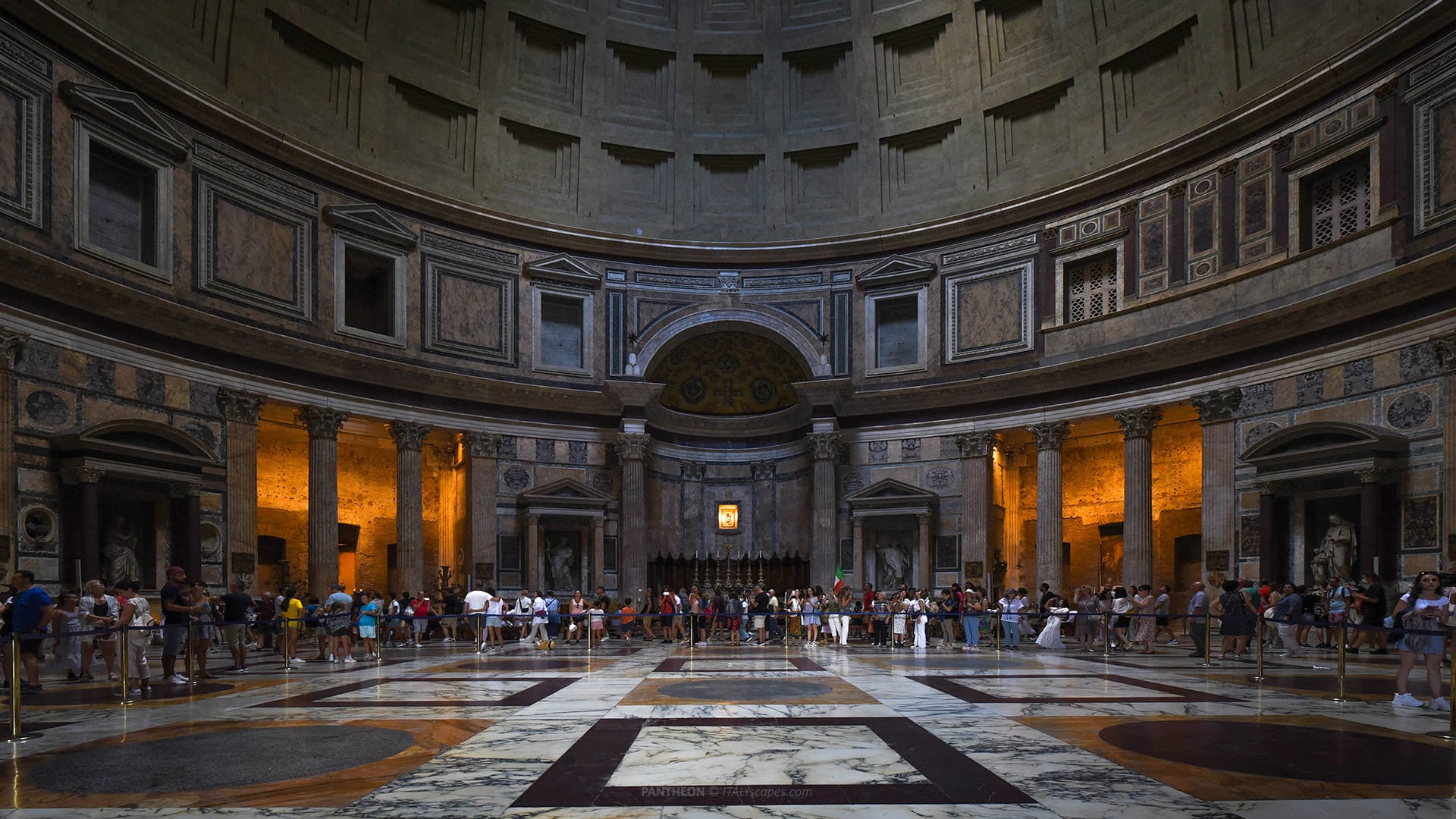
Behind the portico stands the great circular cella, usually called the rotunda. Its walls are more than 6 meters thick, allowing them to support the immense weight of the dome above. This mass is partly hidden by the elegance of the interior design.
The rotunda is not simply a thick circular wall. It is a highly engineered structure, organized with relieving arches, internal voids, and eight large piers that distribute the weight of the dome. These structural solutions allowed Roman builders to create an unprecedented interior volume.
The interior wall is articulated by alternating niches, aedicules, columns, and colored marble surfaces. This decoration reduces the visual heaviness of the structure and creates a rhythm of vertical and curved forms around the circular space.
The Dome and the Oculus
The dome has a diameter of about 43.30 to 43.44 meters, depending on the measurement system used. It remains the largest unreinforced concrete dome in the world, an extraordinary achievement considering that it was built almost two millennia ago.
Roman engineers reduced the weight of the dome by changing the materials used in the concrete. Heavier aggregates were used lower down, while lighter materials, including volcanic stone, were used higher up, reducing pressure near the crown of the structure.
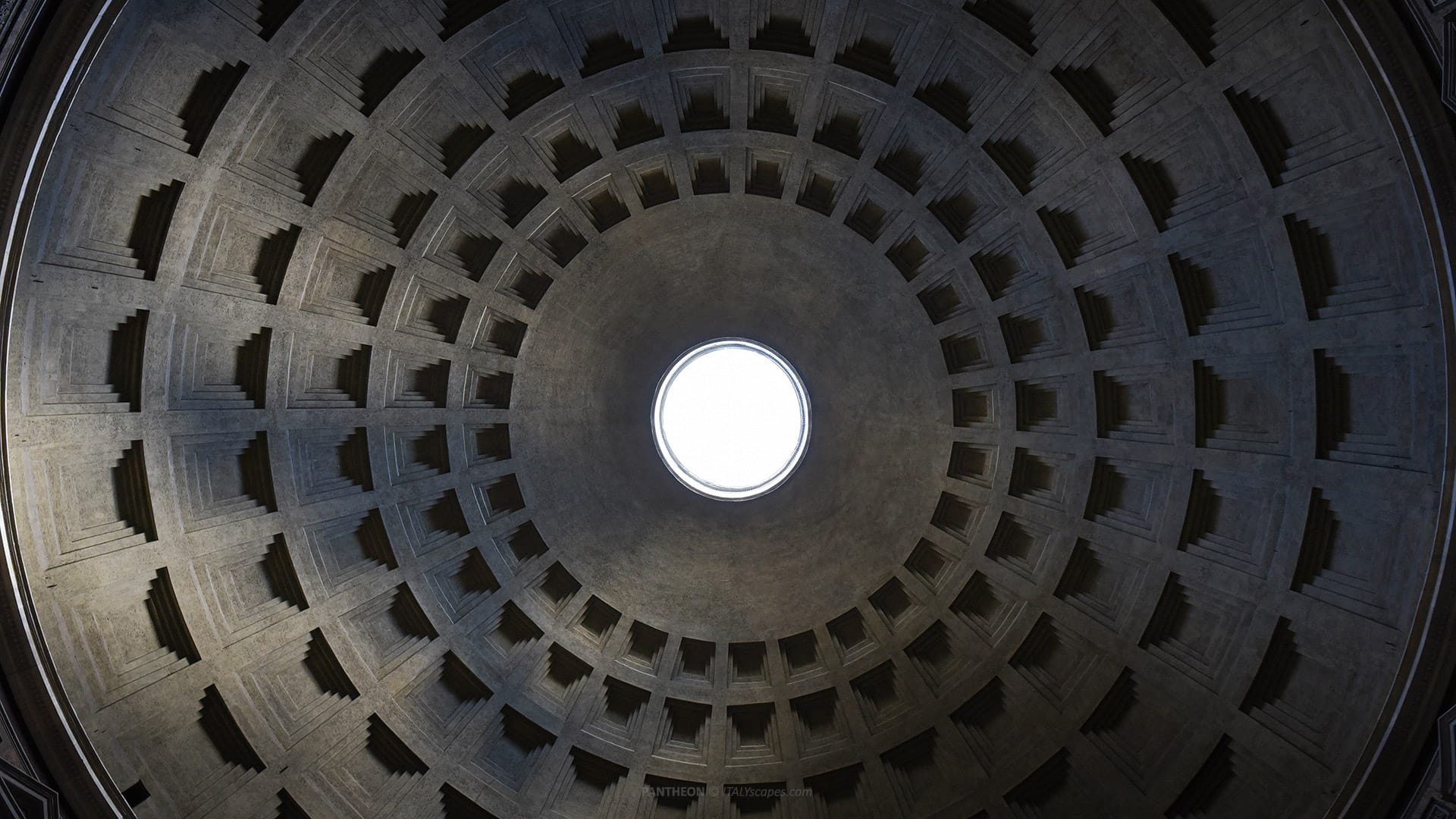
The inner surface of the dome is decorated with five rings of coffers, each ring containing 28 recessed panels. These coffers reduce weight, create visual depth, and give the dome a powerful geometric rhythm that guides the eye upward toward the oculus.
At the center of the dome is the oculus, a circular opening approximately 8.9 meters in diameter. It is the only direct natural light source inside the building and also functions as a symbolic connection between the interior space and the sky above Rome.
Light, Rain and Interior Space
The oculus is open to the sky, so rain enters the interior during storms. The floor was designed to handle this problem through a subtle slope and a drainage system, traditionally associated with 22 drainage holes distributed in the pavement.
Light entering through the oculus changes constantly during the day. The beam moves across the dome, walls, and floor, making time visible inside the building. This effect is one of the reasons the interior feels dynamic despite its severe geometric order.
The interior floor is paved with colored marble arranged in circular and rectangular patterns. Much of the ancient decorative logic has survived, even if restorations and replacements occurred over time. The floor reinforces the dialogue between round and square forms.
Art of the Pantheon
Ancient Decoration and Lost Elements
The ancient decoration of the Pantheon was richer than what is visible today. The pediment probably held bronze sculptures, now lost, and the portico once had bronze fittings that contributed to the building’s original brilliance and imperial appearance.
Ancient literary references mention decoration associated with Agrippa’s temple, including works by Greek artists. However, the present building belongs mainly to the Hadrianic reconstruction, so it is difficult to reconstruct precisely how much of the older decorative program survived.
The most important surviving artistic element is the architecture itself. The combination of marble, columns, coffers, geometry, and light forms a monumental artistic composition.
Christian Art and Liturgical Elements
After the conversion of the building into a church, Christian artworks and liturgical furnishings gradually transformed the ancient interior. The monument became the Basilica of Santa Maria ad Martyres, and its sacred function introduced altars, devotional images, and Christian ceremonies.
One of the most important religious objects associated with the basilica is the Byzantine icon of the Virgin and Child, traditionally linked to the early Christian dedication of the monument.
The high altar marks the liturgical center of the basilica. Around the circular interior, chapels and niches contain artworks, memorials, and devotional elements added during different historical periods.
A famous ceremony takes place at Pentecost, when rose petals are dropped through the oculus after the religious celebration. This tradition connects the architecture of the dome with Christian ritual, turning the ancient opening into part of a living liturgical event.
Raphael’s Tomb and Renaissance Memory
Raphael’s tomb is one of the most visited points inside the monument. The artist chose the Pantheon as his burial place, and his presence there strengthened the building’s Renaissance identity as a sacred monument of classical perfection and artistic greatness.
His tomb includes an inscription traditionally associated with the humanist Pietro Bembo. The monument presents Raphael not only as a painter, but as an artist whose work was considered in harmony with the ideals of antiquity.
Other artists buried there, including Annibale Carracci and Baldassare Peruzzi, reinforce this role.
Royal Tombs and National Monuments
The royal tombs inside the Pantheon belong to the modern history of Italy. Vittorio Emanuele II, the first king of unified Italy, was buried there after his death in 1878, turning the ancient monument into a national memorial.
King Umberto I, assassinated in 1900, was also buried inside the building. His wife, Queen Margherita of Savoy, rests there as well. Their tombs connect the monument with the history of the Kingdom of Italy and the Risorgimento.
How to Get to the Pantheon
Getting to the Pantheon on foot
The easiest way to reach the Pantheon is often on foot, especially when visiting the historic center of Rome. The monument stands in Piazza della Rotonda, within walking distance of Piazza Navona, the Trevi Fountain, Campo de’ Fiori, and Largo di Torre Argentina.
From the Trevi Fountain, the walk is about 650 to 700 meters, usually taking around 8 to 10 minutes. From Piazza Navona, the distance is roughly 300 meters, while Largo di Torre Argentina is about 400 meters away.
From the Colosseum, the distance is approximately 2.5 to 2.7 kilometers, depending on the route. The walk can take around 30 to 35 minutes, crossing some of the most important areas of ancient and Baroque Rome.
Getting to the Pantheon by metro
The Pantheon does not have a metro station directly beside it. The closest useful station is Barberini, on Metro Line A, located about 700 meters from the monument. From there, visitors can walk through the historic center toward Piazza della Rotonda.
Another practical option is Spagna, also on Metro Line A. The distance from Spagna to the monument is around 1.2 to 1.3 kilometers, depending on the route, and the walk passes near some of Rome’s most visited central areas.
Metro Line A is useful for visitors arriving from areas such as Termini, the Spanish Steps, or the Vatican zone. However, because the monument is located deep in the historic center, the final part of the journey almost always requires walking.
Getting to the Pantheon by bus
Buses are often more convenient than the metro for reaching the Pantheon, because several routes stop closer to Piazza della Rotonda. The most useful nearby area is Largo di Torre Argentina, located about 400 meters from the monument.
Useful bus lines include 30, 40, 62, 64, 81, 87, and 492, depending on the starting point. Visitors should get off near Largo di Torre Argentina or Corso Rinascimento, then continue on foot through the streets of the historic center.
From the Vatican area, bus line 492 can be useful, with stops near Corso Rinascimento. From areas near the Roman Forum or Colosseum, bus line 87 is often a practical option, depending on traffic and service changes.
Getting to the Pantheon by Tram
The tram is not the most direct way to reach the Pantheon, but it can be useful for visitors arriving from Trastevere or areas connected to tram line 8. The most practical stop is usually near Largo di Torre Argentina or Piazza Venezia.
From Largo di Torre Argentina, the walk to Piazza della Rotonda is about 400 meters. The route is short and passes through central streets that lead directly toward the monument, making the tram a good option when coming from the southwest.
The Pantheon’s Oculus
Frequently Asked Questions about the Pantheon
Where is the Pantheon located in Rome?
The Pantheon is located in Piazza della Rotonda, in the historic center of Rome. It is close to Piazza Navona, Largo di Torre Argentina, and the Trevi Fountain.
Is the Pantheon still a church?
Yes, the Pantheon is still an active Catholic church. Its official Christian name is Basilica of Santa Maria ad Martyres, and religious services are still held inside.
Who built the Pantheon in Rome?
The first temple was built by Marcus Agrippa between 27 and 25 BC. The building visible today was reconstructed during the reign of Emperor Hadrian.
Why is the Pantheon so famous?
The Pantheon is famous for its perfect proportions, ancient Roman concrete dome, central oculus, and exceptional preservation. Its dome remains the largest unreinforced concrete dome in the world.
How big is the Pantheon dome?
The dome has a diameter of about 43.3 meters, almost equal to the interior height of the building. This creates the impression of a perfect sphere inside.
What is the oculus of the Pantheon?
The oculus is the circular opening at the center of the dome. It measures about 8.9 meters in diameter and is the only direct natural light source inside.
How much does it cost to visit the Pantheon?
The standard ticket costs €5, while reduced tickets are available for eligible visitors. Free entry applies to specific categories, including visitors under 18 and entitled persons.
Sources:Buy tickets & tours:GetYourGuide -
Photos
-
Map
-
Reviews

1 Review on “Pantheon”
Leave a Review


Impressive, indeed! And when you think that after 2000 years it’s still standing…