-
About
Table of Contents
Buy tickets & tours:GetYourGuideSt Peter’s Basilica (Basilica di San Pietro) is the largest of the four papal basilicas of Rome and one of the most important religious buildings in Christianity. Officially known as the Papal Basilica of Saint Peter in the Vatican, it stands in Vatican City, at the western end of Piazza San Pietro.
Although the basilica is located in Vatican City, an independent state, it is usually visited during a trip to Rome. Its position, close to Castel Sant’Angelo, the Tiber River and the historic center of Rome, makes it one of the most accessible and significant landmarks for visitors to the Eternal City.
The basilica is often described as one of the largest churches in the world, both for its physical dimensions and for its role in Catholicism. It is the site of major papal liturgies and one of the most important pilgrimage destinations connected to the Apostle Peter.
However, St Peter’s Basilica is not the cathedral of Rome. That title belongs to the Basilica of Saint John Lateran, the official seat of the Bishop of Rome. Saint Peter’s Basilica is instead a papal basilica closely connected with the Vatican, the papacy and the tomb traditionally associated with Saint Peter.
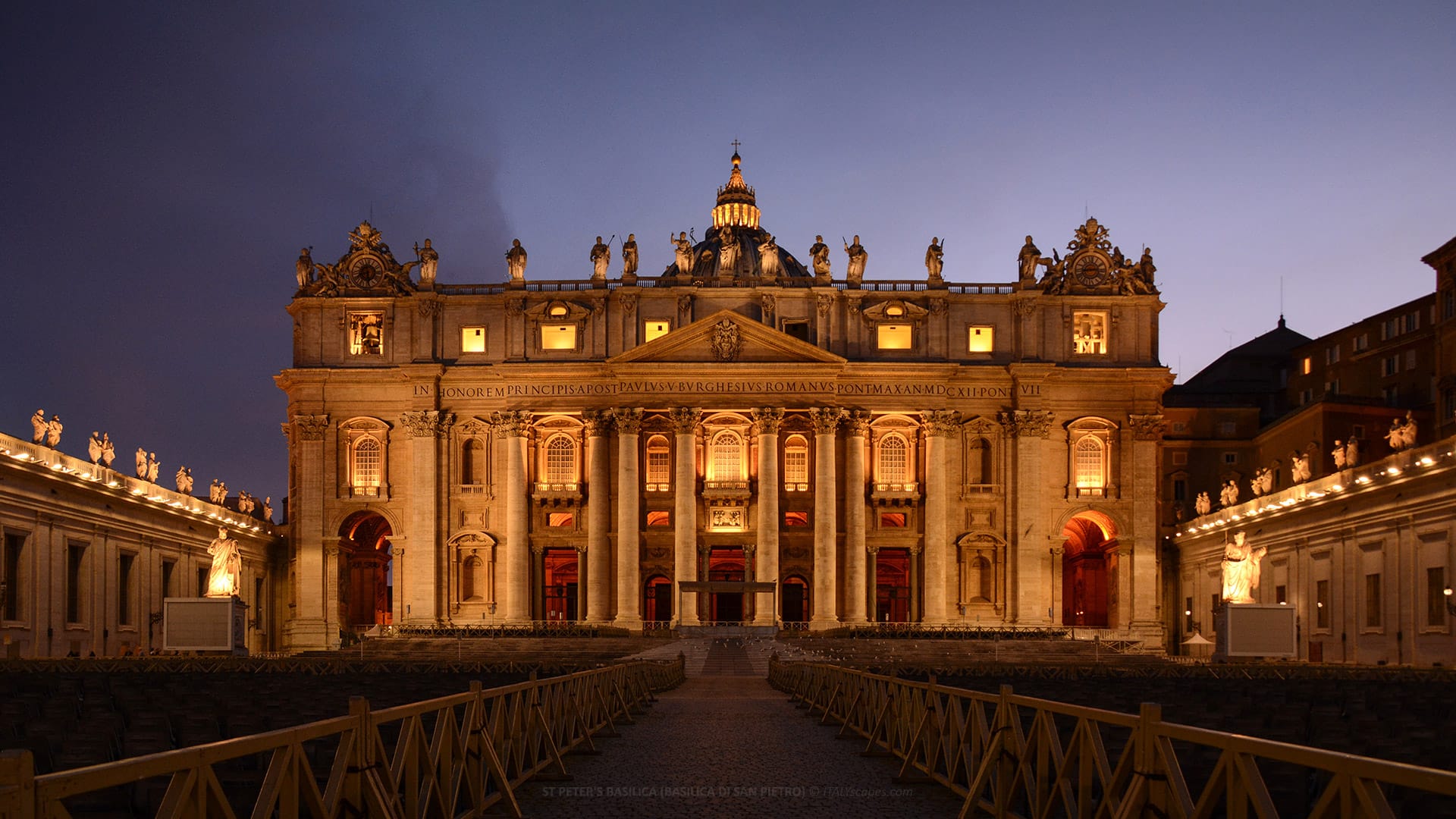
Short History of St Peter’s Basilica (Basilica di San Pietro)
The Constantinian Basilica
According to Christian tradition, Saint Peter was martyred in Rome during the reign of Emperor Nero, probably in the area of the Vatican Hill. The site later became associated with his burial, making it one of the earliest and most important places of Christian memory in Rome.
In the 4th century, Emperor Constantine ordered the construction of a large basilica over the place believed to be Saint Peter’s tomb. This first church, usually known as the Constantinian Basilica, became one of the great pilgrimage churches of late antique and medieval Rome.
The old basilica had the typical early Christian plan, with a long nave, side aisles, an atrium and an apse. For more than a thousand years, it served as a major religious center and burial place for popes, nobles and other important figures connected with the Church.
By the late Middle Ages, however, the Constantinian basilica was in poor structural condition. Its age, repeated alterations and the ambitions of Renaissance popes led to discussions about renovation, expansion and eventually complete replacement with a much larger and more modern church.
The First Renaissance Projects
In the 15th century, Pope Nicholas V began a major plan to transform the old basilica. The project was entrusted to Bernardo Rossellino, who proposed a new choir, a larger transept and a dome, while keeping part of the Constantinian structure.
The works began around 1450, but they stopped after the death of Pope Nicholas V. Some activity resumed between 1470 and 1471, under Pope Paul II, with the involvement of Giuliano da Sangallo, but the project did not reach completion.
Bramante and the New Basilica
The construction of the present basilica began on April 18, 1506, under Pope Julius II. The first major architect was Donato Bramante, one of the most influential masters of the High Renaissance. His project proposed a monumental church with a centralized Greek-cross plan.
Bramante’s design was based on powerful geometry, massive piers and a great central dome. The project reflected the Renaissance idea of architectural harmony and was intended to create a building worthy of the tomb of Saint Peter and the authority of the papacy.
To begin the new basilica, Bramante demolished large parts of the old Constantinian structure, especially the presbytery area. This decision caused controversy, because the ancient basilica was deeply connected with Christian memory, papal ceremonies and centuries of pilgrimage tradition.
The death of Pope Julius II in 1513 and Bramante in 1514 slowed the construction. The building site continued, but the original centralized vision was repeatedly modified by later architects, who adapted the plan according to changing liturgical, structural and artistic needs.
Raphael, Sangallo and the Interrupted Works
After Bramante’s death, Raphael became the main architect of the basilica, working with Giuliano da Sangallo and Fra’ Giocondo. Raphael moved toward a Latin-cross plan, extending the nave and making the church more suitable for processions and large liturgical gatherings.
Following Raphael’s death in 1520, Antonio da Sangallo the Younger gradually became the leading architect. He prepared a large wooden model and developed a more complex design, with strong structural elements and a grand architectural system that differed from Bramante’s original clarity.
The Sack of Rome in 1527 interrupted the works for several years. Construction resumed more actively under Pope Paul III, who wanted to strengthen the project and restore momentum after the political and religious crisis that had affected Rome.
Antonio da Sangallo the Younger continued to direct the building site until his death in 1546. By that point, the basilica had already passed through several competing architectural visions, and the final form of the church was still far from complete.
Michelangelo and the Dome
After Sangallo’s death, Michelangelo Buonarroti took charge of the basilica. He was already in his seventies, but he gave the project a decisive new direction. Michelangelo simplified the plan, strengthened the central structure and returned closer to Bramante’s monumental centralized concept.
Michelangelo’s most famous contribution was the design of the great dome. He did not live to see it completed, but his architectural vision shaped its form. The dome became one of the defining images of Rome and one of the most influential domes in European architecture.
After Michelangelo’s death in 1564, the project continued under later architects. Giacomo Della Porta, assisted by Domenico Fontana, completed the dome between 1588 and 1590, modifying its profile and giving it the elevated shape visible today.
The dome rises above the crossing of the basilica, directly over the papal altar and the traditional tomb of Saint Peter.
Maderno and the Completion of the Basilica
In the early 17th century, Pope Paul V decided to extend the basilica toward the east. Carlo Maderno was entrusted with the work and transformed the plan into a Latin cross, adding the long nave and designing the monumental façade.
Maderno’s intervention began in 1608 and changed the way visitors experienced the church. The longer nave created a more traditional basilican layout, suitable for large ceremonies, but it also reduced the visual dominance of Michelangelo’s dome from the square.
The façade, built between 1607 and 1614, completed the front of the basilica. Its giant order, columns, pilasters and attic create a vast architectural screen, while the central balcony became the place from which papal blessings are traditionally delivered.
The basilica was consecrated by Pope Urban VIII on November 18, 1626. This date marked the formal completion of a project that had lasted 120 years and had involved some of the greatest architects of the Renaissance and Baroque periods.
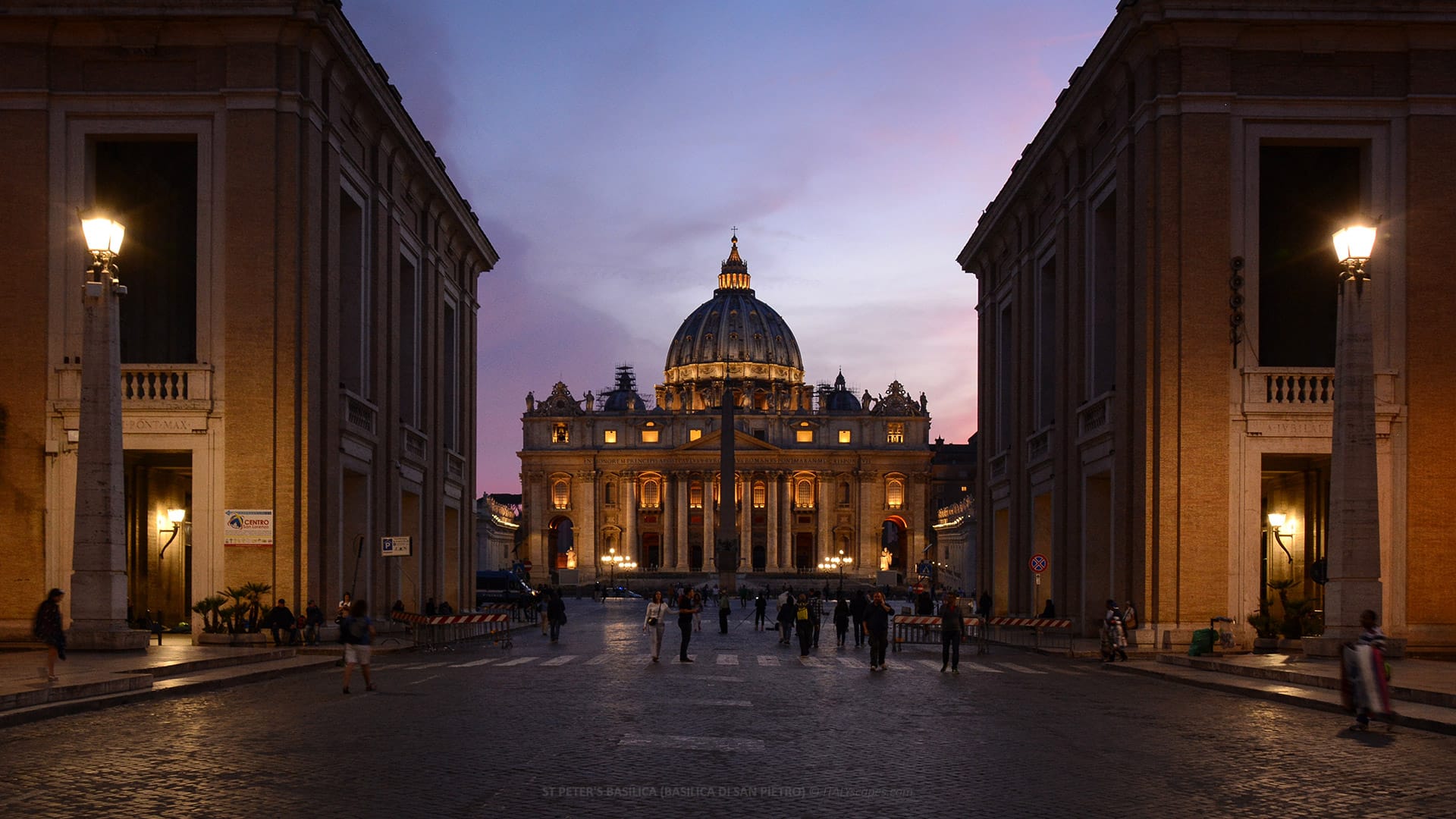
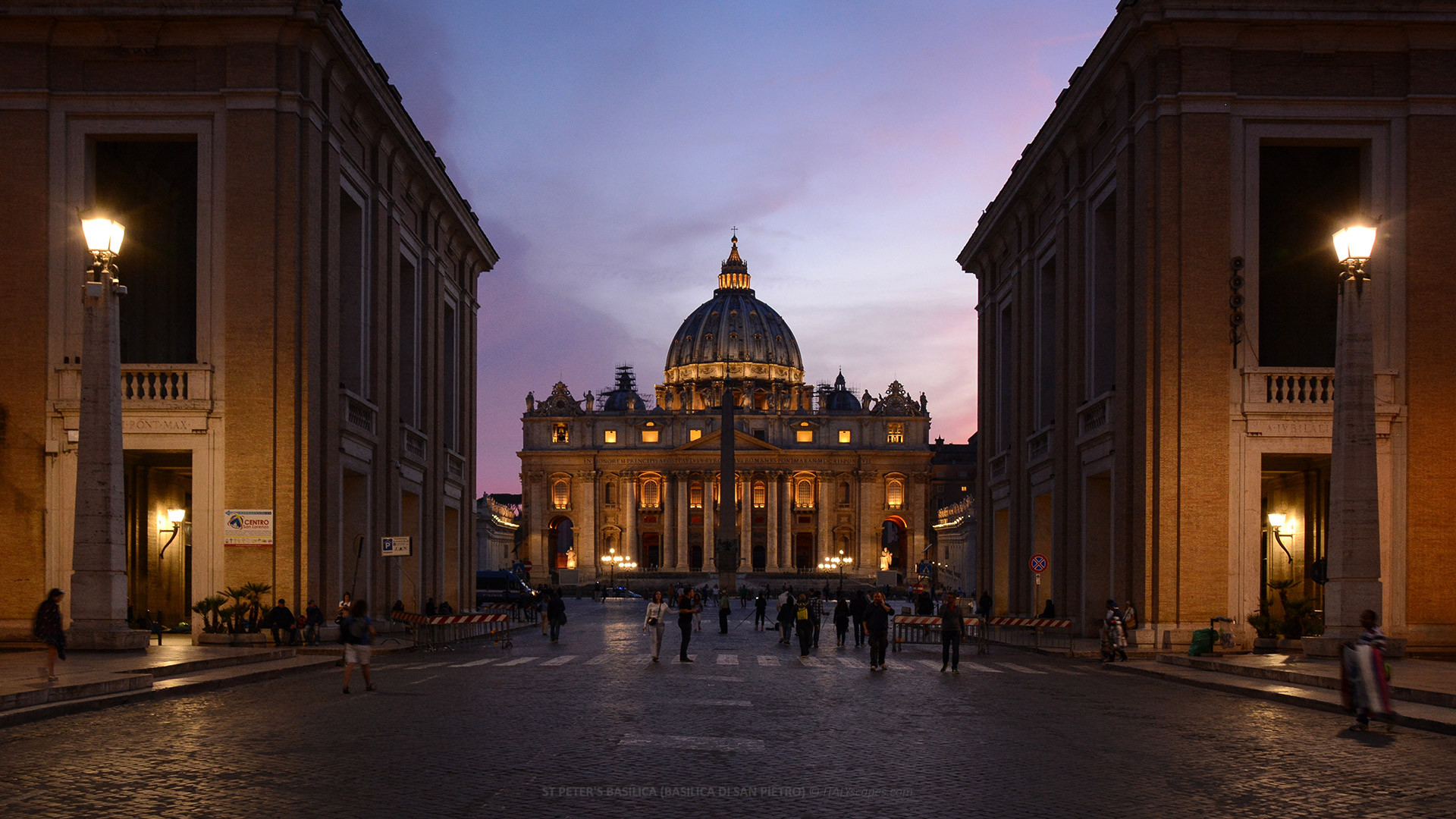
View of St Peter’s Basilica from Via della Conciliazione
Architecture of St Peter’s Basilica (Basilica di San Pietro)
General Dimensions and Plan
St Peter’s Basilica is one of the largest religious buildings ever constructed. It measures approximately 187 meters in length and reaches about 136 meters in height to the top of the dome. Its vast interior can accommodate tens of thousands of faithful during major celebrations.
The basilica has a Latin-cross plan, with a long central nave, side aisles, chapels, a transept and a deep apsidal area. The crossing, marked by the dome, is the architectural and symbolic center of the building, aligned with the papal altar and the tomb of Saint Peter.
The total covered area is often given at around 23,000 square meters, making the basilica exceptional not only for its height and length, but also for the scale of its interior surfaces, chapels, altars, monuments and liturgical spaces.
The building combines Renaissance and Baroque architecture. Bramante, Raphael, Sangallo and Michelangelo shaped the Renaissance phase, while Maderno and Bernini completed the basilica’s later appearance with a more theatrical and ceremonial Baroque language.
The Façade
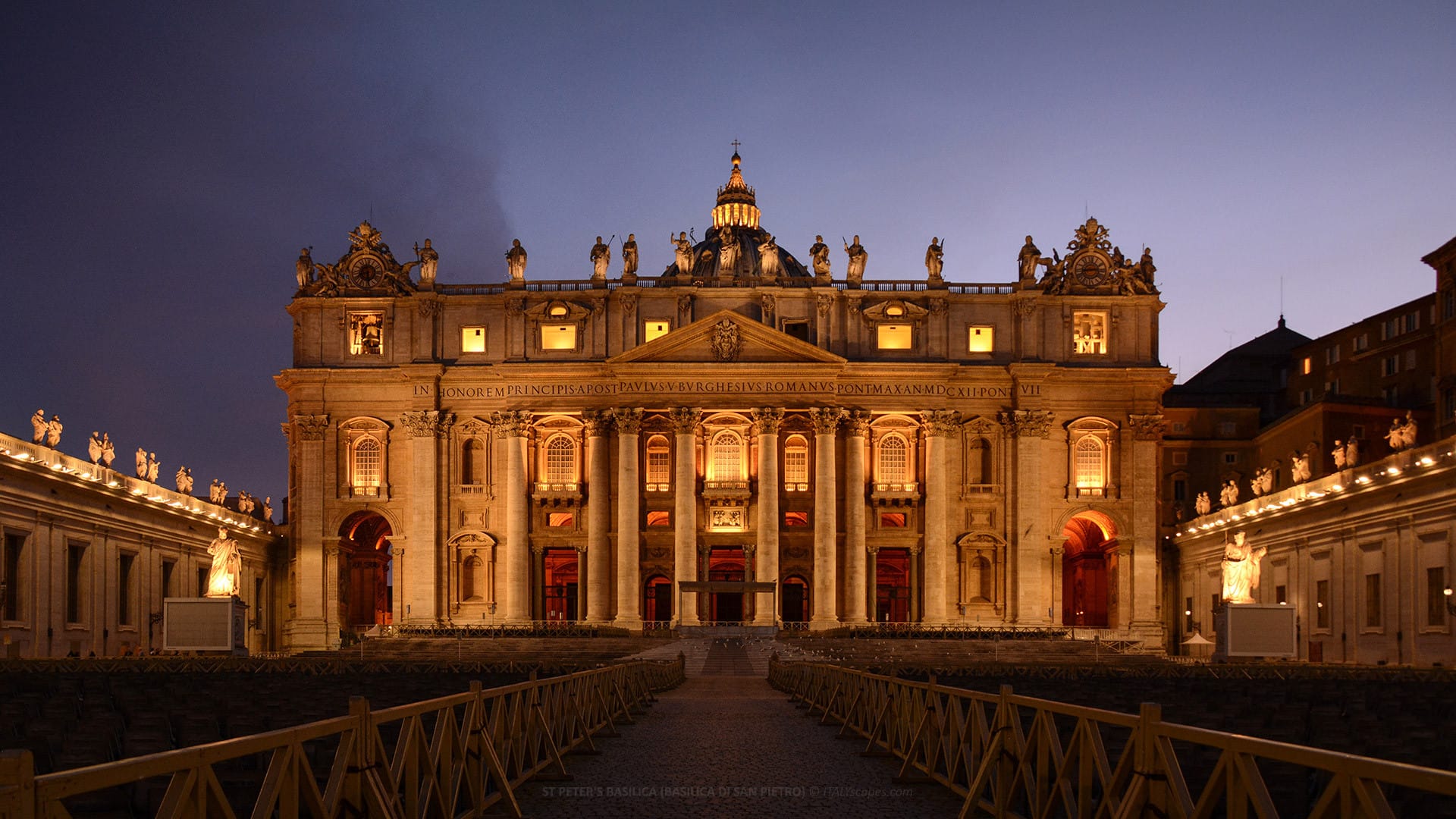
The façade of St Peter’s Basilica was designed by Carlo Maderno and completed in the early 17th century. It is about 115 meters wide and around 45 meters high, forming a monumental front that dominates the eastern side of Piazza San Pietro.
The façade is articulated by giant columns and pilasters that frame the main entrances. Above them runs a large attic, crowned by statues representing Christ, John the Baptist and the Apostles, except Saint Peter, whose statue stands at ground level in the square.
At the center of the façade is the Loggia of the Blessings, used for solemn papal appearances. From this balcony, the new pope is traditionally announced after a conclave, and the pope gives the Urbi et Orbi blessing on major occasions.
The Interior
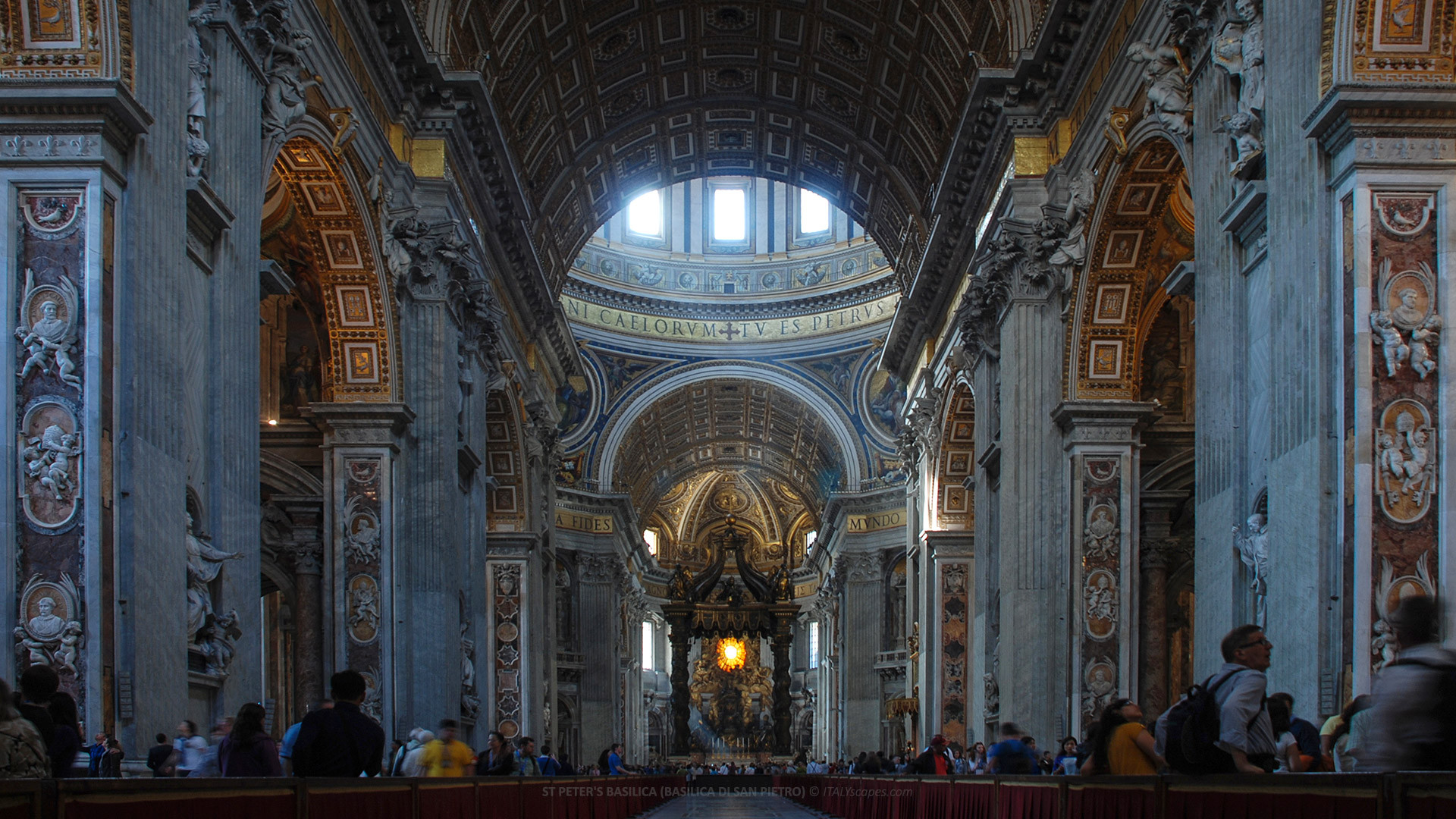
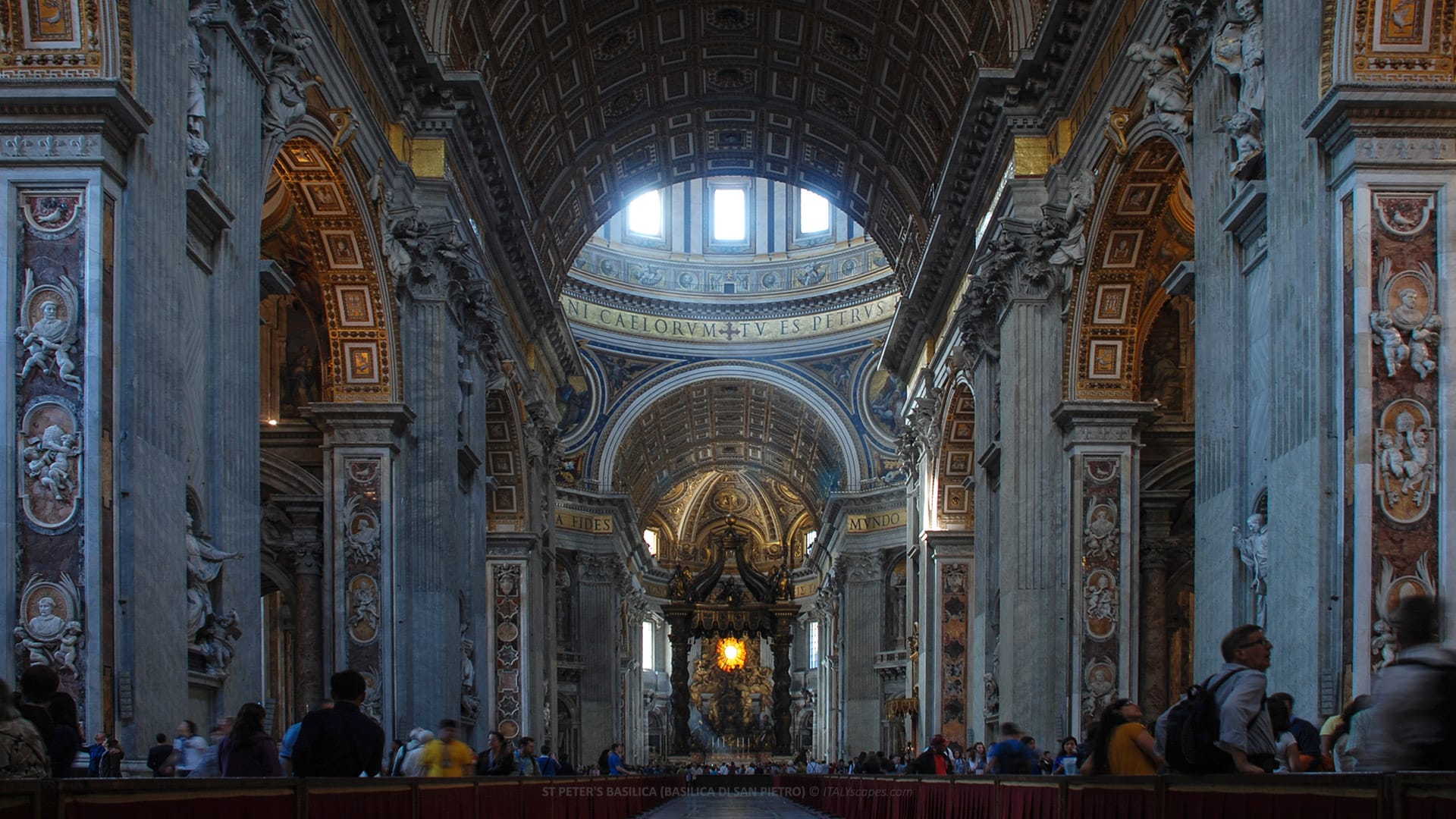
The interior is divided into a broad central nave and side aisles, separated by massive piers and large round arches. The scale is deliberately monumental, but the rich decoration, marble surfaces and sculptural details reduce the visual impression of empty size.
The central nave is covered by a barrel vault and leads toward the crossing, the papal altar and the apse. Along the nave, inscriptions in large letters emphasize the basilica’s connection with papal authority and the words of Christ to Saint Peter.
The floor contains markers showing the relative lengths of other major churches. These markers help visitors understand the immense size of Saint Peter’s Basilica by comparing it with cathedrals and churches from different parts of the Christian world.
The side aisles contain chapels, altars, tombs and devotional spaces. Among the most important areas are the Chapel of Baptism, the Chapel of the Presentation, the Choir Chapel and the Chapel of the Blessed Sacrament.
The Dome
The dome is the most recognizable architectural element of St Peter’s Basilica. Designed by Michelangelo and completed after his death, it rises above the crossing and reaches more than 133 meters to the top of the cross.
The dome has an internal diameter of about 41.5 meters and an external diameter of nearly 59 meters. It rests on four enormous piers, which had to support the immense weight of the masonry structure and transfer it safely to the foundations.
The climb to the dome includes more than 500 steps if taken entirely on foot. Visitors who use the elevator still need to climb the final narrow staircase to reach the upper level and the panoramic viewpoint over Vatican City and Rome.
Inside, the dome is decorated with mosaics and inscriptions. Its structure and decoration emphasize the vertical axis of the basilica, from the tomb of Saint Peter below, through the papal altar, to the dome and the cross above the city.
The Papal Altar and Bernini’s Baldachin
The space beneath the dome is dominated by Bernini’s Baldachin, one of the most famous works of Baroque art. Built between 1624 and 1633, it stands almost 30 meters high and marks the position of the papal altar.
The Baldachin is made of bronze and supported by four twisted columns. Its form recalls ancient ciboria while creating a dramatic Baroque focus within the vast space of the crossing.
The papal altar stands directly above the area traditionally associated with the tomb of Saint Peter. Only the pope, or priests delegated by him, normally celebrate Mass at this altar, underlining the basilica’s special connection with the papacy.
Behind the crossing, in the apse, stands Bernini’s Cathedra Petri, or Chair of Saint Peter. This monumental composition frames a relic traditionally associated with the apostle and creates a powerful visual conclusion to the main axis of the basilica.
Art of St Peter’s Basilica (Basilica di San Pietro)
The Portico and the Entrances
Before entering the basilica, visitors pass through the portico, which extends across the width of the façade. This transitional space contains important sculptural works and connects the open space of Piazza San Pietro with the sacred interior of the church.
The portico is flanked by two equestrian statues. On one side is Charlemagne, sculpted by Agostino Cornacchini. On the other side is Constantine, represented in a dramatic composition by Gian Lorenzo Bernini, referring to the first Christian emperor’s decisive role in the history of the site.
The basilica has five main entrances, including the Holy Door. The Holy Door is opened only during Jubilee Years and has a special religious meaning connected with pilgrimage, penance and the granting of indulgence in Catholic tradition.
Michelangelo’s Pietà
In the first chapel on the right is Michelangelo’s Pietà, one of the most famous sculptures in the world. Created when Michelangelo was still young, it represents the Virgin Mary holding the dead body of Christ after the Crucifixion.
The sculpture is remarkable for its technical perfection, polished marble surface and balanced composition. Mary is shown with an idealized youthful face, while Christ’s body is arranged with extraordinary anatomical precision and emotional restraint.
The Pietà is also important because it is the only work Michelangelo signed. The signature appears on the band across Mary’s chest, a rare detail in the artist’s career and a key fact in the history of Renaissance sculpture.
Today, the Pietà is protected behind glass, following an attack in the 20th century. Despite this barrier, it remains one of the most visited and studied works inside the basilica, and one of the greatest masterpieces of Italian Renaissance art.
Chapels on the Right Aisle
After the Pietà, the right aisle continues with several important chapels. The Chapel of Saint Sebastian contains a large mosaic representing the martyrdom of the saint and is also associated with the tomb of Pope John Paul II.
The Chapel of the Blessed Sacrament is one of the most important devotional spaces in the basilica. It contains a tabernacle designed by Gian Lorenzo Bernini and is used for prayer and Eucharistic adoration, so visitors are expected to maintain silence.
These chapels show how Saint Peter’s Basilica functions simultaneously as a monumental architectural space, a museum of sacred art and an active place of worship. Each chapel has a specific devotional role within the broader ceremonial plan.
Chapels on the Left Aisle
The left aisle includes the Chapel of Baptism, designed by Carlo Fontana. This chapel is used for baptismal ceremonies and contains an altar and decorative program connected with the sacrament of baptism, one of the central rites of Christian life.
Further along the left side are the Chapel of the Presentation and the Choir Chapel. The Choir Chapel is especially important for liturgical use and contains works connected with the musical and ceremonial traditions of the basilica.
Statues, Mosaics and Papal Monuments
The façade is preceded by statues of Saint Peter and Saint Paul, sculpted in the 19th century by Giuseppe De Fabris and Adamo Tadolini.
Inside the basilica, numerous statues represent saints, popes and founders of religious orders. Their placement reflects Catholic history and the universal character of the Church, bringing together figures from different periods, regions and spiritual traditions.
How to Get to St Peter’s Basilica (Basilica di San Pietro)
Getting to St Peter’s Basilica on foot
Saint Peter’s Basilica can be reached on foot from several important areas of Rome. From Castel Sant’Angelo, the walk to Piazza San Pietro is short and direct, following Via della Conciliazione, the broad avenue that frames the approach to the basilica.
From Piazza Navona or Campo de’ Fiori, the walk is longer but still practical for visitors who want to cross the historic center. The route usually passes near Ponte Sant’Angelo, offering one of the most scenic approaches toward the Vatican.
Getting to St Peter’s Basilica by metro
The closest metro station is Ottaviano-San Pietro, on Rome Metro Line A. It is located about 900-950 meters from the basilica, and the walk usually takes around 10 minutes, depending on crowds and security access.
From Roma Termini, visitors can take Line A in the direction of Battistini and get off at Ottaviano. This is one of the simplest public transport options for reaching the Vatican area from the main railway station of Rome.
Cipro station, also on Line A, is another possible option, especially for visitors who combine Saint Peter’s Basilica with the Vatican Museums. However, Ottaviano is generally the more direct stop for the basilica and Piazza San Pietro.
Getting to St Peter’s Basilica by bus
The closest bus stops are in the areas of Cavalleggeri/San Pietro, Piazza Pia and nearby streets around the Vatican. Depending on the exact stop, the walking distance to the basilica is usually between 350 and 500 meters.
Bus line 64 is one of the most useful routes because it connects Roma Termini with the Vatican area. Other lines serving nearby stops include 34, 46, 62, 98, 881 and 916, depending on direction and current local routes.
Getting to St Peter’s Basilica by tram
The nearest useful tram connection is Tram 19, which stops at Piazza del Risorgimento, about 600 meters from Saint Peter’s Basilica. From there, visitors can walk toward the Vatican walls and continue to Piazza San Pietro.
Tram 19 is useful for visitors coming from northern and eastern areas of Rome. It does not stop directly in front of the basilica, but it provides a practical connection to the Vatican district and the Ottaviano transport area.
Getting to St Peter’s Basilica by train
The nearest railway station is Roma San Pietro, located about 1 kilometer from the basilica. It is connected with regional trains and can be useful for visitors coming from other parts of Rome or from towns on regional lines.
From Roma San Pietro station, the walk to Piazza San Pietro usually takes around 10 to 15 minutes. The route passes through the area behind the Vatican and approaches the basilica from the south-western side.
The train is not the most common option for first-time visitors staying in central Rome, because the metro and buses are usually more straightforward. However, it can be practical for travelers arriving from areas connected to the regional railway network.
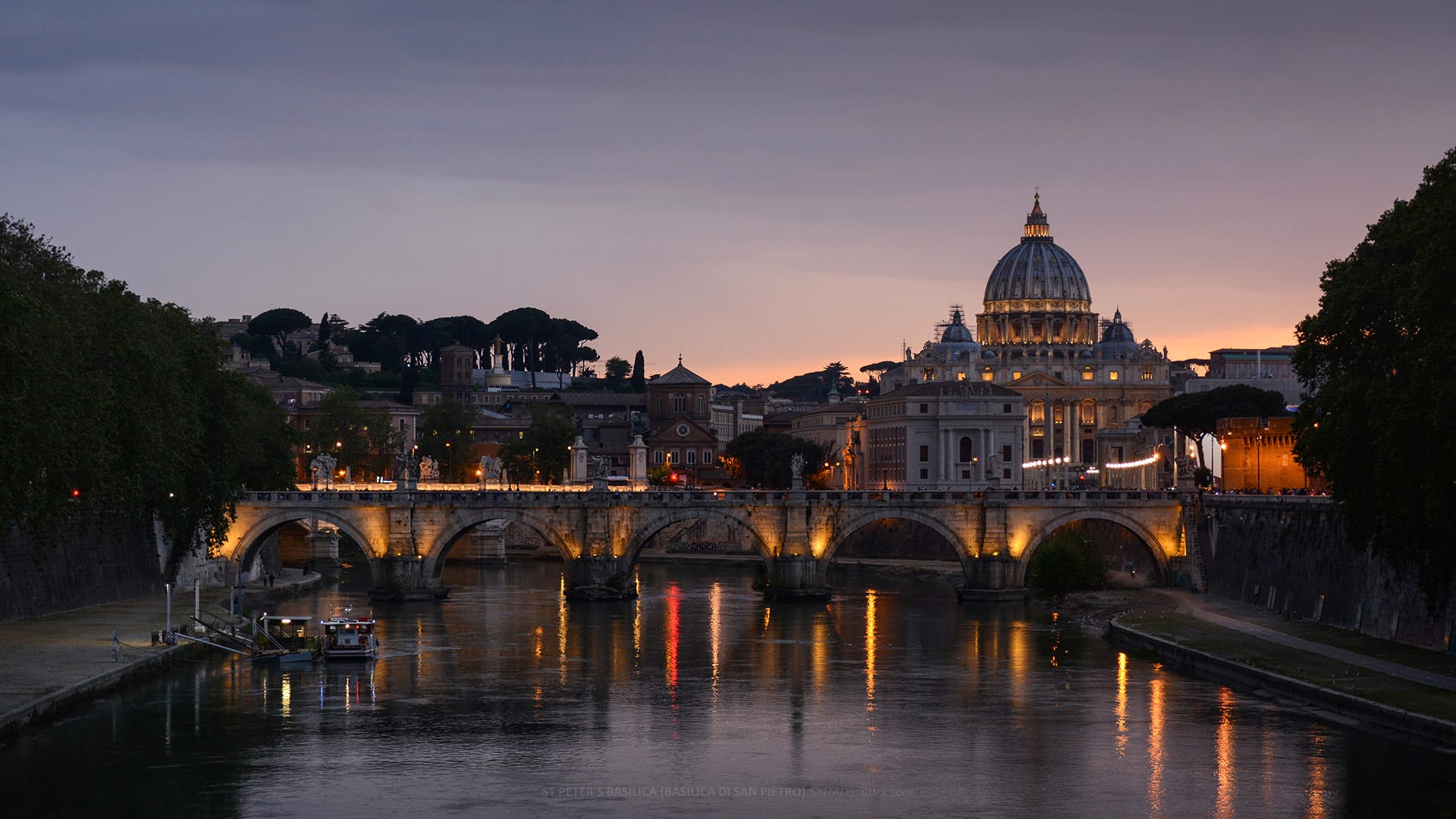
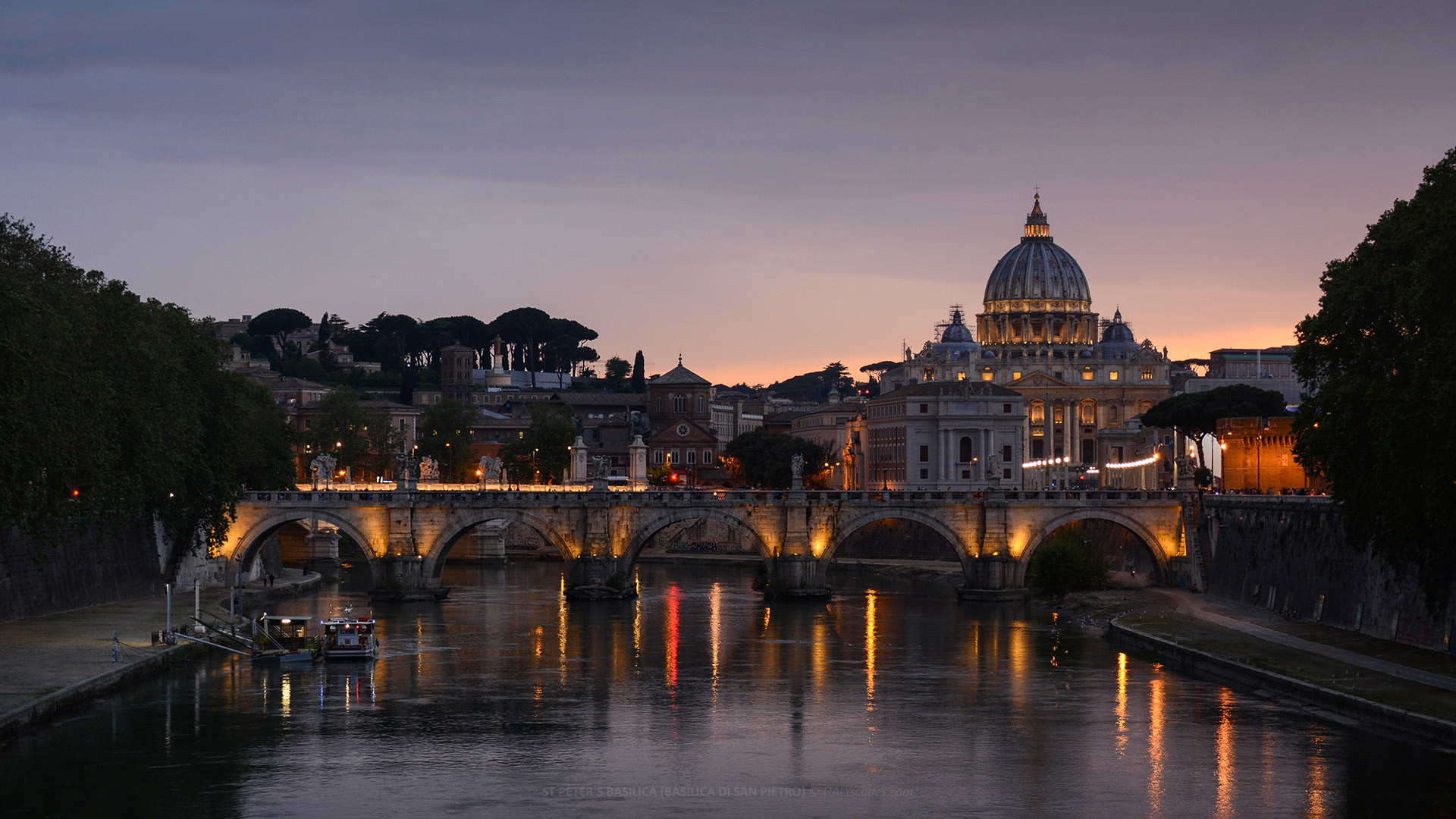
View of St Peter’s Basilica from Ponte Umberto I
Frequently Asked Questions about St Peter’s Basilica (Basilica di San Pietro)
Where is St Peter’s Basilica located?
St Peter’s Basilica is located in Vatican City, at the western end of Piazza San Pietro. Although it is not technically in Italy, it is usually visited during a trip to Rome.
Is St Peter’s Basilica the largest church in the world?
St Peter’s Basilica is considered one of the largest churches in the world, with a vast interior area of about 23,000 square meters and space for tens of thousands of worshippers.
Is Basilica di San Pietro the cathedral of Rome?
No. Basilica di San Pietro is a papal basilica, but the cathedral of Rome is the Basilica of Saint John Lateran, the official seat of the Bishop of Rome.
Who built St Peter’s Basilica?
The present basilica was built between 1506 and 1626. Important architects included Bramante, Raphael, Antonio da Sangallo the Younger, Michelangelo, Giacomo Della Porta and Carlo Maderno.
How tall is the dome of St Peter’s Basilica?
The dome of St Peter’s Basilica rises to more than 133 meters above the ground. It is one of the most recognizable architectural symbols of Rome and Vatican City.
What famous artworks are inside St Peter’s Basilica?
The most famous artworks include Michelangelo’s Pietà, Bernini’s Baldachin, the Cathedra Petri, papal monuments, mosaics, chapels and important sculptures from the Renaissance and Baroque periods.
How do you get to St Peter’s Basilica by metro?
The closest metro station is Ottaviano-San Pietro, on Metro Line A. From there, it takes about 10 minutes on foot to reach Piazza San Pietro and the basilica.
Is St Peter’s Basilica free to visit?
Entrance to St Peter’s Basilica is generally free, but visitors must pass through security checks. Access to the dome, guided tours and some special areas usually requires a separate ticket.
Sources:Buy tickets & tours:GetYourGuide -
Photos
-
Map
-
Reviews