Table of Contents
During the Second World War, Bassano del Grappa, a historic town in northern Italy, experienced German occupation, armed resistance, and violent reprisals. Located near the strategically important Monte Grappa and the Brenta Valley, the town became a significant center of partisan activity, while its civilian population endured repression, military operations, and Allied air raids.
Following the Italian armistice of September 1943, German forces occupied the town, supported by the authorities of the Italian Social Republic. Local resistance groups organized sabotage operations and guerrilla attacks, culminating in the devastating events of September 1944, when dozens of captured partisans and civilians were publicly executed in Bassano del Grappa.
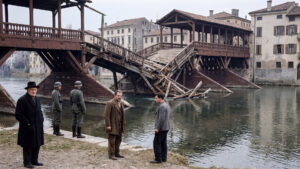
The final months of the conflict brought further destruction, including the partisan sabotage of the historic Ponte Vecchio, German reprisals, and repeated Allied bombardments. By April 1945, the collapse of German control and the advance of partisan forces brought liberation, leaving behind a history of sacrifice, resistance, and remembrance.
Bassano del Grappa Before the Second World War
During the years preceding the Second World War, Bassano del Grappa was governed under Benito Mussolini’s Fascist dictatorship. In 1926, the traditional office of mayor was replaced by a government-appointed podestà. Political opposition was restricted, while Fascist organizations increasingly influenced education, public ceremonies, youth activities, and other aspects of local society.
The Fascist authorities also promoted the memory of the First World War, particularly the battles fought on nearby Monte Grappa. In 1928, the city officially changed its name from Bassano Veneto to Bassano del Grappa, strengthening its association with the mountain that had become a symbol of Italian military sacrifice.
The city’s economy included agriculture, commerce, traditional craftsmanship, and industrial production. One particularly important employer was the Smalteria Metallurgica Veneta, established during the 1920s. Its workers would later play a significant role in local antifascist activity, maintaining political connections that had survived despite years of repression.
Italy entered the Second World War on June 10, 1940, when Mussolini declared war on France and Britain. As the conflict continued, military mobilization and shortages increasingly affected Italian communities. Bassano del Grappa remained under Fascist administration until July 25, 1943, when Mussolini was removed from power following the collapse of his government.
The German Occupation of Bassano del Grappa (1943)
The announcement of the Italian armistice on September 8, 1943, fundamentally changed the situation. Italian military units received inadequate instructions about how to respond to their former German allies. German forces rapidly occupied strategic locations throughout northern and central Italy, taking advantage of the disorganization of the Italian armed forces.
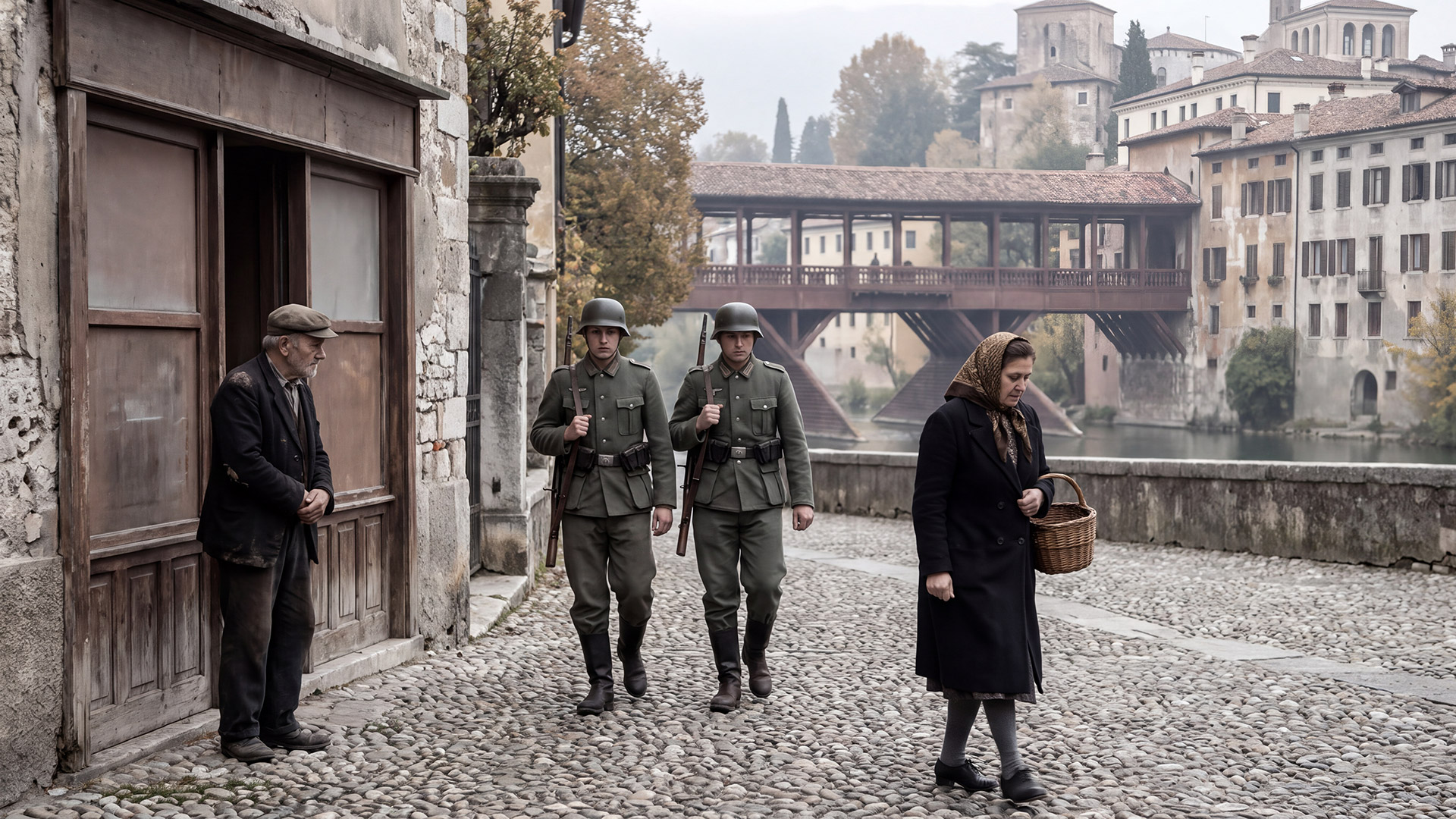
German troops entered Bassano del Grappa on September 14, 1943. The city’s location made it particularly valuable: the Valsugana corridor connected the Veneto plain with Trentino and routes toward Germany. These roads and railway connections carried military supplies, industrial materials, personnel, and other resources essential to German operations.
The occupiers established several military and security offices in requisitioned buildings. Bassano del Grappa came under the German military command based in Verona, while local security activities involved the German Security Service. Ca’ Cornaro housed a counterintelligence unit, and Caserma Reatto accommodated a German antiaircraft training establishment.
Meanwhile, Mussolini established the Italian Social Republic, a Fascist state dependent on German military support. The local Republican Fascist organization was formally reconstituted in October 1943, initially attracting approximately one hundred members. The new authorities supported German control and organized military and political measures against opponents of the regime.
Bassano del Grappa also accommodated offices connected with the Italian Social Republic’s military administration, including an Air Force undersecretariat. The Alpine Battalion “Bassano”, belonging to the Monterosa Division, was stationed locally. Its personnel included Italian soldiers who had been captured after the armistice and subsequently agreed to serve the new Fascist state.
The Rise of the Resistance Movement
Opposition to Fascism had survived among local socialist families, industrial workers, teachers, students, and members of the clergy. Following the German occupation, these existing connections contributed to the establishment of clandestine antifascist networks. Local committees associated with the emerging Italian liberation movement began organizing during autumn 1943.
Workers at the Smalterie Venete factory formed one particularly important group. Shortly before Christmas 1943, they organized a brief strike, an exceptionally dangerous action under wartime regulations. The factory director presented the dispute as an economic protest, helping prevent the participants from being deported to Germany.
The Resistance also developed through connections with the University of Padua and neighboring communities. Among the local figures involved were Alfeo Guadagnin, who helped establish a Matteotti partisan formation, and medical student Ludovico Todesco, who became associated with armed resistance on Monte Grappa.
Former Italian soldiers who escaped German capture joined civilians attempting to avoid conscription into the armed forces of the Italian Social Republic. By late 1943 and early 1944, partisan groups had appeared around Crespano, Cassola, San Pietro di Rosà, Cismon del Grappa, and other communities surrounding Bassano del Grappa.
During spring 1944, these formations carried out attacks against military installations, communications infrastructure, and transport routes. Their operations included destroying railway sections, interrupting electricity supplies, obtaining weapons, and attacking Fascist positions. One important target was Forte Tombion, where partisan activity disrupted transport through the Valsugana corridor.
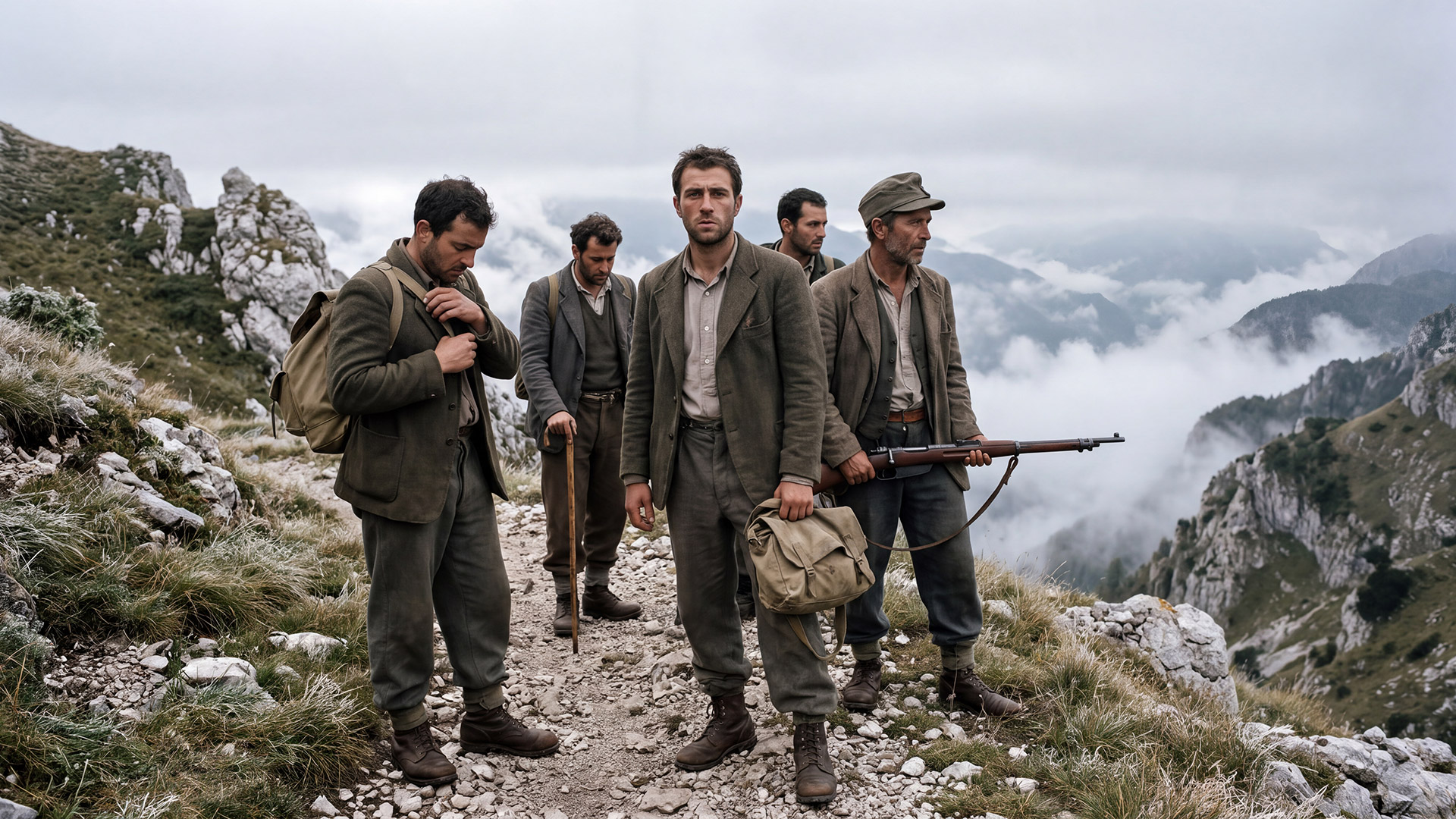
The Grappa Roundup – September 1944
By summer 1944, Monte Grappa had become an important refuge for partisans, military deserters, and young men avoiding Fascist recruitment. Approximately 1,000-1,200 men were associated with the mountain formations, although not all possessed adequate weapons, ammunition, or military training.
The principal organizations included the Giacomo Matteotti Brigade, commanded by Angelo Pasini, various Italia Libera formations, and units associated with the Garibaldi movement. Their positions extended across different parts of the massif, making coordination difficult. Commanders disagreed over whether to defend fixed mountain positions or continue mobile guerrilla operations.
German authorities considered the partisan presence a serious threat to communications between northern Italy and the Reich. In September, they organized Operation Piave, a large-scale military offensive involving German security forces, regular military units, and formations belonging to the Italian Social Republic.
The operation began on September 20, 1944, with attacks from the northeastern approaches to Monte Grappa. Further advances followed from the Brenta Valley and southern settlements. German and Fascist troops blocked access roads and employed artillery, machine guns, armored vehicles, and overwhelming numerical superiority against the poorly equipped partisan formations.
The fighting resulted in the collapse of organized partisan resistance across much of the mountain. Approximately 200 people were killed during combat or immediately after capture, while around 400 prisoners were deported to Germany, according to local historical estimates. Further killings followed in surrounding villages, including Possagno, Crespano, and Carpanè.
The Hangings of 1944 – Bassano’s Forgotten Tragedy
The repression reached Bassano del Grappa during the final days of Operation Piave. Between September 23 and 24, 1944, sixteen young prisoners were executed at Caserma Reatto by German and Italian Fascist personnel. Their bodies were placed in a common grave, while additional detainees remained in military custody.
On September 26, 1944, thirty-one prisoners were transported through the city on an open truck, with their hands tied behind their backs. The condemned men were taken to the tree-lined avenues near the historic center, where preparations had been made for a series of public hangings.
The executions were carried out under German authority, with the participation of Italian Fascist personnel. Herbert Andorfer was among the German officers responsible for the operation, while SS noncommissioned officer Karl Franz Tausch was implicated in the repression. The victims were hanged from trees and displayed with signs identifying them as “bandits”.
Father Odone Nicolini managed to reach some prisoners before their execution and offer religious assistance, despite opposition from the German authorities. The condemned men were executed individually, while residents were compelled to witness the killings. Their bodies remained suspended for approximately twenty hours.
The episode became known as the Bassano massacre, one of the most notorious acts of Nazi-Fascist repression in the Veneto. The executions were intended to intimidate the population and discourage support for the Resistance. They formed part of a wider campaign of killings that affected numerous communities surrounding Monte Grappa.
Life Under Occupation – Fear, Repression and Survival
Military occupation created serious economic difficulties for Bassano’s civilian population. Hotels and private buildings were requisitioned for military personnel and officials, while refugees and displaced families increased demand for accommodation. Food rationing and shortages of heating fuel became increasingly difficult problems for the municipal administration.
German and Republican Fascist forces maintained control through military patrols, investigations, arrests, and surveillance. The National Republican Guard, Black Brigades, and political investigation offices participated in anti-partisan repression. Lieutenant Alfredo Perillo, who headed a local investigative unit, became closely associated with the security apparatus operating in the area.
Families suspected of supporting partisans faced significant risks, particularly when providing food, shelter, or information. German authorities also used the northern transport network to move Italian workers and prisoners toward Germany. Deportation and forced labor formed part of the occupation’s broader system of coercion.
Despite the losses suffered in September, the Resistance gradually reorganized. On October 5, 1944, survivors established the Martiri del Grappa Brigade at Castion di Loria, under Primo Visentin, known as “Masaccio”. Other formations reorganized separately, while financial assistance and parachuted supplies helped sustain renewed operations during the following months.
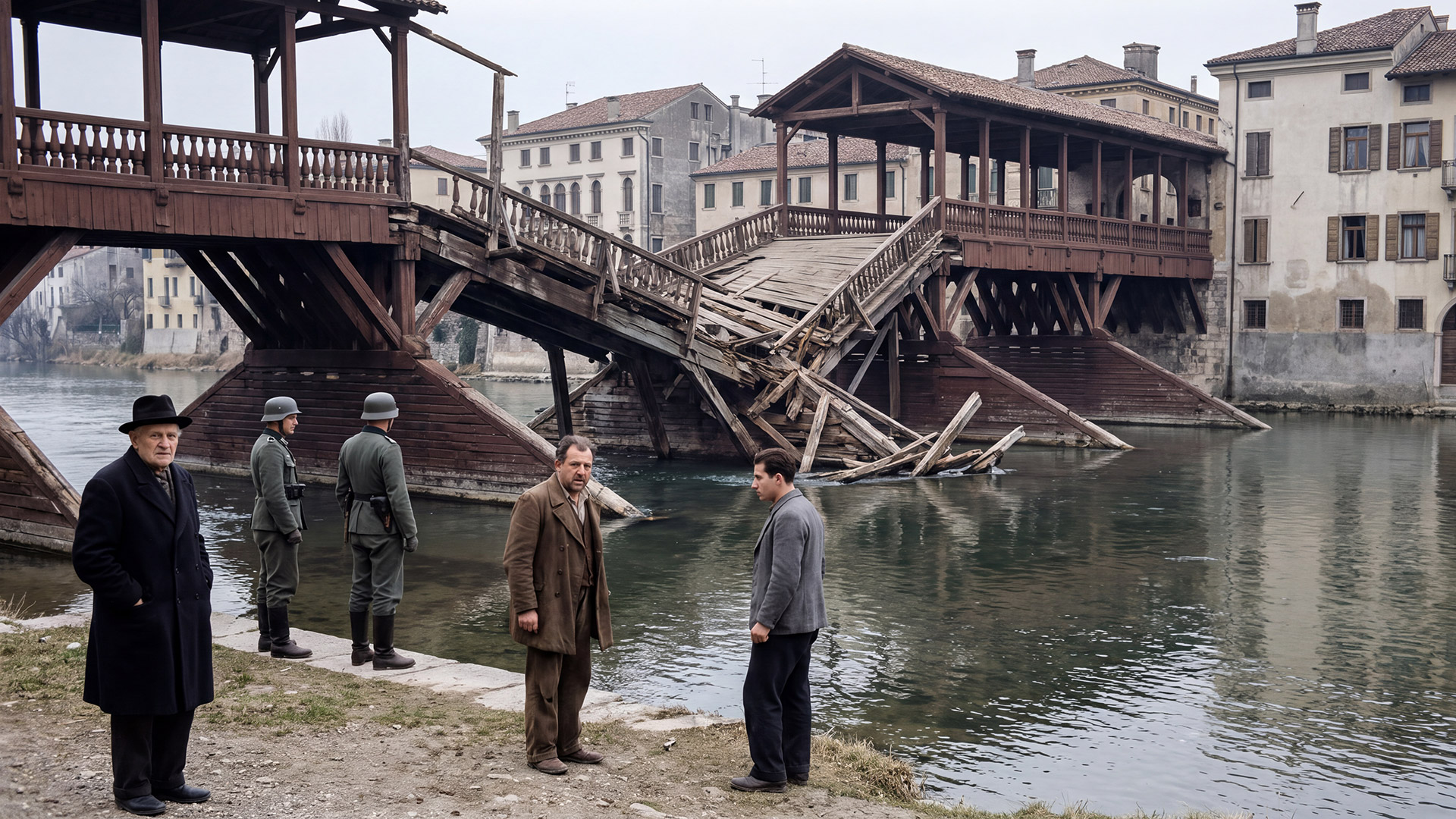
The Destruction of Ponte Vecchio in February 1945
By early 1945, Bassano’s bridges had become important targets because German military transport continued to use the Brenta crossings. Allied aircraft repeatedly attacked Ponte della Vittoria, also known as Ponte Nuovo, seriously damaging the structure during bombardments on February 12 and 13.
With the newer bridge severely damaged, the historic Ponte Vecchio remained strategically important. The wooden crossing, designed by Andrea Palladio in the sixteenth century, connected the historic center with Angarano. Its continued use by German military traffic prompted the regional Resistance command to authorize a sabotage operation.
On the evening of February 17, 1945, a partisan group commanded by Primo Visentin, assisted by Andrea Cocco, approached the bridge. Some participants disguised themselves as German soldiers or Fascist militiamen. They placed explosive charges intended to disable the crossing and interrupt military movement between the riverbanks.
The explosion damaged the bridge near the Angarano side, making it unusable for traffic. The operation also caused the deaths of two civilians and injuries to two others. Although the sabotage achieved its military objective, the civilian casualties demonstrated the dangers associated with armed operations in populated areas.
German authorities responded with another execution. On February 22, 1945, Federico Alberti, Cesare Lunardi, and Antonio Zavagnin were shot on the bridge as a reprisal. The three prisoners had not participated in the sabotage. Their deaths illustrated the German policy of punishing detainees for partisan actions carried out by others.
The Allied Bombings and the Final Days of the Second World War
From January to April 1945, Bassano del Grappa experienced repeated Allied air raids aimed primarily at disrupting German transport infrastructure. Local historical records document twenty-three bombing attacks before liberation. Roads, railway connections, and bridges were particularly important targets as German forces prepared for the possibility of retreat.
Attacks continued throughout February and March, including operations against road bridges and transport facilities. On March 23, 1945, Allied aircraft bombed a road bridge in Bassano del Grappa. Further attacks occurred in April as Allied forces advanced through northern Italy and increasingly targeted German supply and withdrawal routes.
On April 23 and 24, 1945, aircraft attacked several crossings over the Brenta, including bridges in and around Bassano del Grappa. The bombardment of April 24 caused extensive damage to buildings and also affected the Civic Museum. Residential areas suffered alongside installations that had been selected for military reasons.
The city’s antiaircraft defenses were unable to prevent the attacks. Civilian buildings were damaged or destroyed, and the interruption of important crossings complicated local movement. By late April, the military infrastructure of the Brenta Valley had suffered extensive disruption, immediately before the final battles for control of the territory.
The Liberation of Bassano del Grappa (April 1945)
The final Allied offensive in northern Italy accelerated during April 1945, while partisan organizations prepared coordinated uprisings across occupied territories. Beginning on April 25, resistance formations around Bassano del Grappa intensified operations against remaining German and Republican Fascist positions, attacking military installations and attempting to secure surrounding communities.
The Martiri del Grappa Brigade operated principally east of the Brenta, while the Giovane Italia Brigade, led by Ermenegildo Moro and Valentino Filato, was active on the opposite side. These formations participated in the final liberation operations, confronting German units that continued resisting despite the general collapse of Fascist authority.
On April 29, 1945, partisan commander Primo Visentin was killed during the final fighting in the surrounding area. His death occurred near Riese, during an attempt to negotiate the surrender of German soldiers. Visentin did not survive to participate in the subsequent celebrations marking the end of occupation.
The liberation unfolded over several days. Some chronologies identify April 28 as the date of liberation, while more detailed local accounts record partisan entry on April 29 and the completion of liberation on April 30. The remaining German resistance was overcome, ending approximately twenty months of military occupation.
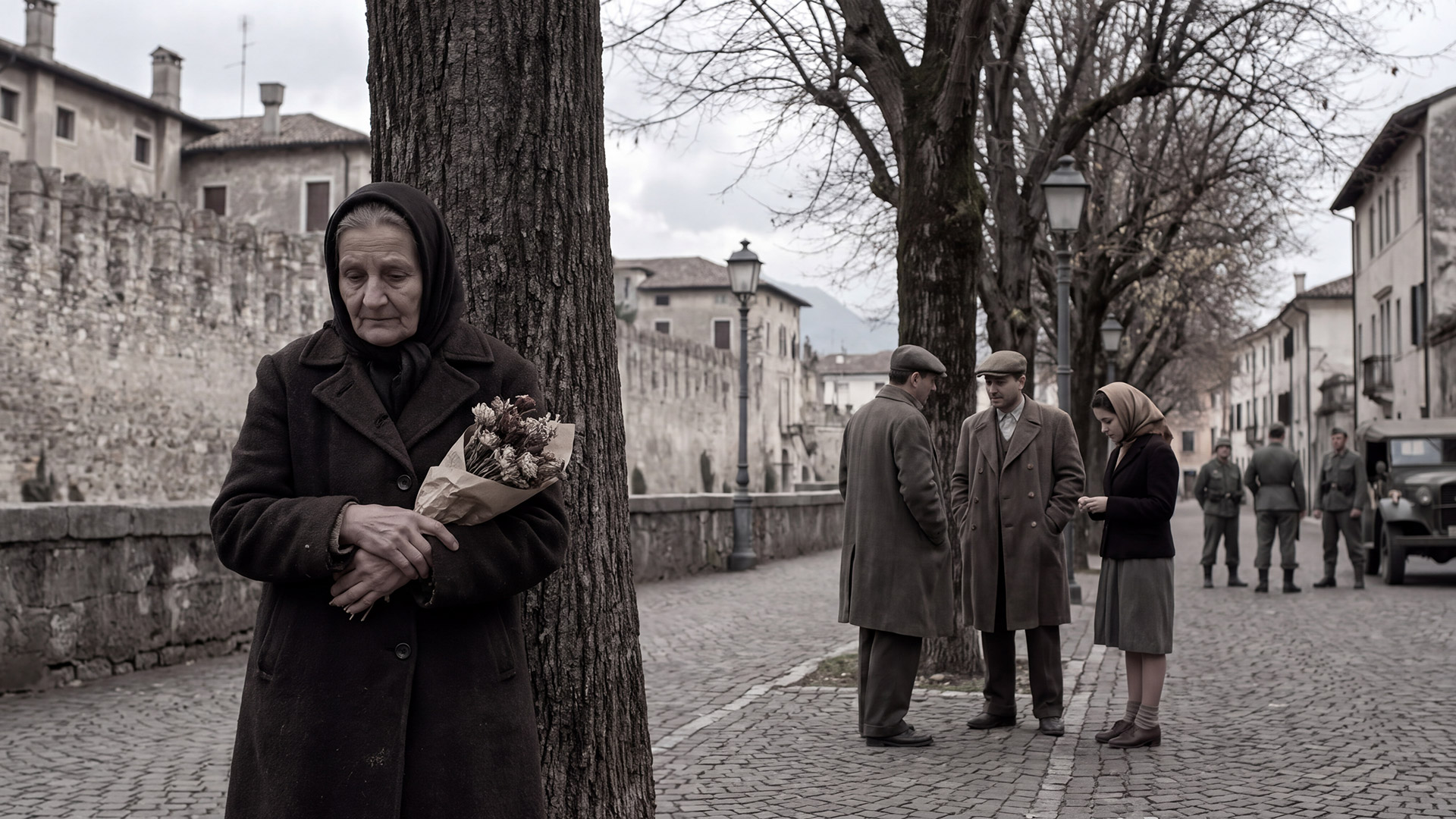
Remembering the War – Monuments and Memorials
The sacrifices of the city and surrounding territory received national recognition after the conflict. On October 9, 1946, Bassano del Grappa was awarded the Gold Medal of Military Valor for its contribution to the Italian Resistance and the struggle against Nazi-Fascist occupation.
The official award citation recorded 171 people hanged, 603 executed by firing squads, 804 deported, 3,212 prisoners, and 285 houses burned across the city and Monte Grappa territory during the occupation. These figures refer to the wider affected area rather than exclusively to residents of the historic center.
The avenue where the September 1944 hangings took place is now known as Viale dei Martiri. Memorial crosses, photographs, and inscriptions attached to trees commemorate individual victims. Near Porta delle Grazie, a memorial plaque erected in 1957 records the names of those executed during the repression.
Another important postwar reconstruction concerned Ponte Vecchio, rebuilt with substantial involvement from the Alpini and inaugurated on October 3, 1948, in the presence of Prime Minister Alcide De Gasperi. The restored bridge became known as Ponte degli Alpini, preserving the historic design while marking the city’s recovery from wartime destruction.
The history of Bassano del Grappa during the Second World War remains visible in its streets, monuments, and commemorative sites. Viale dei Martiri, the memorial inscriptions, and the reconstructed bridge preserve evidence of occupation, resistance, civilian suffering, and liberation, connecting the events of 1943-1945 with the city’s present-day historical identity.
Images generated with Nano Banana Pro / Google AI Studio