Table of Contents
In the historic centre of Como, far from the temples and deserts of ancient Egypt, lies an extraordinary archaeological treasure. The mummy of Como belongs to Isiuret, a young Egyptian priestess whose body has survived for almost three thousand years. Her story involves sacred rituals, a vanished tomb, a sealed funerary covering, and objects concealed beneath ancient linen.
Her name was written in hieroglyphs upon the covering prepared for her burial. Around it, images of Egyptian gods invoke protection for her journey into the afterlife. Those inscriptions have preserved her identity across the centuries, even as the civilization that created them underwent profound transformations.
Isiuret’s remarkable history extends far beyond ancient Thebes. In the nineteenth century, her funerary covering reached Italy, where it remained unopened for decades. When a collector finally opened it in 1887, he discovered her wrapped body. More than a century later, another investigation uncovered something that the first examination had overlooked.
A Name Written for Eternity
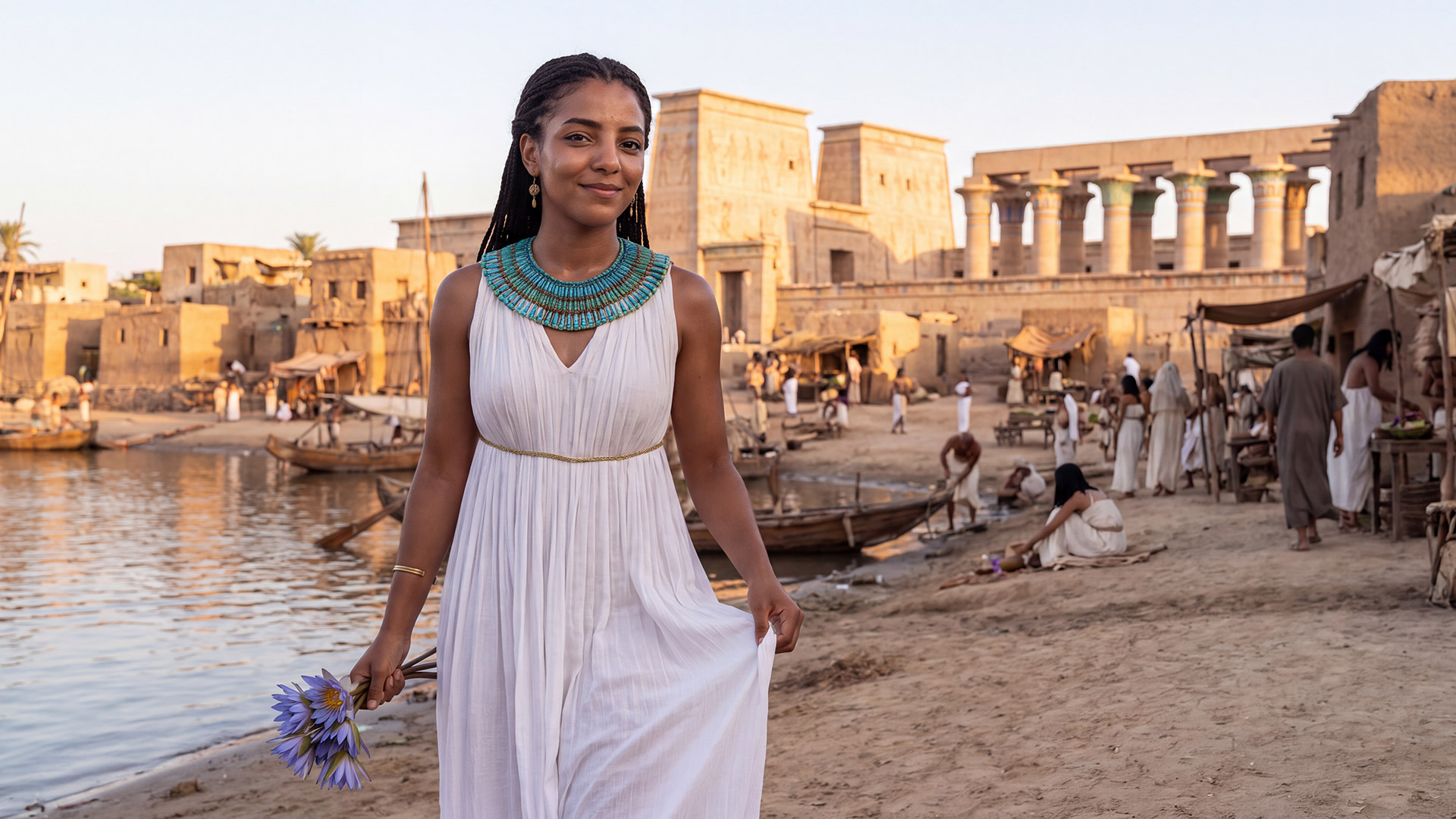
Isiuret lived during Egypt’s Twenty-Second Dynasty, in the Third Intermediate Period. Her funerary covering is generally dated to the ninth century BC. This was an age in which the great temples of Thebes remained important religious institutions, maintaining ceremonies and traditions inherited from earlier periods of Egyptian history.
Her name, Isiuret, means “Isis the Great”, referring to one of the most important goddesses of ancient Egypt. Isis was associated with divine protection, motherhood, and the restoration of life. Her worship played a significant role in the religious beliefs surrounding death and the possibility of existence beyond it.
Inscriptions on the funerary covering identify Isiuret as a woman connected with the temple community of Thebes, the ancient city occupying the area of modern Luxor. This was the religious centre of the cult of Amun, whose monumental sanctuary at Karnak dominated the sacred landscape of Upper Egypt.
The texts also preserve her genealogy, connecting the deceased with her family. These inscriptions were intended to maintain her personal identity in the afterlife. Nearly three millennia later, they still identify the woman beneath the linen, giving her a place in history that countless other ancient Egyptians have lost.
The Sacred Duties of a Young Woman
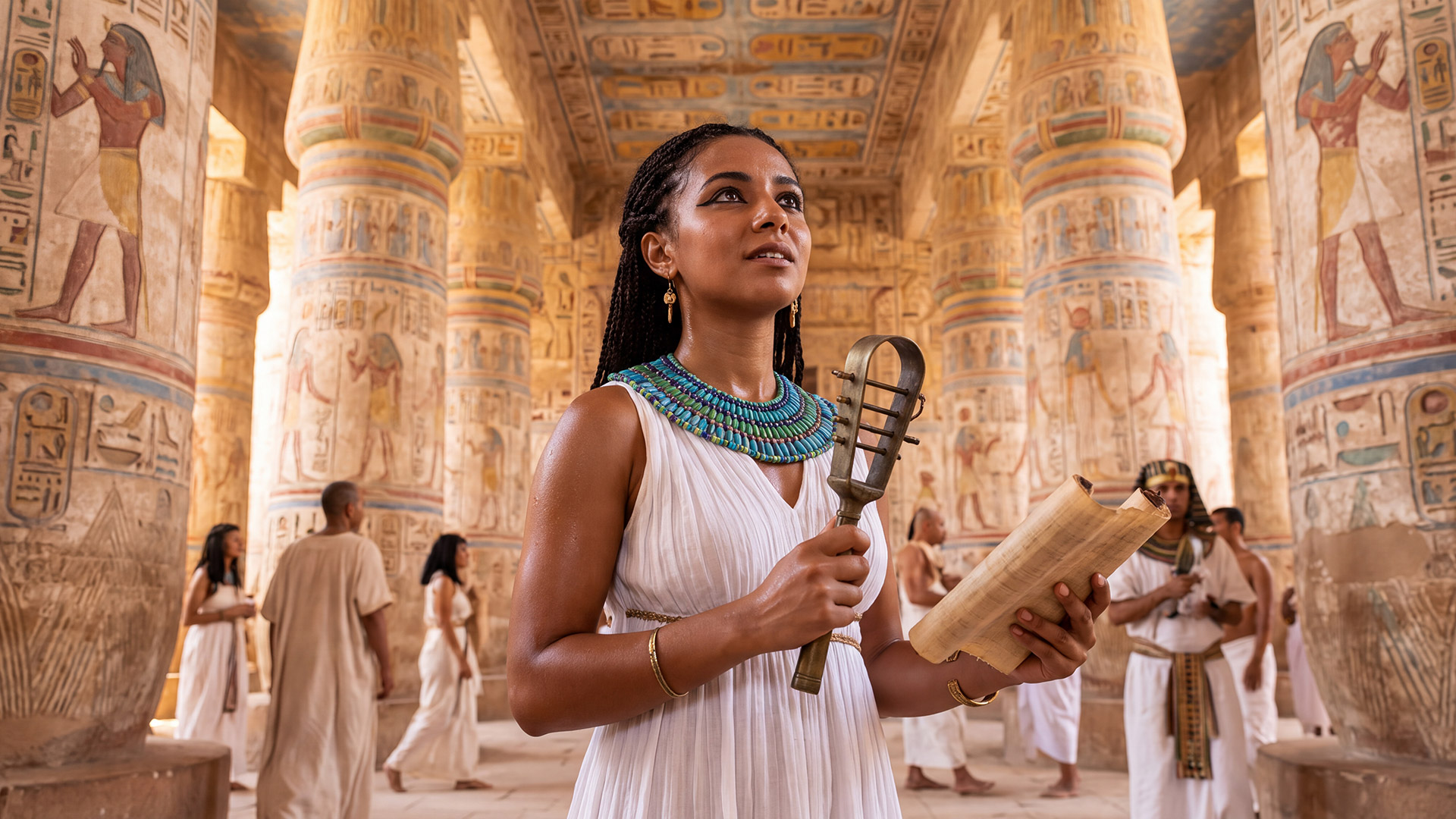
Isiuret’s titles reveal an unusual connection with the worship of the Theban triad, consisting of Amun, Mut, and Khonsu. The three deities occupied a central position in the religious traditions of Thebes, and their sanctuaries formed part of the extensive temple landscape at Karnak.
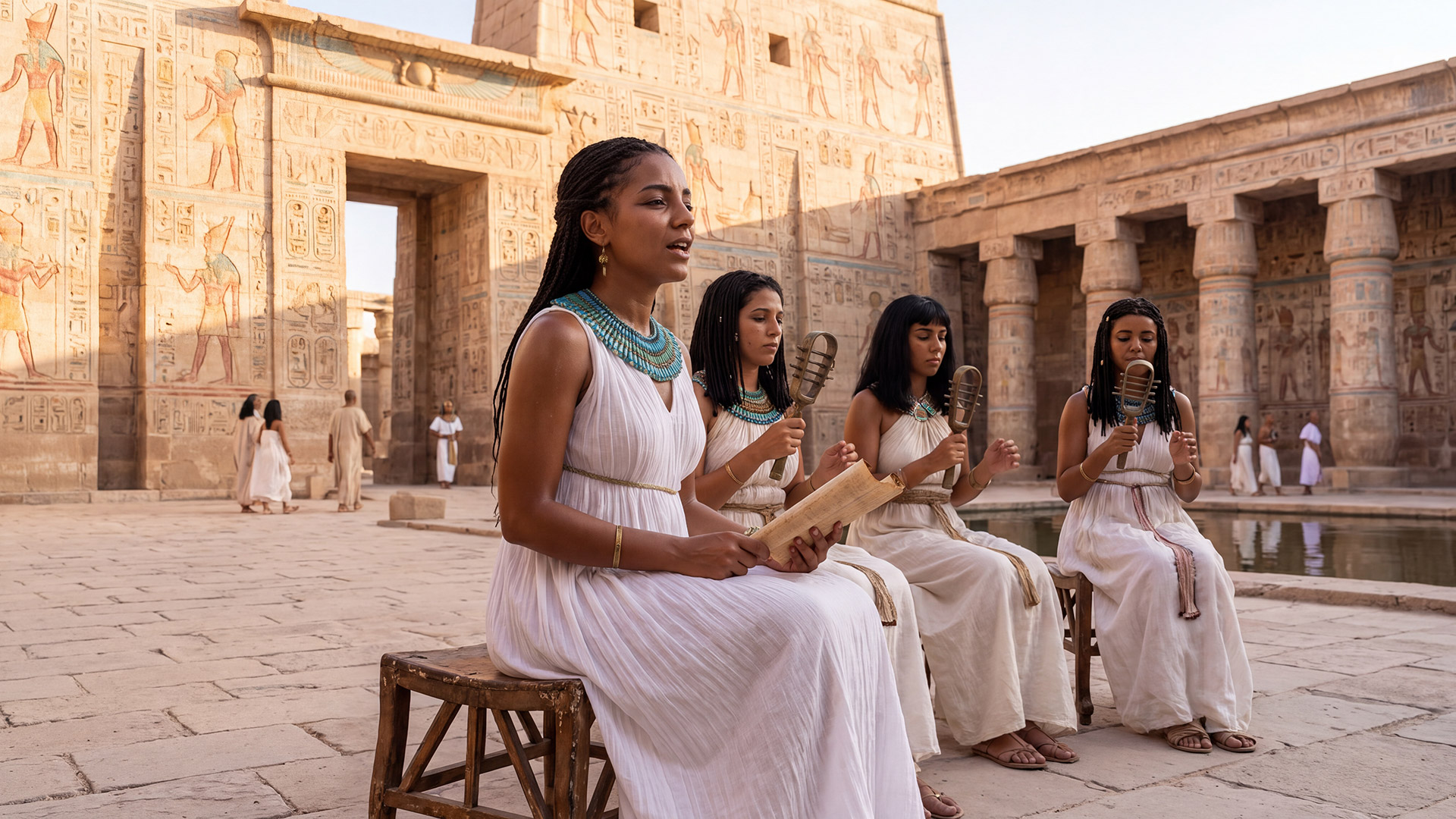
One of her titles was sistrum player of Amun-Ra. The sistrum was a sacred percussion instrument, producing a rattling sound when shaken. It accompanied religious ceremonies, and its distinctive sound was associated with divine worship. Isiuret’s title places her among the women connected with these ancient temple rituals.
She was also identified as a singer in the choir of Mut. The goddess Mut, divine consort of Amun, possessed an important sanctuary at Karnak. Singing formed part of Egyptian religious ceremonies, alongside processions, offerings, and music performed in honour of the gods.
Her third title was nurse of the child Khonsu, the youthful deity completing the sacred triad. Together, these three offices reveal the religious identity of the young priestess. They are among the most intimate details preserved from her life, connecting her directly with the ceremonial world of ancient Thebes.
A Face That Survived the Centuries
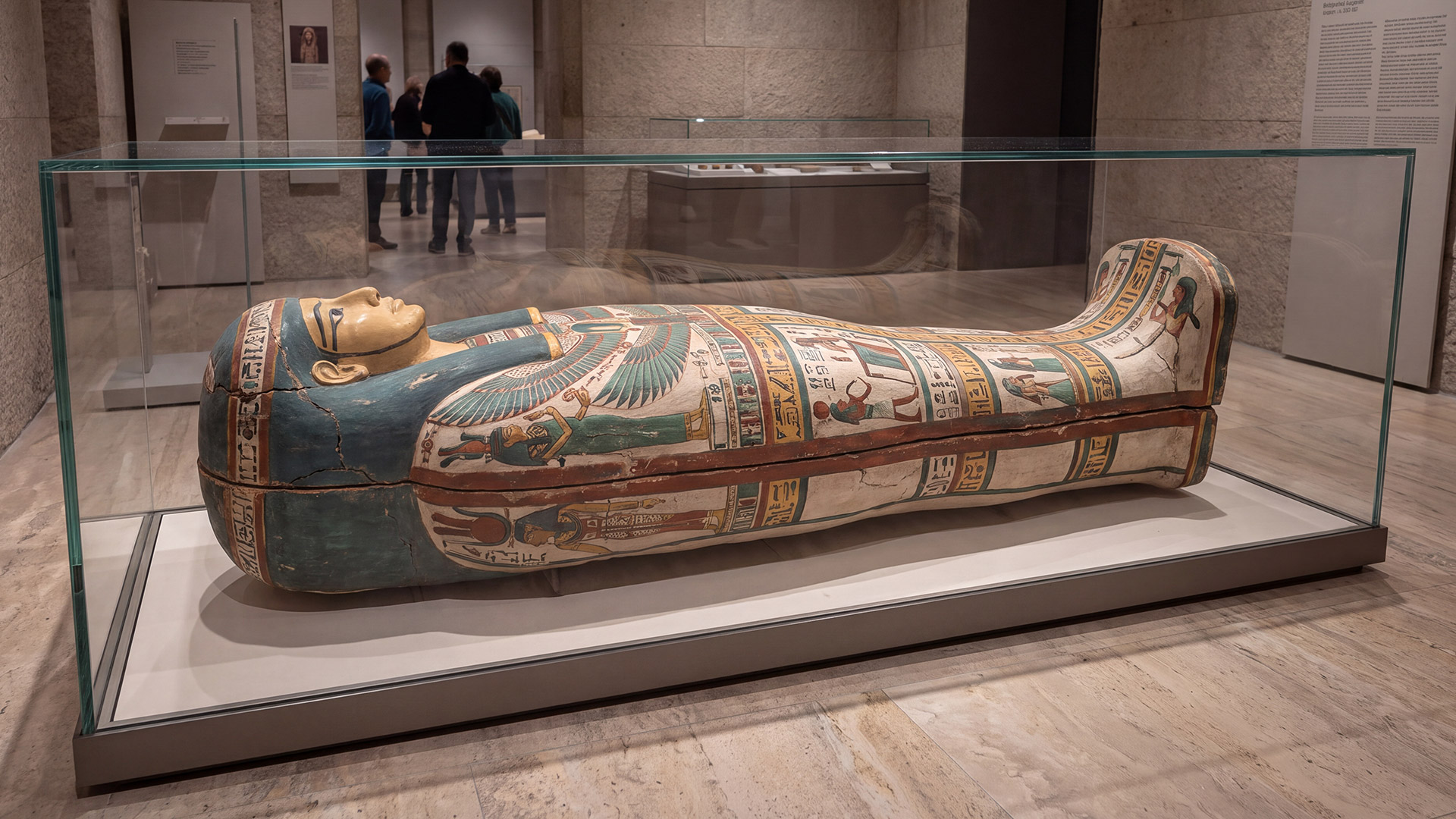
After Isiuret’s death, her body was prepared for burial and enclosed within an elaborate anthropoid cartonnage, approximately 160 centimetres high. The covering followed the shape of a human figure and displayed a carefully painted representation of the deceased, intended to preserve her funerary identity.
Cartonnage was created from layers of linen and other materials, strengthened with plaster-like preparations until they formed a rigid shell. Once the surface was ready, craftsmen painted it with religious images and hieroglyphs. The resulting object combined physical protection with the sacred symbolism of Egyptian burial traditions.
The painted face belonged to the artistic conventions of its period, presenting the deceased in an idealized form. Its symmetrical features formed part of an elaborate decorative composition. This stylized image was intended to endure, preserving the appearance of a funerary figure long after the body beneath it had been concealed.
The cartonnage probably once fitted inside a larger wooden coffin, which disappeared during the burial’s later history. What survives in Como is the inner protective covering, closely associated with the wrapped body. Even without its original outer container, it remains an exceptionally informative example of ancient Egyptian funerary craftsmanship.
The Gods Who Protected the Dead
Across the painted surface, numerous Egyptian divinities appear in decorated compartments. Some are represented embracing the deceased, expressing their protective role. The images formed part of a religious system in which sacred symbols and written invocations were believed to assist the dead beyond earthly existence.
The hieroglyphic inscriptions were equally important. They contained prayers invoking divine protection, alongside personal information identifying Isiuret. The longest passages occupied the sides and lower portions of the covering, transforming it into a written record of her identity and her hopes for the afterlife.
Egyptian funerary beliefs placed considerable importance on preserving the body, maintaining the individual’s name, and ensuring a favourable passage into the next world. These ideas explain the extraordinary care invested in Isiuret’s burial. The painted cartonnage was both a protective enclosure and a sacred object prepared for eternity.
The Lost Tomb and the Journey to Europe
The original burial place of Isiuret has disappeared from the historical record. Her religious titles and the characteristics of her funerary covering strongly associate her with Thebes, one of Egypt’s principal religious centres. At some point, the burial was removed from its original setting and entered the antiquities trade.
The first documented chapter of its European history began in 1819, when the Egyptian ruler Muhammad Ali reportedly presented the funerary object to Baldassarre Valerio. According to the account accompanying the gift, Valerio had paid debts incurred by several Egyptian students, receiving the remarkable antiquity in recognition of his assistance.
The burial arrived with a description claiming that it had been recovered from the pyramids of Memphis, in northern Egypt. That geographical attribution contrasted with its Theban religious inscriptions and artistic characteristics. The discrepancy became part of the object’s complicated history, reflecting the uncertain documentation accompanying many Egyptian antiquities entering European collections.
The journey itself was extraordinary. A funerary object prepared for a woman connected with the temples of Upper Egypt had become a possession of an Italian family. Its painted surface preserved the religious imagery of another civilization, while its interior remained closed, concealing the ancient remains for which it had been created.
The Sealed Burial of the Valerio Family
For almost seventy years, Isiuret’s funerary covering remained in the possession of the Valerio family. The cartonnage was preserved unopened, maintaining a direct physical connection with the ancient burial. Those who examined its exterior could see its painted figures and inscriptions, but the body enclosed within remained hidden.
The long preservation of the unopened object is particularly remarkable. By the time it changed ownership again, it had already spent decades in Italy. The painted shell had passed through generations, while the funerary wrappings beneath it retained much of the arrangement established by ancient Egyptian embalmers.
In 1887, this period of relative obscurity ended. The Valerio family sold the burial to Alfonso Garovaglio, an Italian collector whose interests included Egyptian archaeology. The acquisition would lead to the first documented opening of Isiuret’s funerary covering and the beginning of a new chapter in its history.
Alfonso Garovaglio and His Egyptian Treasures
Alfonso Garovaglio had developed a substantial collection of Egyptian antiquities during the nineteenth century. In 1869, he travelled to Egypt, acquiring objects that reflected the growing European fascination with ancient civilizations. His collection eventually included religious figures, funerary equipment, amulets, and other artefacts.
He preserved many of these objects at his residence in Loveno, near Menaggio, on Lake Como. Specially designed cabinets displayed the antiquities in an arrangement inspired by Egyptian architecture. Their forms recalled the monumental entrances, or pylons, of ancient temples, giving the private collection a distinctive appearance.
The acquisition of Isiuret’s burial in 1887 was separate from Garovaglio’s earlier Egyptian journey. The object had been in the Valerio family’s possession since 1819. Nevertheless, it became one of the most remarkable pieces in his collection, distinguished by its elaborate decoration and the ancient remains concealed inside.
The Opening of 1887
In 1887, Garovaglio decided to examine the interior of the funerary covering. He opened the cartonnage by cutting it horizontally, separating parts of the rigid enclosure that had protected the deceased. The operation revealed the body of a woman, preserved within layers of ancient linen.
Isiuret remained completely wrapped, her body secured by a linen strip approximately seven metres long. The discovery confirmed that the cartonnage contained an actual Egyptian mummy. The painted funerary figure, previously admired as an ancient artefact, was now directly connected with the physical remains of the woman named in its inscriptions.
Garovaglio recorded the opening, creating an important document in the burial’s modern history. His examination followed nineteenth-century practices, when collectors frequently investigated mummies through direct physical intervention. Later restorers would identify damage associated with this opening, revealing another aspect of the object’s complicated journey through European collections.
A Priestess Finds a Home in Como
Following Garovaglio’s death in 1905, his Egyptian collection entered the civic museum in Como through a testamentary bequest. The donation included the mummy of Como, together with numerous objects accumulated during the collector’s lifetime. The collection became an important part of the city’s archaeological heritage.
One condition of the bequest concerned the preservation of the original exhibition arrangement. The cabinets made for Garovaglio’s residence at Loveno were retained, maintaining the distinctive Egyptian-inspired appearance of the display. These furnishings became historical objects in their own right, documenting the collecting practices of nineteenth-century Italy.
The Egyptian section eventually included approximately one thousand artefacts, ranging from small religious figures to funerary objects. Among them were ushabti, statuettes placed in Egyptian tombs to perform work on behalf of the deceased in the afterlife, and amulets associated with religious protection and renewal.
Isiuret occupied a special position within this remarkable collection. Her decorated cartonnage and preserved body brought together ancient craftsmanship, religious symbolism, and the history of a named individual. The burial became one of the most significant Egyptian objects held by the Museo Archeologico Paolo Giovio, situated in Como’s historic centre.
The Examination That Revealed Her Age
In 1990, the mummy underwent a remarkable investigation at Sant’Anna Hospital in Como. Specialists used computed tomography, a medical imaging technique that allowed them to examine the ancient remains without dismantling the wrappings. The procedure was described as the first CT examination performed on an Egyptian mummy in Italy.
The technology revealed details that earlier investigators could not examine without physically disturbing the body. X-ray images provided information about the skeleton and internal structures, allowing specialists to investigate the individual behind the painted funerary face. The examination represented a significant development in the study of Isiuret.
One result brought the ancient priestess into sharper focus: she had died between 18 and 30 years of age. The woman whose name had survived for nearly three millennia was therefore still relatively young when her body was prepared for burial in Egypt.
The finding added a human dimension to her religious titles and funerary decorations. Isiuret was no longer represented solely by an elaborate archaeological object. Her age could now be estimated through direct examination of her remains, connecting the sacred image on the cartonnage with a young woman who had once lived in Thebes.
An Ancient Burial Under Investigation
In February 2009, the mummy of Como was entrusted to the conservation laboratory Nicola Restauri, located in Aramengo, in the province of Asti. The project involved the examination and restoration of both the preserved body and its decorated funerary covering, whose materials required careful stabilization.
The work was directed technically by Gianluigi Nicola, a specialist experienced in the conservation of ancient human remains. Researchers examined the condition of the cartonnage, the linen wrappings, and the effects of previous interventions. The project combined restoration techniques with chemical, physical, and radiographic investigations.
The painted surface presented particular conservation challenges. Some areas were at risk of losing their colour, requiring the application of suitable stabilizing materials. The ancient linen also needed careful treatment, especially where the wrappings had become weakened by age and by substances originally used during mummification.
During the investigation, radiographic examinations revealed an unexpected discovery. Within the funerary wrappings, objects placed there in antiquity had remained concealed. More than a century after Garovaglio’s opening, the ancient burial still contained two hidden amulets that had escaped the attention of earlier investigators.
The Amulet of the Heart
One of the recovered objects was a heart-shaped amulet, belonging to the religious equipment traditionally placed with the Egyptian dead. The heart held exceptional importance in ancient Egyptian beliefs, being closely associated with individual identity, consciousness, and the judgment that followed death.
In Egyptian funerary tradition, the deceased faced the weighing of the heart, a judgment associated with the god Osiris. The heart was weighed against the feather of Maat, symbolizing truth and cosmic order. Protective amulets and sacred formulas were intended to help the deceased pass successfully into the afterlife.
The object recovered from Isiuret’s wrappings belongs to this religious world, in which material objects were believed to possess protective powers. Its discovery provided direct evidence of the ritual preparations made for the priestess, adding another element to the sacred imagery already preserved on her cartonnage.
The Papyrus-Shaped Amulet
The second recovered object had the form of a papyrus column, a motif deeply rooted in ancient Egyptian religious symbolism. Papyrus was associated with the fertile Nile landscape and the ideas of renewal and regeneration. Its representation in funerary equipment expressed beliefs concerning the continuation of existence after death.
One of the objects was recovered as a fragment, while its corresponding piece had already been preserved in the museum’s collection. Recognizing the relationship allowed the restorers to reunite the separated parts, restoring an ancient object whose pieces had been kept apart during its modern history.
The Traces Left by Ancient Craftsmen
The investigation produced another remarkable discovery. On the surface of the cartonnage, restorers identified impressions of fabric, interpreted as traces left by the clothing of individuals who worked on the funerary covering in antiquity. The hardened material had preserved evidence associated with the people who manufactured it.
The examination also revealed information about the successive layers used to form the cartonnage. Specialists could investigate how the materials had been assembled, shaped, and decorated. These findings offered a more detailed understanding of Egyptian funerary craftsmanship, extending the significance of the burial beyond its painted surface.
For the restorers, the discoveries transformed the work into something resembling a historical investigation. Every surviving fragment had the potential to reveal information about the original burial or its later treatment.
The Return of Isiuret
On 16 February 2010, after approximately a year of conservation and investigation, Isiuret returned to the Museo Archeologico Paolo Giovio in Como. The restoration project, supported by approximately 21,000 euros, had stabilized the fragile cartonnage and wrappings while producing important information about the ancient burial.
The return attracted renewed attention to the Egyptian collection and its most remarkable inhabitant. The discoveries had added new chapters to Isiuret’s history: the surviving amulets, the evidence of ancient craftsmanship, and a better understanding of the materials that had protected her body over the centuries.
In 2015, the museum organized a presentation exploring the scientific and historical research conducted on the priestess. Museum specialist Isabella Nobile and forensic anthropology researcher Davide Porta discussed investigations that had gradually revealed more about the preserved remains and the remarkable circumstances of their conservation.
The Priestess Who Still Has a Story to Tell
Today, Isiuret remains among the most extraordinary treasures associated with Como’s archaeological heritage. Her funerary covering belongs to the collections of the Museo Archeologico Paolo Giovio, housed in Palazzo Giovio, at Piazza Medaglie d’Oro 1, within the city’s historic centre.
Her history stretches from the sacred temples of ancient Thebes to an Italian private collection, from the opening of a sealed cartonnage to modern medical examinations. Through these transformations, her name and funerary identity have endured, preserved by the inscriptions prepared for her journey into eternity.
The mummy of Como is remarkable not because of a supernatural curse or an invented legend, but because of the extraordinary survival of its ancient details. A young priestess, sacred inscriptions, protective gods, concealed amulets, and traces of forgotten craftsmen form a story shaped by almost three thousand years of history.
Images generated with Nano Banana Pro / Google AI Studio