Table of Contents
The Ravenna mosaics (Early Christian Monuments of Ravenna) form one of the most extraordinary ensembles of ancient Christian art and architecture in the world.
Nestled in Ravenna, these eight monuments – built between the 5th and 6th centuries AD – exemplify the height of early Christian and Byzantine mosaic art and reflect the city’s pivotal role as capital of the Western Roman Empire and later of Byzantine Italy.
In 1996, UNESCO inscribed the Early Christian Monuments of Ravenna on the World Heritage List because they represent masterful mosaic artistry, unique artistic exchanges between East and West, and outstanding witnesses to religious, political, and cultural transformations in late antiquity.
Taken together, these sites provide a comprehensive narrative of early Christian iconography, the transition from Roman to Byzantine styles, and the way sacred art was used to express theological ideas.
The Ravenna mosaics – with vibrant colors, glittering gold backgrounds, and sophisticated compositions – are among the best surviving early Christian mosaics in the world.
The eight monuments included in the UNESCO serial site are:
- Mausoleum of Galla Placidia
- Neonian Baptistery (Cathedral Baptistry)
- Arian Baptistery
- Basilica of Sant’Apollinare Nuovo
- Archiepiscopal Chapel (Chapel of St. Andrew)
- Mausoleum of Theodoric
- Basilica of San Vitale
- Basilica of Sant’Apollinare in Classe
Each of these monuments tells part of Ravenna’s story, revealing how artistic traditions from Greco-Roman antiquity, the Eastern Mediterranean, and local contexts were woven into deeply expressive religious art.
Neonian Baptistery – Beginning of Ravenna Mosaics Tradition
The Neonian Baptistery, also known as the Cathedral Baptistry, is the oldest of Ravenna’s early Christian monuments and predates most of the other sites. It was constructed in the early 5th century and is notable for its harmonious architectural form and richly decorated dome.
The baptistery’s most striking mosaic – in the dome – depicts the Baptism of Christ in the River Jordan. This work combines classical influences with emerging Christian themes and was among the earliest attempts to express theological narratives in vivid mosaic form.
The architectural form of the baptistery – a central octagonal plan – symbolizes spiritual rebirth, while the use of mosaic elevates the rite of baptism into a visually sacred experience.
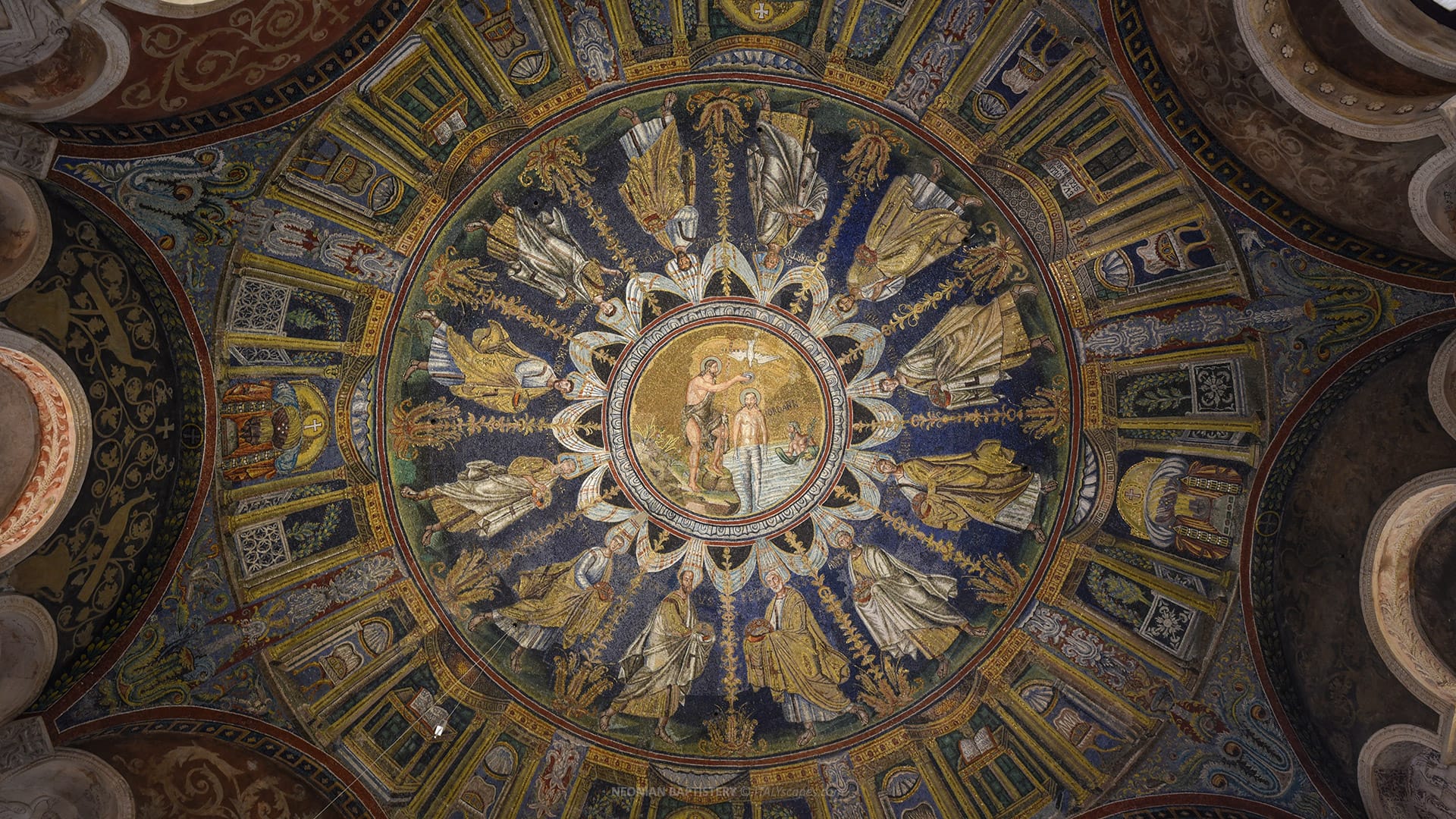
Neonian Baptistery
Arian Baptistery – A Testament to Early Christian Diversity
The Arian Baptistery was constructed in the first half of the 6th century under the rule of the Ostrogothic king Theodoric, who adhered to Arian Christianity, a branch considered heterodox by the mainstream Church.
While the primary structure resembles the Neonian Baptistery architecturally, its mosaics differ subtly in iconographic nuances.
The central dome also depicts the Baptism of Christ, but details in style and presentation reflect Arian theological emphasis, adding richness to the narrative of early Christian diversity in Ravenna.
The existence of two baptisteries – Orthodox and Arian – within the same city highlights the religious pluralism that characterized Ravenna during its period as a political and cultural crossroads.
Basilica of Sant’Apollinare Nuovo – Mosaic Story of Salvation
The Basilica of Sant’Apollinare Nuovo was originally built as a palatine chapel for Theodoric the Great in the early 6th century. Its mosaics form one of the most extensive narrative cycles in the collection.
The mosaics depict scenes from both the Old and New Testaments, as well as processions of saints and martyrs. These richly detailed compositions illustrate a theological journey from Creation to Salvation, integrating narrative clarity with luminous materials.
The basilica’s mosaic program also reveals the transition from Western to Eastern influences, combining Roman tradition with elements that would later be central to Byzantine artistic vocabulary.
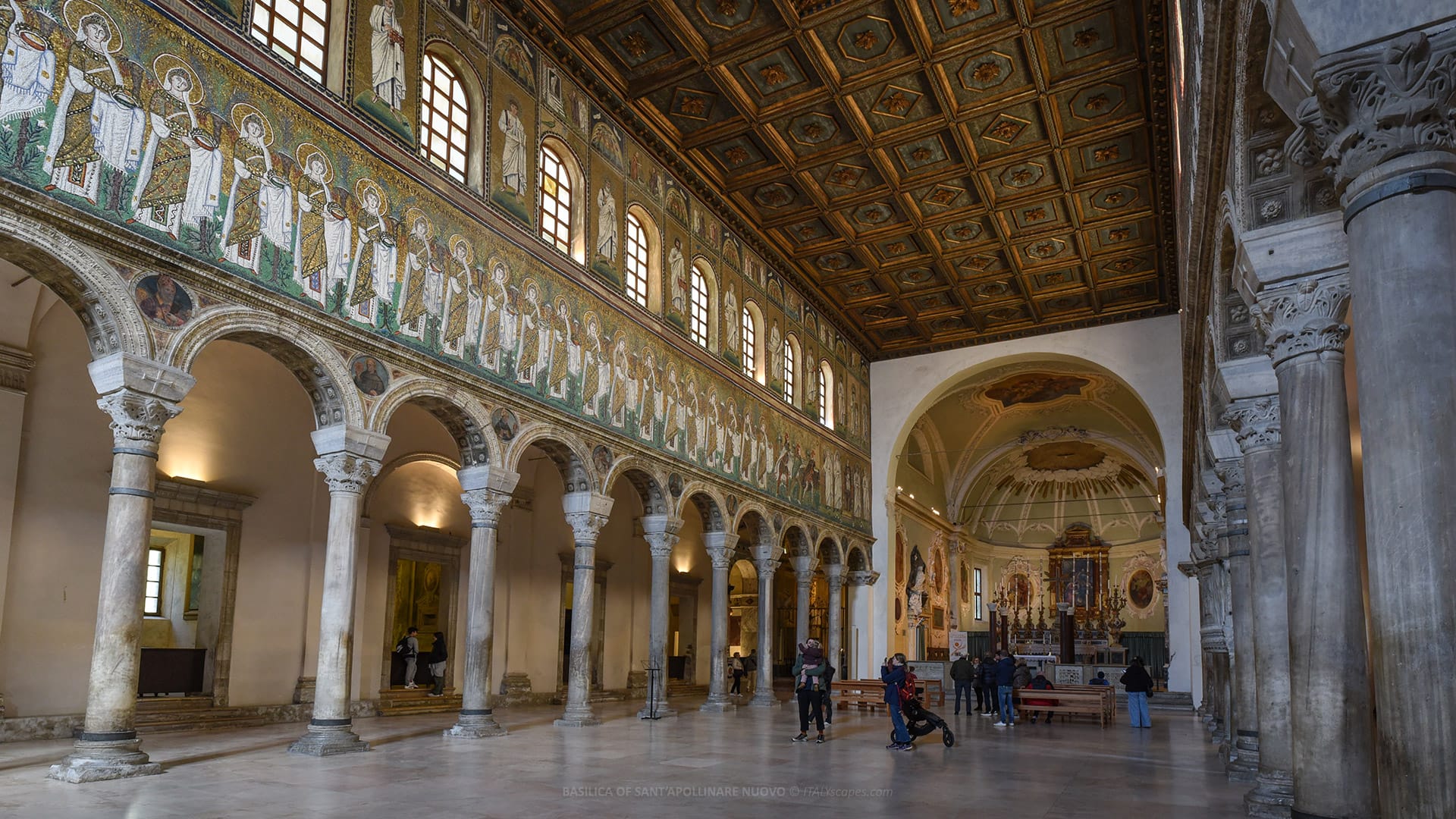
Basilica of Sant’Apollinare Nuovo
Archiepiscopal Chapel – Intimate Mosaic Expression
Also known as the Chapel of St. Andrew, the Archiepiscopal Chapel is a small but significant structure dating to around the early 6th century.
It stands out for its intimate mosaic decoration, which, although less extensive than that of larger basilicas, demonstrates a refined command of sacred imagery.
The mosaic scenes here focus on themes of salvation and divine protection, using small, precise tesserae to create an immersive visual environment.
Mausoleum of Galla Placidia – Stars in the Heavenly Vault
The Mausoleum of Galla Placidia is one of the earliest and most iconic monuments in Ravenna. Built in the first half of the 5th century, it is a small cruciform structure whose unassuming exterior belies the extraordinary mosaic decoration inside.
The interior mosaics are set against a deep blue background dotted with stars, creating a celestial space that symbolizes the Christian conception of heaven.
The most famous scene shows the Good Shepherd, seated among sheep, a motif that evokes care and guidance, a theme central to Christian theology.

Mausoleum of Galla Placidia – Christ as the Good Shepherd
Mausoleum of Theodoric – Stone and Symbol
The Mausoleum of Theodoric dates to around 520 AD and is distinct among Ravenna’s monuments because it is not decorated with mosaics. Instead, its architecture asserts monumental presence through sheer scale and use of massive Istrian stone blocks.
Built for the Ostrogothic king Theodoric the Great, the mausoleum’s simplicity contrasts with the intricate decoration elsewhere, yet it embodies early medieval royal funerary architecture.
Its most remarkable feature is the single-piece stone roof, reflecting exceptional technical skill and an ambitious architectural vision.
Basilica of San Vitale – Imperial Power in Mosaic Form
The Basilica of San Vitale, consecrated in 547, is universally considered the masterpiece of Byzantine art in the West.
Unlike traditional longitudinal basilicas, San Vitale follows a centralized octagonal plan, reflecting Eastern architectural models and emphasizing symbolic geometry rather than processional movement.
The interior mosaics concentrate in the presbytery and apse, where theology, liturgy, and imperial authority merge.
The apse conch depicts Christ Pantocrator, seated on a blue globe symbolizing cosmic rule, flanked by angels. Christ offers the martyr’s crown to Saint Vitale, while Bishop Ecclesius presents a model of the church, visually linking heaven, martyrdom, and ecclesiastical authority.
The most famous Ravenna mosaics appear on the side walls of the presbytery: the imperial panels of Emperor Justinian and Empress Theodora.
Justinian is shown surrounded by clergy and soldiers, holding a paten for the Eucharist; Theodora carries a chalice, accompanied by court attendants.
The mosaics of San Vitale demonstrate a decisive break from classical naturalism. Figures are frontal, hieratic, and timeless, floating against golden backgrounds.

Basilica of San Vitale
Basilica of Sant’Apollinare in Classe – Monumental Faith
The Basilica of Sant’Apollinare in Classe, consecrated in 549, stands just outside Ravenna, near the ancient port of Classe, once one of the most important naval bases of the Roman Empire.
Architecturally, Sant’Apollinare in Classe is a large longitudinal basilica, more traditional in form than San Vitale. Its significance lies primarily in the apse mosaic, one of the most powerful symbolic compositions in early Christian art.
The apse depicts Saint Apollinaris, the first bishop of Ravenna, standing in prayer amid a paradisiacal green landscape filled with trees, plants, and sheep.
Above him, a jeweled cross set against a starry sky represents the Transfiguration of Christ, with Moses and Elijah symbolized by clouds.
Unlike the imperial focus of San Vitale, Sant’Apollinare in Classe emphasizes pastoral imagery and ecclesiastical continuity. Saint Apollinaris appears not as a martyr in suffering, but as a serene spiritual guide, reinforcing the bishop’s role as shepherd of the faithful.
Why the Early Christian Monuments of Ravenna Became a UNESCO Site
In 1996, UNESCO inscribed the Early Christian Monuments of Ravenna on the World Heritage List based on four cultural criteria:
Criterion (i): Masterpiece of Human Creative Genius
The Ravenna mosaics represent an absolute peak of mosaic art, unmatched in quality, preservation, and consistency. Their technical execution, color brilliance, and compositional sophistication mark a decisive moment in the history of visual culture.
Criterion (ii): Exchange of Human Values
Ravenna mosaics demonstrate the fusion of Western Roman tradition with Eastern Byzantine influences, showing how artistic ideas circulated across the Mediterranean. Ravenna became a bridge between classical antiquity and medieval Byzantium.
Criterion (iii): Unique Testimony to a Cultural Tradition
The monuments provide an exceptional testimony to early Christian civilization, documenting theological concepts, liturgical practices, and political structures during a critical transitional period in European history.
Criterion (iv): Outstanding Architectural Ensemble
Together, the eight monuments form a coherent and complete ensemble illustrating the development of Christian architecture and decoration between the 5th and 6th centuries, preserved in their original urban and religious context.

Basilica of San Vitale
Why Ravenna Mosaics Are Unique in the World
What sets Ravenna mosaics apart is not only their beauty, but their state of preservation. Unlike many early Christian sites that were rebuilt, destroyed, or heavily altered, Ravenna’s monuments survived with their mosaic cycles largely intact.
Equally important is the variety of contexts: funerary (Galla Placidia), baptismal (Neonian and Arian Baptisteries), imperial (San Vitale), episcopal (Archiepiscopal Chapel), monastic (Sant’Apollinare in Classe), and royal (Theodoric).
Finally, Ravenna mosaics mark the moment when Western art abandoned illusionistic realism and embraced a symbolic, transcendent vision – a transformation that would shape medieval and Byzantine art across Europe and the Eastern Mediterranean.
Early Christian Monuments of Ravenna and Modern Cultural Identity
Today, the Early Christian Monuments of Ravenna are not isolated relics but part of a living city. Churches remain active places of worship, while museums and conservation programs ensure the protection of these fragile masterpieces.
Ravenna’s identity as the City of Mosaics is rooted directly in this UNESCO site. Scholars, artists, and visitors from around the world continue to study and admire these works, confirming Ravenna’s role as a cornerstone of European cultural heritage.
Sources: