-
About
Table of Contents
Buy tickets & tours:GetYourGuideThe Neonian Baptistery (Italian: Battistero Neoniano) is one of the most ancient and remarkable monuments in Ravenna, carrying profound historical, architectural, and artistic significance.
Dating back to the early 5th century, it stands as the oldest building in Ravenna still preserved virtually intact and reflects the city’s transformation into a major center of early Christianity within the late Western Roman and Byzantine worlds.
Today, the Neonian Baptistery forms part of Ravenna’s UNESCO World Heritage listing – the Early Christian Monuments of Ravenna.
Despite its modest exterior, the baptistery houses some of the most stunning 5th-century mosaics in the world, giving insights into early Christian theology, symbolism, and artistic achievement.
Short History of the Neonian Baptistery
The Neonian Baptistery was begun in the late 4th or early 5th century CE during the period when Ravenna became the capital of the Western Roman Empire under Emperor Honorius.
It was initially erected at the behest of Bishop Ursus (Orso), who also founded the associated cathedral, known historically as the Basilica Ursiana – now largely lost except for fragments incorporated into later structures.
Construction continued into the mid-5th century and was completed around AD 450 under Bishop Neon (Neone), whose name the building now bears.
Neon not only oversaw the architectural completion but also commissioned the remarkable mosaic decoration that now defines the baptistery’s interior.
In its original liturgical context, the baptistery played a central role in the initiation rites of early Christianity, particularly the sacrament of baptism, which signified spiritual rebirth and entry into the Christian community.
Its octagonal design follows a long Christian tradition in which the number eight symbolizes resurrection and eternal life – seven days plus one, representing the day of resurrection beyond earthly time.
The building’s appellation Orthodox Baptistery (Battistero degli Ortodossi) refers to the early Church’s theological distinctions: it served congregations adhering to what was considered the “right doctrine”, as opposed to the contemporaneous Arian community, which used a different baptistery in Ravenna now known as the Arian Baptistery.
Over the centuries, the baptistery remained in continuous use and remarkably well preserved.
Although the ground level has shifted due to subsidence – a common geological phenomenon in Ravenna – lowering the building by about three meters, the core structure and interior decoration remain largely intact.
Today, along with other early Christian monuments in Ravenna, the Neonian Baptistery is recognized by UNESCO as one of the world’s most important surviving examples of early Christian architecture and art.
Architecture of the Neonian Baptistery
The architectural form of the Neonian Baptistery reflects both Roman building traditions and the early Christian adaptation of those models toward liturgical function.
The baptistery is distinguished by its octagonal plan, a shape used widely in early Christian baptisteries to express theological meaning. Each of the eight sides symbolizes a connection between creation (seven days of the week) and the grace of new life in Christ that Baptism brings (the eighth day).
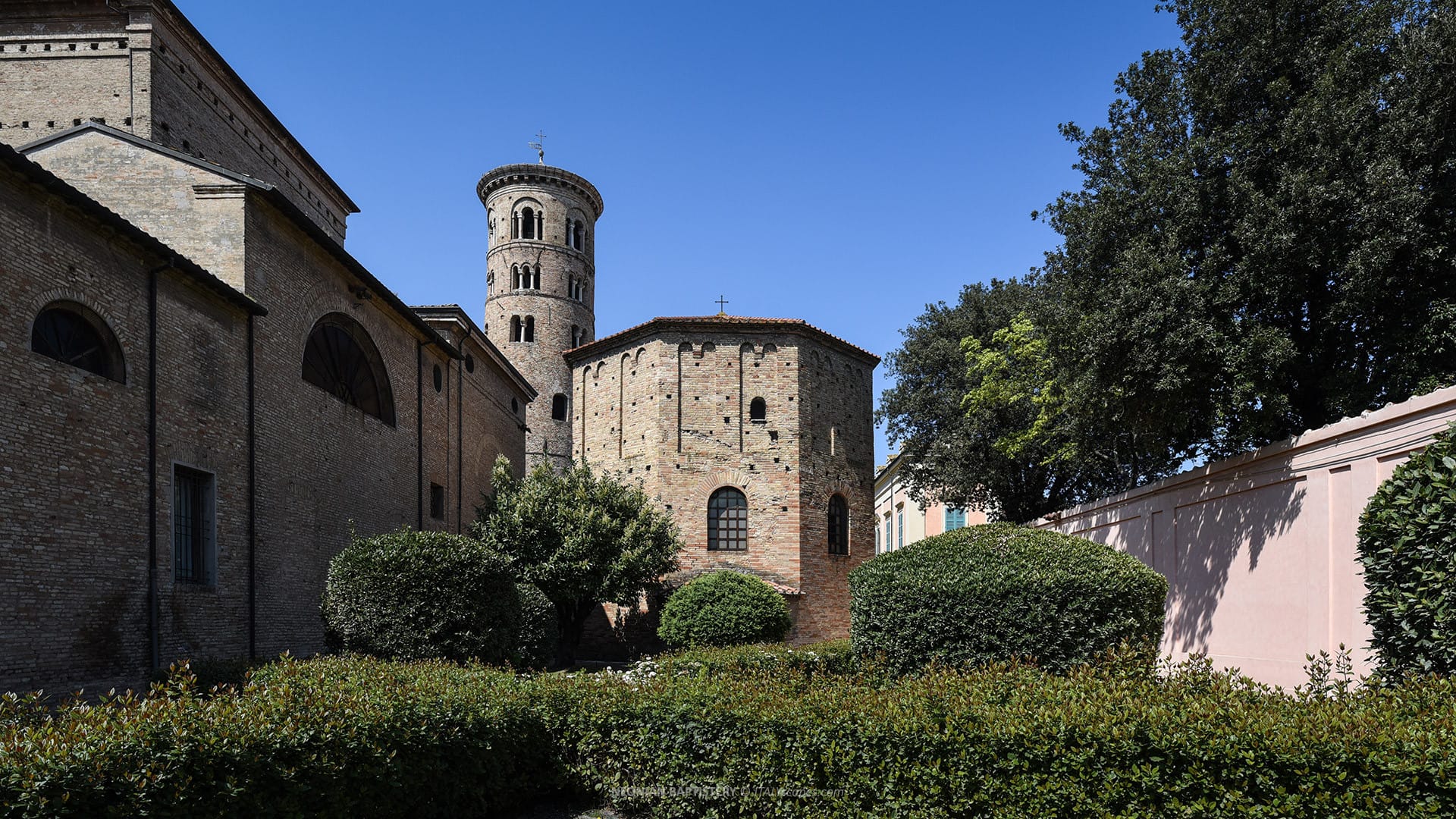
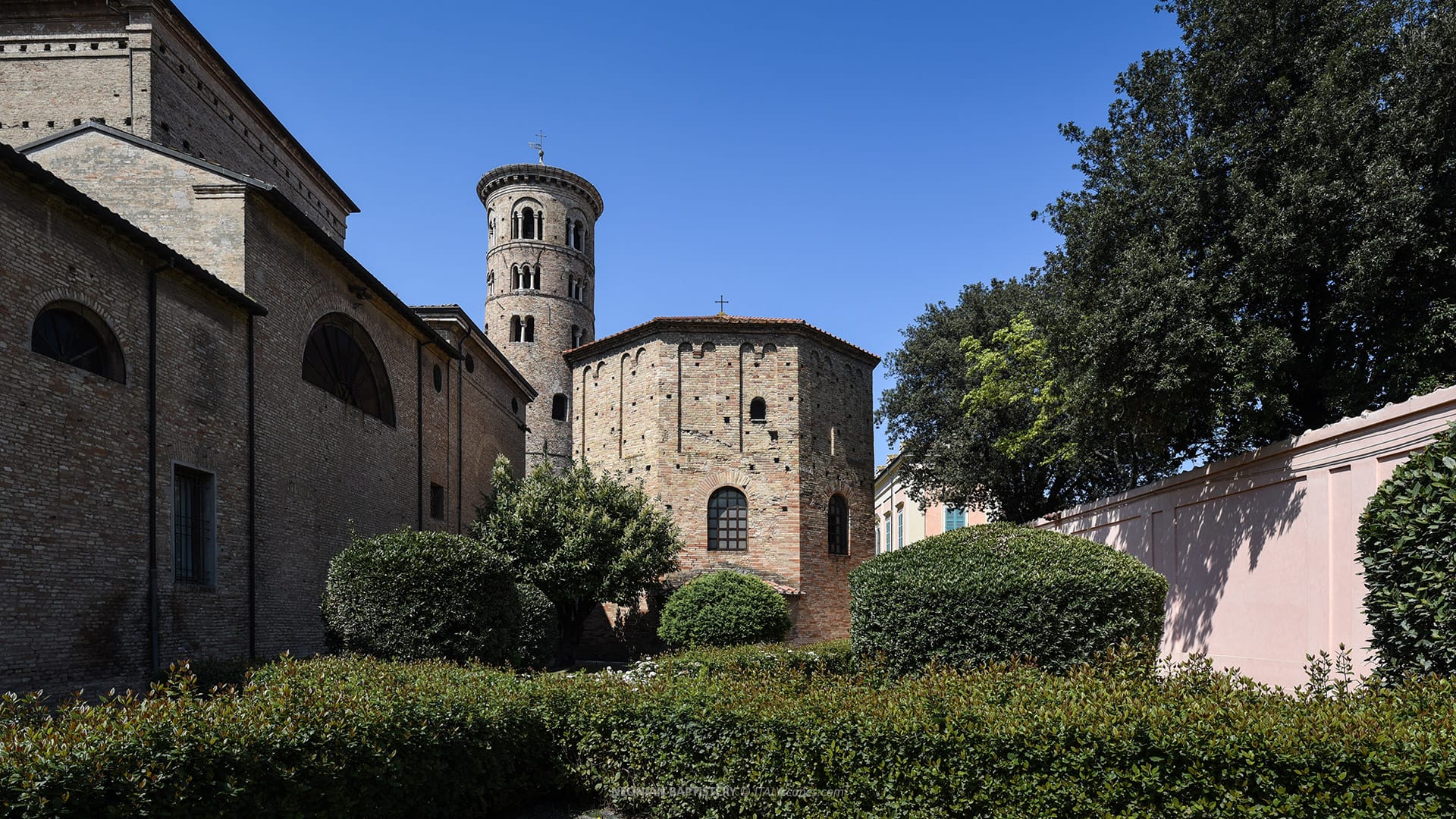
Constructed in brick, the building’s exterior reveals a simple, harmonious structure with minimal external decoration. Its façade features pairs of blind arches and narrow windows on each side, allowing light to enter diffusely and highlight the sacred interior.
Because of long-term ground settling (subsidence), the baptistery appears partly sunk compared to its original platform. Nonetheless, the proportions and overall structural integrity reflect the architectural mastery of early 5th-century builders.
The simplicity of the exterior serves as a visual contrast to the richly decorated interior, emphasizing that spiritual significance and sacred art were reserved for the interior spaces where the rites of baptism and worship occurred.
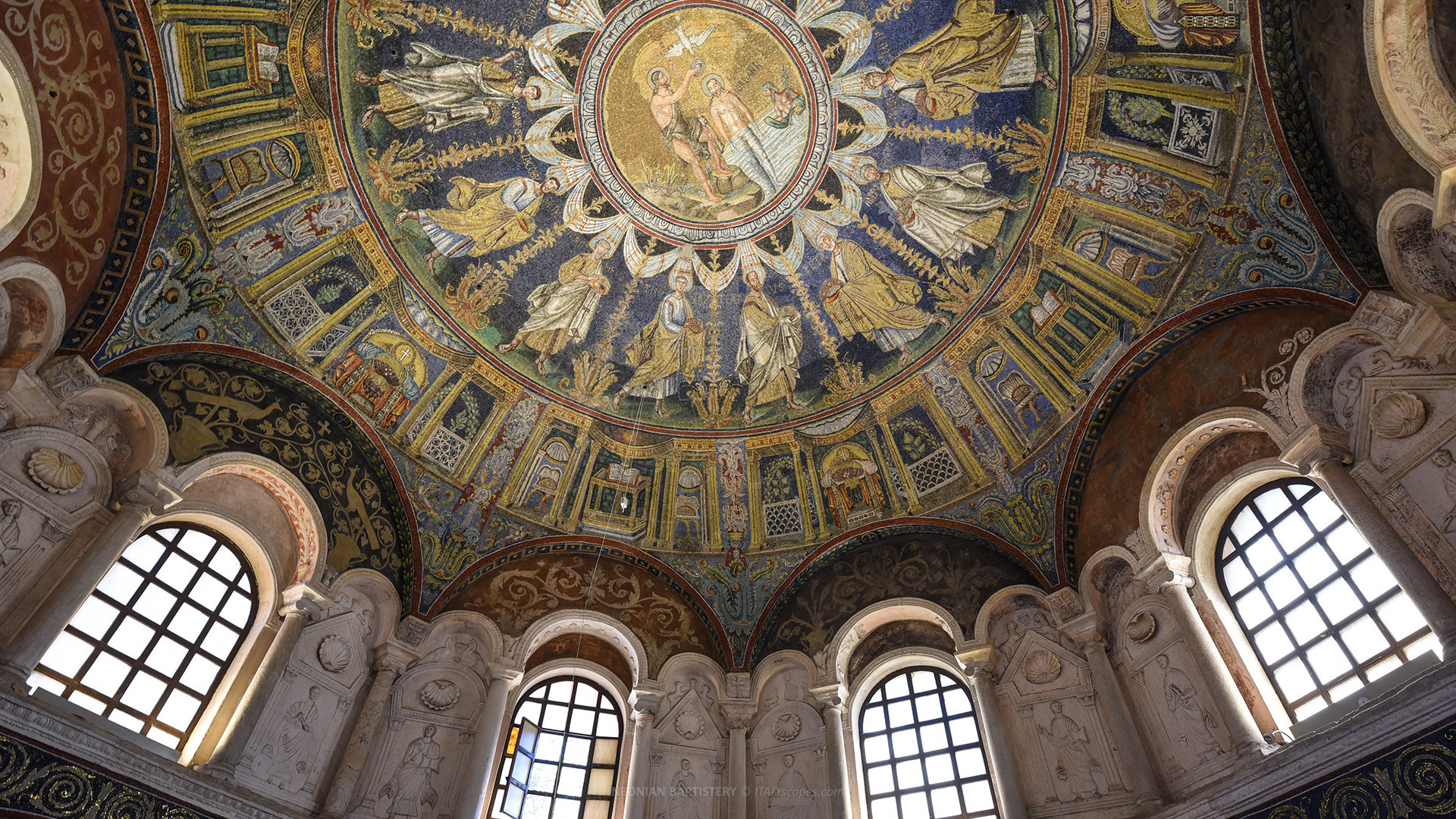
The interior space is defined by a central baptismal font and an open chamber leading the eye upward toward the dome mosaic, one of the most striking features of the building.
The octagonal form is echoed in the layout of the walls, the arrangement of arches, and the architectural rhythm that guides visitors toward the central ritual focus.
Art of the Neonian Baptistery
The art within the Neonian Baptistery includes richly crafted mosaics that are among the earliest surviving Christian mosaics in the world.
These mosaics, executed in the late 5th century under Bishop Neon’s patronage, remain remarkably well preserved, offering a breathtaking visual narrative of early Christian iconography.
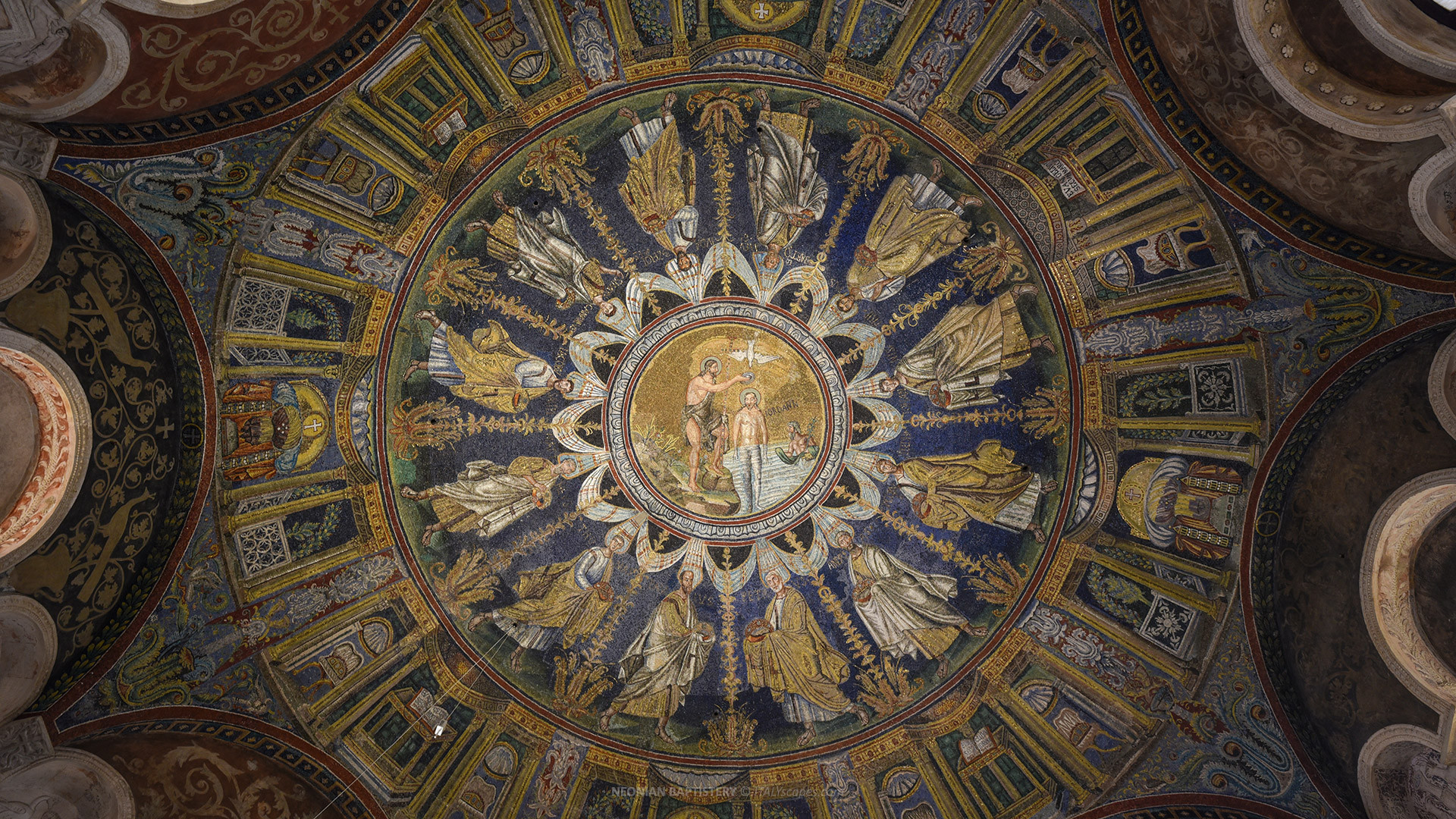
Dome Mosaic – The Baptism of ChristThe centerpiece of the baptistery’s artistic program is the dome mosaic, which depicts the Baptism of Jesus by John the Baptist in the River Jordan. In this central medallion:
- Jesus stands waist-deep in the river, portrayed as a youthful and beardless figure – consistent with early Christian conventions.
- John the Baptist is shown pouring water over Jesus’ head, marking the sacramental event of baptism.
- A bearded river god personification represents the River Jordan, a motif inherited from classical art.
- The Holy Spirit, represented by a dove, hovers above the scene, signifying divine presence.
This mosaic program not only celebrates the rite central to the baptistery but also visually asserts the orthodox Christian doctrine of salvation and divine grace.
Circling ApostlesSurrounding the central medallion is a majestic procession of the twelve apostles, arranged symmetrically in two opposing directions. Each apostle carries symbolic attributes and is depicted with dynamic movement, reflecting both classical influences and early Byzantine mosaic style.
The apostles form a circular motif around the baptismal scene, creating a visual metaphor for the universal witness to Christ’s baptism and the Church’s mission.
Lower Registers and SymbolismBelow the dome, additional mosaics and stucco decorations include figurative and ornamental motifs that incorporate early Christian symbolism, such as vines, scrollwork, and geometric patterns. These enrich the narrative and echo themes of spiritual growth, salvation, and divine protection.
Overall, the artistry within the Neonian Baptistery illustrates an evolution from Roman naturalism to a new symbolic language unique to Christian mosaics – rich in color, theological meaning, and eternal light reflected from tesserae of glass and stone.
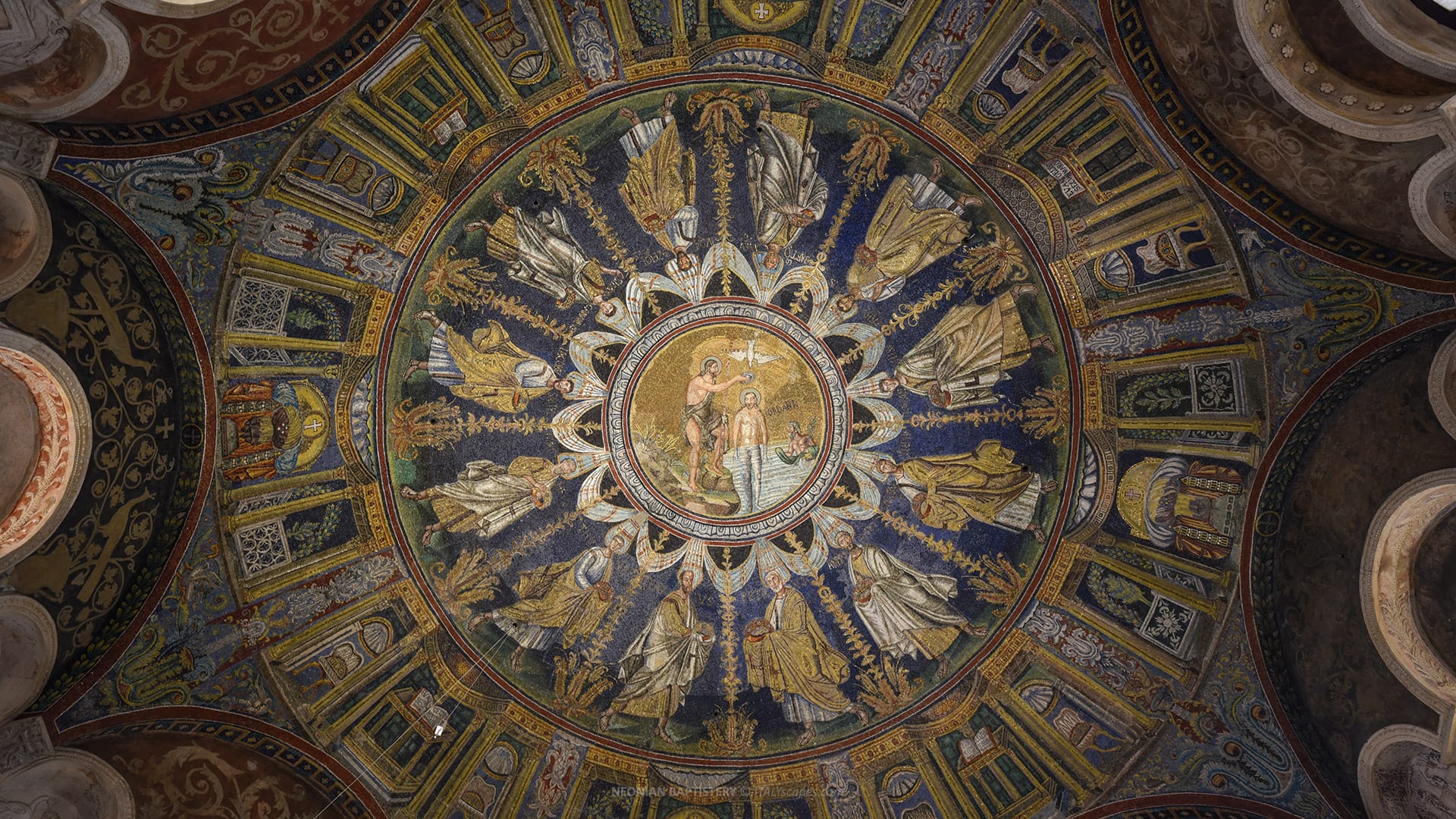
The mosaic
How to Get to the Neonian Baptistery
The Neonian Baptistery is located in the historic center of Ravenna, making it easily accessible from major transport hubs, including Ravenna train station (Ravenna FS).
The distance from the Ravenna railway station to the baptistery is approximately 1.1-1.3 kilometers (about 0.7-0.8 miles) – a walk of about 12–15 minutes through Ravenna’s historic streets. The walk is straightforward for most visitors and leads into the core of the city’s UNESCO-listed monuments.
- On Foot: Walking from the train station is recommended for most visitors. Head south from the station through Via di Roma and continue toward Piazza del Popolo. From there, follow signs toward the Neonian Baptistery, which sits near other historic sites such as the Archiepiscopal Museum and the Cathedral of Ravenna.
- By Bus: The nearest bus stop is located on Via Arnaldo Guerrini, approximately 130 meters from the Neonian Baptistery, and is served by Bus Line 70.
- By Taxi or Ride Service: Taxis are available outside Ravenna train station and provide a quick and comfortable alternative for visitors who prefer not to walk or use public transport. The journey to the city center usually takes just a few minutes.
Sources:Buy tickets & tours:GetYourGuide -
Photos
-
Video
Table of Contents
-
Map
-
Reviews