-
About
Table of Contents
Buy tickets & tours:GetYourGuideThe Mausoleum of Galla Placidia is one of the most extraordinary early Christian monuments in Ravenna, renowned worldwide for its exceptionally preserved 5th-century mosaics.
Located in Via Galla Placidia, in the northern area of Ravenna’s historic center, this compact brick building conceals an interior of astonishing artistic richness.
Despite its modest exterior appearance, the Mausoleum of Galla Placidia is considered one of the finest surviving examples of early Christian mosaic art and architecture in the Mediterranean world.
Dating to the first half of the 5th century, the Mausoleum of Galla Placidia belongs to a crucial historical period when Ravenna served as the capital of the Western Roman Empire.
Its decoration reflects the transition from classical Roman artistic traditions to a new Christian visual language, combining symbolic imagery, theological meaning, and refined craftsmanship.
For this reason, the Mausoleum of Galla Placidia is included in the UNESCO World Heritage Site “Early Christian Monuments of Ravenna”, a designation that recognizes its universal cultural value.
Although traditionally associated with Galla Placidia, one of the most influential women of late antiquity, the monument’s function, symbolism, and artistic program extend beyond its funerary reputation.
Today, the mausoleum stands as a key stop for anyone interested in early Christianity, Byzantine art, and the history of Ravenna as an imperial city.

Short History of the Mausoleum of Galla Placidia
According to long-standing tradition, the mausoleum was commissioned by Galla Placidia, daughter of the Roman Emperor Theodosius I, sister of Emperor Honorius, and mother of Valentinian III, who later ruled as Western Roman Emperor.
Galla Placidia was one of the most powerful political figures of her time, navigating the complex collapse of Roman authority in the West with remarkable skill.
Her life was marked by dramatic political shifts. Between 414 and 415, she was Queen consort to Ataulf, King of the Visigoths, after having been taken to Gaul during the Gothic sack of Rome.
Later, from 417 to 421, she became Empress consort to Constantius III, and after his death, she acted as regent for her son Valentinian III, effectively governing the Western Roman Empire during his early reign.
Tradition holds that Galla Placidia built the mausoleum as a dynastic funerary monument intended for herself, her husband Constantius III, and her brother Honorius. However, historical evidence suggests that this belief is more symbolic than factual.
It is now widely accepted that Galla Placidia died in Rome in 450 and was buried there, likely in the Honorian Mausoleum near Old Saint Peter’s Basilica. As a result, the structure in Ravenna was probably never used as her actual burial place.
Instead, the Mausoleum of Galla Placidia appears to have functioned as a funerary chapel associated with the nearby Church of the Holy Cross (Santa Croce), which was part of a larger ecclesiastical complex commissioned by Galla Placidia.
This connection helps explain the building’s architectural form and its rich symbolic decoration, which aligns more closely with liturgical and devotional use than with a purely sepulchral function.
Over the centuries, the building survived largely intact, despite changes in ground level caused by Ravenna’s gradual subsidence.
Unlike many ancient monuments, it was never radically altered or rebuilt, allowing its mosaics to reach the present day in an extraordinary state of preservation.
In 1996, its historical and artistic significance was formally recognized through its inclusion in the UNESCO World Heritage listing, confirming the mausoleum’s status as one of the most important early Christian monuments in the world.

Christ as the Good Shepherd
Architecture of the Mausoleum of Galla Placidia
Architecturally, the Mausoleum of Galla Placidia is a small but highly refined structure that exemplifies early Christian design principles.
The building follows a Latin cross plan, with a central nave slightly longer than the transept arms. This layout reflects the growing importance of Christian symbolism in architectural forms, where spatial organization carried theological meaning.
The exterior is deliberately austere. Constructed entirely of brick, the mausoleum presents a simple façade that contrasts sharply with the lavish decoration inside.
This contrast was intentional, reflecting early Christian ideals that privileged spiritual richness over external display.
The building’s dome is concealed from the outside by a square lantern tower that rises above the gabled roof, giving the structure a compact and grounded appearance.
External decorative elements are limited but meaningful. At the top of the lantern sits a pine cone, an ancient symbol of immortality and resurrection.
The façades are articulated by blind arches and a modest cornice, adding rhythm without excessive ornamentation.
Above the main portal, a small marble frieze depicts two felines facing each other amid vine branches, a motif that blends classical decorative traditions with Christian symbolism associated with the vine as a sign of life and salvation.
The interior spatial organization is centered on the dome, which dominates the building and creates a sense of vertical elevation. Four lunettes surround the dome, each pierced by a small window that allows filtered light to enter.
Additional lunettes are positioned at the ends of the cross arms, creating a rhythmic sequence of curved surfaces ideally suited for mosaic decoration.
At the ends of the arms stand three marble sarcophagi. The one placed in the central arm dates back to the Roman period, while the two in the side arms originate from the 4th and 5th centuries.
Although traditionally attributed to members of Galla Placidia’s family, these sarcophagi likely served a symbolic or commemorative purpose rather than housing the remains of the imperial figures themselves.
Art of the Mausoleum of Galla Placidia
The artistic decoration of the Mausoleum of Galla Placidia is among the oldest and most celebrated mosaic cycles in Ravenna, dating to the second quarter of the 5th century.
These mosaics represent a crucial moment in the development of Christian art, where classical naturalism began to give way to symbolic representation and spiritual abstraction.
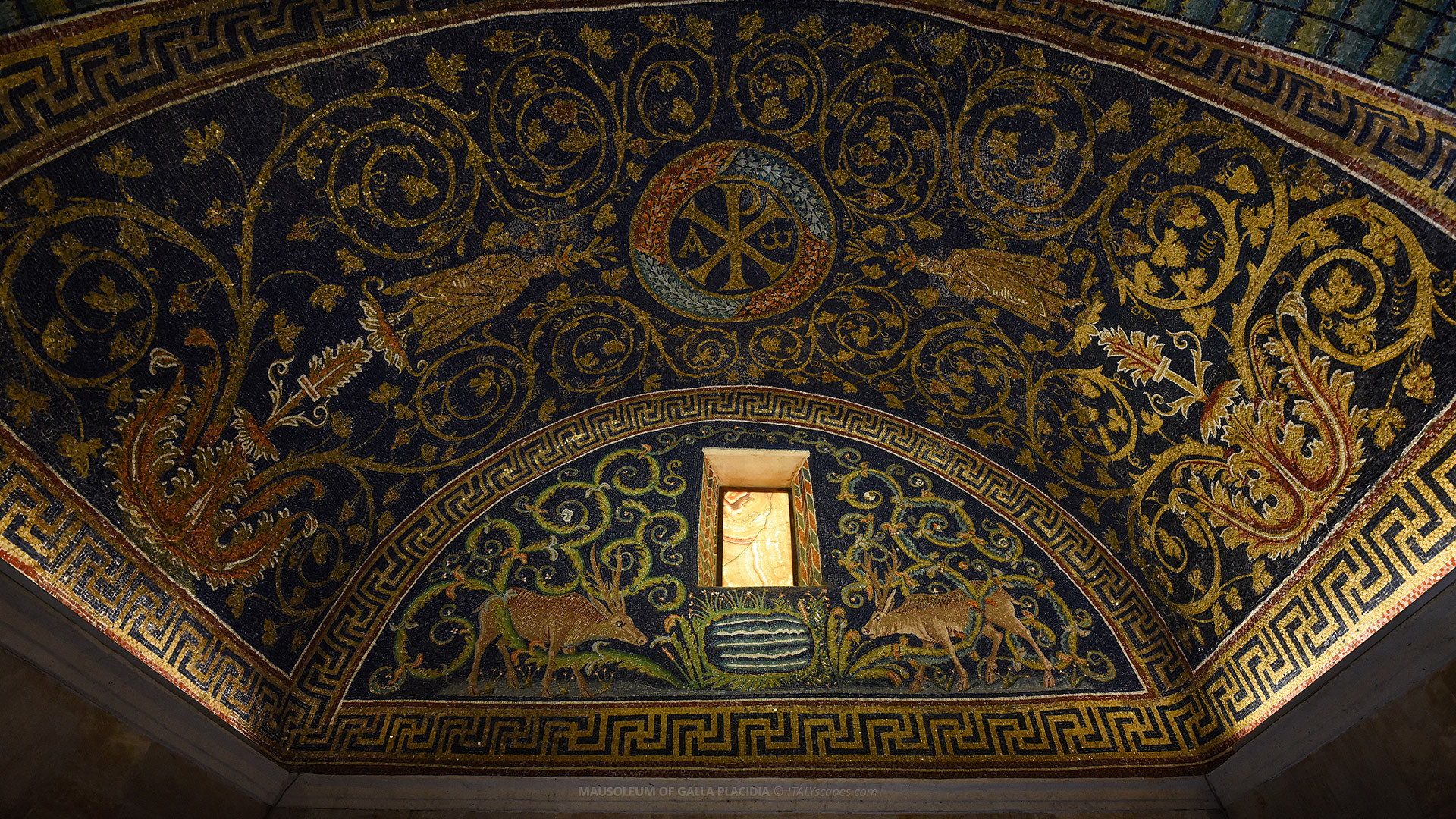
The most iconic element is the dome mosaic, which depicts a golden cross set against a deep blue background filled with countless stars. This celestial imagery transforms the dome into a vision of the heavens, symbolizing eternal life and divine transcendence.
The intense blue, created using precious glass tesserae, is one of the most striking visual features of the Mausoleum of Galla Placidia and contributes to its almost otherworldly atmosphere.
In the lunettes surrounding the dome, pairs of Apostles are shown with raised arms in an attitude of adoration, all oriented toward the central cross. Their placement reinforces the idea of cosmic order, with Christ’s symbol at the center of the universe.
The barrel vaults and arches of the cross arms are richly decorated with festoons of flowers, fruits, and vines, rendered with remarkable delicacy.
These motifs draw on classical decorative traditions but are reinterpreted in a Christian context, symbolizing abundance, paradise, and the promise of salvation.
One of the most famous images appears in the lunette above the entrance, which depicts Christ as the Good Shepherd. Seated on a rock and surrounded by sheep, Christ is shown wearing imperial gold and purple garments, holding a cross-staff.
In the opposite lunette, Saint Lawrence is portrayed carrying a large cross on his shoulder, moving toward a grill – the instrument of his martyrdom – while holding an open book that symbolizes the Gospel.
The side lunettes depict deer drinking from flowing water, an image drawn from Psalm 42 (“As the deer longs for flowing streams…”). This motif symbolizes the soul’s thirst for God and reinforces the baptisterial and salvific themes present throughout the Mausoleum of Galla Placidia.

Saint Lawrence
How to Get to the Mausoleum of Galla Placidia
The Mausoleum of Galla Placidia is conveniently located within Ravenna’s historic center, making it easy to reach from the city’s main transportation hub.
- On foot: From Ravenna railway station, the mausoleum is approximately 1 kilometer away, a distance that can be comfortably covered on foot in about 12-15 minutes. Walking is often the most pleasant option, as it allows visitors to explore Ravenna’s historic streets.
- By bus: For those who prefer public transport, the closest bus stop is located on Via Maggiore, about 450 meters from the mausoleum, and is served by Bus Line 70. From the stop, a short walk leads directly to the monument.
- Taxi or Ride Share: Taxis are also available outside the railway station and provide a quick and comfortable alternative, especially for visitors with limited time or mobility. The ride to the historic center typically takes only a few minutes.
Thanks to its central location, the Mausoleum of Galla Placidia is easily combined with visits to nearby landmarks such as the Basilica of San Vitale, the Neonian Baptistery, and other UNESCO-listed monuments, making it an essential stop on any itinerary through Ravenna’s extraordinary early Christian heritage.
Sources:Buy tickets & tours:GetYourGuide -
Photos
-
Video
Table of Contents
-
Map
-
Reviews