Table of Contents
Dante Alighieri was born in Florence between 14 May and 13 June 1265 and died in Ravenna during the night between 13 and 14 September 1321. His real baptismal name was Durante di Alighiero degli Alighieri, but he became universally known through the shorter form Dante.
Dante Alighieri is considered the greatest poet of medieval Italy and one of the essential founders of Italian literature. His importance comes not only from the Divine Comedy, but also from his political writings, his defense of the vernacular, and his transformation of exile into literary geography.
The life of Dante Alighieri was shaped by Florence, but it was not limited to Florence. After his political condemnation in 1302, he moved through several Italian territories, including Romagna, Lunigiana, the Veneto, Verona, Venice, and Ravenna. His biography is therefore a route across medieval Italy.
This route is not a decorative tourist idea. It is built on documented places, political connections, literary references, and monuments that preserve his memory. Florence explains his birth and exile, Verona explains patronage, Venice explains his final embassy, and Ravenna explains his death and burial.
The Life of Dante Alighieri
Dante Alighieri was born into a minor Florentine noble family connected to the Guelph political environment. His father was Alighiero di Bellincione, and his mother was Bella, whose full identity remains uncertain. The family was not among Florence’s most powerful houses, but it belonged to the city’s civic world.
In 1295, Dante Alighieri entered the Arte dei Medici e Speziali, the guild of physicians and apothecaries. This registration was necessary because Florentine law required guild membership for public office. His choice of guild was practical, not medical, and allowed him to participate in civic government.
In 1300, Dante Alighieri became one of the priors of Florence, serving from 15 June to 15 August. The priorate was one of the highest offices of the Florentine republic. During this period, the internal division between White Guelphs and Black Guelphs became increasingly dangerous.
The conflict worsened after the intervention of Pope Boniface VIII and Charles of Valois. While Dante Alighieri was away from Florence on a political mission, the Black Guelphs took control. In 1302, he was condemned in absentia, fined, exiled, and threatened with death if he returned.
The exile of Dante Alighieri lasted almost 20 years, from 1302 until his death in 1321. He first remained connected with other White Guelph exiles, then gradually separated from factional politics. His writings show a growing disappointment with local conflicts and a stronger interest in universal political order.
The Works of Dante Alighieri
Early Poetry and Beatrice
The early poetry of Dante Alighieri belongs to the world of the Dolce Stil Novo, a refined poetic movement that treated love as spiritual elevation and moral discipline. His relationship with Beatrice, traditionally identified as Beatrice Portinari, became the central poetic event of his youth.
The Vita Nova, written in the 1290s, combines prose and poetry to describe the poet’s love for Beatrice. The book is not a simple autobiography. It organizes memory, dream, grief, and spiritual interpretation into a literary structure that prepared the symbolic world of the Divine Comedy.
The Rime contain poems from different periods of Dante Alighieri’s life. Some are love lyrics, while others are moral, philosophical, political, or experimental. The so-called rime petrose are especially important because their hard style contrasts with the sweeter language of his early Stilnovist production.
Philosophical and Political Works
The Convivio was written during exile and remained unfinished. Dante Alighieri planned it as a vast intellectual banquet in the vernacular, explaining canzoni through philosophical commentary. The work shows his ambition to make serious knowledge available beyond Latin-speaking clerics, scholars, and university specialists.
De vulgari eloquentia was written in Latin, but it defends the literary dignity of the vernacular. Dante Alighieri searched for an illustrious Italian language above local dialects. The treatise is fundamental because it explains why he could choose Italian, not Latin, for his greatest poem.
De Monarchia is the most important political treatise by Dante Alighieri. It argues that imperial authority should be independent from papal power in temporal matters. The work reflects his hope that a universal monarchy could bring peace to Italy and end the violence of competing city-states.
The Divine Comedy
The Divine Comedy is the masterpiece of Dante Alighieri and one of the central works of European literature. The poem contains 100 cantos, divided into Inferno, Purgatorio, and Paradiso. Its fictional journey begins in the year 1300, during the poet’s imagined middle age.
The poem is written in terza rima, using interlocking rhymes and hendecasyllabic lines. Dante Alighieri combines theology, astronomy, philosophy, classical literature, politics, autobiography, and local history. The result is both a journey through the afterlife and a judgment on the world he knew.
The Divine Comedy also preserves a geography of medieval Italy. Florence, Rome, Bologna, Verona, Ravenna, Venice, and many other places appear directly or indirectly. Towers, rivers, families, battles, popes, emperors, and civic conflicts become part of a poem that remains universal because it is deeply concrete.
Florence
Florence – Birthplace, Memory, and Political Wound
The Baptistery and the Medieval City
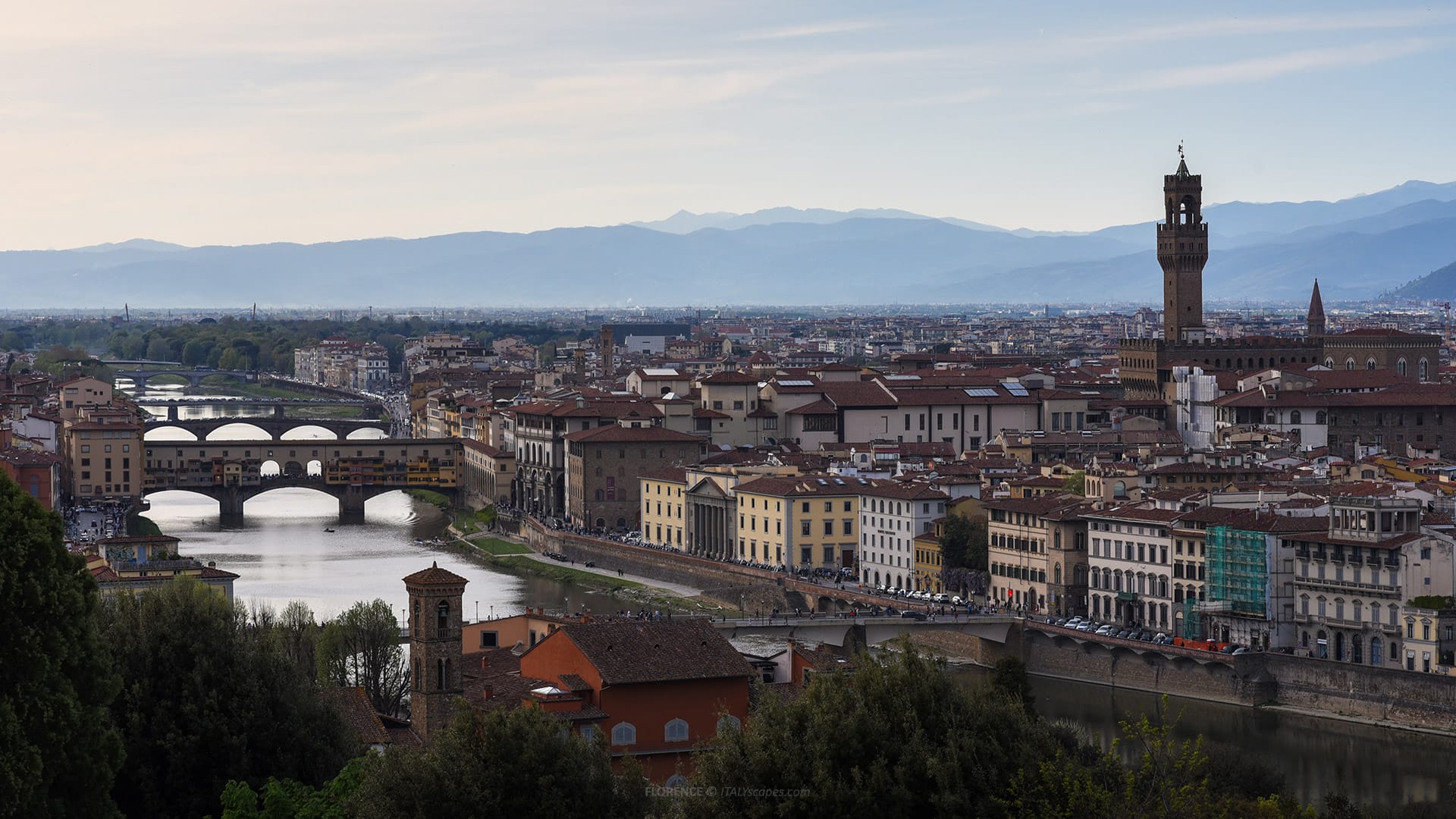
Florence is the birthplace of Dante Alighieri and the city from which he was permanently exiled. The first essential stop is the Baptistery of San Giovanni, which Dante remembered with emotional force in the Divine Comedy. Its octagonal structure still stands at the religious heart of medieval Florence.
The Baptistery is covered with white and green marble and was one of the most important sacred buildings in Dante’s Florence. The poet called it “my beautiful San Giovanni”, a phrase that shows personal attachment. For a Dante itinerary, it is more important than any later memorial.
Near the Baptistery, the present Cathedral of Santa Maria del Fiore marks a major transition in Florentine history. Construction began in 1296, when Dante Alighieri was still living in the city. He did not see Brunelleschi’s dome, completed in the 15th century, but he knew the early project.
The Dante Quarter and Beatrice’s Memory
The so-called Casa di Dante is a museum located in the historic area traditionally associated with the Alighieri family. It should not be presented as the authenticated original house of Dante Alighieri. Its value is topographical and educational, because it explains the social world of medieval Florence.
The nearby Church of Santa Margherita de’ Cerchi is traditionally linked with Beatrice and with the Portinari family. The connection is part of Florentine memory rather than a fully documented biographical certainty. Still, the church remains one of the most visited Dante-related places in the city.
The area around Via Santa Margherita, Via Dante Alighieri, and the medieval towers gives visitors a compact image of 13th-century Florence. The streets are narrow, the urban fabric is dense, and the route helps explain how family, faction, guild, and parish shaped civic identity.
Piazza della Signoria and the Politics of Exile
Piazza della Signoria represents the political Florence that formed and expelled Dante Alighieri. His service as prior in 1300 placed him inside the highest level of republican government. The square and the Palazzo Vecchio preserve the later monumental face of that civic authority.
The sentence of 1302 changed the poet’s life permanently. Dante Alighieri was accused of political and financial crimes by the victorious Black Guelph regime. The charges were tied to factional politics, and the punishment included exile, confiscation, heavy fines, and death if he returned to Florence.
Basilica di Santa Croce preserves the most important Florentine monument to Dante Alighieri, although his body is not there. The cenotaph by Stefano Ricci was created between 1818 and 1829 and inaugurated in 1830. It expresses Florence’s later regret for the poet it had condemned.
Casentino and Poppi – Battle, Tradition, and the Guidi
The Casentino is connected with Dante Alighieri through both biography and tradition. The most secure fact is the Battle of Campaldino, fought on 11 June 1289, when Florence defeated Arezzo. Dante took part as a young cavalryman, before his public offices and long before exile.
The battlefield near Poppi helps visitors understand that Dante Alighieri was not only a scholar and poet. He also experienced war directly. The political violence of Tuscany, the rivalry between cities, and the memory of battle later entered the moral and historical world of the Divine Comedy.
Poppi is dominated by the Castello dei Conti Guidi, one of the most important medieval castles in Tuscany. Dante Alighieri is traditionally connected with the Guidi family during exile, and the castle has long been included in routes linked to his movements through Casentino.
Rome
Rome – Papal Power and the Crisis of 1301
The Political Mission to Boniface VIII
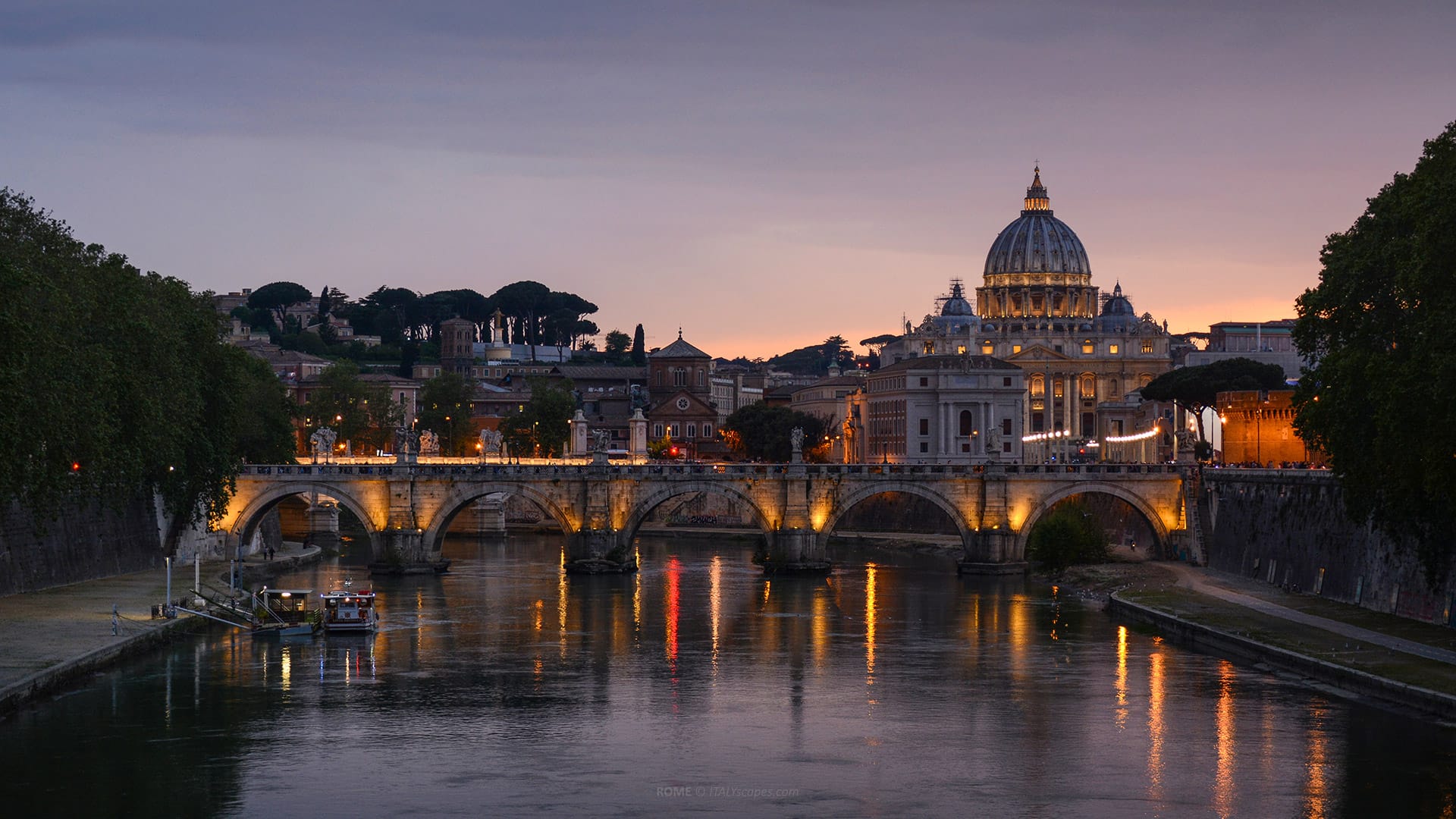
Rome became decisive for Dante Alighieri because of the Florentine embassy to Pope Boniface VIII in 1301. Florence sent representatives to resist papal pressure during the conflict between White and Black Guelphs. While the mission unfolded, Charles of Valois entered Florence and changed the city’s political balance.
The medieval papal city was not simply a religious center. It was also a political power capable of influencing Tuscan governments. For Dante Alighieri, the Roman mission became linked with personal catastrophe, because he could not defend himself in Florence when the Black Guelphs seized power.
A Dante route in Rome should focus on the idea of papal authority rather than on a single preserved room. The Basilica of San Giovanni in Laterano, the medieval papal seat, helps visitors understand the institutional power that stood behind Boniface VIII and Florentine politics.
Rome in the Divine Comedy
Rome also had enormous symbolic value in the works of Dante Alighieri. It was the ancient capital of empire, the city of Christian martyrdom, and the seat of the papacy. This triple identity explains why Rome appears in his political imagination as both sacred and corrupted.
The Jubilee year 1300 is central to the chronology of the Divine Comedy. The poem’s journey is set in that year, when Rome attracted pilgrims from across Christendom. The city therefore stands behind the poem as a place of pilgrimage, penitence, authority, and historical memory.
Forlì – Romagna and the First Phase of Exile
Forlì belongs to the early exile of Dante Alighieri, when he remained connected with other White Guelph exiles and Ghibelline allies. The city was ruled by the Ordelaffi family, and Scarpetta Ordelaffi became one of the political figures associated with Dante’s first years away from Florence.
This period was marked by plans, alliances, and failed attempts to regain Florence. Dante Alighieri gradually understood that factional revenge would not restore civic justice. His later writings suggest increasing distance from the narrow politics of the exiled White Guelphs and their military ambitions.
Forlì also appears in the Divine Comedy through the memory of violent conflicts in Romagna. A route through the city can include Piazza Saffi and the Abbey of San Mercuriale, which help visitors visualize the medieval civic environment connected with the Ordelaffi and Romagnol politics.

Bologna
Bologna – Study, Poetry, and the Two Towers
Bologna was one of the greatest university cities of medieval Europe. Dante Alighieri is traditionally connected with Bologna before and during exile, and the city’s legal, rhetorical, and scholarly culture fits his intellectual formation. It was a natural stop for writers, jurists, students, and political exiles.
The University of Bologna was especially famous for law, but the city also had an active literary environment. Dante Alighieri knew the poetic culture of northern Italy and used learned references with extraordinary precision. Bologna therefore belongs to the intellectual map behind his language, style, and political thought.
A Dante itinerary in Bologna should begin in Piazza Maggiore and continue toward the medieval tower district. The urban fabric still preserves the impression of a powerful communal city. Bologna helps visitors understand how medieval learning, civic pride, and vertical architecture entered Dante’s imagination.
The most concrete Dante monument in Bologna is the Torre Garisenda, mentioned in Inferno XXXI. Dante Alighieri used the leaning tower as a visual comparison, proving that he knew Bologna’s most recognizable landmark. The reference is precise, urban, and rooted in direct architectural observation.
Padua and Treviso – The Veneto Before Verona
Padua is connected with the movements of Dante Alighieri after the first years of exile. The city was one of the most active cultural centers in northern Italy, close to universities, religious orders, courts, and artistic innovation. Its importance lies in context more than in one certain residence.
A Dante route in Padua should be presented with caution. The poet’s passage belongs to broader biographical tradition, but not every famous monument can be linked directly to him. The city’s medieval fabric, however, helps place him inside the intellectual and political Veneto of the early 1300s.
Treviso is connected with the Marca Trevigiana, a region mentioned in Dante’s works and linked with noble families known to him. The figure of Gherardo da Camino, lord of Treviso, is especially important because Dante Alighieri remembered him positively in his moral and political geography.
The city’s historic center still preserves a compact medieval structure. Piazza dei Signori, Palazzo dei Trecento, and the water channels around the old town help visitors understand the civic world of Treviso. The connection is regional and political, not based on a single surviving Dante house.
Lunigiana – Diplomacy, Castles, and the Malaspina
The Peace of Castelnuovo
Lunigiana is one of the most securely documented regions in the exile of Dante Alighieri. In 1306, he was welcomed by the Malaspina family, who controlled strategic lands between Tuscany, Liguria, and Emilia. The region lay along important routes crossing the Apennines and the Magra Valley.
The key event was the Peace of Castelnuovo, signed on 6 October 1306. Dante Alighieri acted as procurator for the Malaspina in negotiations with the bishop-count of Luni, Antonio Nuvolone da Camilla. This diplomatic role is one of the clearest documentary proofs of his exile activity.
Castelnuovo Magra is therefore a major Dante destination. The medieval village and its castle area preserve the memory of the agreement.
Mulazzo and the Malaspina Landscape
Mulazzo is another important center in the Lunigiana route of Dante Alighieri. It was connected with the Malaspina dello Spino Secco and later developed a strong Dante memory. The Torre di Dante and local monuments help visitors place the poet inside a castle-based feudal landscape.
The Malaspina lands mattered because they offered protection during exile. Dante Alighieri praised the family in the Divine Comedy, especially for their hospitality and honor. Lunigiana shows a different side of medieval Italy, less communal than Florence, and more defined by castles, lineages, and territorial lordship.
Verona – The Great Refuge of Exile
The First Veronese Shelter
Verona was one of the most important cities in the exile of Dante Alighieri. He stayed there first in 1303-1304, under Bartolomeo della Scala, and later for a longer period under Cangrande della Scala. The city offered protection, prestige, and political possibility.
The connection with Verona is confirmed by the Divine Comedy itself. In Paradiso XVII, Dante Alighieri presents Verona as the first refuge of exile and praises Cangrande della Scala. The passage is essential because it turns a personal experience of hospitality into poetic prophecy.
Verona was not a marginal shelter. Under the Scaligeri, the city became one of the strongest powers in northern Italy. Dante Alighieri found there a court aligned with imperial and Ghibelline hopes, very different from the fractured republican politics that had destroyed his Florentine career.
Piazza dei Signori and the Statue of Dante
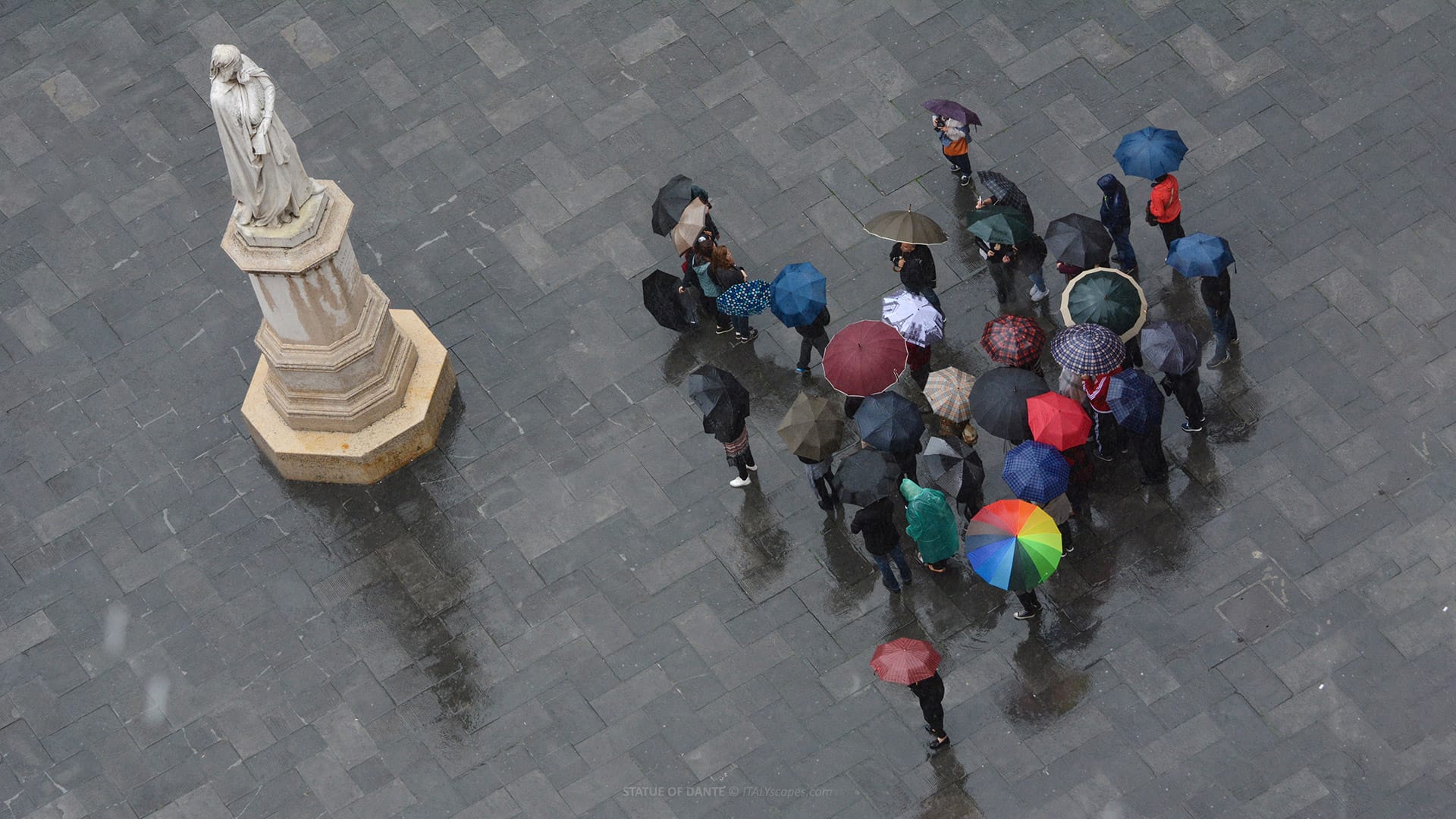
Piazza dei Signori is the symbolic center of Dante’s memory in Verona. The square is often associated with the poet because of the statue by Ugo Zannoni, inaugurated in 1865 for the 600th anniversary of his birth. It remains the city’s most visible Dante monument.
The statue is made of Carrara marble and stands in the middle of the square. It represents Dante Alighieri as a severe, meditative figure, holding a book and looking downward. The monument belongs to 19th-century civic memory, but it marks a genuine medieval connection with Verona.
Around the square stand buildings linked with Verona’s medieval government and Scaliger power. Palazzo del Podestà, Palazzo della Ragione, and the nearby courtyards evoke the political world in which Dante Alighieri lived as a guest. This urban setting makes Verona one of the clearest Dante cities.
The Scaliger Tombs and Cangrande
The Scaliger Tombs, beside the Church of Santa Maria Antica, are essential for understanding Dante’s Verona. They commemorate the Della Scala lords who ruled the city. The most important for Dante Alighieri is Cangrande della Scala, praised in Paradiso and remembered as a powerful patron.
Cangrande della Scala was born in 1291 and died in 1329, after Dante. His tomb includes an equestrian image that expresses military lordship and dynastic pride. Although the monument is later than Dante’s life, it preserves the world of power that protected him in exile.
Verona is strongly associated with the final development of Dante Alighieri’s political and poetic thought. The city is linked with De Monarchia, letters, and parts of Paradiso.
The statue of Dante in Piazza dei Signori, Verona
Venice – Final Embassy and Literary Image
The Embassy of 1321
Venice entered the biography of Dante Alighieri near the end of his life. In 1321, while living in Ravenna, he undertook an embassy to Venice on behalf of Guido Novello da Polenta. The mission was connected with tensions between Ravenna and the Venetian Republic.
The journey had fatal consequences. Returning from Venice through marshy areas near the Adriatic, Dante Alighieri contracted a fever, traditionally identified with malaria. He reached Ravenna but died shortly afterward, during the night between 13 and 14 September 1321, at about 56 years old.
The Arsenale in the Divine Comedy
Venice also appears in the Divine Comedy through the famous comparison with the Arsenale. In Inferno XXI, Dante Alighieri describes boiling pitch by evoking the Venetian shipyard, where workers repaired ships during winter. The reference proves his attention to real labor, technology, and urban industry.
The Venetian Arsenale was one of the greatest industrial and naval complexes of medieval Europe. Its gates, walls, docks, and shipbuilding spaces help visitors understand why the image was so powerful. Dante transformed a practical working place into one of the most memorable scenes in Inferno.

Arsenale di Venezia
Ravenna – Last Home, Death, and Tomb
The Final Refuge
Ravenna was the last home of Dante Alighieri. He arrived there around 1318, under the protection of Guido Novello da Polenta. After many years of movement, the city offered a more stable environment, where the poet could complete his work and gather family and students.
In Ravenna, Dante Alighieri completed the Divine Comedy. This fact makes the city one of the most important literary destinations in Italy. The final cantos of Paradiso belong to the spiritual and intellectual world of Ravenna, even though the poem’s vision rises beyond earthly geography.
Dante’s Tomb and the Basilica of San Francesco
The most important monument in Ravenna is Dante’s Tomb, built between 1780 and 1781 by architect Camillo Morigia. The small Neoclassical mausoleum stands near the Basilica of San Francesco. It preserves the poet’s remains and forms the heart of the city’s Dante area.
The tomb contains a sepulcher, a bas-relief of Dante by Pietro Lombardo, commissioned in 1483, and a Latin epitaph attributed to Bernardo Canaccio. A votive lamp burns inside. Florence traditionally offers the oil for this lamp every year in September, acknowledging the poet it exiled.
The Basilica of San Francesco is directly connected with the funeral of Dante Alighieri in 1321. The ceremony took place there after his death.
The Zone of Silence and the Museo Dante
The area around the tomb is known as the Zone of Silence. It includes the Quadrarco di Braccioforte, the Franciscan cloisters, and spaces connected with the long history of Dante’s remains. The atmosphere is deliberately quiet, emphasizing memory rather than monumental spectacle.
The history of the remains is complicated. Franciscan friars hid the bones to prevent their removal, especially when Florence wanted them back. They were rediscovered in 1865, during the 600th anniversary of Dante Alighieri’s birth, and later protected again during the Second World War.
The Museo Dante, located near the tomb, explains the poet’s life, works, iconography, and posthumous reputation. Together with the tomb, the Basilica of San Francesco, the cloisters, and Casa Dante, it creates the most complete and concentrated Dante itinerary in any Italian city.
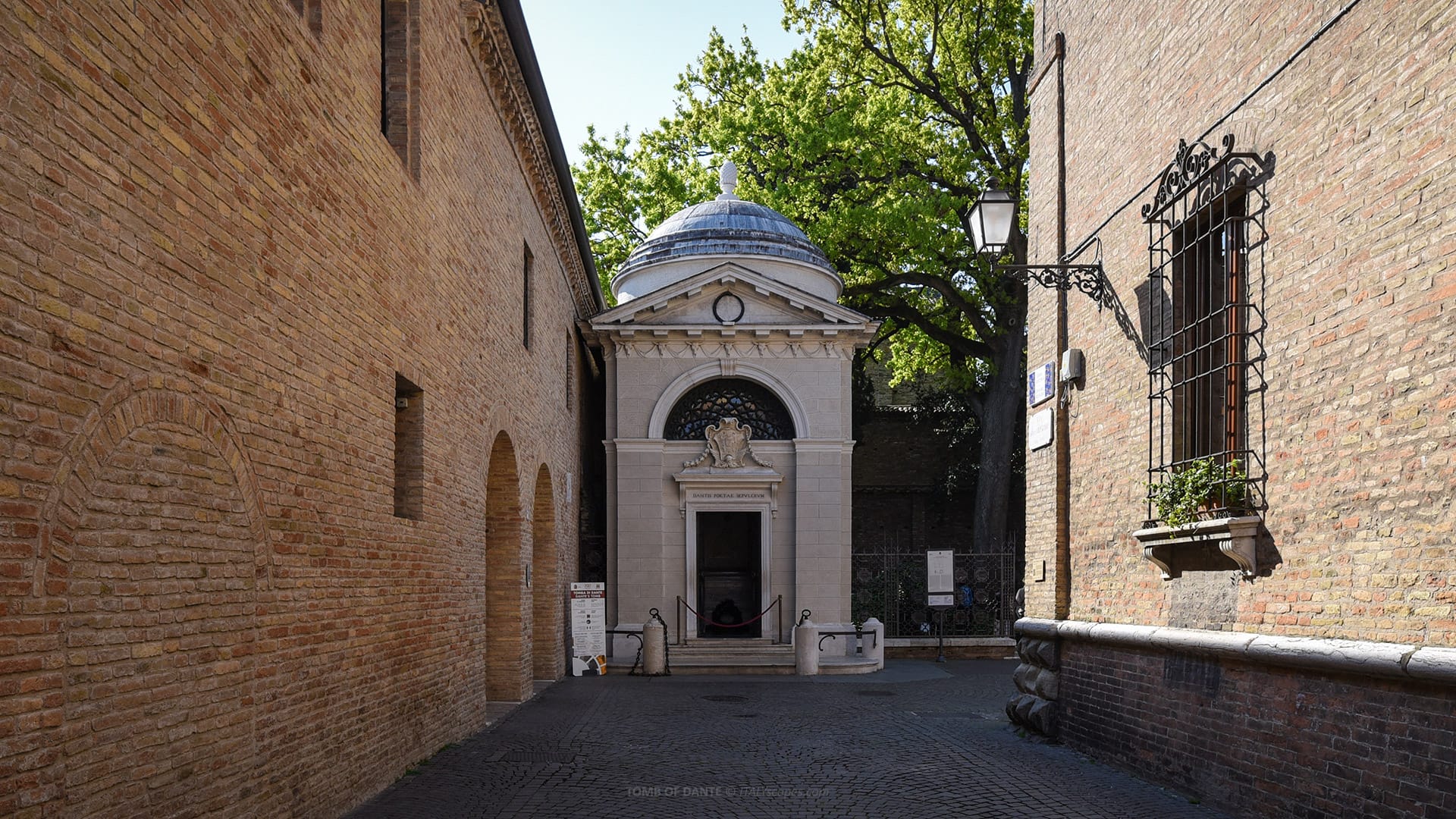
Tomb of Dante, Ravenna
Italy Seen Through Dante
Following Dante Alighieri through Italy means following the real map of a medieval exile. Florence gives the beginning, the language, the political wound, and the memory of Beatrice. Forlì, Bologna, Padua, Treviso, Lunigiana, and Casentino show movement, conflict, study, diplomacy, and survival.
Verona gives the great refuge, the Scaliger court, and the patronage of Cangrande. Venice gives the final embassy and the Arsenale image. Ravenna gives the last home, the completion of the Divine Comedy, the funeral, the tomb, and the strongest physical memory of the poet.
The route is powerful because it connects monuments with facts. Baptisteries, towers, castles, piazzas, tombs, churches, libraries, and shipyards are not decorative additions. They are part of the historical world that Dante Alighieri knew, judged, transformed, and preserved inside European literature.
Frequently Asked Questions about Dante Alighieri
Who was Dante Alighieri?
Dante Alighieri was a medieval Italian poet, writer, and political exile from Florence. He is best known as the author of the Divine Comedy, one of Europe’s greatest literary works.
When was Dante Alighieri born?
Dante Alighieri was born in Florence between 14 May and 13 June 1265. His exact birth date is unknown, but this period is generally accepted by scholars.
When did Dante Alighieri die?
Dante Alighieri died in Ravenna during the night between 13 and 14 September 1321. He was about 56 years old and was buried in Ravenna.
Why was Dante Alighieri exiled from Florence?
Dante was exiled in 1302 after the Black Guelphs took control of Florence. He was accused of political crimes, fined, and condemned to death if he returned.
What is Dante Alighieri’s most famous work?
Dante’s most famous work is the Divine Comedy, a long poem divided into Inferno, Purgatorio, and Paradiso. It describes a journey through Hell, Purgatory, and Heaven.
Where is Dante Alighieri buried?
Dante Alighieri is buried in Ravenna, not Florence. His tomb stands near the Basilica of San Francesco, where his funeral was held after his death in 1321.