
Table of Contents
Verona is compact enough for one full day, but the route must be planned carefully. This Verona itinerary connects the Roman Arena, Castelvecchio, Basilica of San Zeno, Porta Borsari, Piazza delle Erbe, Piazza dei Signori, Juliet’s House, Ponte Pietra, and the Roman Theatre without turning the day into a forced march.
The plan is designed for travellers arriving at Verona Porta Nuova railway station in the morning. The full route covers about 8.5 to 10 kilometres on foot, depending on short detours, tower climbs, and museum choices. A bus or taxi can reduce the first or last walking section.
This Verona itinerary includes real breaks for coffee, lunch, water, and evening rest. It prioritises two paid or interior visits: the Arena and the Basilica of San Zeno. Other monuments are treated as exterior stops, short visits, or optional entries, because Verona has too many important sites for one day.
The day works best from March to October, when daylight is longer and San Zeno has wider visiting hours. On Sundays and religious holidays, San Zeno opens to tourists in the afternoon, so move the basilica after lunch and keep the historic centre for the morning.
Why This One-Day Verona Itinerary Works
Verona’s historic centre lies inside the bend of the Adige River, while San Zeno stands west of the centre. Many rushed routes skip San Zeno because it is outside the tight Roman-medieval core. This Verona itinerary includes it early, after Castelvecchio, when walking energy is still high.
The route also respects Verona’s historical layers. It begins with the Roman amphitheatre, moves through Scaliger military architecture, reaches one of the city’s greatest Romanesque churches, then returns through Roman gates, medieval squares, family tombs, literary landmarks, bridges, and the theatre area across the river.
Do not try to visit every museum in one day. The Castelvecchio Museum, Juliet’s House, Torre dei Lamberti, the Arena, San Zeno, the Cathedral complex, and the Archaeological Museum can each consume serious time. This Verona itinerary selects highlights and leaves deeper visits for another trip.
For realistic timing, reserve at least 10 hours in the city. A good schedule is 8:30 am to 7:00 pm, with dinner afterward. The day includes one proper lunch break, two shorter pauses, and enough flexibility to slow down in summer heat or during crowded weekends.
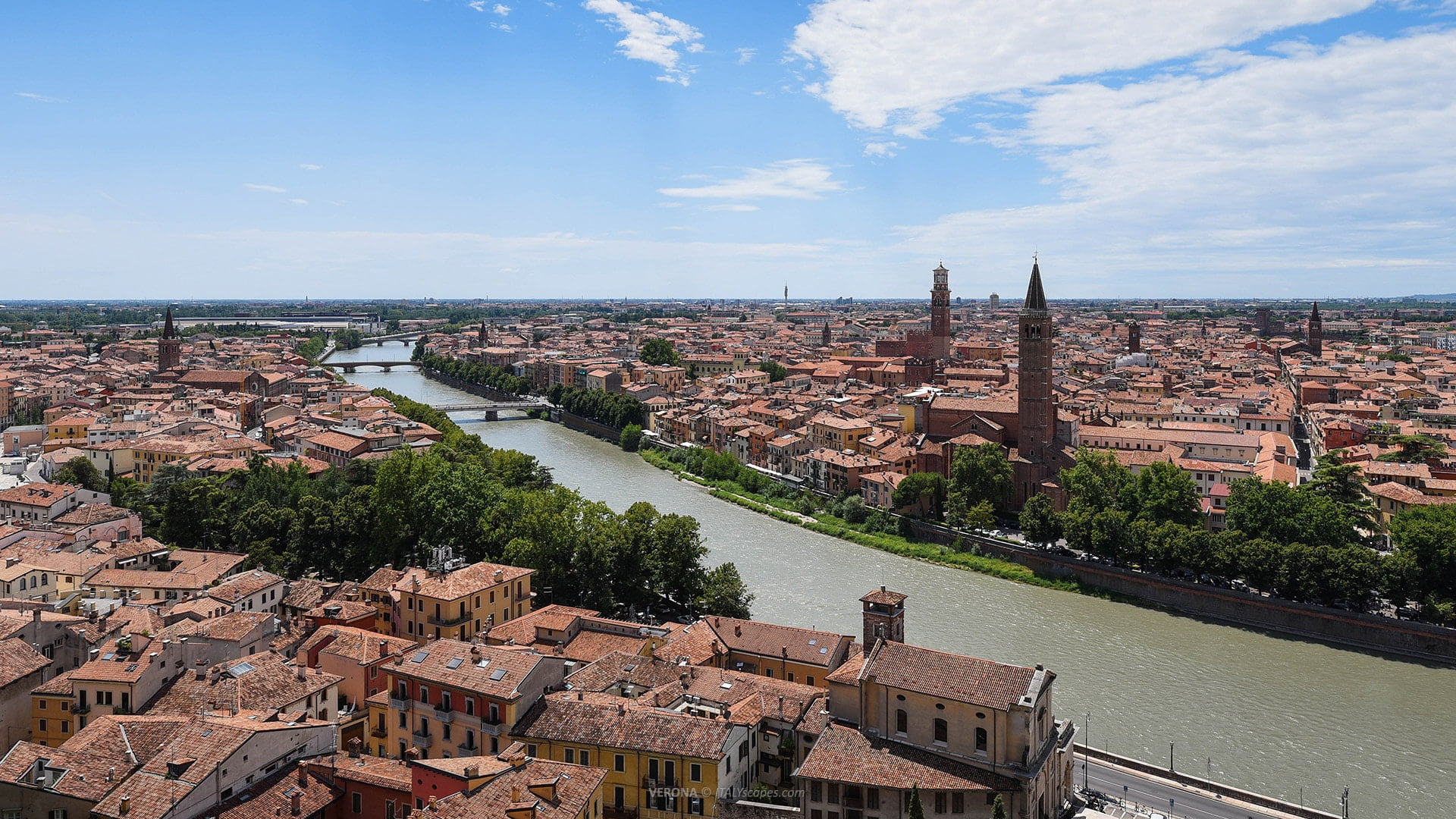
Verona seen from the terrace of Castel San Pietro
8:30 am – Start at Verona Porta Nuova Station
Begin at Verona Porta Nuova, the city’s main railway station. From the station to Piazza Bra, the walking distance is about 1.5 to 1.7 kilometres, usually 20 to 25 minutes. The route follows Corso Porta Nuova and enters the historic centre through the Portoni della Bra.
If you want to save energy for the rest of the Verona itinerary, take a local bus or taxi from the station to Piazza Bra. This is useful in hot weather, with luggage, or before an evening train. The central route already includes several kilometres of stone streets and bridge crossings.
The entrance into Piazza Bra is important because it introduces Verona’s scale. The square brings together the Arena, Palazzo Barbieri, the Gran Guardia, cafés, gardens, and the medieval Portoni della Bra. It is the practical starting point for a first visit, not only a postcard location.
Pause for 10 minutes in Piazza Bra before entering any monument. Buy water, check tickets, and look at the Arena from different angles. The amphitheatre sits directly in the urban fabric, which makes Verona different from archaeological parks where ancient monuments feel separated from daily city life.
9:00 am – Arena di Verona and Piazza Bra
Start the sightseeing part of this Verona itinerary with the Arena di Verona, the city’s most famous Roman monument. The amphitheatre was built in the 1st century AD and originally stood just outside the Roman walls. Today, it dominates Piazza Bra in the modern city centre.
The Arena’s external axes measure about 152.43 metres by 123.23 metres, making it one of the largest preserved Roman amphitheatres in Italy. Its original capacity reached around 30,000 spectators, while the modern performance layout is smaller because the stage occupies part of the ancient seating area.
Allow 45 to 60 minutes if you enter. This is enough for the internal corridors, the stone seating, the view over the arena floor, and a clear understanding of the building’s structure. A complete archaeological visit is longer, but one day in Verona requires disciplined timing.
If event preparations restrict access, keep the visit shorter and focus on the exterior. The surviving Ala dell’Arena, the remaining section of the outer ring, shows the monument’s lost scale. The current building is impressive, but the original outer structure was even more monumental.
Before leaving Piazza Bra, look at Palazzo Barbieri, built between 1836 and 1848, and the Gran Guardia, whose construction began in the 17th century. Do not spend too long here. The next stop is Castelvecchio, and you must reach San Zeno before lunch.

The Verona Arena seen from Piazza Bra
10:00 am – Walk to Castelvecchio and Arco dei Gavi
From the Arena to Castelvecchio, walk west along Via Roma. The distance is about 650 metres, usually 8 to 10 minutes. This short section is one of the easiest transitions in the Verona itinerary because it connects Roman spectacle, medieval power, and the city’s later military history.
Before entering the Castelvecchio area, stop at the Arco dei Gavi. This Roman honorary arch was built around the mid-1st century AD for the Gavia family. It was demolished by French military engineers in 1805 and reconstructed by anastylosis near Castelvecchio in 1932.
The arch is important because private monumental arches were rare in Roman architecture. Its position near the ancient Via Postumia also helps explain Verona’s role as a road city. The route from Porta Borsari to Corso Cavour and Castelvecchio still preserves the logic of Roman movement.
Continue to Castelvecchio, built in the 14th century by Cangrande II della Scala. The castle was originally called Castello di San Martino in Aquaro and later became known as Castelvecchio. It served both as a military fortress and as a protected residence for the Scaliger lord.
For this Verona itinerary, visit the courtyards and exterior rather than the full museum unless you skip another major stop. The Castelvecchio Museum deserves 90 minutes or more, especially for sculpture, painting, and Carlo Scarpa’s modern museum layout. One day is better served by the bridge and fortress.
10:35 am – Ponte Scaligero and the Adige River
Walk onto the Ponte Scaligero, also called the Castelvecchio Bridge. It was built between 1354 and 1356 as part of the defensive system of Castelvecchio. The bridge gave Cangrande II della Scala a protected escape route across the Adige in case of rebellion.
The bridge is about 120 metres long and has three arches. The largest span measures about 48.70 metres, an exceptional medieval engineering achievement at the time of construction. Its red brick upper structure and white stone lower parts match Verona’s Scaliger military architecture.
The bridge survived for centuries but was destroyed by retreating German troops on April 24, 1945. It was reconstructed after the war using recovered materials where possible. This makes it both a medieval monument and an important example of post-war restoration in Verona.
Allow 20 to 25 minutes here. Cross the bridge slowly, look back toward Castelvecchio, and pause over the Adige. This is also a good moment for photographs, because the river, bridge, battlements, and castle towers form one of Verona’s strongest architectural views.
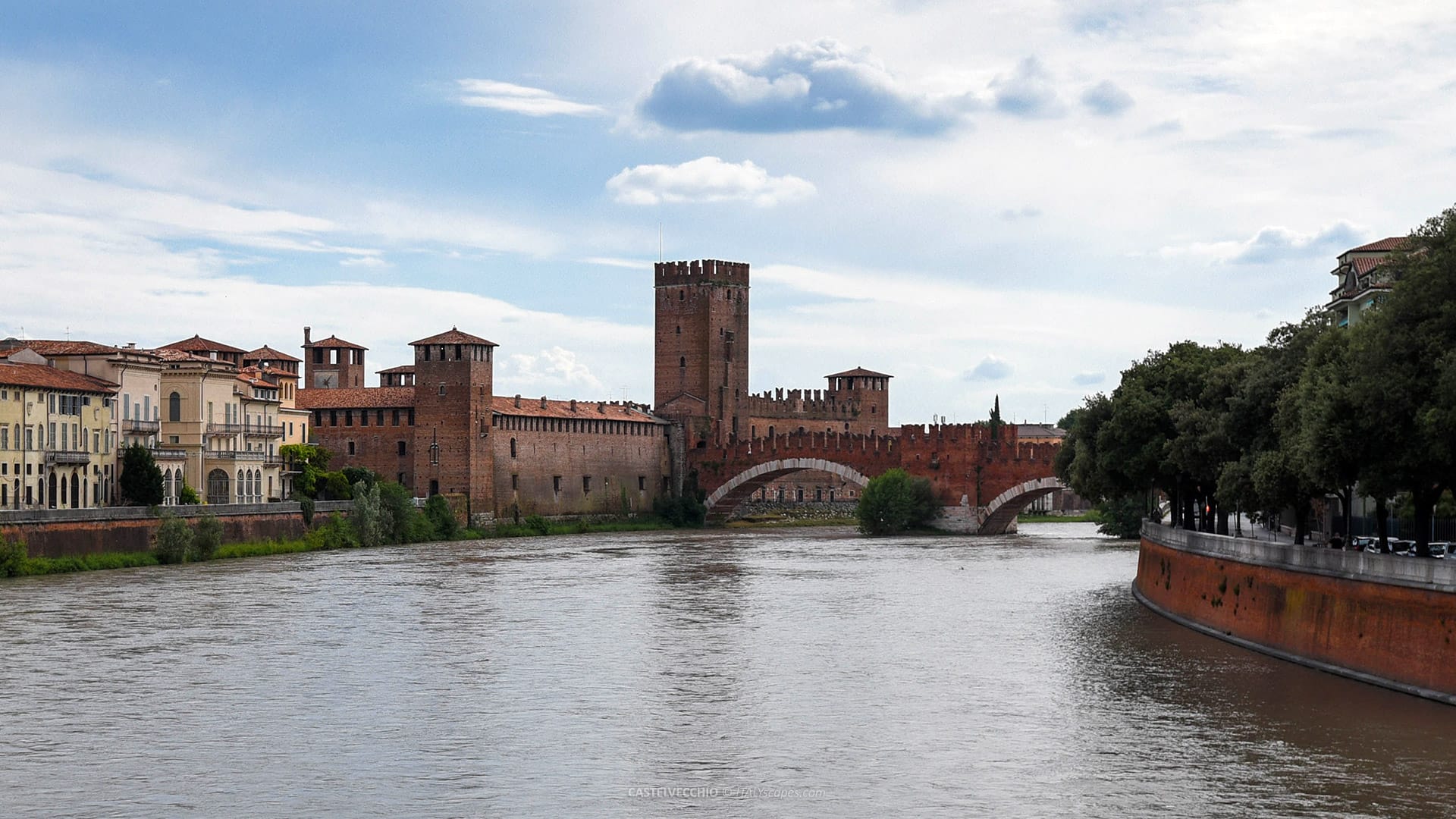
Castelvecchio and the Scaliger Bridge
11:00 am – Walk to the Basilica of San Zeno
From Castelvecchio to the Basilica of San Zeno, the walk is about 900 metres to 1 kilometre, usually 12 to 15 minutes. This section leaves the busiest historic core and moves into a quieter western district. It is the reason this Verona itinerary feels more complete.
San Zeno is essential because it is one of the great Romanesque churches of northern Italy. The saint was Verona’s bishop and patron, and the basilica developed near the area where he was buried. Earlier religious buildings stood here before the present medieval structure took shape.
A larger basilica was consecrated on December 8, 806, in the presence of King Pepin. Later rebuilding and enlargement followed, especially after the earthquake of 1117, which damaged many Veronese buildings. Much of the present basilica belongs to the great Romanesque phase that followed.
Plan 45 to 55 minutes for San Zeno. This is not a quick exterior stop. The façade, rose window known as the Wheel of Fortune, bronze doors, crypt, cloister, frescoes, and Andrea Mantegna’s altarpiece make San Zeno one of the strongest cultural stops of the day.
Inside, look for the crypt where the remains of Saint Zeno are kept and the polychrome statue known as San Zeno Laughing. The famous altarpiece by Andrea Mantegna, painted in 1457-1459, is one of the most important Renaissance works still connected with the church.
From March 1 to October 31, 2026, tourist visiting hours are generally 9:00 am to 6:30 pm Monday to Friday, 9:00 am to 6:00 pm Saturday, and 1:00 pm to 6:30 pm Sundays and religious holidays. Always adapt this Verona itinerary around worship and current access.

The facade of the Basilica di San Zeno Maggiore
12:00 pm – Return Toward Porta Borsari
After San Zeno, walk back toward the historic centre. The distance from Piazza San Zeno to Porta Borsari is about 1.2 kilometres, usually 15 to 18 minutes. This is a practical return route because it brings you back to the Roman street system without repeating Piazza Bra.
If you are tired, take a taxi or local bus from San Zeno toward the centre. Saving 15 minutes here can help if you entered the Arena and San Zeno fully. The Verona itinerary remains realistic only if you protect time for lunch and the afternoon river section.
Arrive at Porta Borsari, one of Verona’s most important Roman gates. The original structure dates to the late 1st century BC, while the surviving white stone façade belongs to the imperial phase. It marked a principal entrance into Roman Verona along the Via Postumia.
Spend 10 minutes at the gate. Notice the two lower arches, the upper rows of framed windows, and the dense city fabric around it. Porta Borsari is not isolated like a museum object; it still stands inside an active street, surrounded by shops, pedestrians, and modern movement.
12:30 pm – Coffee Break on Corso Porta Borsari
This is the first proper rest stop after the morning’s walking. Choose a café on or near Corso Porta Borsari and stop for 20 to 25 minutes. The goal is not sightseeing, but recovery: espresso, water, a small snack, and a realistic pause before the central squares.
By this point, the Verona itinerary has already covered the Arena, Castelvecchio, Ponte Scaligero, San Zeno, and Porta Borsari. That is enough for one morning. Do not add a museum here unless you are willing to remove either Juliet’s House, Ponte Pietra, or the Roman Theatre later.
The next section is compact and mostly pedestrian. From Porta Borsari to Piazza delle Erbe, the distance is about 350 metres, usually 5 minutes. This short walk follows one of the most historically important lines in the city, moving from the Roman gate toward the old forum.
1:00 pm – Piazza delle Erbe
Piazza delle Erbe stands on the area of the ancient Roman forum. It later became Verona’s market square and remains one of the busiest spaces in the historic centre. This Verona itinerary places it around midday, when the square is active and lunch options are close.
The square contains several important monuments. The Madonna Verona fountain was built in 1368, using a Roman statue traditionally dated to 380 AD. Around the square, look at the frescoed Mazzanti Houses, the Domus Mercatorum, Palazzo Maffei, and the column with the Lion of Saint Mark.
Do not rush directly through the square. Allow 20 to 25 minutes for orientation, photographs, and a slow walk around the perimeter. Piazza delle Erbe is useful because it shows Verona’s continuity: Roman forum, medieval market, Scaliger power, Venetian symbols, and modern public life in one place.
From here, you can see or quickly reach Torre dei Lamberti, Verona’s tallest tower. It rises to 84 metres and offers a 360-degree view from above the historic centre. The tower can be climbed by stairs or reached partly by elevator, but the visit changes the day’s timing.
1:30 pm – Lunch Near Piazza delle Erbe or Piazza dei Signori
Take lunch near Piazza delle Erbe, Piazza dei Signori, or the small streets between them. Plan 60 to 75 minutes, including waiting, eating, and a short rest. A one-day Verona itinerary needs a real meal break because the afternoon includes more walking and at least one river crossing.
Choose a simple osteria, trattoria, or casual restaurant rather than a long formal meal. Verona is a good place for local dishes, but the priority at midday is timing. Pasta, risotto, gnocchi, a substantial salad, or a quick plate with local ingredients works better than a heavy tasting menu.
Avoid scheduling Torre dei Lamberti immediately before lunch if queues are long. A tower climb can take 35 to 50 minutes, especially with waiting and photographs. If the view matters more than Juliet’s House, climb the tower after eating and shorten the literary stop later.
Use lunch to decide how ambitious the afternoon should be. The full Verona itinerary continues to Piazza dei Signori, the Scaliger Tombs, Juliet’s House, Santa Anastasia, Ponte Pietra, the Roman Theatre, and possibly Castel San Pietro. In hot weather, remove one church or skip the uphill viewpoint.

Piazza dei Signori – Verona
2:45 pm – Piazza dei Signori and the Scaliger Tombs
From Piazza delle Erbe, walk through the archway toward Piazza dei Signori. The distance is under 150 metres, usually 2 minutes. The atmosphere changes immediately from market square to political square, with palaces connected to the Commune, the Scaliger lords, and Venetian administration.
Piazza dei Signori is also known for the statue of Dante Alighieri, who found refuge in Verona after his exile from Florence. Around the square stand Palazzo della Ragione, Palazzo del Capitanio, Palazzo del Podestà, the Loggia del Consiglio, and other buildings linked to civic power.
Palazzo della Ragione was built at the end of the 12th century for the new magistracies of the Commune. Its complex includes Torre dei Lamberti, begun in 1172 and later raised to its present height. The nearby Scala della Ragione uses Verona’s characteristic red marble.
A few steps away are the Arche Scaligere, the monumental tombs of the Della Scala family. They stand beside the small church of Santa Maria Antica and include the tomb of Cangrande I della Scala, the most famous lord of Verona and Dante’s Veronese patron.
Allow 30 to 35 minutes for Piazza dei Signori and the Scaliger Tombs. This is enough for exterior viewing, photographs, and orientation. Entering Torre dei Lamberti, the Gallery of Modern Art, or other interior spaces requires a different version of the Verona itinerary.
3:20 pm – Juliet’s House
From Piazza dei Signori to Juliet’s House, walk about 300 metres, usually 4 to 5 minutes. The route passes through dense medieval streets and reaches Via Cappello. This is one of the most crowded points in Verona, so keep expectations practical and do not over-allocate time.
Juliet’s House is a medieval residential building associated with the Dal Cappello family. The similarity between Cappello and Capuleti helped connect it with Shakespeare’s Juliet. The building was restored in 1935 by Antonio Avena, who reshaped parts of the site for its literary identity.
The famous balcony is not a medieval survival in the simple romantic sense. It belongs to the 20th-century restoration of the site. The courtyard also contains the bronze statue of Juliet by Nereo Costantini, although the main historical value of the house is its medieval structure and later cultural reception.
For this Verona itinerary, treat Juliet’s House as a 20 to 30-minute stop unless you specifically want the museum. Crowds can be dense, and the site is more symbolic than essential architecturally. It is still worth including because Verona’s global image is strongly tied to Romeo and Juliet.
3:55 pm – Walk Toward Sant’Anastasia
From Juliet’s House to the Basilica of Santa Anastasia, walk about 600 to 650 metres, usually 8 minutes. This section moves northeast through the older city toward the Adige. It is a useful transition from Verona’s literary tourism back to major medieval religious architecture.
Sant’Anastasia is Verona’s largest Gothic church and was developed by the Dominicans from the late 13th century onward. The façade was never fully completed, which is why the exterior appears more austere than the interior. The church preserves important chapels, frescoes, and Dominican artistic patronage.
If you enter, keep the visit to 20 minutes. Focus on the nave, the scale of the Gothic interior, and the Pellegrini Chapel, associated with Pisanello’s fresco of Saint George and the Princess. A longer visit is possible, but this Verona itinerary still needs the river section.
If you are tired, view Sant’Anastasia from outside and continue toward Ponte Pietra. This is not a failure of the route. Verona has several major churches, and San Zeno has already received the full interior visit. The afternoon should remain balanced, not become a church checklist.

Basilica of Santa Anastasia
4:30 pm – Ponte Pietra and the Roman River Crossing
From Sant’Anastasia to Ponte Pietra, walk about 400 metres, usually 5 minutes. The bridge is one of Verona’s most important Roman monuments and one of the best places to understand the city’s relationship with the Adige. This is the most atmospheric late-afternoon section.
Ponte Pietra means “Stone Bridge”. It replaced an earlier wooden crossing connected with the Via Postumia and became the oldest bridge in Verona. The bridge is about 120 metres long and has five arches, although different parts belong to different historical phases.
On April 24, 1945, retreating German troops destroyed most of the bridge. It was reconstructed after the war using original recovered materials where possible, and the rebuilding was completed in 1957. Like Ponte Scaligero, it carries both ancient history and post-war restoration history.
Cross the bridge slowly from the historic centre toward the Roman Theatre side. Allow 15 minutes for the crossing and photographs. The view upstream and downstream shows the Adige bend, the coloured stone of the bridge, the hillside above the river, and the compact mass of Verona behind you.

Ponte Pietra
4:50 pm – Roman Theatre and Castel San Pietro Viewpoint
After crossing Ponte Pietra, the Roman Theatre is only a few minutes away. It was built in the 1st century BC at the foot of Colle San Pietro, on the left bank of the Adige.
The theatre area preserves the cavea, steps, arcades, and archaeological remains. The full Archaeological Museum visit can take 60 to 90 minutes, so it is too long for the complete Verona itinerary unless you skip Juliet’s House, Sant’Anastasia, or the San Pietro viewpoint.
For a realistic one-day route, spend 20 to 25 minutes around the theatre area, then decide whether to climb toward Castel San Pietro. The viewpoint is one of the best places for a wide view over Verona, the Adige, Ponte Pietra, towers, churches, and terracotta roofs.
The uphill walk from Ponte Pietra to the panoramic terrace usually takes 10 to 15 minutes, depending on pace and heat. There is also a funicular in normal operating periods, but schedules can change. If you are tired, stay by the river and save the viewpoint for another visit.
5:30 pm – Coffee, Gelato, or Water Break
After the Roman Theatre or the San Pietro viewpoint, take a proper pause. Stop near Ponte Pietra, in Veronetta, or after crossing back into the historic centre. Plan 25 to 30 minutes for coffee, gelato, water, or simply sitting down after several hours of walking.
This is the second important rest stop in the Verona itinerary. Without it, the evening return to Piazza Bra feels rushed. The day has already included Roman monuments, medieval fortifications, a major basilica, central squares, literary Verona, Gothic architecture, and river views.
If the weather is hot, use this break to reduce the final section. Skip any extra shopping streets and return slowly toward Piazza Bra. If the weather is mild and daylight remains strong, walk back through Piazza delle Erbe and Corso Porta Borsari for a final view of the historic axis.
6:15 pm – Return Toward Piazza Bra
From Ponte Pietra to Piazza Bra, the walk is about 1.4 to 1.6 kilometres, usually 18 to 22 minutes depending on the route. The most direct way passes through the historic centre, but a slower route through Piazza delle Erbe gives a better final sequence.
This return section closes the Verona itinerary as a loop. You began with the Arena, moved west to San Zeno, crossed back through Roman Verona, reached the medieval-political centre, continued to the river, and now return to the amphitheatre area for evening light, dinner, or a performance.
If you have not entered the Arena in the morning, do not assume you can do it now. Closing times, event setups, and ticket rules vary. Evening in Piazza Bra is better used for walking around the amphitheatre, seeing the square fill up, and choosing dinner nearby.
Dinner can be near Piazza Bra, Piazza delle Erbe, or on a quieter street between the two. If there is an opera or concert in the Arena, eat early and arrive with time for security checks. On performance nights, the square becomes more crowded and restaurants fill quickly.
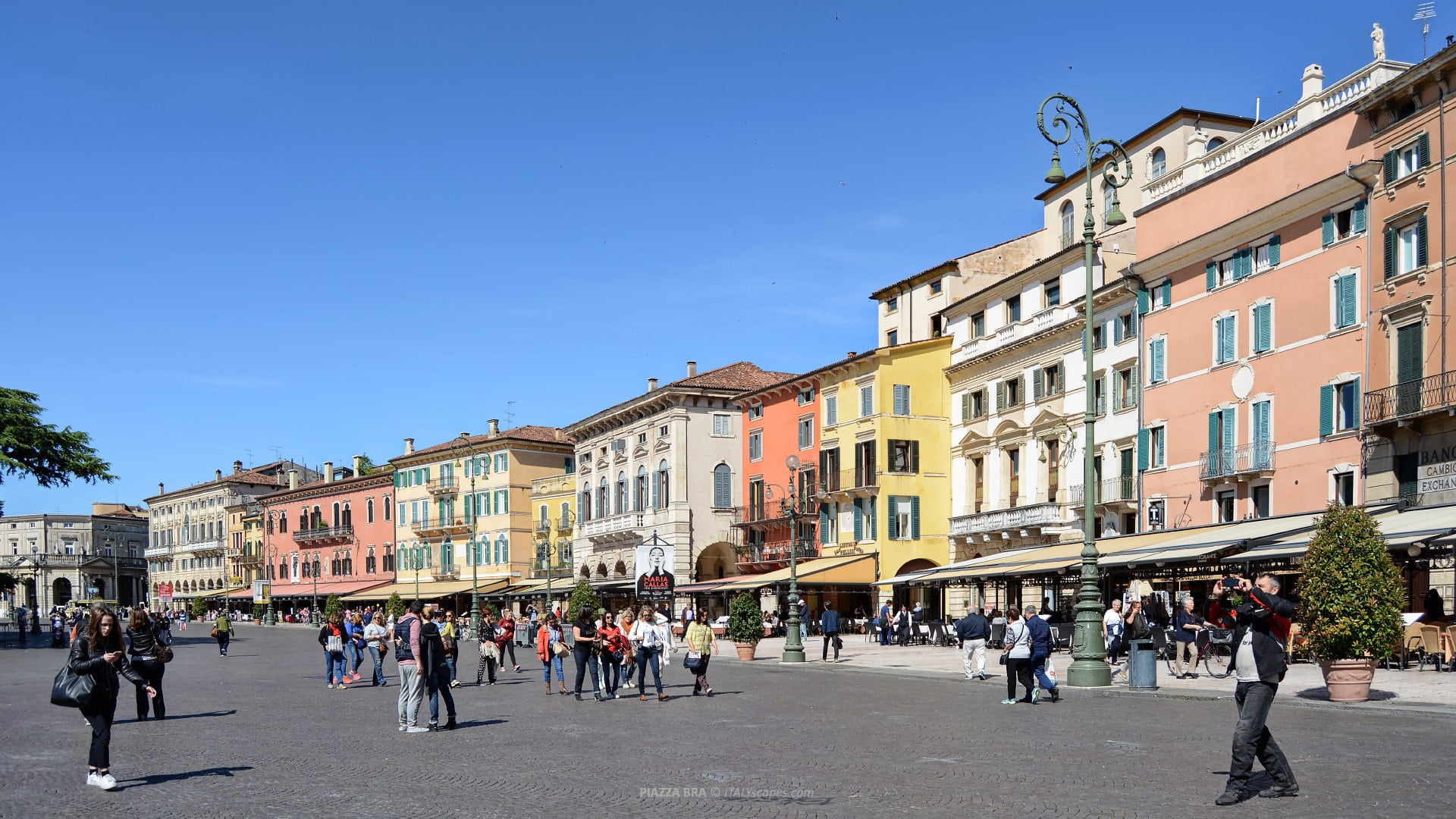
Piazza Bra
Practical Walking Summary
The total walking distance for this Verona itinerary is about 8.5 kilometres without the Castel San Pietro climb. Add approximately 1 kilometre for the viewpoint and small detours. Travellers who walk from and back to Verona Porta Nuova station can exceed 11 kilometres in one day.
The longest single walking sections are Porta Nuova to Piazza Bra at about 1.5 to 1.7 kilometres, San Zeno to Porta Borsari at about 1.2 kilometres, and Ponte Pietra to Piazza Bra at about 1.5 kilometres. Each is manageable, but together they matter.
The most efficient paid-entry combination is Arena plus San Zeno. Add Torre dei Lamberti only if you are willing to shorten Juliet’s House, Sant’Anastasia, or the Roman Theatre area. Add Castelvecchio Museum only by removing several later stops from the afternoon.
Good shoes are necessary because the route includes stone paving, bridges, church floors, narrow medieval streets, and possible uphill walking. Summer visitors should carry water and avoid turning the climb to Castel San Pietro into a mandatory stop. The viewpoint is excellent, but not essential.
Best Adjustments for Sundays and Shorter Days
On Sundays and religious holidays, San Zeno opens to tourist visits in the afternoon. In that case, begin with Piazza Bra, the Arena, Castelvecchio, Porta Borsari, Piazza delle Erbe, and Piazza dei Signori. After lunch, go west to San Zeno, then return only if energy allows.
If you arrive after 10:00 am, remove either the Roman Theatre and San Pietro viewpoint or Sant’Anastasia. Do not remove San Zeno if the goal is a complete Verona itinerary. The basilica is too important for Verona’s religious, artistic, and architectural identity.
If rain is heavy, make the route more interior-focused. Visit the Arena, San Zeno, and either Castelvecchio Museum or Torre dei Lamberti if conditions allow. Skip the San Pietro climb and reduce time on bridges. Ponte Pietra and Ponte Scaligero are better in dry weather.
If you prefer a slower day, keep only Piazza Bra, Arena, Castelvecchio, San Zeno, Porta Borsari, Piazza delle Erbe, Piazza dei Signori, Juliet’s House, and Ponte Pietra. That shorter Verona itinerary still covers Roman, medieval, Scaliger, religious, and literary Verona without exhausting the afternoon.
Final Route Overview
Verona Porta Nuova Station → Piazza Bra → Arena di Verona → Arco dei Gavi → Castelvecchio → Ponte Scaligero → Basilica of San Zeno → Porta Borsari → Piazza delle Erbe → Piazza dei Signori → Scaliger Tombs → Juliet’s House → Sant’Anastasia → Ponte Pietra → Roman Theatre → Castel San Pietro viewpoint → Piazza Bra.
This route is realistic because it limits major interior visits and respects walking time. It includes the Arena, the old Roman gates, the main medieval squares, the Della Scala monuments, the Adige bridges, and the Basilica of San Zeno. That makes it a balanced Verona itinerary for a first full day.
The plan does not show everything in Verona. It deliberately leaves the Cathedral complex, Castelvecchio Museum, full Archaeological Museum, San Fermo, Giardino Giusti, and detailed shopping streets for another visit. One day is enough for Verona’s structure, but not for every monument.
Used well, this Verona itinerary gives a complete first impression of the city: Roman Verona in stone, medieval Verona in brick and towers, Scaliger Verona in fortifications and tombs, religious Verona in San Zeno, and literary Verona around Juliet’s House. It is full, but still possible.

Arco dei Gavi
Frequently Asked Questions about a Verona Itinerary
Is one day enough to visit Verona?
One day is enough to see Verona’s main landmarks, including the Arena, Piazza delle Erbe, Juliet’s House, Ponte Pietra, Castelvecchio, and Basilica of San Zeno, with a realistic walking itinerary.
What should I not miss in Verona?
The most important places to see in Verona are the Arena, Piazza Bra, Piazza delle Erbe, Piazza dei Signori, the Scaliger Tombs, Juliet’s House, Ponte Pietra, and Basilica of San Zeno.
Is Verona easy to explore on foot?
Yes, Verona is very walkable. Most major attractions are inside or near the historic centre, although Basilica of San Zeno requires a slightly longer walk from the central area.
How far is Verona Porta Nuova from the historic centre?
Verona Porta Nuova railway station is about 1.5 to 1.7 kilometres from Piazza Bra. The walk usually takes around 20 to 25 minutes along Corso Porta Nuova.
Is the Arena di Verona worth visiting inside?
Yes, the Arena is worth visiting inside because it is one of the best-preserved Roman amphitheatres in Italy, built in the 1st century AD and still used for performances.
Why is Basilica of San Zeno important?
Basilica of San Zeno is one of Verona’s greatest Romanesque monuments. It is famous for its bronze doors, crypt, rose window, frescoes, and Andrea Mantegna’s Renaissance altarpiece.
Where is the best viewpoint in Verona?
One of the best viewpoints in Verona is the terrace near Castel San Pietro. From there, you can see Ponte Pietra, the Adige River, church towers, rooftops, and the historic centre.
Is Verona expensive to visit?
Verona can be moderately priced if you walk, limit paid attractions, and eat away from the busiest squares. Costs rise with museum entries, Arena events, central restaurants, and overnight stays.


