
Table of Contents
The Della Scala family, also known as the Scaligeri or Scaligers, ruled Verona during one of the most important periods in the city’s medieval history. From the late thirteenth century to 1387, they transformed a turbulent commune into a powerful regional lordship with military strength, political ambition, and a recognizable architectural identity.
Their rise began after the fall of Ezzelino da Romano, whose death in 1259 opened a new phase in Veronese politics. The city needed internal order after years of violence, factional conflict, and unstable communal government. The Della Scala family used civic offices to turn temporary authority into dynastic power.
The dynasty’s most famous ruler was Cangrande I della Scala, a military leader, imperial vicar, patron of Dante Alighieri, and one of the most successful Ghibelline lords of northern Italy. Under him, Verona expanded beyond its local borders and became a central force in the political struggles of the fourteenth century.
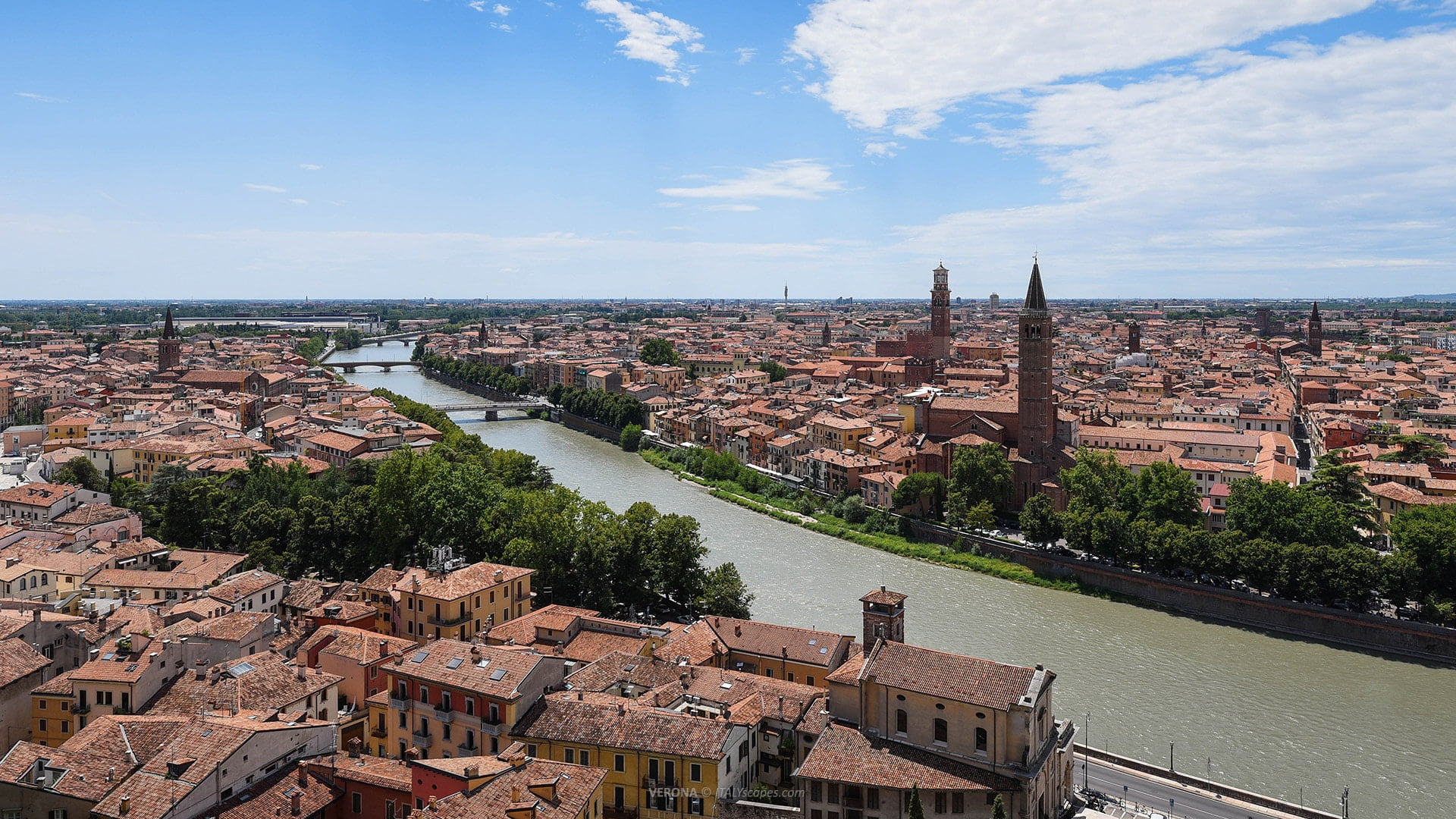
The legacy of the Della Scala family is still visible in Verona through Castelvecchio, the Ponte Scaligero, the Scaliger Tombs, medieval walls, fortified gates, and palaces associated with their government.
Verona
Origins of the Della Scala Family
From Commune to Lordship
The Della Scala family was already prominent in Verona by the eleventh century, but its political domination began much later. Medieval Verona was a commune, governed through civic magistracies, councils, military factions, and alliances. Like many northern Italian cities, it was divided by conflicts between noble families, merchant groups, and Guelf and Ghibelline interests.
After Ezzelino da Romano was defeated and died in 1259, Mastino I della Scala emerged as a stabilizing figure. He became one of the main civic authorities in Verona and later obtained the office of captain of the people, a position that allowed him to command popular and military support inside the commune.
Mastino I was assassinated in 1277, but his death did not end the family’s political rise. His brother Alberto I della Scala succeeded him and strengthened the dynastic character of the regime. Under Alberto, the Della Scala authority became more clearly hereditary, marking the transition from communal office to lordship.
Alberto I and the Consolidation of Power
Alberto I ruled from 1277 to 1301 and gave the Della Scala regime greater continuity. He reinforced family control over civic institutions and managed Verona through alliances, patronage, and careful political balancing. His rule helped transform the family from powerful magistrates into established lords of the city.
Alberto’s government also positioned Verona inside the wider politics of northern Italy. The city was connected to Ghibelline interests, imperial authority, and regional rivalry with neighboring powers. These connections would later become decisive under Cangrande I, when the Della Scala ambitions expanded far beyond Verona itself.
During Alberto’s rule, the family built its political base in the area around Piazza dei Signori and Santa Maria Antica. These places later became closely associated with Scaliger power.
Alberto I left several sons who would shape the next phase of the dynasty: Bartolomeo I, Alboino I, and Cangrande I. Their succession kept power within the family and confirmed that Verona was no longer simply a commune governed by rotating magistrates, but a city dominated by one ruling house.

Piazza dei Signori – Verona
The Early Scaliger Lords
Bartolomeo I and the Dante Connection
Bartolomeo I della Scala ruled from 1301 to 1304. His reign was short, but it has a special place in literary memory because Dante Alighieri was received in Verona during the years of his exile. Dante later referred to a “great Lombard” in the Paradiso, traditionally connected with Bartolomeo.
Bartolomeo’s rule continued the policies of Alberto I rather than transforming them. He preserved family authority and maintained Verona as an important Ghibelline center. His period did not produce the dramatic territorial expansion later associated with Cangrande I, but it helped maintain stability after Alberto’s death.
The association with Dante also indicates that the Della Scala court was not only a military and political center. It attracted exiles, intellectuals, clerics, and courtiers who moved through northern Italy during years of intense factional conflict. Verona became a place where political asylum and cultural prestige could meet.
Bartolomeo died in 1304, and power passed to his brother Alboino I della Scala. The succession remained inside the family, confirming the strength of the dynastic system created after Mastino I and Alberto I.
Alboino I and the Imperial Link
Alboino I della Scala ruled from 1304 to 1311. His reign is important because he associated his younger brother Cangrande with power. From 1308, Cangrande began to rule alongside Alboino, gaining experience in government, diplomacy, and military command before becoming the dominant figure of the dynasty.
During Alboino’s time, Verona’s links with the Holy Roman Empire became stronger. The Della Scala family supported the imperial cause and benefited from the descent of Henry VII into Italy. In 1311, Alboino and Cangrande received the title of imperial vicars for Verona and its territory.
The title of imperial vicar strengthened the legitimacy of the Della Scala lordship. It connected local rule with imperial authority and gave the family a legal and symbolic foundation for expansion. In the fragmented politics of northern Italy, such titles mattered because they helped justify domination over cities and territories.
Alboino died in 1311, leaving Cangrande I as the central ruler. The moment marked the beginning of the most ambitious and successful period in the history of the Della Scala family.
Cangrande I della Scala – The Great Lord of Verona
A Military and Political Leader
Cangrande I della Scala was born in 1291 as Can Francesco della Scala, the son of Alberto I and Verde da Salizzole. His nickname, meaning “Great Dog”, became one of the most recognizable names in medieval northern Italy. It also connected with the canine imagery used in Scaliger heraldry.
Cangrande was associated with rule from a young age and developed a reputation as a skilled commander. His political identity was strongly Ghibelline, and he presented himself as a defender of imperial interests in Italy. This position placed him against many Guelf forces and rival cities.
After Alboino’s death in 1311, Cangrande became the effective lord of Verona. His rule combined military expansion, imperial legitimacy, and courtly prestige.
Cangrande’s success rested on speed, personal authority, and the ability to exploit divisions among neighboring cities. He expanded Scaliger influence during a period when communal institutions were weakening across northern Italy and signorial regimes were becoming more common.
Expansion Beyond Verona
Cangrande’s first major objective was Vicenza, which came under Scaliger control between 1312 and 1314. This was a decisive step because Vicenza gave the Della Scala family a stronger territorial base.
He later fought for control of Padua, one of Verona’s most important rivals. The struggle against Padua lasted for years and involved shifting alliances, military campaigns, and internal factions. Cangrande finally took Padua in 1328, shortly before the end of his life.
Cangrande also extended his authority over Feltre and Belluno, strengthening the family’s position toward the Alpine routes. In 1318, he became captain general of the Ghibelline League, confirming his leadership among imperial supporters in northern Italy.
By the late 1320s, the Della Scala state had become one of the most powerful signorial formations in northern Italy. Cangrande’s authority reached beyond local politics, and Verona became a capital of military ambition, Ghibelline strategy, and aristocratic court culture.
Dante at the Scaliger Court
Cangrande I is closely linked to Dante Alighieri, who spent part of his exile in Verona. The Della Scala court offered Dante protection during a difficult period after his expulsion from Florence. This association strengthened the cultural prestige of the dynasty.
Dante’s connection with the family is especially important because Cangrande was traditionally linked to the dedication of the Paradiso. Whether every detail of the tradition is debated, the relationship between Dante and the Scaliger court remains one of the most famous cultural episodes in medieval Verona.
Cangrande’s reputation was strengthened by chroniclers, poets, and later historians. He became the ideal Scaliger ruler: young, energetic, victorious, generous to allies, feared by enemies, and connected with one of the greatest literary figures of the Middle Ages.
Death at Treviso
In 1329, Cangrande conquered Treviso, extending the Scaliger sphere still further. Soon after entering the city, he became ill and died on 22 July 1329. His sudden death created suspicion even in later tradition, and modern studies of his remains have discussed the possibility of poisoning.
His death ended the dynasty’s greatest moment of expansion. Cangrande had built a powerful state around Verona, Vicenza, Padua, Treviso, Feltre, and Belluno. However, the territories he gathered required constant military control, diplomatic management, and financial resources.
Cangrande was buried in the family funerary complex near Santa Maria Antica. His tomb became one of the most famous monuments of the Scaliger dynasty. The equestrian image of Cangrande in armor expressed the ideal of the ruling warrior, victorious even in death.
After Cangrande I, the Della Scala family still held major power, but the balance changed. His successors inherited an ambitious territorial state, yet they lacked his political timing and military authority. The dynasty had reached its peak, and the next phase brought overextension.

Vicenza
Mastino II and the Overextension of Scaliger Power
Ambition After Cangrande
After Cangrande I died, power passed to his nephews Mastino II della Scala and Alberto II della Scala, the sons of Alboino I. Although they ruled jointly, Mastino II became the more active and dominant figure. He tried to continue the expansionist policy of his uncle.
Mastino II was bold, wealthy, and ambitious. He controlled Verona and Vicenza and sought to enlarge the state further. In the early years of his rule, he conquered Brescia in 1332 and gained influence over Parma and Lucca, extending Scaliger interests deep into Lombardy and Tuscany.
This expansion made the Della Scala family one of the most threatening powers in northern and central Italy. However, it also provoked fear among neighboring states. Venice, Florence, Milan, Ferrara, Mantua, Bologna, and other powers did not want Verona to dominate the mainland.
Mastino’s expansion showed the limits of the Scaliger system. Cangrande had expanded through military ability and political timing, but Mastino’s acquisitions created a broad coalition against him. The Della Scala state became too large to defend easily and too threatening to be tolerated.
The Anti-Scaliger Coalition
The conflict against Mastino II developed in the 1330s. A coalition led by Florence and Venice opposed his expansion. Other powers, including the Visconti of Milan, the Este of Ferrara, the Gonzaga of Mantua, and papal interests, later joined the pressure against him.
The war exposed the vulnerability of the Della Scala territories. Padua, conquered with great difficulty by Cangrande I, was lost during the conflict. Mastino could resist for a time, but he faced enemies on several fronts and could not maintain the wide state inherited and expanded after 1329.
Peace was reached in 1339, with the mediation of Emperor Louis IV of Bavaria. The settlement reduced Scaliger power sharply. Mastino II was left mainly with Verona and Vicenza, while many of the territories gained by Cangrande and Mastino were divided among victorious enemies.
The result marked a turning point. The Della Scala family remained important, but its dream of regional supremacy had failed. Verona continued to be a strong lordship, yet it no longer dominated northern Italy as it had under Cangrande I.
The Tomb of Mastino II
Mastino II died in 1351 and was buried in the Scaliger Tombs. His funerary monument is one of the most elaborate in the complex. It was begun during his lifetime and reflects the continuing desire of the dynasty to present itself through Gothic sculpture, military imagery, and aristocratic display.
The tomb originally had painted and gilded decoration. It includes religious scenes, sculpted figures, and an equestrian statue of Mastino II. The monument communicates power even after political decline, showing how the Della Scala family used funerary art to preserve its public image.
Mastino’s tomb also marks the contrast between appearance and reality. The monument suggests grandeur, but his reign ended with major territorial losses. In Verona, the family still looked powerful, yet the wider political position of the dynasty had been weakened.
The Scaliger Tombs therefore functioned as more than burial places. They were public statements beside Santa Maria Antica, close to the political center of the city. Through them, the Della Scala rulers presented themselves as knights, lords, Christians, and permanent masters of Verona.
Florence
Cangrande II and Castelvecchio
Internal Conflict and Suspicion
After Mastino II, rule passed to his sons: Cangrande II, Cansignorio, and Paolo Alboino. In practice, Cangrande II became the main ruler from 1351 to 1359. His government was marked by suspicion, internal tension, and concern about revolt inside Verona.
Cangrande II was nicknamed Can Rabbioso, or “Raging Dog”, a sign of his harsh reputation. Unlike Cangrande I, whose image combined military success with generosity and cultural prestige, Cangrande II was remembered for oppressive rule and strained relations with his own family and subjects.
The most important monument of his reign was Castelvecchio, built between 1354 and 1356. The castle was not only a defensive work against external enemies. It also gave the ruler a fortified residence and a secure position inside a city where internal revolt was possible.
Castelvecchio was built on the right bank of the Adige, incorporating earlier structures, walls, and the area of San Martino in Aquaro. Its massive brick walls, towers, keep, and bridge made it the most important military monument of the Della Scala lordship.
The Ponte Scaligero
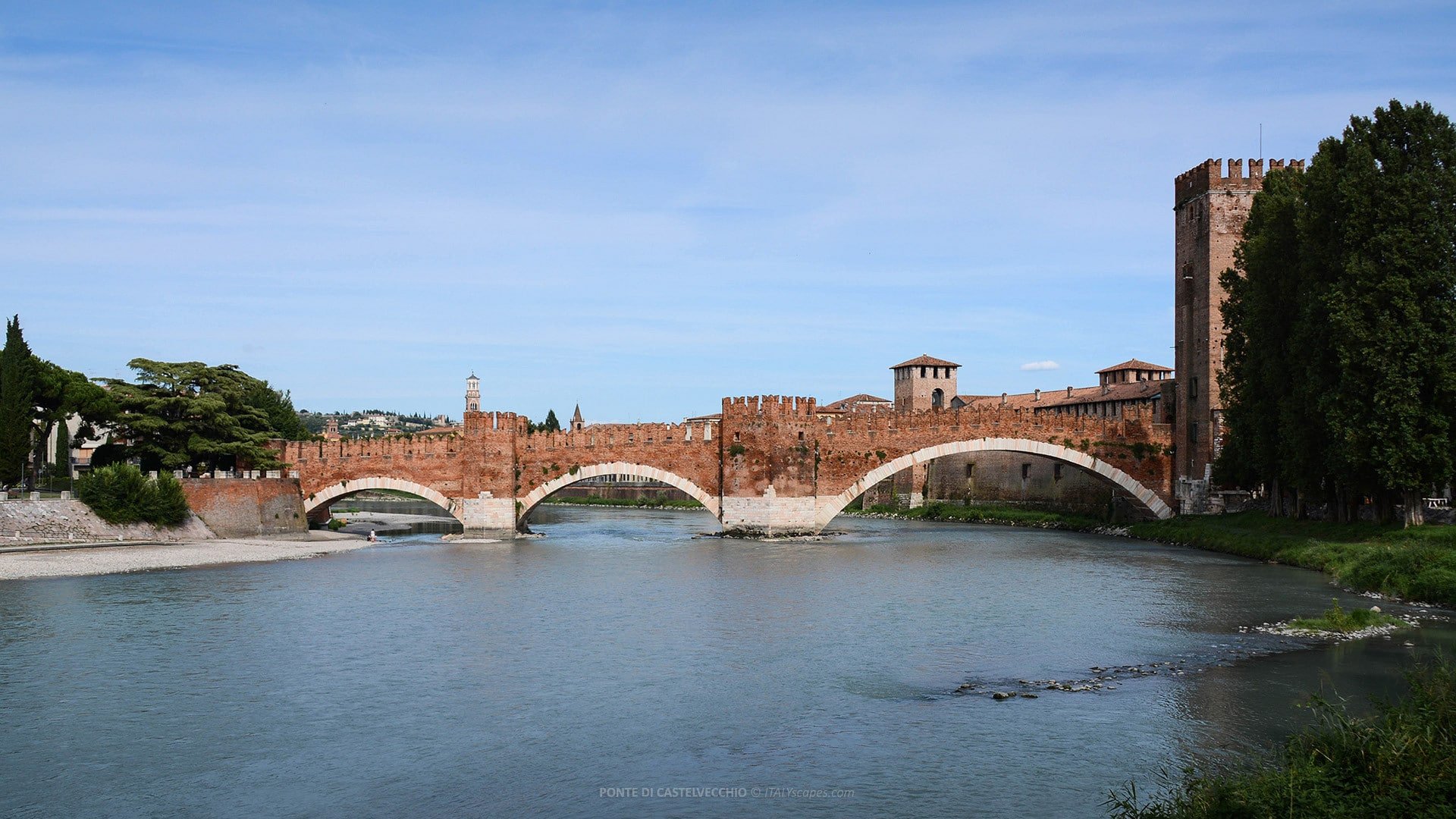
The Ponte Scaligero, also called the Castelvecchio Bridge, was built as part of the same fortified system. It crossed the Adige and connected the castle with the opposite bank. This was not only a bridge for movement, but a strategic escape route.
The bridge is one of the most impressive examples of fourteenth-century military engineering in Verona. Its largest arch measures about 48 meters, a remarkable span for its time. The structure combined brick, local stone, defensive walls, and crenellations connected visually with Castelvecchio.
The existence of the bridge reveals the political climate under Cangrande II. A ruler who needed a fortified residence and escape route was not fully secure inside his own capital. The architecture of Castelvecchio expresses power, but also fear and defensive calculation.
Cangrande II was assassinated in 1359 by his brother Cansignorio, with support connected to the Carraresi of Padua. His death continued the pattern of internal violence that had begun to damage the dynasty. The Della Scala family was now threatened not only by enemies outside Verona, but by itself.

Castelvecchio
Cansignorio and the Last Brilliant Phase
Rule After Fratricide
Cansignorio della Scala ruled from 1359 to 1375. He came to power after the assassination of Cangrande II, an act that reveals the brutality of succession politics within the family. He initially ruled with his brother Paolo Alboino, but real authority belonged to Cansignorio.
His reign brought a measure of stability after the harsh government of Cangrande II. Although he had taken power violently, Cansignorio invested in urban works and monuments. He understood that visible building projects could reinforce legitimacy and present his rule as orderly and beneficial to Verona.
Cansignorio’s government did not restore the territorial empire of Cangrande I. The Della Scala state remained reduced compared with its peak. However, Verona still had political importance, and the ruler used architecture, administration, and ceremonial display to sustain dynastic authority.
The Tomb of Cansignorio
Cansignorio prepared one of the most spectacular monuments of the dynasty: his tomb in the Arche Scaligere. Completed around 1375, it was designed by Bonino da Campione, one of the leading sculptors associated with Lombard Gothic art.
The tomb of Cansignorio is the richest and most decorative of the Scaliger Tombs. It includes warrior saints, Gospel figures, Virtues, Apostles, architectural pinnacles, and an equestrian statue of the ruler. The monument transforms political memory into stone, sculpture, and sacred imagery.
Cansignorio’s tomb shows how the Della Scala family wished to be remembered. The ruler appears as an armed horseman, protected by Christian iconography and surrounded by signs of legitimacy. The monument does not mention the violence of his rise; it presents authority as noble, ordered, and divinely framed.
The tomb also reflects the artistic quality of fourteenth-century Verona. The Scaliger cemetery beside Santa Maria Antica became one of the most important Gothic funerary complexes in Italy. Its iron enclosure, decorated with the ladder motif of the family name, made the space immediately identifiable.
The Fall of the Della Scala Family
The Crisis After Cansignorio
Cansignorio died in 1375. Before his death, he arranged for power to pass to his illegitimate sons Bartolomeo II and Antonio I. To secure this succession, his brother Paolo Alboino was killed. The event revealed again how dynastic survival depended on violence.
Bartolomeo II and Antonio I inherited a weakened state. Verona still had strong walls, monuments, and civic importance, but the Della Scala family no longer had the political strength of the early fourteenth century. Financial pressure, internal mistrust, and external threats limited their authority.
Bartolomeo II ruled jointly with Antonio until 1381, when he was murdered. Antonio was widely suspected of involvement in his brother’s death. After that, Antonio ruled alone, but his position was fragile. The dynasty had become associated with internal killings as much as with public order.
Antonio lacked the prestige of Cangrande I and the resources of Mastino II. He faced powerful neighbors and inherited the consequences of decades of political contraction. The Della Scala family had once built a regional power; by the 1380s, it struggled to preserve Verona itself.
Gian Galeazzo Visconti and 1387
The final blow came from Gian Galeazzo Visconti, the lord of Milan. In 1387, Antonio I was overthrown, and Verona passed under Visconti control. This ended the Della Scala lordship after roughly one hundred twenty-five years of dominance in the city.
The fall of 1387 was not an isolated accident. It resulted from long-term decline after the overextension of Mastino II, repeated succession violence, the rise of stronger territorial powers, and the strategic ambitions of Milan. Verona was too important to remain independent under a weakened dynasty.
Antonio fled and died in 1388, ending the effective political role of the ruling line. Later members of the family attempted to recover power, but the age of the Scaligeri as rulers of Verona was over. The city would later pass to Venice in 1405.
Ponte Scaligero (Ponte di Castelvecchio)
The Della Scala Legacy in Verona
The Della Scala family changed the physical and political identity of Verona. They strengthened walls, controlled gates, built military architecture, shaped the area around Piazza dei Signori, and created one of the most memorable Gothic funerary complexes in Italy.
Their monuments were practical and symbolic at the same time. Castelvecchio controlled access and protected the ruler. The Ponte Scaligero provided a fortified crossing and possible escape route. The Scaliger Tombs preserved dynastic memory. The walls and gates defended the city and marked its medieval boundaries.
The family also helped make Verona a cultural center during the age of Dante. Cangrande I’s court gave the city literary prestige that survived long after the end of the lordship. This cultural memory is as important as the military history of the dynasty.
What remains is one of the strongest medieval identities in Italy. Castelvecchio, the Ponte Scaligero, the Scaliger Tombs, the walls, and the symbolic ladder of the family still define Verona’s historic center. The Della Scala family disappeared as rulers, but their Verona survived in stone.
Frequently Asked Questions about the Della Scala Family
Who were the Della Scala family?
The Della Scala family, also known as the Scaligeri, were the medieval lords of Verona. They ruled the city from the late thirteenth century until 1387.
Why were the Della Scala important for Verona?
The Della Scala transformed Verona into a powerful medieval city-state. They strengthened its walls, expanded its territory, built major monuments, and shaped much of its Gothic identity.
Who was the most famous member of the Della Scala family?
The most famous member was Cangrande I della Scala, a successful military leader, imperial vicar, patron of Dante Alighieri, and the greatest ruler of medieval Verona.
What territories did Cangrande I control?
Cangrande I expanded Scaliger power beyond Verona. He controlled Vicenza, Padua, Treviso, Feltre, and Belluno, making Verona a major Ghibelline power.
What are the Scaliger Tombs?
The Scaliger Tombs are Gothic funerary monuments near Santa Maria Antica. They contain the tombs of important Della Scala rulers, including Cangrande I, Mastino II, and Cansignorio.
Why is Castelvecchio connected to the Della Scala?
Castelvecchio was built by Cangrande II della Scala between 1354 and 1356. It served as a fortified residence, military stronghold, and possible escape point.
When did Della Scala rule end in Verona?
Della Scala rule ended in 1387, when Antonio I della Scala was overthrown and Verona passed under the control of Gian Galeazzo Visconti of Milan.
Sources:


