-
About
Table of Contents
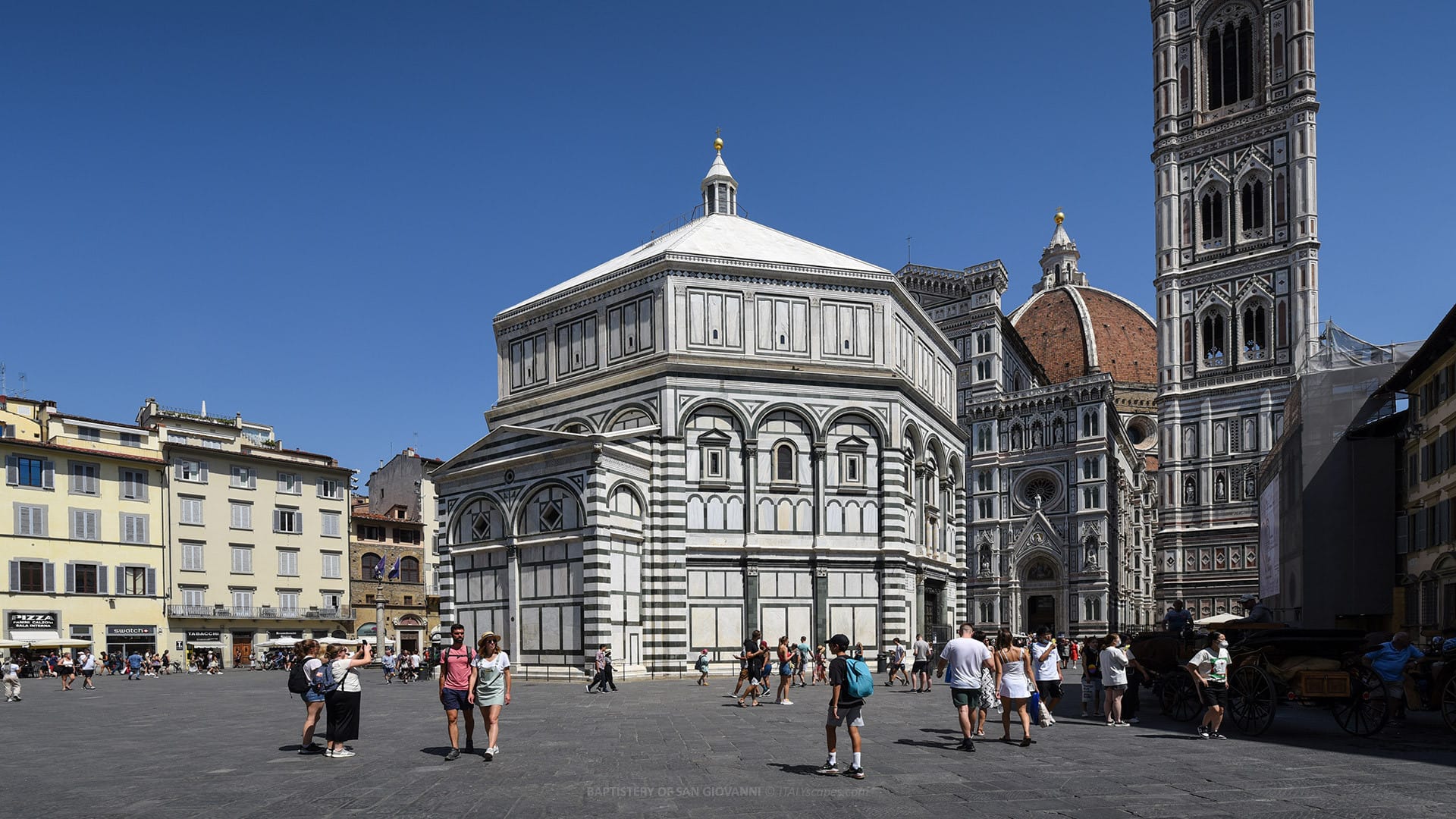
Buy tickets & tours:GetYourGuideThe Baptistery of San Giovanni is one of the defining monuments of Florence, located in Piazza del Duomo, directly in front of the Cathedral of Santa Maria del Fiore. Dedicated to Saint John the Baptist, patron saint of Florence, it stands at the religious and civic center of the historic city.
The building is also known as the Florence Baptistery or the Baptistery of Saint John. It belongs to the monumental complex of Piazza del Duomo, together with Florence Cathedral, Brunelleschi’s Dome, Giotto’s Bell Tower, Santa Reparata, and the Opera del Duomo Museum.
The baptistery has an octagonal plan, a diameter of 25.6 meters, three monumental portals, and 24 windows. Its exterior is covered with geometric patterns in white and green marble, while the interior was designed for baptism, civic ceremony, liturgy, and large public gatherings.
The monument is especially famous for its bronze doors, the marble floor, the matroneum, the Roman and medieval sepulchres, and the great mosaic cycle that covers the vault. The original bronze doors are now preserved in the Opera del Duomo Museum, while copies stand on the building.
Today, the Baptistery of San Giovanni is part of the UNESCO-listed Historic Centre of Florence.
Short History of the Baptistery of San Giovanni
Early Origins and Medieval Tradition
The early history of the Baptistery of San Giovanni is complex because the surviving evidence is limited. Medieval Florentines believed the building had once been a pagan Roman temple dedicated to Mars, later converted into a Christian church, but this interpretation is now treated with caution.
The official history of the monument connects the present structure with an earlier baptistery of the 4th or 5th century. The building visible today is generally associated with the Romanesque phase of Florence, especially the major works carried out between the 11th and 12th centuries.
The traditional date of 1059, linked to Pope Nicholas II, has long been used in descriptions of the baptistery. Recent research has questioned some older assumptions about the exact meaning of this date, so it is safer to describe the monument as an 11th-century Romanesque building with earlier Christian roots.
The Civic Role of San Giovanni
The dedication to Saint John the Baptist gave the baptistery a role beyond church ritual. Dante famously referred to the monument as his “beautiful San Giovanni”, showing how strongly the baptistery was linked to Florentine identity.
The baptistery was also connected to the city’s powerful merchant world. The Arte di Calimala, the guild of cloth merchants, played a central role in commissioning and financing major artistic works for the monument, including the great bronze doors and liturgical treasures.
From Romanesque Florence to the Renaissance
During the 13th and 14th centuries, the interior decoration of the baptistery developed into one of the most important artistic programs in Florence. The mosaic cycle, marble floor, and liturgical furnishings transformed the building into a visual summary of salvation history.
The monument remained central during the rise of Renaissance art. Andrea Pisano created the south bronze doors in the 14th century, while Lorenzo Ghiberti produced the north doors and the east doors in the 15th century.
Architecture of the Baptistery of San Giovanni
Octagonal Plan and Symbolism
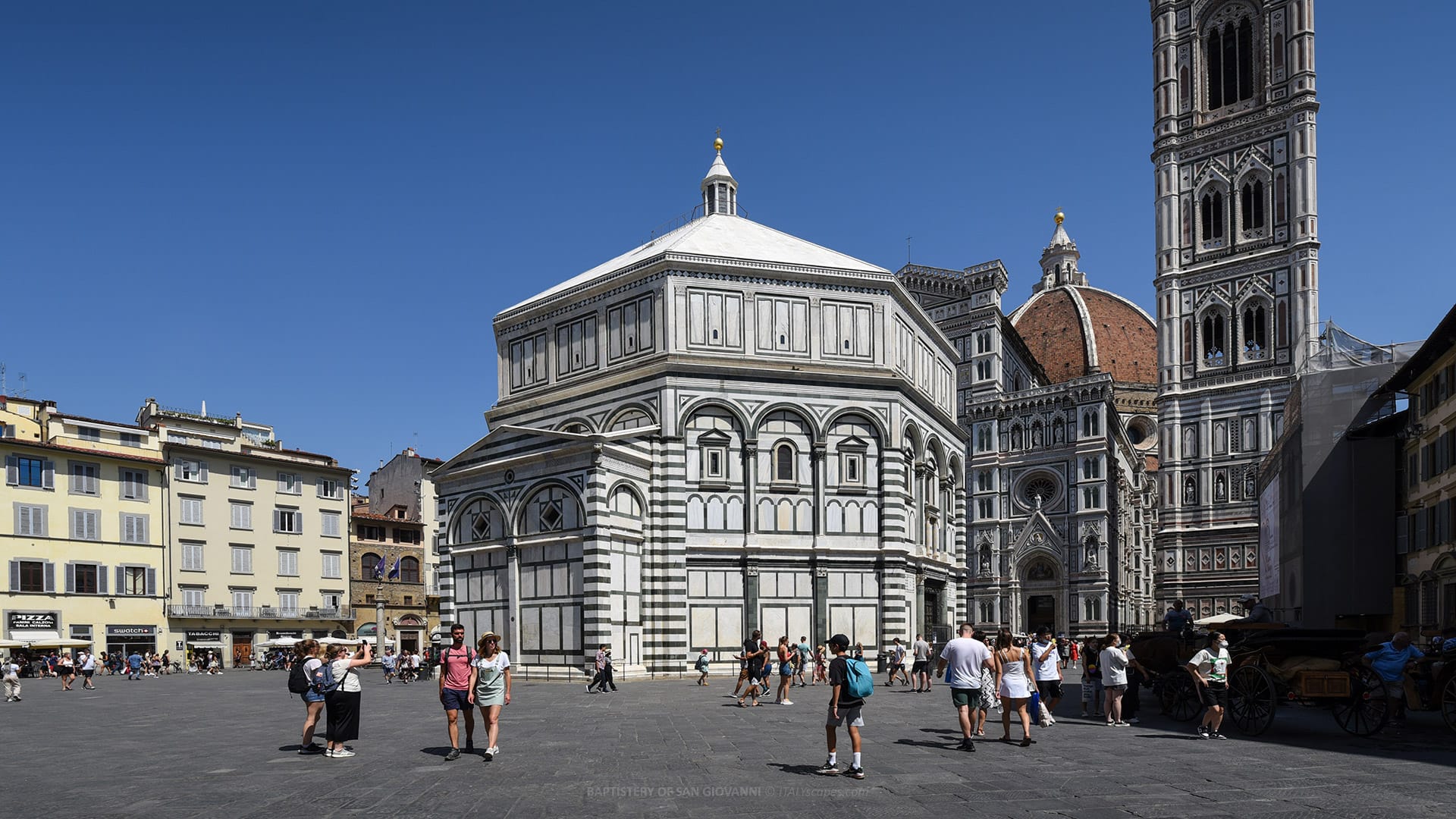
The Baptistery of San Giovanni has an octagonal plan, a form widely used in Christian baptisteries. The number eight had a symbolic meaning in medieval Christianity, referring to the “eighth day”, the time beyond the seven days of Creation and a sign of resurrection.
The building measures 25.6 meters across and includes an apsidal extension, known as the scarsella, on the western side. This small rectangular apse gives direction to the otherwise centralized plan and marks the liturgical focus of the interior.
The baptistery has no large central supporting structure inside. The weight of the vault is carried by the surrounding masonry, creating an open central space.
Exterior Design and Marble Decoration
The exterior is one of the clearest examples of Florentine Romanesque architecture. Its walls are covered with white marble and green marble from Prato, arranged in geometric panels, arches, pilasters, and horizontal bands that give the monument a strict visual order.
The marble decoration is organized on three vertical levels. The lower level uses pilasters and rectangular frames, the middle level contains arches and windows, and the upper level prepares the transition toward the roof. This disciplined structure creates balance on all eight sides.
The building opens through three portals, located on the south, north, and east sides. Each portal was eventually decorated with bronze doors, turning the entrances into major narrative cycles in metal.
Above the building is a double vault: eight internal sails and an external eight-sided prismatic roof. From outside, the baptistery does not show a high dome like Florence Cathedral, but its roof construction is essential to the monument’s form and interior space.
Interior Space and Matroneum
Inside, the Baptistery of San Giovanni is divided into horizontal levels, as on the exterior. The lower zone contains columns, marble revetment, and architectural framing, while the second level includes the matroneum, or women’s gallery, running above the main interior space.
The ancient columns and capitals inside the baptistery show the reuse of earlier materials and the prestige of classical forms in medieval Florence. The interior marble decoration uses polychrome panels, geometric forms, and references to ancient Roman architecture.
Art of the Baptistery of San Giovanni
The Mosaic Cycle
The mosaic decoration of the baptistery is one of the largest medieval mosaic programs in Florence. It covers the vault, the apse, parts of the matroneum, parapets, and wall areas, creating a vast visual program in colored and gilded glass tesserae.
The mosaics were made mainly in the 13th and 14th centuries. Their production began with artists connected to Byzantine traditions and continued with Tuscan masters, including names such as Cimabue, Coppo di Marcovaldo, and Meliore.
The western part of the vault is dominated by the monumental figure of Christ the Judge, placed between the blessed and the damned. This Last Judgment scene was one of the most powerful images seen by medieval Florentines entering the baptistery.
The rest of the vault includes horizontal registers with the angelic hierarchies, scenes from Genesis, the story of Joseph, episodes from the life of Christ and Mary, and scenes from the life of Saint John the Baptist.
The current restoration campaign, which will be completed in 2028, is a major conservation project. It covers more than 1,100 square meters of mosaic surface and involves around 10 million tesserae, with scaffolding reaching approximately 31.5 meters inside the monument.
The Bronze Doors
The three bronze doors of the baptistery form one of the most important sculptural programs in Florence. They were created over more than a century and show the transition from Gothic sculpture to the visual language of the Renaissance.
The south doors were made by Andrea Pisano between 1330 and 1336. Their panels present scenes from the life of Saint John the Baptist, together with allegorical figures of the virtues, arranged in a clear Gothic framework.
The north doors were made by Lorenzo Ghiberti between 1403 and 1424 after a famous competition of 1401. Their panels show episodes from the New Testament, along with the Evangelists and Doctors of the Church.
The east doors, also by Ghiberti, were made between 1425 and 1452. They contain 10 large rectangular panels with scenes from the Old Testament, using perspective, deep spatial relief, and complex narrative composition.
These east doors became known as the Gates of Paradise. Their fame comes from their gilded bronze surface, technical refinement, and Renaissance treatment of space. The originals are now in the Opera del Duomo Museum, while copies are installed outside.
Above the east portal is the sculptural group of the Baptism of Christ, associated with Andrea Sansovino, with a later angel by Innocenzo Spinazzi. Other sculptural groups once connected to the baptistery are also preserved in the Opera del Duomo Museum.
Interior Works and Works Now in the Museum
The baptistery also contained major works of sculpture, metalwork, textiles, and liturgical furniture. Some were removed for conservation and are now displayed in the Opera del Duomo Museum, where visitors can see them in controlled museum conditions.
Among the works associated with the baptistery are Donatello’s wooden Penitent Mary Magdalene, the silver altar of Saint John, liturgical vestments, embroidered textiles, and monumental works connected with the exterior portals.
The tomb monument of Cardinal Baldassarre Coscia, created by Donatello and Michelozzo, is one of the important Renaissance sepulchral works connected with the interior. It shows how the baptistery remained a prestigious burial and commemorative space.
The marble floor is also a major artwork. Its inlaid patterns include geometric designs, animals, and textile-like arrangements. The floor connects the baptistery to Mediterranean luxury culture, medieval craftsmanship, and the symbolic use of marble in sacred architecture.

The Florence Cathedral between the Baptistery of San Giovanni and Giotto’s Campanile
How to Get to the Baptistery of San Giovanni
The Baptistery of San Giovanni is located in the historic center of Florence, in Piazza del Duomo and beside Piazza San Giovanni. It stands directly in front of the main façade of the Cathedral of Santa Maria del Fiore and very close to Giotto’s Bell Tower.
Because the monument is inside the compact historic center, the easiest way to reach it is usually on foot. Most major central attractions are within walking distance, including Piazza della Signoria, Palazzo Vecchio, the Uffizi Gallery, San Lorenzo, and the Accademia Gallery.
Getting to the Baptistery of San Giovanni on foot
The Baptistery of San Giovanni is located about 800-900 meters from Firenze Santa Maria Novella railway station, depending on the exact route. The walk normally takes about 10 to 12 minutes through the historic center.
A practical route from Santa Maria Novella follows Via Panzani and Via de’ Cerretani toward Piazza San Giovanni. This is one of the most direct approaches to the Duomo area and leads straight toward the baptistery and the cathedral façade.
From Piazza della Signoria, the baptistery is about 450 meters away. Visitors can walk along Via dei Calzaiuoli, one of the main pedestrian streets between the civic center of Florence and the religious center around Piazza del Duomo.
From Ponte Vecchio, the distance is about 750-850 meters, depending on the route. A walk through Piazza della Signoria and Via dei Calzaiuoli allows visitors to combine the Arno River, Palazzo Vecchio, Orsanmichele, and the Duomo complex in one route.
Getting to the Baptistery of San Giovanni by bus
The closest bus stops are in the streets around Piazza del Duomo, because the immediate area is partly pedestrian and traffic-restricted. Stops such as Studio and Roma Duomo are within a very short walk of the baptistery.
Urban routes serving the Duomo area may include small electric or city-center buses such as C1, C2, C3, or C4, depending on direction and current routing.
Getting to the Baptistery of San Giovanni by taxi
A taxi can be useful for reaching the Baptistery of San Giovanni from Florence Airport, from distant hotels, or from areas outside the historic center. The monument itself is in a restricted central zone, so taxis may stop at the closest permitted point.
From Firenze Santa Maria Novella station, a taxi is usually not necessary for visitors without luggage, because the walk is short. However, it may be practical for travelers with heavy bags, limited mobility, or accommodation near the station but outside the easiest walking route.
Frequently Asked Questions about the Baptistery of San Giovanni
Where is the Baptistery of San Giovanni located?
The Baptistery of San Giovanni is located in Piazza del Duomo, directly in front of Florence Cathedral. It stands in the religious heart of Florence’s historic center.
How much does it cost to visit the Baptistery of San Giovanni?
The Baptistery is included in the Ghiberti Pass, which costs 15€ full price and 5€ reduced price. Children aged 0-6 can enter free of charge.
Are the mosaics of the Baptistery visible now?
The vault mosaics are currently under restoration, so they are not visible during the normal visit. The restoration campaign is scheduled from 2023 to 2028.
What are the Gates of Paradise?
The Gates of Paradise are the famous east bronze doors by Lorenzo Ghiberti, made between 1425 and 1452. The originals are preserved in the Opera del Duomo Museum.
What is inside the Baptistery of San Giovanni?
Inside, visitors can see marble decoration, tomb monuments, the matroneum, the marble floor, and the restored architectural space. The famous vault mosaics are temporarily hidden by restoration work.
Sources:Buy tickets & tours:GetYourGuide -
Photos
-
Video
Table of Contents
-
Map
-
Reviews