-
About
Table of Contents
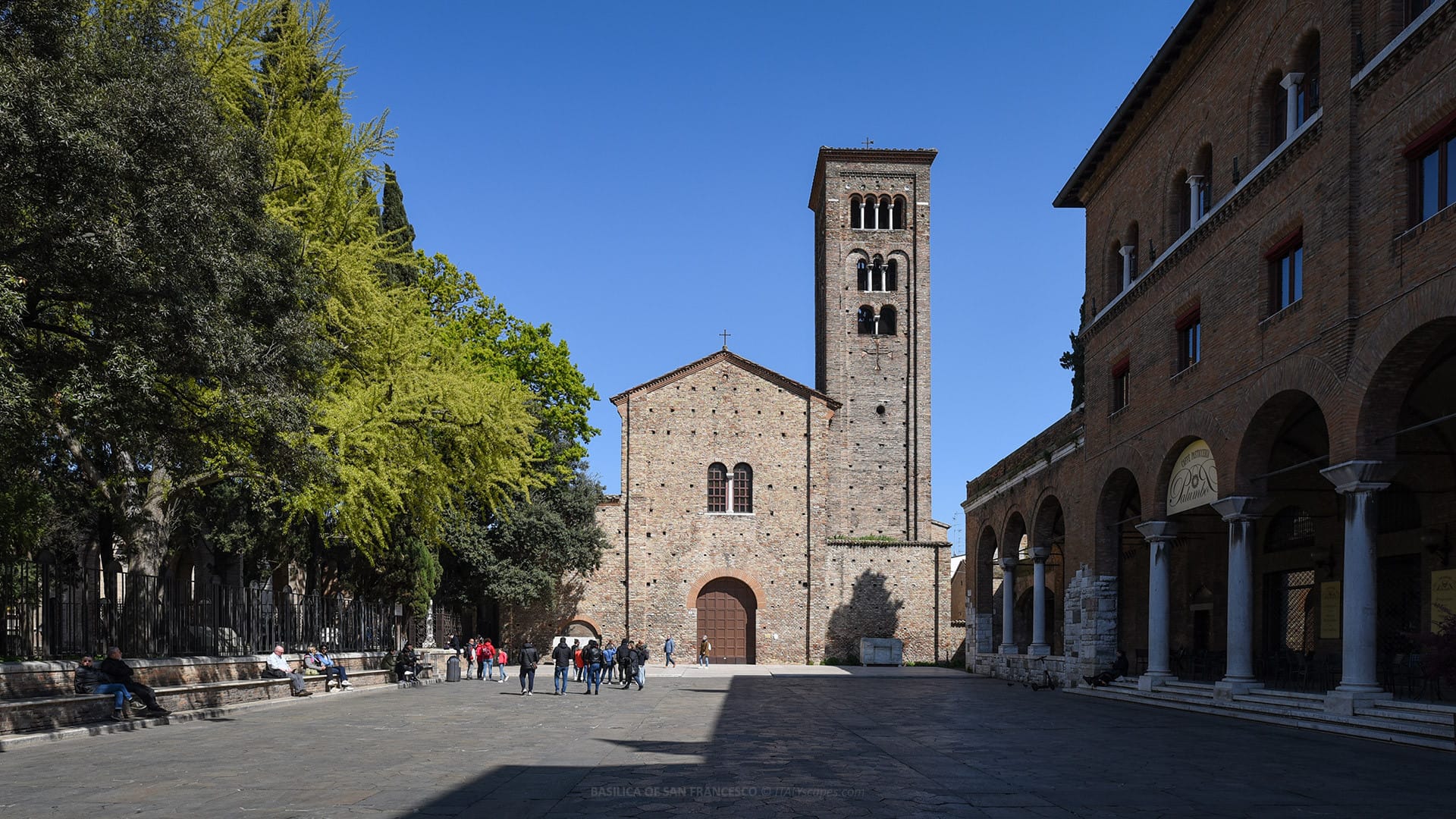
Buy tickets & tours:VivaTicketThe Basilica of San Francesco is a historic Roman Catholic church located in the heart of Ravenna.
With origins tracing back to the 5th century, it stands as one of the city’s oldest sacred buildings and plays a central role in Ravenna’s religious and cultural heritage.
The Basilica of San Francesco is also well known for its connection to Dante Alighieri, as it hosted his solemn funeral in 1321 and sits near his tomb in the city’s “Zone of Silence”.
Today, the basilica remains a living parish church affiliated with the Order of Friars Minor Conventual and welcomes visitors curious to explore its long history, distinctive architecture, submerged crypt, and art.
Short History of the Basilica of San Francesco
The site of the Basilica of San Francesco has been sacred since shortly after AD 450, when Bishop Neone (Neo) – the same figure who founded the Neonian Baptistery – commissioned the original church dedicated to Saints Peter and Paul, known as the Church of the Apostles.
Between the 9th and 10th centuries, that early building was demolished and replaced with a larger church still visible today, along with a bell tower dating to the same period. This structure was initially known as San Pietro Maggiore.
In 1261, the church was granted to the Franciscan order and was rededicated to Saint Francis of Assisi, taking its present name. From this point, it became an integral part of the Franciscan presence in Ravenna.
The Basilica of San Francesco achieved critical historical significance in 1321, when the funeral of Dante Alighieri – the renowned author of The Divine Comedy – was celebrated within its walls.
Dante, who had spent his final years in Ravenna, was initially buried in the adjacent Franciscan cemetery, as he had requested. Although his remains were later moved to Ravenna’s dedicated tomb nearby, the funeral at San Francesco remains an essential event in the building’s history.
Over the centuries, the basilica underwent numerous restorations and additions. Baroque altars and decorative elements were added in later periods, especially between the 16th and 18th centuries.
A major restoration was conducted in 1793 by architect Pietro Zumaglini, which helped unify its form while preserving many medieval features.
During the Napoleonic era, the adjacent convent was suppressed in 1810, though the church itself remained open as a parish. After World War II and the subsequent decline of military rule, the Franciscans returned to run the church in 1949.
In the early 20th century, significant restoration took place in connection with the 600th anniversary of Dante’s death (1921). Baroque elements were removed to reveal a more austere and historically coherent interior more in line with early Gothic and Franciscan sensibilities.
An artistic competition was launched to decorate the interior with themes inspired by The Divine Comedy, but the winning design by Adolfo De Carolis was never realized due to the artist’s premature death.
Architecture of the Basilica of San Francesco
The architectural profile of the Basilica of San Francesco blends centuries of construction and restoration, creating a structure that reflects Romanesque simplicity, medieval engineering, and subsequent stylistic interventions.
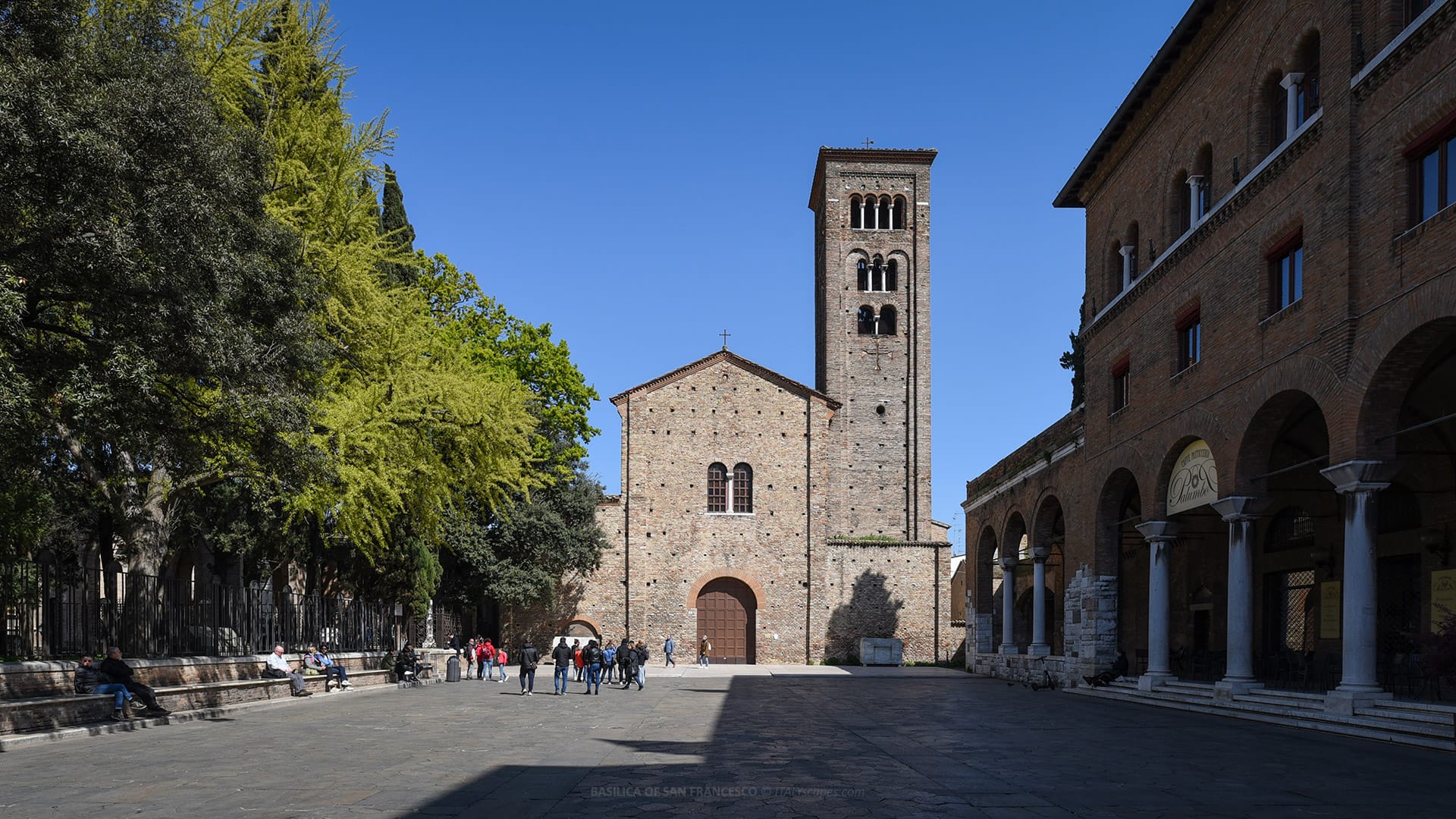
ExteriorThe basilica’s exterior presents an unadorned façade, characteristic of Franciscan aesthetic values emphasizing humility and simplicity. The main structure – largely dating from the 9th-10th century rebuilding – exhibits the Romanesque style typical of northern Italian churches of that era.
A notable architectural feature is the square bell tower, which stands beside the church and was built during the earlier reconstruction phase.
This tower was restored in 1921 for the 600th anniversary of Dante’s death, and its three levels of windows – bifora (two openings), trifora (three), and quadrifora (four) – add visual rhythm to the façade.
Interior PlanInside, the church follows a traditional basilica layout with three naves separated by two rows of columns.
The columns – often repurposed from ancient Roman buildings – support semi-circular arches (a tutto sesto), linking the architectural vocabulary of early and medieval Christian building traditions.
The floor level of the current interior is higher than that of the original church, evidence of Ravenna’s gradual ground subsidence due to its low-lying environment near the Adriatic Sea.
Crypt and Unique FeaturesOne of the basilica’s unique architectural elements is its former crypt, located beneath the presbytery.
This crypt – originally intended to house the relics of Bishop Neone – is now partially submerged due to rising water levels, creating a rare and atmospheric space where mosaics remain visible beneath shallow water filled with fish.
Visitors can view this space through small windows accessible from inside the church.
The blending of water with ancient tesserae creates a striking visual contrast, inviting contemplation of both the natural and the sacred – an architectural environment where building and site interact uniquely.
Art of the Basilica of San Francesco
While the Basilica of San Francesco is not primarily celebrated for an extensive cycle of mosaics like other Ravenna churches, it houses a number of artistic elements, funerary monuments, frescoes, and decorative works that reflect its long use and storied past.
Inside the Basilica of San Francesco, visitors can find fresco fragments, Renaissance chapels, and sculptures that reveal different historical layers.
Along the right nave’s chapels, artworks from the 16th and 17th centuries display the continuing patronage and artistic enrichment of the basilica through successive generations.
One chapel from 1525 features remnants of a 14th-century fresco, while another from 1532 has a painted dome and altarpiece by Gaspare Sacchi depicting the Madonna and Child with saints – examples of how Renaissance and later artistic trends were incorporated into the space.
Although not easily accessible due to water, the crypt’s ancient mosaic floor remains a significant artistic feature. These mosaics date to the earliest phases of the church and provide a direct connection to Ravenna’s early Christian past.
How to Get to the Basilica of San Francesco
The Basilica of San Francesco is located in Piazza San Francesco, in the historic center of Ravenna, making it easily accessible by foot, public transport, or taxi from Ravenna train station (Ravenna FS).
The distance from Ravenna railway station to the Basilica of San Francesco is approximately 1.0-1.2 kilometers (0.6-0.75 miles), which typically takes about 10-15 minutes on foot through Ravenna’s historic streets filled with architectural landmarks.
- On Foot: Walking from the station is the most straightforward and recommended way to reach the basilica. From the station entrance, head south along Via di Roma and follow signs leading into the historic centre. The journey leads past the city’s charming squares and churches until you arrive at Piazza San Francesco, where the basilica awaits.
- By Bus: Several local city bus lines stop near central Ravenna, with the closest bus stops typically located around Piazza Caduti della Libertà or Piazza del Popolo, both within a short walk of Piazza San Francesco. The nearest bus stop is Piazza Caduti, approximately 120 meters away, and is served by bus lines 1, 3, 4, 5, 8, 18, 70, 80, 145, 147, 149, 154, 155, 156, 157, 158, and 159.
- Taxi or Ride Service: Taxis are available outside the Ravenna train station and provide a direct, comfortable option for visitors who prefer not to walk or take public transport. The ride to the city’s historic center usually takes only a few minutes, dropping you near Piazza San Francesco.
Once at Piazza San Francesco, the basilica stands prominently among other historic monuments, including Dante’s Tomb, the Quadrarco di Braccioforte, and the associated museums and cloisters that compose Ravenna’s rich cultural heritage.
Sources:Buy tickets & tours:VivaTicket -
Photos
-
Map
-
Reviews