-
About
Table of Contents
Piazza Roma is one of the principal public spaces in Monza‘s historic centre and the architectural setting of the Arengario, the city’s medieval communal palace. Located within the pedestrian core, the square connects Via Italia, Via Vittorio Emanuele II, Via Carlo Alberto, and the streets leading toward Monza Cathedral and Piazza Trento e Trieste.
The square has an irregular form produced by centuries of urban transformation rather than a single planned design. Medieval civic architecture stands beside early 20th-century palaces and the Fontana delle Rane, while shops and commercial premises maintain the area’s traditional role as an active meeting point within central Monza.
Its importance comes primarily from the concentration of civic history around the Arengario. The former town hall represents medieval municipal autonomy, while surrounding architecture documents later changes that transformed the dense medieval neighbourhood into a more open urban space during the 19th and early 20th centuries.
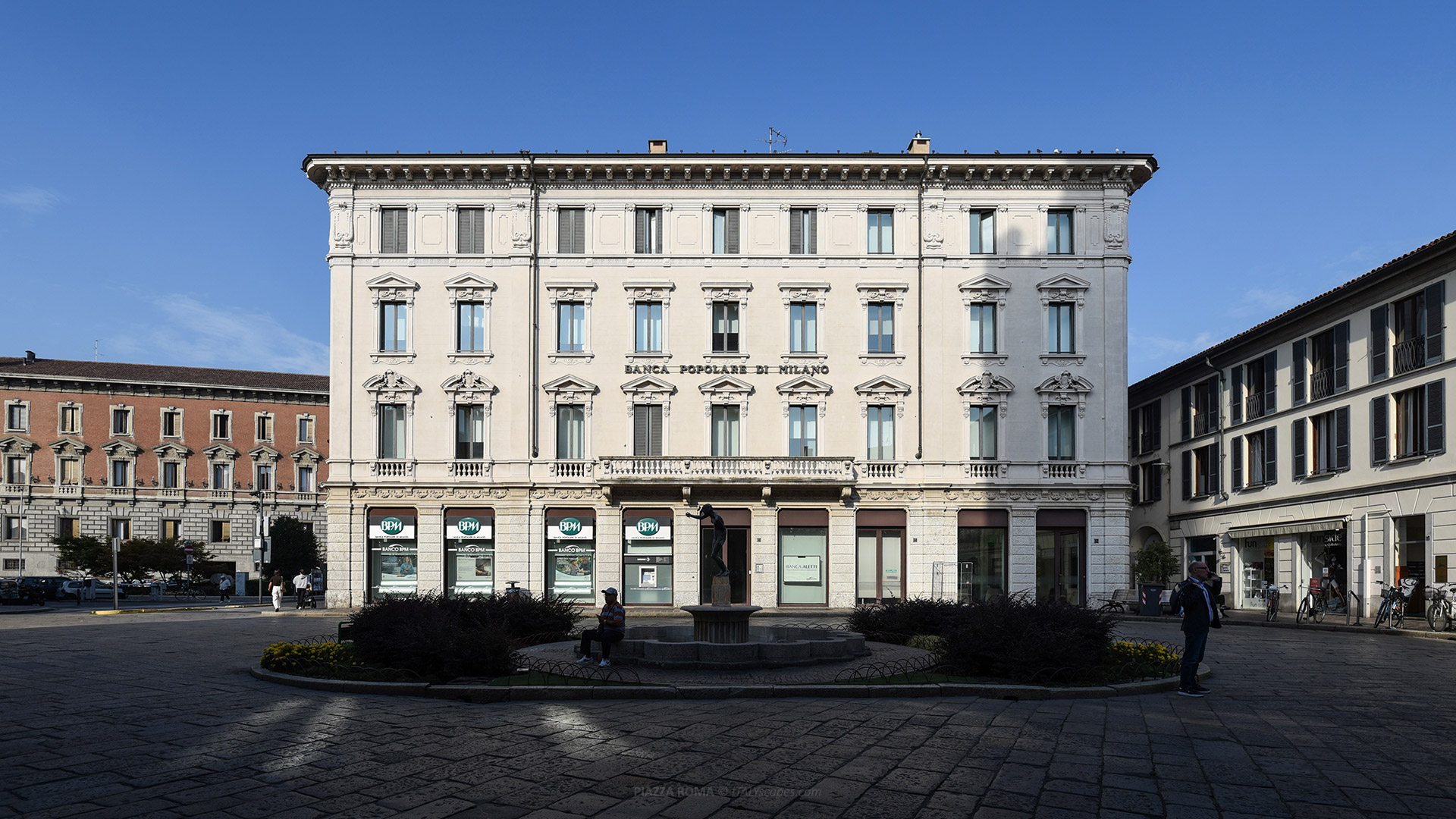
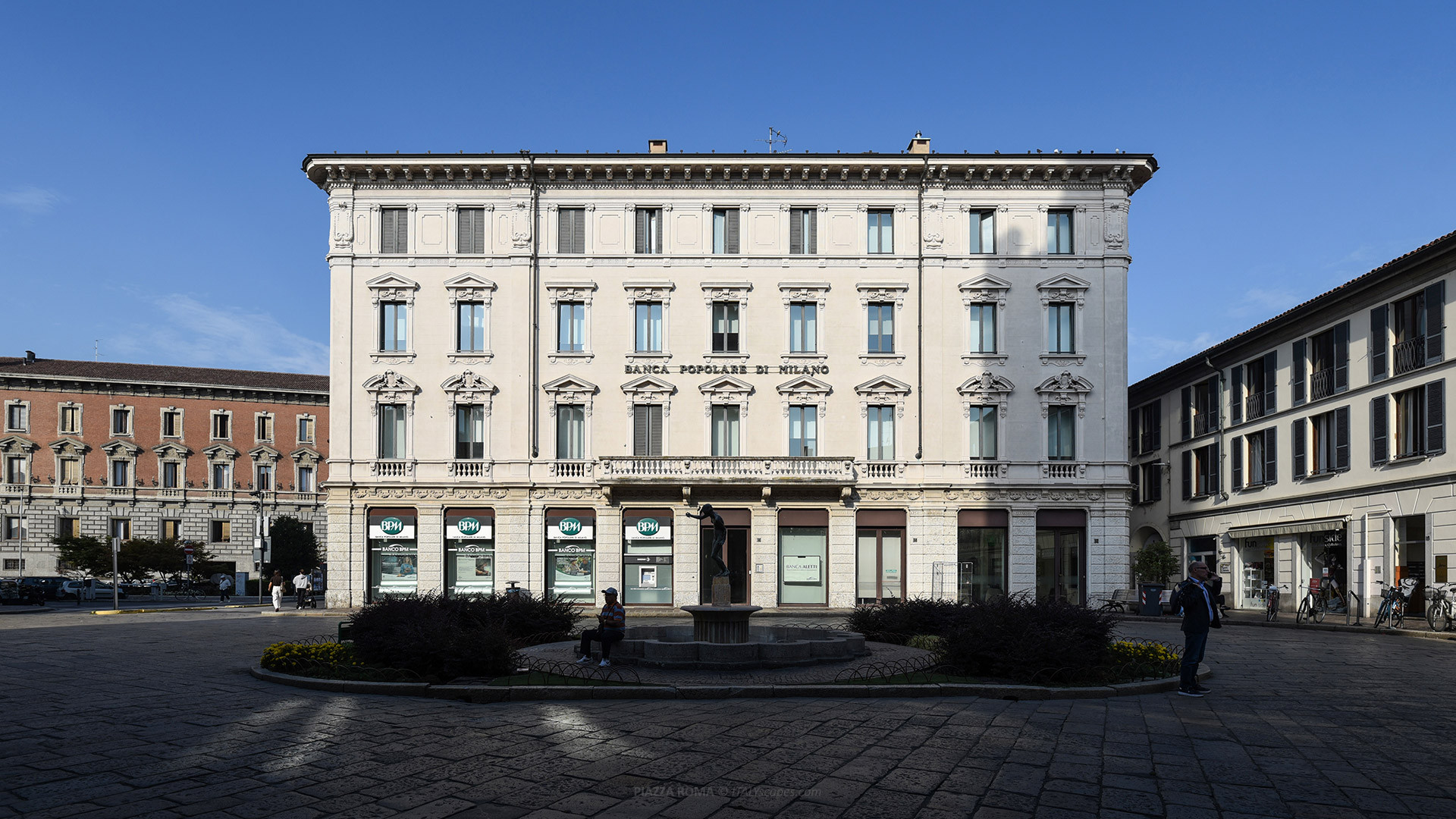
Piazza Roma with the Fontana delle Rane and Palazzo Piazza Roma 10 in central Monza.
Short History of Piazza Roma
The Medieval Civic Centre
The early history of the square is closely connected with the development of Monza’s medieval communal institutions. Before an independent municipal palace existed, city magistrates met in spaces associated with the cathedral, demonstrating how religious and civic authority initially shared the same urban nucleus within medieval Monza.
During the second half of the 13th century, the municipality constructed the Arengario as an independent civic headquarters. The palace stood at the edge of the Pratum Magnum, Monza’s great medieval market space, providing a permanent location for municipal administration, justice, assemblies, and commercial regulation.
The Arengario and the Expansion of Civic Functions
The Arengario gradually acquired architectural features that strengthened its role as the symbol of municipal government. Its civic tower was added after the original palace, providing bells and eventually a public clock, while the small stone loggia known as the Parléra served for the proclamation of official decisions.
Administrative and judicial buildings once stood closer to the Arengario than they do today. The former Palazzo Pretorio was physically connected to the civic palace through a suspended passage, creating a larger municipal complex that occupied considerably more of the surrounding urban fabric than the surviving Arengario suggests.
The 19th-Century Opening of the Square
A decisive transformation occurred during the mid-19th century, when demolitions around the Arengario enlarged the surrounding open space. Removing neighbouring structures gradually isolated the medieval communal palace, changing it from one component of a dense civic complex into a freestanding monument dominating the square.
The process continued as municipal and judicial functions moved elsewhere. Palazzo Pretorio survived beside the Arengario until the beginning of the 20th century, but its demolition in 1903 removed the most important remaining architectural connection with the former medieval governmental complex.
The opening of the square also improved circulation between Via Italia, Piazza Trento e Trieste, Via Carlo Alberto, and Via Vittorio Emanuele II. Piazza Roma increasingly became a junction within the expanding commercial centre rather than simply the forecourt of the old municipal palace.
Early 20th-Century Transformation
The first decades of the 20th century brought another important phase of redevelopment. New buildings appeared around the medieval monument, replacing older structures with larger palaces designed for residential, commercial, financial, and professional activities associated with a rapidly modernizing city.
Among these additions was the building created for Credito Italiano at Piazza Roma 1 in 1927. Its construction introduced a purpose-built financial institution into one of Monza’s most historically important public spaces, reflecting the increasing role of banking and modern commercial services within the city centre.
Another extensive development, today catalogued as Palazzo Piazza Roma 10, occupies several addresses around the square. Constructed during the early 20th century, this group of masonry buildings originally combined dwellings and shops and later evolved toward office and commercial functions.
The Fontana delle Rane and the 1932 Arrangement
Piazza Roma received another distinctive element in 1932, when the Fontana delle Rane was installed beside the Arengario during the definitive early 20th-century reorganization of the square. The fountain was created by Friulian sculptor Aurelio Mistruzzi and remains one of Monza’s protected public artworks.
The central bronze figure depicts a young woman reacting to the cold water sprayed by a frog she holds. She stands within a lobed fountain basin containing additional bronze frogs, while a polychrome mosaic on the bottom represents aquatic motifs including other frogs and fish.
Local residents commonly call the figure La Sirenetta, or “the little mermaid”. The work has also been connected with the local legend of Amira, the princess of the frogs, and Dagoberto, a story traditionally linked with an ancient watercourse and Monza’s early historical mythology.
Architecture of Piazza Roma
Arengario
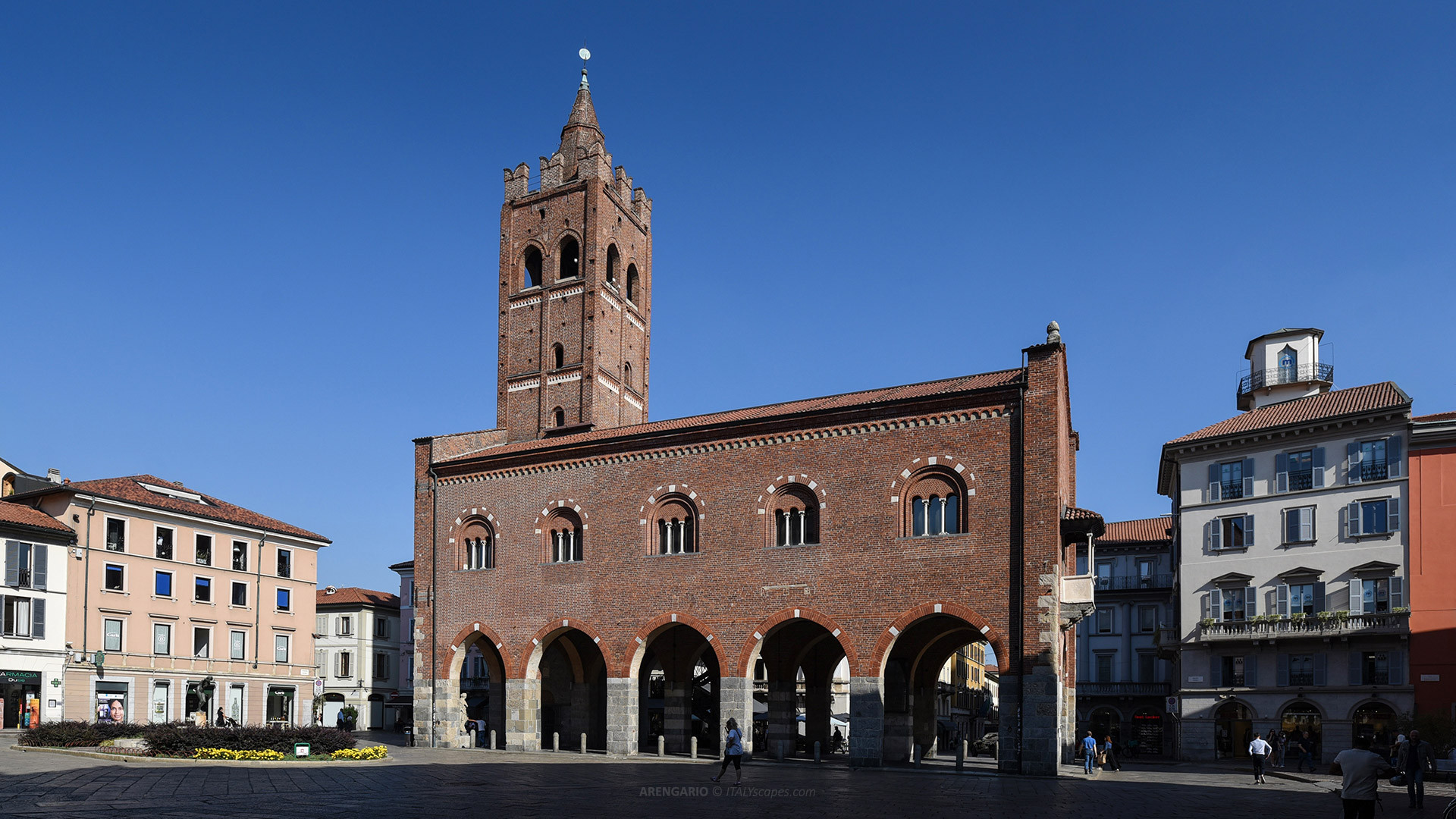
The dominant monument is the Arengario, Monza’s former communal palace and the most important surviving medieval civic building in the city. Constructed during the second half of the 13th century, it follows the northern Italian model of an open commercial portico supporting a large assembly hall above.
Its longitudinal ground floor consists of pointed arches supported by rectangular pillars without conventional capitals. Exposed brick dominates the upper walls, while stone appears in the structural supports and decorative details. The building belongs to the architectural culture of Lombard Gothic, although later restorations modified several openings.
The large upper hall originally accommodated municipal councils, judicial activity, merchants, and public administration. Timber roof trusses span the interior, creating a broad uninterrupted space appropriate for communal assemblies. The hall later underwent numerous alterations before restoration recovered much of its original spatial unity.
The civic tower provides the building’s principal vertical accent. Rising to approximately 44 metres including its spire, it has a square brick shaft, pointed openings in the bell chamber, Ghibelline swallowtail battlements, and an octagonal upper termination that makes it immediately recognizable across central Monza.
On the southern façade is the Parléra, a projecting stone loggia added during the late medieval period. Municipal officials used this elevated platform to proclaim decrees and decisions to residents gathered below, giving the architectural feature a direct function within medieval civic government.
Banca Credito Italiano
At Piazza Roma 1 stands the palace historically identified as Banca Credito Italiano. Constructed in 1927, the building belongs to the modernization of central Monza that occurred during the decades when older structures around the Arengario were being replaced or reorganized.
Its presence is historically significant because it demonstrates how financial and commercial institutions entered the medieval civic centre during the early 20th century.
Palazzo Piazza Roma 10
Opposite and around parts of the Arengario stands the extensive property documented as Palazzo Piazza Roma 10, associated with civic numbers 10, 12, 14, and 16. The complex was created during the early 20th century as an aggregation of regular masonry buildings around the historic square.
Originally, the premises combined residential accommodation and shops, reflecting the traditional mixed-use structure of Monza’s centre. Today, the buildings are primarily occupied by offices and commercial activities, continuing the square’s long association with retail and professional services.
The principal façades are relatively rigorous in composition. Stone frames and rectangular decorative divisions organize the surfaces, while several windows are crowned by triangular pediments or broken curvilinear elements.
Fontana delle Rane
The principal freestanding artwork in the square is the Fontana delle Rane, created by Aurelio Mistruzzi and installed in 1932. The fountain combines bronze sculpture, stonework, water jets, and mosaic decoration and is formally protected for its artistic and historical importance.
At the centre, a nude female figure reacts to water projected by the frog held in her hand. The figure stands over a lobed basin, while smaller bronze frogs positioned around the fountain produce additional water jets, reinforcing the playful aquatic theme of the composition.
The basin floor imitates an underwater environment through a polychrome mosaic representing fish and frogs.
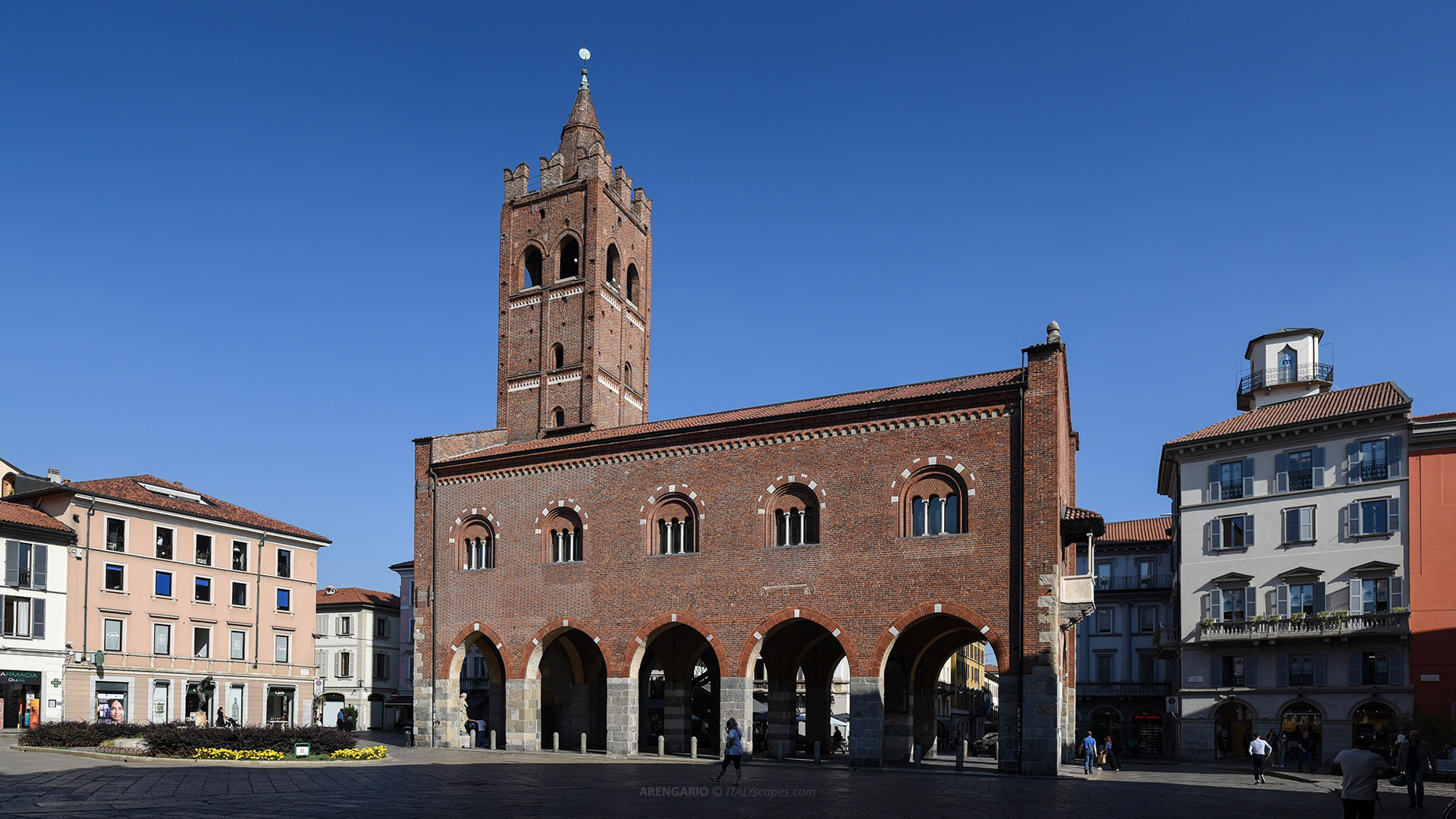
The Arengario and its civic tower in Piazza Roma, Monza.
How to Get to Piazza Roma
Piazza Roma occupies a central position within Monza’s historic pedestrian district and is approximately one kilometre from Monza railway station. Visitors arriving by train can reach it easily on foot, while buses provide connections to nearby Piazza Carducci and taxis are available outside the station.
Getting to Piazza Roma on foot
Walking is generally the easiest option from Monza. The route normally takes around 12 minutes, depending on pace and the station exit used. From the railway area, continue north toward the historic centre and the principal pedestrian shopping streets.
The final section follows the central urban axis toward Via Italia and the Arengario. The medieval tower becomes an easily recognizable landmark when approaching the square, while the surrounding pedestrian streets make navigation relatively straightforward even for visitors arriving in Monza for the first time.
Walking also places several other attractions naturally along the itinerary. Piazza Trento e Trieste lies nearby, while Monza Cathedral and Piazza Duomo can be reached within a few minutes after arriving at Piazza Roma, allowing visitors to explore the central monuments entirely on foot.
Getting to Piazza Roma by bus
Visitors preferring public transport can use services stopping at Piazza Carducci, located only a short walk from Piazza Roma. Regular line Z206 serves the stop, while Z211 and Z212 operate as circular services according to their respective schedules, including holiday service patterns.
From Piazza Carducci, walk east for only a few minutes toward the Arengario. The short final section passes directly through the central civic district, making the stop one of the most convenient public-transport access points for Piazza Roma.
Getting to Piazza Roma by taxi
An official taxi rank is available at Monza railway station, and the city also operates a 24-hour radio-taxi service. The journey to the historic centre is short and can be useful for passengers carrying luggage, visitors with reduced mobility, or travellers arriving during poor weather.
Because Piazza Roma lies within Monza’s ZTL and pedestrian-oriented central area, taxis may use the nearest authorized approach rather than stopping beside the Arengario itself.
Frequently Asked Questions about Piazza Roma
Where is Piazza Roma in Monza?
Piazza Roma lies in the heart of Monza’s historic centre, around the Arengario and close to Via Italia, Piazza Trento e Trieste, Piazza Duomo, and Monza Cathedral.
Why is Piazza Roma important?
The square contains the Arengario, Monza’s medieval communal palace and symbol of municipal autonomy, together with later architecture documenting the city centre’s transformation through subsequent centuries.
What is the main attraction in Piazza Roma?
The principal landmark is the Arengario, a late 13th-century civic palace with an open portico, large assembly hall, medieval tower, and the projecting Parléra loggia.
What is the Fontana delle Rane?
The Fontana delle Rane is a 1932 fountain by Aurelio Mistruzzi, featuring a bronze female figure, sculpted frogs, water jets, and a polychrome mosaic basin.
Can you visit inside the Arengario?
The Arengario interior is currently temporarily closed while accessibility and future-use projects are developed. The exterior, portico, tower, and square remain accessible.
How far is Piazza Roma from Monza railway station?
The square is approximately one kilometre from Monza railway station. The walk generally takes around 12 minutes through the commercial and pedestrian city centre.
What other attractions are near Piazza Roma?
Nearby attractions include Monza Cathedral, Piazza Duomo, Piazza Trento e Trieste, Palazzo Comunale, Via Vittorio Emanuele II, and Ponte dei Leoni, all reachable easily on foot.
-
Photos
-
Map
-
Reviews