-
About
Table of Contents
Piazza Duomo is the religious and symbolic heart of Monza‘s historic centre, a compact and irregularly shaped square dominated by the Basilica of San Giovanni Battista. The square occupies part of the city’s oldest urban nucleus and developed around the royal church founded by Lombard Queen Theodelinda at the end of the 6th century.
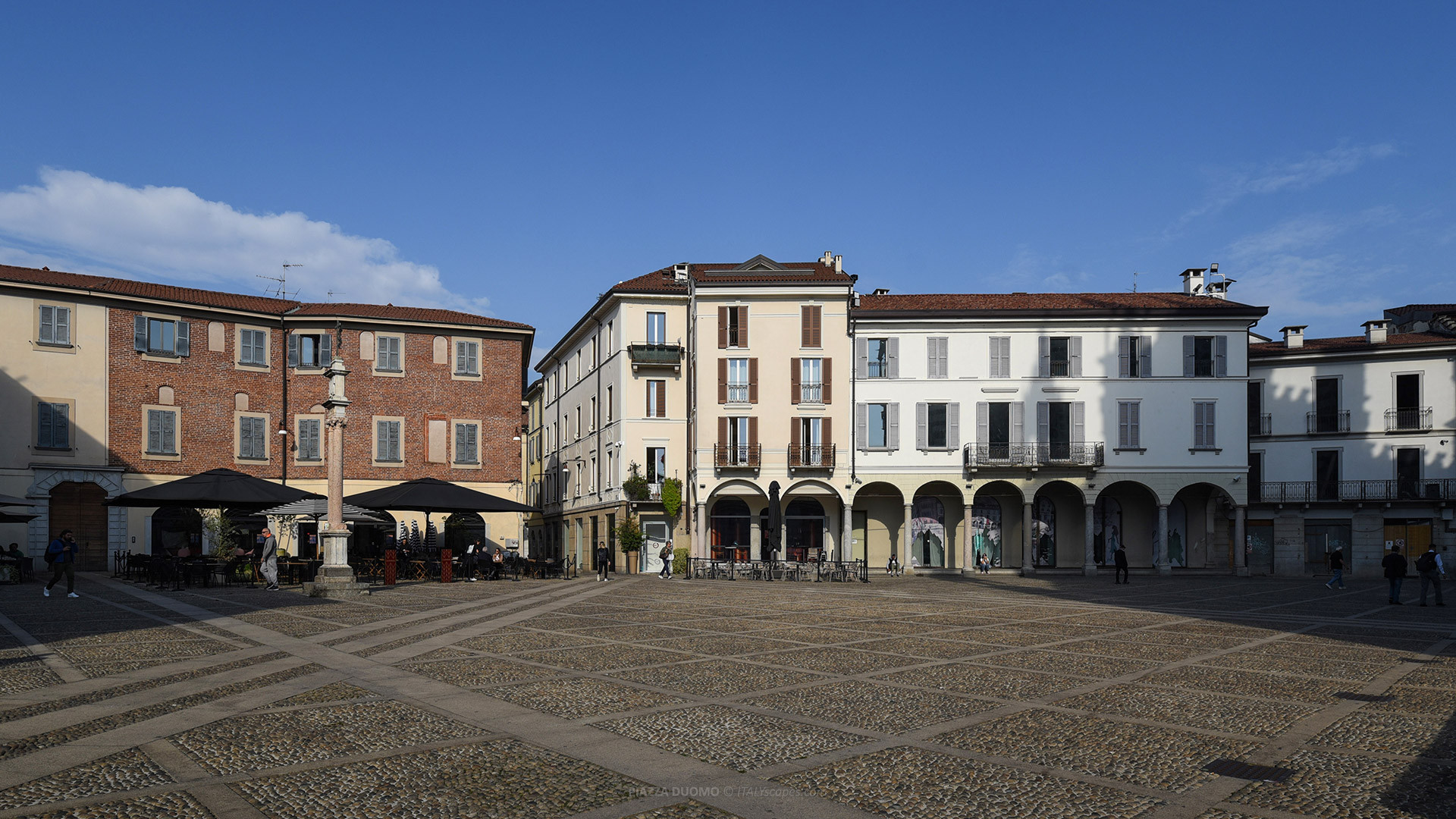
Unlike the much larger Piazza Trento e Trieste, Piazza Duomo feels enclosed and intimate. Its architecture reflects centuries of urban development, with the monumental cathedral façade facing the Palazzo degli Arcipreti, historic residential and commercial buildings, the entrance to the Canonica, and the small Crocetta monument standing within the paved public space.
The square remains part of Monza’s pedestrian centre and is used for religious celebrations, cultural events, civic gatherings, and everyday pedestrian activity. Piazza Roma and the Arengario lie only a short walk away, while narrow streets connect Piazza Duomo with Via Italia, Via Lambro, and the surrounding medieval street network.
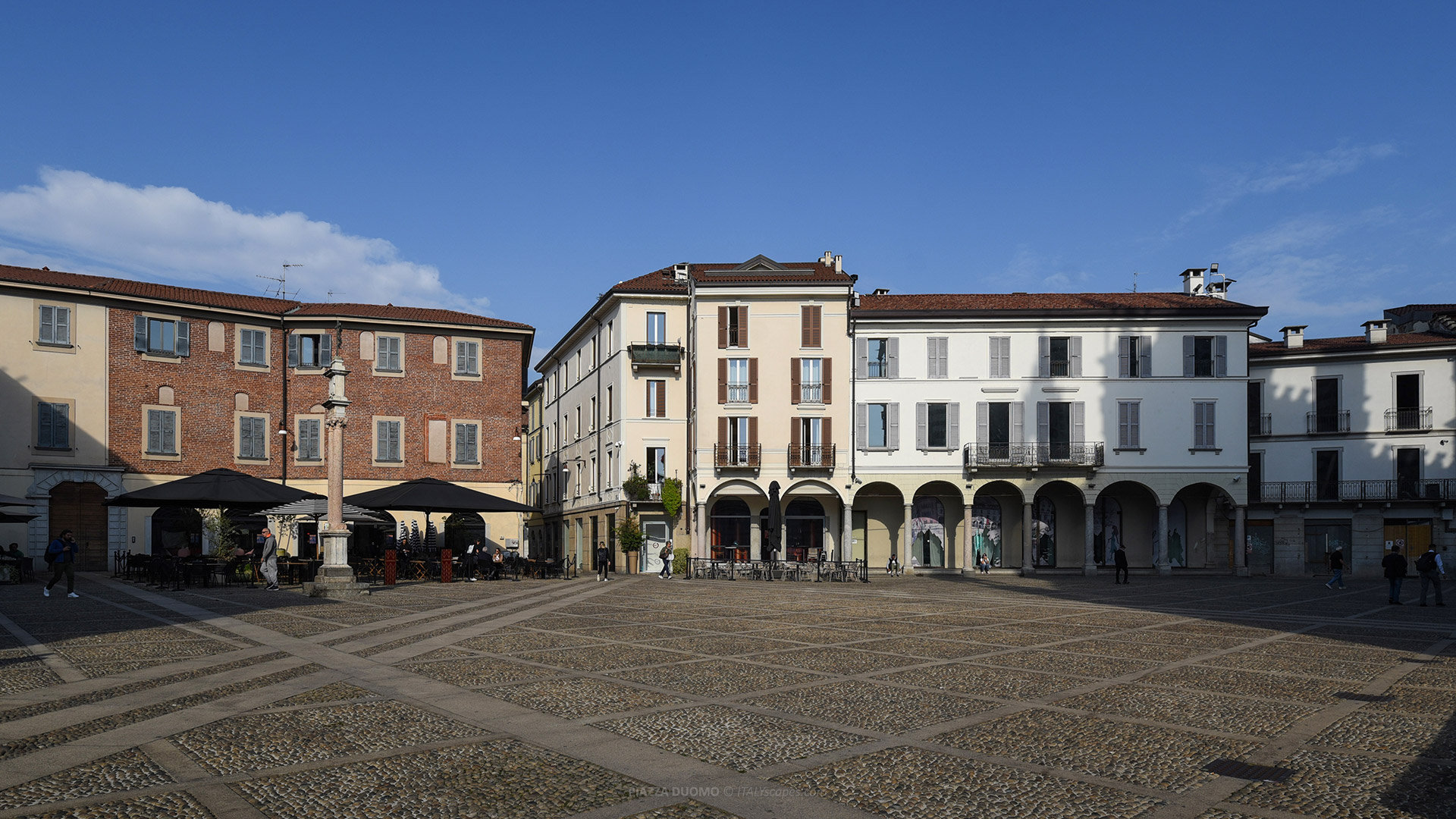
Historic buildings and arcades surrounding Piazza Duomo in Monza
Short History of Piazza Duomo
The Lombard Origins
The history of Piazza Duomo is inseparable from the origins of Monza itself. At the end of the 6th century, Queen Theodelinda founded a royal chapel dedicated to Saint John the Baptist near the Lombard royal residence, establishing an important religious centre around which part of the early settlement developed.
The original church was already functioning by 603, when Theodelinda’s son Adaloald was baptized there. Although the first basilica has largely disappeared beneath later construction, its presence established the site as a religious and political focus many centuries before Piazza Duomo acquired its present shape.
The early settlement developed around this sacred nucleus, connected with the royal court and the broader Lombard kingdom. Over time, houses, ecclesiastical buildings, spaces belonging to the clergy, and narrow streets accumulated around the church, producing a dense medieval urban fabric rather than the open square visible today.
The Medieval Square Takes Shape
Between the 12th and 13th centuries, the area in front of the church became increasingly important as an urban churchyard and meeting place. It stood within a network of streets used by residents, merchants, clergy, and travellers, while buildings extended much closer to the church than the current boundaries of Piazza Duomo suggest.
A decisive transformation began in 1300, when reconstruction of the earlier basilica started. The new church was conceived on a much larger scale, and later 14th-century work directed by Matteo da Campione further enlarged the complex, including the façade that now dominates the western side of the square.
The area directly in front of the basilica remained constrained by medieval houses for decades. During the 15th century, several buildings standing close to the churchyard were demolished, creating a wider open space. This intervention established much of the irregular configuration that still characterizes Piazza Duomo today.
Religious and Civic Life
During the late Middle Ages and early modern period, Piazza Duomo functioned primarily as the space immediately associated with the basilica. Religious processions, ceremonies, public gatherings, and other activities connected with the clergy regularly used the square, while commercial exchanges also occurred within the surrounding streets and open areas.
The historical importance of the cathedral meant that major ceremonies could give Piazza Duomo a role extending beyond ordinary parish life. Monza’s connection with the Iron Crown, royal traditions, and the memory of Queen Theodelinda gave the church and surrounding space a symbolic importance that reached far beyond the local community.
The square also participated in everyday commercial activity. Markets and small-scale exchanges occurred in and around the area, although the much larger Pratum Magnum, corresponding to modern Piazza Trento e Trieste, progressively became the principal location for major markets and public gatherings requiring more space.
The Crocetta and the Plague
One of the most distinctive historical objects in Piazza Duomo is the Crocetta, whose origins are connected with the plague that struck Monza in 1576–1577. During the epidemic, communal religious practices had to adapt because gathering large numbers of people inside churches increased the risk of contagion.
Temporary outdoor altars and crosses were consequently established in public spaces, allowing residents to participate in collective prayers from a distance. An altar in Piazza Duomo became one of these devotional points, reflecting measures promoted during the period associated with Archbishop Carlo Borromeo.
After the epidemic ended, permanent monuments replaced some of these temporary structures. The Crocetta in Piazza Duomo was erected in 1578 to mark the place connected with the outdoor altar and collective prayer, preserving the memory of one of the most difficult episodes in Monza’s early modern history.
From the 18th to the 20th Century
During the 18th and 19th centuries, Piazza Duomo remained a mixture of religious forecourt, pedestrian space, and small-scale commercial area. Residential and commercial buildings continued to define its edges, producing the enclosed urban character that distinguishes it from larger monumental squares created through deliberate demolition and formal planning.
The cathedral itself underwent substantial architectural and decorative changes, indirectly modifying the visual identity of the square. New interiors, later restorations, and continuing work on the cathedral complex gradually transformed the monument while leaving Piazza Duomo’s fundamental relationship with the façade unchanged.
At the end of the 19th century, deterioration of the cathedral façade led to an extensive restoration directed by Luca Beltrami, working with Giuseppe Landriani. The programme, carried out between the 1890s and 1908, replaced degraded materials and reconstructed architectural details lost or altered during previous centuries.
These changes gave the cathedral frontage much of the appearance visible from Piazza Duomo today. The restored pinnacles, marble facing, rose window surroundings, and upper architectural details strengthened the façade as the dominant visual element of the square, overshadowing the much smaller buildings surrounding it.
Piazza Duomo in the Modern City
During the 20th century, traffic and market functions were progressively reduced in the immediate cathedral area. Piazza Duomo became increasingly understood as a monumental pedestrian space, while commercial activity continued primarily through shops, cafés, and businesses occupying the ground floors of surrounding buildings.
Further conservation campaigns improved the cathedral and its setting. The most recent major façade restoration was completed in 2020, following extensive investigation of its different stones and marbles. The work recovered important aspects of the façade’s colour and material character while addressing deterioration caused by age and environmental exposure.
A new architectural lighting system was introduced after the restoration, using LED technology to illuminate the cathedral façade while preserving its architectural details. The project increased the visibility of the monument after dark without fundamentally changing the subdued character of the surrounding square.
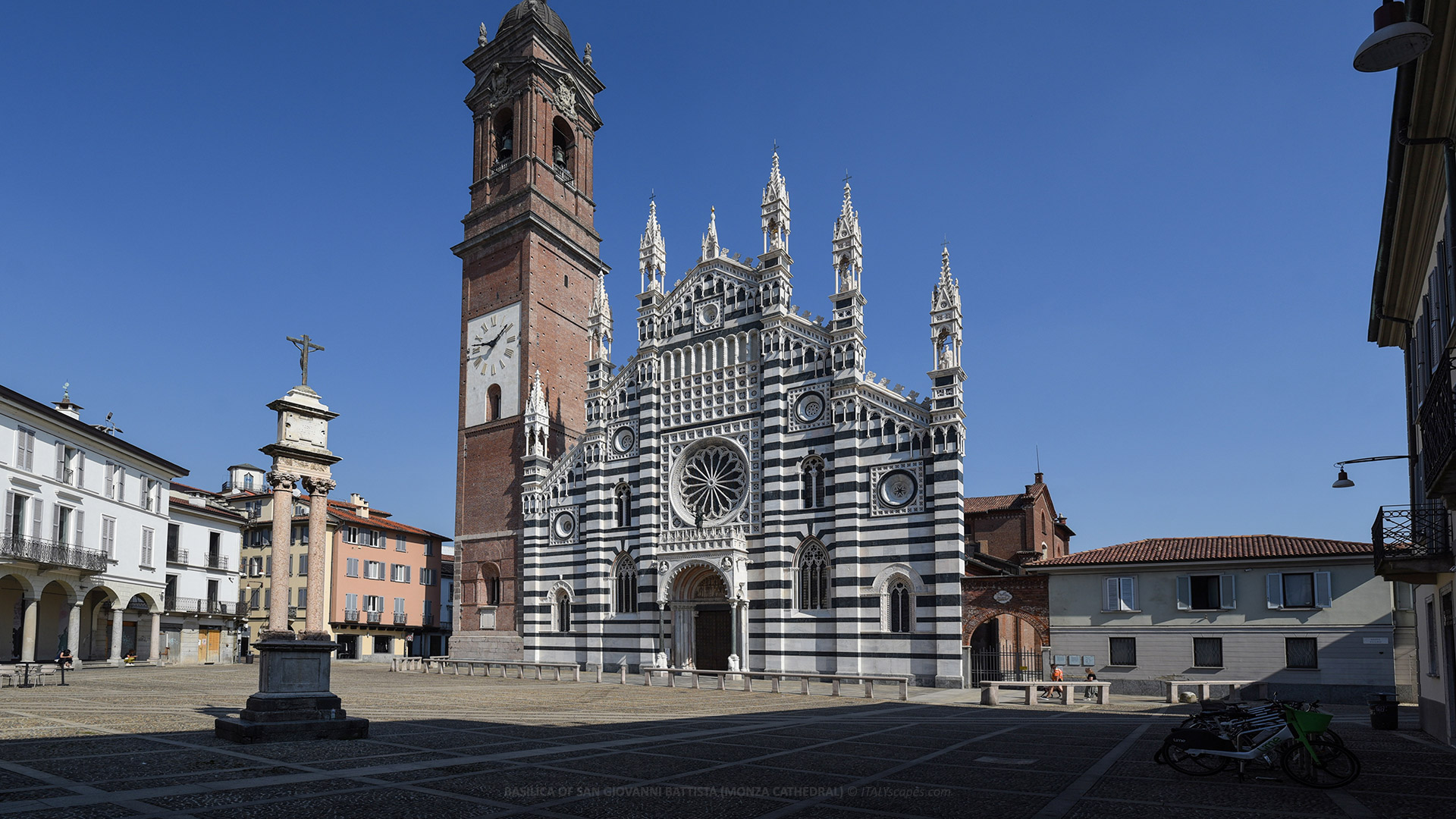
Architecture of Piazza Duomo
Basilica of San Giovanni Battista
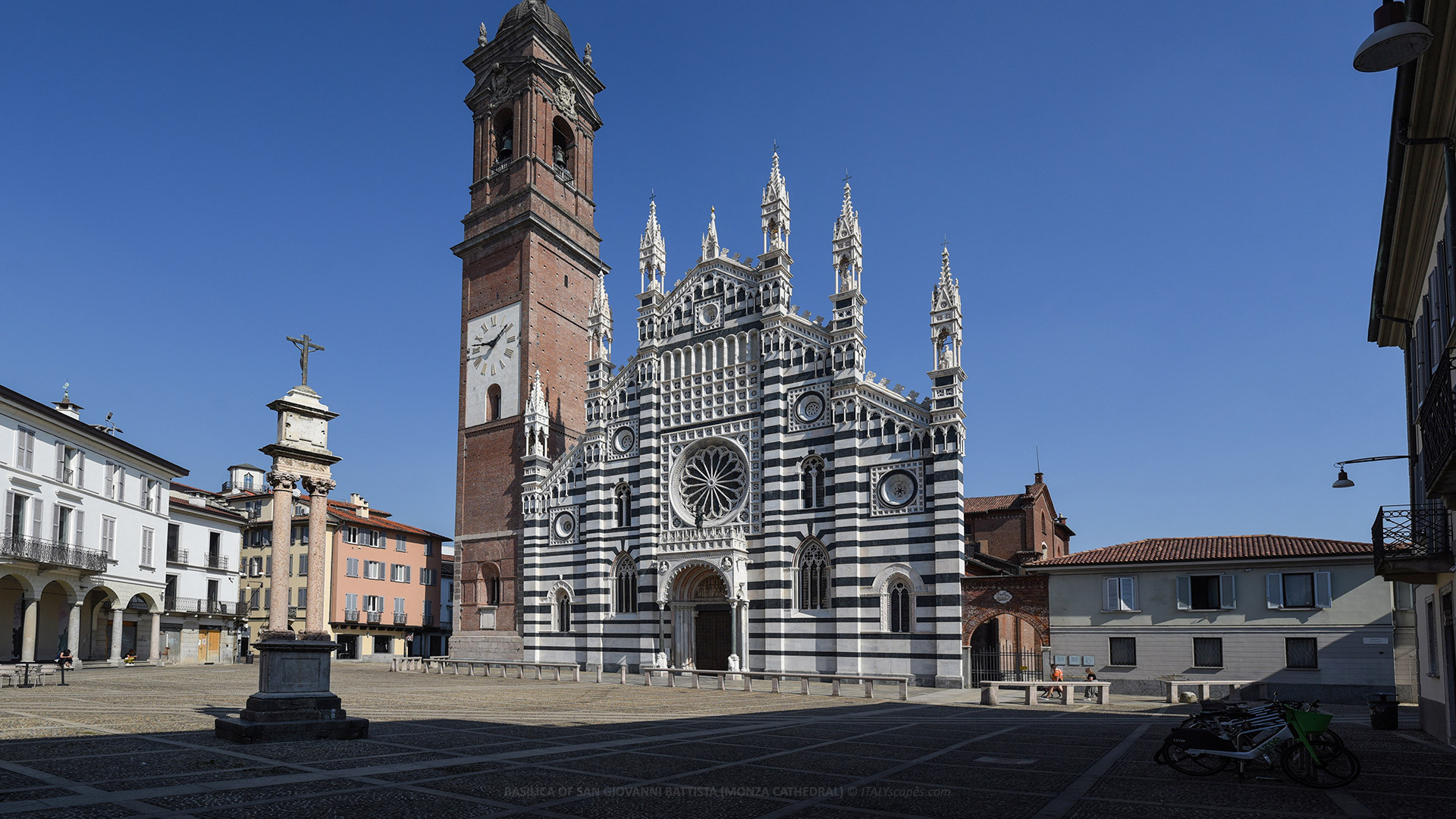
The dominant building is the Basilica of San Giovanni Battista, commonly called Monza Cathedral. The present church largely developed from the rebuilding begun in 1300, replacing the earlier Lombard foundation established by Queen Theodelinda and producing the monumental complex that now occupies almost an entire side of Piazza Duomo.
Its façade was substantially developed under Matteo da Campione during the second half of the 14th century. The composition follows a Gothic architectural language, with a broad frontage corresponding to the enlarged basilica and a complex arrangement of pinnacles, windows, decorative panels, sculpture, and architectural frames.
The façade is immediately recognizable for its horizontal bands of contrasting stone. White marble alternates with dark green material, creating the bichrome pattern that emphasizes the geometry of the surface. Extensive restoration has replaced significant portions of the original facing while preserving the historical appearance of the composition.
The Bell Tower and Cathedral Complex
To the left of the main façade rises the cathedral’s monumental bell tower, constructed from 1592 during the extensive transformation of the complex following the Counter-Reformation. Ercole Turati directed the project, which continued into the 17th century before the installation and blessing of its bells.
The approximately 75-metre tower is built largely in brick, creating a strong contrast with the cathedral’s striped marble façade. Its height allows it to remain visible from numerous locations around central Monza and makes it one of the most recognizable vertical landmarks of the city.
Decorative medallions on the bell chamber contain symbols linked with the religious and political traditions of the basilica, including references to the Iron Crown and ecclesiastical authority. The tower consequently functions not only as a bell structure but also as part of the symbolic programme of the cathedral complex.
To the right of the façade, a Neo-Gothic arch marks access toward the Canonica. Beyond the arch runs a narrow passage between the southern chapels of the basilica and buildings historically connected with the cathedral clergy, preserving the close relationship between religious architecture and the surrounding medieval street network.
Palazzo degli Arcipreti
Opposite and alongside parts of the church complex stands the Palazzo degli Arcipreti, historically associated with the archpriest of Monza. Documentary and architectural evidence indicates a long development, while much of the present building belongs to construction carried out between the late 15th and first half of the 16th century.
The palace has an irregular plan reflecting its incorporation into the existing urban fabric. Its three-storey façade follows the line of Piazza Duomo rather than imposing a strictly symmetrical geometry, helping explain why the square itself retains such an irregular and intimate spatial character.
Sections of exposed brick, traces of blind arches, historic window openings, and surviving masonry reveal parts of the older structure. The building underwent significant later alterations, particularly during the 18th and 19th centuries, when rooms, doors, windows, and internal floors were adapted to new requirements.
Some first-floor interiors retain decorative fresco fragments and historic coffered ceilings, although the building is not normally visited as a tourist attraction. Major conservation work during the late 20th century removed later exterior plaster in selected areas and exposed portions of the earlier brick fabric.
The Crocetta
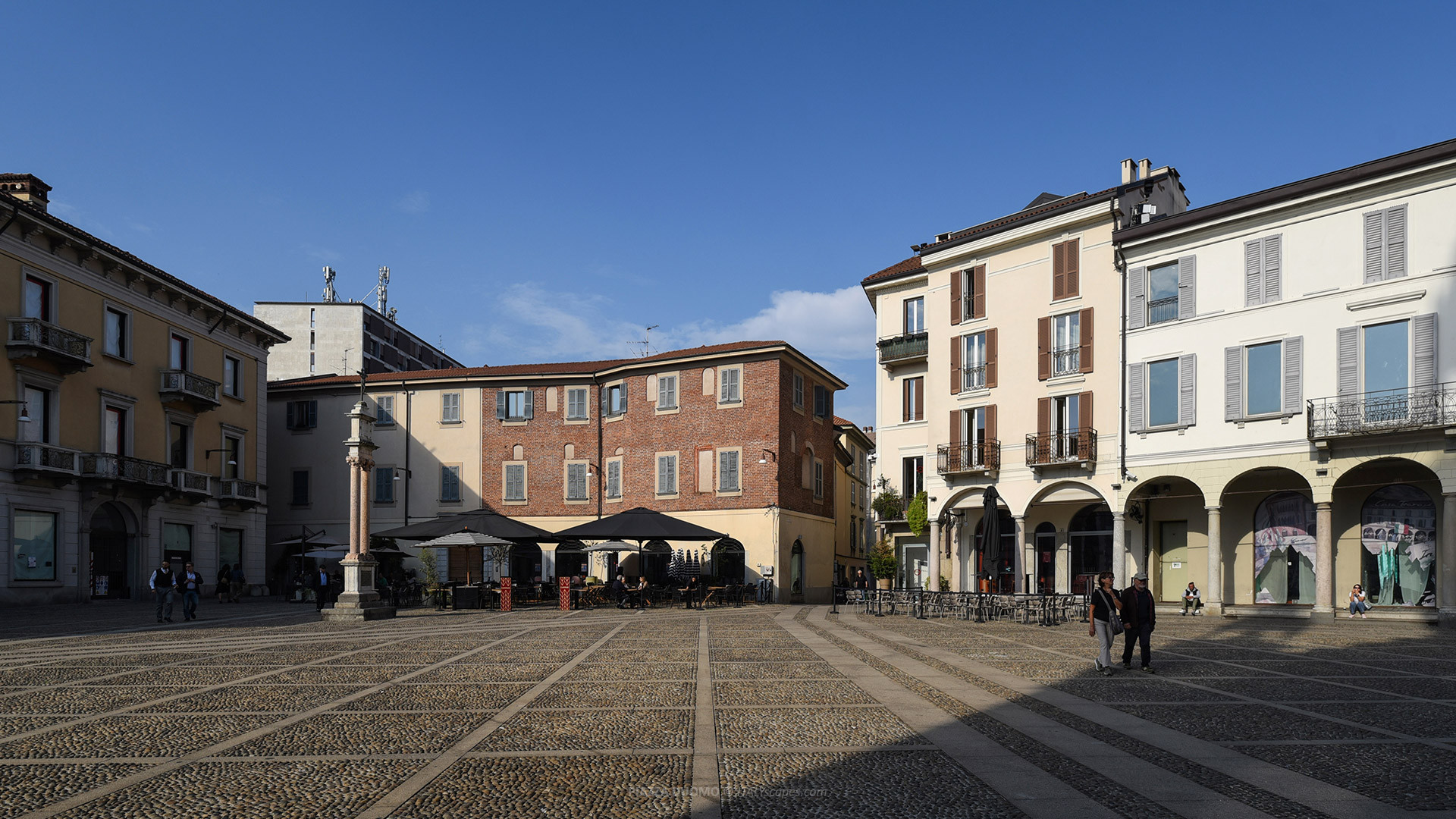
The Crocetta is the principal freestanding monument within Piazza Duomo. Erected in 1578, it commemorates the outdoor devotional arrangements established during the plague of 1576-1577, when public prayer had to be organized while reducing gatherings within enclosed religious buildings.
Its importance is primarily historical and religious rather than monumental in scale. Compared with the cathedral façade or bell tower, the Crocetta is a relatively modest structure, yet its position within the square preserves a direct physical reference to the plague of San Carlo and local devotional practices.
Residential and Commercial Buildings
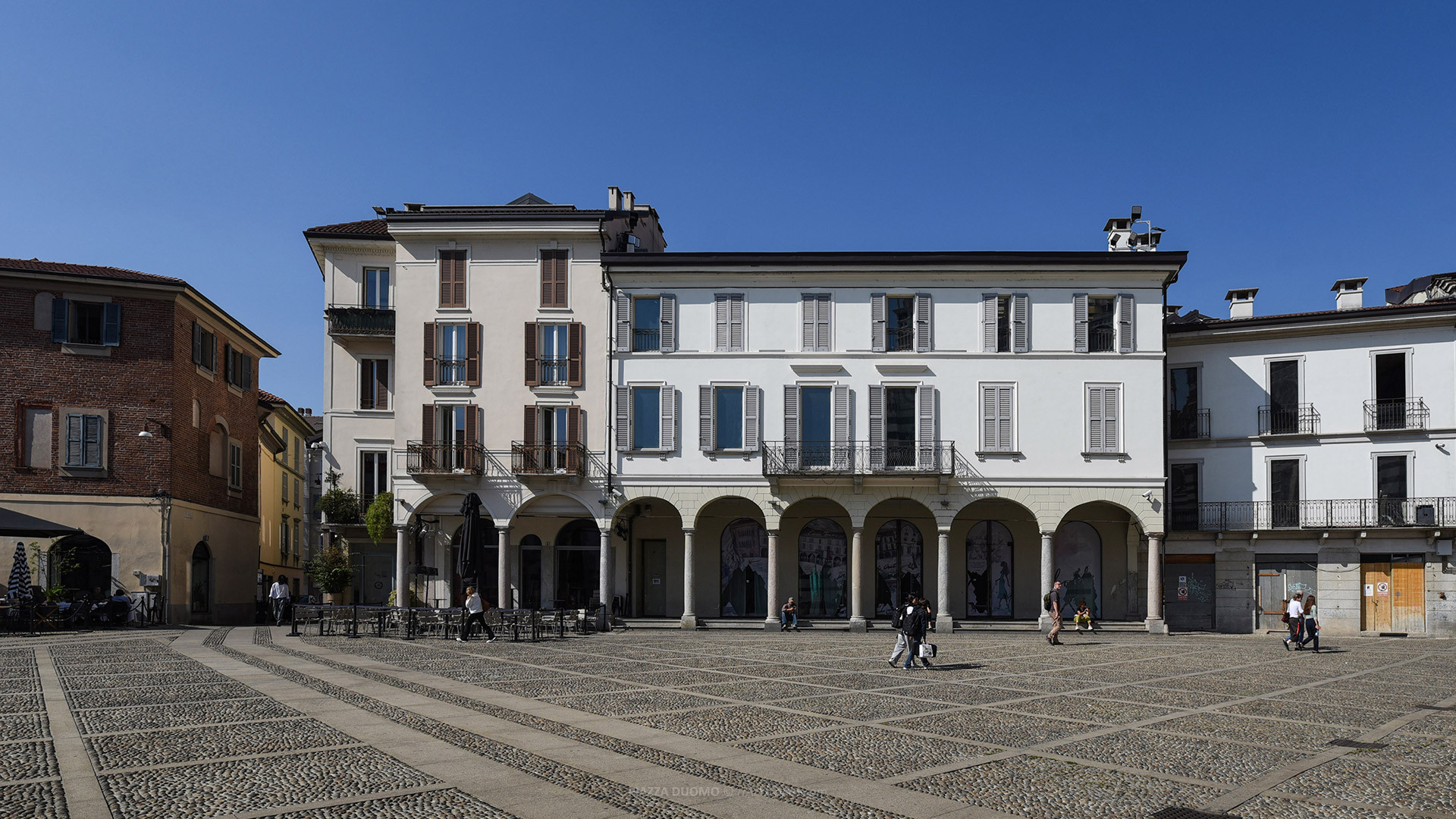
The remaining edges of Piazza Duomo are formed primarily by residential and commercial buildings that developed between the early modern period and the 19th century. Unlike the cathedral and Palazzo degli Arcipreti, many do not have individual monumental identities but collectively define the spatial enclosure of the square.
Their façades are generally modest in scale, usually several storeys high, with shops or businesses occupying ground floors and residential or office spaces above. Their restrained appearance ensures that the cathedral remains visually dominant while preserving the mixed-use character typical of an Italian historic centre.
The buildings also reveal how Piazza Duomo differs from formally designed Renaissance or 19th-century squares. There is no uniform architectural order around the perimeter. Changes in building height, façade alignment, street openings, materials, and dates of construction create an organic urban composition reflecting gradual development.
Narrow streets enter the square from several directions, including routes connecting toward Via Lambro, Via Canonica, Piazza Roma, and the commercial centre. These passages preserve the relationship between Piazza Duomo and Monza’s older pedestrian network rather than separating the square as an isolated monumental precinct.
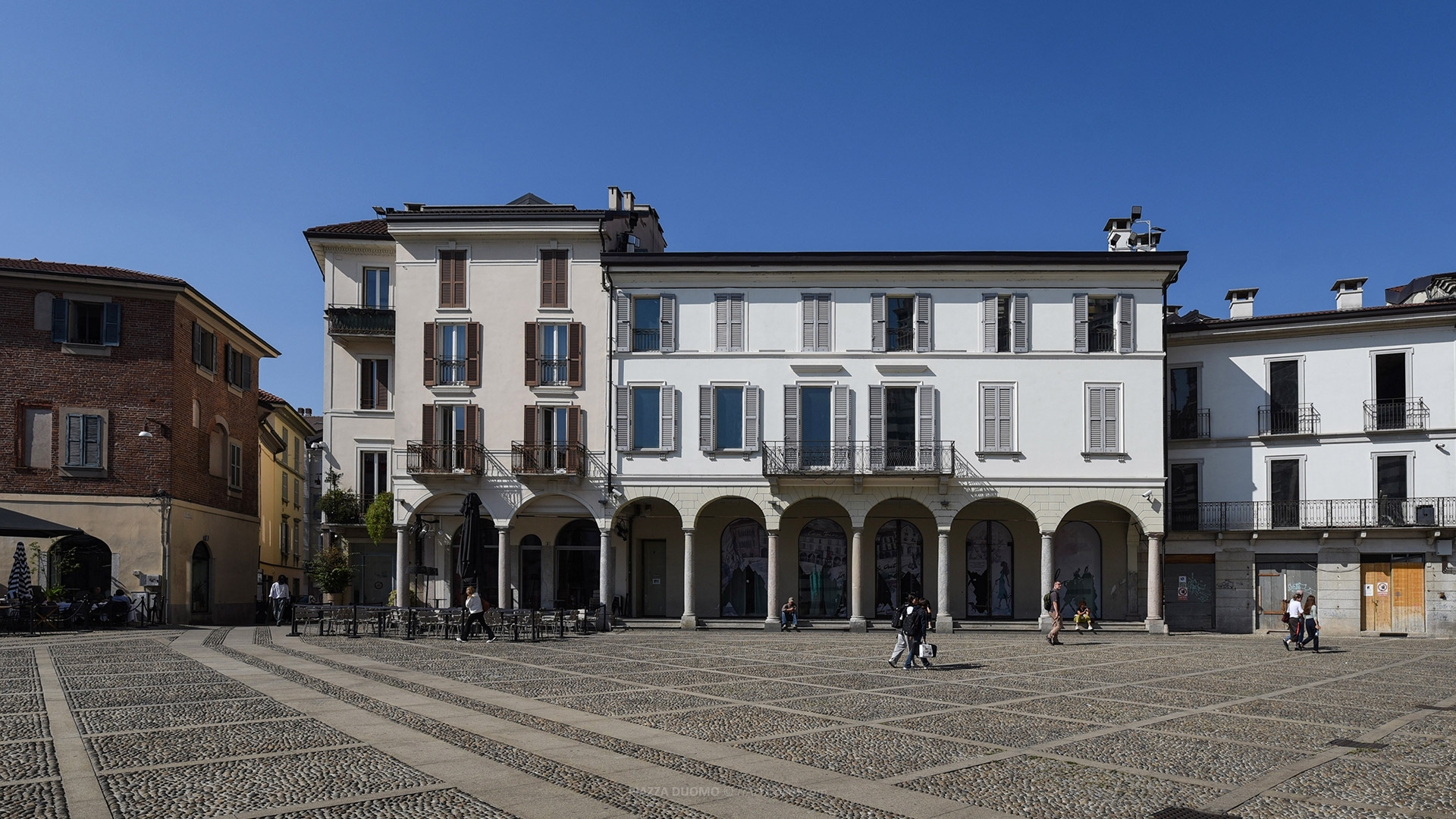
Arcaded façades along Piazza Duomo in the historic centre of Monza.
How to Get to Piazza Duomo
Piazza Duomo lies in the pedestrian historic centre of Monza, roughly one kilometre from Monza railway station. Its central location makes walking the easiest option for most visitors, although buses can shorten the route and taxis are useful for travellers carrying luggage or requiring easier access.
Getting to Piazza Duomo on foot
From Monza railway station, the walk to Piazza Duomo generally takes around 12-15 minutes. Leave the station toward the city centre and continue north through Monza’s commercial streets, following signs toward the Duomo or Piazza Roma before entering the narrower pedestrian streets surrounding the basilica.
The route is mostly flat and passes directly into the central shopping and historic district. Piazza Trento e Trieste and Piazza Roma lie close to the route, allowing travellers to combine the walk with several other important attractions rather than treating the cathedral square as an isolated destination.
Getting to Piazza Duomo by bus
Visitors who prefer public transport can use buses serving central Monza and continue the final section on foot. Piazza Carducci is a particularly convenient stop because it lies close to Piazza Roma and only a few minutes’ walk from Piazza Duomo.
The stop is served by lines Z206, Z211, and Z212, according to their respective operating schedules. From Piazza Carducci, continue toward Piazza Roma and then follow the pedestrian streets south-east toward the cathedral façade.
Getting to Piazza Duomo by taxi
An official taxi rank operates at Monza railway station, providing the simplest option for travellers with heavy luggage or reduced mobility. The road journey is short, although the exact duration depends on traffic conditions and the route available through central Monza.
Because Piazza Duomo itself lies within the pedestrian zone, taxis normally stop at the nearest accessible street rather than directly in front of the cathedral. The remaining distance is short, allowing passengers to reach the square with only a brief final walk.
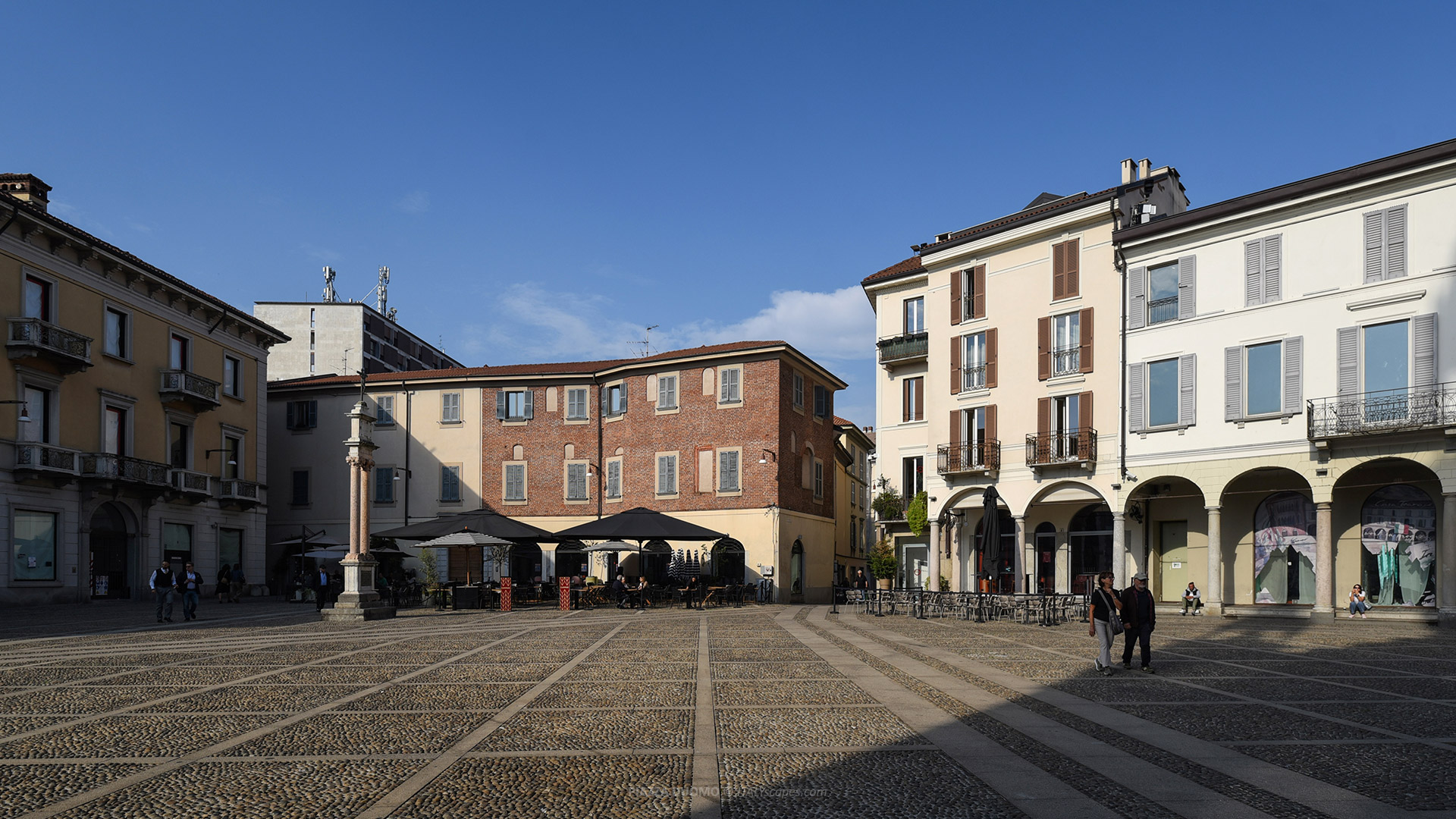
Piazza Duomo with the Crocetta and historic buildings in central Monza.
Frequently Asked Questions about Piazza Duomo
Where is Piazza Duomo in Monza?
Piazza Duomo lies in the historic pedestrian centre of Monza, directly in front of the Basilica of San Giovanni Battista and a short walk from Piazza Roma.
Why is Piazza Duomo important?
The square developed around the church founded by Queen Theodelinda and forms part of Monza’s oldest religious and urban nucleus, preserving more than fourteen centuries of history.
What is the main attraction in Piazza Duomo?
The principal attraction is the Basilica of San Giovanni Battista, commonly called Monza Cathedral, with its Gothic façade, historic treasury, Chapel of Theodelinda, and Iron Crown.
What is the Crocetta in Piazza Duomo?
The Crocetta is a 1578 devotional monument marking the location associated with an outdoor altar used for communal prayer during the plague of 1576-1577.
How far is Piazza Duomo from Monza railway station?
The square is roughly one kilometre from Monza railway station. Walking normally takes approximately 12-15 minutes through the central commercial and pedestrian district.
What other attractions are near Piazza Duomo?
Nearby sights include the Arengario, Piazza Roma, Piazza Trento e Trieste, Palazzo Comunale, and the medieval streets around Via Lambro, all within easy walking distance.
-
Photos
-
Map
-
Reviews