-
About
Table of Contents
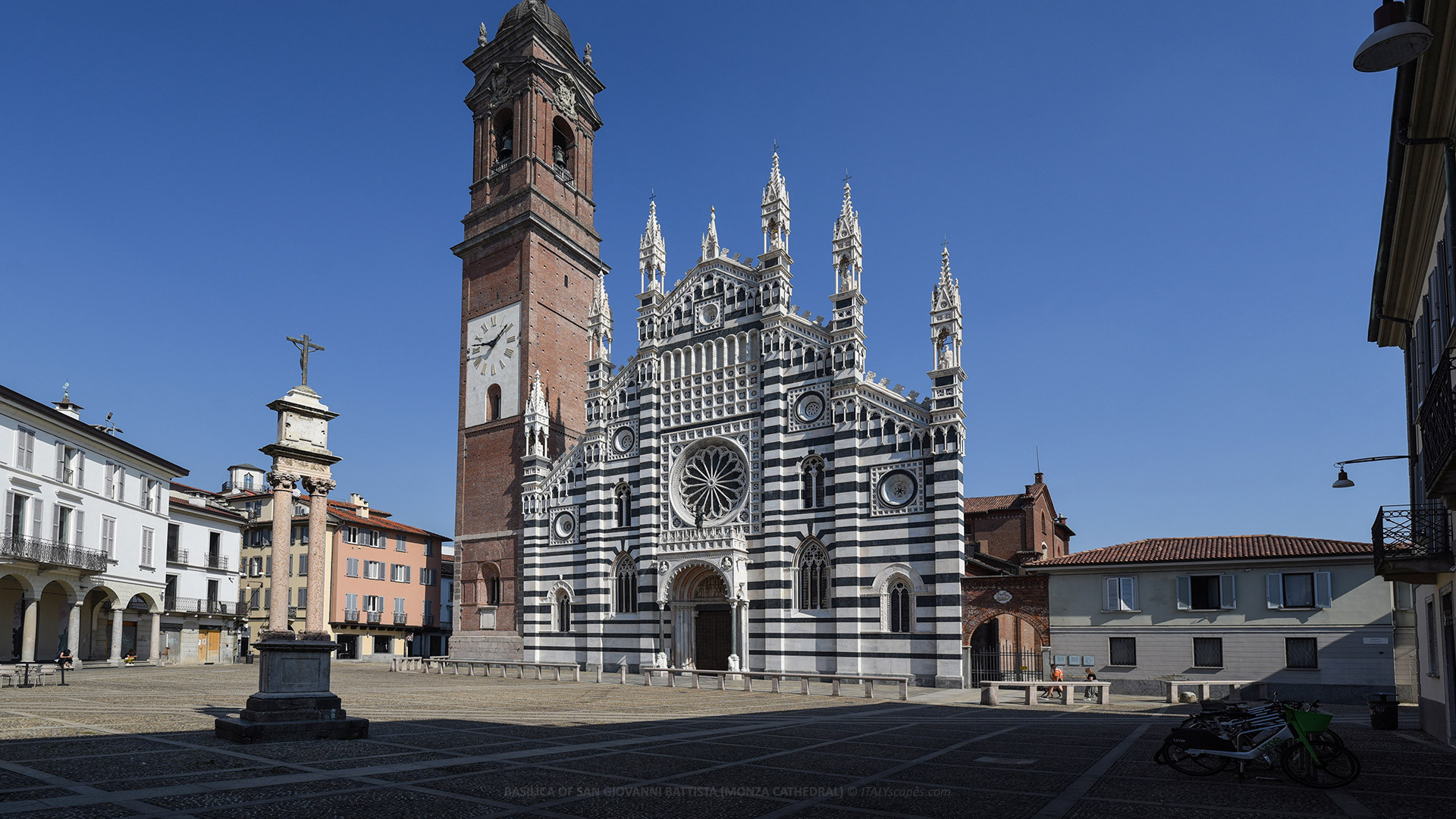
The Basilica of San Giovanni Battista, commonly known as Monza Cathedral or Duomo di Monza, stands in Piazza Duomo in the historic centre of Monza. The basilica developed from a royal church founded by Lombard Queen Theodelinda and remains the city’s principal religious monument.
The present building combines a medieval structure with later architectural and decorative transformations. Its most recognizable features include the striped marble façade, large rose window, 75-metre bell tower, richly decorated interior, and Chapel of Theodelinda, where the Iron Crown of Lombardy is preserved under controlled visitor access.
The complex is also inseparable from the adjoining Museum and Treasury of Monza Cathedral, which preserves extraordinary objects associated with Theodelinda, the Lombard monarchy, medieval Christianity, and later rulers. Together, the basilica, chapel, Iron Crown, treasury, and museum document more than fourteen centuries of religious, political, and artistic history.
Short History of the Basilica of San Giovanni Battista (Monza Cathedral)
The Foundation of Queen Theodelinda
The origins of Monza Cathedral date to the late 6th century, when Queen Theodelinda founded a church dedicated to Saint John the Baptist close to the Lombard royal residence. Monza was then a relatively small settlement, but the queen’s presence transformed it into an important political and religious centre.
The original basilica was certainly standing by 603, when Secundus of Non baptized Adaloald, the son of Theodelinda and King Agilulf, inside the church. The building therefore formed part of the Lombard court environment and was closely connected with the dynasty’s gradual movement from Arian Christianity toward Catholicism.
Theodelinda maintained important relations with Pope Gregory the Great, and the church acquired significance extending far beyond Monza itself. Medieval tradition increasingly associated the foundation with the monarchy, the cult of Saint John the Baptist, prestigious relics, and objects presented to the queen or deposited within the royal sanctuary.
Very little survives architecturally from the first Lombard basilica. Archaeological and museum collections preserve some building materials and fragments of early liturgical furnishings, but the structure seen today belongs principally to later periods. The historical continuity of the site, rather than the survival of the original building, is therefore fundamental.
The Medieval Reconstruction
A major reconstruction began in 1300, replacing the earlier church with a much larger building. The first phase produced a Latin-cross basilica with three naves, a transept, wooden roofs over the longitudinal body, and a flat eastern termination. The main altar of this new medieval church was consecrated in 1346.
The rebuilding took place during a period of increasing Visconti interest in Monza. The political value of the city’s treasury and the tradition surrounding the Iron Crown helped strengthen the basilica’s symbolic importance, particularly because Monza was associated with ceremonies linking royal and imperial authority with the historic Kingdom of Italy.
From around 1360, the project became considerably more ambitious. Two additional lateral aisles containing chapels were created, transforming the church into a five-aisled structure. The western front was simultaneously expanded, and large chapels were constructed beside the principal eastern area during the final decades of the century.
The principal figure in this phase was Matteo da Campione, an architect and sculptor belonging to the celebrated tradition of craftsmen from the lakes between Lombardy and present-day Switzerland. He worked extensively at the church until his death in 1396 and was buried within the complex he had helped transform.
The Chapel of Theodelinda and the Renaissance Period
Around the beginning of the 15th century, the chapel dedicated to Queen Theodelinda took shape beside the presbytery. Its importance increased substantially when the Zavattari family created a vast painted cycle devoted to the queen between 1441 and 1446, making the chapel one of the outstanding artistic spaces of Monza Cathedral.
During the 16th century, major changes affected the eastern section of the basilica. Following the reforms associated with the Catholic Church and the episcopate of Carlo Borromeo, the medieval presbytery was reorganized and enlarged. Pellegrino Tibaldi reconstructed the choir between 1575 and 1577.
The same period brought a renewed programme of monumental construction. Work on the new freestanding bell tower began in 1592, when the first stone was laid. Architect Ercole Turati executed the project, and the main structure was completed in the early 17th century before the bells were solemnly blessed in 1628.
The new tower replaced the earlier arrangements used for bells and created a powerful visual landmark beside the Basilica of San Giovanni Battista. Later generations continued modifying the surrounding spaces, including the construction of a large crypt beneath the choir and a new baptistery during the first decades of the 17th century.
The Baroque Transformation
The 17th century brought changes that progressively altered the appearance of the medieval interior. A new vault was constructed over the main nave in 1644, creating broad surfaces that could later receive painted decoration and replacing much of the visual character associated with the earlier timber-covered Gothic basilica.
Further architectural and liturgical developments continued around the sacristy. In 1681, an octagonal chapel for the Treasury was created, providing a dedicated setting for objects that had accumulated around the basilica through royal donations, religious devotion, dynastic ceremonies, and the long-standing association with Queen Theodelinda.
During the late 17th and 18th centuries, successive decorative campaigns transformed the interior into a rich synthesis of painting, illusionistic architecture, stucco, altars, and monumental canvases. Although the medieval structure remained beneath these interventions, the visual atmosphere became predominantly Baroque and Rococo in many important areas.
The Neoclassical period introduced further changes. Andrea Appiani designed a new high altar in 1798, while Carlo Amati created a new pulpit in 1808. These interventions demonstrate that Monza Cathedral continued to evolve rather than being preserved as a fixed medieval monument.
Napoleon and the Modern Restoration
The political upheavals of the Napoleonic period affected the cathedral treasury directly. In 1796, French authorities confiscated most of its precious holdings. Some objects were permanently lost, while part of the collection was eventually returned to Monza in 1816 following the restoration of Austrian rule in Lombardy.
By the late 19th century, deterioration made extensive restoration unavoidable. Architect Luca Beltrami directed a major campaign affecting the façade between 1890 and 1908, replacing damaged stonework, reconstructing missing upper elements, and substantially renewing the medieval exterior while following historical evidence available at the time.
Beltrami also reorganized the Chapel of Theodelinda. The queen’s medieval sarcophagus was repositioned, a new floor was created, and an altar-reliquary for the Iron Crown was installed in 1895–1896. The large metal screen that today separates the chapel from the transept also belongs to this restoration phase.
Further conservation has continued into the 21st century. Restoration of the Zavattari frescoes was completed after a major modern campaign, while the façade underwent additional conservation before reopening fully in 2020.
Architecture of the Basilica of San Giovanni Battista (Monza Cathedral)
The Medieval Plan
Monza Cathedral developed around a Latin-cross arrangement whose medieval core was progressively enlarged. The longitudinal body now contains five aisles, with the outer spaces largely divided into chapels. A transept intersects the nave before the extended presbytery and choir, creating a complex interior produced through several historical building campaigns.
The structural organization still reveals elements of the medieval reconstruction despite the later decorative covering. Columns, piers, arches, chapels, the transept, and the overall proportions preserve the underlying Gothic spatial framework, while later vaults and painted surfaces considerably changed how visitors perceive that original architecture.
The side chapels created additional spaces for altars, family patronage, relics, and devotional images. Two especially important larger chapels stand beside the principal eastern zone: the Chapel of Theodelinda on the north side and the Chapel of the Rosary on the opposite side.
The church’s present interior should therefore not be interpreted as belonging to one architectural period. Medieval structural components coexist with Renaissance modifications, Baroque vaulting, Rococo decoration, Neoclassical furnishings, and later restorations. This architectural stratification is one of the defining characteristics of the monument.
The Marble Façade
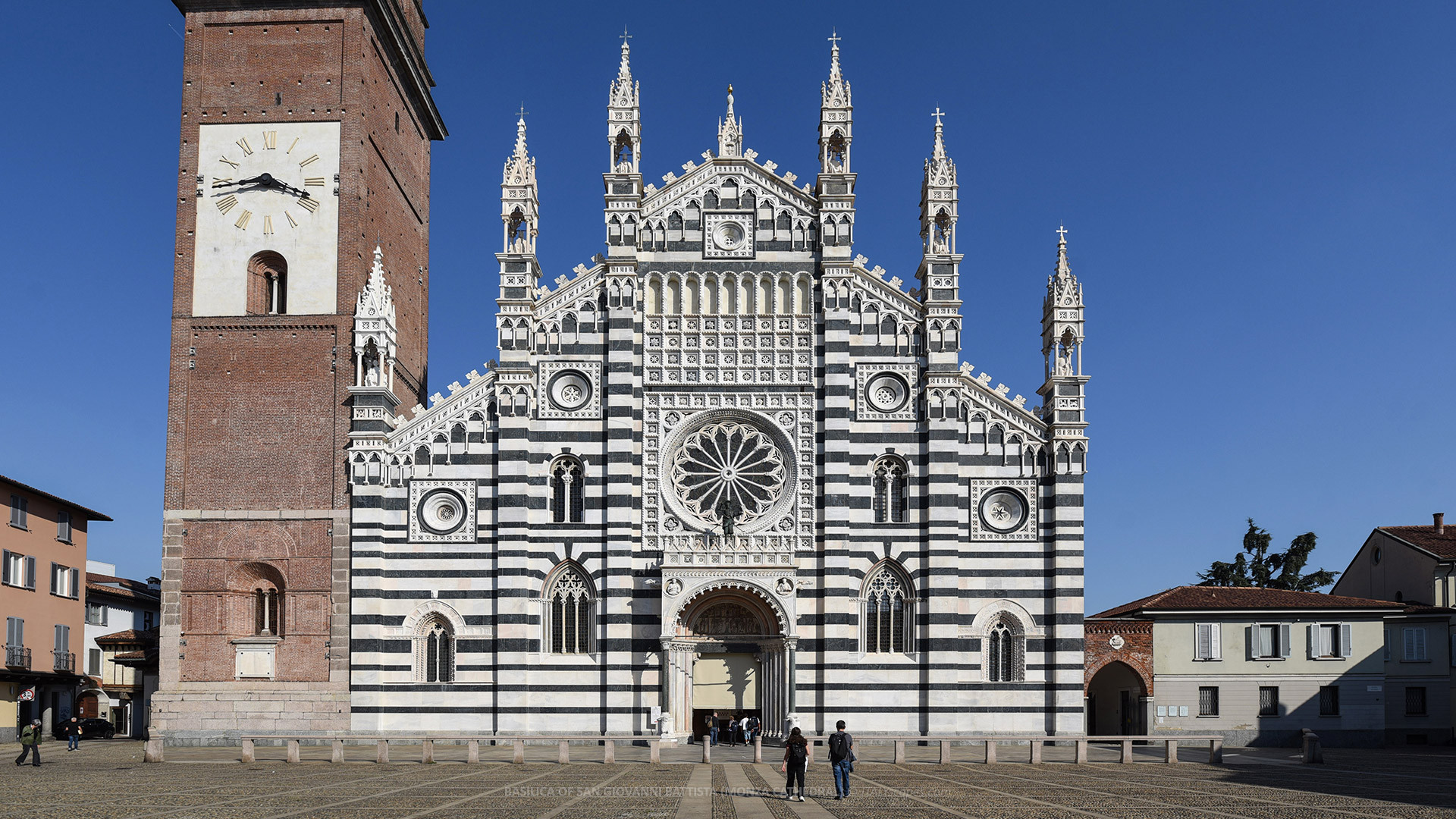
The façade designed and completed under Matteo da Campione is the most immediately recognizable element of the Basilica of San Giovanni Battista. It forms a broad screen divided into five vertical fields, corresponding to the expanded medieval building behind it and emphasizing the monumental scale achieved during the 14th-century enlargement.
Alternating bands of light and dark stone create its characteristic polychrome appearance. The medieval façade originally used different materials from some of those visible today because large portions of the facing were replaced during later conservation. Nevertheless, the bichrome horizontal pattern remains fundamental to the design.
At the centre is an elaborate portal with multiple receding mouldings, sculptural decoration, and a lunette connected iconographically with Saint John the Baptist. Above it dominates an exceptional sixteen-part rose window, framed by elaborate pierced marble decoration and positioned as the principal visual focus of the upper façade.
Vertical pilasters, small architectural tabernacles, sculptural details, windows, geometric ornament, and the reconstructed upper pinnacles create an unusually rich surface. Matteo da Campione combined Lombard building traditions with artistic influences from central Italy, particularly the decorative architectural culture of Tuscany, producing one of Monza’s most distinctive medieval façades.
The Bell Tower
The monumental bell tower rises beside the basilica to a height of approximately 75 metres, making it one of the most visible historic structures in Monza. Construction began in 1592, and Ercole Turati developed the project within an architectural environment strongly influenced by Pellegrino Tibaldi.
The tall square shaft culminates in the bell chamber, where the external composition becomes more elaborate. Large heraldic emblems represent symbols connected with the cathedral and its history, including the Iron Crown and Cross of the Kingdom, the archpriest’s insignia, and imagery taken from the historic cathedral treasury.
Although the principal construction was finished earlier, completion of the bell installation and exterior details continued into the following decades. The bells were formally blessed in 1628. The tower subsequently became a major landmark of Monza and the surrounding Brianza landscape, visible from numerous approaches to the historic centre.
Interior Spaces
The interior presents a strong contrast with the medieval exterior. Broad painted vaults, monumental canvases, richly decorated chapels, marble altars, gilding, and illusionistic architectural painting dominate the visitor’s view. Much of this decorative richness results from campaigns undertaken between the late 17th and 18th centuries.
The presbytery and choir form one of the most elaborate parts of Monza Cathedral. Their expanded configuration reflects the liturgical reforms implemented during the age of Carlo Borromeo, while subsequent painters transformed the surfaces into a coordinated decorative environment representing biblical, theological, and dynastic subjects.
The main nave is visually unified by its great painted vault, while the side aisles lead toward a sequence of individual chapels. This arrangement allows the Basilica of San Giovanni Battista to combine the monumental scale of a basilica with smaller devotional spaces dedicated to distinct saints, relics, confraternities, and liturgical functions.
Art of the Basilica of San Giovanni Battista (Monza Cathedral)
The Chapel of Theodelinda
The artistic highlight of Monza Cathedral is the Chapel of Theodelinda, located beside the presbytery in the northern transept. Its polygonal Gothic structure is almost completely covered by paintings created by the Zavattari, a Lombard family of artists active during the first half of the 15th century.
The cycle consists of 45 narrative scenes devoted to Queen Theodelinda. The stories draw upon historical and legendary traditions concerning her marriages, royal role, religious devotion, and foundation of the basilica, transforming the walls into an extensive visual narrative dedicated to Monza’s most important early medieval ruler.
Although the events concern Lombard history, the figures appear in luxurious 15th-century court costume, surrounded by architecture, jewellery, textiles, ceremonies, banquets, journeys, and political encounters resembling the world of the Visconti. The cycle therefore provides exceptionally rich evidence for elite material culture in late medieval Lombardy.
Gold, raised decoration, patterned surfaces, brilliant colour, and meticulous details give the paintings their distinctive splendour. The cycle ranks among the major surviving achievements of International Gothic painting in Italy and is generally considered the most important surviving work associated with the Zavattari workshop.
The Iron Crown
The Chapel of Theodelinda also preserves the Iron Crown, one of the most historically significant objects associated with the church. The small crown consists of six hinged gold segments decorated with gems, enamel plaques, and raised gold rosettes, arranged around a narrow metal band on the interior.
Christian tradition identified that inner band with iron made from one of the nails of the Crucifixion, linking the object with Saint Helena and Constantine. This identification belongs to religious tradition rather than independently demonstrable archaeological fact, but it explains much of the crown’s extraordinary devotional prestige.
The crown also acquired major political importance. It became associated with the kingship of Italy and was used in important coronation traditions involving rulers including Charles V, Napoleon Bonaparte, and Ferdinand I of Austria.
Medieval Sculpture and Goldsmithing
Among the principal medieval works inside the basilica is the sculptural pulpit associated with Matteo da Campione, later adapted as an organ tribune. Its reliefs combine religious figures, symbolic subjects, ornamental elements, and imagery connected with the relationship between ecclesiastical and imperial authority.
A sculpted panel once belonging to this ensemble depicts an imperial coronation with the Iron Crown. The composition places the ruler within a political and religious ceremony and includes references to Monza’s treasury and imperial institutions, demonstrating the importance attached to the basilica’s royal traditions during the later Middle Ages.
The high altar preserves another outstanding medieval work: the gilded silver frontal created by Borgino dal Pozzo between 1350 and 1357. Decorated with enamels, precious materials, and scenes from the life of Saint John the Baptist, it represents one of the most important surviving works associated with the medieval rebuilding.
The Great Painted Cycles
The transepts contain important evidence of 16th-century artistic renewal. Giuseppe Arcimboldo and Giuseppe Meda worked on the monumental Tree of Jesse in the southern transept, while the northern side received an extensive cycle devoted to episodes from the life of Saint John the Baptist.
During the 17th century, the decoration expanded across the presbytery and choir. Artists including Stefano Danedi, Isidoro Bianchi, Carlo Cane, and Ercole Procaccini the Younger contributed to this complex programme, supported by illusionistic architectural painting that unified individual scenes with the surrounding built environment.
The vault of the main nave was decorated in 1693 by Stefano Maria Legnani, known as Legnanino, with architectural framing supplied by collaborators. The new painted surface became a dominant feature of the nave and helped establish the lavish late-Baroque character still experienced by visitors entering the basilica today.
Ten large canvases displayed along the nave explore the histories of Theodelinda and the Iron Crown. Different painters contributed to the series between the 17th and 18th centuries, including Sebastiano Ricci, Filippo Abbiati, and Andrea Porta, extending the cathedral’s dynastic narrative beyond the medieval chapel.
The 18th century brought additional decoration throughout Monza Cathedral. Pietro Gilardi worked on the crossing, while Carlo Innocenzo Carloni decorated vaults of the lateral aisles, the triumphal arch, and parts of the transept. These campaigns made the interior an important survey of Lombard late-Baroque and Rococo painting.
How to Get to the Basilica of San Giovanni Battista (Monza Cathedral)
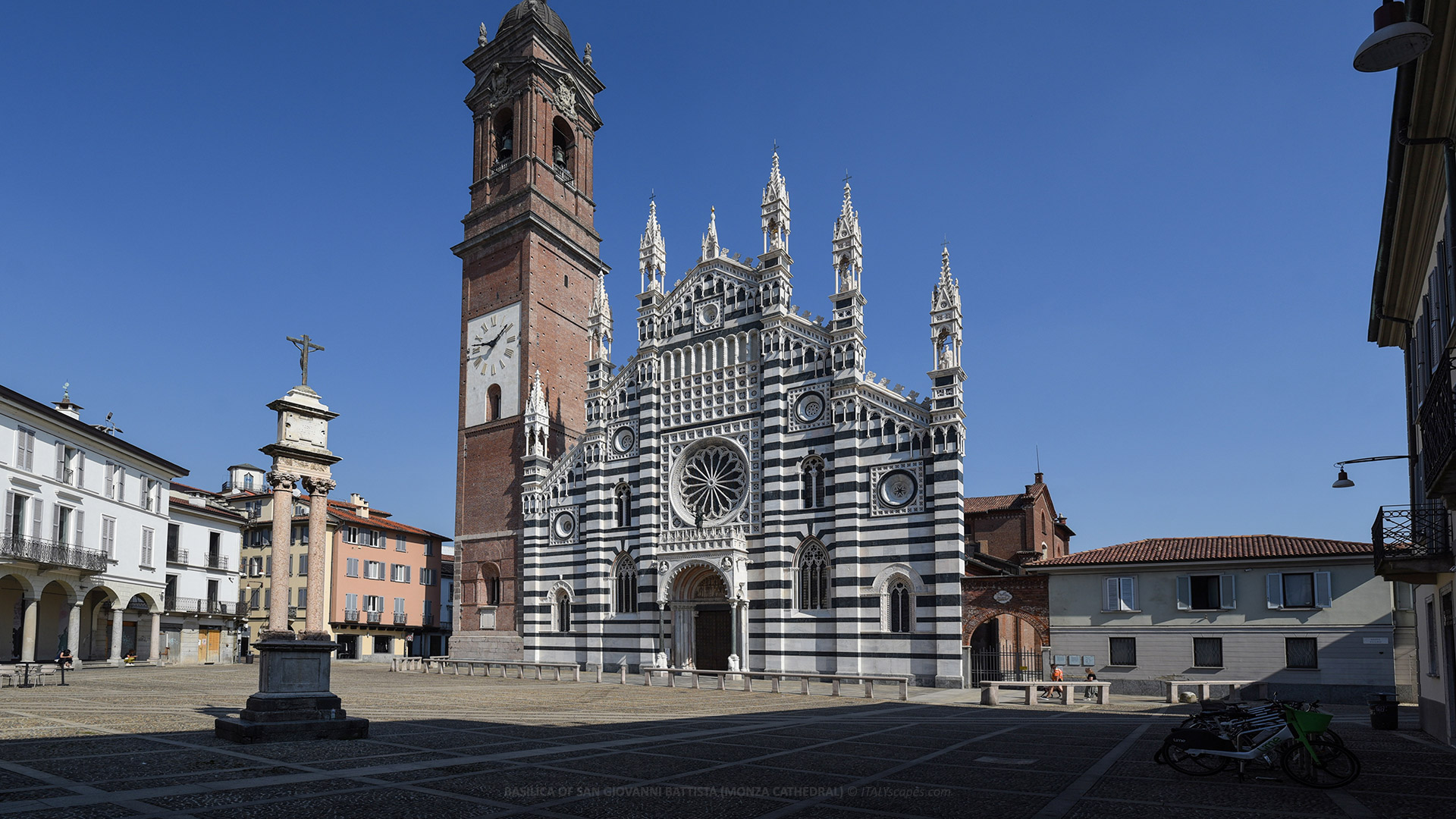
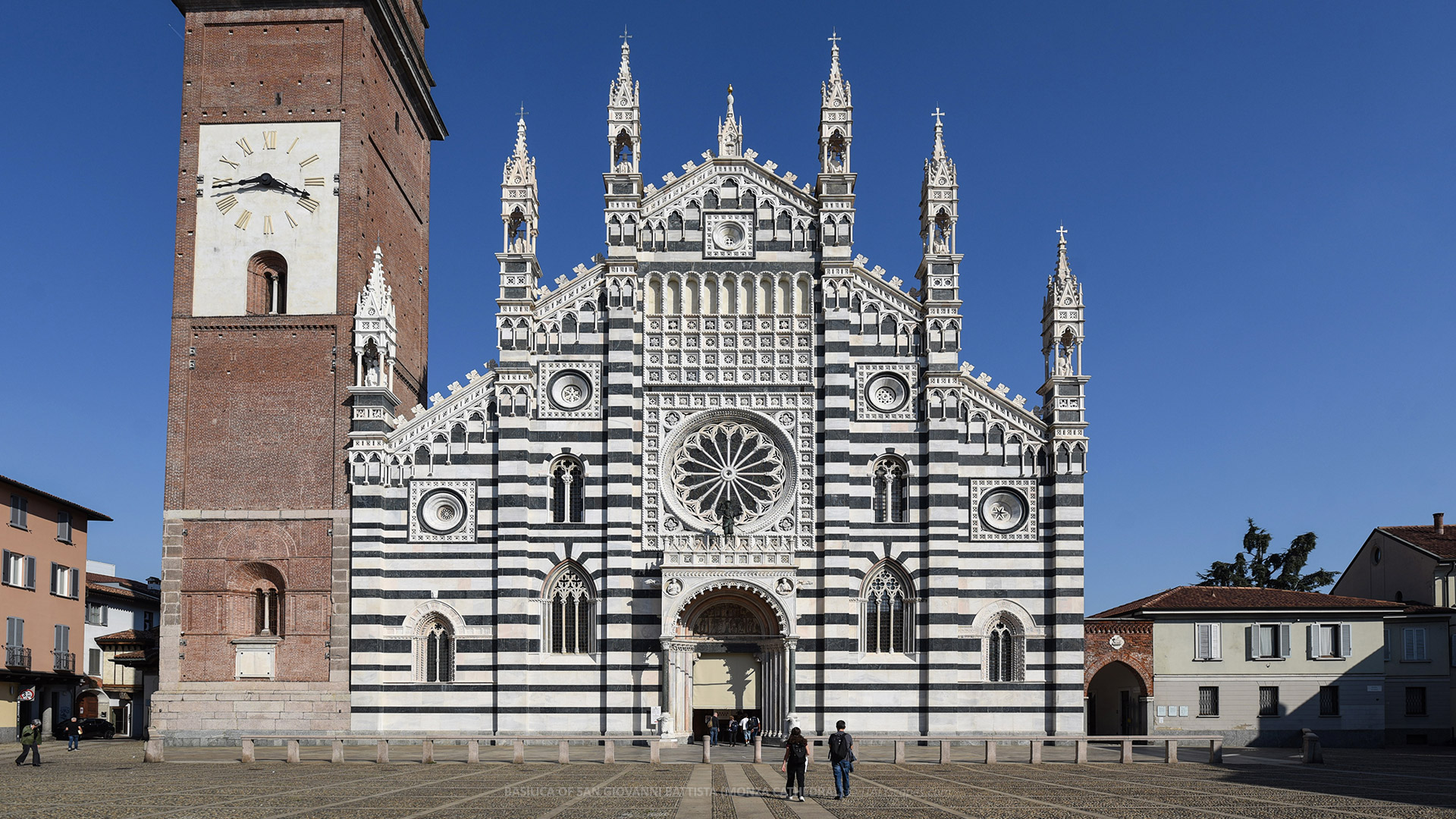
The Basilica of San Giovanni Battista stands in Piazza Duomo, inside Monza’s compact pedestrian historic centre. Visitors arriving by train normally use Monza railway station. From there, the basilica is easily accessible on foot, while local buses and taxis provide alternatives for visitors carrying luggage or with limited mobility.
Getting to the Monza Cathedral on foot
Walking is normally the easiest option from Monza railway station. The cathedral lies approximately one kilometre from the station, and the journey usually takes around 12-15 minutes depending on walking speed and the route chosen through the historic centre.
From the station area, continue north toward the central pedestrian streets and Piazza Roma. The final approach leads through the old centre to Piazza Duomo, where the façade appears within a relatively enclosed urban space. The route is largely straightforward and mostly flat once inside central Monza.
Walking also makes practical sense for sightseeing. The cathedral stands only moments from the Arengario, Piazza Roma, Via Italia, and other central landmarks, allowing visitors to combine Monza Cathedral with several attractions during a compact historic-centre itinerary without purchasing additional transport.
Getting to the Monza Cathedral by bus
Visitors preferring public transport can use buses from the station area toward central Monza. A convenient stop is Piazza Carducci (Monza), situated close to Piazza Roma and within a short pedestrian walk of the Basilica of San Giovanni Battista.
Piazza Carducci (Monza) is served by line Z206, while circular services Z211 and Z212 operate according to their respective schedules. From the stop, continue through Piazza Roma and the pedestrian streets for several minutes until reaching Piazza Duomo. Current routes should be checked before travelling.
Getting to the Monza Cathedral by taxi
An official taxi rank is available outside Monza railway station, making a taxi practical for visitors with luggage, limited mobility, or very little time. Because the distance is short, the journey normally requires only a brief drive through central Monza, depending on traffic conditions.
Piazza Duomo itself lies within the pedestrian historic centre, so vehicles may need to stop at the nearest accessible street rather than directly beside the cathedral entrance. From the drop-off point, the remaining walking distance is minimal, making taxis a convenient alternative to the station-to-centre walk.
Frequently Asked Questions about the Basilica of San Giovanni Battista (Monza Cathedral)
Is Monza Cathedral actually a cathedral?
Despite its common English name and Italian designation as Duomo di Monza, it is not an episcopal cathedral. It is the Basilica of San Giovanni Battista within the Archdiocese of Milan.
Who founded the Basilica of San Giovanni Battista?
The original church was founded by Queen Theodelinda near the end of the 6th century and was already standing when her son Adaloald was baptized there in 603.
Is it free to enter Monza Cathedral?
Yes. The main basilica can be visited freely, subject to religious services and opening times. The Chapel of Theodelinda, Iron Crown, museum, and treasury follow separate visitor arrangements.
Can I see the Iron Crown without booking?
No. Visits to the Chapel of Theodelinda and Iron Crown require advance booking and are always accompanied by museum staff, including for individual visitors.
How long does the Chapel of Theodelinda visit take?
The accompanied visit lasts approximately 30 minutes and includes an explanation of the Zavattari fresco cycle and the Iron Crown preserved inside the chapel.
How long should I allow for the cathedral complex?
Allow about 90 minutes to two hours for the basilica, Chapel of Theodelinda, Iron Crown, and museum. The museum alone typically requires around 40-45 minutes.
What is the most important artwork in Monza Cathedral?
The Zavattari fresco cycle in the Chapel of Theodelinda is generally considered its greatest painted masterpiece, while the Iron Crown is the cathedral’s most famous historical object.
-
Photos
-
Map
-
Reviews