-
About
Table of Contents
Regata Storica 2026 (Historical Regatta 2026) will take place on Sunday, September 6, 2026, in the beautiful and world-famous city of Venice.
Both a dazzling historical pageant and a high-level sporting competition, Regata Storica is one of Venice’s most anticipated traditions.
It celebrates the city’s centuries-old rowing culture while paying homage to its powerful maritime legacy, born in the days of the Serenissima Repubblica di Venezia.
Every year, the canals of Venice – especially the Grand Canal, the city’s main waterway – are transformed into a giant open-air stage.
A spectacular historical parade and a series of fiercely contested rowing races turn the water into a colorful, living tapestry of banners, traditional boats, music, and shouting crowds.
What Is the Date for Regata Storica 2026?
Traditionally, Regata Storica is held on the first Sunday in September, a custom that fixes the festival firmly in the late summer calendar of Venice.
For Regata Storica 2026, this means the event will take place on Sunday, September 6, 2026.
This date is particularly appealing for those planning a trip to Venice. Early September often brings mild temperatures, long golden evenings, and a slightly calmer rhythm after the peak of the August tourist season.
The city retains its summer energy, but the atmosphere becomes more relaxed, making it an ideal moment to combine sightseeing with watching a unique cultural event.
What Is the Location of Regata Storica 2026?
Regata Storica 2026 will take place, of course, in Venice, the capital of the Veneto region in northeastern Italy.
Venice has about 50,000 residents in its historical center, out of roughly 265,000 people in the wider metropolitan area. The city is famous for its exceptional structure: the historic center is built on 118 small islands, separated by canals and connected by bridges.
The route of Regata Storica 2026 runs right through the heart of this historic world. The day’s events are centered on Bacino di San Marco (St. Mark’s Basin) and the Grand Canal, the S-shaped main waterway lined with palaces, churches, and historic buildings.
The races traditionally start in the San Marco Basin, just off the famous Piazza San Marco, then proceed up the Grand Canal, passing landmarks such as the Accademia Bridge, and continue toward Ca’ Foscari Palace, where a large floating platform known as the Machina marks the finish line.
This platform functions as a grandstand and ceremonial podium, from which winners are honored and prizes are awarded.
Short History of Regata Storica
The particular geography of the Venetian Lagoon encouraged rowing from the earliest settlements.
With shallow waters, sandbanks, and narrow canals, sailing was often impractical: people needed flat-bottomed boats and agile, skillful rowers simply to move around.
Over time, Venetians became famed for their rowing skills, and what began as a necessity gradually turned into leisure, competition, and eventually organized regattas.
According to legend, the origins of the regatta date back to the year 942. During a popular festival, pirates allegedly kidnapped several young Venetian women.
The men of Venice gave chase in their boats, rowing with such speed and determination that they managed to catch the pirates and rescue the women.
This dramatic episode is often cited as the inspiration for the Festa delle Marie and the tradition of competitive rowing associated with it.
The first documented use of the term “regata” appears in a 1274 manuscript, which mentions a regatta held in Venice, confirming that boat races were already part of city life by the 13th century.
From this point onward, rowing competitions became more formalized, with clearer rules and increasing prestige.
In the late Middle Ages and Renaissance, public authorities recognized the military value of these contests. Regattas served to train the crews of war galleys and other naval vessels, keeping them fit, disciplined, and battle-ready.
Throughout the 15th and 16th centuries, regattas were frequently organized by the Compagnie della Calza, elite youth associations that arranged pageants, tournaments, and festivities in Venice.
In 1631, the powerful Council of Ten (Consiglio dei Dieci), one of the main governing bodies of the Serenissima, decided that only the State could organize such races.
This decision underlined the political and strategic importance of regattas, transforming them into official events sponsored and controlled by the Republic.
The expression “Regata Storica” (Historical Regatta) was introduced in 1899, on the proposal of then-mayor Filippo Grimani. Around the same period, the idea of a historical procession was added, evoking the triumphal arrival in Venice of Catherine Cornaro, the last Queen of Cyprus.
Catherine, a member of a prominent Venetian family, abdicated in favor of Venice in 1489, allowing the Republic to annex Cyprus. Her triumphant reception became a key reference point for the ceremonial pageant we see today.
During World War II, the Historical Regatta was suspended, particularly after 1939, when the war and occupation disrupted many public events.
It resumed in 1946, and from that year onward it has been held annually without interruption, becoming a permanent fixture in the Venetian calendar and a flagship event for the city’s cultural identity.
Over the decades, more categories were added to the races – including women’s races and competitions for young rowers and very young rowers – reflecting both social change and the desire to involve new generations in the tradition of voga alla veneta.
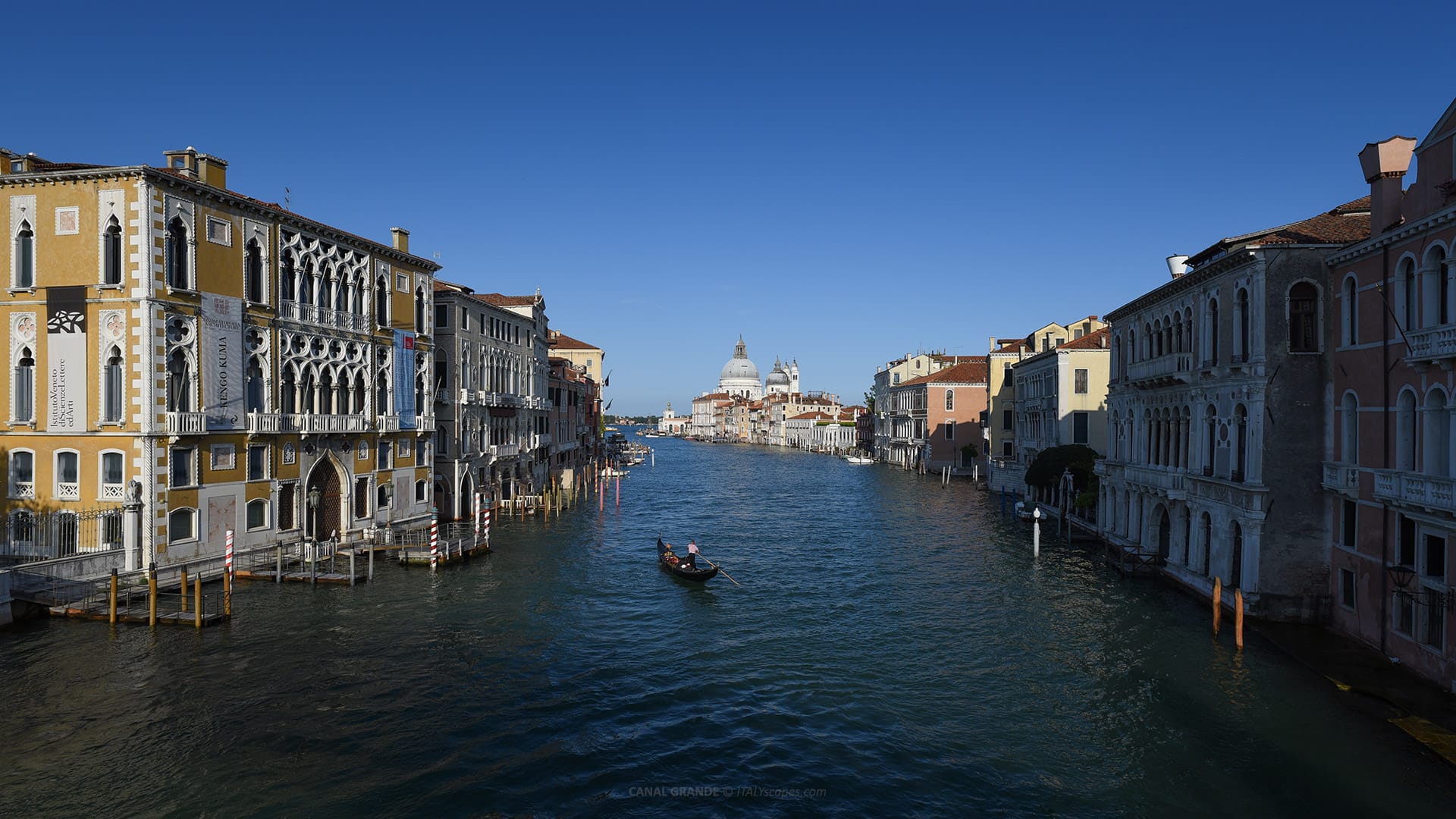
Canal Grande
Regata Storica Today
Today, Regata Storica is a carefully orchestrated blend of historical reenactment and modern sport, drawing huge crowds to the Grand Canal every year.
The day begins with a magnificent historical parade (corteo storico) along the Grand Canal.
This procession is a true feast for the eyes. Spectacular boats in bright colors, adorned with carvings and flags, glide slowly along the water.
Many of these ceremonial boats are modeled after 16th-century bissone and the legendary Bucintoro, the doge’s richly decorated state barge.
Rowers and passengers are dressed in elaborate period costumes representing the Doge, nobles, ambassadors, and other important figures from the time of the Venetian Republic.
Watching the corteo storico feels like stepping into a Renaissance painting: the palaces along the Grand Canal provide the set, and the boats and costumes bring the scene to life.
Once the historical parade has set the mood, attention shifts to the competitive races that give Regata Storica 2026 its sporting heart.
The regattas feature only traditional Venetian wooden boats, all built by specialized boatyards (squeri) and propelled exclusively by oars resting in the characteristic wooden forcola.
Since the post-war period, the main competition boats include:
- Gondolini – long, narrow, extremely fast two-oared boats designed specifically for racing, used in the top men’s event.
- Caorline – larger six-oared boats, historically used for transporting goods and people.
- Mascarete – light, two-oared boats traditionally used by women.
- Pupparini – elegant boats used for youth races, once used as private “casada” boats by noble families.
Each competition boat is painted in a distinctive color, and numbers and colors are historically associated with particular crews and zones of Venice. The boats line up in colorful rows at the starting area, creating an unforgettable spectacle even before the races begin.Among the various races, the most prestigious is the Regata dei Campioni su Gondolini (Champions’ Race on gondolini).
This race closes the program and is considered the pinnacle of the Venetian rowing season. The best male rowers in the lagoon compete in pairs: one at the stern, who also acts as strategist and steersman, and one at the bow, whose main role is to provide power.
Winners receive not only prize money but also a richly embroidered flag – red for first place, white for second, green for third, and blue for fourth – continuing a tradition recorded in the official albo d’oro (roll of honor).
Over time, some rowers have become true legends, winning multiple Historical Regattas and earning the unofficial title of “re del remo” (“king of the oar”), awarded to anyone who wins the gondolini race five years in a row.
In addition to the Champions’ Race, Regata Storica 2026 will include races for women, youths, and even children, ensuring that Venice’s rowing tradition continues to be passed on through generations.
Calendar of Events for Regata Storica 2026
Regata Storica 2026 will begin with an impressive procession of boats, many of them built to resemble 16th-century ceremonial vessels, navigating along the Grand Canal and led by a replica of the famous Bucentaur (Bucintoro), the festive ship of the doges of Venice.
Seven rowing races will be held throughout the afternoon, grouped by category according to the age of the rowers and the number of oarsmen.
The races will start in the San Marco Basin, follow the Grand Canal past the Accademia Bridge, and finish in front of Ca’ Foscari Palace, where the Machina marks the official finish line and hosts the award ceremonies.
A typical program for Regata Storica 2026 is expected to be:
- 4:00 pm – Historical parade along the Grand Canal, featuring costumed crews, traditional boats, and gondolas. The corteo storico sets the scene, presenting historical figures and ceremonial vessels before the races begin.
- 4:30 pm – Maciarele and Schie regatta, a two-oared race dedicated to children, often divided by age groups and designed to introduce the youngest participants to competitive rowing.
- 4:50 pm – Young rowers’ twin-oared regatta, showcasing the skills of teenage rowers and demonstrating how the art of voga alla veneta is passed on to new generations.
- 5:10 pm – Six-oared caorline regatta, a dynamic and powerful race featuring the larger traditional boats once used for transport, now turned into racing machines through teamwork and rhythm.
- 5:40 pm – Women’s twin-oared mascarete regatta, a high-level competition that highlights the strength, technique, and determination of Venice’s female rowers.
- 6:10 pm – Twin-oared gondolini regatta, the Champions’ Race and climax of the day, in which the city’s top male rowers battle for victory, prestige, and a place in the history of Regata Storica.
Times and details may be refined by the City of Venice as the event approaches, but this structure reflects the traditional format that has made the Historical Regatta one of the most beloved and iconic events in Venice.
Sources: -
Photos
-
Video
Table of Contents
-
Map
-
Reviews
6 September 2026