
Table of Contents
Saint Anthony of Padua was born in Lisbon, Portugal, in 1195, and was baptized with the name Fernando. He entered religious life as an Augustinian canon, first near Lisbon and later in Coimbra, before joining the Franciscans in 1220, after the martyrdom of five Franciscan missionaries in Morocco.
His desire was to preach in Africa, but illness changed his route. After reaching Morocco, he became too sick to continue his mission. On the return journey toward Portugal, his ship was driven by contrary winds to Sicily. That unexpected arrival in 1221 marked the beginning of his Italian itinerary.
Saint Anthony of Padua spent only about ten years in the Franciscan Order, yet his Italian years shaped his identity. In Italy, he became a preacher, teacher of theology, provincial minister, defender of the poor, and finally the saint most closely associated with Padua. His feast is celebrated on 13 June.
He died at Arcella, near Padua, on 13 June 1231, at about 36 years old. Less than one year later, on 30 May 1232, Pope Gregory IX canonized him in Spoleto. In 1946, the Church proclaimed him Doctor of the Church, with the title Doctor Evangelicus.
This route follows Anthony’s Italian path in chronological order, from his shipwreck in Sicily to his final days in the Veneto. It focuses on the cities and places where he spent meaningful time, preached, taught, governed, or left a lasting devotional memory.
Capo Milazzo and Sicily – The Unexpected Arrival in Italy
Anthony’s Italian story began not by plan, but through a maritime accident. After leaving Morocco because of illness, he tried to return to Portugal, but his ship was pushed toward Sicily. Tradition connects the landing with Capo Milazzo, in the province of Messina, in 1221.
The Sicilian stay was a time of recovery, not public fame. Anthony was still a young Portuguese friar, physically weakened and unknown in Italy. Sources describe a convalescence lasting about two months, before he was able to continue north toward Assisi and the Franciscan community.
The most important monument connected with this Sicilian episode is the rock sanctuary of Sant’Antonio di Padova at Capo Milazzo. Tradition identifies the cave sanctuary as the refuge where Anthony stayed after the shipwreck. The site became a place of devotion linked to his first arrival in Italy.
The memory of the shipwreck also explains why modern devotional routes sometimes describe Anthony as a saint who crossed Italy from south to north. His path was not a planned pilgrimage, but the result of illness, weather, obedience, and Franciscan mission.
Assisi – The Chapter of the Mats in 1221
After recovering in Sicily, Anthony traveled to Assisi for the great Franciscan assembly traditionally known as the Chapter of the Mats. The meeting took place around Pentecost in 1221, and it gathered friars from across the growing Franciscan movement.
Assisi was decisive because Anthony encountered the world of Francis directly. He saw and heard Francis of Assisi in person, but he did not yet become famous. Contemporary tradition presents him as humble, reserved, and almost unnoticed among the many friars present.
The place most closely connected with this meeting is the Porziuncola, the small church now enclosed within the Basilica of Santa Maria degli Angeli, near Assisi. The Porziuncola was one of the central places of early Franciscan life and is linked to the 1221 gathering.
Anthony did not stay in Assisi as a public figure. After the chapter, when many friars returned to their communities, he was noticed by Brother Graziano, provincial minister of Romagna. Graziano assigned him to the hermitage of Montepaolo, near Forlì.

Assisi
Montepaolo – The Hidden Year Near Forlì
In June 1221, Anthony reached Montepaolo, near Dovadola and Forlì. This became his first real residence in Italy. The hermitage stood in a quiet, isolated position in the hills, and Anthony lived there for about one year, until September 1222.
Montepaolo was not a city of public triumph, but a place of silence. Anthony prayed, served the other friars, performed humble tasks, and deepened his Franciscan vocation. His intellectual formation was already strong, but here he lived as an unknown friar among a small community.
The principal monument is the Eremo di Montepaolo, one of the most important Anthonian sanctuaries in Emilia-Romagna. It preserves the memory of Anthony’s first Italian residence and of the cave where tradition says he withdrew for solitary prayer and contemplation.
Montepaolo matters because it shows the hidden beginning of Anthony’s Italian mission. Before becoming the famous preacher of Padua, he was a fragile, foreign friar recovering from failed plans, illness, and displacement. His public life emerged from this year of obscurity.
Forlì – The First Public Preaching in 1222
The turning point came in Forlì, in September 1222, during priestly ordinations involving Franciscan and Dominican friars. According to tradition, the expected preacher was unavailable, and Anthony was asked to speak. His sermon revealed an unexpected command of Scripture and theology.
The listeners were surprised by his clarity, learning, and spiritual force. Until then, Anthony had been almost anonymous. After Forlì, he was no longer seen only as a humble foreign friar, but as a preacher with rare biblical knowledge and persuasive power.
The Forlì episode is usually connected with the area of the city’s religious center and with the memory of San Mercuriale, one of Forlì’s best-known monuments. Modern Anthonian routes also connect Forlì with Montepaolo, emphasizing the city as the place of his public revelation.
After this event, Anthony began preaching across northern Italy and southern France. His mission focused on the Gospel, moral reform, reconciliation, and opposition to heretical movements. Forlì therefore marks the beginning of his recognized public ministry.
Bologna – The First Franciscan Teacher of Theology
Around the end of 1223, Anthony was sent to Bologna to teach theology to the friars. This was a major moment in Franciscan history, because he became one of the first, and traditionally the first, formal theology teachers within the Franciscan Order.
The assignment received the approval of Francis of Assisi, who wrote a short letter allowing Anthony to teach theology, provided that study did not extinguish the spirit of prayer and devotion. This balance between learning and spirituality became central to Anthony’s identity.
Anthony probably taught in Bologna for about two years, when he was roughly 28 to 30 years old. His work there helped shape the intellectual future of the Franciscans, showing that preaching, biblical study, and theological formation could serve the mission of the Order.
A modern monument connected with this memory is the Basilica of Sant’Antonio di Padova in Bologna, built between 1898 and 1904 and later recognized as an Anthonian sanctuary. It commemorates the saint’s connection with the city and his role as a teacher.
Bologna is important because it adds another dimension to Anthony’s Italian route. He was not only a miracle-working popular saint, but also a learned theologian. His later title, Doctor Evangelicus, reflects this union between scholarship and evangelical preaching.

Bologna
Rimini – The City of the Miracles in Tradition
Rimini belongs to Anthony’s early preaching period. Tradition places him there around 1223, during his mission against heretical movements in Romagna. The city is associated with two of the best-known episodes in Anthonian devotion: the preaching to the fish and the miracle of the mule.
These episodes belong to hagiographic tradition, not to civic documentation in the modern sense. They nevertheless became central to Anthony’s image as a preacher whose words could reach even creation itself when human listeners refused to hear him.
According to the tradition of the preaching to the fish, Anthony went to the sea after people refused to listen. He addressed the fish, which gathered as if hearing the sermon. The story expresses the power of preaching and the resistance of a city described as religiously divided.
The miracle of the mule is linked to Eucharistic devotion. Tradition says that a mule knelt before the consecrated host, demonstrating reverence for the Eucharist. In Rimini, this episode became one of the most visible memories of Anthony’s presence.
The main monument is the Tempietto di Sant’Antonio, in Piazza Tre Martiri. The small octagonal chapel was begun in 1518 and recalls the miracle of the mule. Rimini therefore preserves Anthony not as a long-term resident, but as a preacher whose memory shaped civic devotion.
Assisi Again – The General Chapter of 1227
Anthony returned to Assisi for the General Chapter of the Friars Minor, held at Pentecost on 30 May 1227. By then, his public role had changed. He was no longer the unknown friar of 1221, but a recognized preacher and teacher.
The 1227 chapter came after the death of Francis in 1226 and during a crucial period for the Order. The Franciscans were expanding rapidly, and questions of discipline, study, preaching, and governance were becoming increasingly important.
After this period, Anthony probably became provincial minister for northern Italy, most likely between 1227 and 1230. This office required him to visit Franciscan communities and guide the friars. His Italian route therefore widened through administrative responsibility, not only preaching.
The Assisi monument connected with this phase remains the Franciscan complex around the Porziuncola and the later basilical memory of Francis. For Anthony, Assisi was the place where his Franciscan identity was confirmed, first in humility and later in service.
Northern Italy – Provincial Minister and Itinerant Preacher
Between 1227 and 1230, Anthony’s work as provincial minister brought him through several Franciscan houses of northern Italy. The exact details of every journey are not always clear, but the office itself confirms a mobile life of preaching, visitation, correction, and spiritual guidance.
This period matters because Anthony was not attached to one city alone. He served communities across a broad northern Italian province. His reputation grew because he combined learning, austerity, pastoral care, and direct speech against abuses within society and the Church.
His travels also prepared the way for his deeper bond with Padua. Among the cities and convents of northern Italy, he came to prefer Padua and the small Franciscan community near Santa Maria Mater Domini, where he found a spiritual base.

Rimini
Padua – The City That Gave Him His Name
Padua became the city most closely identified with Anthony. He was not born there, but his strongest public ministry and final spiritual legacy developed there. This is why he became known worldwide as Anthony of Padua, not only Anthony of Lisbon.
His Paduan stays were relatively short but intense. Sources indicate two close periods: the first between 1229 and 1230, and the second between 1230 and 1231. During these years, he preached, taught, heard confessions, defended the poor, and formed the local Franciscan community.
The small church of Santa Maria Mater Domini was central to his Paduan life. In 1229, a Franciscan convent rose beside it, probably founded by Anthony himself. This site later became the nucleus of the great basilica dedicated to him.
Anthony’s preaching in Padua reached its height during Lent 1231. He preached with great intensity and devoted himself to reconciliation. His ministry was not limited to sermons; it addressed concrete social problems, especially poverty, debt, injustice, and moral disorder.
One of the clearest civic effects of his teaching is connected with the statute of 17 March 1231. Under the podestà Stefano Badoer, Padua established that an insolvent debtor, once he surrendered his goods and was not guilty of fraud, should not remain imprisoned.
Anthony is also associated with the composition or development of the Sermones, a large theological and pastoral work intended especially to help preachers. Although details about their exact writing process remain debated, the text reflects his deep biblical culture and preaching method.
The greatest monument connected with Anthony is the Basilica of Saint Anthony of Padua, known locally as Il Santo. Construction began in 1232, one year after his death, and was largely completed by 1310, becoming one of Italy’s major pilgrimage churches.
The basilica incorporates the earlier Santa Maria Mater Domini, preserved as the Chapel of the Madonna Mora. This link is essential: the present shrine did not replace Anthony’s Paduan memory, but grew around the small church connected with his life, burial, and Franciscan community.
Inside the basilica, the Chapel of the Saint preserves his tomb. Pilgrims come to touch or pray near the tomb, continuing a devotion that began immediately after his death. The basilica also houses important chapels, cloisters, frescoes, sculptures, relics, and museum collections.
Padua is therefore the heart of any itinerary following Anthony through Italy. Sicily explains his arrival, Assisi his Franciscan confirmation, Montepaolo his hidden formation, Forlì his public revelation, Bologna his teaching mission, but Padua explains his name and lasting identity.
Camposampiero – The Final Retreat in 1231
After the exhausting preaching of Lent 1231, Anthony’s health declined. He accepted an invitation to rest at Camposampiero, about 20 kilometers from Padua, under the hospitality of Count Tiso. He arrived there in the spring, traditionally in May 1231.
Camposampiero was then a small settlement with a castle. For Anthony, it became a place of rest, prayer, and final contemplation. Tradition says he asked for a simple cell to be built in a walnut tree, where he could withdraw from noise and pray.
The two principal monuments are the Sanctuary of the Vision and the Sanctuary of the Walnut Tree. The Sanctuary of the Vision recalls the tradition that Count Tiso saw Anthony holding the Child Jesus in his arms, surrounded by a supernatural light.
The Sanctuary of the Walnut Tree preserves the memory of Anthony’s prayer near the walnut tree and of his preaching to people who gathered around him. These places are among the most important Anthonian sites in the province of Padua.
Camposampiero is also the starting point of the so-called Last Walk, the devotional route that recalls Anthony’s final journey toward Padua on 13 June 1231. Modern pilgrims still connect Camposampiero, Arcella, and the Basilica of the Saint in a single Anthonian itinerary.
Arcella – The Place of His Death
On Friday, 13 June 1231, Anthony became gravely ill at Camposampiero and asked to be taken back to Padua. He wanted to die at his Franciscan community near Santa Maria Mater Domini. The friars placed him on a cart drawn by oxen.
He did not reach the center of Padua alive. The group stopped at Arcella, then a village outside the city, where there was a small religious hospice associated with the Poor Clares. There Anthony received his final care.
Tradition records his final words as “I see my Lord”. He died at about 36 years old. His body was later taken to Padua and buried at Santa Maria Mater Domini, the place he had chosen and loved during his periods of intense ministry.
The main monument is the Santuario Antoniano dell’Arcella, also known as Sant’Antonino. Inside it is preserved the cell connected with Anthony’s death. The sanctuary is one of the three key sites of his final route, together with Camposampiero and the Basilica in Padua.
Arcella gives Anthony’s itinerary its human conclusion. The famous preacher, teacher, and future Doctor of the Church died not in a palace or cathedral, but at the edge of Padua, exhausted by preaching and pastoral service.
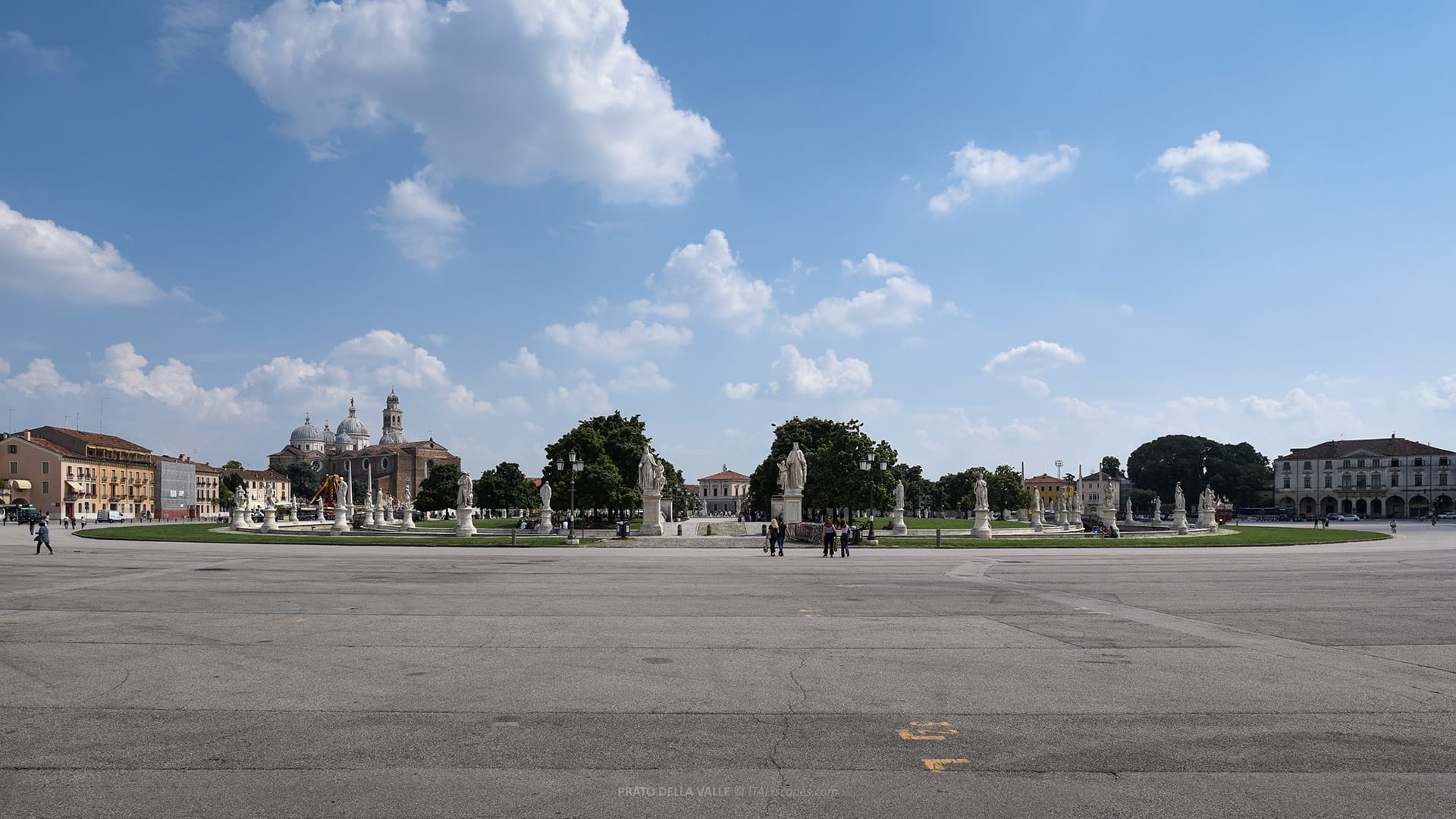
Padua
Padua After 1231 – Burial, Canonization, and the Birth of the Basilica
After Anthony’s death, his body was taken to Padua. He was buried on 17 June 1231 in the small church of Santa Maria Mater Domini. Devotion grew quickly, supported by reports of miracles and by the attachment of the Paduan people.
The speed of his canonization was exceptional. On 30 May 1232, less than one year after his death, Pope Gregory IX proclaimed him a saint in Spoleto. This rapid canonization shows how strong his reputation had become immediately after his death.
The construction of the great basilica began in 1232 to provide a worthy shrine for his tomb. The basilica developed over decades and became a vast pilgrimage complex, combining Romanesque, Gothic, Byzantine, and later artistic elements.
The basilica is not the Cathedral of Padua, but it is the city’s most famous religious monument. Its identity is inseparable from Anthony’s tomb, relics, and memory. Locals often call it simply Il Santo, meaning The Saint.
The basilica also preserves the older site of Santa Maria Mater Domini as the Chapel of the Madonna Mora. This continuity makes the monument historically important: the modern pilgrimage church still contains the memory of Anthony’s actual Paduan environment.
A Saint Shaped by Movement
Anthony’s Italian route was not linear in the modern tourist sense. It began with a shipwreck in Sicily, passed through the Franciscan center of Assisi, continued in the silence of Montepaolo, opened publicly in Forlì, matured intellectually in Bologna, and reached its deepest form in Padua.
Each Italian place reveals a different side of him. Capo Milazzo shows the fragile newcomer. Assisi shows the Franciscan disciple. Montepaolo shows the hidden contemplative. Forlì shows the preacher. Bologna shows the teacher. Padua shows the pastor, reformer, and saint.
Camposampiero and Arcella complete the route with his final days. There, Anthony’s life moved from public preaching to silence, illness, and death. Yet those places also became living sanctuaries, because his final journey became one of the most important devotional routes in northern Italy.
To follow Saint Anthony through Italy is to follow a biography written in movement: sea routes, hermitages, convents, city squares, classrooms, sanctuaries, and roads. His name belongs to Padua, but his Italian path crosses several regions and explains why his cult spread so rapidly.
Today, the Basilica of Saint Anthony in Padua remains the center of his memory. Still, the full story becomes clearer only when Padua is connected with Sicily, Assisi, Montepaolo, Forlì, Bologna, Rimini, Camposampiero, and Arcella – the places that shaped Anthony before he became “Il Santo”.
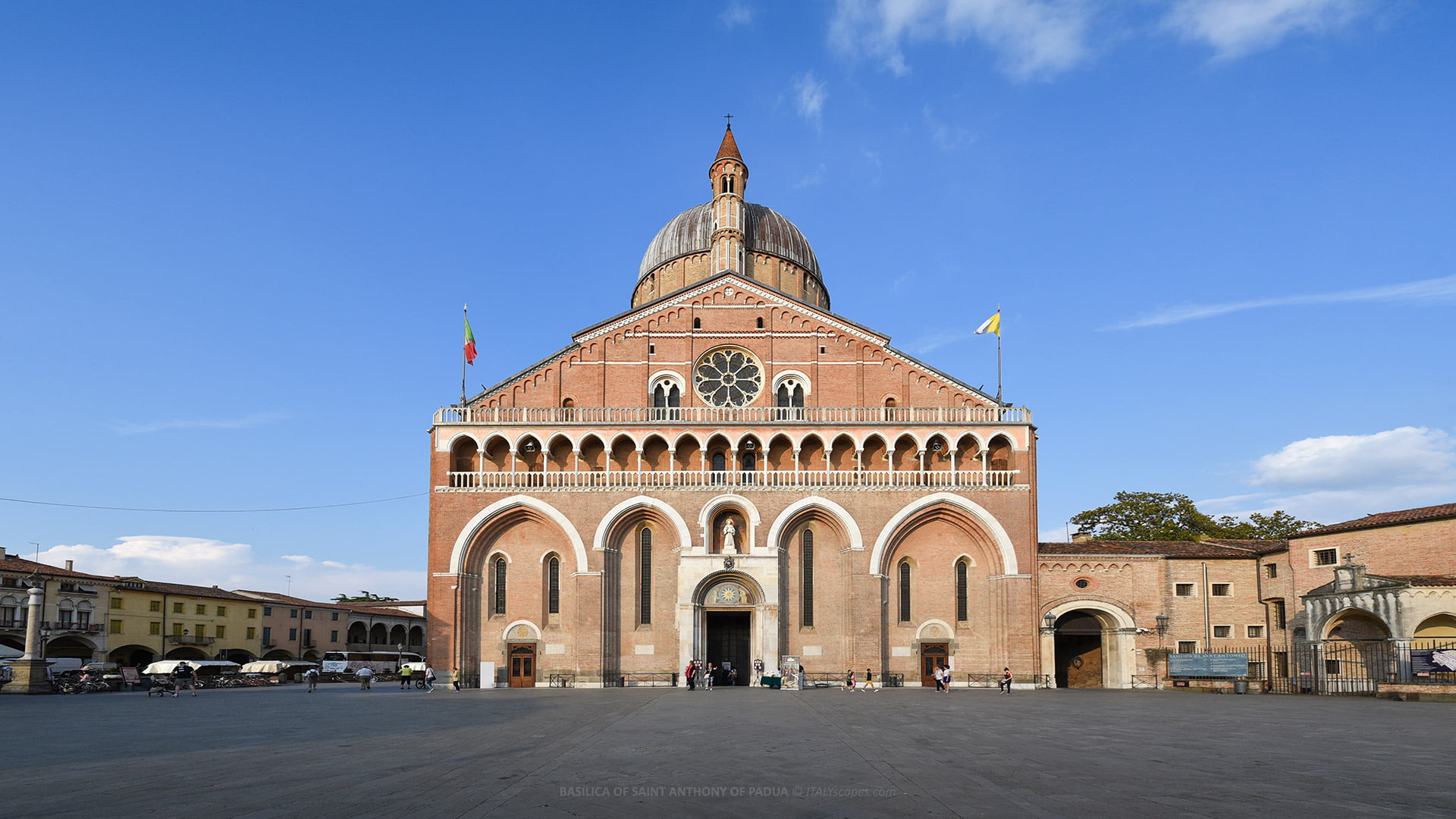
Basilica of Saint Anthony of Padua
Frequently Asked Questions about Saint Anthony of Padua
Why is he called Saint Anthony of Padua?
He is called Saint Anthony of Padua because Padua became the city most closely linked to his preaching, final years, death, burial, and great basilica.
Was Saint Anthony born in Padua?
No. Saint Anthony was born in Lisbon, Portugal, in 1195. He became associated with Padua only during the final and most important years of his life.
What did Saint Anthony do in Assisi?
In 1221, Anthony attended the Franciscan Chapter of the Mats in Assisi. There, he entered more deeply into the world of Saint Francis and the early Franciscans.
What happened to Saint Anthony in Forlì?
In 1222, Anthony preached unexpectedly in Forlì during an ordination ceremony. His sermon revealed his deep theological knowledge and began his public fame as a preacher.
What was Saint Anthony’s connection with Bologna?
In Bologna, Anthony taught theology to Franciscan friars around 1223. This made him one of the earliest theology teachers in the Franciscan Order.
What is the most important monument linked to Saint Anthony?
The most important monument is the Basilica of Saint Anthony in Padua. Construction began in 1232, one year after his death, around his tomb.
Where did Saint Anthony die?
Saint Anthony died at Arcella, near Padua, on 13 June 1231. He was later buried in Padua, where his basilica became a major pilgrimage site.


