
Table of Contents
The Roman Inquisition was established in 1542, when Pope Paul III created the Sacred Roman and Universal Inquisition through the papal bull Licet ab initio. It became one of the central institutions of the Catholic Church during the Counter-Reformation, especially against Protestant doctrines entering the Italian peninsula.
The institution was not the same as the Spanish Inquisition or the medieval inquisitorial tribunals. The Roman Inquisition was a papal body based in Rome, connected with local tribunals in Italian territories and other Catholic regions. Its primary task was to investigate heresy, schism, suspect books, religious dissent, and doctrinal error.
In Christian theology, heresy meant the formal denial, rejection, or persistent doubt of a doctrine considered essential by the Catholic Church. In practice, the Roman Inquisition judged cases involving Protestant sympathies, unorthodox biblical interpretation, mystical doctrines, cosmological claims, forbidden books, and religious movements considered dangerous to Catholic unity.
The Roman Inquisition operated through interrogations, denunciations, written records, theological examination, censorship, prison sentences, public abjurations, and, in serious cases, transfer to secular authorities for execution. Its most famous cases involved intellectuals, clerics, philosophers, scientists, mystics, and ordinary people accused of challenging official doctrine.
The following nine cases show how the Roman Inquisition treated heresy across more than two centuries. They include reform-minded cardinals, humanists, a Friulian miller, a philosopher, scientific controversies, mystical movements, and late eighteenth-century Freemasonry.
Cardinal Giovanni Morone – A High-Ranking Churchman Suspected of Heresy
Giovanni Morone was one of the most important Catholic figures ever investigated by the Roman Inquisition. He was not an outsider attacking the Catholic Church, but a cardinal, diplomat, bishop, and experienced churchman. His case shows that suspicion of doctrinal error could reach even the highest ecclesiastical ranks.
Morone had been involved in diplomacy with German Protestants and was associated with moderate Catholic reform circles. During the tense years of the Counter-Reformation, such contacts became dangerous. Under Pope Paul IV, who was deeply hostile to Protestantism, Morone was suspected of Lutheran sympathies and arrested in 1557.
He was imprisoned in Castel Sant’Angelo, in Rome, from 1557 to 1559. The Roman Inquisition investigated his orthodoxy, but the case collapsed after the death of Paul IV. Morone was released, later absolved, and eventually returned to a central role inside the Catholic Church.
The importance of Morone’s trial lies in its political and institutional meaning. It proved that the Roman Inquisition could be used not only against obvious religious dissenters, but also against influential churchmen whose theological moderation appeared suspicious in a time of confessional conflict.
Morone’s later career was remarkable. After his release, he helped guide the final phase of the Council of Trent, one of the defining events of the Catholic Reformation.
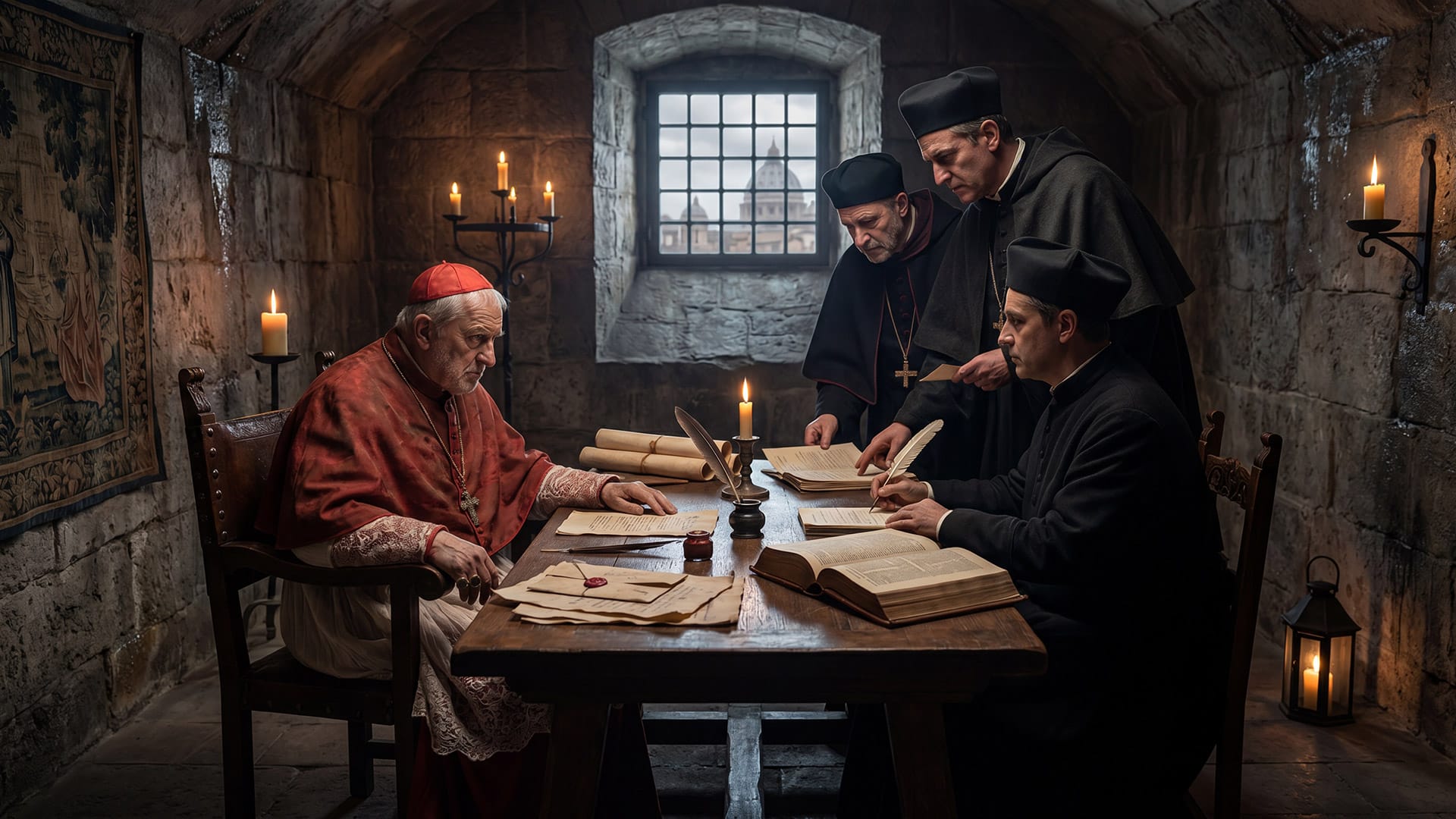
Giovanni Morone accused of heresy by the Roman Inquisition
Pietro Carnesecchi – Humanism, Reform, and Execution in Rome
Pietro Carnesecchi was a Florentine humanist, courtier, and former papal secretary. He moved in elite intellectual circles and was connected with spiritual reformers influenced by Juan de Valdés. His case became one of the most famous Roman Inquisition trials against Italian sympathizers of Protestant or semi-Protestant ideas.
Carnesecchi had earlier been investigated and acquitted, but suspicion followed him for decades. The Roman Inquisition later reopened his case under Pope Pius V, a pope strongly committed to suppressing religious dissent. Carnesecchi’s connections, writings, conversations, and theological opinions were examined as evidence of doctrinal deviation.
His trial focused on issues connected with justification, grace, free will, the authority of the Catholic Church, and sympathy for reformist positions. Carnesecchi was not a public revolutionary, but he represented an elite current of Italian religious reform that Rome eventually considered unacceptable.
In 1567, Pietro Carnesecchi was condemned in Rome. He was executed by beheading, and his body was burned. His death became a warning to aristocrats, scholars, clerics, and humanists who had hoped for internal reform without breaking openly from the Catholic Church.
The case of Carnesecchi is important because it shows the Roman Inquisition acting against refined theological dissent, rather than only against popular superstition or open Protestant preaching.
Aonio Paleario – A Humanist Condemned for Religious Reform
Aonio Paleario was an Italian humanist, scholar, and teacher associated with reformist religious ideas. He criticized aspects of ecclesiastical corruption and was accused of supporting doctrines incompatible with the Catholic Church. His case belongs to the same world of learned religious dissent that produced Carnesecchi’s trial.
Paleario’s writings and opinions brought him under suspicion long before his final condemnation. He was connected with debates about grace, salvation, clerical authority, and the role of Scripture. The Roman Inquisition treated his theological positions as evidence of heresy rather than acceptable scholarly debate.
His trial took place in Rome, where he was condemned to death. In 1570, Aonio Paleario was executed. The sentence demonstrated that intellectual reputation, classical learning, and humanist culture offered no protection when doctrinal suspicion became formal prosecution.
The Paleario case matters because it reveals how the Roman Inquisition reacted to the overlap between Renaissance humanism and Protestant reform. The Catholic Church did not reject learning as such, but it treated certain interpretations of Scripture, justification, and church authority as threats to Catholic doctrine.
His case is less famous than those of Bruno and Galileo, but it belongs among the major trials of the Roman Inquisition against Italian religious nonconformity.
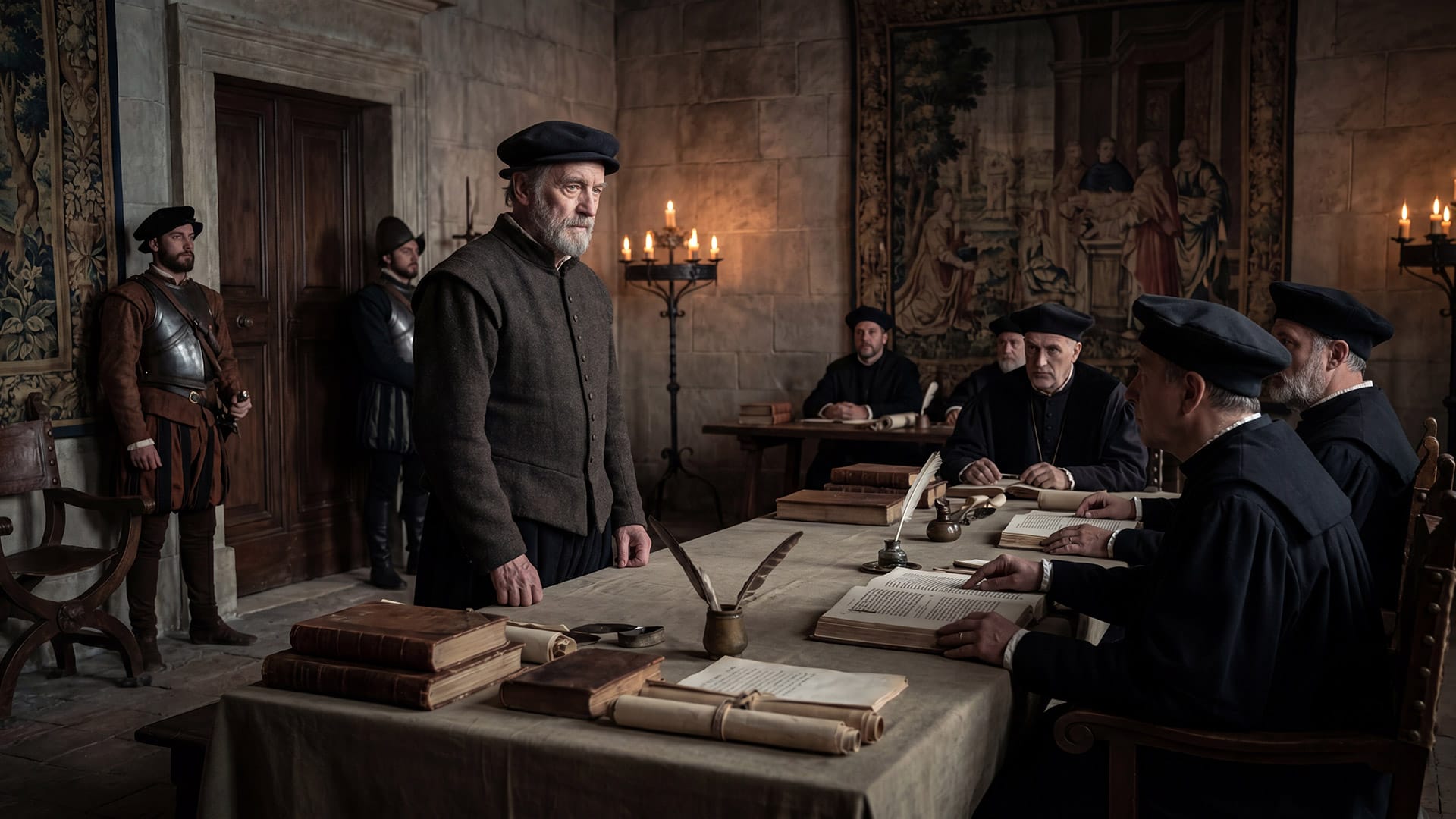
Aonio Paleario tried for heresy by the Roman Inquisition
Menocchio – A Friulian Miller Before the Inquisition
Domenico Scandella, known as Menocchio, was a miller from Montereale, in Friuli. His case became famous because it shows how the Roman Inquisition dealt with ordinary people, not only philosophers, clerics, and scientists. Menocchio’s trial is a key source for popular religious culture in early modern Italy.
Menocchio could read, and his ideas came from a mixture of books, oral culture, local beliefs, and personal interpretation. He developed unusual views about creation, God, Christ, angels, the church, and religious authority. These opinions were recorded in detail during his inquisitorial interrogations.
His most famous cosmological image compared creation to a natural process, later summarized through the image of “cheese and worms”. The Roman Inquisition did not treat these ideas as harmless fantasy. It judged them as dangerous doctrinal error and evidence of religious disobedience.
Menocchio was tried first in the 1580s and forced to abjure. He was later investigated again after repeating or maintaining unorthodox views. Because he was considered a relapsed heretic, his second case ended far more severely. In 1599, he was executed.
The importance of Menocchio’s case lies in its social depth. It shows that heresy was not only a matter of universities, courts, or printed books. The Roman Inquisition monitored local speech, village reputation, religious imagination, and personal interpretations of Christianity among ordinary laypeople.
Giordano Bruno – Philosophy, Theology, and Fire at Campo de’ Fiori
Giordano Bruno was a Dominican friar from Nola, philosopher, writer, and one of the most famous victims of the Roman Inquisition. His case is often simplified as a conflict between science and religion, but the historical record is more complex. Bruno was condemned mainly for theological and philosophical positions.
Bruno left the Dominican Order and lived in several European cities, including Geneva, Toulouse, Paris, London, Wittenberg, Prague, Helmstedt, Frankfurt, and Venice. His writings defended an infinite universe, innumerable worlds, and a radical reinterpretation of nature. His thought went far beyond ordinary Copernican astronomy.
His cosmology was certainly important. Bruno accepted and expanded the Copernican model, arguing that the universe had no fixed center and that the stars could be suns with other worlds. These ideas challenged the closed Aristotelian-Ptolemaic cosmos still influential in Catholic and academic thought.
However, the Roman Inquisition did not condemn Bruno only because of heliocentrism. The charges involved doctrines concerning the Trinity, the divinity of Christ, the Incarnation, the Eucharist, the virginity of Mary, the immortality and transmigration of the soul, magic, and the interpretation of Scripture.
Bruno was arrested in Venice, in 1592, after being denounced by Giovanni Mocenigo, a Venetian nobleman who had invited him. The Venetian Inquisition interrogated him first. In 1593, he was extradited to Rome, where the Roman Inquisition kept him imprisoned for years.
The Roman phase of Bruno’s trial lasted from 1593 to 1600. He defended himself, distinguished philosophical reasoning from matters of faith, and sometimes tried to explain or qualify his positions. But he refused full recantation of the doctrines judged unacceptable by the Catholic Church.
The final sentence condemned Bruno as an obstinate heretic. On February 17, 1600, he was taken to Campo de’ Fiori, in Rome, and burned alive. His execution became one of the most enduring symbols of intellectual conflict with religious authority in early modern Europe.
Bruno’s case is central to the history of the Roman Inquisition because it combined several kinds of perceived danger: apostasy from religious life, radical philosophy, cosmological speculation, criticism of doctrine, and refusal to submit. It was not a narrow scientific trial, but a major doctrinal one.
His posthumous reputation changed dramatically. In the nineteenth century, Italian liberals, anticlerical thinkers, and supporters of free thought turned Bruno into a martyr of intellectual liberty. The monument erected in Campo de’ Fiori in 1889 made his memory a public challenge to ecclesiastical authority.
Historically, Bruno should not be reduced either to a modern scientist or to a simple victim of misunderstanding. He was a radical philosopher whose cosmology, theology, memory arts, magical interests, and anti-Aristotelian thought formed a dangerous profile in the eyes of the Roman Inquisition.
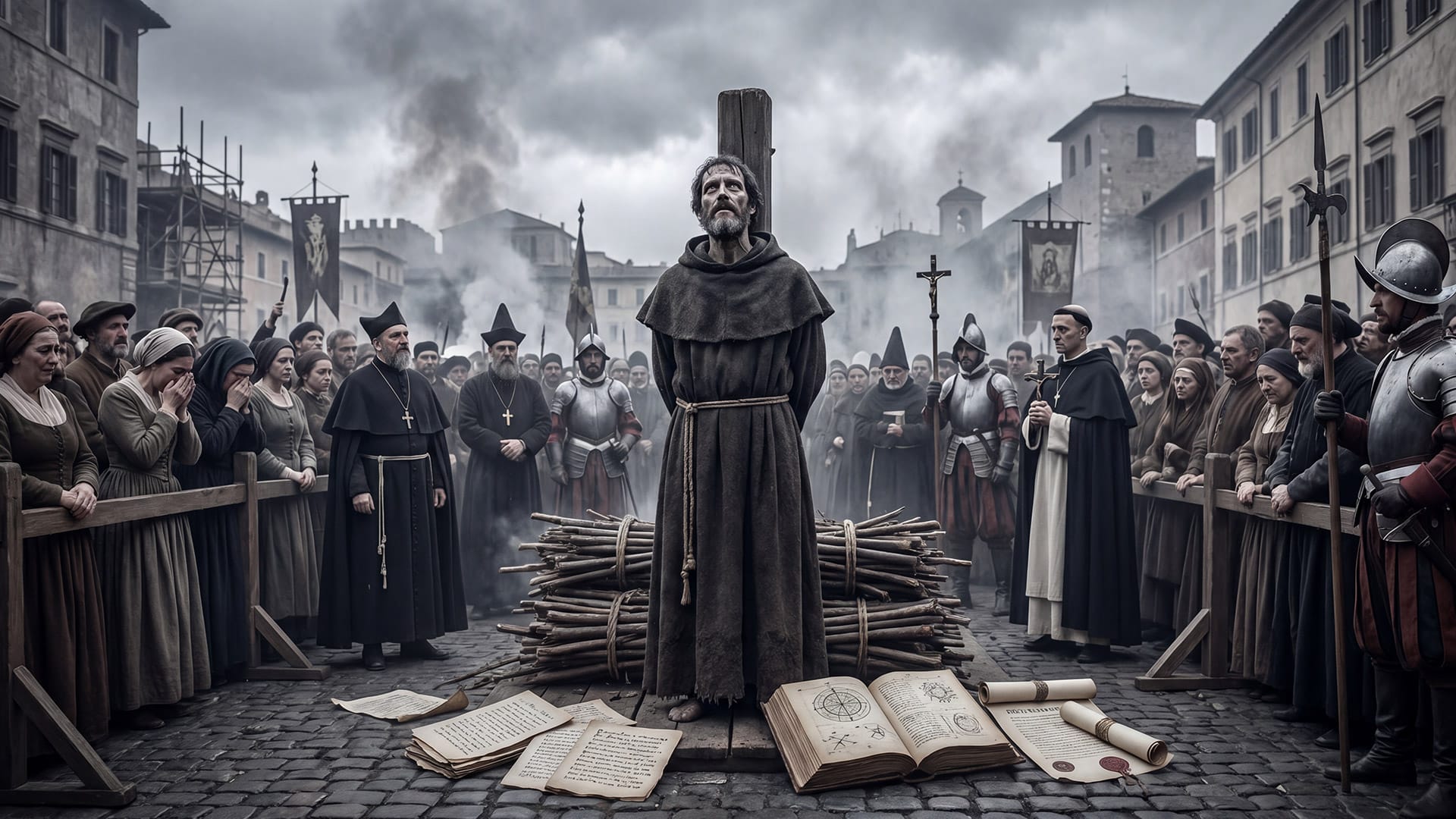
Giordano Bruno condemned for heresy by the Roman Inquisition
The Condemnation of Copernicanism in 1616
Nicolaus Copernicus died in 1543, the same year his major work, De revolutionibus orbium coelestium, was published in Nuremberg. Copernicus himself was never tried by the Roman Inquisition. The major inquisitorial crisis over Copernicanism came decades later, when heliocentrism became a live theological controversy.
The Copernican model placed the Sun near the center of the planetary system and made Earth a moving planet. For many theologians and natural philosophers, this contradicted traditional readings of Scripture and Aristotelian physics. The Catholic Church did not immediately condemn Copernicus in 1543, but suspicion grew later.
By the early seventeenth century, Galileo’s telescopic discoveries and public defense of Copernicanism made the issue more urgent. In 1616, consultants of the Roman Inquisition examined the propositions that the Sun is motionless at the center and that Earth moves around it.
The consultants judged the immobility of the Sun at the center of the world “foolish and absurd in philosophy” and formally heretical because it appeared to contradict Scripture. The movement of Earth was also censured. These judgments shaped the Catholic Church’s official response to heliocentrism.
On March 5, 1616, the Congregation of the Index issued a decree against Copernican books. Copernicus’s De revolutionibus was not absolutely destroyed or permanently banned in every form; it was suspended until corrected. Works by Paolo Antonio Foscarini and Diego de Zúñiga were also targeted.
The 1616 condemnation is one of the most important cases in the history of the Roman Inquisition because it transformed a mathematical and astronomical debate into a doctrinally controlled subject. From that moment, Copernicanism could not be freely taught as physical truth within Catholic intellectual life.
This case is essential for understanding Galileo’s later trial. Galileo was warned in 1616 not to hold or defend Copernicanism as true. The exact wording and legal force of that warning later became central during his 1633 proceedings before the Roman Inquisition.
The condemnation of Copernicanism was not a trial of Copernicus himself, but it functioned as a doctrinal trial of a theory. It shows how the Roman Inquisition and the Catholic Church could treat cosmology as a matter linked to Scripture, theology, censorship, and ecclesiastical obedience.
Galileo Galilei – Science, Scripture, and the 1633 Trial
Galileo Galilei was born in Pisa in 1564 and became one of the most important figures in the history of modern science. His telescopic observations supported the idea that the traditional geocentric cosmos was incomplete. His case became the most famous Roman Inquisition trial involving astronomy.
In 1610, Galileo published Sidereus Nuncius, reporting observations of the Moon, the Milky Way, and the moons of Jupiter. These discoveries did not prove heliocentrism by themselves, but they damaged the older idea of perfect celestial spheres and strengthened the credibility of Copernican astronomy.
Galileo also argued that Scripture should not be interpreted against demonstrated natural truth. In his letters on Copernicanism, especially to Benedetto Castelli and Christina of Lorraine, he tried to separate the language of the Bible from technical astronomical explanation. This position increased suspicion.
After the 1616 condemnation, Galileo was expected not to defend Copernicanism as physical truth. For years he remained cautious, but under Pope Urban VIII he received permission to write a balanced discussion of the Ptolemaic and Copernican systems, provided the matter remained hypothetical.
The result was Dialogue Concerning the Two Chief World Systems, published in 1632. The book compared the Ptolemaic and Copernican systems through a literary dialogue. Although formally structured as debate, it strongly favored the Copernican position and made the geocentric defender, Simplicio, appear weak.
The Roman authorities reacted quickly. Galileo was summoned to Rome in 1633 and tried by the Roman Inquisition. The central issue was not telescope use alone, but whether he had disobeyed the 1616 warning and presented a condemned doctrine as physically true.
On June 22, 1633, Galileo was found “vehemently suspected of heresy”. He was forced to abjure the Copernican position, his Dialogue was prohibited, and he was sentenced to imprisonment. The sentence was soon commuted to house arrest, where he spent the rest of his life.
Galileo lived under house arrest mainly at Arcetri, near Florence, and continued scientific work despite age, illness, and restrictions. His later Two New Sciences, published in 1638 outside Italy, became a foundation text for mechanics. The Catholic Church’s sentence, however, remained historically decisive.
The Galileo case is important because it joined scientific argument, biblical interpretation, censorship, personal politics, and obedience to ecclesiastical authority. It was not simply a debate about whether Earth moves. It was a trial about who could define truth when natural philosophy seemed to challenge theology.
In the wider history of the Roman Inquisition, Galileo’s trial became the best-known example of institutional conflict between new science and traditional doctrine. Unlike Bruno, Galileo was not executed. But his forced abjuration became one of the most famous acts of submission in European intellectual history.
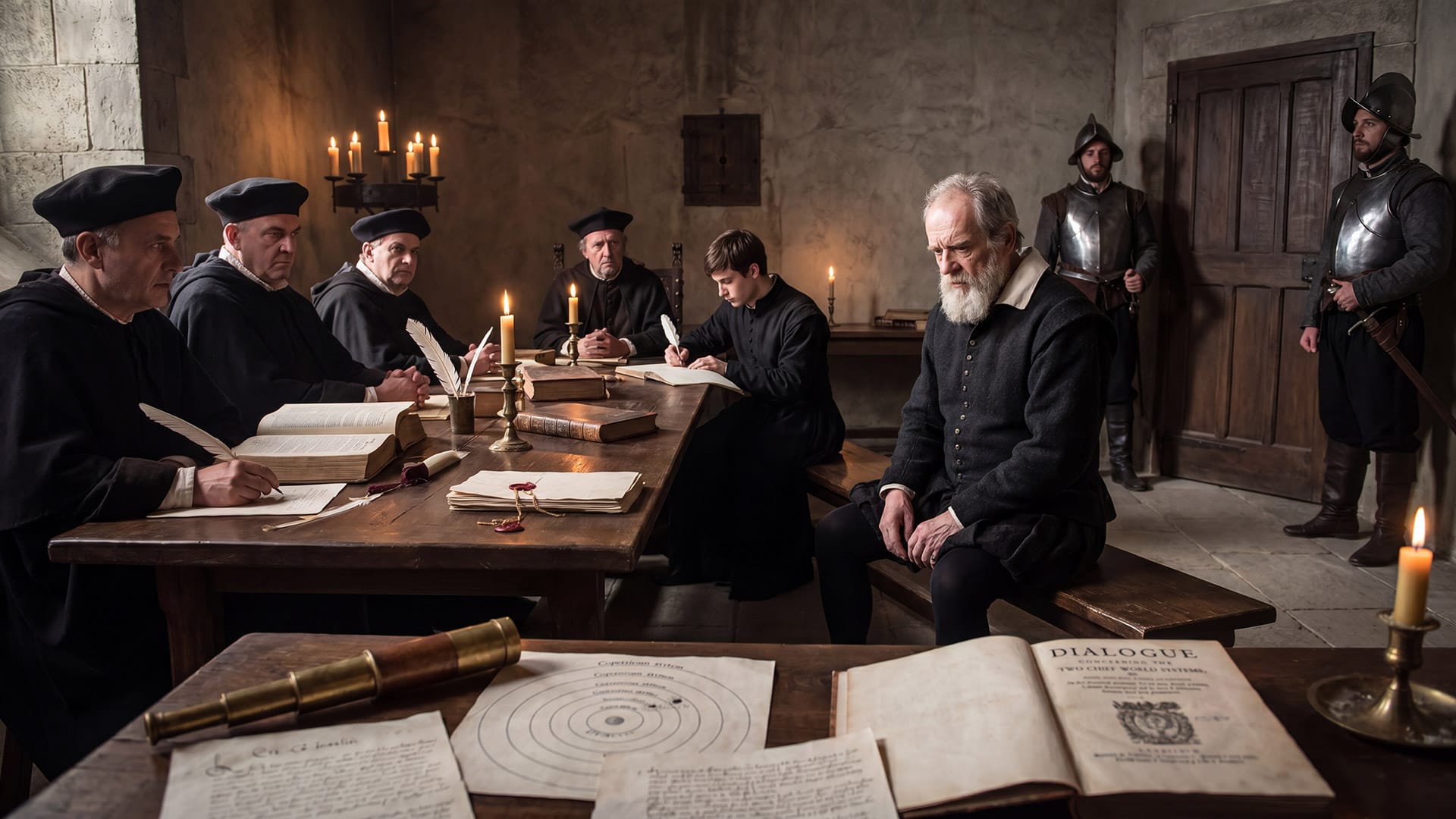
Galileo Galilei before the Roman Inquisition on heresy charges
Miguel de Molinos – Quietism and Mystical Heresy
Miguel de Molinos was a Spanish priest and spiritual writer associated with Quietism, a mystical movement centered on interior prayer, passivity before God, and spiritual annihilation of the self. His book The Spiritual Guide, published in 1675, became influential in seventeenth-century Catholic spirituality.
At first, Molinos had powerful admirers in Rome. His teaching seemed to offer a path of deep contemplation and detachment. Over time, however, critics accused Quietism of encouraging passivity, neglect of sacraments, moral laxity, indifference to salvation, and dangerous forms of spiritual self-abandonment.
Molinos was arrested in Rome in 1685 and tried by the Holy Office. The Roman Inquisition examined propositions associated with his teaching and with the broader Quietist movement. The case was highly significant because it took place inside Catholic spirituality, not against Protestantism or open atheism.
In 1687, Molinos publicly abjured and was sentenced to life imprisonment. Pope Innocent XI confirmed the condemnation of sixty-eight propositions associated with Quietism. The trial marked one of the most important Roman Inquisition actions against mystical doctrine inside the Catholic Church.
Molinos died in prison in 1696. His case shows that heresy could be detected not only in open denial of dogma, but also in forms of devotion judged to distort grace, free will, moral responsibility, sacramental life, and obedience to ecclesiastical authority.
Alessandro Cagliostro – Freemasonry, Occultism, and the Late Inquisition
Alessandro Cagliostro, born Giuseppe Balsamo in Palermo, was an adventurer, occultist, healer, and Freemason active across Europe in the eighteenth century. His case belongs to the late history of the Roman Inquisition, when the institution increasingly confronted Freemasonry, magic, secret societies, and Enlightenment-era suspicion.
Cagliostro had become famous through occult practices, healing claims, esoteric rituals, and his so-called Egyptian Masonry. He was arrested in Rome in 1789 after attempting to establish Masonic activity in the Papal States. Freemasonry had already been condemned by papal authority in the eighteenth century.
The Roman Inquisition charged him with offenses connected to heresy, magic, superstition, and Freemasonry. His case was not like the trials of Carnesecchi, Bruno, or Galileo. It belonged to a later world shaped by secret societies, political anxiety, anti-Masonic policy, and revolutionary-era fear.
In 1791, Cagliostro was condemned to death, but the sentence was commuted to life imprisonment. He was eventually held at the fortress of San Leo, where he died in 1795. His trial became one of the last famous cases associated with the Roman Inquisition.
Cagliostro’s case shows how the meaning of heresy expanded in late early modern Rome. The Catholic Church no longer confronted only Protestant doctrine or unorthodox theology. It also treated secret ritual systems, occult claims, and Masonic organization as threats to faith, authority, and public order.
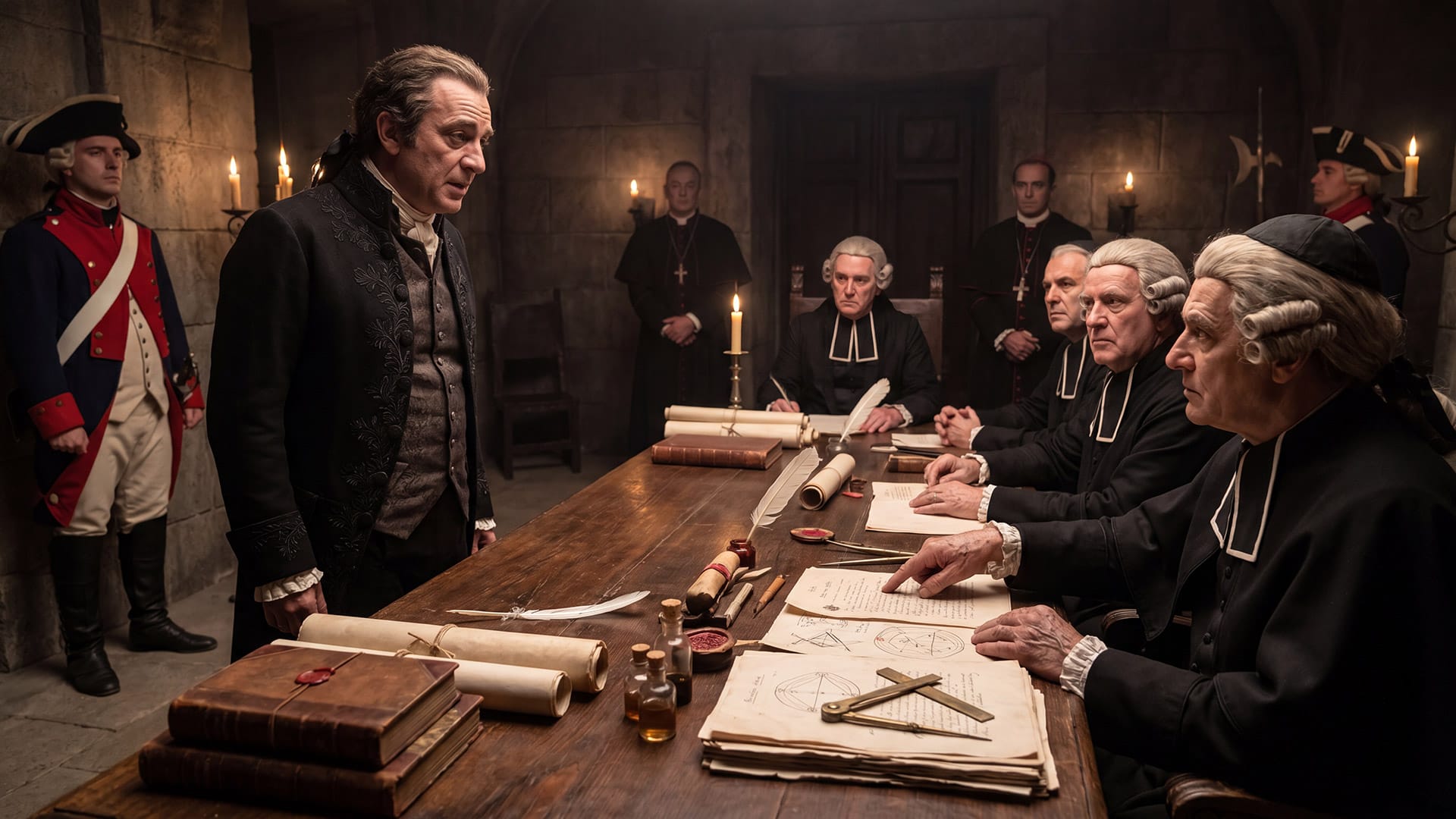
Alessandro Cagliostro investigated for heresy by the Roman Inquisition
The Roman Inquisition and the Boundaries of Orthodoxy
The nine cases show that the Roman Inquisition was not limited to one kind of defendant or one type of accusation. It prosecuted cardinals, humanists, philosophers, villagers, scientists, mystics, and occultists. Across these trials, heresy remained the key category used to defend Catholic orthodoxy.
Giovanni Morone’s case shows the danger of suspicion inside the hierarchy. Carnesecchi and Paleario show the suppression of reformist humanism. Menocchio reveals popular religious creativity under interrogation. Bruno shows the fatal consequences of radical philosophy, theological nonconformity, and refusal to recant.
The 1616 condemnation of Copernicanism and Galileo’s 1633 trial remain the most famous cases involving astronomy. They prove that the Catholic Church treated cosmological claims as dangerous when they appeared to contradict Scripture, challenge ecclesiastical authority, or ignore previous doctrinal restrictions.
Molinos and Cagliostro show the later evolution of inquisitorial concern. The Roman Inquisition moved from Protestant and humanist dissent toward mystical passivity, devotional suspicion, Freemasonry, occultism, and secret societies. Its targets changed, but its central function remained the defense of doctrine and authority.
From Giordano Bruno to Galileo Galilei, the Roman Inquisition shaped some of the most important conflicts between belief, knowledge, authority, and conscience in early modern Europe. Its greatest heresy trials remain essential for understanding the Catholic Church, intellectual freedom, censorship, and the limits of permitted thought.
Frequently Asked Questions about the Roman Inquisition
What was the Roman Inquisition?
The Roman Inquisition was a papal tribunal established in 1542 by Pope Paul III to investigate heresy, religious dissent, forbidden books, Protestant influence, and doctrinal errors inside the Catholic world.
Was the Roman Inquisition the same as the Spanish Inquisition?
No. The Roman Inquisition was controlled by the papacy in Rome, while the Spanish Inquisition was closely connected to the Spanish monarchy. They had different structures, territories, and political roles.
Why was heresy considered such a serious crime?
Heresy was considered dangerous because it challenged doctrines officially defended by the Catholic Church. In early modern Europe, religious unity was also linked to political order and social stability.
Was Giordano Bruno executed only because of heliocentrism?
No. Giordano Bruno supported Copernican ideas, but his condemnation involved broader theological issues, including the Trinity, Christ, the Eucharist, the soul, infinite worlds, and his refusal to recant.
What was the 1616 condemnation of Copernicanism?
In 1616, Roman authorities judged the claim that the Sun stands still and Earth moves as contrary to Scripture. Copernicus’s book was suspended until corrected, not immediately destroyed.
Why was Galileo Galilei tried in 1633?
Galileo Galilei was tried because his Dialogue Concerning the Two Chief World Systems appeared to defend Copernicanism as physical truth, despite the restrictions and warnings connected with the 1616 condemnation.
Images generated with Nano Banana Pro / Google AI Studio


