
Table of Contents
The Italian Maritime republics were medieval port cities whose wealth, autonomy, and political influence came from navigation, naval power, and long-distance trade. Their rise began when Mediterranean routes became essential again after centuries of instability. From the 9th century onward, ships often mattered more than roads.
The term usually refers to Venice, Genoa, Pisa, and Amalfi, the four best-known maritime republics. Their coats of arms have appeared since 1947 on the flags of the Italian Navy and the Italian merchant marine. Each city built its power on fleets, ports, merchants, maritime law, and overseas privileges.
These republics were not identical states. Some were communes, some duchies, some oligarchic republics, and some changed institutions over time. What united them was maritime autonomy, the ability to defend trade by naval force, and the creation of commercial networks across the Mediterranean, the Adriatic, the Black Sea, and the Levant.
Their merchants carried spices, silk, precious stones, cloth, grain, oil, wine, metals, timber, wool, coral, and other valuable goods. Their ships linked Italy with Byzantium, the Islamic world, North Africa, the Holy Land, Spain, France, and Northern Europe, turning ports into political powers.
Their success depended on geography. Venice was protected by its lagoon. Genoa occupied a natural Ligurian port. Pisa controlled the Arno and the Tuscan coast before silting changed its maritime position. Amalfi stood on a steep coast at the center of routes between the Latin West, Byzantium, and the Arab world.
The maritime republics also contributed to navigation, maritime law, finance, shipbuilding, and cartography. Amalfi was associated with the spread and improvement of the compass in Europe. Venice developed major naval institutions and maritime statutes. Genoa became a financial power. Pisa used sea power to support its Mediterranean expansion.
Their history was not only commercial. It was also military. These cities fought Saracen raiders, supported Crusades, founded quarters and colonies abroad, competed for islands, and fought each other in long naval wars. Their rivalries shaped the balance of power in the medieval Mediterranean.
Venice – The Longest-Lived Maritime Empire
Venice was the most durable of the maritime republics. It emerged from lagoon communities formed between the 5th and 6th centuries, when inhabitants of the Veneto mainland sought safety from invasions. Its protected islands allowed it to develop separately from inland feudal powers and to build a maritime identity.
In its early centuries, Venice was formally connected to the Byzantine world. This position gave the city a privileged role between East and West. Its merchants understood Greek, Latin, and Adriatic markets, and the city gradually transformed Byzantine dependence into practical autonomy.
A decisive step came with the Pactum Lotharii of 840, concluded with the Carolingian emperor Lothair I. The agreement reflected Venice’s growing ability to act independently. The formal break with Byzantine authority came later, after conflict with Constantinople between 1122 and 1126.
In 1143, the Commune Veneciarum institutionalized Venetian independence. The doge remained the symbolic head of the state, but power increasingly belonged to councils and magistracies. Venice became an oligarchic republic dominated by merchant families, with institutions designed to limit personal rule.
Venice’s first strategic space was the Adriatic. Around the year 1000, it fought pirates along the coasts of Istria and Dalmatia. Control over Adriatic routes allowed Venice to protect trade, collect influence, and present itself as the guardian of maritime order in the northern Adriatic.
The city’s greatest leap came after the Fourth Crusade in 1204, when Constantinople was captured and the Byzantine Empire was partitioned. Venice obtained a commercial empire in the eastern Mediterranean, including Crete, parts of Euboea, Aegean islands, and trading stations on the Greek mainland.
Crete became one of Venice’s most important overseas possessions. The island gave the republic a strategic base between the Adriatic, the Aegean, Egypt, and the Levant. Venetian rule there lasted for centuries, until the long Ottoman-Venetian war of 1645-1669 ended with the loss of Crete.
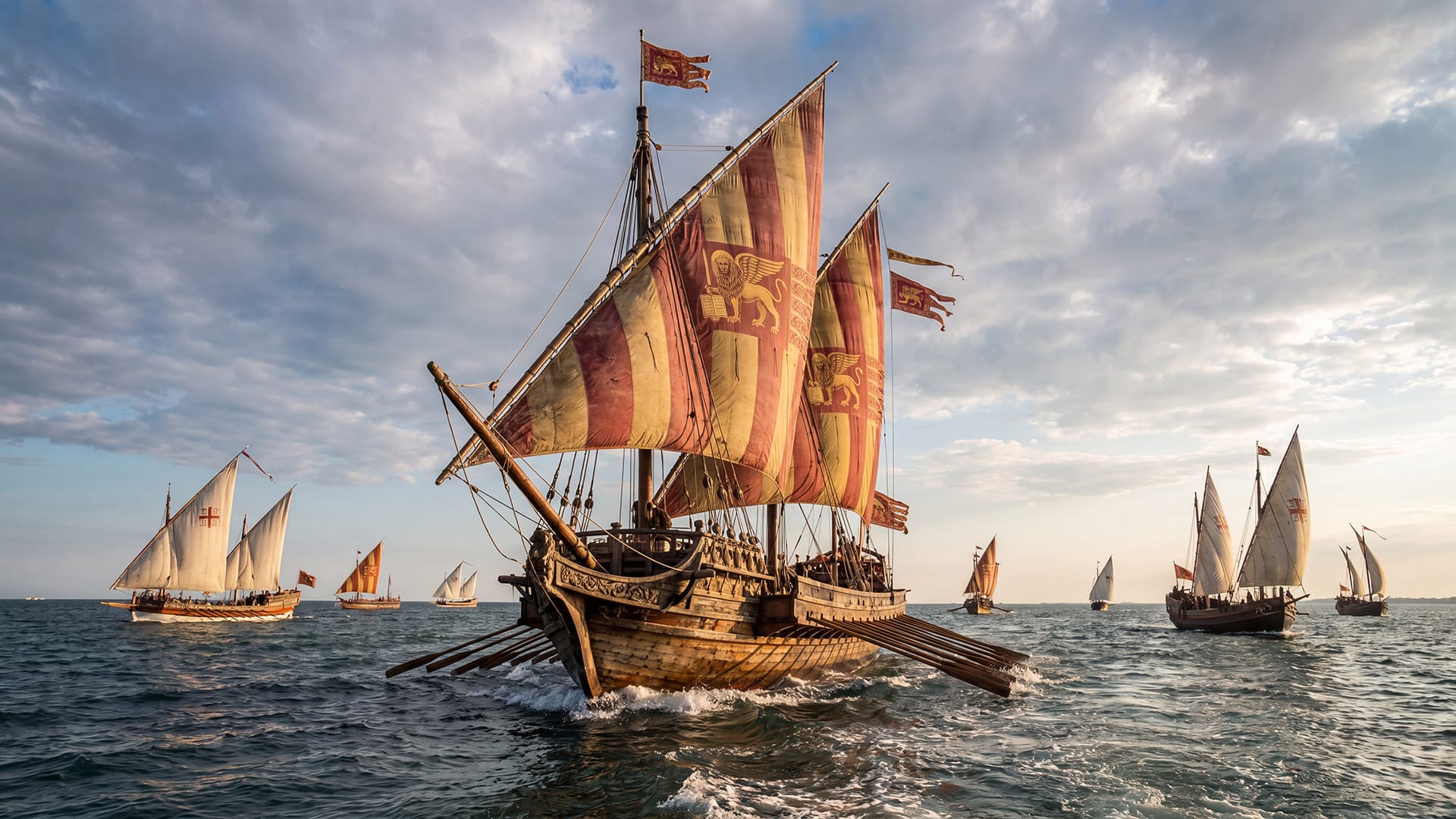
Venice also acquired Cyprus in 1489, when Caterina Cornaro ceded the kingdom to the republic. Cyprus was valuable because of its position near Syria, Anatolia, and Egypt. It remained Venetian until 1571, when the Ottoman Empire captured the island during the war that culminated at Lepanto.
The Venetian economy depended on eastern trade, especially spices, luxury fabrics, and goods moving through Byzantine and Islamic ports. Venice did not simply trade; it negotiated privileges, controlled convoys, built arsenals, and created institutions able to coordinate merchants, ships, diplomacy, and war.
Its main rival became Genoa. After 1261, when the Byzantines recovered Constantinople with Genoese support, Genoa gained access to Black Sea markets and challenged Venice’s eastern dominance. For almost two centuries, Venetian and Genoese interests collided from the Aegean to the Bosporus and the Black Sea.
The War of Chioggia was the most dangerous moment for Venice. Genoese forces occupied Chioggia and threatened the lagoon itself in 1379, but Venice reorganized, trapped the Genoese, and forced their surrender. The Peace of Turin in 1381 ended the war and confirmed Venice’s recovery.
In the 15th century, Venice expanded onto the Italian mainland. It took Treviso, then extended influence across Veneto and Friuli. This was partly defensive: mainland territory gave Venice food supplies, land routes, and security against neighboring powers. It also changed Venice from a mainly maritime state into a territorial power.
Venice began to decline when Ottoman expansion reduced its eastern markets and Atlantic discoveries shifted European trade. Constantinople fell in 1453, Euboea in 1470, Cyprus in 1571, and Crete in 1669. Venice remained independent, wealthy, and culturally powerful, but its Mediterranean supremacy was weakened.
The Venetian Republic ended in 1797, when Napoleon’s campaign destroyed the old oligarchic state. Ludovico Manin, the last doge, abdicated on 12 May 1797. Venice had lasted far longer than the other maritime republics, but it could not survive the military and political revolutions of the late 18th century.
Genoa – Venice’s Great Rival and the Power of the Black Sea
Genoa rose from a Ligurian settlement with an excellent natural harbor. After the fall of the Roman Empire, it remained relatively obscure, but the city revived in the 10th century. A Fatimid fleet attacked and sacked Genoa in 934 or 935, after which the Genoese rebuilt and turned increasingly toward the sea.
By the late 10th century, Genoa was gaining autonomy. In 958, it obtained important concessions from Berengar II. Before 1100, the Compagna Communis united citizens, merchants, nobles, and armed groups into a communal structure. This marked the emergence of Genoa as an independent maritime commune.
Genoa first cooperated with Pisa against Muslim raiders in the western Mediterranean. Together, they attacked Saracen positions and contributed to the recovery of Sardinia. This alliance soon became rivalry, because both cities wanted influence over Corsica, Sardinia, and the Tyrrhenian Sea.
The First Crusade gave Genoa a major opportunity. Genoese ships transported men and supplies, and Genoese merchants received privileges in the Holy Land. From the 12th century onward, Genoa became one of the main commercial powers of the Levant, competing directly with Venice and Pisa.
During the 12th and 13th centuries, Genoa was among Europe’s leading ports. Its trade included eastern spices, dyestuffs, medicines, western cloth, metals, African wool, skins, coral, and gold. Shipbuilding, banking, and textiles developed alongside maritime commerce.
Genoa’s overseas network was flexible. It did not always rule large territories directly. Many Genoese colonies began as quarters, warehouses, fortified districts, or self-governing merchant settlements. Over time, some became larger possessions, especially in strategic coastal zones.
The Treaty of Nymphaeum in 1261 was crucial. Genoa supported the Byzantine Empire of Nicaea against the Latin Empire of Constantinople. When Byzantium recovered Constantinople, the Genoese received privileges that opened the Black Sea and weakened Venetian influence in the eastern Mediterranean.
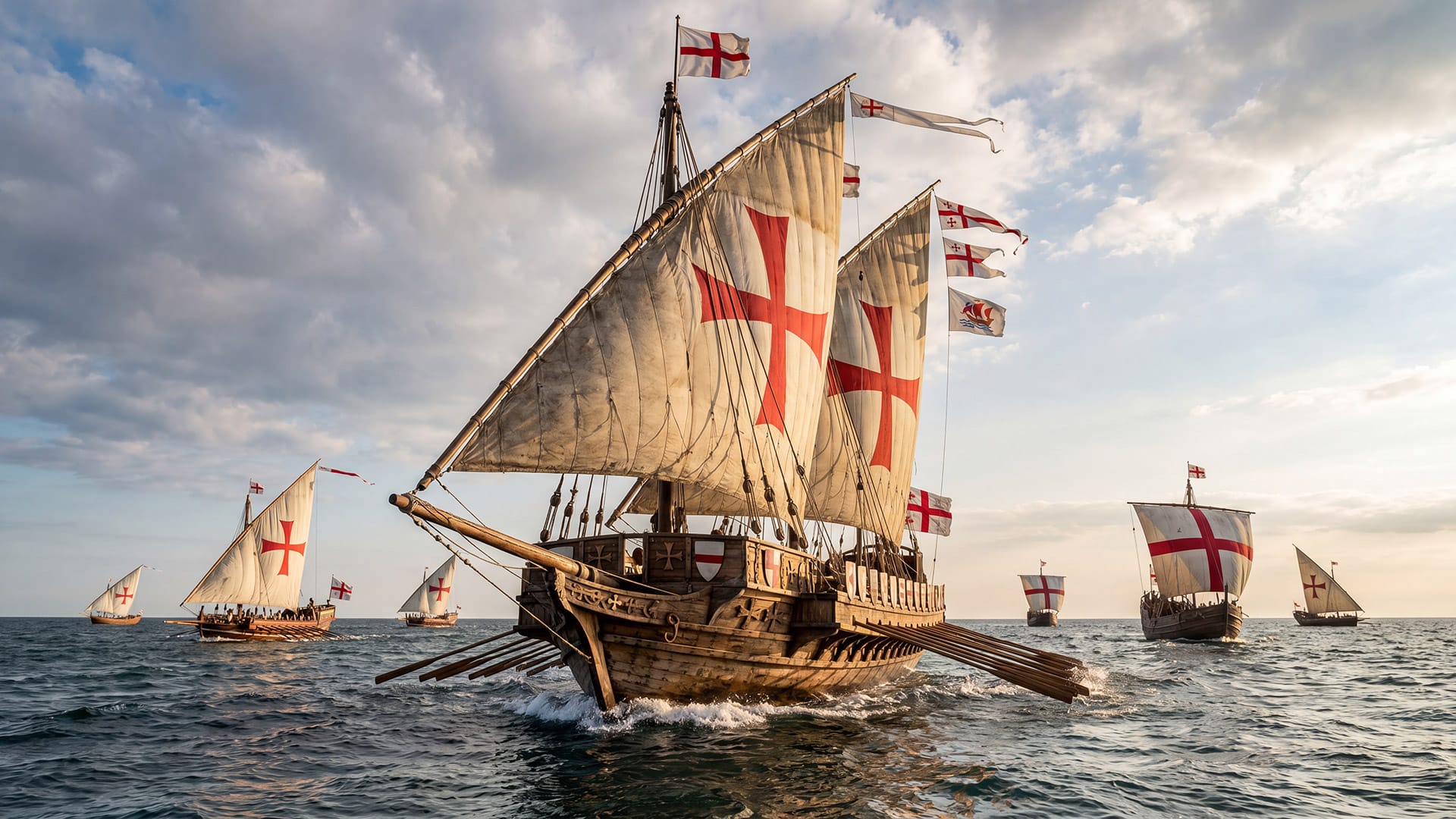
Genoa developed important bases in Pera or Galata, near Constantinople, and in Kaffa, now Feodosiya, in Crimea. Kaffa became the center of a Genoese-controlled stretch of the Crimean coast. These Black Sea colonies connected Genoa to grain, slaves, furs, wax, and eastern goods.
Genoa’s political peak came after naval victories over its rivals. In 1284, it defeated Pisa at Meloria, crippling Pisan sea power. In 1298, it defeated Venice at Curzola, although that victory did not destroy Venetian power. These victories marked Genoa’s highest medieval prestige.
Genoa controlled or influenced Liguria, much of Corsica, northern Sardinia, parts of the Aegean, and southern Crimea. Its merchants also operated across the Mediterranean through colonies and trading stations. The republic could compete with monarchies despite its compact territory.
Internal instability was Genoa’s greatest weakness. Powerful families such as the Doria, Spinola, Fieschi, and Grimaldi often competed for control. Governments were short-lived, factional struggles were frequent, and the city struggled to maintain a stable political structure despite its economic strength.
In 1339, Simone Boccanegra became the first doge of Genoa, an attempt to stabilize government on a model partly inspired by Venice. The reform did not solve Genoa’s deeper problems. Wars, factionalism, and financial strain continued through the 14th and 15th centuries.
Genoa lost influence in the eastern Mediterranean as crusader states collapsed and Ottoman power advanced. Its Levant and Black Sea colonies gradually became difficult to defend. Some became almost independent from the mother city before being conquered by Egyptian or Ottoman forces.
In 1528, Andrea Doria reorganized the republic and restored internal order. Genoa then entered a second phase of importance, less maritime than financial. Genoese bankers became deeply connected with the Spanish monarchy, and the 16th century was later remembered as the “century of the Genoese”.
The old republic declined again as Spain declined. Corsica remained a major problem, with repeated revolts. In 1768, Genoa ceded Corsica to France by the Treaty of Versailles. In 1797, under Napoleonic pressure, the Republic of Genoa became the Ligurian Republic, ending the medieval state’s long independent tradition.
Pisa – A Naval Power Between the Arno, Sardinia, Corsica, and the Crusades
Pisa developed on the Arno River, close to the sea. Today the city lies about 10 kilometers from the Ligurian Sea, because centuries of sedimentation moved the coastline away. In the Middle Ages, however, Pisa was still a maritime power connected to Porto Pisano and the Tyrrhenian routes.
Ancient Pisa had been a Roman naval base and remained important in Tuscany after the fall of Rome. Its revival came in the 11th century, when the city used sea power, Tuscan resources, and commercial opportunity to become one of the strongest ports in the western Mediterranean.
Pisa’s early rise was tied to war against Muslim raiders. In 1016, Pisans and Genoese drove Saracens from Sardinia. In 1063, the Pisan fleet attacked Muslim Palermo. Wealth from these campaigns helped finance Pisa’s monumental cathedral complex, where building began in the 11th century.
The Pisan commune formed in the second half of the 11th century. Its institutions developed together with military success, diplomacy, and Mediterranean commerce. Pisa became present in fairs, ports, and markets far beyond Tuscany, and its merchants appeared along many Mediterranean coasts.
Pisa took control of Elba and expanded its influence over Sardinia and Corsica. These islands were essential for western Mediterranean trade, naval security, and rivalry with Genoa. Pisa’s ambitions were also supported by imperial alliances, especially with the German emperors.
Frederick Barbarossa granted Pisa important privileges in 1162 and 1163, strengthening its position on the Tyrrhenian coast. Pisa generally followed the Ghibelline, pro-imperial side in Italian politics. This brought advantages against some enemies, but also tied Pisa to conflicts beyond maritime commerce.
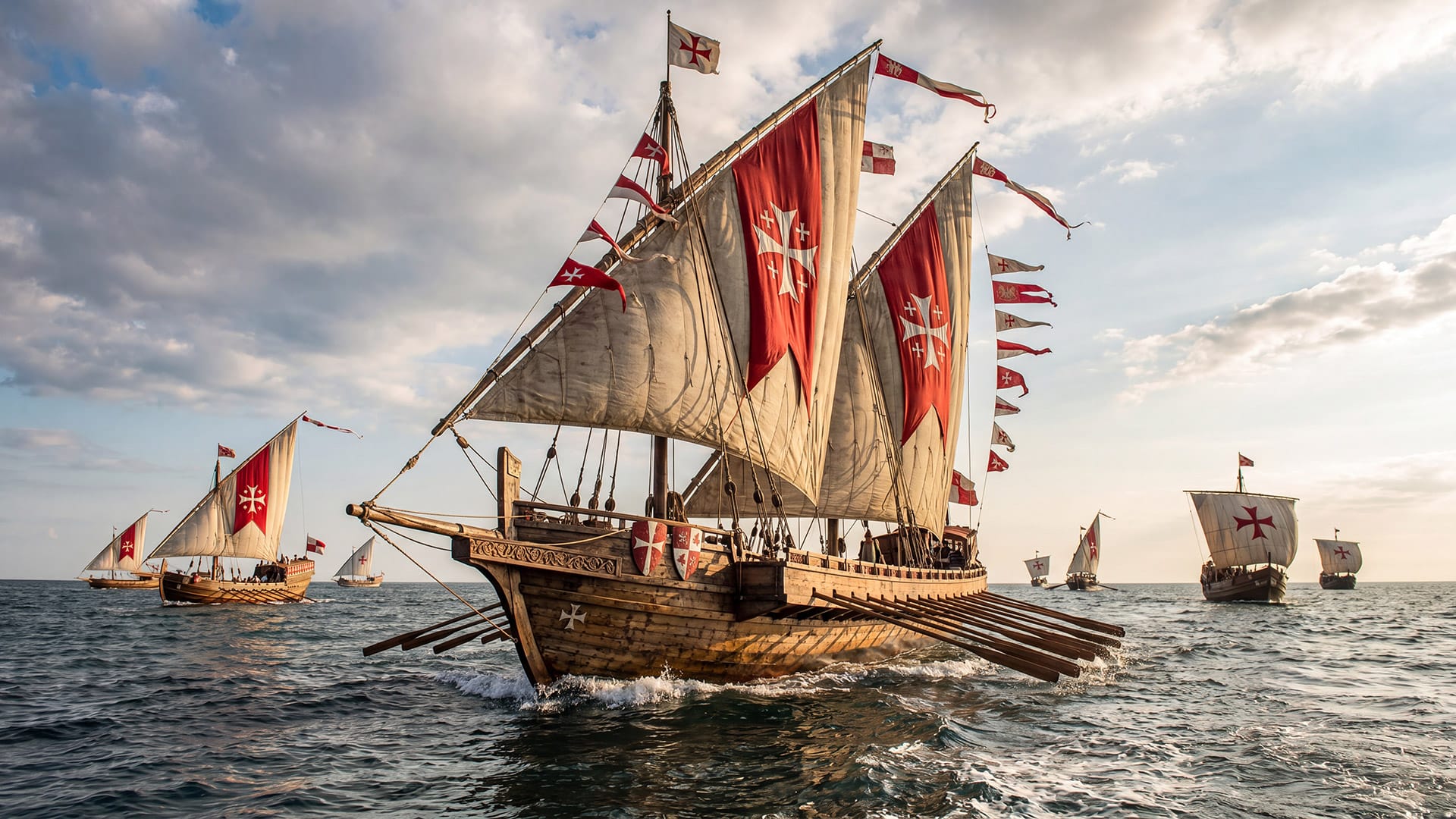
Pisa participated in the Crusades and gained trading positions in the eastern Mediterranean. Pisan merchants were active in Syria and the Levant. Their naval contribution brought economic privileges, but it also put Pisa into competition with Venice and Genoa in the same ports and routes.
Relations with Venice were mixed. The two cities clashed near Rhodes in 1099, during the First Crusade period, but later signed agreements defining zones of influence. In 1180, they agreed on non-interference between Adriatic and Tyrrhenian interests, and another treaty followed in 1206.
The decisive rivalry was with Genoa. Pisa and Genoa first cooperated against Saracens, but conflict over Corsica and western Mediterranean influence soon became unavoidable. Wars broke out in the 11th and 12th centuries, with major confrontations in 1066, 1070, 1119-1133, and 1162-1175.
Pisa reached a high point in the 13th century. It was active in Sardinia and Corsica, faced Lucca and Florence on land, and supported the imperial cause. In 1241, the imperial fleet, assisted by Pisa, defeated a Genoese fleet near Giglio and Montecristo.
The turning point came at the Battle of Meloria, fought on 6 August 1284 near Livorno. Genoa defeated Pisa in a naval battle that caused enormous losses. Thousands of Pisans were killed or captured, and the defeat permanently damaged Pisa’s ability to dominate the western Mediterranean.
After Meloria, Pisa could not regain its old position. In 1299, it renounced claims to Corsica in favor of Genoa. In 1324-1325, Aragon defeated Pisa near Cagliari and took Sardinia. Losing the islands meant losing the strategic base of Pisan maritime influence.
Pisa also had powerful land enemies. Florence and Lucca competed with it in Tuscany. Unlike Venice and Genoa, Pisa had to spend major resources defending its hinterland. This inland pressure weakened its navy and trade at the moment when its maritime rivals were expanding.
In 1406, Pisa was conquered by Florence. It briefly recovered autonomy in 1494, during the Italian Wars, and restored some republican institutions. Florence reconquered the city in 1509. By then, silting of the Arno and the rise of Livorno had ended Pisa’s role as a major port.
Amalfi – The Early Maritime Republic of the Tyrrhenian South
Amalfi was one of the earliest maritime republics. Its greatest influence came between the 9th and 11th centuries, before Venice, Genoa, and Pisa reached their full power. Its position on the Campanian coast made it a natural intermediary between Italy, Byzantium, North Africa, and the Islamic Mediterranean.
The city was under Byzantine influence in the early Middle Ages. The first certain notices place it under Byzantine rule in 533, and by 596 it was already an episcopal seat. Amalfi gradually acquired autonomy and became independent in the 9th century after escaping Lombard pressure.
Amalfi’s strength came from trade rather than large territorial conquest. Its merchants operated in Sicily, Apulia, Tripoli, Alexandria, Constantinople, and other Mediterranean ports. These communities included houses, shops, warehouses, churches, and monasteries, forming commercial presences without always requiring direct political rule.
The city traded timber to North Africa, receiving gold in exchange. From Byzantium and eastern markets, Amalfitans bought spices, precious stones, silk, fine textiles, perfumes, and luxury goods. These products were then sold in Italy, including inland routes that could reach Ravenna, the Po, and Pavia.
Amalfi issued its own coins, including the tarì, which circulated in Mediterranean trade. The city’s currency reflected strong relations with Islamic markets, because its forms were close to Muslim coinage. This shows how Amalfi combined Latin, Byzantine, and Arab commercial worlds.
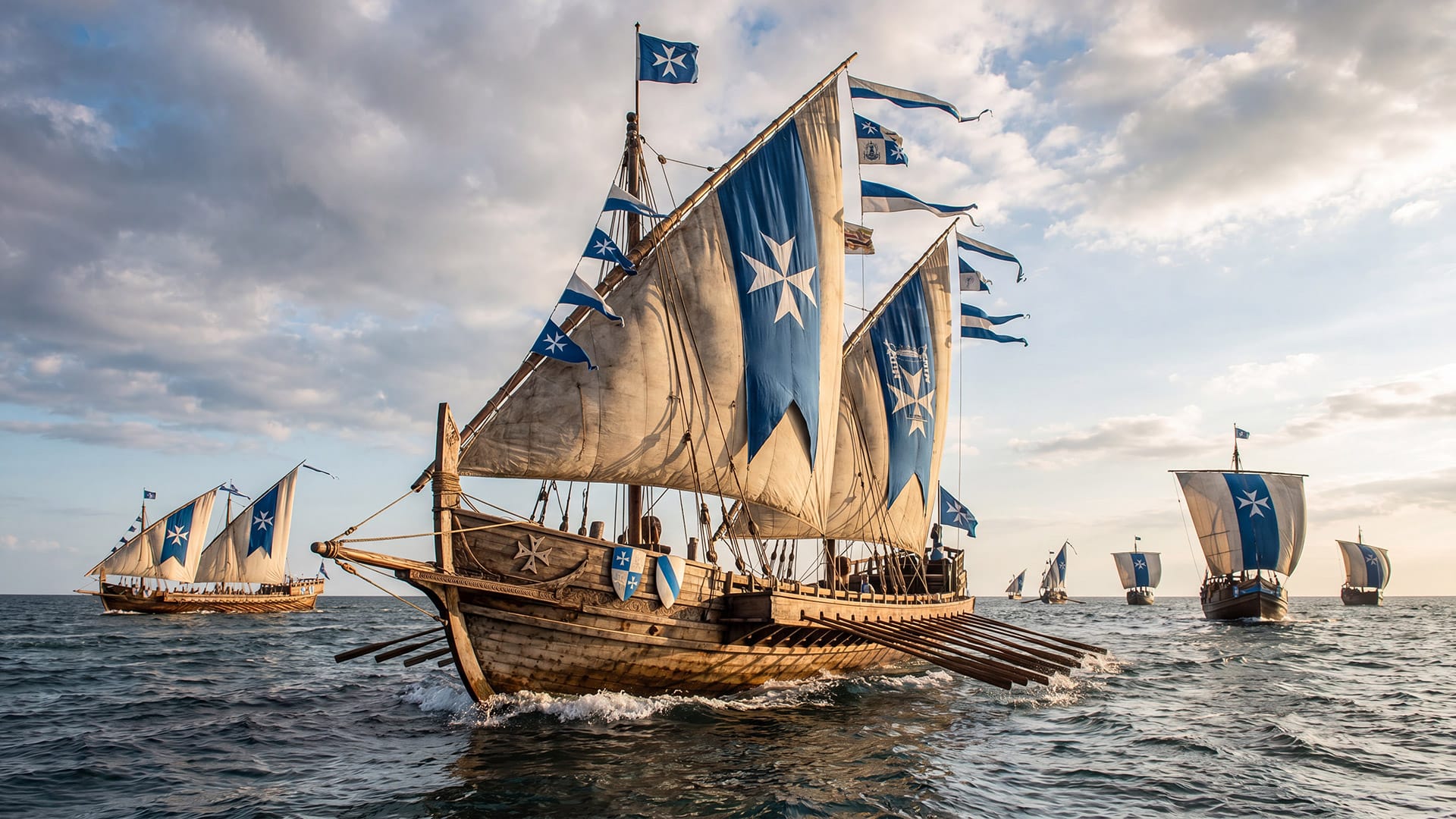
The Tavole Amalfitane were among the most important medieval maritime law codes. They regulated relationships among shipowners, sailors, and merchants. Amalfi’s legal tradition remained influential long after its political decline, showing that its maritime culture was more durable than its military power.
Amalfi is often connected with the compass. The legendary Flavio Gioia is not considered a historical inventor, but Amalfitans are associated with improving and spreading the use of the compass in European navigation. This fits Amalfi’s role as an early transmitter of maritime knowledge.
The decline began in the 11th century. In 1039, internal conflict helped Guaimar V of Salerno conquer the duchy, though Amalfi recovered in 1052. In 1073, Robert Guiscard, invited in the context of conflict with Salerno, took control of the duchy.
Amalfi retained some autonomy under Norman influence, but the last duke, Marino Sebaste, was removed around 1100. In 1131, Roger II of Sicily revoked Amalfi’s administrative autonomy. The city continued trading, but its independent political and naval power was broken.
A severe blow came in 1135, when Pisans sacked Amalfi during war involving the Normans, the pope, the emperor, Genoa, and Pisa. The attack damaged the city and its fleet. From that period, Amalfi was increasingly overshadowed by Pisa, Genoa, and Venice.
Nature and disease accelerated the decline. In 1343, a destructive sea storm or tsunami hit the Amalfi coast, damaging settlements, fortifications, shipyards, warehouses, and maritime equipment. In 1348, the Black Death further reduced the population and weakened the city’s economic life.
The Smaller Maritime Republics
The four traditional republics were not the only maritime city-states. A broader historical list includes Ancona, Gaeta, Noli, and Ragusa. These cities were smaller or less dominant, but they shared key features: maritime trade, autonomy, merchant institutions, naval activity, and Mediterranean connections.
Ancona rose on the Adriatic and became important between the 11th and 15th centuries. It developed trade with the eastern Mediterranean and resisted Venetian attempts to dominate Adriatic commerce. Its position made it a natural rival to Venice and a partner of Ragusa.
Ancona had its own currency, the agontano, accepted in Mediterranean trade. It also developed maritime laws known as the Statuti del mare, which took shape from the 12th century. Its territory was defended by castles and extended between the Adriatic and nearby river valleys.
In 1173, Ancona resisted a major siege involving imperial forces and Venetian ships. The city survived and preserved its liberty. Its greatest prosperity came in the 15th century, and in 1447, Pope Eugene IV officially recognized it as a republic.
Ancona’s decline began after the fall of Constantinople in 1453, which weakened eastern trade. In 1532, Pope Clement VII placed Ancona under direct papal administration. The city’s prosperity continued for a time, but its practical independence was ended.
Gaeta acquired administrative autonomy from Byzantium in 839. Under the Docibile dynasty, especially in the 10th century, it became an important Tyrrhenian maritime center. It traded with Italian cities and North African markets and possessed its own laws and currency.
Gaeta was often linked with Amalfi in campaigns against Muslim raiders. In 849, it joined the Campanian League to defend Ostia and Rome. In 915, Gaeta and Amalfi participated in the Christian league that defeated the Arab-Berber base on the Garigliano.
Noli was a small Ligurian maritime republic. Its fortune grew during the Crusades, when its port served ships, men, and supplies bound for the Holy Land. It bought rights from the Del Carretto marquises and achieved independence in 1192, confirmed in 1196 by Henry VI.
Noli became a close ally and protectorate of Genoa from 1202, while preserving internal independence. This made it unusual: it did not mint its own currency or develop autonomous overseas fondachi like larger republics. Its prosperity declined when Crusader traffic ended and larger ships favored bigger ports.
Ragusa, today Dubrovnik in Croatia, belonged to the Adriatic maritime world. Founded by refugees from Epidauros after its destruction in 615, it developed eastern Mediterranean trade from the 7th century and became a major Adriatic merchant city from the 11th century.
Ragusa was under Venetian control after 1204, then gained wider self-government after the Peace of Zadar in 1358, under Hungarian suzerainty. It later accepted formal Ottoman supremacy after 1526, paying tribute to preserve autonomy. Its decline followed the devastating earthquake of 6 April 1667.
Regatta of the Historical Marine Republics
The Regatta of the Historical Marine Republics was created in 1955 by the municipalities of Venice, Genoa, Amalfi, and Pisa. Its purpose was to commemorate the four best-known medieval maritime republics through a rowing competition preceded by a historical parade.
The first regular edition took place in 1956 at Pisa. The event is held in rotation among the four cities. It normally takes place between late May and early July, though special editions and calendar changes have occurred in different years.
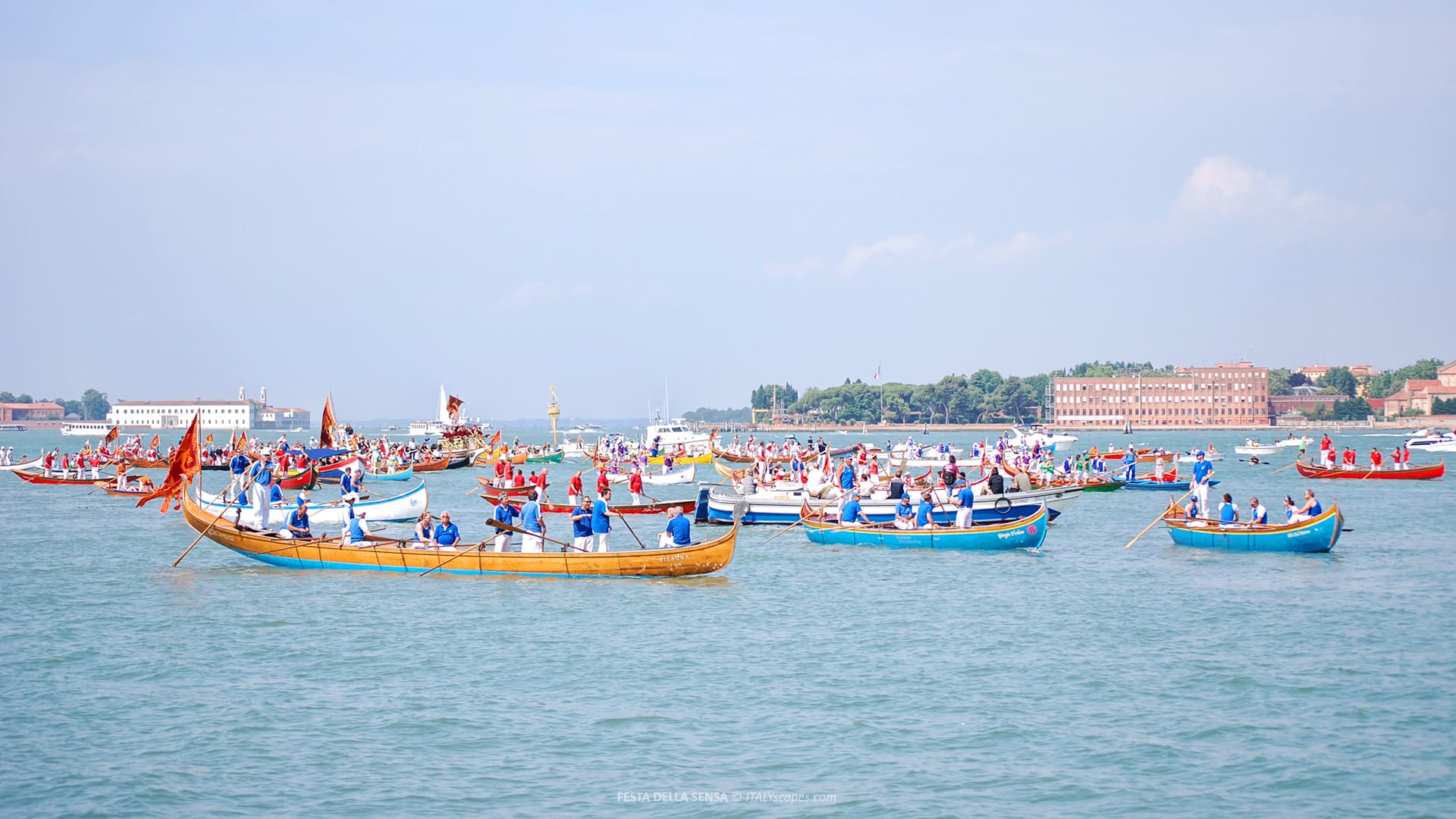
The regatta is not only a sport event. It is also a civic and historical ceremony. Each city stages a procession with costumes, banners, and figures connected to its medieval past. The parade recalls the period when merchant fleets, admirals, doges, consuls, and dukes shaped Mediterranean politics.
Each crew is composed of 8 rowers and 1 helmsman, with reserves available. Since 2004, crew composition rules have required half the athletes to come from the relevant region and half from the relevant province, preserving the local identity of the competition.
The boats are built according to the same structural standards. Empty and with accessories, but without oars, they must weigh at least 760 kilograms. Earlier boats were wooden, while modern ones are made of fiberglass to improve efficiency while respecting the required weight.
Each boat has a color and a figurehead. Amalfi uses blue and the winged horse. Genoa uses white and the dragon, linked to Saint George. Pisa uses red and the eagle, reflecting its imperial connections. Venice uses green and the winged lion of Saint Mark.
The course is 2 kilometers long, but the setting changes according to the host city. Amalfi rows along the Tyrrhenian coast. Genoa rows in the Ligurian port area. Pisa rows upstream on the Arno. Venice rows in the lagoon of the Adriatic.
The winner receives a gold and silver trophy showing a rowing galley supported by four hippocamps, with the coats of arms of the four republics. The trophy is held for one year, until the next edition. Each victory adds another medal to the trophy base.
The regatta keeps the memory of the maritime republics visible in modern Italy. It does not reproduce medieval politics, but it preserves the symbols of four cities whose fleets once connected Italy to the Adriatic, the Tyrrhenian Sea, the Aegean, the Black Sea, and the Levant.
Frequently Asked Questions about the Italian Maritime Republics
What were the Italian Maritime Republics?
The Italian Maritime Republics were medieval port cities that became powerful through sea trade, naval strength, diplomacy, and overseas commercial networks across the Mediterranean, Adriatic, Black Sea, and Levant.
Which were the four main Italian Maritime Republics?
The four main Italian Maritime Republics were Venice, Genoa, Pisa, and Amalfi. Their coats of arms still appear on the flag of the Italian Navy and merchant marine.
Why was Venice the most powerful maritime republic?
Venice lasted the longest because it controlled major trade routes, built a strong navy, ruled important territories such as Crete and Cyprus, and maintained stable political institutions.
Why were Genoa and Venice rivals?
Genoa and Venice competed for control of eastern Mediterranean trade, Byzantine privileges, Black Sea routes, colonies, and access to valuable goods from Asia and the Levant.
What caused the decline of Pisa as a maritime power?
Pisa declined after the Battle of Meloria in 1284, when Genoa destroyed much of its naval strength. Later, Pisa lost influence in Sardinia, Corsica, and Tuscany.
Were there other Italian maritime republics besides the four main ones?
Yes. Smaller maritime republics included Ancona, Gaeta, Noli, and Ragusa, today Dubrovnik. They had trade networks, local autonomy, maritime laws, and strategic Adriatic or Tyrrhenian roles.
What is the Regatta of the Historical Marine Republics?
The Regatta of the Historical Marine Republics is a modern rowing competition created in 1955. Venice, Genoa, Pisa, and Amalfi compete with crews representing their medieval maritime heritage.
Images generated with Nano Banana Pro / Google AI Studio


