
Table of Contents
The history of Venice is the story of a city that rose from a lagoon settlement into one of the most influential maritime powers in Europe. Built on islands, mudbanks, canals, and protected waters, Venice developed differently from the great land powers of Italy. Its strength came from the sea.
For centuries, Venice controlled trade between Western Europe, Byzantium, the Levant, and the wider Mediterranean. Its merchants carried spices, silk, grain, salt, timber, metals, and luxury goods. Its ships connected markets, while its diplomats defended commercial privileges in ports far beyond the Adriatic.
Venice was also a political experiment. The doge stood at the head of the state, but he was never an absolute ruler. His authority was limited by councils, magistrates, noble families, and strict constitutional traditions. This system helped Venice avoid monarchy, but it also made the republic severe and suspicious.
The history of Venice was shaped by moments of ambition, danger, victory, humiliation, and collapse. Some events expanded Venice’s power across the Mediterranean. Others showed the limits of its institutions, its navy, or its diplomacy. Together, they explain how the Serenissima became powerful and why it eventually fell.
These decisive moments are essential for understanding the history of Venice. They reveal a republic that was not only beautiful, but also calculating, disciplined, commercial, and often ruthless. Behind the palaces and churches stood a state built on strategy, sea power, secrecy, and survival.
The Fourth Crusade and the Sack of Constantinople
Venice and the Crusader Contract
One of the most decisive episodes in the history of Venice began with the Fourth Crusade. In 1201, Venice agreed to provide ships and transport for a large crusading army. The expedition was officially intended for the recovery of Jerusalem, but it soon became entangled in debt and politics.
The crusaders had overestimated the number of men who would arrive in Venice. When fewer fighters appeared, they could not fully pay the enormous sum promised to the Venetians. Doge Enrico Dandolo used this situation to redirect the expedition toward objectives that served Venetian interests.
The first major diversion was Zara, a Christian city on the Dalmatian coast that had rebelled against Venetian control. The attack was controversial because it targeted fellow Christians, but for Venice it had strategic value. Control of the Adriatic was essential for the republic’s security and trade.
The Fall of Constantinople
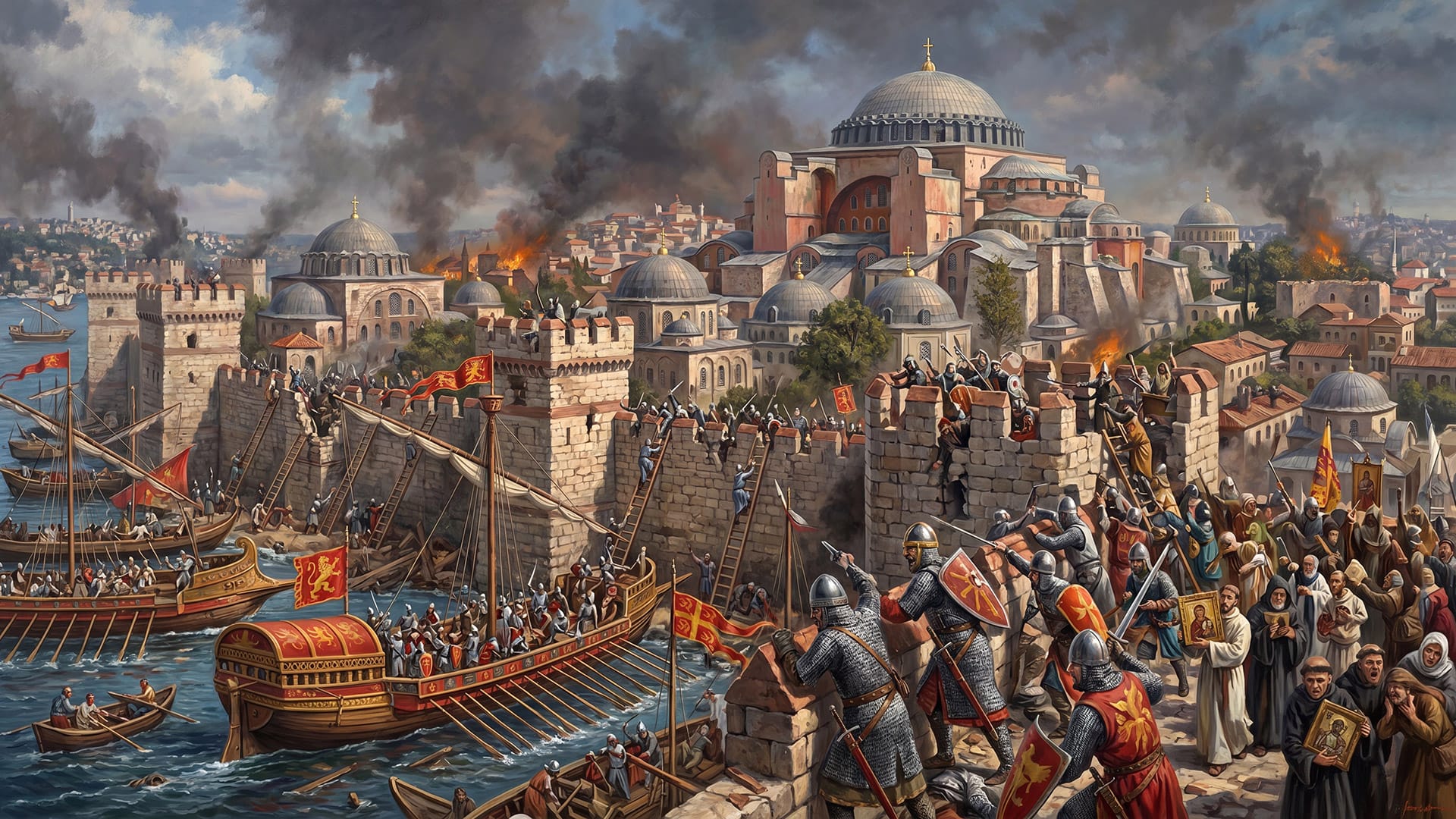
The crusade then moved toward Constantinople, capital of the Byzantine Empire. In 1204, the city was captured and sacked by the crusading forces. The event deeply weakened Byzantium and transformed the political balance of the eastern Mediterranean. Venice emerged as one of the main beneficiaries.
After the conquest, Venice gained commercial privileges, territories, islands, and strategic ports. These possessions became part of the Stato da Mar, the Venetian maritime empire. It was not a compact land empire, but a chain of maritime bases, colonies, fortresses, and trading stations.
Venice also brought back treasures, artworks, relics, and Byzantine influences. These helped shape the symbolic image of the city, especially around St Mark’s Basilica. The famous bronze horses associated with the basilica became signs of Venetian victory, prestige, and eastern ambition.
A Maritime Empire Is Born
The sack of Constantinople turned Venice into more than a commercial republic. It became an imperial maritime power with possessions across the eastern Mediterranean. Crete, parts of Euboea, Aegean islands, and trading posts strengthened Venice’s role between Europe and the Levant.
This moment also created long-term consequences. Venice gained wealth and influence, but it also deepened hostility with Byzantines, Genoese, and other Mediterranean rivals. The Fourth Crusade gave Venice enormous advantages, yet it tied the republic to centuries of conflict in the eastern Mediterranean.
Marino Faliero and the Doge Who Challenged the Republic
A Doge with Limited Power
In 1354, Marino Faliero became doge of Venice. The office looked magnificent from the outside, but the doge was not an absolute ruler. Venetian institutions carefully restricted his power, because the republic feared tyranny, dynastic ambition, and personal rule above the law.
The doge represented Venice in ceremonies, diplomacy, and state rituals, but real authority was shared with councils and noble institutions. The republic’s political system was designed to keep the head of state under control. This made Faliero’s later actions especially dangerous for Venetian stability.
Venice in the mid-14th century faced external pressure, social tension, and rivalry with Genoa. Faliero ruled during a difficult period, when the gap between aristocratic power and popular resentment could become politically explosive. His short reign became one of the darkest episodes in the history of Venice.
The Conspiracy of 1355
Faliero was accused of plotting against the Venetian aristocracy in 1355. The traditional account says he became involved in a conspiracy with non-noble figures who wanted to overthrow the ruling oligarchy. Whether driven by personal ambition or political frustration, the accusation was catastrophic.
For Venice, the issue was not only one man’s guilt. The deeper danger was constitutional. If a doge could use his position to destroy the aristocratic republic, the entire political system would collapse. The state reacted quickly and with extreme severity.
Faliero was arrested, tried, condemned, and executed in April 1355. His death took place in the Doge’s Palace, the symbolic heart of Venetian power. The message was unmistakable: no doge, however high, stood above the Republic of Venice.

The Black Veil in the Doge’s Palace
The most famous consequence was the erasure of Faliero’s memory. In the Sala del Maggior Consiglio, where the portraits of the doges were displayed, Faliero’s image was replaced by a dark veil or black inscription. His absence became a permanent warning.
This was a form of political punishment beyond death. Venice did not simply execute a traitor; it condemned him to historical disgrace. The empty place among the doges shows how seriously the republic treated betrayal, ambition, and threats to its aristocratic order.
Faliero’s story remains one of the most powerful episodes connected with the Doge’s Palace. It reveals the severity of Venetian politics and the strength of republican institutions. Venice preferred to kill and erase its own doge rather than allow personal power to break the state.
The War of Chioggia and the Day Venice Almost Fell
The Rivalry Between Venice and Genoa
The next decisive moment came during the long rivalry between Venice and Genoa. Both republics competed for maritime trade, colonies, naval routes, and influence in the Mediterranean and Black Sea. Their conflict was not occasional; it was structural, commercial, and strategic.
The War of Chioggia, fought between 1378 and 1381, was the last major medieval war between the two maritime republics. It was part of a wider struggle that involved not only fleets, but also alliances with other Italian and European powers hostile to Venice.
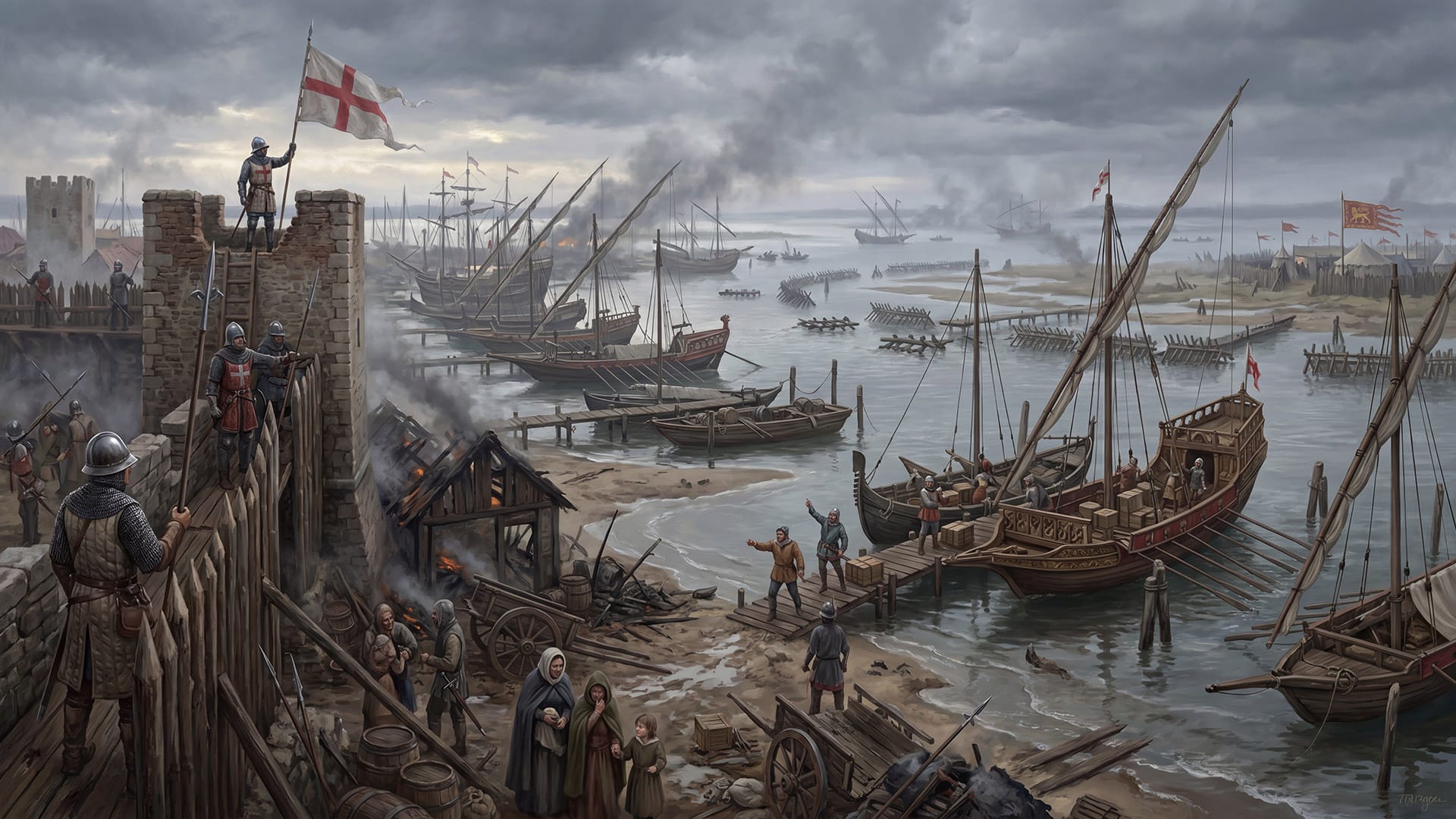
For Venice, the danger became immediate when Genoese forces captured Chioggia in 1379. Chioggia stood at the southern edge of the Venetian lagoon. Its occupation meant that the enemy had reached the threshold of Venice itself, threatening the city’s security and supply lines.
The Lagoon Under Threat
Venice was used to fighting wars far from home, in Dalmatia, Greece, the Aegean, and the Levant. Chioggia was different. The enemy was no longer distant. A hostile fleet and army were positioned inside the lagoon system, close enough to endanger the republic’s survival.
The psychological effect must have been severe. Venice’s lagoon had always been its greatest defense against land armies. Now that same lagoon had become a battlefield. If Genoa had consolidated its position, Venice could have been isolated, starved, or forced into surrender.
Venice responded by mobilizing ships, men, money, and commanders. Important figures such as Vettor Pisani and Carlo Zeno were associated with the Venetian recovery. Through blockade, naval pressure, and determination, the republic gradually reversed the situation.
Survival and the Peace of Turin
The Venetian counteroffensive culminated in the recovery of Chioggia. The Genoese forces, once threatening Venice, became trapped and weakened. The war officially ended with the Peace of Turin in 1381. Both republics were exhausted, but Venice had survived its most dangerous medieval crisis.
The War of Chioggia was decisive because Venice came close to disaster and escaped. Genoa remained important, but it never again posed the same existential danger to Venice. The republic’s maritime position recovered, even if the war had revealed its vulnerability.
After this crisis, Venice increasingly understood that security also required control of nearby mainland territories. The republic did not abandon the sea, but the experience of Chioggia encouraged greater attention to the Terraferma, Venice’s mainland state in northern Italy.
The League of Cambrai and the European Attack on Venice
Venice Becomes Too Powerful on Land
By the late 15th century, Venice was no longer only a maritime empire. It had expanded across mainland northern Italy, controlling cities, fortresses, and agricultural territories. This made the republic richer and more secure, but it also alarmed popes, emperors, kings, and Italian rivals.
Venice’s mainland expansion changed how other powers saw the republic. It was no longer simply a commercial city with colonies overseas. It had become a territorial power in Italy. This made it a target in the violent diplomatic world of the Italian Wars.
In 1508, the League of Cambrai was formed against Venice. The alliance included Pope Julius II, Holy Roman Emperor Maximilian I, King Louis XII of France, and Ferdinand of Aragon. Its purpose was to attack Venetian power and divide its possessions.
The Disaster at Agnadello
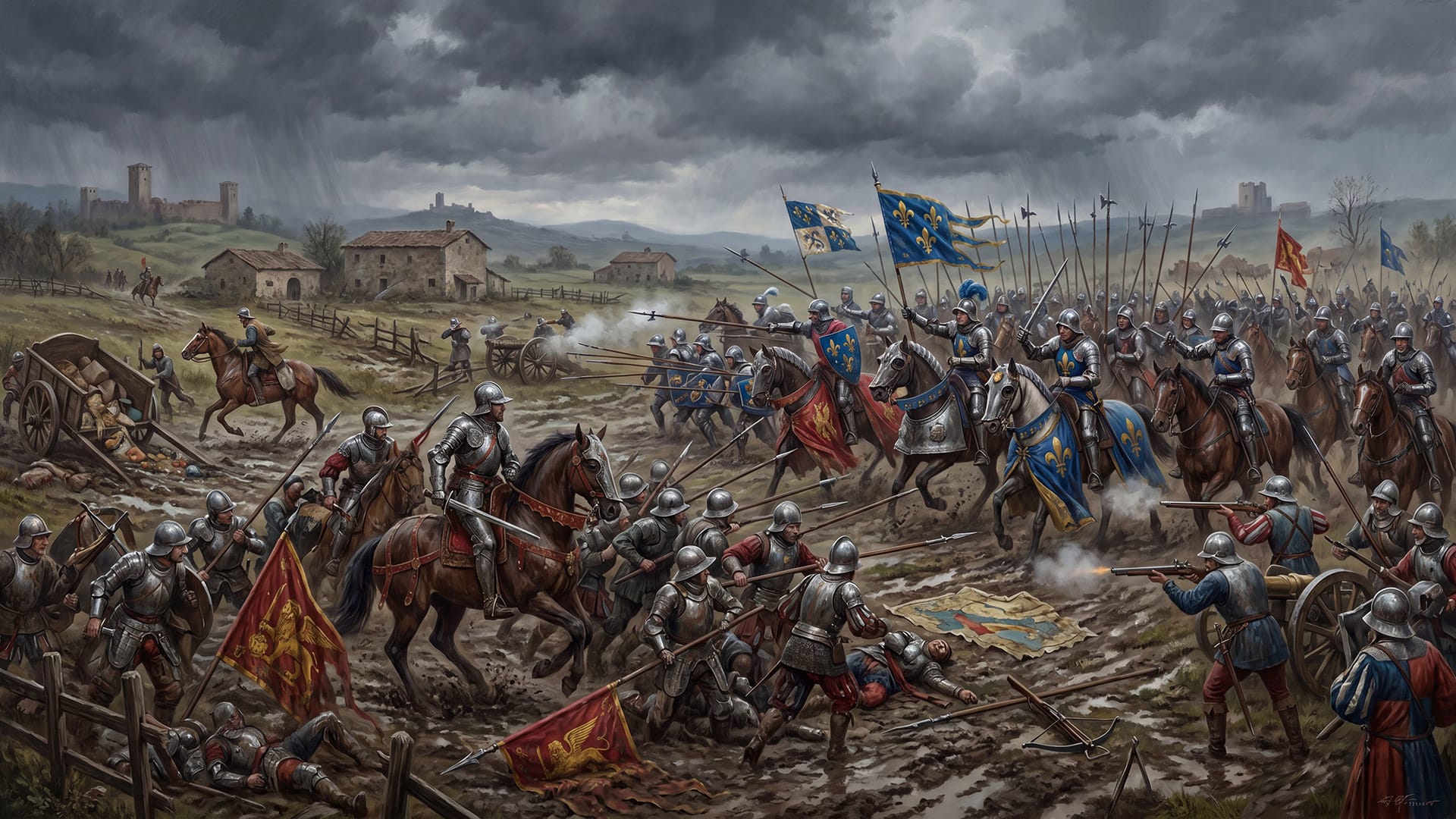
The crisis became dramatic in 1509, when Venice suffered a severe defeat at the Battle of Agnadello. French forces defeated Venetian troops commanded by Bartolomeo d’Alviano. After the battle, Venice temporarily lost many mainland territories and seemed close to political collapse.
Agnadello was one of the greatest shocks in the history of Venice. The republic had survived naval rivalries and Mediterranean wars, but now it faced modern territorial monarchies with large armies. Mainland expansion had brought Venice wealth, but also a new kind of danger.
The defeat revealed that Venice could not dominate northern Italy without provoking coalitions stronger than itself. Its land empire was more exposed than its lagoon capital. The city itself remained difficult to conquer, but its mainland territories could be attacked by powerful armies.
Diplomacy Saves the Republic
Venice survived because the League of Cambrai did not remain united. Its members had competing interests. Once French influence in Italy became too strong, Pope Julius II and other powers reconsidered their positions. Venice used diplomacy, flexibility, and negotiation to recover much of what it had lost.
The League of Cambrai marked a turning point. Venice survived the crisis, but its confidence was permanently damaged. The republic could still act as a major Italian power, yet it had to be more cautious. The age of easy territorial expansion was over.
This episode shows one of Venice’s greatest strengths: political adaptability. The republic was defeated on the battlefield, but not destroyed. It used diplomacy to exploit divisions among its enemies, proving that Venetian survival depended as much on negotiation as on military force.
The Battle of Lepanto and the Struggle for the Mediterranean
Cyprus and the Ottoman Threat
In the 16th century, Venice faced a powerful rival in the eastern Mediterranean: the Ottoman Empire. Ottoman expansion threatened Venetian colonies, naval routes, and commercial interests. The struggle was not only religious; it was also about ports, islands, taxation, maritime corridors, and imperial control.
The immediate background to Lepanto was the war over Cyprus, one of Venice’s most valuable possessions. The Ottoman conquest of the island in 1570–1571 was a major blow. Venice lost a strategic eastern base that had linked its trade to the Levant.
The fall of Cyprus pushed Venice into the Holy League, an alliance supported by Pope Pius V and Spain. The coalition united several Catholic powers against the Ottoman fleet. Venice contributed important naval forces, because its Mediterranean position depended on resisting Ottoman domination.
The Battle of 1571
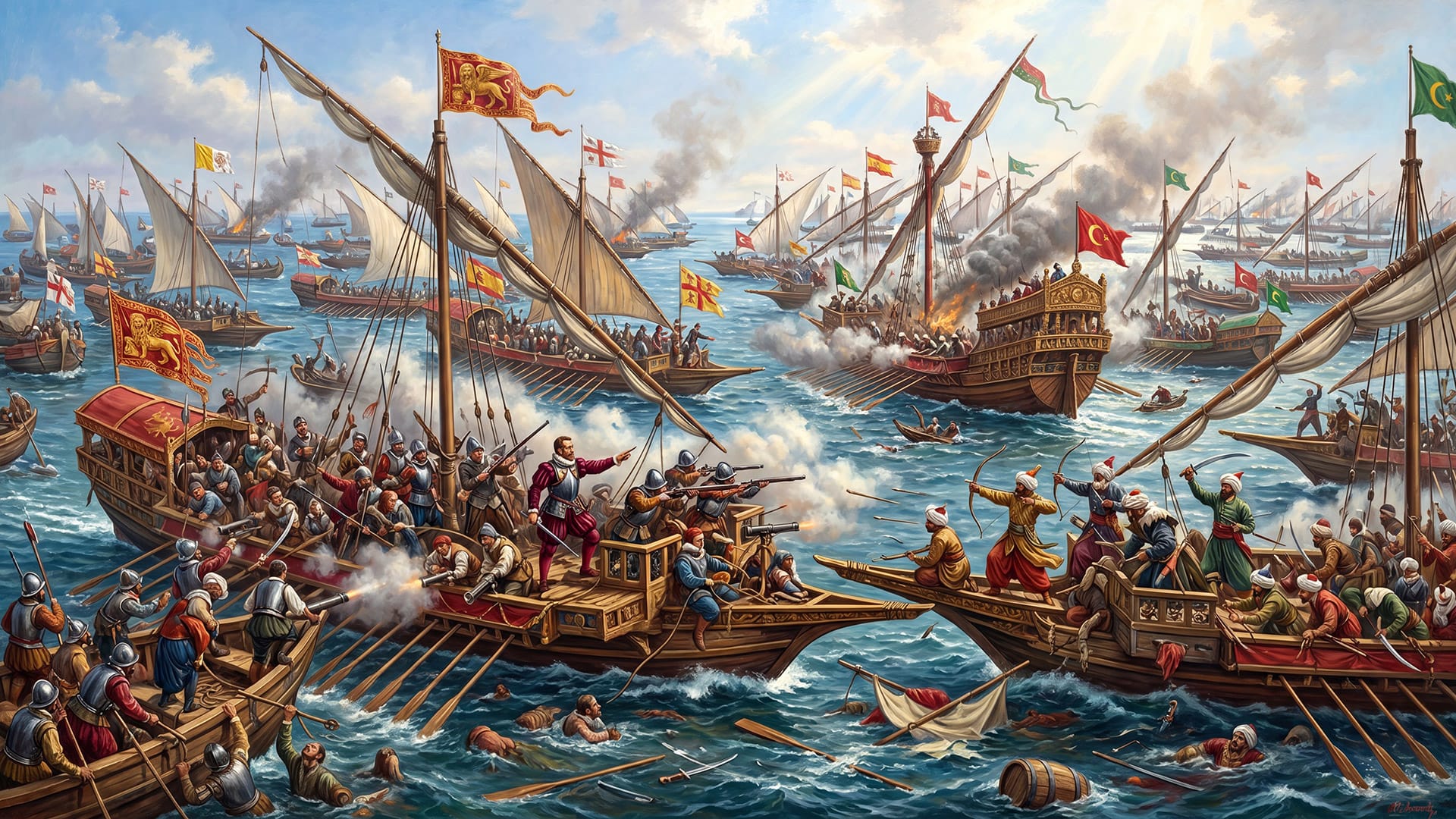
The Battle of Lepanto was fought on October 7, 1571. The Holy League fleet, commanded overall by Don John of Austria, confronted the Ottoman navy in one of the largest naval battles of the early modern period. Venice played a major role in the coalition.
The Christian coalition won a major victory. The Ottoman fleet suffered heavy losses, and the battle became famous across Catholic Europe. Lepanto was celebrated as proof that Ottoman naval power could be defeated, and Venice gained prestige after the painful loss of Cyprus.
For Venice, the victory had emotional and symbolic value. It offered revenge after the fall of Cyprus and confirmed that Venetian naval expertise still mattered. Venetian ships, commanders, and resources remained important in the wider Mediterranean balance of power.
Victory Without Recovery
The strategic result was more limited than the celebration suggested. Venice did not recover Cyprus. The Ottoman Empire rebuilt its naval power, and the long-term balance in the eastern Mediterranean did not return to Venice’s favor. Lepanto was glorious, but not decisive enough to restore empire.
This contradiction makes Lepanto essential to the history of Venice. It was both a triumph and a sign of decline. Venice could still fight, but it increasingly needed alliances with larger powers. Its own resources were no longer enough to dominate the eastern Mediterranean alone.
Lepanto also belongs to a broader transformation of world trade. Atlantic routes were becoming more important, while Mediterranean commerce lost some of its former centrality. Venice remained wealthy and magnificent, but the commercial world that had made it dominant was slowly changing.
The Fall of the Republic and the End of the Serenissima
Venice in the Age of Napoleon
The final decisive moment came in 1797, during Napoleon Bonaparte’s Italian campaign. By then, Venice was still culturally brilliant and symbolically powerful, but its political and military strength had declined. The republic tried to preserve independence through neutrality, caution, and diplomacy.
The old Venetian system had survived for centuries, but revolutionary warfare changed the situation. France brought mass armies, ideological pressure, and rapid political transformation. Venice’s aristocratic institutions were slow, conservative, and poorly prepared for the speed of Napoleonic expansion.
The last doge was Ludovico Manin, elected in 1789. He ruled during the republic’s final years, when the old ceremonies still existed but the state no longer had the force to defend its independence. The Serenissima had prestige, but not enough power.
The Last Vote of the Great Council
On May 12, 1797, the Maggior Consiglio voted to end the old republican government. Ludovico Manin abdicated, and the Republic of Venice ceased to exist after more than a millennium of independence. It was one of the most dramatic endings in European political history.
The fall of Venice was not a heroic last stand like Chioggia or Lepanto. It was a political collapse under military pressure. Napoleon’s forces had transformed the balance of power in northern Italy, and Venice lacked the means to resist effectively.
Later in 1797, the Treaty of Campo Formio transferred Venice to Habsburg Austria. This confirmed that the old republic had become an object of great-power diplomacy. A state that once negotiated from strength was now divided and transferred by others.

From Republic to Memory
The fall of the republic ended the sovereign history of Venice. After 1797, Venice continued as a city of art, architecture, memory, and culture, but no longer as an independent maritime state. Its political identity was broken, even if its symbolic power survived.
The end was especially tragic because Venice had endured so many earlier crises. It had survived Genoa, the League of Cambrai, Ottoman pressure, and centuries of diplomatic danger. Yet it could not survive the revolutionary and military transformation of Europe at the end of the 18th century.
The fall of the Serenissima changed how Venice was remembered. It was no longer feared as a republic of merchants, ships, spies, and councils. It became increasingly imagined as a city of beauty, melancholy, decline, and vanished grandeur.
Why These Moments Define the History of Venice
The decisive moments in the history of Venice show a republic shaped by ambition and survival. The Fourth Crusade gave Venice an empire. Marino Faliero’s execution defended the state against internal tyranny. The War of Chioggia saved the lagoon from Genoese conquest.
The League of Cambrai revealed the dangers of mainland expansion. Lepanto showed both the glory and limitations of Venetian naval power. The fall of 1797 ended the Serenissima as a sovereign state and transformed Venice from a political force into a historical legend.
These events explain why Venice cannot be understood only as a romantic city of canals. It was also a disciplined republic with harsh laws, careful institutions, military ambition, commercial intelligence, and a deep fear of disorder. Its beauty was inseparable from its political structure.
Venice rose because it mastered the sea, protected its lagoon, controlled trade, and built a system stronger than individual rulers. It declined because the world changed: empires grew larger, Atlantic commerce expanded, warfare evolved, and old republican institutions lost their ability to adapt.
Today, these turning points still echo across Venice. St Mark’s Basilica recalls eastern conquest. The Doge’s Palace remembers political discipline. Chioggia recalls existential danger. Lepanto recalls naval glory. The memory of 1797 reminds us that even the most enduring republics can disappear.
Frequently Asked Questions about the History of Venice
What were the most decisive moments in the history of Venice?
The most decisive moments include the Fourth Crusade, the execution of Marino Faliero, the War of Chioggia, the League of Cambrai, the Battle of Lepanto, and the fall of the Republic in 1797.
Why was the Fourth Crusade important for Venice?
The Fourth Crusade was important because it helped Venice gain territories, trade privileges, and influence in the eastern Mediterranean, transforming the republic into a major maritime empire.
Who was Marino Faliero?
Marino Faliero was a Venetian doge accused of plotting against the republic in 1355. He was executed, and his memory was publicly erased inside the Doge’s Palace.
What was the League of Cambrai?
The League of Cambrai was a powerful alliance formed in 1508 against Venice. It included major European rulers who wanted to weaken Venice and divide its mainland territories.
When did the Republic of Venice fall?
The Republic of Venice fell on May 12, 1797, when the Great Council voted to end the old government under pressure from Napoleon’s military campaign in northern Italy.
Images generated with Nano Banana Pro / Google AI Studio


