-
About
Table of Contents
Buy tickets & tours:VivaTicketThe Tempio Voltiano is a Neoclassical monument and science museum located on the southwestern shore of Lake Como, in the city of Como. Dedicated to Alessandro Volta, the Italian physicist who invented the electric battery, the building stands in the Giardini a Lago, at the end of Viale Guglielmo Marconi.
Designed by architect Federico Frigerio and inaugurated in 1928, the monument commemorates the centenary of Volta’s death in 1827. Its architecture draws inspiration from the Pantheon in Rome, incorporating classical columns, a monumental dome, elaborate marble decorations, and a circular central hall designed to celebrate the achievements of the famous scientist.
Inside the building, the Volta Museum preserves scientific instruments, historical documents, and personal memorabilia associated with Alessandro Volta. The permanent exhibition examines his contributions to electricity, electrometry, and the study of gases, including his invention of the voltaic pile, widely recognized as the first electric battery capable of supplying a continuous electric current.
The monument occupies a prominent position on Como’s waterfront, close to the Monumento ai Caduti, the city’s war memorial. Its gardens connect the building with the surrounding lakeside public spaces, while the historic center and the main railway station are within walking distance, making the museum accessible to visitors exploring Como.
Short History of the Tempio Voltiano
Alessandro Volta and His Scientific Legacy
Alessandro Giuseppe Antonio Anastasio Volta was born in Como on February 18, 1745. He became one of the leading experimental physicists of his time, conducting influential research into electrical phenomena and gases. His scientific achievements established an international reputation that continued to grow during the nineteenth century.
In 1774, Volta became a professor at the Royal School of Como, where he taught physics before moving to the University of Pavia in 1779. His early investigations included the electrophorus, an electrostatic device, and experiments involving gases, electrical charge, and methods of measuring electrical phenomena.
Volta’s most important achievement came in 1799, when he developed the voltaic pile, an apparatus producing a continuous electric current through chemical reactions between different metals and an electrolyte. Announced in 1800, the invention marked a turning point in experimental physics and laid the foundations for electrochemistry.
The scientist died on March 5, 1827, in Como. His discoveries continued to influence research and technological development, while the international scientific community commemorated his achievements by naming the volt, the unit of electric potential difference, in his honor.
The 1899 Volta Exhibition and the Fire
In 1899, Como organized a major exhibition celebrating the centenary of the invention of the electric battery. The exhibition included scientific apparatus, historical documents, and objects associated with Volta, providing an opportunity to present his achievements to visitors and researchers.
However, a devastating fire destroyed the exhibition pavilions and numerous scientific objects displayed inside them. The disaster resulted in the loss of original instruments and documents, creating a serious gap in the surviving material evidence of Volta’s experimental investigations.
The destruction demonstrated the importance of establishing a permanent museum capable of preserving the remaining scientific heritage. The surviving objects, together with reconstructions of instruments lost in the fire, would eventually form an essential part of the collection housed in the new monument.
Construction and Inauguration
The project became possible through Francesco Somaini (1855-1939), a cotton industrialist and public figure who financed the construction. Somaini promoted the initiative as a tribute to Volta and eventually donated the completed building to the municipality of Como.
The architectural project was entrusted to Federico Frigerio (1873-1959), who designed a monumental building inspired by classical architecture. Construction began in 1925 and was completed in 1927, coinciding with the centenary of Volta’s death.
The Tempio Voltiano was officially inaugurated in July 1928, during the celebrations commemorating the physicist. Although the municipality and several historical accounts give slightly different dates for the inauguration, the monument’s opening established a permanent institution dedicated to the preservation of Volta’s scientific legacy.
In 1933, Albert Einstein visited the monument and paid tribute to Volta’s achievements. Einstein recognized the importance of the electric battery to modern technology, highlighting the lasting influence of the Italian physicist’s work on subsequent scientific discoveries.
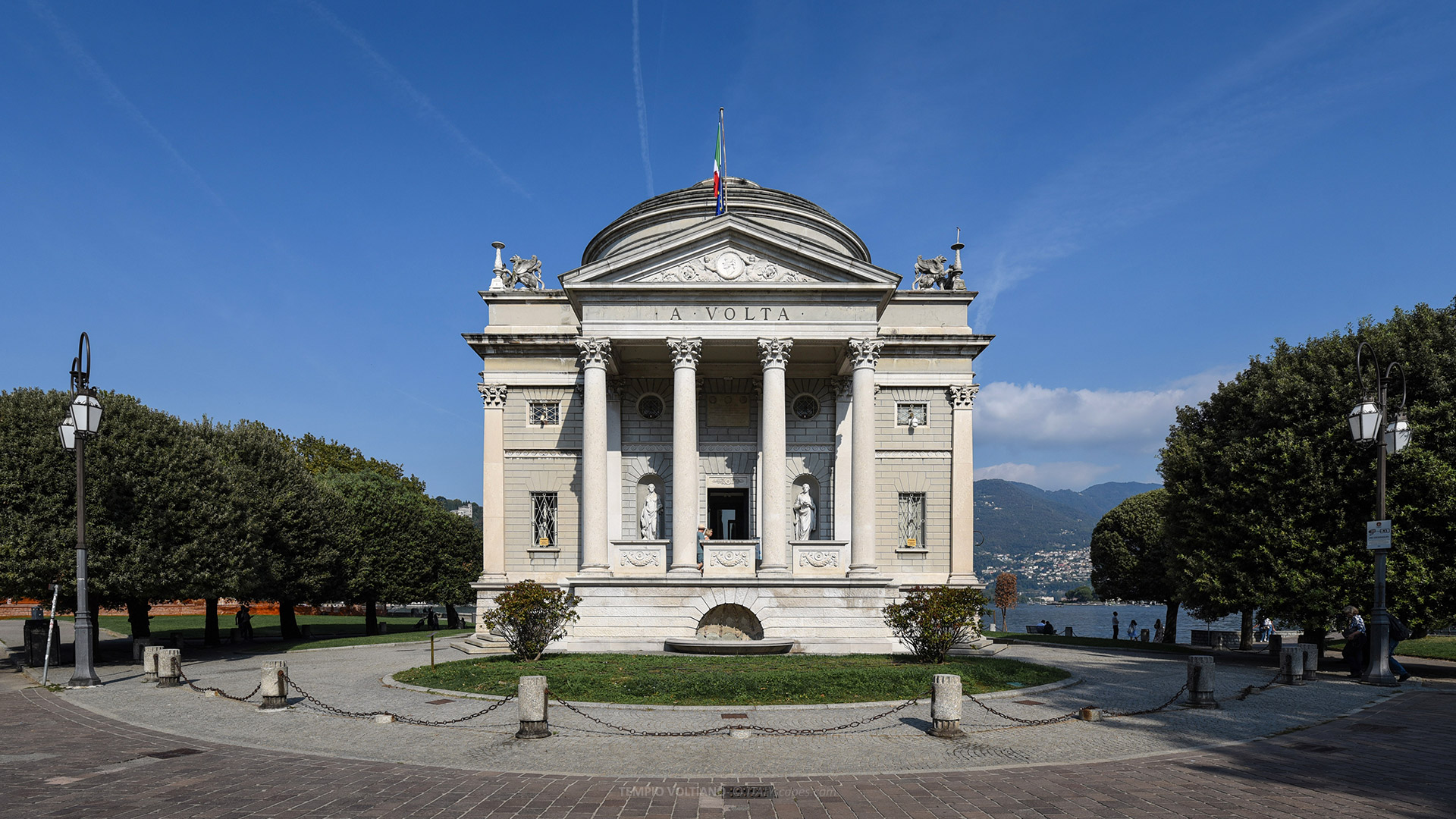
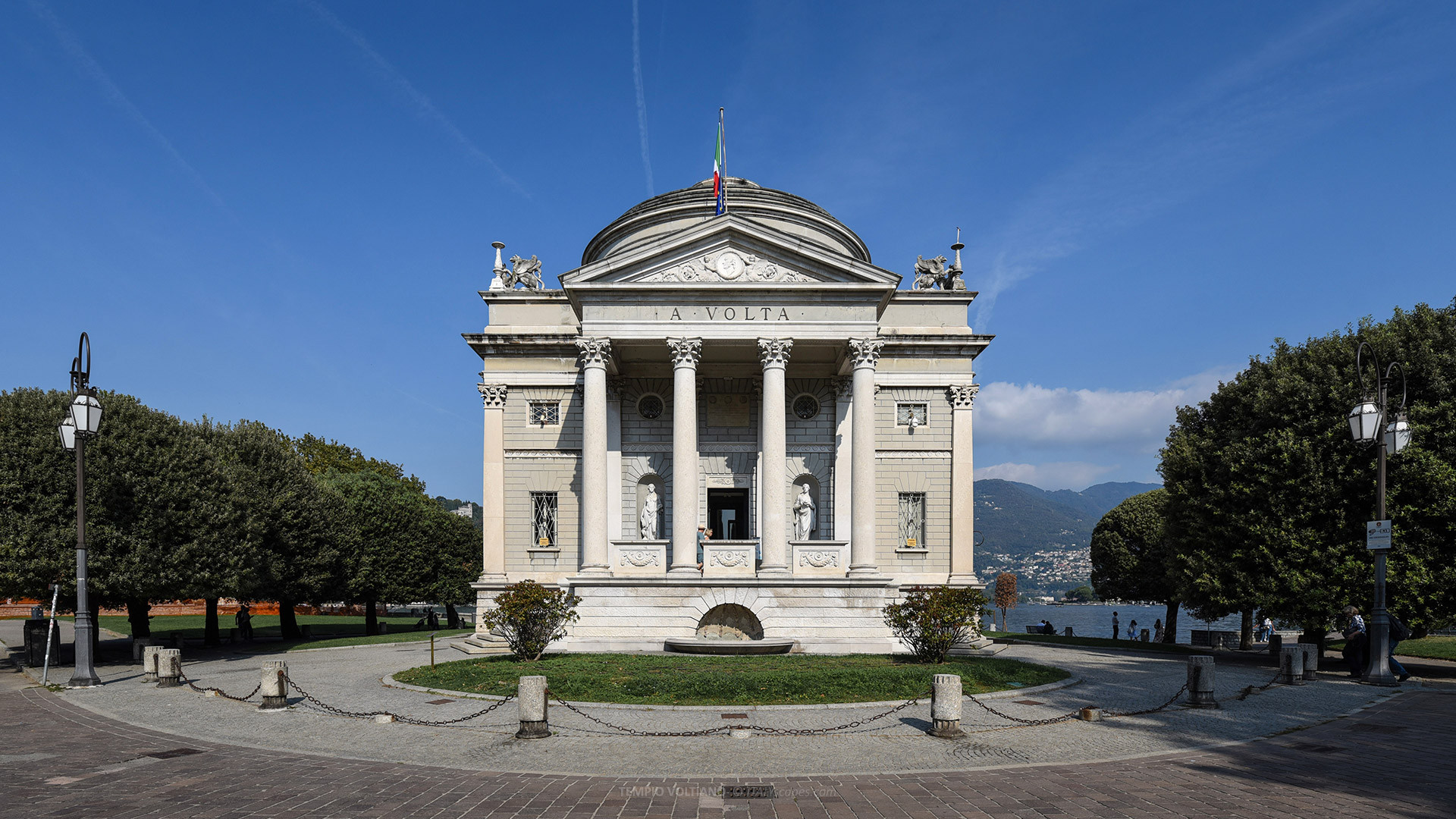
The Neoclassical façade of Tempio Voltiano, designed by Federico Frigerio.
Architecture of the Tempio Voltiano
Architectural Style and Exterior
The Tempio Voltiano is an example of Lombard Neoclassical architecture, incorporating references to ancient Roman temples and elements associated with Palladian architecture. Frigerio selected this monumental architectural language to express the scientific importance of Alessandro Volta through a building resembling a classical sanctuary.
The most recognizable architectural reference is the Pantheon in Rome, particularly its domed central space and monumental entrance. The composition combines a classical portico with a prominent central volume, creating a symmetrical building whose external appearance emphasizes its commemorative purpose.
The main façade includes a portico supported by four Corinthian columns, made from Aurisina limestone. The two statues flanking the entrance represent Science and Faith, allegorical figures created by the sculptors Carlo and Luigi Rigola.
The building has a reinforced-concrete structure covered externally with limestone from the Karst region. This combination allowed Frigerio to employ contemporary construction techniques while maintaining the appearance of a monument inspired by classical architectural traditions.
The Raised Platform and Central Dome
The principal floor stands approximately 2.5 meters above ground level, a deliberate architectural measure intended to protect the museum from flooding caused by fluctuations in Lake Como. Two symmetrical flights of stairs lead to the elevated entrance platform.
The centerpiece of the interior is a circular hall measuring almost 12 meters in diameter, crowned by a large dome illuminated through a central opening. This configuration creates a monumental space whose proportions and architectural details reinforce the building’s resemblance to an ancient Roman temple.
The dome is supported by four corner pillars and eight marble columns. These structural elements form an elaborate interior architectural composition, incorporating Corinthian capitals, an entablature, and a dedicatory inscription executed in gilded bronze lettering.
An upper gallery or loggia surrounds the central hall, dividing the architectural composition horizontally. Its parapet interrupts the height of the Corinthian order and provides space for decorative reliefs and medallions connected with the biography of Alessandro Volta.
Interior Decorations and Artistic Elements
The parapet of the upper gallery features four stucco high-relief panels created by Pietro Clerici. The panels illustrate episodes from Volta’s life and are accompanied by sixteen circular medallions displaying significant dates from his biography in gold lettering.
The central hall contains an elaborate mosaic floor decorated with thirty different inlays of marble, onyx, and alabaster. The decorative stones, obtained from various geographical locations, introduce contrasting colors and textures into the otherwise predominantly classical architectural setting.
The combination of polished stone, sculptural decorations, columns, and natural light creates a highly ornamented interior. Unlike many modern science museums, whose architecture emphasizes functional exhibition rooms, the Tempio Voltiano was conceived as a monumental commemorative building as well as a permanent exhibition space.
The Museum
The Permanent Scientific Collection
The museum preserves an extensive collection of scientific apparatus associated with Alessandro Volta, including original instruments, objects dating from his lifetime, later historical equipment, and reconstructions. The replicas are particularly important because several original instruments disappeared during the fire of 1899.
The scientific exhibition occupies the ground floor, where fifteen display cases present different aspects of Volta’s experimental research. The collection is organized thematically, allowing visitors to understand the development of his investigations and the relationship between his inventions and contemporary scientific knowledge.
The exhibition covers electricity, electrometry, thermal phenomena, gases, and natural electrical processes. It includes equipment used to produce, detect, and measure electrical charge, alongside devices illustrating experiments conducted during the eighteenth and early nineteenth centuries.
The objects are presented as historical evidence of experimental science, rather than as examples of contemporary technology. Their construction, materials, and operating principles demonstrate how scientists investigated physical phenomena before the development of modern electronic measuring instruments.
The Voltaic Pile and Electrical Experiments
Among the museum’s most significant exhibits are examples and reconstructions associated with the voltaic pile. Volta’s invention used alternating conductive metals separated by material moistened with an electrolyte, producing an electric potential difference through electrochemical reactions.
Unlike earlier electrostatic devices, which generated electrical charges that could be discharged rapidly, the battery provided a sustained source of electric current. This capability transformed experimental electricity and enabled investigations that contributed to the subsequent development of electrochemistry.
The museum also presents equipment related to electrometers and electroscopes, instruments employed to detect or measure electrical phenomena. Volta’s contributions to electrometry improved experimental techniques and helped researchers investigate quantities and relationships that were difficult to determine using earlier methods.
Other exhibits concern capacitors and electrostatic apparatus, including instruments connected with the study of electrical induction and the interaction between conducting surfaces. These investigations contributed to the evolving understanding of electrical charge, potential difference, and the behavior of conductors.
Gas Research and Other Scientific Investigations
Volta also conducted important experiments involving flammable gases, particularly methane. In 1776, he identified methane in marsh gas and investigated its properties, including its ability to ignite when exposed to an electrical spark.
His experiments led to the development of devices such as the Volta lamp and an electro-pneumatic pistol, which used electrical sparks to ignite combustible gases. These instruments illustrate the relationship between his investigations into electricity and his research into chemical and physical processes.
A separate section addresses thermal phenomena, presenting apparatus associated with the scientific understanding of heat and temperature. The exhibition places Volta’s investigations within the broader development of eighteenth-century experimental physics and its increasingly systematic measurement techniques.
Another section examines atmospheric electricity and natural electrical phenomena, reflecting the interest of contemporary physicists in processes occurring outside the laboratory. Volta investigated different forms of electrical behavior while developing equipment intended to improve scientific observation and measurement.
Volta’s Dispute with Luigi Galvani
The exhibition also examines the scientific disagreement between Alessandro Volta and Luigi Galvani concerning electrical phenomena observed in animal tissues. Galvani’s experiments involving frog muscles led him to propose that electricity was generated within living organisms.
Volta questioned aspects of this explanation and investigated the electrical effects produced by contact between different conducting materials. His experiments contributed to the development of the voltaic pile, although the subsequent understanding of electrochemical processes went beyond the explanations proposed by either scientist.
The debate became an important episode in the history of electrophysiology and electrochemistry. Museum instruments associated with these investigations illustrate how experimental disagreements encouraged further research and contributed to discoveries that influenced several branches of physical science.
The Upper Gallery and Biographical Exhibition
The upper gallery presents a biographical exhibition dedicated to Alessandro Volta, focusing on his family, personal relationships, public responsibilities, and professional achievements. This section complements the scientific collection by placing his discoveries within the historical circumstances of his lifetime.
Through portraits, paintings, documents, and explanatory panels, visitors can follow important episodes in the physicist’s career and his connections with Como. The exhibition also examines his acquaintances, friendships, and institutional responsibilities, illustrating his involvement in civic and academic life.
The exhibition concludes with the honors and recognition Volta received from his native city and the international scientific community. These materials document the reputation acquired by the physicist and the historical importance attributed to his discoveries.
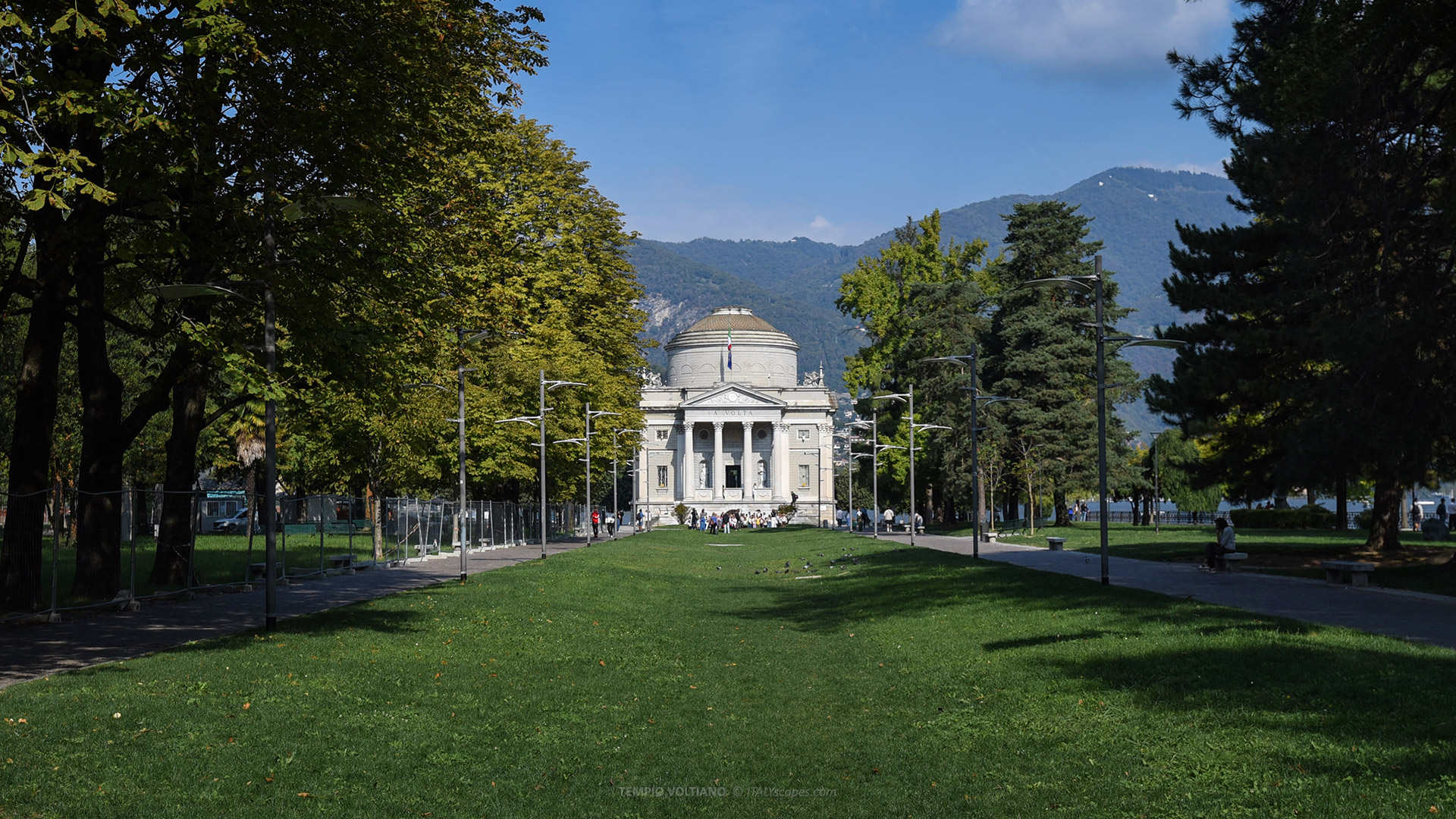
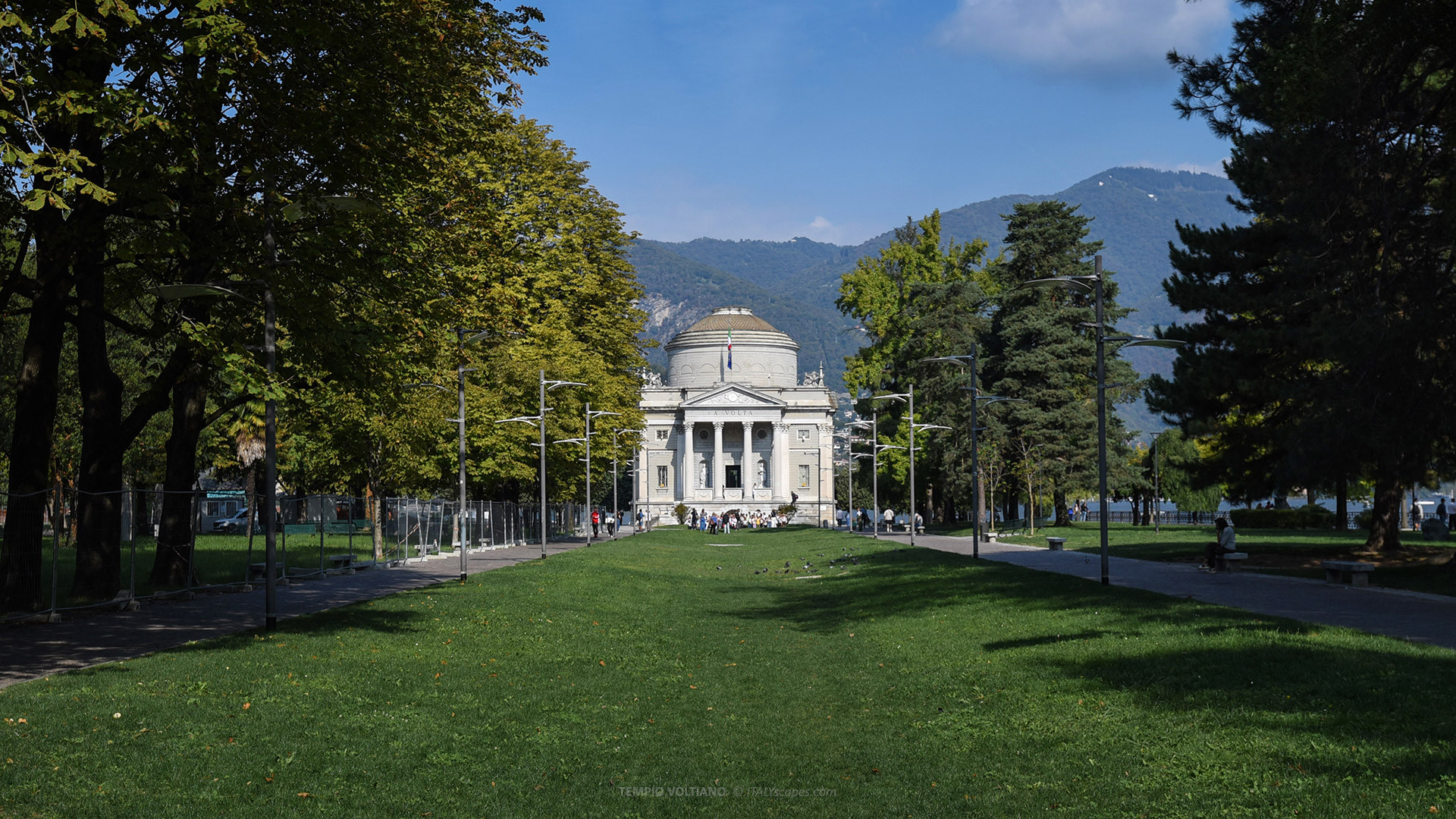
Tempio Voltiano, seen from the gardens along Lake Como.
How to Get to the Tempio Voltiano
The Tempio Voltiano is located at Viale Guglielmo Marconi 1, along the southwestern waterfront of Lake Como. The closest major railway station is Como San Giovanni, which serves trains connecting Como with Milan, other destinations in Lombardy, and Switzerland.
The monument is approximately 800-900 meters from Como San Giovanni, depending on the route chosen. Walking is generally the simplest option, although buses and taxis are available for travelers carrying luggage or requiring assistance.
Getting to the Tempio Voltiano on foot
From Como San Giovanni, leave the railway station through the main entrance and head toward the lake. The walking route leads toward the western section of Como’s waterfront, where the Tempio Voltiano stands near the lakeside gardens.
The journey takes approximately 11-15 minutes, depending on walking speed and the chosen route. The monument is situated near the western end of the waterfront promenade, within the landscaped area known as Giardini a Lago.
Getting to the Tempio Voltiano by bus
Public buses operated by ASF Autolinee serve Como’s railway station and central waterfront. However, because the distance to the museum is relatively short, traveling by bus does not necessarily offer a significant advantage over walking.
One useful reference point is the Lungolario Trento bus stop, situated approximately 450 meters from the museum. From there, visitors can continue on foot along the waterfront, reaching the Tempio Voltiano in approximately six minutes.
Getting to the Tempio Voltiano by taxi
Taxis offer an alternative for visitors arriving at Como San Giovanni, particularly those carrying heavy luggage or experiencing reduced mobility. The journey covers approximately 1-1.5 kilometers by road, depending on the route taken.
Under normal traffic conditions, the taxi ride takes only a few minutes. However, the total journey time may increase because of traffic, the location of the pickup point, or restrictions affecting vehicle access near the waterfront.
Frequently Asked Questions about the Tempio Voltiano
Where is the Tempio Voltiano located?
The Tempio Voltiano is located at Viale Guglielmo Marconi 1, in the Giardini a Lago area of Como, on the southwestern shore of Lake Como, in Lombardy, northern Italy.
How long does it take to visit the Tempio Voltiano?
Allow approximately 30-60 minutes to explore the scientific instruments, historical displays, and biographical exhibition. The duration depends on individual interests and how thoroughly visitors examine the collections.
Is the Tempio Voltiano accessible to wheelchair users?
Yes. The municipality confirms that the Tempio Voltiano provides lift access for visitors with reduced mobility or wheelchairs, allowing access to the exhibition spaces despite the building’s monumental architectural configuration.
Which railway station is closest to the Tempio Voltiano?
Como San Giovanni is approximately 800 meters from the Tempio Voltiano, while Como Lago is approximately 900 meters away. Both stations are within convenient walking distance of the monument.
What other attractions are near the Tempio Voltiano?
Nearby attractions include the Monumento ai Caduti, Giardini a Lago, the Lake Como waterfront, and Life Electric, the contemporary sculpture by Daniel Libeskind situated on the Diga Foranea pier.
Buy tickets & tours:VivaTicket -
Photos
-
Map
-
Reviews