-
About
Table of Contents
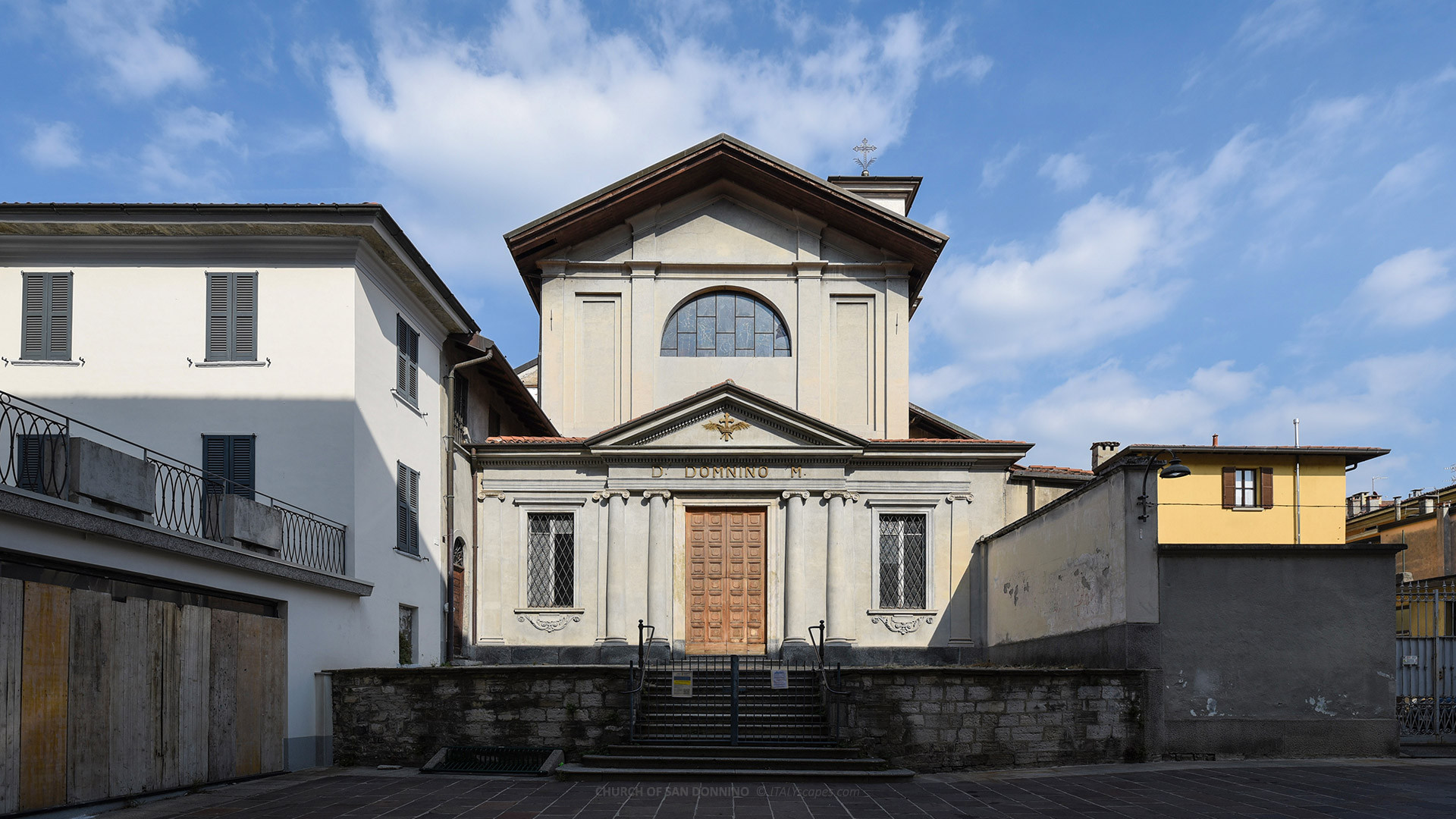
The Church of San Donnino is a historic Catholic church located at Via Armando Diaz 125, in the walled historic centre of Como, Lombardy. Dedicated to Saint Domninus of Fidenza, the building has medieval origins but owes much of its present appearance to extensive renovations carried out between the 17th and 19th centuries.
Distinguished by its Neoclassical entrance portico and richly decorated Baroque interior, the Church of San Donnino preserves important frescoes, paintings, sculptures, and architectural details.
It is particularly associated with Alessandro Volta, the celebrated Italian physicist and inventor of the electric battery, who was baptized here in 1745 and whose funeral was celebrated here in 1827.
Short History of the Church of San Donnino
Medieval Origins and Early Reconstructions
The earliest surviving written references to the church date from the late 13th century, when it belonged to the ecclesiastical district known as the Pieve di Zezio. Its original construction date remains uncertain, although architectural evidence confirms the existence of an earlier building characterized by Romanesque elements and a semicircular apse.
During the 14th century, the original church underwent substantial reconstruction, producing a building with two naves and several devotional spaces. Historical documents describe five altars dedicated to different saints and religious subjects. The façade also displayed a painted representation of Saint Domninus, the martyr to whom the church was dedicated.
By 1430, the Church of San Donnino was already functioning as an established parish church. Its importance within the religious organization of Como is documented through ecclesiastical records, while pastoral inspections undertaken during subsequent centuries provide valuable information about its architectural arrangement, furnishings, and devotional traditions.
The Great Seventeenth-Century Transformation
The most significant architectural transformation occurred during the 17th century, when the medieval building was extensively reconstructed. The works took place during a period associated with bishops belonging to the Archinto family and reflected the changing requirements of Catholic worship following the Counter-Reformation.
The original arrangement of two naves was replaced with a single-nave structure, accompanied by four lateral chapels and a quadrangular choir. By 1629, the two chapels closest to the presbytery had been completed, while construction and decoration of the remaining chapels continued during the following decades.
These works involved numerous artists, craftsmen, and private patrons. Wealthy families contributed to the financing of individual chapels, while religious institutions supported other interventions. During the reconstruction, workers also discovered ancient remains, including tessellated pavements and other archaeological materials beneath the existing building.
Alessandro Volta and the Church of San Donnino
The Church of San Donnino has an important connection with Alessandro Volta, born in Como on February 18, 1745. The following day, he was baptized here by the parish provost, receiving the names Alessandro Giuseppe Antonio Anastasio. His family residence stood less than 200 metres from the church, on present-day Via Alessandro Volta.
Volta remained closely associated with his childhood parish throughout his life. Historical accounts describe his participation in religious activities, including teaching catechism to young people. His lessons reportedly attracted numerous children, illustrating an aspect of the scientist’s personal life distinct from his celebrated scientific research.
Following Volta’s death on March 5, 1827, his funeral was celebrated in San Donnino on March 7. The church consequently occupies an important position in Como’s historical itineraries dedicated to the inventor, alongside his birthplace, the Gattoni Tower, and the Tempio Voltiano.
Later Renovations and Religious Life
Several architectural interventions took place during the 18th and 19th centuries, gradually transforming the church’s appearance. These included modifications to the principal altar, decorative programmes, and liturgical furnishings. The renovations also reflected changing artistic preferences, particularly the increasing influence of Neoclassical design in northern Italy.
During the Second World War, the Church of San Donnino lost its original bells when they were requisitioned for military requirements. Replacement bells were installed in 1947, using bronze recovered from the earlier set. The new bells entered service at Christmas, restoring an important element of the church’s traditional religious activities.
Today, San Donnino belongs to the parish community associated with the Basilica of San Fedele. It also serves the Ukrainian Greek-Catholic community in Como, which celebrates the Divine Liturgy according to the Byzantine rite, demonstrating the continuing religious importance of this historic building.
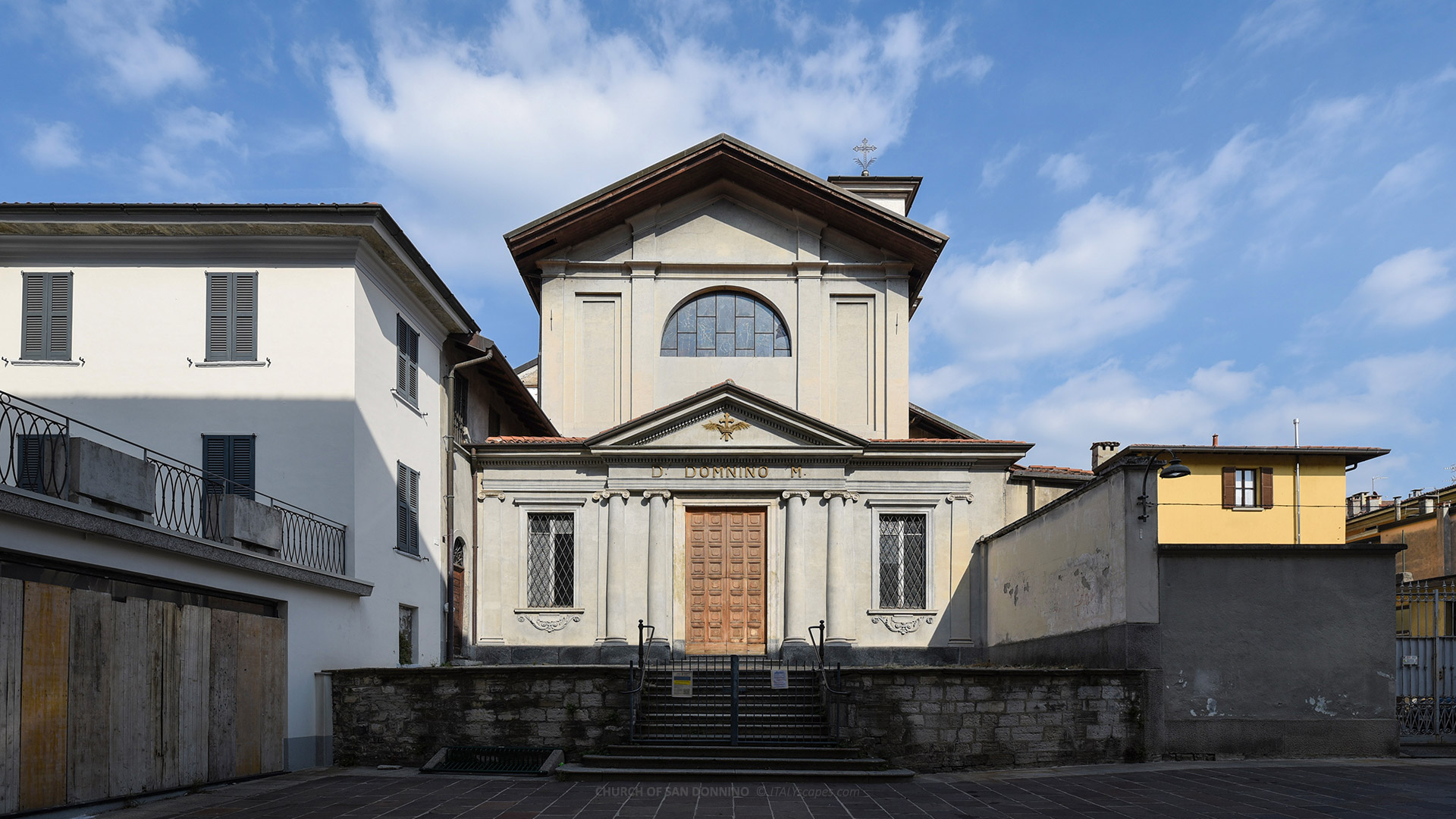
Church of San Donnino in Como, featuring its Neoclassical entrance portico.
Architecture of the Church of San Donnino
The Façade and Entrance Portico
The Church of San Donnino stands slightly above the level of Via Armando Diaz, reached through a stone staircase leading to a small elevated churchyard. Its position creates a distinctive architectural setting within the medieval street network, separating the entrance from the surrounding pedestrian area.
The principal façade preserves elements of its 17th-century composition, including pilasters and an upper triangular pediment. Its appearance was modified by the addition of a projecting entrance portico, designed to create a more monumental approach while incorporating architectural elements associated with classical antiquity.
Completed in 1813, the portico was designed by Carlo Polti, an architect associated with Simone Cantoni. Its Neoclassical composition features Ionic half-columns, pilasters, an architraved entrance, and a triangular pediment. The central section projects slightly forward, emphasizing the principal doorway.
The Nave and Interior Arrangement
The interior follows a longitudinal plan, organized around a single nave covered by a barrel vault. The space is articulated by wall pilasters and decorated architectural elements, creating a regular sequence of surfaces between the entrance and the principal altar.
Two chapels open along each side of the nave, producing a symmetrical arrangement characteristic of many churches reconstructed during the Baroque period. Their entrances are integrated into the architectural composition, while the adjacent wall surfaces provide space for paintings, sculptures, and other religious furnishings.
The nave terminates in a quadrangular presbytery, separated from the main congregation area by the arrangement of the sanctuary. Architectural decoration creates the impression of greater depth, while the distribution of the interior spaces reflects the liturgical requirements introduced during successive historical periods.
The Bell Tower and Architectural Details
The bell tower rises along the right side of the church. Constructed in its present form in 1770 and subsequently modified during the 19th century, it has a relatively simple appearance, contrasting with the richer architectural decoration of the main façade.
A horizontal stringcourse separates the lower section from the upper bell chamber, establishing the principal decorative division of the tower. Its restrained composition reflects the functional character of the structure, which was designed primarily to accommodate the bells used during religious celebrations.
The interior also contains a choir gallery above the entrance, originally constructed in 1750 and restored in 1937 under the direction of architect Federico Frigerio. The gallery houses the church organ, forming an important architectural and musical component of the building.
Art of the Church of San Donnino
The Main Altar and Presbytery Decorations
The principal altar is one of the most impressive artistic elements of the church. Reconstructed in 1752, the monumental Baroque structure dominates the presbytery and incorporates architectural ornamentation characteristic of 18th-century ecclesiastical decoration.
Above the altar hangs a 17th-century painting depicting the Virgin Mary with the Christ Child, accompanied by Saint Domninus and another religious figure, generally identified as Saint Abbondius. The identity of the second saint has occasionally been disputed, with alternative interpretations suggesting Pope Pius V.
The lateral walls of the presbytery contain frescoes representing Moses and Elijah, painted by Francesco Silva during the 18th century. The surrounding decoration includes illusionistic architectural perspectives by Giuseppe Coduri Vignoli, creating the impression of an enlarged architectural space beyond the actual sanctuary walls.
The Chapel of the Crucifix
The Chapel of the Crucifix, situated along the left side of the nave, was constructed between 1617 and 1620 through the patronage of the Hospital of Sant’Anna. Its decorative programme represents an important example of early 17th-century religious art in Como.
The chapel contains frescoes executed by Giovanni Domenico Caresana between 1619 and 1620. Their artistic language reflects influences associated with Bernardino Luini and the Lombard painting tradition, incorporating religious subjects within an elaborate decorative arrangement.
The architectural decoration includes stucco ornaments created by the Bianchi family from Moltrasio. These were subsequently gilded by Marzio Carpano, introducing additional richness to the chapel. The combination of painted scenes, relief decoration, and gilded surfaces illustrates the artistic practices of the period.
The Volpi Chapel
Another important devotional space is the Volpi Chapel, whose decoration was commissioned by Volpiano Volpi and members of his family. The chapel developed from an earlier Marian space and became one of the most richly decorated sections of the church.
Its elaborate stucco decorations were executed by Giovanni Battista Barberini in 1662, while Antonio Maria Crespi Castoldi, known as Bustino, painted the frescoes in 1675. These contributions demonstrate the combination of sculpture and painting characteristic of Lombard Baroque art.
The altar, constructed in 1630 by Francesco Rusca from Campione, houses a painting representing the Virgin and Child with Saints Dominic, Philip Neri, and Anthony of Padua. Other paintings include The Adoration of the Shepherds and The Marriage of the Virgin, illustrating different episodes from Christian tradition.
The Chapel of the Virgin
The Chapel of the Virgin, located on the right side of the nave, preserves an important decorative cycle associated with Giovanni Mauro della Rovere, commonly known as Il Fiammenghino. The artist contributed frescoes and an Assumption of the Virgin painted in 1620.
Another important artwork is The Nativity of the Virgin, painted in 1888 by Ludovico Pogliaghi. Its presence demonstrates how the artistic decoration developed beyond the original 17th-century programme, incorporating later paintings while preserving the chapel’s Marian dedication.
The chapel also contains an 18th-century statue of the Virgin Mary. Together with the frescoes and paintings, this sculpture forms part of a decorative ensemble that combines different artistic periods, techniques, and approaches to religious representation.
Additional Paintings and Sculptures
The Chapel of Saint Anthony of Padua underwent several modifications between 1788 and the early 20th century. Originally dedicated to Saint Matthew, it was redecorated in 1836-1837 by a painter named Chiesa. A wooden statue of Saint Anthony was subsequently introduced during later renovations.
The sacristy preserves additional paintings, including Saint Francis Adoring the Crucifix, executed by Giovanni Domenico Caresana around 1610-1612. Another unusual object associated with the church is a 15th-century Spanish ivory crucifix originating from Zaragoza.
Among the other sculptures is a wooden Pietà, preserved in a niche near the entrance. A polychrome statue representing Saint Domninus, created by Ezechiele Trombetta during the late 19th century, also belongs to the church’s religious artistic heritage.
Ceiling Decorations and Stained Glass
The barrel vault is decorated with ornamental compositions and medallions representing religious subjects, including the Nativity, Visitation, and Glory of the Virgin. Its present decorative arrangement includes work undertaken in 1937 by Angelo Menotti, following designs associated with architect Federico Frigerio.
The interior wall pilasters are crowned with Corinthian capitals, also designed by Frigerio and executed in stucco by Menotti. Their classical forms complement the elaborate ceiling decorations, producing a unified architectural effect despite the different periods represented within the church.
Three stained-glass windows created by Eugenio Rossi during the second half of the 20th century introduce additional artistic elements. The central lunette represents The Martyrdom of Saint Domninus, while the other windows depict The Risen Christ and The Virgin in Glory.
How to Get to the Church of San Donnino
The Church of San Donnino stands at Via Armando Diaz 125, within Como’s historic walled centre. Its location near the Pinacoteca Civica makes it accessible on foot from the principal railway station, while local buses and taxis provide alternatives for visitors arriving from more distant areas.
Getting to the Church of San Donnino on foot
From Como San Giovanni railway station, the church can generally be reached in approximately 15 minutes on foot. Leave the station towards Piazzale San Gottardo and continue into the historic centre, following the streets towards Via Alessandro Volta and Via Armando Diaz.
The church stands opposite Palazzo Volpi, which houses Como’s Civic Art Gallery. From Como Lago railway station, the walk takes approximately 10-15 minutes, passing through the historic centre before reaching the entrance staircase on Via Armando Diaz.
Getting to the Church of San Donnino by bus
Como’s urban public transport services are operated by ASF Autolinee, with numerous routes connecting the railway stations, residential districts, and central areas. The church is situated within the historic pedestrian zone, meaning buses do not stop directly outside the entrance.
One useful option is to travel towards Como – Piazza Vittoria, served by several urban routes, including lines 2 and 5. From the stop, continue on foot into the historic centre, using Via Giovio and Via Diaz to reach the church.
Getting to the Church of San Donnino by taxi
Taxis are available from designated ranks around Como, including Como San Giovanni railway station. The journey towards the church is relatively short, although the exact route and travel time depend on traffic conditions and restrictions affecting the historic centre.
Since Via Armando Diaz lies within a limited-traffic pedestrian area, taxis may need to stop outside the restricted zone. Passengers should request the closest authorized drop-off point and continue on foot towards the church, remembering that the main entrance is reached by a staircase.
Frequently Asked Questions about the Church of San Donnino
Where is the Church of San Donnino located?
The Church of San Donnino is located at Via Armando Diaz 125, in the historic centre of Como, Lombardy, Italy, opposite Palazzo Volpi and the Civic Art Gallery.
When was the Church of San Donnino built?
Its precise foundation date is unknown. The Church of San Donnino is documented from the late 13th century, with major reconstructions during the 14th and 17th centuries.
Who is the Church of San Donnino dedicated to?
The Church of San Donnino is dedicated to Saint Domninus of Fidenza, a Christian martyr traditionally associated with Roman military service, whose relics are venerated in Fidenza.
What architectural style is the Church of San Donnino?
The Church of San Donnino combines Romanesque origins with predominantly Baroque interior decoration and a Neoclassical entrance portico, reflecting several centuries of architectural transformation.
What is the connection between Alessandro Volta and the Church of San Donnino?
Alessandro Volta was baptized here on February 19, 1745, taught catechism within the parish, and had his funeral celebrated here on March 7, 1827.
-
Photos
-
Map
-
Reviews