


Buy tickets:VivaTicket The Official Dinner Show 2027 is one of the prin Read more [...]
-
About
Table of Contents
Festa delle Marie 2027 will be one of the most important historical celebrations within the Venice Carnival 2027, scheduled from January 23 to February 9. The event brings an old Venetian tradition into the modern Carnival through ceremonies, historical costumes, public appearances, and twelve young women chosen as the Marie.
The celebration is more than a costume parade or competition. Its roots are connected with medieval marriage customs, devotion to the Virgin Mary, and the support offered to young brides from poorer families. Over time, these elements developed into a major religious and civic festival involving different parts of Venetian society.
In its contemporary form, twelve young women are selected to represent the Marie throughout Carnival. They attend official ceremonies, cultural activities, and public events while wearing elaborate historical Venetian costumes, creating a direct visual connection between today’s festivities and traditions associated with the former Republic of Venice.
The modern Festa unfolds through several clearly defined stages, beginning with the selection of the twelve Marie and continuing with the vestizione, public appearances, the election of the Maria of the Year, and the final presentation of the winner in Piazza San Marco on Shrove Tuesday.
What Is the Schedule for Festa delle Marie 2027?
Based on the schedule followed by the event in recent years, the Festa delle Marie 2027 program will most likely be the following:
Saturday, January 23, 2027 – Selection of the 12 Maries
The Festa delle Marie 2027 begins on Saturday, January 23, with the selection of the twelve Marie at the Scuola Grande San Giovanni Evangelista. The ceremony is set for approximately 3:00 PM and marks the formal beginning of an experience that continues throughout the entire Carnival period.
The Scuola Grande San Giovanni Evangelista, in the San Polo district, is one of Venice‘s historic confraternal institutions. Its richly decorated halls provide an appropriate setting for an event strongly connected with Venetian ceremonial traditions, civic history, and the public representation of the city’s cultural identity.
The selection is not intended simply as a conventional beauty contest. Candidates are also judged through qualities such as personality, presentation, communication, and their ability to represent Venice during official appearances. Once chosen, the twelve women become the official Marie and participate in events throughout Carnival.
Recent editions have included specific conditions concerning age and connection with Venice or its metropolitan territory. This local element remains important because the Festa presents the Marie not only as Carnival figures, but also as representatives of contemporary Venice within a celebration rooted in the city’s own history.
Saturday, January 30, 2027 – The Vestizione (Fitting and Presentation)
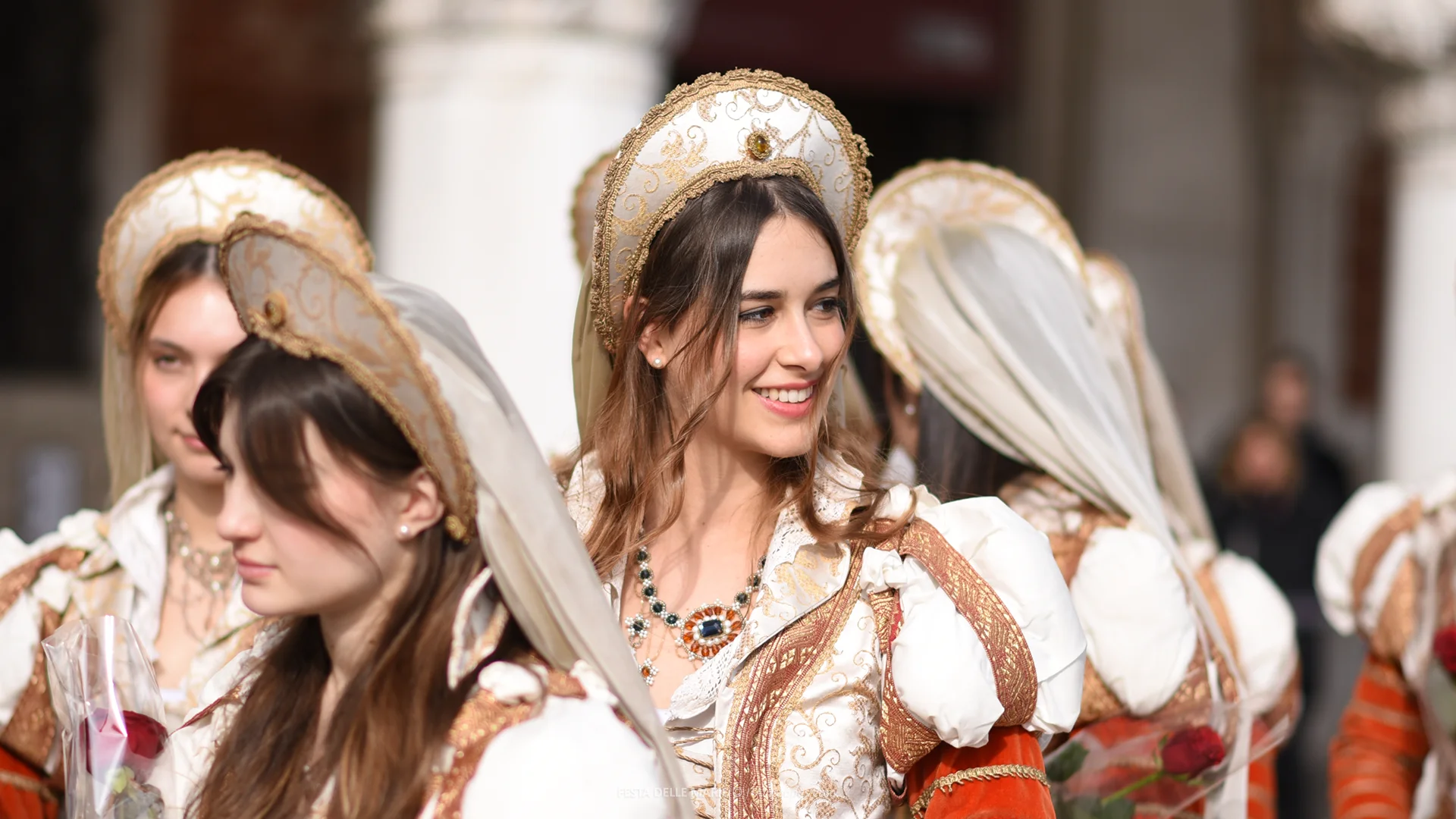
On Saturday, January 30, the twelve participants take part in the vestizione, the ceremony during which they wear their official historical costumes for the first time. This stage gives the Marie the visual identity they will maintain during their principal appearances and public events throughout the Carnival.
The garments are not generic masquerade costumes. They are designed using historical silhouettes, rich fabrics, decorative details, and references to specific periods of Venetian fashion.
Recent designs show that the Festa is not limited to eighteenth-century clothing. Costumes have also drawn inspiration from Renaissance and sixteenth-century Venice, including visual references to major Venetian painters and historic textiles, giving each edition its own distinctive historical character rather than repeating a single Carnival style.
The vestizione also highlights the craftsmanship behind the event. Tailoring, textile production, costume design, and decorative work become part of the celebration itself, reinforcing the connection between the Festa and Venetian artisanal traditions that continue to shape the visual identity of Carnival.
Monday, February 8, 2027 – Election of the 2027 Maria of the Year
On Monday, February 8, the Festa delle Marie 2027 reaches its final competitive stage with the election of the Maria of the Year. The ceremony takes place in the Sale Apollinee at Teatro La Fenice, one of Venice’s most prestigious cultural institutions and a fitting setting for the conclusion of the selection.
By this point, the twelve Marie have spent more than two weeks taking part in ceremonies, cultural initiatives, and public appearances. The final choice therefore follows an extended Carnival experience rather than a single presentation, allowing the participants to be judged after representing the Festa in different public contexts.
Recent editions have also included the title Maria de Il Gazzettino, awarded through a popular vote connected with the Venetian newspaper. This additional distinction gives the public a direct role in the modern Festa and strengthens the relationship between the event, the city, and the local community.
Tuesday, February 9, 2027 – Proclamation of the 2027 Venice Carnival Maria
On Tuesday, February 9, the winning Maria is presented to the public in Piazza San Marco. The Festa delle Marie 2027 concludes on Shrove Tuesday, traditionally the final day of Carnival before Lent, placing the event at the symbolic and geographical centre of the celebrations.
Recent editions have featured a specially created costume for the winning Maria, distinguishing her final appearance from the garments worn collectively by the twelve participants. The design may incorporate references to the artistic or historical theme chosen for that year’s Carnival, giving the winner a unique ceremonial identity.
The proclamation completes a sequence that began with the January selection and continued through the vestizione and official appearances. February 9 is also Shrove Tuesday in 2027, linking the conclusion of Festa delle Marie directly with the traditional final day of the wider Venetian Carnival.
Short History of Festa delle Marie
The Medieval Origins of the Festa
The origins of Festa delle Marie are rooted in medieval Venice, although the earliest phases of the celebration cannot be reconstructed with complete certainty. The tradition became associated with February 2, the Christian Feast of the Purification of the Virgin Mary and the Presentation of Jesus at the Temple.
An early Venetian custom involved couples preparing for marriage receiving a religious blessing at San Pietro di Castello, which served as Venice’s cathedral for centuries. Young women from poorer families gradually became central to the ceremony, linking marriage and religious observance with a broader form of civic assistance.
Wealthier Venetian households provided selected brides with clothing, jewelry, and financial support, helping them obtain the dowries necessary for marriage. The practice combined religious devotion with civic charity, turning private assistance into a visible expression of responsibility toward poorer members of the Venetian community.
The participants became known collectively as the Marie. In the developed form of the celebration, twelve young women took part, later associated in Venetian tradition with the city’s six sestieri, with two Marie connected to each district and supported through the wider ceremonial structure.
As Venice grew richer and more powerful, the event expanded beyond its original religious purpose. Banquets, public festivities, visits to noble households, and journeys by boat transformed the Festa into an important civic celebration, combining devotion, social hierarchy, public spectacle, and displays of Venetian prosperity.
The Legend of the Abducted Brides
The most famous story associated with the Festa concerns the abduction of Venetian brides during one of the marriage ceremonies. According to Venetian tradition, pirates attacked the celebration, kidnapped the young women, and seized the jewelry and other valuables forming part of their dowries before attempting to escape.
The Venetians pursued the attackers and, according to the traditional narrative, overtook them near the area of Caorle. The raiders were defeated, while the women and their possessions were recovered and returned to Venice, turning the rescue into one of the Festa’s central historical legends.
The exact chronology remains uncertain. Different versions place the episode in 943, 944, or 973, while accounts also disagree about the identity of the attackers and several details surrounding the rescue.
The kidnapping story is therefore better understood as a combination of historical tradition and Venetian civic legend. Even so, it became inseparable from the identity of the Festa, linking the celebration with ideas of communal solidarity, maritime defence, religious protection, and the recovery of civic honour.
Santa Maria Formosa and the Casseleri
Another important tradition concerns the casseleri, craftsmen who specialised in making wooden chests and boxes. Venetian legend credits members of this trade with helping pursue and defeat the pirates responsible for abducting the brides, giving the guild a special place in the story of the Festa.
The casseleri were closely connected with the parish of Santa Maria Formosa in the Castello district. Their supposed role in the rescue established a lasting ceremonial association between the celebration and the Church of Santa Maria Formosa, one of the locations most strongly linked with the Festa’s historical memory.
According to tradition, the craftsmen asked the Doge to visit their parish annually in recognition of their assistance. This developed into a formal relationship involving official visits, ceremonial gestures, and gifts, showing how the Festa connected craft guilds, religious institutions, and political authority within Venetian civic life.
The Festa at Its Height
During the Middle Ages, Festa delle Marie developed into a large public celebration. The twelve women appeared in costly clothing and jewelry, while processions, banquets, religious ceremonies, and organised festivities transformed their participation into a visible expression of Venetian wealth and communal identity.
The celebrations could continue for several days. Noble households hosted the Marie and other guests, while the city’s canals became part of the spectacle through ceremonial journeys by boat. These processions allowed residents to watch the participants and reinforced the uniquely Venetian character of the event.
As the festivities became more elaborate, their financial cost also increased. Valuable clothing, jewelry, decorated boats, hospitality, and ceremonial organisation placed growing demands on the families and institutions involved, eventually encouraging the authorities to reduce the scale of the celebration.
The Marie de Tola and the Decline of the Festa
In 1272, Venetian authorities reduced the number of Marie as part of efforts to limit expenditure. During the following century, the event continued to change as its original charitable and religious purposes became increasingly mixed with entertainment, public spectacle, and costly ceremonial display.
In the fourteenth century, living participants were replaced in parts of the ceremony by wooden female figures remembered in Venetian tradition as the Marie de tola. The substitution considerably altered an event whose identity had previously depended on the presence of real young women.
The wooden figures proved unpopular. Spectators mocked them and threw objects at them, creating enough disorder for Venetian authorities in 1349 to prohibit attacks on the figures. The reaction demonstrated how strongly the population associated the Festa with living participants rather than symbolic substitutes.
The celebration finally disappeared in 1379, during the War of Chioggia between Venice and Genoa. The Republic faced a major military crisis, while the Festa had already been reduced from its earlier form. Its stories nevertheless survived in chronicles, local tradition, and Venetian cultural memory.
The Modern Revival of Festa delle Marie
Festa delle Marie returned in 1999 as part of the modern Venice Carnival. Its revival is closely associated with Venetian director and cultural organiser Bruno Tosi, who adapted the historical tradition into a contemporary ceremonial event centred once again on twelve young women.
The revived Festa did not attempt to reconstruct medieval practices literally. Instead, it restored recognisable elements such as the twelve participants, historical clothing, ceremonies, and public appearances, combining them with a modern selection process and a structured program extending across the Carnival period.
Costume design quickly became one of the defining features of the revived celebration. Venetian designers and artisans create garments inspired by historical periods, paintings, fabrics, and decorative traditions, making the Festa an opportunity to showcase both the city’s past and its continuing craft heritage.
The modern program follows a clear narrative, moving from selection and vestizione through cultural activities and public appearances to the election of the Maria of the Year and the final ceremony in Piazza San Marco.
Although today’s celebration differs substantially from its medieval predecessor, it preserves its most distinctive themes: young women, historical dress, public ceremony, craftsmanship, and Venetian civic identity. Festa delle Marie 2027 will once again connect those traditions with the modern celebrations of Venice Carnival 2027.
-
Photos
-
Video
Table of Contents
-
Map
-
Reviews
-
Related eventsView all related events
Venice Carnival Official Dinner Show 2027 - 31 January 2027
Buy tickets:VivaTicket The Official Dinner Show 2027 is one of the prin Read more [...]