
Table of Contents
Florence is the most important Italian city for understanding the early life, artistic formation, civic identity, and final memory of Michelangelo Buonarroti.
The artist was born in 1475 in Caprese, in the territory of the Republic of Florence, where his father briefly held a local administrative post. Shortly after his birth, the Buonarroti family returned to Florence, the city that shaped his artistic training, reputation, and lifelong identity.
A journey through Florence in the footsteps of Michelangelo is a route through churches, family houses, civic squares, Medici buildings, defensive walls, and burial places. Florence preserves his youthful sculptures, his most famous statue, his only surviving panel painting, his architecture, and his tomb.
This itinerary follows the most important Florentine edifices connected with the sculptor: Casa Buonarroti, Santa Maria Novella, Santo Spirito, Piazza San Marco, the Accademia Gallery, Piazza della Signoria, Palazzo Vecchio, the Uffizi, San Lorenzo, the Medici Chapels, the Laurentian Library, Santa Maria del Fiore, the Opera del Duomo Museum, San Miniato al Monte, and Santa Croce.

Casa Buonarroti – The Family Memory of Michelangelo
Casa Buonarroti is one of the most important places in Florence for understanding Michelangelo’s early development and family legacy. The building became connected with the Buonarroti family and is now a museum dedicated to the artist, his descendants, and the history of his work in Florence.
The museum is important because it preserves two early marble reliefs by the artist: Madonna of the Stairs and Battle of the Centaurs. These works belong to his youth and show how quickly he absorbed Florentine sculpture, classical models, and the influence of earlier masters such as Donatello.
The Madonna of the Stairs, generally dated around 1490, is a small marble relief showing the Virgin Mary and the Child. The technique is shallow and refined, recalling Donatello’s rilievo stiacciato. Even at this early stage, Michelangelo gave the human figure a monumental presence within a restricted surface.
The Battle of the Centaurs, dated around 1490-1492, has a completely different character. Instead of calm devotion, it shows violent movement, intertwined bodies, and classical energy. The subject comes from ancient mythology and reflects the intellectual world of the Medici circle in late 15th-century Florence.
Santa Maria Novella – The Artistic World of Ghirlandaio
Santa Maria Novella does not preserve a major work by the young artist, but it is important for understanding the artistic environment in which he was trained. As a young boy, Michelangelo entered the workshop of Domenico Ghirlandaio, one of the leading painters of Florence in the late 15th century.
Ghirlandaio’s fresco cycle in the Tornabuoni Chapel of Santa Maria Novella is one of the major monuments of Florentine painting before the High Renaissance. Michelangelo’s formal apprenticeship with Ghirlandaio began in 1488, when he was still very young and learning workshop methods, drawing, and fresco practice.
Santa Maria Novella helps explain why Michelangelo’s later painting had such structural force. Although he always considered himself primarily a sculptor, he learned in a city where large fresco cycles shaped religious space. His later work in the Sistine Chapel cannot be separated from this Florentine training.

Santa Maria Novella
Basilica of Santo Spirito – Anatomy and the Wooden Crucifix
The Basilica of Santo Spirito is one of the most intimate Florentine sites connected with Michelangelo’s youth. After the death of Lorenzo de’ Medici in 1492, the young artist is traditionally associated with the Augustinian convent of Santo Spirito, where he studied anatomy and deepened his understanding of the human body.
The church is linked to the wooden Crucifix attributed to the sculptor and today displayed in Santo Spirito. The work is usually connected with his youth and is important because it shows a very different side of the artist from his later monumental marble sculptures.
The Crucifix represents Christ’s body with anatomical clarity and spiritual restraint. It is not a massive heroic figure, but a delicate wooden sculpture that reveals Michelangelo’s early interest in the living structure of the human body. This interest would later become central to David, the Prisoners, and the Sistine figures.
Santo Spirito also matters because it places Michelangelo on the Oltrarno side of Florence, away from the most official civic spaces. Here, the artist’s formation appears connected with study, observation, and religious environment, not only with powerful patrons and public commissions.

Basilica di Santo Spirito
Piazza San Marco – The Medici Garden and Classical Formation
The area around Piazza San Marco is essential for understanding Michelangelo’s early connection with the Medici. Near San Marco, Lorenzo de’ Medici maintained a sculpture garden where young artists could study ancient works and receive artistic instruction. Michelangelo was admitted to this environment while still very young.
This was one of the decisive stages of his formation. The Medici garden exposed him to classical sculpture, humanist culture, and the intellectual world of Lorenzo’s Florence. Michelangelo did not only learn how to carve; he learned how sculpture could express power, mythology, philosophy, and civic identity.
Piazza San Marco today does not preserve the original Medici sculpture garden as Michelangelo knew it. However, the area remains a necessary stop because it marks the place where his talent was recognized by the most powerful cultural circle in Florence.
Galleria dell’Accademia – David and the Unfinished Figures
The Galleria dell’Accademia is the most famous Florentine museum connected with Michelangelo because it houses the original David. The statue was carved between 1501 and 1504 from a large block of Carrara marble that had previously been left unused by other sculptors.
David was originally commissioned in relation to Florence Cathedral, but after completion it was placed in Piazza della Signoria, outside Palazzo Vecchio. The statue became a symbol of the Florentine Republic, representing vigilance, courage, and civic independence through the biblical hero who faced Goliath.
Today, the original David stands inside the Accademia, where it was moved in the 19th century for protection. The statue is over five meters high and shows David before battle, not after victory. His body is still, but his face, neck, hands, and posture create powerful psychological tension.
The Accademia also preserves the Prisoners, also known as the Slaves or Captives, unfinished marble figures originally connected with the tomb project for Pope Julius II. Although that project belonged mainly to Michelangelo’s Roman career, these sculptures are now among the most important Michelangelo works in Florence.
The unfinished Prisoners appear to struggle inside the marble. Their bodies seem partly released and partly trapped in stone, making them central examples of Michelangelo’s non-finito. Whether read as technical process or expressive choice, they show the artist’s belief that sculpture reveals a form already contained within the block.
Another important work in the Accademia is the unfinished Saint Matthew, begun for Florence Cathedral. Michelangelo received a commission for a series of apostles, but only Saint Matthew was started. The figure remains incomplete, giving visitors a direct view of the artist’s carving process and unfinished monumental ambition.
Piazza della Signoria – David in the Political Heart of Florence
Piazza della Signoria is one of the most important civic spaces in Florence and a crucial place in Michelangelo’s biography. After David was completed in 1504, a committee decided that the statue should stand here, in front of Palazzo Vecchio, instead of high on the cathedral.
The original David remained in the square until the 19th century, when it was moved to the Accademia for conservation. A copy now stands in its place.
The square also connects Michelangelo with the intense artistic rivalry of early 16th-century Florence. During this period, he and Leonardo da Vinci were both involved in major projects for the city. Michelangelo prepared the cartoon for the Battle of Cascina, intended for Palazzo Vecchio, although the fresco was never completed.
Piazza della Signoria therefore preserves the civic meaning of Michelangelo’s Florence. It is the place where his sculpture entered public life and where art, republican politics, biblical symbolism, and urban space came together in one of the most famous images of the Renaissance.
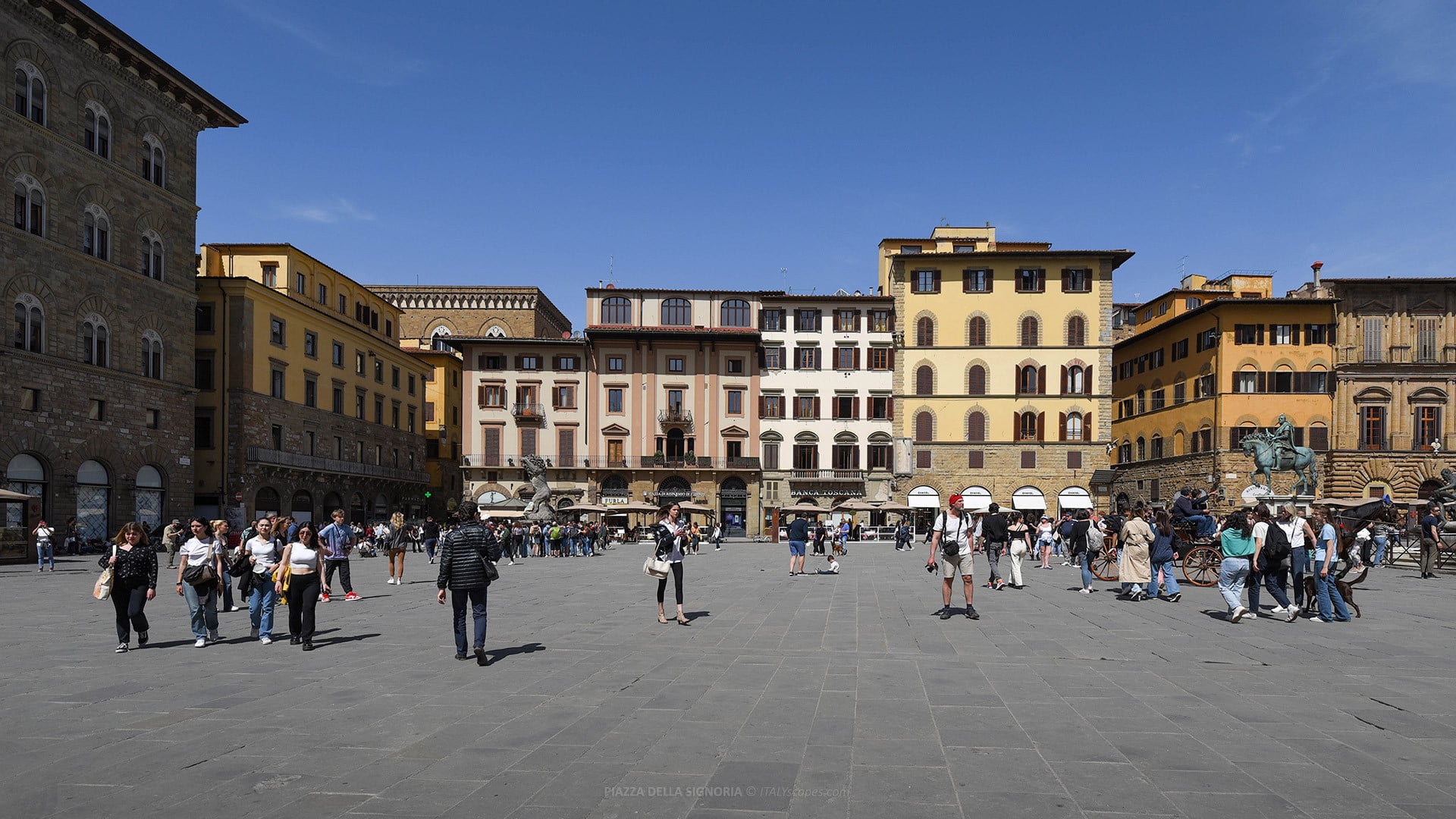
Piazza della Signoria
Palazzo Vecchio – The Unfinished Battle of Cascina
Palazzo Vecchio is directly connected with one of Michelangelo’s most important unfinished Florentine projects. In the early 16th century, he was commissioned to prepare a fresco for the Sala del Gran Consiglio, while Leonardo da Vinci was preparing the Battle of Anghiari for the same civic context.
Michelangelo’s subject was the Battle of Cascina, a Florentine military victory from the 14th century. He prepared a famous cartoon showing soldiers surprised while bathing, rushing to arm themselves. The fresco itself was never executed, and the original cartoon was later lost.
Although the work no longer exists, its importance was enormous. Artists studied the cartoon for its dynamic nude bodies, anatomical energy, and complex movement. The project strengthened Michelangelo’s reputation as a master of the human figure even without producing a finished wall painting.
Palazzo Vecchio is also important because it places Michelangelo inside the political life of Florence. He was not only a private sculptor working for patrons. He received civic commissions that were meant to glorify the Republic and decorate its most important government building.
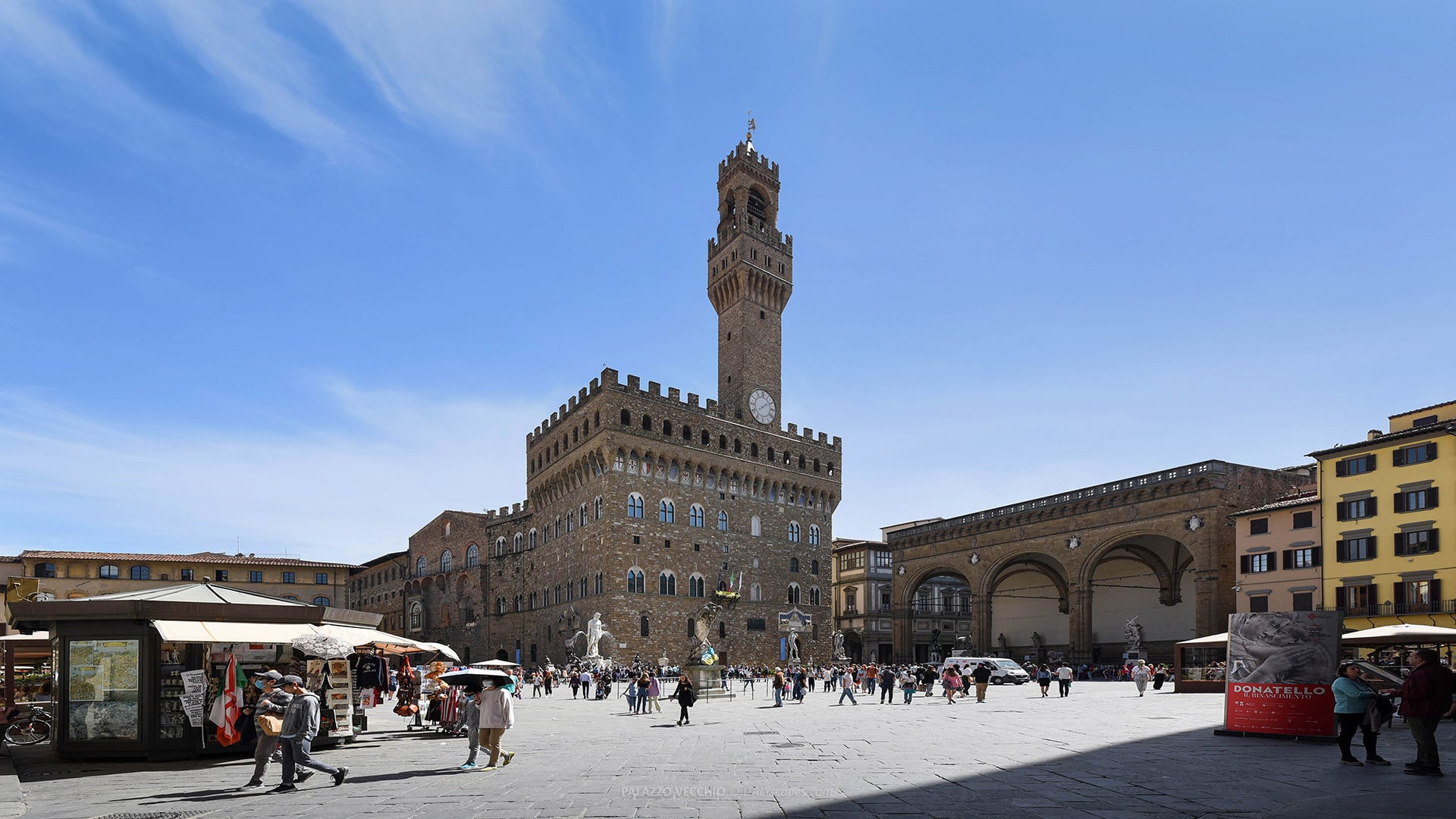
Palazzo Vecchio
Uffizi Galleries – The Doni Tondo and Michelangelo the Painter
The Uffizi Galleries preserve Michelangelo’s most important painting in Florence: the Doni Tondo, also known as the Holy Family. It was painted around 1505-1506 for the Florentine merchant Agnolo Doni, probably in connection with his marriage to Maddalena Strozzi.
The painting is important because it is the only finished panel painting by Michelangelo that survives. It shows the Holy Family in the foreground, with Saint John the Baptist and nude figures behind them. The circular format, or tondo, was commonly associated with domestic devotion in Renaissance Florence.
The Doni Tondo reveals Michelangelo’s sculptural way of thinking. The figures are muscular, twisted, and strongly modeled, almost as if they were carved rather than painted. The bright colors and complex poses anticipate later developments in 16th-century Italian art.
The Uffizi setting is also significant because it places Michelangelo among the greatest painters of Florence. Although he always identified primarily as a sculptor, this work proves that he could transform painting through the same anatomical power and structural intensity found in his marble figures.

Uffizi Galleries
Basilica of San Lorenzo – The Medici Church and Michelangelo’s Architecture
The Basilica di San Lorenzo is one of the central places in Michelangelo’s Florentine career because it was deeply connected with the Medici family. The church was the Medici parish church and became the setting for some of Michelangelo’s most important architectural and sculptural projects.
Michelangelo worked for Medici popes, especially Leo X and Clement VII, on projects connected with San Lorenzo. One of the most famous unrealized commissions was the façade of the basilica. Michelangelo designed an ambitious marble façade, but the project was abandoned and never completed.
Even unfinished, the San Lorenzo façade project is important because it shows the scale of Medici ambition and Michelangelo’s role as designer. He spent time dealing with marble supply, planning, and architectural solutions. The absence of the façade remains one of the great unrealized episodes in Florentine Renaissance architecture.
San Lorenzo also leads directly to the New Sacristy and the Laurentian Library, two of Michelangelo’s greatest Florentine achievements. Here, he was not only making individual statues. He was shaping entire architectural spaces connected with memory, dynasty, manuscripts, death, and political power.

Basilica di San Lorenzo
Medici Chapels – The New Sacristy and the Tombs of the Medici
The Medici Chapels, attached to San Lorenzo, preserve one of Michelangelo’s greatest Florentine ensembles: the New Sacristy. This space was designed as a Medici burial chapel and includes architecture and sculpture conceived together as a unified artistic system.
Michelangelo designed the chapel and sculpted the tombs of Giuliano de’ Medici, Duke of Nemours, and Lorenzo de’ Medici, Duke of Urbino. These were not realistic portraits in the modern sense. They were idealized figures representing status, thought, action, and dynastic memory.
The tombs include the famous allegorical figures of Day, Night, Dawn, and Dusk. These reclining bodies express the passage of time and the inevitability of death. Their powerful forms, unfinished surfaces, and symbolic ambiguity make them among Michelangelo’s most important sculptures in Florence.
The New Sacristy is also important architecturally. Michelangelo created a space where walls, niches, tombs, and figures are tightly connected. The architecture does not merely contain the sculpture; it participates in the same dramatic system of tension, rhythm, and symbolic meaning.
Laurentian Library – Michelangelo as Architect of Knowledge
The Laurentian Library, also part of the San Lorenzo complex, is one of Michelangelo’s most important architectural works in Florence. It was commissioned under Medici patronage to house the family’s manuscript collection and to express the intellectual prestige of the dynasty.
Work began in the 1520s, and Michelangelo directed the project before leaving Florence permanently in 1534. The library was completed later by others, based on his designs and instructions. Even so, its most striking architectural ideas belong to him.
The vestibule is famous for its unusual treatment of walls, columns, brackets, and space. Architectural elements appear compressed and animated, creating an effect of controlled tension. The staircase seems to flow into the room, turning architecture into something almost sculptural.
The reading room is more ordered and calm, with long rows of desks and windows. The contrast between the energetic vestibule and the disciplined reading room shows Michelangelo’s ability to create movement, pressure, and release through architecture alone.
Santa Maria del Fiore – Cathedral Commissions and Civic Ambition
Santa Maria del Fiore, Florence Cathedral, is connected with Michelangelo through several important commissions and projects. David was originally intended for the cathedral, specifically for the series of large sculptural figures associated with the building. The statue later received a different civic location in Piazza della Signoria.
The cathedral also connects with Michelangelo through the unfinished Saint Matthew, now in the Accademia. In 1503, he received a commission to carve statues of the twelve apostles for the cathedral. Only Saint Matthew was begun, and the larger project was abandoned.
These unfinished or redirected projects show how closely Michelangelo’s early Florentine career was tied to the cathedral authorities. Even when works were moved elsewhere or left incomplete, Santa Maria del Fiore remained one of the institutions that shaped his public role in the city.

Santa Maria del Fiore
Museo dell’Opera del Duomo – The Florentine Pietà
The Museo dell’Opera del Duomo preserves the Florentine Pietà, also known as the Bandini Pietà. This late sculpture is one of Michelangelo’s most important works in Florence, although it belongs to his old age and was not created during his youthful Florentine period.
Michelangelo probably intended the work for his own tomb. It shows the dead Christ supported by the Virgin Mary, Mary Magdalene, and a hooded male figure often identified with Nicodemus. The face of Nicodemus is traditionally interpreted as a self-portrait of Michelangelo.
The sculpture remained unfinished and was damaged by Michelangelo himself before passing through later hands. Its broken and incomplete condition is part of its historical importance. Unlike the polished Vatican Pietà of his youth, the Florentine Pietà is tragic, heavy, and spiritually intense.
Its current location in the Museo dell’Opera del Duomo places it near the cathedral complex, one of the great centers of Florentine religious art. The museum context also connects it with works originally made for Santa Maria del Fiore, the Baptistery, and the city’s sacred monuments.
Santa Croce – Michelangelo’s Final Resting Place
The Basilica di Santa Croce is the final Florentine monument in Michelangelo’s life story. He died in Rome on February 18, 1564, at the age of eighty-eight. Although he had spent many of his later years in Rome, Florence wanted him returned as one of its greatest sons.
His body was brought from Rome to Florence and buried in Santa Croce. The monumental tomb was designed by Giorgio Vasari and completed with the help of other artists. The tomb became a public statement of Florence’s claim over Michelangelo’s memory and glory.
The monument includes allegorical references to the arts in which Michelangelo excelled: sculpture, painting, and architecture. This was appropriate because his career had transformed all three fields. Santa Croce presents him not only as a sculptor, but as a universal artistic figure.
Santa Croce is also the burial place of other major Italian figures, which reinforces its role as a pantheon of cultural memory. Michelangelo’s tomb belongs to this larger context, but it remains one of the basilica’s most important monuments.
For a journey through Michelangelo’s Florence, Santa Croce is the natural conclusion. Casa Buonarroti shows his beginning, the Accademia shows his public triumph, San Lorenzo shows his mature architectural and sculptural power, and Santa Croce preserves his final Florentine identity.
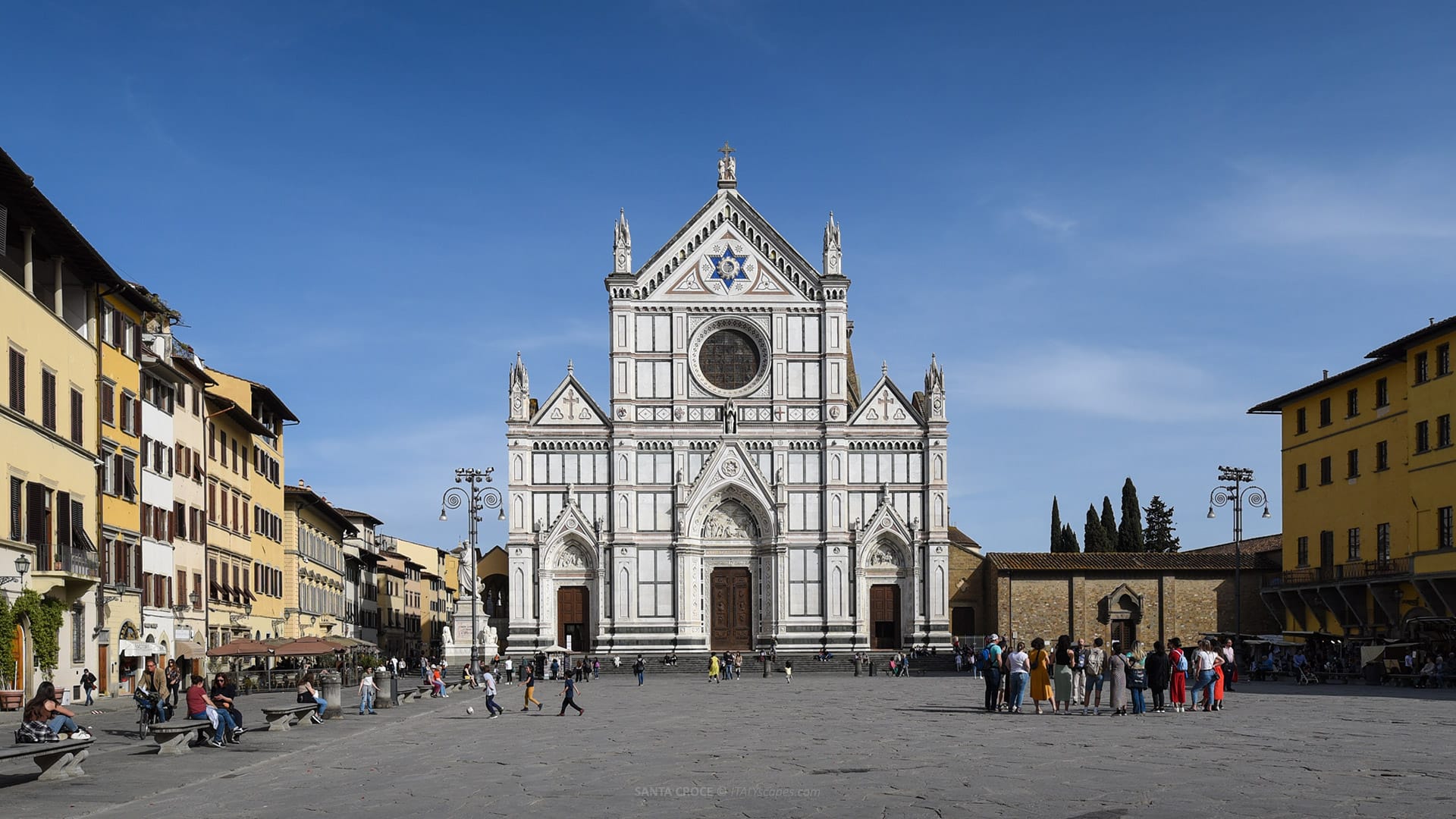
Santa Croce
A Michelangelo Itinerary Through Florence
A practical itinerary through Michelangelo’s Florence can begin at Casa Buonarroti, where the early reliefs reveal the young sculptor’s formation. From there, visitors can continue toward Santa Croce, the place of his burial and one of the strongest symbols of his Florentine memory.
The route can then move toward Santa Maria Novella and Santo Spirito, two churches connected with his artistic and intellectual formation. Santa Maria Novella evokes the world of Ghirlandaio and Florentine fresco painting, while Santo Spirito preserves the intimate wooden Crucifix connected with his youth.
The central part of the itinerary belongs to Piazza della Signoria, Palazzo Vecchio, the Uffizi, and the Accademia. These places show Michelangelo as civic sculptor, unfinished fresco designer, rare painter, and creator of David, the statue that became the emblem of republican Florence.
The San Lorenzo complex should be treated as a separate major stage. The basilica, Medici Chapels, New Sacristy, and Laurentian Library show Michelangelo working for the Medici in sculpture and architecture. This area contains some of the most complex works of his mature Florentine career.
Frequently Asked Questions about Michelangelo in Florence
Why is Florence important for Michelangelo?
Florence was the city where Michelangelo grew up, trained, received major commissions, and created several early masterpieces. It also preserves his family memory, Medici works, and final tomb.
Where can you see Michelangelo’s David in Florence?
The original David is displayed in the Galleria dell’Accademia. A copy stands in Piazza della Signoria, where the statue was originally placed in 1504.
Is Michelangelo buried in Florence?
Yes. Michelangelo died in Rome in 1564, but his body was taken to Florence and buried in the Basilica of Santa Croce, where his monumental tomb stands today.
What did Michelangelo create in the Medici Chapels?
In the New Sacristy of the Medici Chapels, Michelangelo designed the architectural space and sculpted the Medici tombs, including the allegorical figures Day, Night, Dawn, and Dusk.
What is Michelangelo’s connection with San Lorenzo?
San Lorenzo was the Medici family church. Michelangelo worked on projects connected with the complex, including the unfinished façade, the New Sacristy, and the Laurentian Library.
Can you see a Michelangelo painting in Florence?
Yes. The Doni Tondo, also called the Holy Family, is displayed in the Uffizi Galleries. It is Michelangelo’s only surviving finished panel painting.
What is the best Michelangelo itinerary in Florence?
A strong itinerary includes Casa Buonarroti, Santo Spirito, the Accademia, Piazza della Signoria, the Uffizi, San Lorenzo, the Medici Chapels, the Opera del Duomo Museum, San Miniato, and Santa Croce.


