-
About
Table of Contents
Piazza della Repubblica is one of the main squares in Florence, located in the historic center of the city, within the UNESCO-listed area. The rectangular square measures about 75 meters by 100 meters, covers roughly 7,500 square meters, and stands around 250 meters from the Cathedral of Santa Maria del Fiore.
The square is one of the clearest examples of how Florence changed between ancient times, the Middle Ages, and the late 19th century. Its modern appearance belongs mainly to the Risanamento, the large urban redevelopment that transformed the old central market area after Florence became capital of the Kingdom of Italy.
Today, Piazza della Repubblica is a pedestrian and commercial space, bordered by historic cafés, hotels, shops, porticoes, and 19th-century buildings. It is crossed by central streets such as Via Roma, Via degli Speziali, Via degli Strozzi, Via dei Brunelleschi, Via Pellicceria, and Calimala.
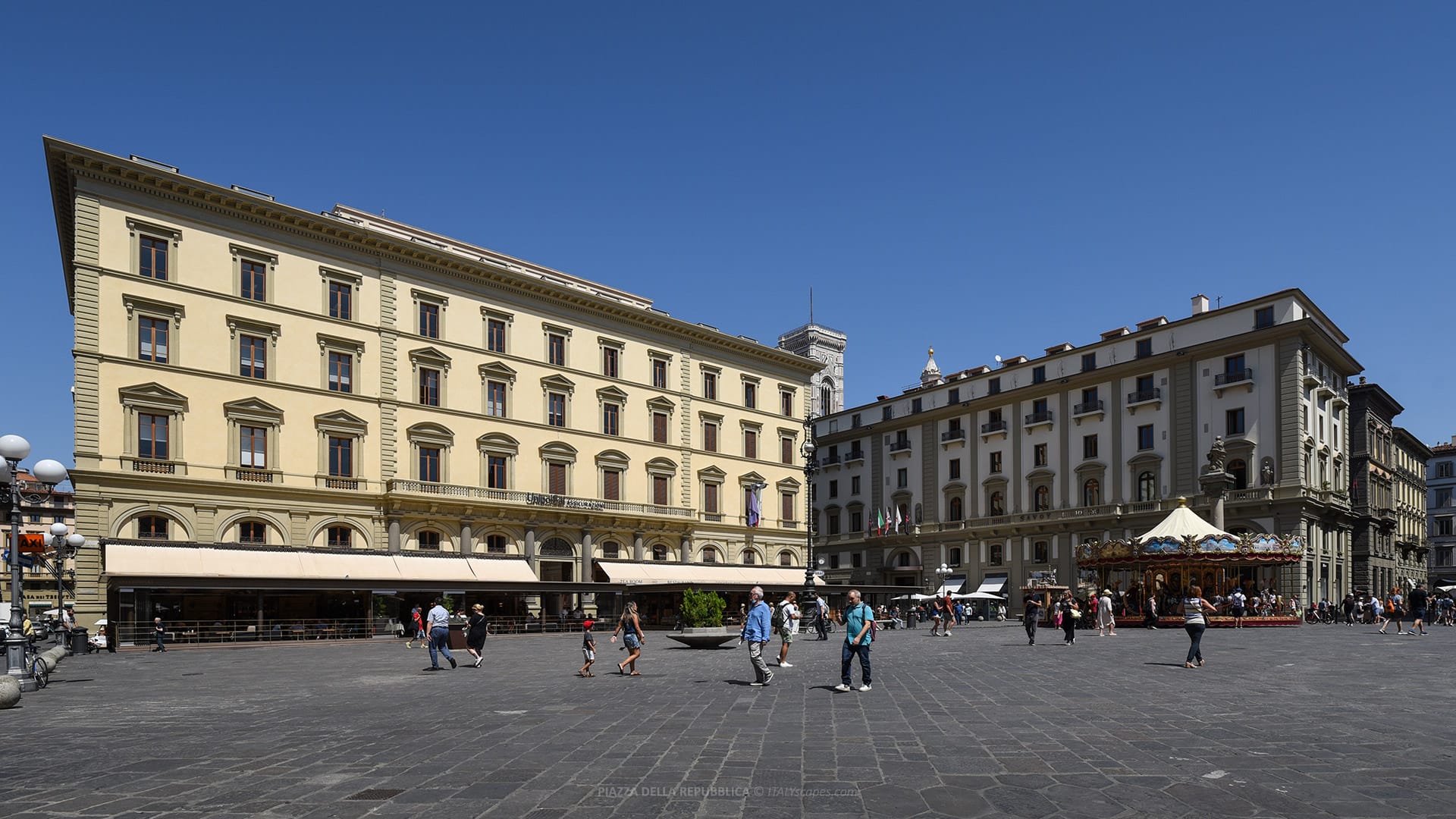
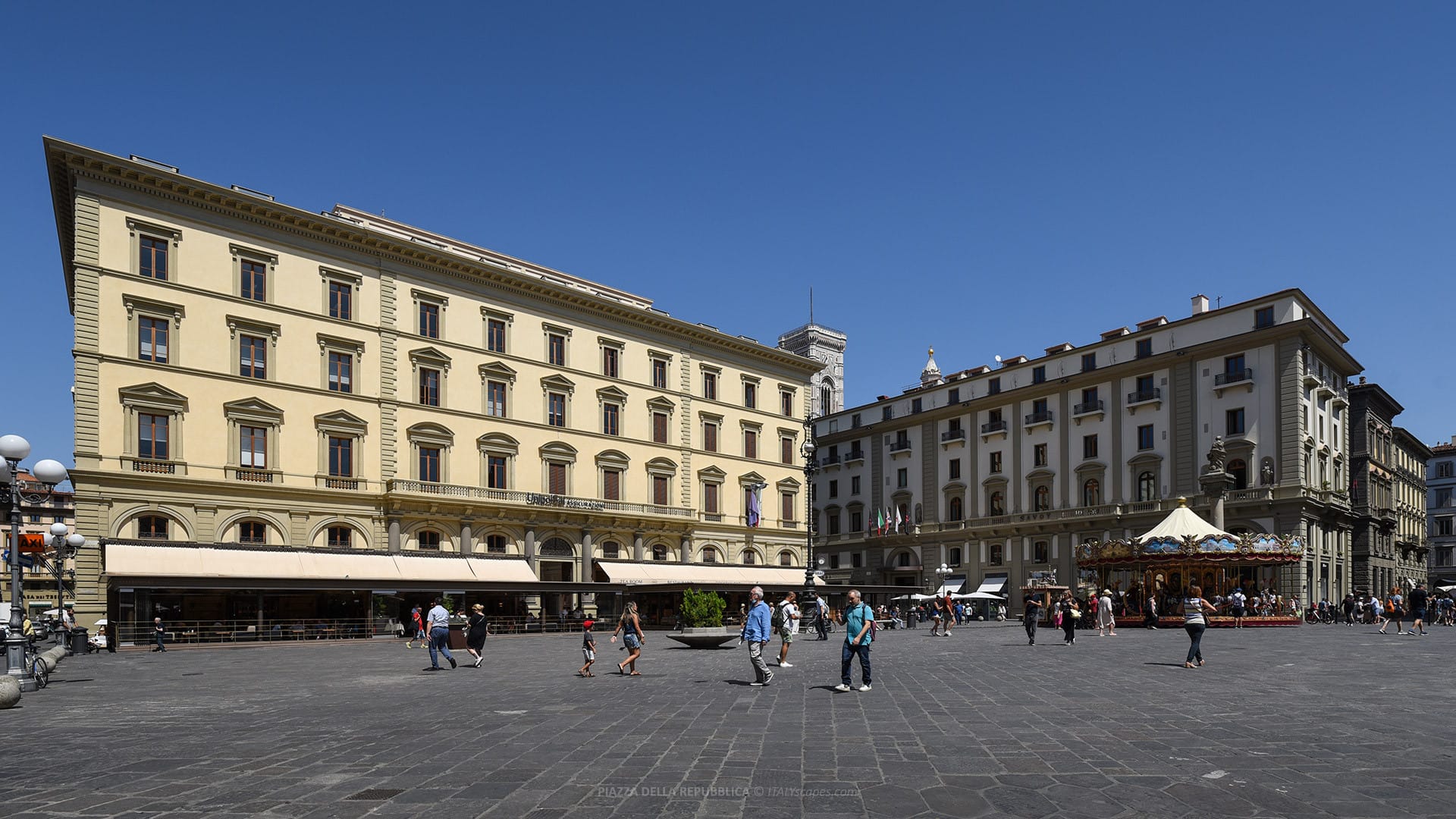
Piazza della Repubblica, with Palazzo Levi on the left and the Savoy on the right
Short History of Piazza della Repubblica
The Roman Forum of Florentia
Piazza della Repubblica has been connected with the center of Florence since Roman times. In ancient Florentia, this area corresponded to the Roman forum, the main public space where the city’s most important civic, commercial, and religious functions were concentrated.
The Roman layout of Florence was based on two principal streets, the cardo and the decumanus. Their crossing point was located in this area. The cardo corresponded broadly to the axis of Via Roma, Calimala, and Via Por Santa Maria, while the decumanus followed the direction of Via del Corso, Via degli Speziali, and Via degli Strozzi.
Archaeological discoveries made during the 19th-century demolitions confirmed the ancient importance of the area. Remains of Roman buildings, a thermal complex, and religious structures were found beneath the modern square. The Capitolium temple stood toward the western side, roughly where the porticoes stand today.
In the imperial period, the Roman forum was probably made more monumental. The square was raised, extended, and paved at a higher level. Ancient evidence also indicates the presence of steps, openings, and a small portico with statues of magistrates and emperors.
Mercato Vecchio and the Medieval City
During the early Middle Ages, the former forum area became densely built. Florence grew inside its walls, and the central district filled with houses, shops, narrow lanes, and tower-houses. Chroniclers described an overcrowded city where open land almost disappeared and buildings rose vertically because space was limited.
The area kept its role as a meeting and trading place. After the year 1000, the market function became more organized, and the space developed into the Mercato Vecchio, or Old Market. It served commerce, while Piazza del Duomo was associated with religious life and Piazza della Signoria with political and civic affairs.
The Old Market was smaller than the present square and occupied only about one third of today’s Piazza della Repubblica. It extended south only as far as the line of Via degli Speziali and the old Via dei Ferrivecchi, today corresponding to Via degli Strozzi.
At the center of Mercato Vecchio stood the Beccheria, a 14th-century building used for slaughtering animals and selling meat. Behind it was the Loggia del Pesce, built in the 16th century. Around these structures stood dense rows of stalls, masonry shops, wooden booths, and covered market spaces.
The Jewish Ghetto
The area also included the historic Jewish Ghetto of Florence. In 1571, Cosimo I de’ Medici ordered the city’s Jewish population to live in this enclosed district. The ghetto contained an Italian synagogue and a Spanish or Levantine synagogue, reflecting the diversity of the local Jewish community.
The ghetto occupied a large block near the Old Market, between streets that correspond today to Via dei Brunelleschi, Via dei Pecori, Via Roma, and Piazza della Repubblica. After Jewish emancipation, the district was gradually occupied by poorer residents and became one of the most degraded parts of central Florence.
The old ghetto was definitively cleared in 1885 and demolished from 1888 during the Risanamento. In its place rose modern residential and commercial buildings, including Palazzo Levi and Palazzo Ceci e Rossi, separated by the newly opened stretch of Via dei Tosinghi.
A scale reconstruction of the old ghetto is preserved in the Jewish Museum of Florence. This model is important because almost no visible architectural evidence of the ghetto survives in the square itself.
The Column of Abundance
The main visible memory of the old market is the Column of Abundance, also called the Column of Wealth. It marks the ancient crossing point of the Roman cardo and decumanus, and therefore represents the symbolic center of Roman Florence.
The present column was erected in 1430-1431 by the Ufficiali di Torre. Its grey granite shaft comes from Elba.
The column originally carried a statue by Donatello, representing Abundance. That statue deteriorated and was replaced in 1721 by a work by Giovan Battista Foggini. During the 19th-century demolitions, the column was dismantled and parts of it were moved to the lapidary collection of San Marco.
In 1956, the column was reassembled near its original position, although slightly farther east to avoid obstructing traffic. The statue visible today is not the fragile original, but a modern copy made to protect the historical sculptural tradition associated with the monument.
The Risanamento and the New Square
The modern square was created during the Risanamento, the redevelopment of central Florence carried out after the city became capital of the Kingdom of Italy between 1865 and 1871. The intervention aimed to modernize the old center, improve hygiene, and reshape the city’s commercial image.
Plans to transform the area existed from the 1860s, but the project was revived in the early 1880s. The municipal administration approved the new urban arrangement in 1883, and the final project was approved in 1888, after new legislation made expropriation easier.
The redevelopment destroyed a large part of medieval Florence. Demolitions removed tower-houses, churches, guild buildings, noble palaces, artisan workshops, narrow lanes, and old market structures. The Loggia del Pesce by Vasari was dismantled and later reassembled in Piazza dei Ciompi.
The operation was officially presented as a sanitary and urban improvement, but it was also connected to real estate speculation and the ambitions of the emerging bourgeois class after Italian unification. Artists and historians later described the loss as one of the most significant erasures in Florence’s historic center.
On 20 September 1890, an equestrian monument to Vittorio Emanuele II was inaugurated in the square in the presence of the king. For a period, the square was named after him. The statue was removed in 1932 and moved to the Cascine area.
In April 1947, after the proclamation of the Italian Republic in 1946, the square received its present name. The new name honored the Republic, although many Florentines continued for years to refer to the place informally as Piazza Vittorio.
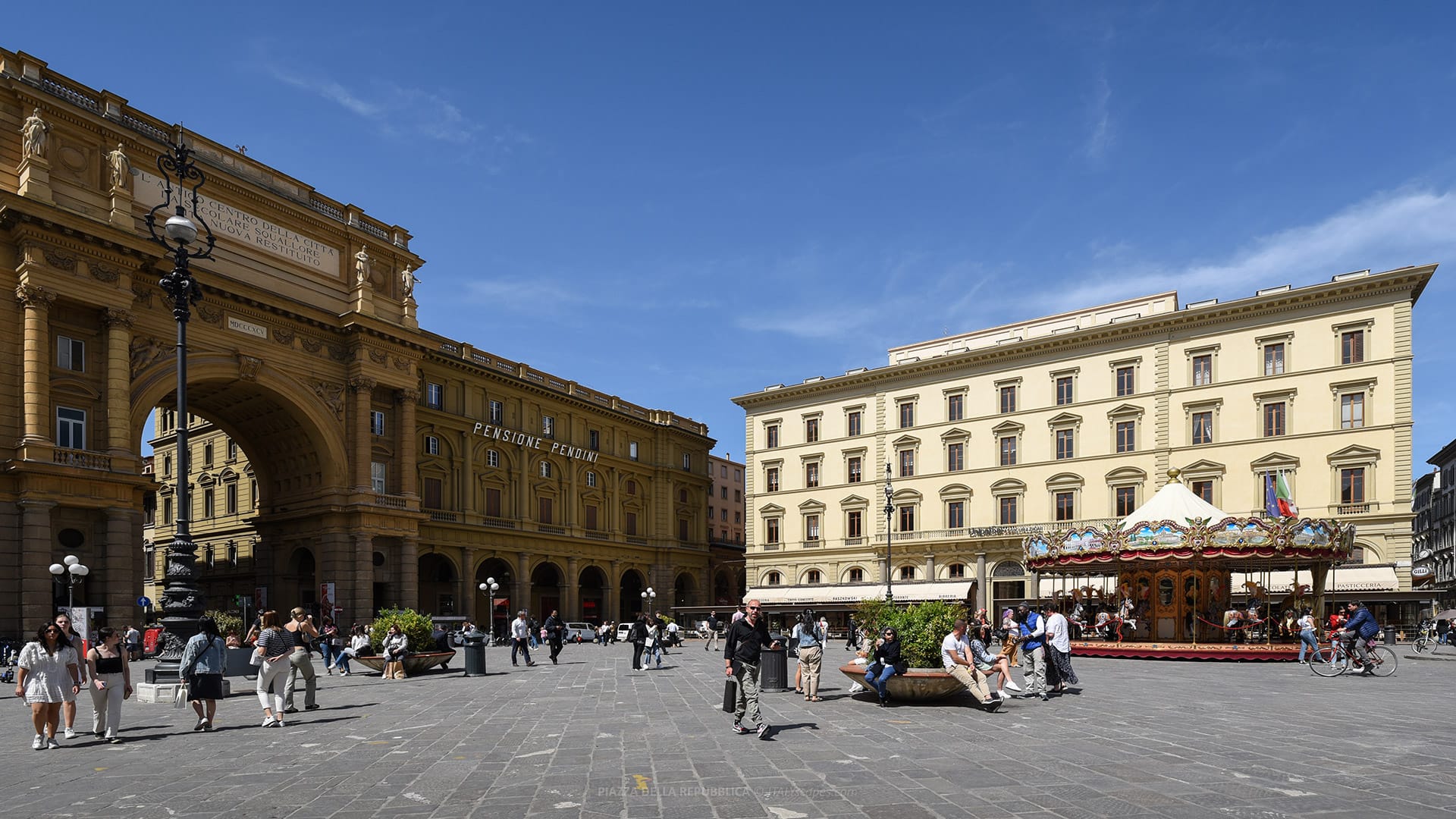
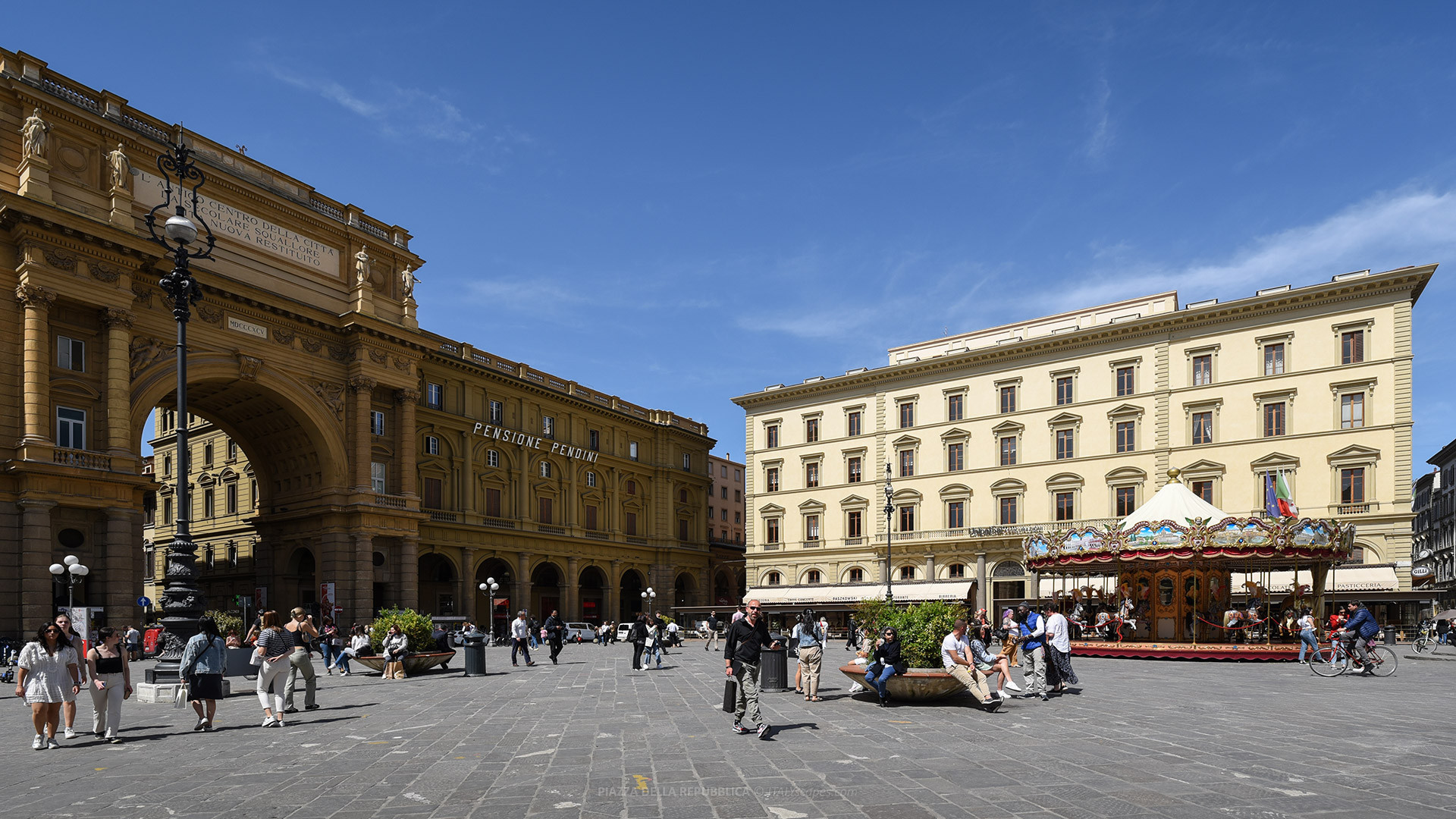
Piazza della Repubblica, with the Arcone on the left and Palazzo Levi on the right
Architecture of Piazza della Repubblica
General Layout
Piazza della Repubblica is a rectangular pedestrian space, approximately 100 meters long and 75 meters wide. Its shape, paving, porticoes, and monumental fronts reflect the late 19th-century redevelopment rather than the medieval market fabric that once occupied the area.
The northern side is about 75 meters long and is dominated by Palazzo Levi. On its ground floor are two of Florence’s historic cafés, Caffè Gilli and Caffè Paszkowski, both linked to the cultural and social life of the city.
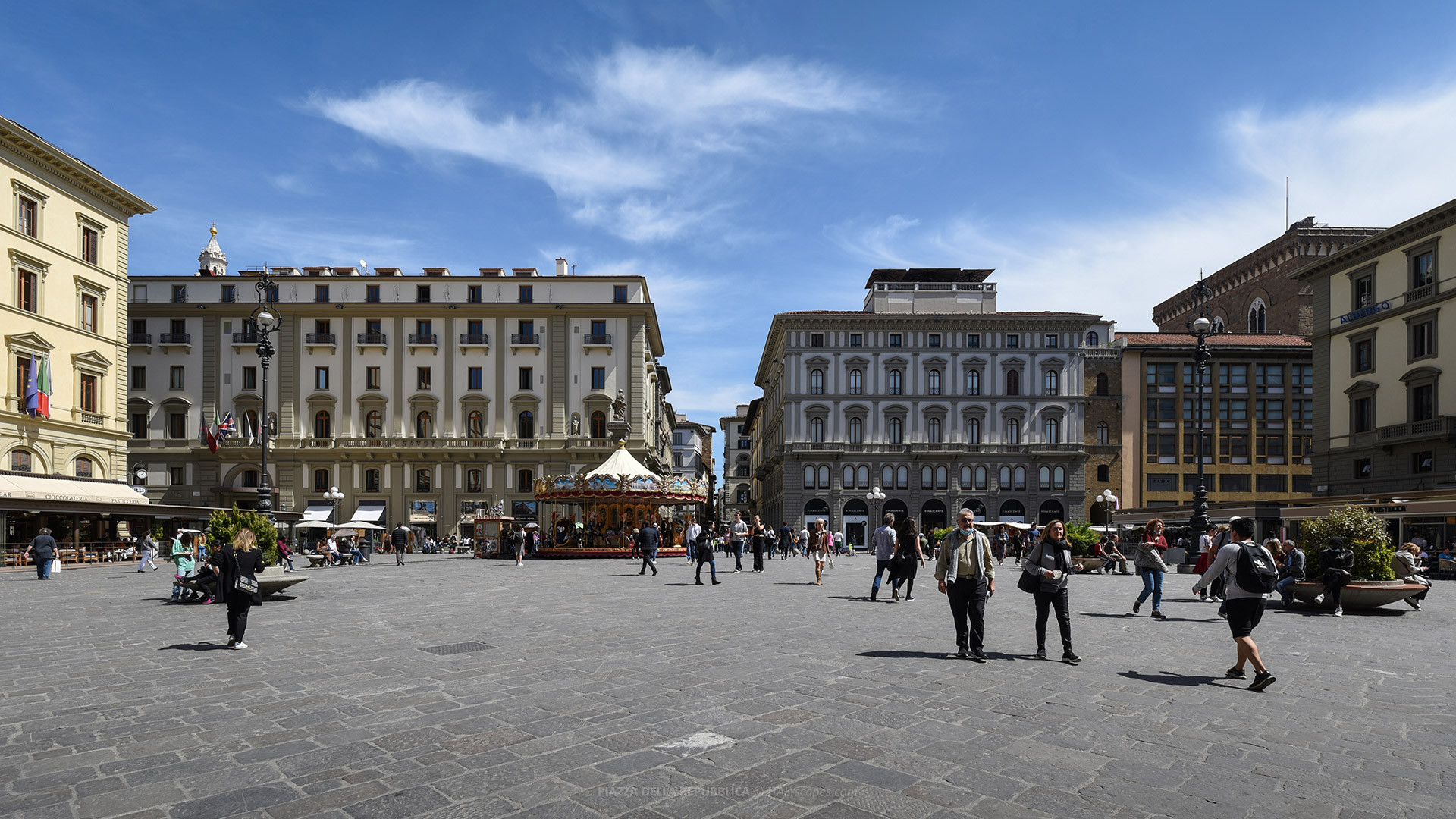
The eastern side includes two principal buildings, the Savoy and the Palazzo del Trianon, with Via degli Speziali entering the square between them. The former Banco di Sicilia building, although more connected with Via Calimala, is also associated with the numbering and architectural context of the piazza.
The southern side is occupied by the three parts of Palazzo delle Giubbe Rosse. This side became famous for literary and artistic cafés, especially Caffè Le Giubbe Rosse and Donnini, which helped turn the square into a modern urban meeting place.
The western side is the most theatrical. It is marked by the Palazzo dell’Arcone di Piazza, the long porticoes, and the large triumphal arch known as the Arcone. The porticoes extend toward Via dei Brunelleschi on one side and Via Pellicceria on the other.
Palazzo dell’Arcone and the Arcone
The Arcone was designed by Vincenzo Micheli and completed in 1895. It was conceived as a monumental architectural backdrop for the new square, framing the entrance to Via degli Strozzi and giving the piazza a ceremonial western front.
The design was inspired by Florentine Renaissance architecture, but the final result belongs clearly to the eclectic taste of the late 19th century. Its large central arch, side porticoes, and symmetrical façades gave the newly opened square a monumental character unusual in older Florence.
Above the arch is the famous inscription traditionally attributed to Isidoro Del Lungo: “The ancient center of the city, restored from age-old squalor to new life.” The wording reflects the official rhetoric of the Risanamento, although the demolitions remain historically controversial.
The Arcone once carried an allegorical plaster group representing Italy, Art, and Science. The group deteriorated and was removed in 1904. The building later underwent conservation work, including structural and decorative interventions in the 21st century.
Palazzo Levi and the Northern Side
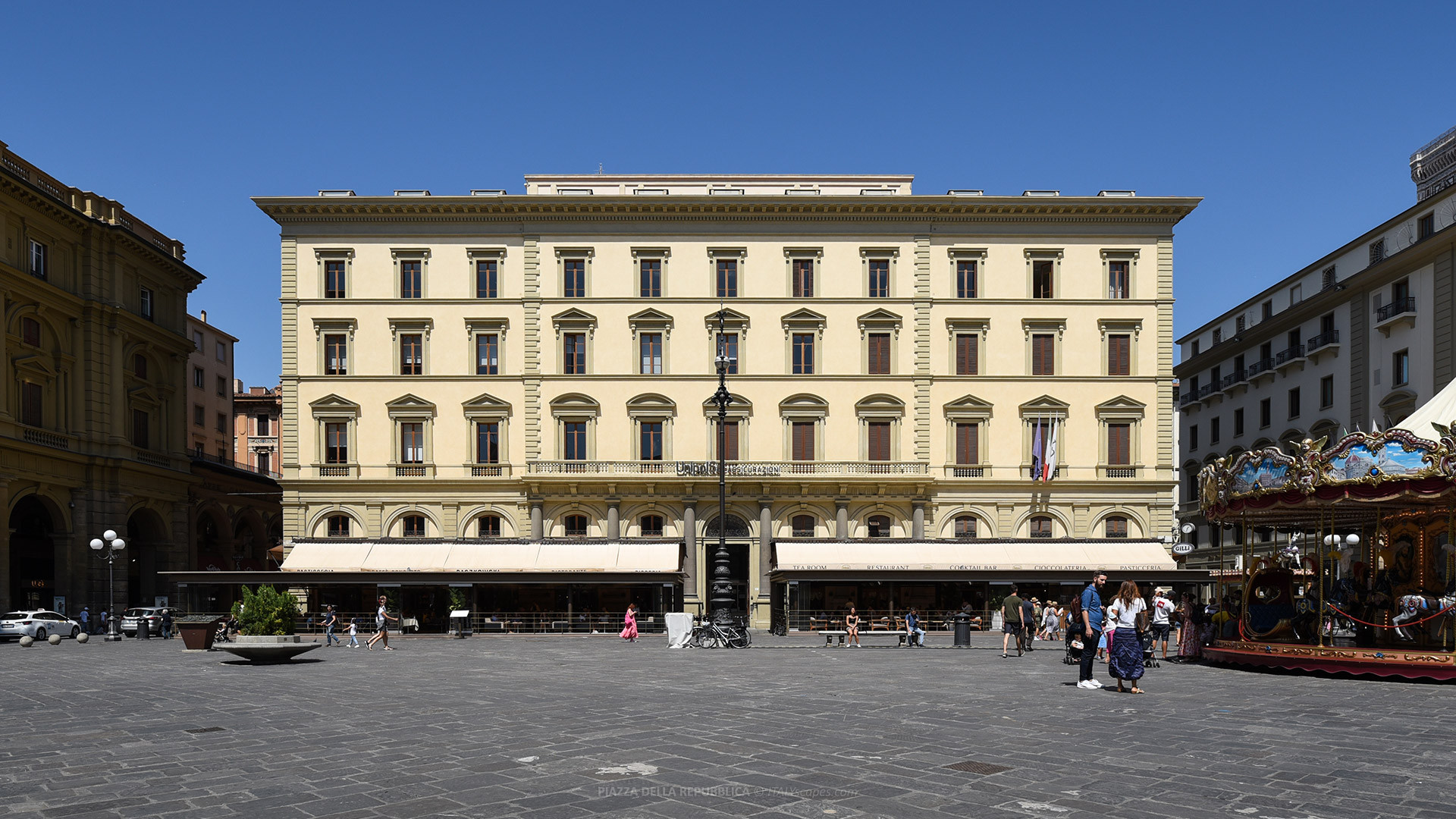
Palazzo Levi occupies the northern side of the square and contributes strongly to its late 19th-century image. It stands where the Risanamento replaced older urban fabric with wider fronts, regular façades, and commercial ground floors suited to the new bourgeois city.
The building is especially important because it houses Caffè Gilli and Caffè Paszkowski. These venues connect the architecture of the square with Florence’s social history, offering continuity between the post-Risanamento city and the café culture of the 19th and 20th centuries.
Savoy, Trianon, and the Eastern Side
The Savoy building was erected in 1898 by Vincenzo Micheli at the corner of Piazza della Repubblica and Via degli Speziali. It was designed from the beginning as a hotel and became one of the most visible signs of the square’s transformation into a modern, elegant urban space.
Its façade uses eclectic forms based on classical and Florentine architectural references. The piano nobile includes niches with allegorical statues of the Seasons, made by Vincenzo Rosignoli. The ground level is marked by broad arches used for shops and commercial entrances.
Palazzo del Trianon was designed by Luigi Buonamici, with a project already prepared in 1888. It has a rich neo-16th-century character, with balconies and decorative details. The original ground-floor rooms were occupied by the Trianon café, opened in 1891 and closed in 1896.
Palazzo delle Giubbe Rosse and the Southern Side
Palazzo delle Giubbe Rosse was designed by Torquato Del Lungo. Its architecture is more sober than some of the other late 19th-century façades around the piazza. One part of the building, facing Via San Miniato fra le Torri, incorporates remains of the older Palazzo dei Catellini da Castiglione.
The building became famous above all for Caffè Le Giubbe Rosse, opened in 1897 as a beer hall called Reininghaus. The Florentines associated the place with its waiters’ red jackets, and the nickname eventually became the identity of the café itself.
Le Giubbe Rosse was one of Florence’s most important literary cafés. It was connected with Futurism, the magazine Lacerba, the group around La Voce, and figures such as Giovanni Papini, Ardengo Soffici, Aldo Palazzeschi, Dino Campana, Eugenio Montale, and many others.
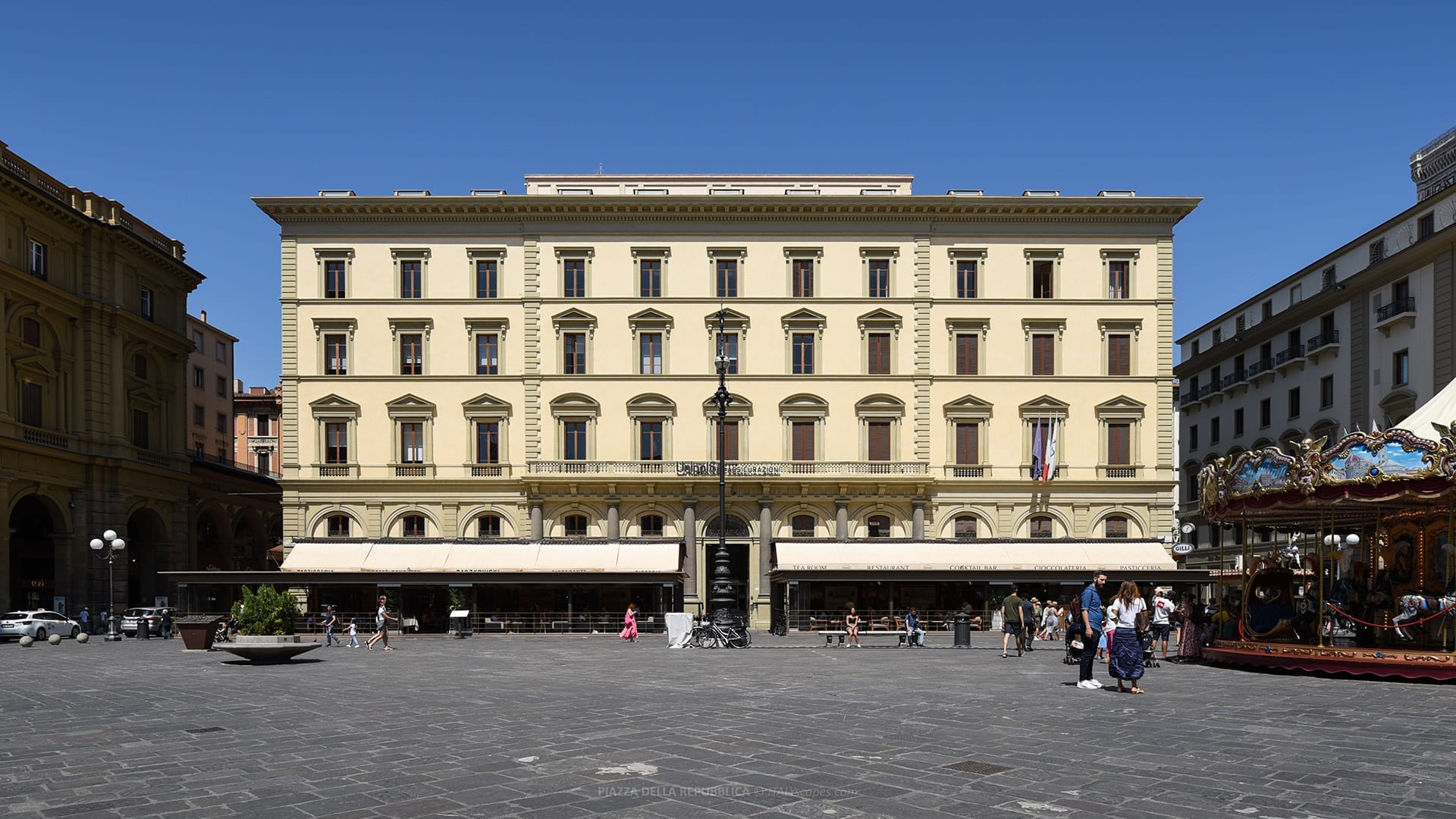
Palazzo Levi
How to Get to Piazza della Repubblica
Piazza della Repubblica is located in the pedestrian and commercial heart of Florence, very close to the city’s main historic attractions. It is easy to reach on foot from the Duomo, Piazza della Signoria, Ponte Vecchio, and Firenze Santa Maria Novella railway station.
Getting to Piazza della Repubblica on foot
From Firenze Santa Maria Novella railway station, Piazza della Repubblica is roughly 800 meters to 1 kilometer away, depending on the exact starting point and route. The walk usually takes about 10 minutes, although luggage, cobblestones, and crowds can slow visitors down.
A practical route from the station follows the central streets toward the historic core. Visitors can walk along Via degli Avelli, Via de’ Panzani, and Via de’ Cerretani, then continue near the Cathedral zone before reaching the square through Via Roma or adjacent streets.
From the Cathedral of Santa Maria del Fiore, Piazza della Repubblica is only a short walk away. The distance is about 250 to 300 meters, and the route through Via Roma or nearby streets usually takes 3 to 5 minutes at a normal pace.
From Piazza della Signoria, the walk is also short, about 450 to 500 meters. Visitors can reach the square through Via dei Calzaiuoli, Via degli Speziali, or nearby central streets.
Getting to Piazza della Repubblica by bus
The closest useful bus stops are around the central streets near the square, including the area of Vecchietti and nearby stops on routes serving the historic center. Because the core of Florence includes pedestrian zones and traffic restrictions, bus access can vary by route and direction.
Urban bus services operated by Autolinee Toscane connect the area with other parts of Florence. Lines serving the center, including routes such as 6 and 11, can be useful depending on the visitor’s starting point, but schedules and stops should be checked before travel.
From nearby stops, the final approach to the square is usually very short. Visitors should expect to walk the last 100 to 200 meters, especially because Piazza della Repubblica itself is a pedestrian space and vehicles do not normally enter the center of the square.
Getting to Piazza della Repubblica by Taxi
A taxi is useful for visitors carrying luggage, arriving late, or travelling from accommodation outside the historic center. From Firenze Santa Maria Novella railway station to Piazza della Repubblica, the journey is short and can take around 5 to 10 minutes, depending on traffic.
The distance is small, but Florence’s restricted traffic zones, one-way streets, and pedestrian areas can affect the exact route. Taxis usually stop at accessible points near the square rather than inside it, so visitors may still need a brief final walk.
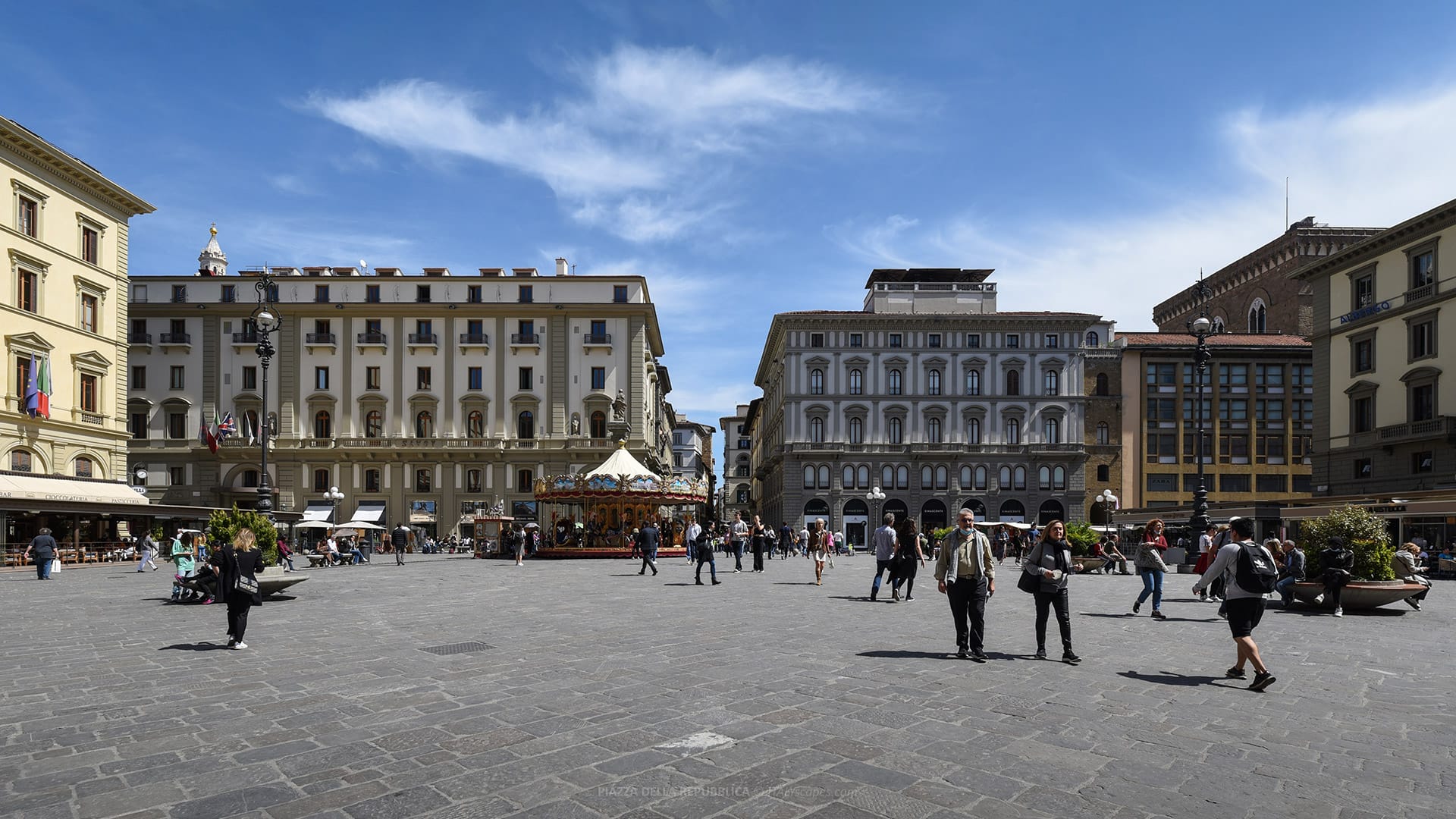
The eastern side of Piazza della Repubblica
Frequently Asked Questions about Piazza della Repubblica
Where is Piazza della Repubblica in Florence?
Piazza della Repubblica is located in the historic center of Florence, about 250 meters from the Cathedral of Santa Maria del Fiore and within walking distance of Piazza della Signoria.
Why is Piazza della Repubblica important?
The square marks the ancient center of Roman Florence. It later became the medieval Mercato Vecchio and was completely transformed during the 19th-century Risanamento.
What happened to the Mercato Vecchio?
The Mercato Vecchio was demolished during the Risanamento between the late 19th century and the 1890s, when Florence’s old center was radically modernized.
What is the Column of Abundance?
The Column of Abundance marks the symbolic center of ancient Florence, near the crossing of the Roman cardo and decumanus. The statue visible today is a modern copy.
What is the Arcone in Piazza della Repubblica?
The Arcone is the large triumphal arch on the western side of the square. It was designed by Vincenzo Micheli and completed in 1895.
How big is Piazza della Repubblica?
Piazza della Repubblica measures approximately 75 meters by 100 meters and covers about 7,500 square meters, making it one of Florence’s main central squares.
How do you get to Piazza della Repubblica?
The easiest way is on foot. The square is about 10 minutes from Santa Maria Novella station, 3-5 minutes from Florence Cathedral, and 5-7 minutes from Piazza della Signoria.
Sources: -
Photos
-
Map
-
Reviews