-
About
Table of Contents
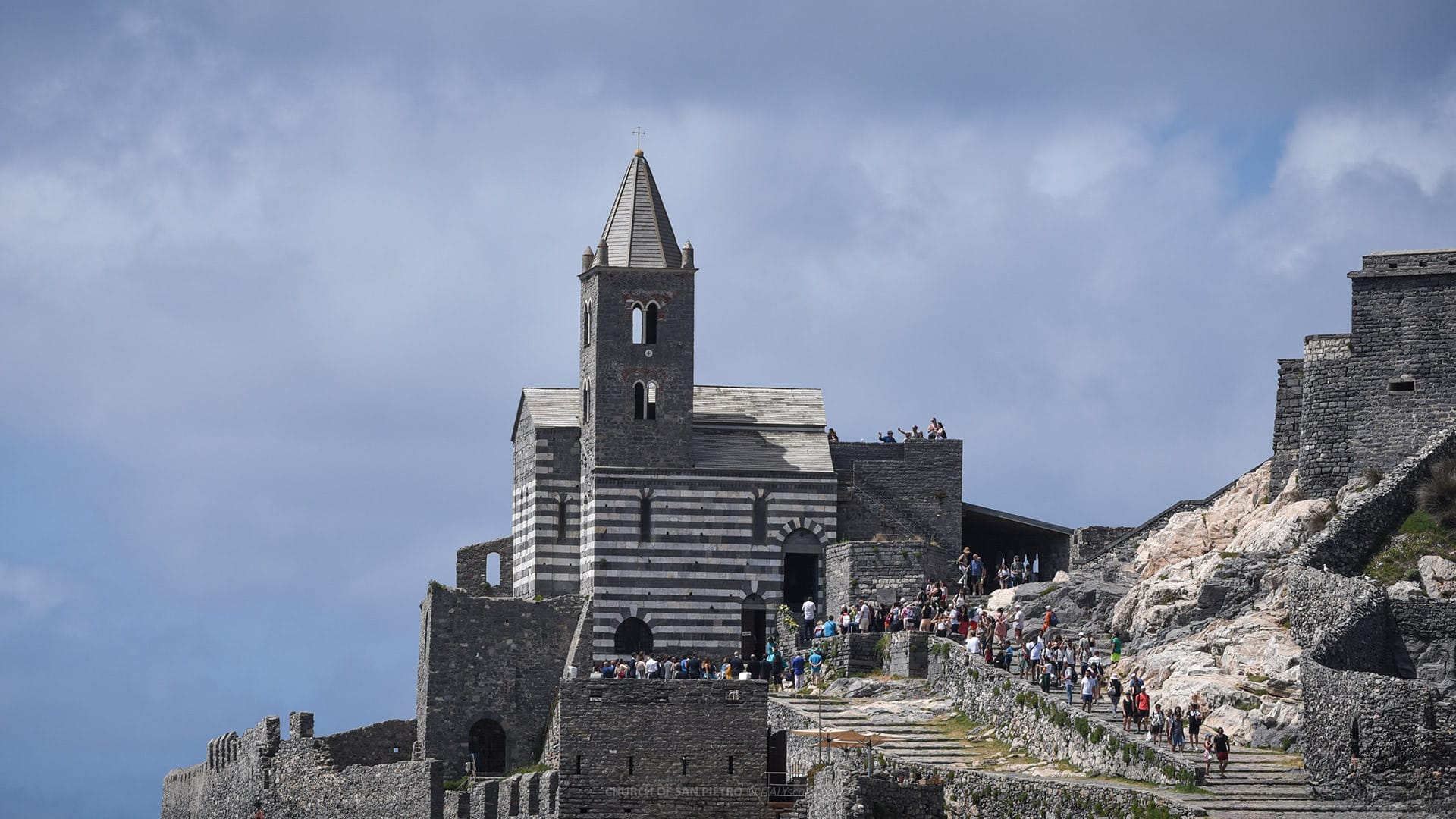
The Church of San Pietro is one of the most evocative religious monuments in Portovenere.
Dedicated to Saint Peter, the church rises dramatically on a rocky promontory at the western edge of the historic village, directly facing the sea and overlooking the wide expanse of the Gulf of Poets.
Its isolated position, suspended between land and water, gives it a symbolic and visual power unmatched by any other building in Portovenere.
Perched above the waves, the Church of San Pietro appears almost inseparable from the cliff on which it stands. The surrounding landscape amplifies its spiritual presence: steep rock walls descend into the sea, while the open horizon stretches endlessly westward.
This unique setting has made the church one of the most recognizable landmarks of the Ligurian coast and a defining image of Portovenere.
Beyond its striking location, the Church of San Pietro represents a layered historical and architectural narrative. Over centuries, the building absorbed religious, military, and cultural functions, reflecting the changing role of Portovenere within the Mediterranean world.
Short History of the Church of San Pietro
The origins of the Church of San Pietro are deeply rooted in antiquity.
The site on which the church stands was already considered sacred in pre-Christian times. Archaeological and historical evidence indicates that a pagan temple dedicated to Venus Erycina once occupied the rocky promontory, emphasizing the spiritual continuity of the location.
The earliest Christian structure on the site dates back to the 5th century. This original church, built in the Syriac tradition, was characterized by a simple rectangular plan with a semicircular apse. Its austere form reflected early Christian architectural principles and the strategic importance of the location.
The church was officially consecrated in 1198, marking a significant moment in its medieval history.
During this period, Portovenere was expanding as a fortified maritime settlement, and San Pietro played a central role in the town’s religious and symbolic landscape.
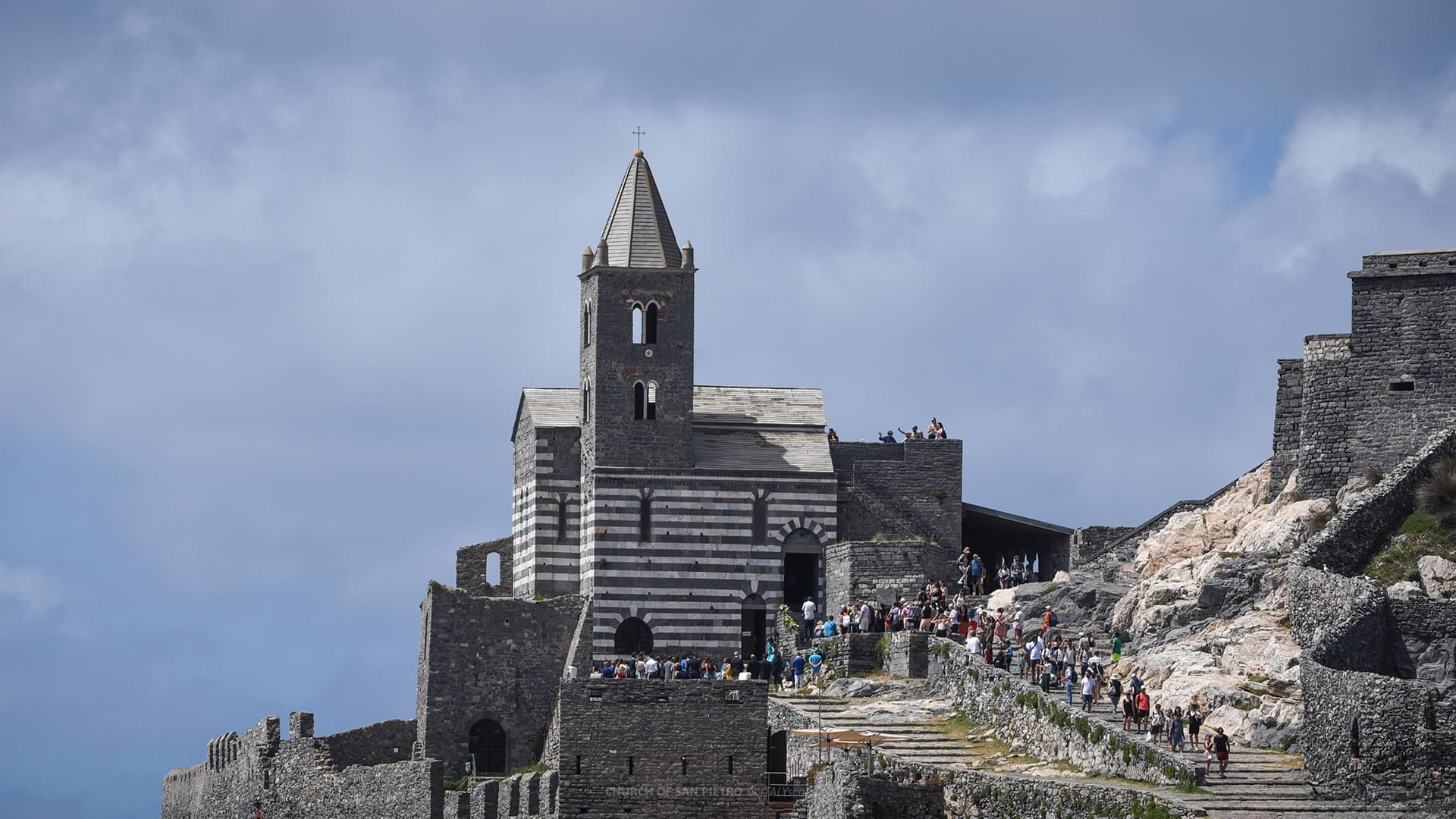
In the 13th century, under Genoese influence, the church underwent important aesthetic transformations. Between 1256 and 1277, the exterior walls were decorated with distinctive horizontal black-and-white stone bands.
This decorative pattern became a hallmark of Ligurian-Gothic architecture and gave the church its current visual identity.
Toward the end of the 14th century, the Church of San Pietro lost its parochial title in favor of the Church of San Lorenzo, which became the main parish church of Portovenere. Despite this change, San Pietro retained its religious importance and continued to be officiated by the secular clergy until 1798.
The church’s strategic location exposed it to military events. In 1494, it suffered damage during attacks by the Aragonese, reflecting the broader conflicts affecting the Ligurian coast during the late Middle Ages.
Later, during the Napoleonic era, the church was repurposed for military use. Its elevated position made it suitable as a coastal battery defending the Gulf of La Spezia. This period altered the building’s function but also contributed to its preservation as a fortified structure.
A major restoration campaign was carried out between 1929 and 1934. These works aimed to recover the church’s historical appearance, stabilize the structure, and remove inappropriate additions from previous centuries. The works restored San Pietro to its role as a religious and cultural monument.
Architecture of the Church of San Pietro
Architecturally, the Church of San Pietro is a composite structure that reflects different historical phases. The oldest part of the building belongs to the early Christian period and preserves the characteristics of Syriac architectural tradition.
This original church features a rectangular plan terminated by a semicircular apse. Its simple geometry and solid masonry convey a sense of permanence and spiritual austerity, appropriate to its early Christian origins.
Two round arches connect this ancient nucleus with the later medieval church. This transition marks a clear architectural evolution, linking the simplicity of early Christianity with the more articulated forms of the Middle Ages.
The newer section of the church is characterized by a wooden roof structure, contrasting with the stone vaulting typical of other medieval buildings. This choice reflects both structural necessity and regional construction practices.
The presbytery is divided into three chapels, each covered with ogival and cross vaults. These vaults rest on polystyle pillars, creating a rhythmic spatial articulation that guides the eye toward the altar.
The chapel on the left side is surmounted by a square bell tower. This tower terminates in a pyramidal roof and contributes to the church’s vertical emphasis, balancing the horizontal extension of the cliff.
Each side of the bell tower is decorated with rows of mullioned windows. These openings lighten the mass of the structure and introduce a refined decorative element consistent with Gothic influences.
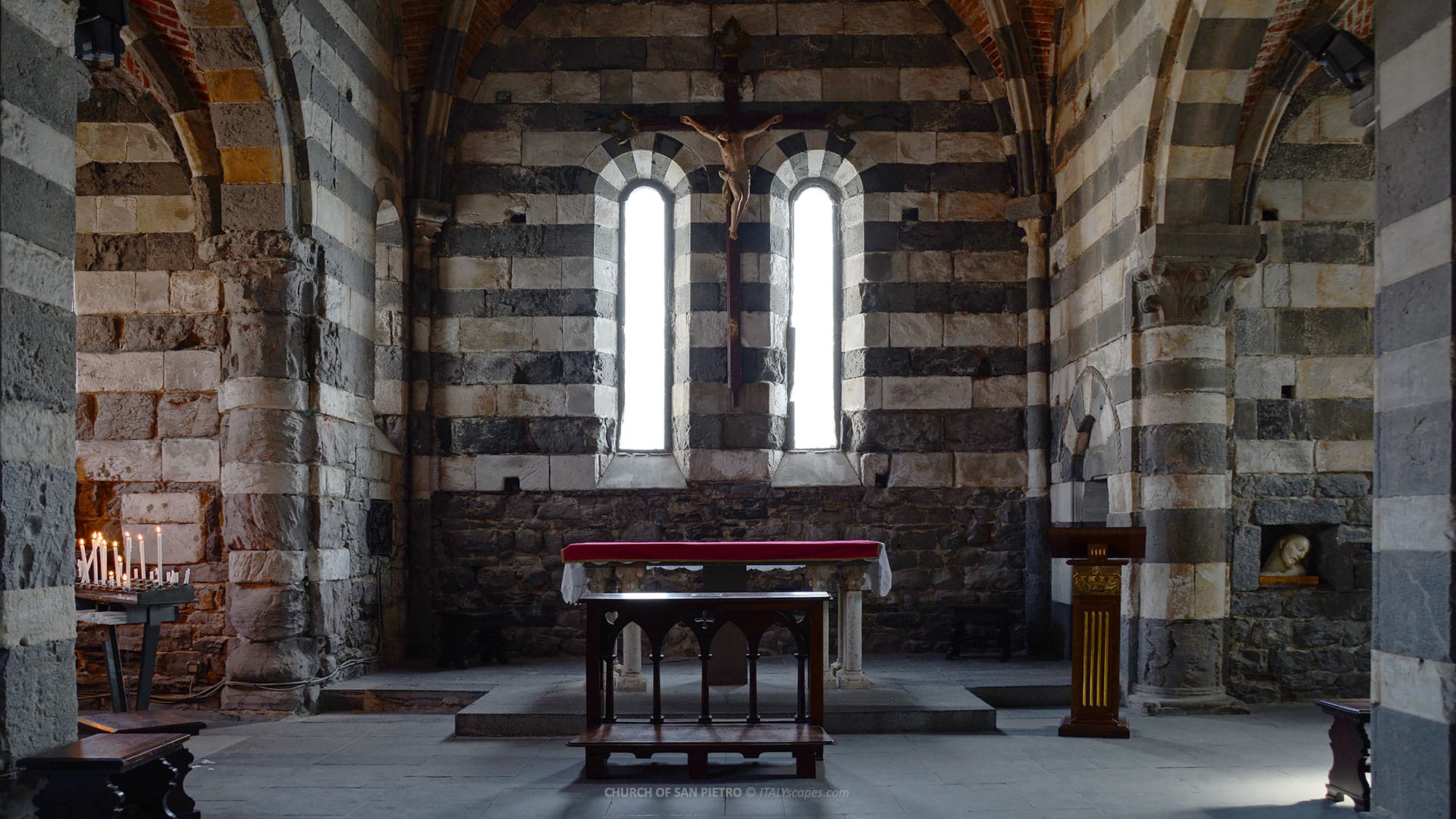
Inside, the church maintains a sober and contemplative atmosphere. The interior decoration echoes the exterior façade through the use of black-and-white horizontal stripes, reinforcing visual continuity between inside and outside.
The contrast between light and dark stone surfaces enhances the architectural rhythm of the space. This chromatic alternation is both decorative and symbolic, reflecting the Ligurian tradition of striped ecclesiastical façades.
The relationship between architecture and landscape is fundamental to the Church of San Pietro. Large openings frame views of the sea, allowing natural light and the surrounding environment to become part of the sacred experience.
Rather than overwhelming the visitor with ornamentation, the church relies on proportion, material, and setting to convey its spiritual message.
How to Get to the Church of San Pietro
The Church of San Pietro is located approximately 500 meters from Piazza Bastreri, the main square of Portovenere and the usual arrival point for buses coming from La Spezia.
From Piazza Bastreri, the church can be reached on foot in about 8 minutes. The route follows the waterfront along Via Calata Doria, offering scenic views of the Marina di Portovenere and the sea.
Walking along the quay, visitors gradually approach the western edge of the village. The church becomes increasingly visible as the path curves toward the rocky promontory on which it stands.
The route is mostly flat and pedestrian-friendly, making it accessible to most visitors. The final stretch involves a gentle ascent as the path reaches the church entrance.
Sources: -
Photos
-
Map
-
Reviews