-
About
Table of Contents
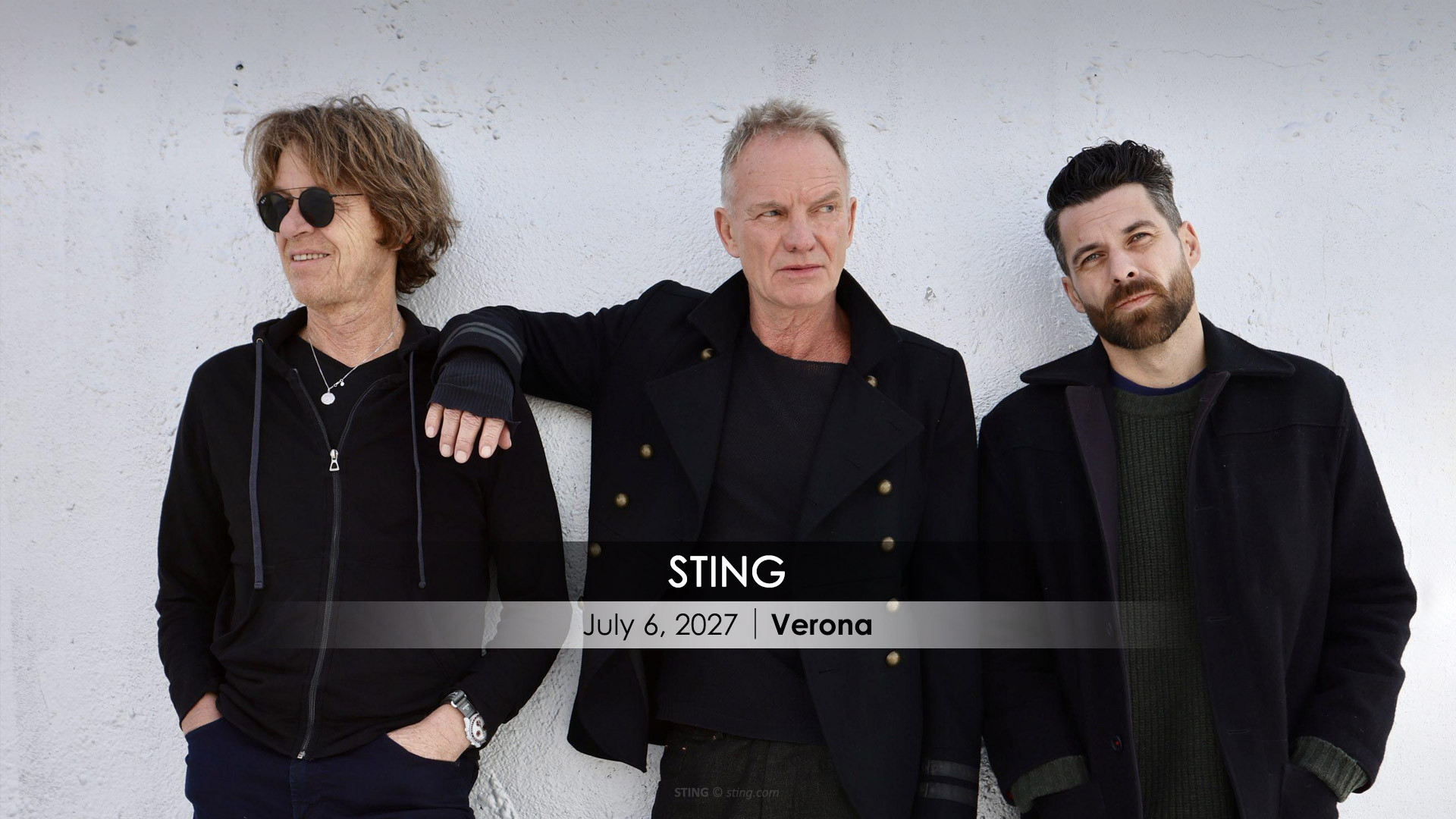
Sting will perform at the Arena di Verona on Tuesday, July 6, 2027, bringing his Sting 3.0 Tour to one of Italy’s most celebrated historic concert venues. The event is scheduled for 8:00 pm and will take place inside the ancient Roman amphitheatre in Piazza Bra, in the historic centre of Verona.
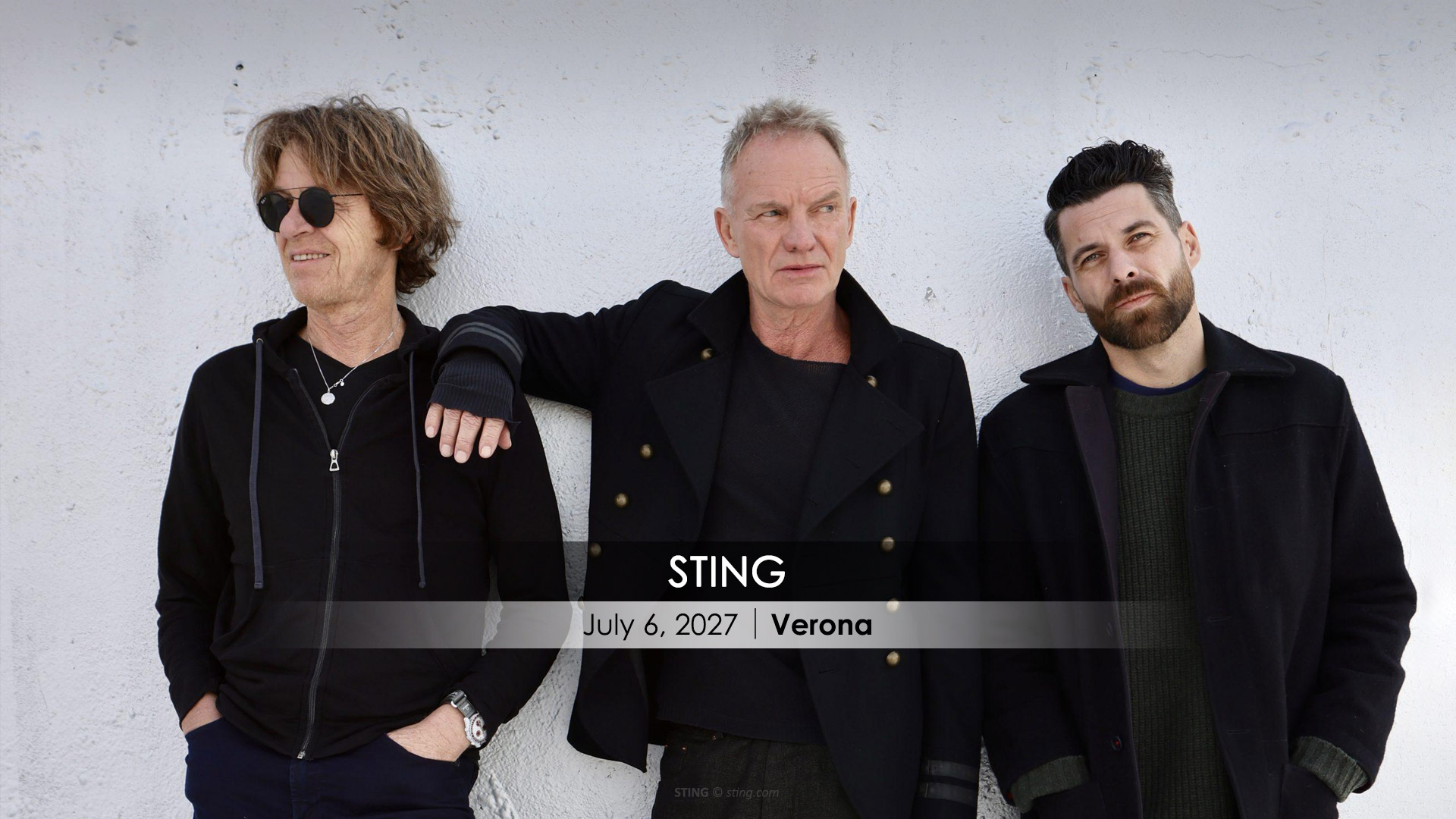
The concert is part of the European leg of the tour, produced by Cherrytree Music Company and Live Nation. Sting will perform alongside guitarist Dominic Miller and drummer Chris Maas, presenting arrangements of material from his solo career and his years with The Police through a three-piece instrumental formation.
Sting
Born Gordon Matthew Thomas Sumner on October 2, 1951, in Wallsend, Northumberland, England, Sting is a British singer, songwriter, bassist, and actor. He grew up near Newcastle upon Tyne and became interested in music during childhood, developing his instrumental abilities while attending school and later studying to become a teacher.
Before achieving international recognition, he worked as a schoolteacher and performed with local jazz and rock groups. One of these was Last Exit, a Newcastle-based band active during the 1970s. His professional nickname originated from a black-and-yellow striped sweater that reminded another musician of a bee.
In 1977, he moved to London and established The Police with drummer Stewart Copeland. Guitarist Andy Summers joined shortly afterwards, completing the group’s best-known line-up. Their music combined elements of punk rock, reggae, and new wave, distinguishing them from many other British bands emerging during the same period.
The Police achieved international success with songs including Roxanne, Message in a Bottle, Walking on the Moon, Don’t Stand So Close to Me, and Every Breath You Take. Their final studio album, Synchronicity, appeared in 1983, preceding the group’s decision to concentrate on separate musical projects.
Sting subsequently developed a solo career characterised by stylistic experimentation. His compositions incorporated jazz harmonies, sophisticated pop arrangements, classical influences, and elements of traditional music. He frequently collaborated with musicians from different backgrounds, creating recordings that departed from the relatively restricted instrumental format of The Police.
His professional activities also extended beyond recording and touring. He appeared in films including Quadrophenia, Dune, and Lock, Stock and Two Smoking Barrels. In 1989, he and his wife, Trudie Styler, helped establish the Rainforest Foundation, supporting Indigenous communities and environmental protection initiatives.
Sting Discography
Sting has released 15 solo studio albums, including collaborative projects, alongside numerous live recordings, compilations, and soundtrack contributions. His first solo album, The Dream of the Blue Turtles, appeared in June 1985 and introduced a new instrumental approach involving prominent jazz musicians, including Branford Marsalis, Kenny Kirkland, and Omar Hakim.
The album contained If You Love Somebody Set Them Free, Fortress Around Your Heart, and Russians. It reached number two on the Billboard 200 and number three on the UK Albums Chart. The recording sessions and subsequent tour were documented in Bring On the Night, a concert film released in 1985.
His second album, …Nothing Like the Sun, followed in October 1987. It included Englishman in New York, Fragile, We’ll Be Together, and They Dance Alone. The record reached number one in the United Kingdom and presented arrangements combining pop, jazz, and Latin American musical influences.
The album The Soul Cages, released in 1991, developed a more introspective musical direction. Its compositions were influenced by the death of Sting’s father and memories of growing up near the shipyards of northeastern England. The record included All This Time, Mad About You, and its title track.
His fourth album, Ten Summoner’s Tales, appeared in March 1993 and included several internationally successful songs. Fields of Gold, If I Ever Lose My Faith in You, Shape of My Heart, and Seven Days demonstrated his ability to combine accessible melodies with complex rhythmic and harmonic arrangements.
In 1996, Sting released Mercury Falling, featuring Let Your Soul Be Your Pilot, You Still Touch Me, and I’m So Happy I Can’t Stop Crying. The album explored different American musical traditions, incorporating country, folk, soul, and rock influences within compositions built around his distinctive vocal style.
The album Brand New Day arrived in September 1999, featuring the successful singles Desert Rose and the title track. Desert Rose included vocals by Algerian singer Cheb Mami, bringing elements of North African raï music into a contemporary pop production. The album achieved multi-platinum sales internationally.
His seventh studio album, Sacred Love, was released in 2003. It featured Send Your Love and Whenever I Say Your Name, a collaboration with Mary J. Blige. Electronic production and atmospheric arrangements played an important role in the record, alongside guitar, keyboards, and traditional instrumental performances.
A significant departure followed with Songs from the Labyrinth in 2006. Working with lutenist Edin Karamazov, Sting recorded compositions associated with Renaissance musician John Dowland. The album combined historical vocal music, lute accompaniment, and spoken readings, demonstrating his interest in European musical traditions.
The subsequent projects If on a Winter’s Night… (2009) and Symphonicities (2010) explored different arrangements. The first contained seasonal compositions and traditional songs, while the second presented orchestral reinterpretations of recordings from his earlier career, performed with the Royal Philharmonic Concert Orchestra.
In 2013, Sting released The Last Ship, a concept album inspired by the shipbuilding communities of his native Tyneside. Its material contributed to a stage musical of the same name, which premiered in Chicago in 2014 before opening on Broadway. The project combined contemporary songwriting with theatrical storytelling.
The album 57th & 9th, released in 2016, marked a return to guitar-oriented rock music. It included I Can’t Stop Thinking About You and One Fine Day. Two years later, Sting collaborated with Jamaican musician Shaggy on 44/876, incorporating reggae influences into a collection of original recordings.
The album My Songs appeared in 2019, featuring newly recorded interpretations of familiar compositions. His fifteenth studio album, The Bridge, followed in November 2021, with songs including Rushing Water, If It’s Love, and For Her Love. The latter project was developed during the COVID-19 pandemic.
The Sting 3.0 Tour began in 2024, returning to a compact instrumental formation. The single I Wrote Your Name (Upon My Heart) was released that year, while Sting 3.0 Live followed in April 2025, documenting performances featuring material from different stages of his recording career.
Sting Awards and Sales
Sting has sold approximately 100 million records worldwide, including his work with The Police. His recordings have received numerous gold, platinum, and multi-platinum certifications, while his commercial success encompasses album charts, international singles rankings, soundtrack contributions, and collaborations with musicians from several musical genres.
He has received 17 Grammy Awards from 45 nominations, recognising achievements in categories including rock, pop, reggae, and music video production. His awards include Best Male Pop Vocal Performance for If I Ever Lose My Faith in You and Best Pop Vocal Album for Brand New Day.
In 2003, Sting was inducted into the Rock and Roll Hall of Fame as a member of The Police. That year, he was also appointed Commander of the Order of the British Empire (CBE). His other distinctions include the Polar Music Prize, awarded in 2017.
His contributions to music and performing arts have also been recognised through the Kennedy Center Honors in 2014. He has received an Emmy Award, a Golden Globe Award, and four Academy Award nominations for original songs written for films, reflecting his achievements beyond conventional studio recordings.
Venue – Arena di Verona
The Arena di Verona is a Roman amphitheatre situated in Piazza Bra, the largest square in Verona’s historic centre. Built during the first century AD, probably around 30 AD, the monument predates the Colosseum in Rome and represents one of the most substantial surviving examples of ancient Roman entertainment architecture.
The amphitheatre was originally constructed outside the city’s defensive walls, allowing large crowds to assemble without obstructing internal streets. Its position was subsequently incorporated into Verona’s expanded fortifications during the reign of Emperor Gallienus, who ordered major defensive improvements in 265 AD.
Roman audiences attended gladiatorial combats, animal hunts, and public spectacles inside the building. The structure was designed to accommodate approximately 30,000 spectators, with seating distributed according to social status. An elaborate network of corridors, stairways, and entrances allowed audiences to move efficiently between the exterior and the seating sections.
The external structure measures approximately 152 metres by 123 metres, while the central performance area measures roughly 76 by 44 metres. The seating area, known as the cavea, surrounds the elliptical floor. Unlike modern concert arenas, the monument retains much of its original Roman structural arrangement.
Its exterior was constructed principally using limestone from the Verona and Valpolicella area, including the characteristic pinkish stone associated with local Roman architecture. The original outer façade contained three superimposed orders of arches, creating a monumental structure that rose considerably higher than most of the surviving exterior.
Much of the outer ring disappeared following the earthquake of 1117, which caused extensive destruction in northern Italy. Only a small section remains visible today, known as the Ala. This surviving fragment comprises four arches arranged on three levels and illustrates the original height of the amphitheatre.
Despite changes in its structure, the Arena remained in use during the Middle Ages, hosting public activities, tournaments, and celebrations. From the Renaissance onwards, restoration and preservation initiatives gradually established the monument as an important civic landmark. These interventions contributed to the survival of its substantial Roman masonry.
The Arena’s modern musical history began on August 10, 1913, when Giuseppe Verdi’s Aida was performed to commemorate the centenary of the composer’s birth. The production established the Arena di Verona Opera Festival, transforming the amphitheatre into one of the world’s most celebrated open-air opera venues.
Today, the monument also accommodates contemporary concerts, theatrical productions, and special cultural events. Its audience capacity varies according to the stage arrangement, seating configuration, and event requirements. Concert productions use temporary technical facilities while preserving the archaeological structures surrounding the performance area.
The Arena stands near several important monuments, including Palazzo Barbieri, the Portoni della Bra, and the historic Liston promenade. Via Roma connects the square with Castelvecchio, while Via Mazzini leads towards Piazza delle Erbe and Verona’s medieval centre, making the amphitheatre accessible from the principal pedestrian routes.

The Verona Arena seen from Piazza Bra
How to Get to Arena di Verona
On foot: The Arena is approximately 1.5 kilometres from Verona Porta Nuova railway station. Visitors can follow Corso Porta Nuova towards the historic centre, pass through the Portoni della Bra, and enter Piazza Bra. The walk generally takes around 20 minutes, depending on walking speed and traffic lights.
By bus: ATV operates urban services connecting the railway station and other parts of Verona with Piazza Bra. Routes serving the area include 11, 12, 13, 51, and 52, while evening and holiday services include lines 90, 92, 94, 96, 97, and 98. Concert-day schedules should be checked before travelling.
By taxi: Official taxis are available outside Verona Porta Nuova railway station and at designated ranks throughout the city. The journey to the Piazza Bra area generally takes approximately 5–10 minutes in normal traffic. Temporary pedestrian restrictions and event-related congestion may affect vehicle access near the amphitheatre.
Frequently Asked Questions about the Sting Concert in Verona
When will the Sting concert in Verona take place?
The concert is scheduled for Tuesday, July 6, 2027, at the Arena di Verona. It is one of three Italian performances announced for the European leg of the tour.
Where will Sting perform in Verona?
The performance will take place at the Arena di Verona, the ancient Roman amphitheatre situated in Piazza Bra, in the historic centre of Verona, in the Veneto region of Italy.
Which musicians will accompany Sting in Verona?
The Sting 3.0 Tour features guitarist Dominic Miller and drummer Chris Maas alongside Sting on bass guitar and vocals, presenting a three-piece arrangement of his musical catalogue.
Will Sting perform songs originally recorded with The Police?
The tour includes music from both periods of his career. However, the exact songs scheduled for the Verona performance have not been officially confirmed.
What is the nearest railway station to the Arena di Verona?
Verona Porta Nuova is the city’s principal railway station, approximately 1.5 kilometres from the amphitheatre. Visitors can reach Piazza Bra on foot, by public bus, or by taxi.
What other concerts will Sting perform in Italy in July 2027?
Two additional Italian dates have been announced: July 2 in Rome, at Roma Summer Fest, and July 4 in Asti, as part of AstiMusica 2027.
-
Photos
-
Video
Table of Contents
-
Map
-
Reviews
6 July 2027 8:00 pm
6 July 2027 11:45 pm