
Table of Contents
We returned to Costa degli Dei (Coast of the Gods) in May 2026 after eight years away. Our previous visit dated back to May 2018. The transformation was immediate and impossible to ignore. Several beaches appeared dramatically smaller, while some stretches of coastline looked visibly damaged by erosion and repeated winter storms.
In 2018, many beaches beneath the cliffs of Tropea felt expansive and open. There was enough space for beach clubs, free public areas and walking corridors. In 2026, several of those same beaches appeared compressed, fragmented, or partially consumed by the sea.
The phenomenon was not isolated. We noticed similar conditions in Tropea, Scilla, Pizzo, Zambrone, and other coastal towns along the Vibonese shoreline. The retreat of the coastline has become one of the most serious environmental problems affecting Costa degli Dei.
Conversations with locals confirmed what we were seeing with our own eyes. Business owners, residents, waiters, and tourism workers all described worsening coastal erosion, increasingly aggressive storms, and a tourism economy struggling under inflation and global instability.
Costa degli Dei
Costa degli Dei remains one of the most spectacular coastal regions in Southern Italy. The turquoise sea, dramatic cliffs, volcanic landscapes, fishing villages, and historic centers still create extraordinary scenery. However, beneath that beauty, a growing environmental and economic crisis is becoming increasingly visible.
What shocked us most was not only the reduction of beaches themselves, but also the atmosphere surrounding tourism activity. Compared to 2018, the region felt economically more cautious, less dynamic, and considerably more fragile than during previous years.
Several restaurants appeared quieter than expected even during favorable spring weather conditions. Certain accommodation structures looked partially empty, while some beach facilities seemed less active than during our earlier visits. The perception of decline was impossible to ignore for us.
The beaches are not disappearing only because of natural processes. According to multiple local reports and regional debates, decades of uncontrolled coastal development, insufficient protection measures, weak regional governance, and delayed interventions have contributed significantly to the current situation.
The issue has become so serious that local entrepreneurs, citizens, associations, and volunteers recently created the Osservatorio Erosione Costiera, a committee dedicated to documenting the progressive destruction of the coastline through photographs, historical comparisons, and scientific monitoring.
The committee argues that the erosion affecting Costa degli Dei now threatens not only beaches, but also tourism, local businesses, public access to the sea, employment, and the long-term economic survival of the region itself.
Tropea – The Symbolic Heart of the Crisis
Tropea represents the symbolic center of Costa degli Dei and among the most important tourism areas in Calabria. The coastline between Tropea and Capo Vaticano generates enormous economic value for the region.
According to local reports, the Tropea-Capo Vaticano area recorded nearly 1.5 million tourist presences in 2025, including a significant number of international visitors. Tourism remains one of the primary economic resources of the Vibonese province and of Calabria as a whole.
However, erosion has already reduced several beaches significantly. In some areas, the coastline appears visibly narrower every year. Beaches once capable of hosting large tourism flows now struggle to maintain the same capacity during peak summer periods.
The problem directly affects public access to the sea. Several stretches of coastline have become increasingly difficult to reach because of disappearing sand, unstable cliffs, damaged access points, or shrinking public areas between private concessions and the shoreline itself.
The situation appears particularly alarming beneath the cliffs of Tropea. Wave action continuously attacks the base of sandstone formations already vulnerable to natural deterioration. Over time, erosion gradually destabilizes both the cliffs and the beaches located below them.
Local observers argue that regional authorities reacted too slowly to the problem. According to the Osservatorio Erosione Costiera, years passed without coordinated long-term intervention strategies, despite increasingly visible evidence of coastal retreat throughout the Vibonese coastline.
The committee openly criticized what it described as a regional governance that continues to nicchiare – essentially avoiding decisive action while erosion progressively destroys one of Calabria’s most valuable tourism assets.
The committee also emphasized that erosion now threatens local economic sustainability. Tourism businesses, beach clubs, restaurants, hotels, transport operators, and seasonal workers all depend heavily on the continued existence of usable beaches.
Historical and contemporary photographs collected by volunteers reveal dramatic transformations in several coastal sections over recent decades. Areas once characterized by large sandy surfaces now appear dramatically reduced or partially replaced by exposed rocks and reinforced barriers.
The issue is no longer merely environmental. Along Costa degli Dei, coastal erosion has become an economic emergency capable of influencing employment, tourism flows, investment, and long-term regional development.
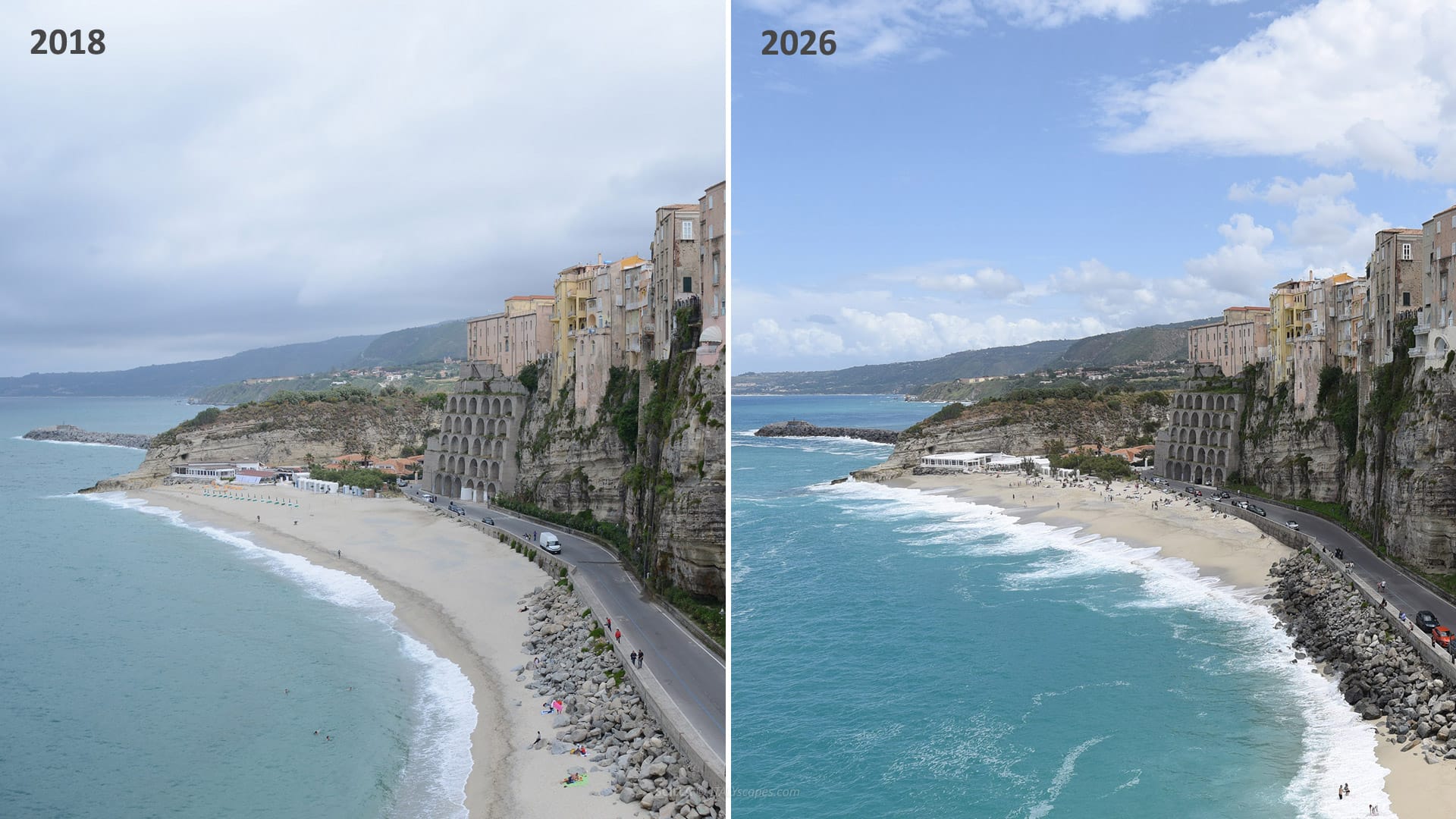
The beach of Tropea, 2018 vs. 2026
Scilla – Tourism Changes and Economic Anxiety
Scilla remains one of Calabria’s most fascinating coastal towns. Chianalea, the Ruffo Castle, the fishing traditions, and the constant view toward Sicily continue attracting visitors searching for authentic maritime landscapes and Southern Italian atmosphere.
However, Scilla also reflects the broader economic anxiety affecting tourism throughout the region. During our visit, several business owners described tourists as far more cautious than before regarding spending habits, restaurant consumption, and vacation duration.
The most revealing conversation happened inside a restaurant near the waterfront. A waitress explained that people no longer spend like they used to years ago. According to her, many customers now order a single pizza and divide it between two people.
That observation perfectly summarizes the broader transformation affecting Mediterranean tourism economies after the pandemic years, inflation crisis, and rising travel costs across Europe. Visitors still arrive, but they increasingly monitor every expense carefully.
Scilla also faces environmental vulnerability. The town sits between mountains and sea within a relatively narrow coastal corridor exposed directly to powerful winter storms generated in the Strait of Messina area.
Several beaches around Scilla appeared narrower than during our previous visits. Repeated storms, wave pressure, and coastal instability seem to accelerate the gradual reduction of sandy surfaces along exposed sections of the shoreline.
Smaller beaches create multiple consequences simultaneously. They reduce tourism capacity, complicate public access, damage local business revenues, and increase pressure on remaining usable coastal sections during peak summer months.
Fishing communities also face growing difficulties. Rising fuel prices, aging populations, and reduced profitability increasingly challenge traditional maritime economies throughout Southern Italy, including those historically linked to Scilla’s fishing identity.
At sunset, Scilla remains breathtaking. Yet beneath the extraordinary scenery, economic caution and environmental fragility are becoming increasingly visible realities shaping the future of the town and its tourism sector.
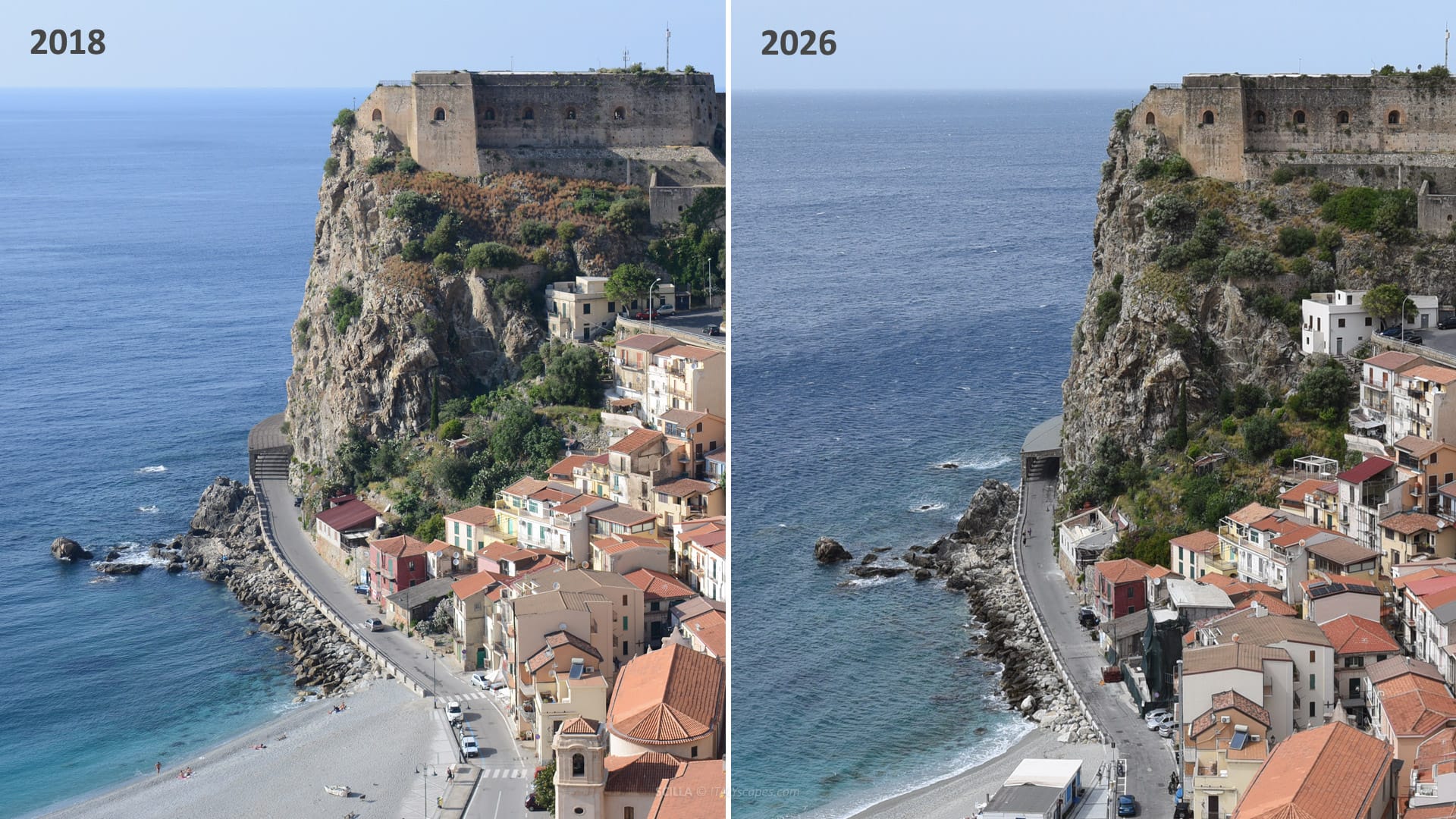
The beach of Scilla, 2018 vs. 2026
Pizzo and the Wider Vibonese Coastline
Pizzo is another important tourism destination increasingly affected by coastal erosion. Although Pizzo relies less exclusively on beaches than Tropea, the retreat of the coastline remains clearly visible in several surrounding areas.
Some beaches near Pizzo appeared reduced compared to previous years, especially in sections exposed directly to winter storms and intense wave activity. Smaller beaches naturally suffer greater visual impact when erosion removes even limited amounts of sand.
Near the Church of Piedigrotta, the effects of coastal erosion appear particularly dramatic. During our visit in May 2026, the small beach in front of the church had completely disappeared. The sea now reaches directly against the rocky shoreline beneath the church, while the sandy area that once existed there appears entirely consumed by erosion and repeated wave action.
The crisis extends far beyond Tropea and Pizzo. Reports increasingly describe erosion problems affecting Briatico, Zambrone, Parghelia, Nicotera, and several additional municipalities throughout the Vibonese coastline.
According to local critics and tourism operators, the regional response remains insufficient compared to the scale of the emergency. Multiple local articles accuse regional governance of doing far too little while erosion progressively destroys strategic tourism infrastructure.
One recurring accusation concerns uncontrolled coastal construction. Several observers argue that decades of cementification along the coastline weakened natural coastal systems and altered sediment movement patterns necessary for beach regeneration.
In many Mediterranean regions, beaches survive through delicate balances involving wave action, sediment transport, river deposits, and coastal currents. Urbanization, retaining walls, artificial structures, and poorly planned construction can severely disrupt those natural mechanisms.
The result becomes increasingly visible over time. Beaches narrow gradually until storms suddenly accelerate the process dramatically. Once a coastline loses enough sand, recovery becomes far more difficult without large-scale intervention and continuous maintenance.
Beach nourishment projects can temporarily restore sections of coastline by adding artificial sand. However, these interventions require enormous investment and constant repetition because strong winter storms frequently remove deposited material within relatively short periods.
Local committees increasingly demand coordinated regional action based on scientific studies, long-term planning, environmental protection, and adequate financial resources. According to the Osservatorio Erosione Costiera, the time for endless analysis without concrete action has already passed.
The committee also emphasizes that Costa degli Dei represents far more than a local tourism destination. The coastline constitutes a strategic regional and national resource whose protection directly affects employment, economic development, and public access to the sea.
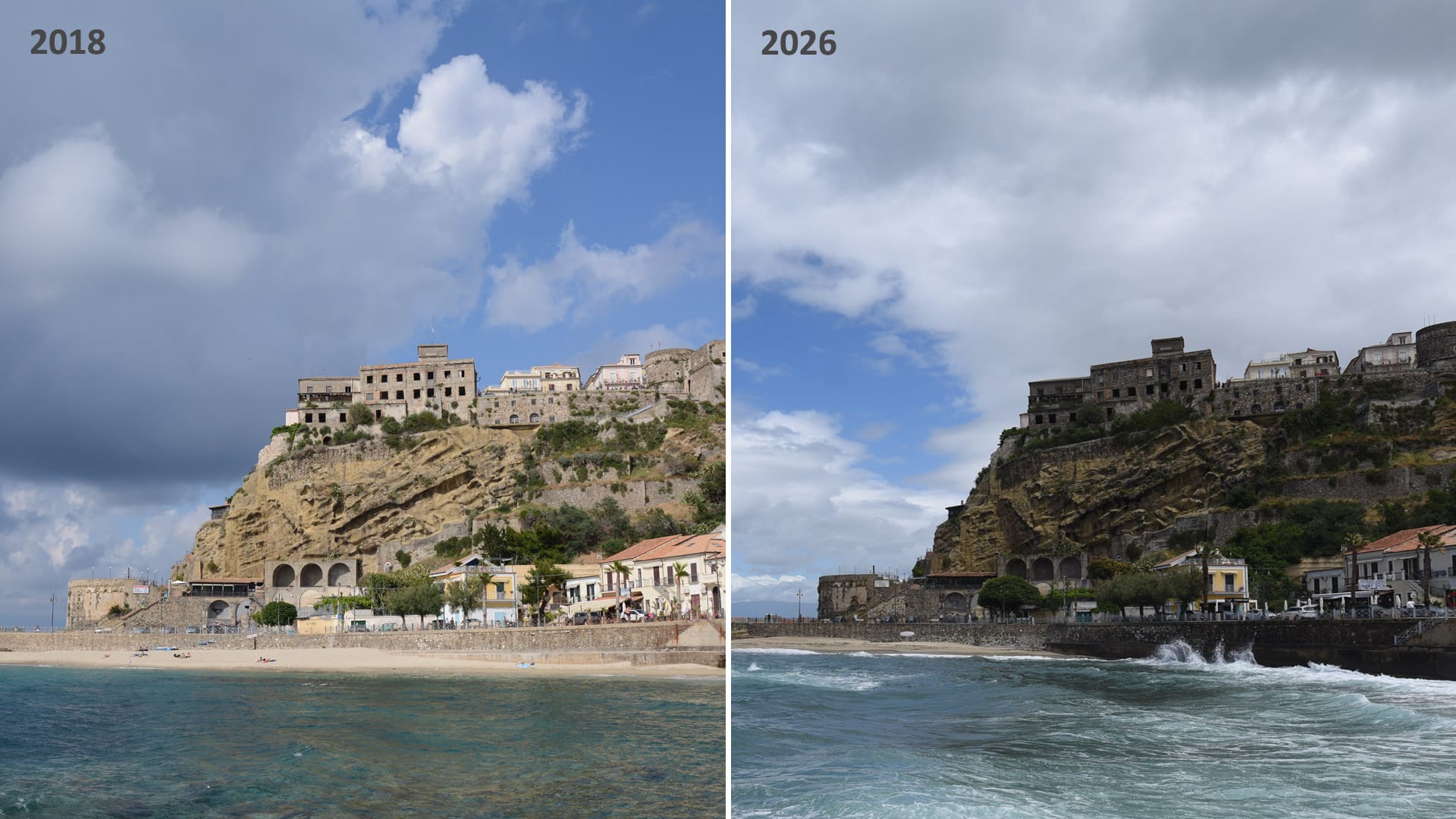
The beach of Pizzo, 2018 vs. 2026
Why the Beaches Are Disappearing
Coastal erosion along Costa degli Dei results from multiple overlapping causes rather than a single isolated phenomenon. Natural environmental processes certainly play an important role, but human activity appears to have intensified the problem significantly during recent decades.
Winter storms remain one of the primary natural causes. Strong Mediterranean storms remove large quantities of sand from beaches and transport them offshore or toward different coastal sections. Increasingly aggressive winter weather appears to accelerate this process substantially.
Climate change likely worsens the situation. Rising sea levels and stronger storms expose Mediterranean coastlines to greater pressure, especially in fragile regions already characterized by unstable cliffs, narrow beaches, and intense urbanization close to the shoreline.
The geology of the Vibonese coastline creates additional vulnerability. Many beaches sit directly beneath sandstone cliffs naturally subject to deterioration and collapse. Wave action attacking the base of those formations gradually destabilizes the entire coastal structure.
Human intervention may have amplified these natural weaknesses. Coastal construction, urban expansion, artificial barriers, drainage modifications, and decades of cementification altered sediment movement patterns necessary for natural beach regeneration.
Several local reports openly accuse decades of uncontrolled development of damaging one of Calabria’s most fragile and valuable environmental systems. The phrase “the coast is drowning in concrete” increasingly appears in regional debates surrounding erosion.
Environmental groups and local committees argue that Calabria requires coordinated scientific planning rather than fragmented emergency interventions reacting only after severe damage already occurred.
The situation now extends beyond aesthetics or tourism marketing. Coastal retreat increasingly threatens roads, businesses, infrastructure, public access areas, and the long-term sustainability of local economies built around seaside tourism.
Experts and local activists increasingly warn that without rapid intervention, certain beaches along Costa degli Dei could become dramatically reduced within coming decades, fundamentally transforming the identity and tourism appeal of the region itself.
Why Tourism Is Changing
The erosion crisis overlaps with broader economic problems affecting tourism throughout Europe. Visitors continue arriving in Calabria, but local workers repeatedly describe tourists as more cautious, more budget-conscious, and less willing to spend freely than before.
Inflation remains one of the main reasons. Rising prices for food, housing, transportation, and energy reduced disposable income across Europe after 2021. Families increasingly reconsider vacation budgets and reduce discretionary expenses during travel.
Fuel prices heavily affect Calabria because many visitors arrive by car after long journeys across Italy or neighboring countries. Transportation alone now costs significantly more than during the late 2010s.
Air travel instability also contributed to tourism uncertainty. Flight cancellations, reduced seasonal routes, strikes, staffing shortages, and airline restructuring continue affecting Southern European tourism destinations dependent on regional airports and low-cost carriers.
Accommodation prices increased sharply after the pandemic because hotels, restaurants, and tourism businesses faced higher operational costs linked to energy, wages, food supply chains, and inflation.
Several local workers described shorter vacations becoming increasingly common. Weekend tourism appears to replace longer stays, while tourists increasingly prioritize cheaper options and stricter daily spending control.
The waitress in Scilla provided perhaps the clearest example of this transformation when she explained that many visitors now divide a single pizza between two people in order to reduce expenses.
That observation reflects broader European tourism behavior. People still travel, but they consume differently, spend differently, and approach holidays with far greater financial caution than before.
Competition from cheaper international destinations also affects Calabria. Several Mediterranean countries offer lower accommodation costs and aggressive tourism packages difficult for smaller Italian coastal towns to compete against economically.
Costa degli Dei remains breathtakingly beautiful. Yet the region now faces a difficult combination of environmental degradation, economic uncertainty, inflation, global instability, and insufficient long-term coastal protection policies.
The coastline still attracts visitors from around the world. However, after returning eight years later, we could not ignore the feeling that Costa degli Dei is slowly becoming more fragile – environmentally, economically, and socially – year after year.
Sources:


