Table of Contents
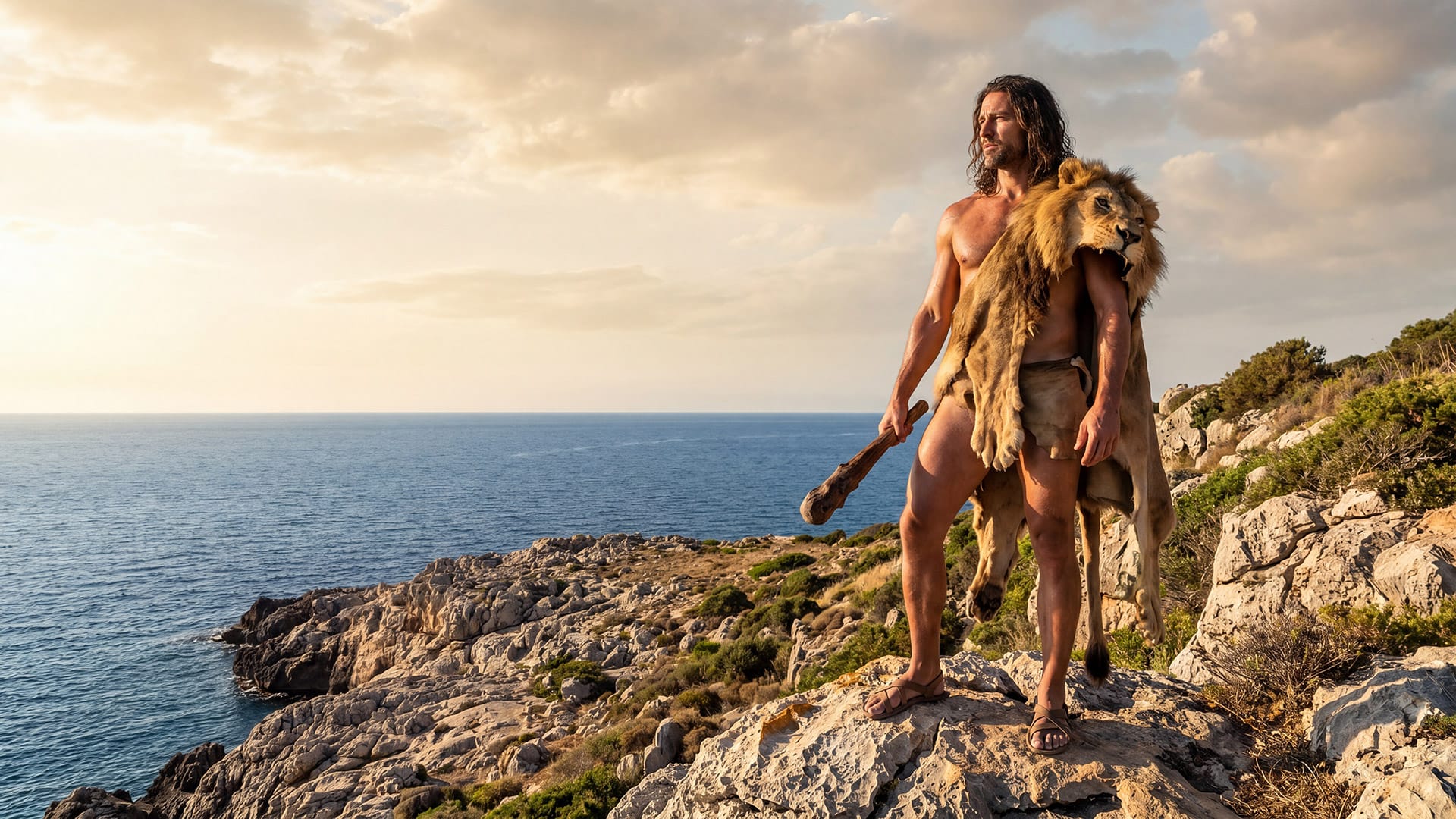
Among the many legends surrounding the origins of Tropea, none is more famous than the story linking the town to Hercules (Heracles), the legendary Greek hero.
According to local tradition, Hercules arrived on the Calabrian coast during his travels and founded a settlement on the rocky promontory that would later become Tropea.
Today, visitors can still find references to Hercules throughout Tropea. The town’s main square is called Piazza Ercole, a reminder of the ancient tradition that attributes the foundation of the city to the hero from Greek mythology.
The legend exists alongside archaeological evidence showing that the area was inhabited long before the historical development of the medieval town. As in many places across Southern Italy, myth and history have become closely intertwined.
Hercules in Greek Mythology
The Hero of Extraordinary Strength
Hercules, known in Greek mythology as Heracles, was one of the most celebrated heroes of the ancient world. He was the son of Zeus, king of the gods, and the mortal woman Alcmene. Because he possessed both divine and human ancestry, Hercules occupied a unique place between mortals and gods.
Ancient myths describe Hercules as possessing immense physical strength. From an early age, he performed extraordinary feats that distinguished him from ordinary men. Over time, he became a symbol of courage, endurance, and perseverance.
His adventures were recorded by Greek and Roman authors and became some of the most famous stories in classical mythology. These tales spread throughout the Mediterranean world and remained influential for centuries.
The Twelve Labors
The best-known episodes of Hercules’ life are the Twelve Labors, a series of difficult tasks imposed upon him.
These labors included defeating powerful monsters, capturing dangerous animals, and retrieving legendary objects from distant lands. They took Hercules across vast regions of the ancient world and transformed him into a universal symbol of heroic achievement.
Among the most famous tasks were the defeat of the Nemean Lion, the destruction of the Lernaean Hydra, the capture of the Erymanthian Boar, and the obtaining of the cattle of Geryon in the far western Mediterranean. These journeys brought him into contact with many different lands and peoples.
Hercules and the Western Mediterranean
Several traditions place Hercules in the western regions of the Mediterranean during his travels. Ancient authors associated him with the area around the modern Strait of Gibraltar, known in antiquity as the Pillars of Hercules.
According to various legends, after completing some of his greatest labors, Hercules sailed eastward through the Mediterranean. During these journeys he was believed to have visited numerous coastal locations, leaving behind shrines, ports, monuments, and settlements.
The story connecting Hercules with Tropea belongs to this broader tradition of heroic travel across the Mediterranean basin.
Tropea – A Town Between History and Legend
Geography and Strategic Position
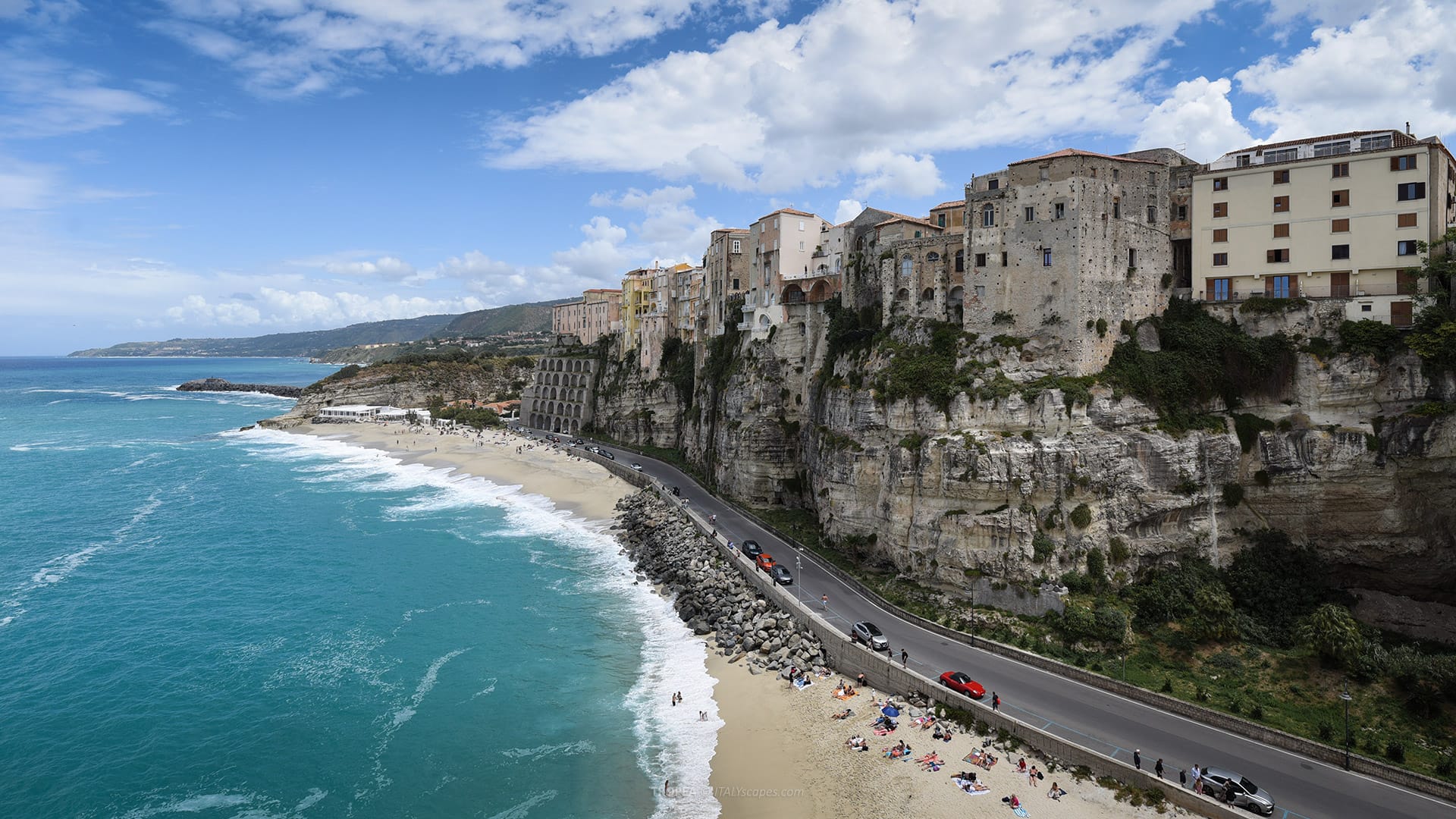
Tropea is located in the region of Calabria, on the Tyrrhenian Sea. The historic center stands on a dramatic cliff approximately 60 meters above sea level, overlooking some of the most famous beaches in Southern Italy.
Its position provides natural protection and extensive views over the coastline. On clear days, the Aeolian Islands and the volcano Stromboli can be seen on the horizon.
The town occupies a central position along the Costa degli Dei (Coast of the Gods), one of Calabria’s most celebrated coastal regions.
Early Human Settlement
While the legend attributes the foundation of Tropea to Hercules, archaeological evidence indicates that the area was inhabited long before historical records.
Evidence of human presence dates back to prehistoric times, including the Neolithic period. Archaeological discoveries demonstrate that people were attracted to the area because of its favorable position and access to marine resources.
The rocky promontory provided both security and a strategic observation point over the sea. For thousands of years, these characteristics made the location attractive for settlement.
Tropea and Magna Graecia
During antiquity, Calabria became part of Magna Graecia, the network of Greek colonies established throughout Southern Italy.
Archaeological finds discovered near Tropea include tombs of Magna Graecian origin, confirming the presence of Greek culture in the region.
Ancient sources indicate that the area came under the influence of Greek civilization several centuries before the Roman period. This Greek cultural background helps explain why a legend involving Heracles became associated with the town.
Roman and Medieval Tropea
The historical development of Tropea accelerated during the Roman era. Ancient sources mention a commercial port known as Forum Herculis, located south of present-day Tropea. The name itself reflects the widespread importance of Hercules within the region.
Because of its elevated position above the sea, Tropea became strategically valuable to successive civilizations. Romans, Byzantines, Normans, and Aragonese all recognized the military and commercial advantages offered by the site.
Remains of Byzantine fortifications still survive today, reflecting the town’s importance during the early medieval period.
The Connection Between Hercules and Tropea
The Traditional Legend
According to local tradition, Hercules arrived on the Calabrian coast while returning from one of his great journeys in the western Mediterranean.
After passing the Pillars of Hercules, identified with the modern Strait of Gibraltar, the hero traveled along the southern coast of Italy. During this voyage he reached the spectacular cliffs overlooking the Tyrrhenian Sea.
Captivated by the natural beauty and strategic position of the location, Hercules supposedly established a settlement there, which later became Tropea. According to some versions of the legend, he transformed the site into one of his ports.
The tradition became deeply rooted in local culture and has been transmitted for centuries. Although different versions of the story exist, they all share the idea that Hercules played a decisive role in the origin of the town.
Tropea as One of Hercules’ Ports
A recurring element of the tradition is the idea that Tropea became one of the ports of Hercules.
Ancient maritime routes connected the western and eastern Mediterranean, and many coastal communities sought to associate themselves with the famous hero. Linking a harbor to Hercules enhanced its prestige and connected it symbolically to the heroic age of mythology.
The dramatic geography of Tropea likely contributed to the persistence of the legend. The imposing cliffs, protected bays, and commanding views create a setting that easily lends itself to heroic narratives.
The natural harbor beneath the historic center would have appeared attractive to ancient sailors. Over time, this geographic reality may have reinforced stories connecting the location with one of mythology’s greatest travelers.
Piazza Ercole
The strongest visible reminder of the legend today is Piazza Ercole, one of the principal squares of Tropea.
Located in the heart of the historic center, the square serves as a popular meeting point for residents and visitors. Its name preserves the memory of the hero traditionally credited with founding the town.
The naming of the square demonstrates how deeply the Hercules legend remains embedded in the identity of Tropea.
The Enduring Legacy of Hercules
The legend of Hercules and the founding of Tropea remains one of the most enduring traditions associated with Calabria’s most famous coastal town.
Although archaeology and history point to a much more complex development involving prehistoric communities, Greek influence, Roman activity, and medieval expansion, the Hercules tradition remains an important part of the town’s identity.
Image generated with Nano Banana Pro / Google AI Studio