
Table of Contents
The Origins of Rome and the Regal Period
The history of Rome begins with the traditional foundation of the city by Romulus on April 21, 753 BC. The earliest settlement developed on the Palatine Hill, close to the Tiber River and the ford near the Tiber Island, a strategic point for trade, movement, and defense.
During the Regal Period, Rome was ruled by kings and grew from a cluster of hilltop villages into an organized city. Latin, Sabine, and Etruscan influences shaped its early institutions, religious practices, engineering knowledge, and urban layout. This period created the first political and sacred spaces of the future capital.
The last kings, traditionally remembered as Etruscan, were associated with important public works. Early drainage systems, paved areas, religious buildings, and defensive structures transformed Rome into a true city. The monarchy ended in 509 BC, when Roman tradition places the expulsion of Tarquinius Superbus.
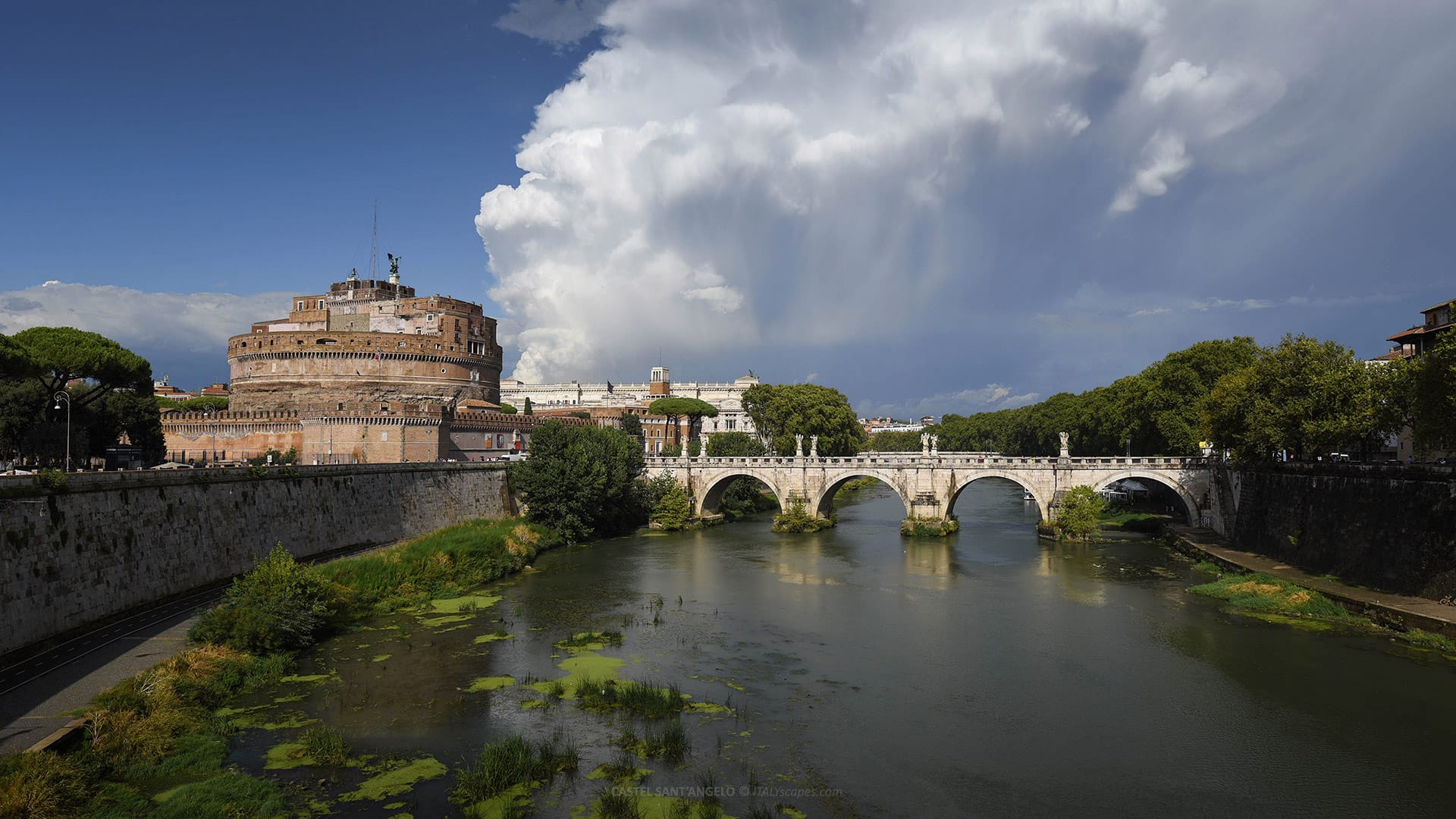
Castel Sant’Angelo and Ponte Sant’Angelo
The Palatine Hill – The Birthplace of Rome
The Palatine Hill is the most important surviving place connected with Rome’s origins. Archaeological remains show early occupation long before the imperial palaces were built. The hill rises about 40 meters above the Roman Forum and offered natural protection in the earliest phase of settlement.
Later Romans preserved the Palatine as a sacred memory of the city’s beginning. The so-called Hut of Romulus, rebuilt and ritually maintained in antiquity, symbolized the modest origin of Roman power.
The Early Republic and the Rise of Civic Power
After 509 BC, Rome became a republic governed by magistrates, assemblies, and the Senate. Political power was contested between patricians and plebeians, leading to reforms such as the creation of the tribunate and the written laws known as the Twelve Tables, traditionally dated to the mid-5th century BC.
The Republic expanded first across Latium, then through central and southern Italy. Military alliances, colonies, roads, and citizenship policies helped Rome absorb defeated communities. By the early 3rd century BC, Rome had become the dominant power on the Italian peninsula and was ready to face Mediterranean rivals.
The Roman Forum – Political Heart of the Republic
The Roman Forum was the central public space of ancient Rome. It developed from a low marshy valley between the Palatine and Capitoline Hills into the main area for politics, religion, justice, commerce, and public memory. Its monuments still preserve the structure of Roman civic life.
Important surviving remains include the Curia Julia, the Senate house rebuilt under Julius Caesar and Augustus, the Temple of Saturn, the Temple of Vesta, the Regia, the Basilica Julia, and the Basilica Aemilia.
Republican Expansion and Mediterranean Wars
Rome’s expansion beyond Italy began with the Punic Wars against Carthage. The First Punic War brought Rome into Sicily, while the Second Punic War, marked by Hannibal’s invasion of Italy, tested Roman endurance. After Carthage’s final defeat in 146 BC, Rome became the leading western Mediterranean power.
In the same century, Rome also defeated Hellenistic kingdoms and expanded eastward. Wealth, slaves, tribute, and Greek culture entered the city on a massive scale. This success changed Roman society, intensified inequality, and created tensions between traditional republican institutions and imperial-scale power.
The Temples of Hercules Victor and Portunus
The Forum Boarium, Rome’s ancient cattle market near the Tiber, preserves two exceptional Republican monuments. The Temple of Hercules Victor, a round marble temple from the late 2nd century BC, reflects Greek influence and commercial religion in an area linked with trade and river traffic.
Nearby, the Temple of Portunus dates mainly from the late 2nd or early 1st century BC. Dedicated to a god associated with harbors, doors, and river crossings, it combines Greek Ionic forms with Roman construction. Both temples show how Republican Rome absorbed Mediterranean artistic models.
The Late Republic and the Age of Civil Wars
From the 2nd century BC, Rome’s political system faced deep crises. The reforms of the Gracchi, the rivalry between Marius and Sulla, and repeated civil conflicts weakened republican norms. Military commanders increasingly used personal armies, wealth, and popular support to dominate public life.
Julius Caesar’s rise marked the decisive turning point. After crossing the Rubicon in 49 BC, he defeated Pompey and became dictator. His assassination in 44 BC did not restore the Republic. Instead, it opened another civil war that ended with Octavian’s victory over Antony and Cleopatra.
Largo di Torre Argentina and the Memory of Caesar
Largo di Torre Argentina preserves the remains of four Republican temples and part of Pompey’s Theatre complex. The area is closely associated with the assassination of Julius Caesar, who was killed during a Senate meeting held in the Curia of Pompey on March 15, 44 BC.
Although the exact ancient setting has changed, the archaeological area remains one of Rome’s strongest links to the final years of the Republic. It shows the density of late Republican urban development, when temples, theatres, porticoes, and political spaces stood close together in the Campus Martius.
Augustus and the Birth of the Empire
Octavian became Augustus in 27 BC, creating a new political system that preserved republican titles while concentrating real authority in one ruler. His reign brought stability after decades of civil war and began the Principate, the first phase of the Roman Empire.
Augustus reorganized administration, expanded building programs, restored temples, reformed the army, and promoted an official image of peace and renewal. He famously associated his rule with the transformation of Rome from a city of brick into a city of marble, although that phrase is symbolic rather than literal.

Flaminio Obelisk, brought to Rome by Augustus
The Ara Pacis – The Monument of Augustan Peace
The Ara Pacis Augustae was commissioned in 13 BC and consecrated in 9 BC. It celebrated Augustus’ return from campaigns in Hispania and Gaul and expressed the official idea of Pax Romana, a peace based on Roman victory, order, dynasty, and religious legitimacy.
The altar measures roughly 11.6 meters by 10.6 meters and about 3.6 meters high. Its reliefs show processions, priests, members of Augustus’ family, mythological scenes, and vegetation.
The Mausoleum of Augustus
The Mausoleum of Augustus was begun in 28 BC in the Campus Martius, before Augustus became Rome’s first emperor in name. It was a huge circular dynastic tomb, about 87 meters in diameter, intended for Augustus and members of the Julio-Claudian family.
Its position near the Tiber and the northern entrance to the city made it highly visible. The monument expressed permanence, succession, and family legitimacy. Even in ruined form, it remains one of the clearest surviving statements of Augustan political architecture in Rome.
The Julio-Claudian and Flavian Emperors
After Augustus, the empire passed through the Julio-Claudian dynasty, including Tiberius, Caligula, Claudius, and Nero. Their reigns strengthened the imperial system but also revealed the dangers of personal rule, palace politics, military loyalty, and succession without a stable constitutional mechanism.
The Flavian dynasty followed the civil war of AD 69. Vespasian restored stability, began major public building, and associated his rule with practical governance. Titus completed major projects, while Domitian strengthened imperial authority. Their monuments reshaped Rome after the trauma of Nero’s reign.
The Colosseum – The Flavian Amphitheatre
The Colosseum, originally the Flavian Amphitheatre, was begun under Vespasian around AD 72 and inaugurated by Titus in AD 80. It was built in the area of Nero’s former private lake, turning imperial luxury into a public entertainment space.
The amphitheatre measures about 189 meters long, 156 meters wide, and 48 meters high. It could hold tens of thousands of spectators and hosted gladiatorial combats, animal hunts, executions, and staged spectacles. Its elliptical structure remains the most famous surviving monument of ancient Rome.

The Arch of Titus
The Arch of Titus stands near the Roman Forum and commemorates Titus’ victory in the Jewish War and the capture of Jerusalem in AD 70. It was built after Titus’ death, probably under Domitian, and became a model for later triumphal arches.
Its reliefs show the triumphal procession carrying spoils from the Temple of Jerusalem, including the menorah. The monument records military conquest, imperial ceremony, and religious symbolism. It also demonstrates how Roman victory was translated into permanent urban memory through stone and sculpture.
Trajan and the Empire at Its Greatest Extent
Under Trajan, who ruled from AD 98 to 117, the Roman Empire reached its greatest territorial extent. His campaigns in Dacia brought Rome control over rich resources and strengthened imperial prestige. Trajan also invested heavily in infrastructure, welfare programs, ports, roads, and monumental construction.
His reign is often associated with administrative competence and military expansion. The city of Rome displayed this success through a vast new forum complex, which included civic spaces, libraries, a basilica, markets, and a monumental column narrating the Dacian Wars.
Trajan’s Forum, Trajan’s Column, and Trajan’s Markets
Trajan’s Forum was the largest of the Imperial Fora and was inaugurated in the early 2nd century AD. It required major excavation near the Quirinal Hill and created a monumental space for administration, justice, ceremony, and imperial representation.
Trajan’s Column, dedicated in AD 113, is about 30 meters high, or about 35 meters including the pedestal. Its spiral relief extends roughly 190 meters and winds around the shaft 23 times, illustrating scenes from the Dacian Wars in extraordinary narrative detail.
Trajan’s Markets, built into the slope of the Quirinal, formed a complex of halls, corridors, shops, and administrative spaces. They are not simply an ancient shopping mall, but part of a broader imperial architectural system connected with the forum and urban management.
Hadrian and the Consolidation of Empire
Hadrian ruled from AD 117 to 138 and focused less on conquest than on consolidation. He traveled widely, inspected provinces, strengthened frontiers, and promoted a more integrated imperial culture. In Rome, his building projects reflected Greek influence, technical ambition, and imperial cosmopolitanism.
Hadrian’s reign gave Rome some of its most enduring architecture. His rebuilding of the Pantheon created one of the greatest surviving spaces of Roman engineering. His mausoleum, later transformed into Castel Sant’Angelo, also became one of the most recognizable ancient structures in the city.
The Pantheon – Hadrian’s Masterpiece
The Pantheon was originally built by Agrippa in the Augustan age, but the surviving structure is generally associated with Hadrian’s reconstruction, completed around AD 126. Its inscription preserves Agrippa’s name, linking the Hadrianic building to Augustan memory and legitimacy.
The interior is defined by a huge concrete dome about 43.3 meters in diameter, nearly equal to the height from the floor to the oculus. The oculus, about 9 meters wide, is the only direct natural light source and creates the building’s famous cosmic effect.
The Pantheon survives exceptionally well because it was converted into a Christian church in the 7th century. Its portico, granite columns, bronze doors, rotunda, coffers, and dome make it the most complete ancient Roman building still standing in Rome.

Hadrian’s Mausoleum – From Imperial Tomb to Castel Sant’Angelo
Hadrian’s Mausoleum was built on the right bank of the Tiber as a dynastic tomb for the emperor and his successors. It was connected to the city by the Pons Aelius, today known as Ponte Sant’Angelo, which also preserves ancient Roman origins.
The cylindrical tomb later became a fortress, papal refuge, and castle. Despite medieval and Renaissance transformations, its ancient core remains visible. The monument shows how Roman structures survived by changing function, sometimes preserving imperial architecture through continuous reuse rather than untouched conservation.
Antonine Rome and Monumental Memory
The Antonine period, especially under Antoninus Pius and Marcus Aurelius, continued the stability of the 2nd century AD while facing new pressures on the frontiers. Rome remained the ceremonial center of empire, filled with monuments that celebrated imperial legitimacy, military success, and dynastic continuity.
Public sculpture and commemorative columns became powerful instruments of political memory. These monuments did not only decorate the city; they turned imperial campaigns, funerary honors, victories, and succession into visible narratives placed in Rome’s busiest urban spaces.
The Column of Marcus Aurelius
The Column of Marcus Aurelius stands in Piazza Colonna and commemorates the emperor’s wars against northern peoples along the Danube frontier. It was inspired by Trajan’s Column but has a more dramatic sculptural style, with deeper carving and stronger contrasts of light and shadow.
The column is about 30 meters high, with a spiral relief narrating military campaigns. Like Trajan’s Column, it later received a Christian statue on top. Its survival shows how imperial military imagery remained embedded in Rome’s urban landscape long after the empire became Christian.
Imperial Leisure and Mass Entertainment
Ancient Rome was not only a city of politics, religion, and military triumph. It was also a city of public entertainment on a vast scale. Spectacles, theatre, chariot racing, baths, and festivals helped structure urban life and reinforced the relationship between rulers and people.
Entertainment buildings were political instruments. Emperors and elite patrons gained prestige by financing spaces for crowds, performances, games, and leisure. These monuments reveal the social side of Roman power, where public generosity, control, and mass participation were closely connected.
Circus Maximus and the Theatre of Marcellus
The Circus Maximus occupied the long valley between the Palatine and Aventine Hills. It was Rome’s greatest chariot-racing venue, with a track over 600 meters long in its largest phase. Today, the open space preserves the outline of one of the largest entertainment structures of antiquity.
The Theatre of Marcellus was dedicated by Augustus and named for his nephew and intended heir, Marcellus. Its diameter was about 130 meters, and the lower levels of its arched façade still survive. Later buildings were constructed above it, preserving the ancient structure through adaptation.
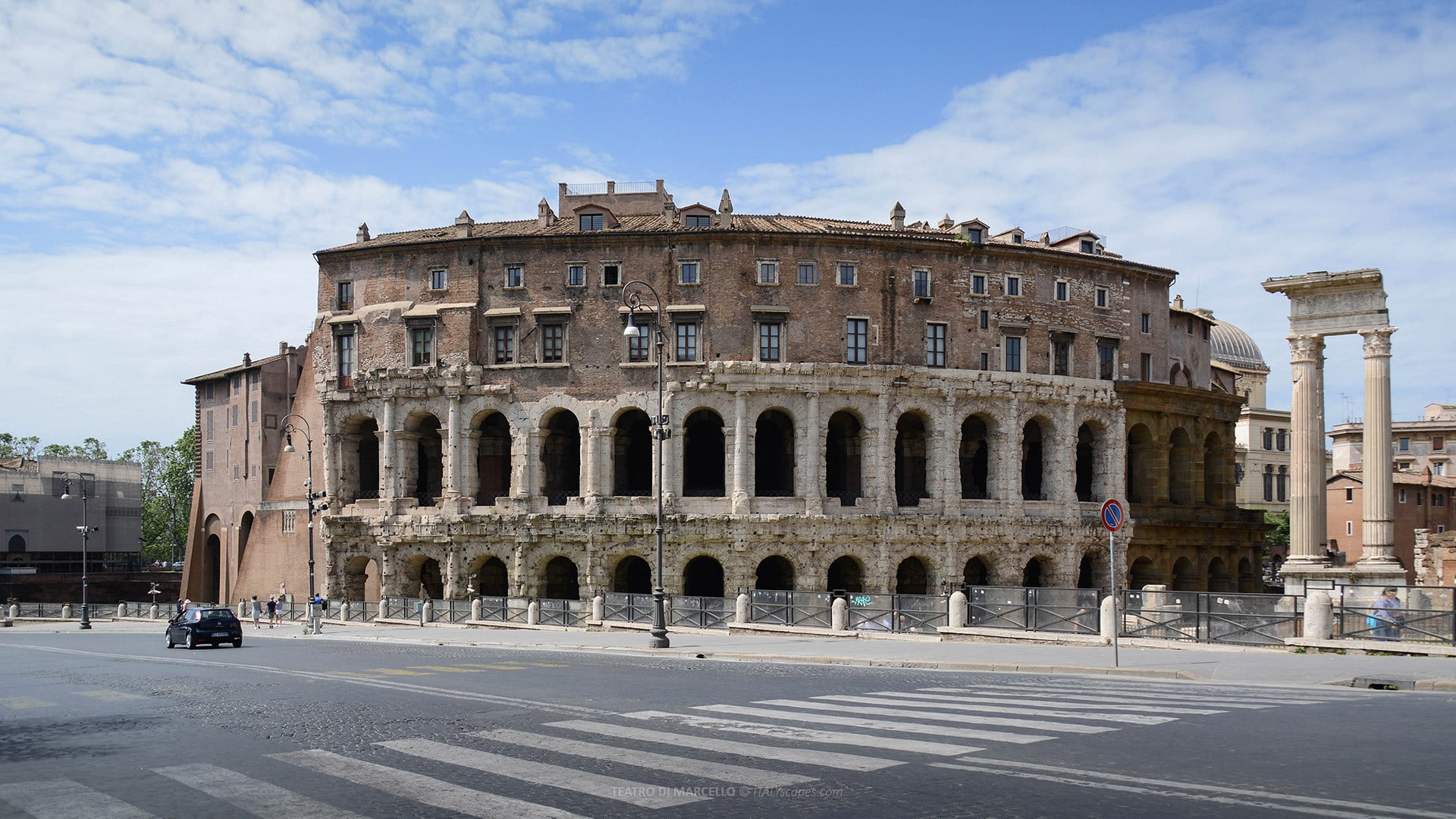
The facade of the Theater of Marcellus
Baths, Daily Life, and Imperial Infrastructure
Roman urban life depended on infrastructure: aqueducts, sewers, roads, bridges, markets, baths, and housing. Public baths were among the most important institutions of imperial society, combining hygiene, exercise, social life, libraries, gardens, art, and political generosity.
Large bath complexes required advanced engineering, huge water supply, heating systems, vaulted halls, and organized maintenance. They also expressed imperial wealth. In Rome, the ruins of the great baths still show the scale of public architecture designed for ordinary urban use.
The Baths of Caracalla
The Baths of Caracalla were begun under Septimius Severus and completed under Caracalla in AD 216. The complex covered about 25 hectares, while the central building measured around 214 meters by 110 meters. It could accommodate roughly 1,600 bathers at one time.
The baths included hot, warm, and cold rooms, palaestrae, libraries, gardens, service tunnels, cisterns, and a large open-air swimming pool. The surviving walls, vaults, and underground areas demonstrate Roman mastery of concrete construction, water management, heating systems, and monumental interior planning.
The Crisis of the Third Century
During the 3rd century AD, Rome faced military invasions, civil wars, economic instability, plague, and rapid changes of emperor. The empire survived, but the old political balance changed. Power shifted toward the army, frontier defense, taxation, and stronger central authority.
Rome was no longer always the practical center of imperial government. Emperors spent increasing time near frontiers or in other administrative capitals. Yet the city remained symbolically essential, and new defensive works showed that even Rome now needed protection from external threats.
The Aurelian Walls
The Aurelian Walls were built between AD 271 and 275 to defend Rome against growing military danger. They enclosed a circuit of about 19 kilometers and incorporated earlier buildings, tombs, aqueducts, and gates into a new defensive system.
The walls were originally about 6 meters high and around 3.5 meters thick, with towers placed at regular intervals of roughly 30 meters. Later emperors strengthened them. Large sections still survive, making them one of the most visible remains of late imperial Rome.
Constantine and the Christianization of Rome
Constantine transformed the empire in the early 4th century. After defeating Maxentius at the Battle of the Milvian Bridge in AD 312, he became the dominant western emperor. His reign changed Rome’s religious landscape by favoring Christianity and supporting major church construction.
The city did not instantly become Christian in every aspect. Traditional monuments, senatorial paganism, imperial memory, and Christian institutions coexisted for generations. However, Constantine’s policies marked a decisive shift that changed Rome’s identity and prepared the transition from imperial capital to Christian center.
The Arch of Constantine
The Arch of Constantine stands near the Colosseum and was dedicated in AD 315. It commemorated Constantine’s victory over Maxentius and reused sculptural elements from earlier monuments of Trajan, Hadrian, and Marcus Aurelius, combining new political meaning with older imperial imagery.
The arch is about 21 meters high, 25.9 meters wide, and 7.4 meters deep. Its inscriptions and reliefs present Constantine as legitimate victor and restorer of order. It is one of the most important surviving monuments from the turning point between pagan imperial Rome and Christian Rome.

The southern facade of the Arch of Constantine
Late Antiquity and the End of Ancient Rome
In AD 330, Constantine founded Constantinople as a new imperial capital in the east. Rome remained prestigious, but its political role declined. The western empire faced increasing pressure, and the city suffered major shocks, including the sack by the Visigoths in AD 410.
The conventional end of the Western Roman Empire came in AD 476, when the last western emperor, Romulus Augustulus, was deposed. Rome did not disappear, but ancient Rome as a political system ended. Its monuments remained, reused, damaged, buried, restored, and reinterpreted over centuries.
Frequently Asked Questions about the History of Rome
When did the history of Rome begin?
The history of Rome traditionally begins on April 21, 753 BC, when Romulus is said to have founded the city on the Palatine Hill, near the Tiber River.
What were the main periods of ancient Roman history?
Ancient Roman history is usually divided into three main periods: the Roman Kingdom, the Roman Republic, and the Roman Empire, followed by Late Antiquity and Rome’s Christian transformation.
What was the Roman Forum used for?
The Roman Forum was the political, religious, legal, and commercial center of ancient Rome. It contained temples, basilicas, Senate buildings, triumphal monuments, and public meeting spaces.
Why is the Colosseum connected to imperial Rome?
The Colosseum was built under the Flavian emperors and symbolized imperial power and public entertainment. It hosted gladiatorial games, animal hunts, executions, and large public spectacles.
Why is the Pantheon so important?
The Pantheon is important because it is one of the best-preserved ancient Roman buildings. Its huge concrete dome, oculus, portico, and continuous use make it unique in Rome.
What does Trajan’s Column represent?
Trajan’s Column commemorates Trajan’s victories in the Dacian Wars. Its spiral reliefs show military scenes, soldiers, fortifications, river crossings, battles, and Roman imperial propaganda.
What ancient Roman monuments can still be seen in Rome today?
Visitors can still see the Colosseum, Roman Forum, Pantheon, Palatine Hill, Trajan’s Column, Theatre of Marcellus, Baths of Caracalla, Aurelian Walls, and several ancient temples and arches.
Sources:


