Table of Contents
Few stories reveal Lucca‘s darker imagination as vividly as the legend of Lucida Mansi. Behind the famous ghost stands a real seventeenth-century noblewoman whose documented life was gradually surrounded by tales of vanity, forbidden lovers, a bargain with the Devil, a desperate race against time, and a fiery journey through the city.
The legend connects several of Lucca’s most distinctive places: the medieval Torre delle Ore, the Renaissance walls, the pond in the Botanical Garden, and Villa Mansi in the countryside near Capannori. Each location adds a different layer to a story in which historical evidence and popular tradition must be kept carefully separate.
For visitors, the value of the story lies not in treating every detail as fact, but in following the way Lucca transformed a noblewoman into one of its best-known supernatural figures. The route of Lucida Mansi offers an unusual introduction to the city’s towers, gardens, aristocratic residences, silk wealth, and enduring local folklore.

Who Was Lucida Mansi?
An Uncertain Identity
Lucida Mansi was an Italian noblewoman who lived in and around Lucca during the first half of the seventeenth century. Her precise identity remains uncertain. Standard accounts usually place her birth around 1606, while another historical reconstruction identifies her as Lucida Saminati, born in Lucca on March 7, 1608.
That reconstruction describes her as the daughter of Vittorio Saminati and Laura Marchiò. Other accounts associate her more generally with the Samminiati family. The differences in spelling and dating are important because they show that the surviving biographical picture is incomplete, even before the supernatural elements of the story are considered.
The name Lucida Mansi, by which she became famous, came from her second marriage. She was not born a Mansi, but entered one of Lucca’s prominent families by marrying Gaspare di Nicolao Mansi. The family’s fortune was connected to the silk trade, an industry central to Lucca’s prosperity from the Middle Ages onward.
Her First Marriage
Lucida Mansi married Vincenzo Diversi while still very young. One reconstruction dates the marriage to January 1626, when she was in her late teens or early twenties. The Diversi belonged to a notable Lucchese family, and their surname also appears among the families that once possessed the Torre delle Ore.
Vincenzo Diversi died violently during the early years of the marriage. A detailed version states that he was killed by an arquebus shot during a dispute over land boundaries. This documented or historically reconstructed explanation differs sharply from the later legend, which accused Lucida of arranging or committing her husband’s murder.
No reliable evidence demonstrates that she killed Vincenzo. The accusation belongs to folklore and should not be presented as biography. Its importance lies elsewhere: by transforming an early widowhood into a suspicious death, storytellers gave Lucida Mansi the first element of the dangerous “black widow” identity that later dominated her reputation.
Marriage into the Mansi Family
After becoming a widow, Lucida Mansi married Gaspare di Nicolao Mansi, described in surviving accounts as both elderly and extremely wealthy. Their considerable age difference attracted attention, especially because later descriptions emphasized Lucida’s beauty. The marriage placed her within a family already known beyond Lucca for its commercial wealth.
The Mansi were among the merchant families whose status grew through the production and international sale of precious textiles. Their palaces, artworks, furnishings, and country properties later became visible expressions of that success. This social background explains why later versions of the Lucida Mansi story are filled with luxury, silk clothing, jewels, banquets, and elaborate interiors.
Accounts written long after her lifetime portrayed the marriage as unhappy and Lucida Mansi as eager to escape an older husband through parties and relationships with younger men. These claims are difficult to verify. They form part of the bridge between the historical noblewoman and the libertine character created by popular storytelling.
Her Documented Death
The most widely accepted account states that Lucida Mansi died in Lucca on February 12, 1649, probably during an outbreak of plague. She was buried in her family crypt inside the Church of the Conception belonging to the Capuchins. Her real death was therefore caused by disease, not by a supernatural abduction.
The church and its convent no longer survive. They were confiscated and destroyed during the Napoleonic period under Elisa Baciocchi, when urban changes connected with Porta Elisa altered that part of Lucca. The disappearance of Lucida’s burial place removed a physical point of reference and may have strengthened the freedom of later legend-making.
Her death in 1649 also creates a decisive contradiction with the best-known Torre delle Ore version, which places the Devil’s return on August 14, 1623. Lucida Mansi would still have been a teenager then, and she demonstrably lived for another twenty-six years. The date belongs to folklore, not a credible chronology.

How History Became Legend
The legend did not preserve a single stable narrative. Instead, different storytellers combined several motifs: the vain beauty, the murderous widow, the deadly trapdoor, the demonic contract, the clock that cannot be stopped, the infernal carriage, the haunted mirror, and the woman’s face beneath dark water.
Some versions focus on the historic center of Lucca, especially Torre delle Ore and the Botanical Garden. Others move the final scene to Villa Mansi at Segromigno in Monte. A further tradition associates Lucida with a Mansi residence near Monsagrati. These geographical variations reveal a mobile legend attached to several evocative places.
The Obsession with Beauty
At the center of every major version stands Lucida Mansi’s extraordinary beauty. The historical woman may indeed have been considered attractive, but the language used by later narratives is unmistakably legendary. She is presented as a woman admired by everyone, surrounded by luxury, and increasingly unable to imagine life without her youthful appearance.
The defining object in this part of the tale is the mirror. Lucida Mansi supposedly ordered an entire room to be covered with mirrors so that she could see herself from every angle. The detail turned ordinary vanity into an architectural obsession and made the reflected face the most recognizable symbol of her story.
The mirror room is usually placed at Villa Mansi, specifically in the bridal chamber. However, this association cannot be accepted as a documented episode from Lucida’s life. The Mansi family acquired the villa in 1675, twenty-six years after her death, when the property had previously belonged to the Cenami family.
The Pact with the Devil
According to the legend, the decisive moment came when Lucida Mansi noticed the first small wrinkle on her face. Terrified by the evidence of aging, she cried over the loss of her beauty. A magnificent young man then appeared and offered what she desired most: thirty additional years of unchanged youth.
The stranger was the Devil in attractive human form. His proposal followed the familiar structure of a demonic bargain: Lucida Mansi would retain her beauty for thirty years, but at the end of that period her soul would belong to him. She accepted, choosing temporary physical perfection over eternal salvation.
For the agreed period, everyone around her continued to age while her appearance remained untouched. The legend therefore presents beauty not as a blessing, but as visible proof of a concealed debt. Each year of preserved youth moved Lucida Mansi closer to a fixed and unavoidable deadline.
The Lovers and the Trapdoor
The darkest versions describe Lucida Mansi as surrounded by young lovers whom she later killed to protect her reputation or satisfy her cruelty. After receiving them in her chamber, she supposedly made them fall through a concealed trapdoor into a shaft filled with sharp blades.
At Villa Mansi, visitors are sometimes shown a trapdoor in the bridal chamber and a presumed portrait incorporated into a mirror frame. These objects contribute to the atmosphere surrounding the story, but they do not establish that Lucida Mansi occupied the room or used it for any crime.
The Final Night at Torre delle Ore
The most famous urban version brings the legend to Torre delle Ore, Lucca’s Clock Tower. After thirty years, the Devil returned to claim Lucida’s soul. She remembered that the contract would expire at midnight and decided to stop the clock before its bells could announce the fatal hour.
Lucida Mansi rushed to the tower and climbed its steep wooden stairs, hoping to reach the mechanism in time. The present ascent contains 207 steps, making the physical effort easy for modern visitors to imagine. In the story, every step becomes part of a desperate struggle against the movement of time.
Torre delle Ore stands on Via Fillungo at the corner with Via dell’Arancio. Rising approximately fifty meters, it is the tallest surviving tower among the many that once shaped medieval Lucca. Its central position and audible bells made it an ideal setting for a legend built around an approaching midnight.
The tower itself dates from the thirteenth century. Lucca’s General Council arranged for a public clock there in 1390, entrusting the mechanism to the goldsmith Labruccio Cerlotti. An external dial followed later, while the surviving eighteenth-century mechanism was designed by Louis Simon with Sigismondo Caturegli’s assistance.
In the legend, Lucida Mansi failed before reaching or stopping the mechanism. The bell struck midnight, confirming that the promised period had ended. Her attempt to defeat the contract by silencing the clock could not change the agreement, and the Devil arrived to collect his payment.
The Fiery Carriage
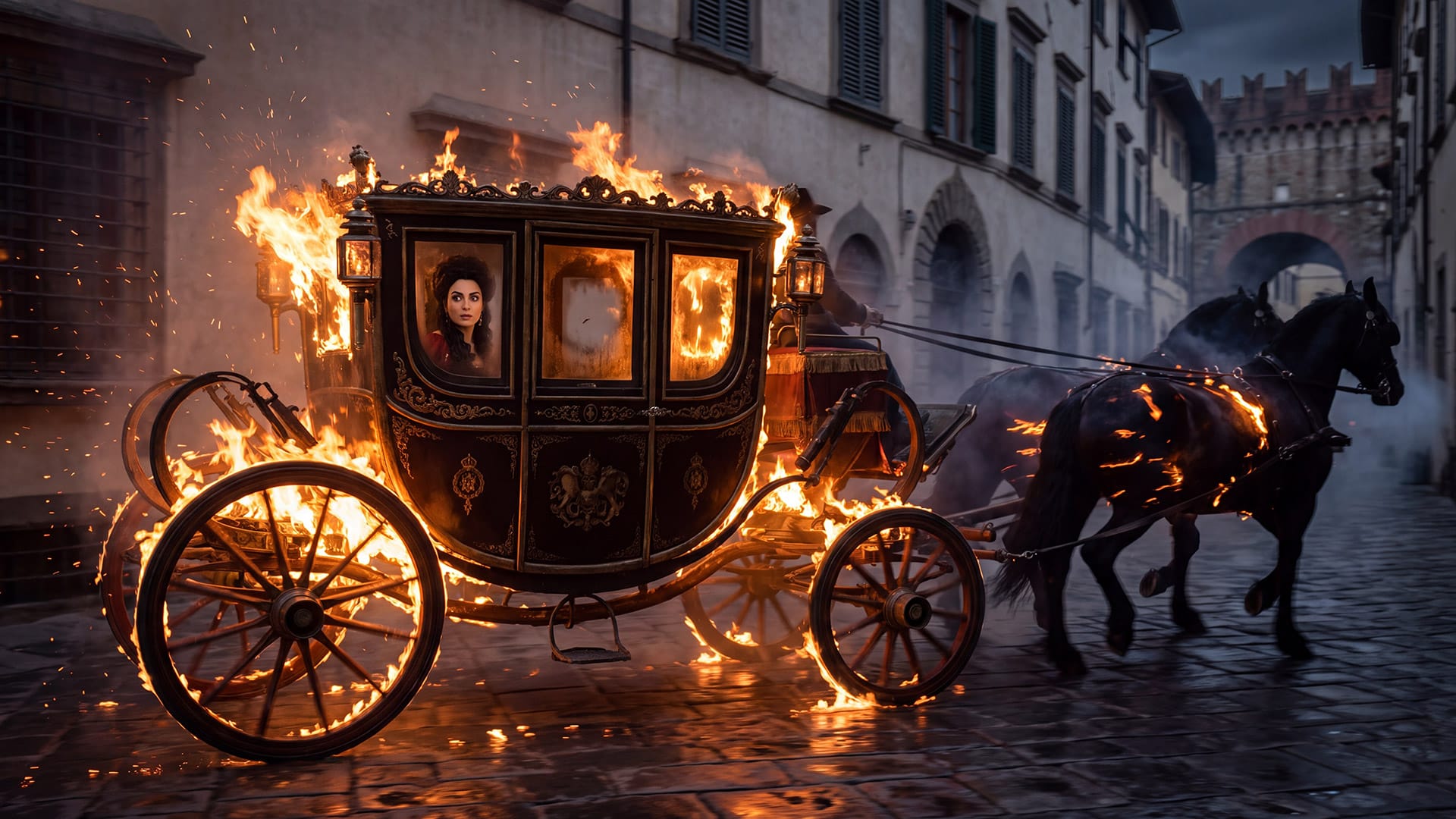
After the bell sounded, the Devil placed Lucida Mansi in a burning carriage. The vehicle raced through Lucca, crossed or followed the city walls, and carried her toward the place where her earthly journey would end. The image of wheels, flames, horses, and nighttime streets gave the legend its most spectacular scene.
The best-known conclusion sends the carriage into the pond of Lucca’s Botanical Garden. Lucida Mansi and her infernal escort disappear beneath the water, transforming the pond into a boundary between the visible city and the supernatural world. Her punishment becomes permanently attached to a real landscape.
Another version moves the sinking carriage to the waters at Villa Mansi, while some accounts say she descended through the same trapdoor used against her lovers. These alternatives should not be merged into one supposed original. They are distinct endings developed within the same tradition.
A later variant places a black carriage outside Villa Mansi on a night in August 1649, closer to the year of Lucida’s documented death. It describes black horses and a burned-faced driver. This version reduces the chronological conflict but remains a legendary reconstruction, not a historical report.
The Legend’s Echoes in Modern Lucca
The Ghost in the Botanical Garden
Popular belief claims that Lucida Mansi’s face can still be seen beneath the water of the Botanical Garden pond. Some tellings say that anyone who places their head close to or beneath the surface may glimpse her sleeping features. Others reserve the apparition for nights illuminated by the full moon.
The current Botanical Garden was founded in 1820 by Maria Luisa of Bourbon, more than 170 years after Lucida’s death. It occupies about two hectares in the southeastern part of Lucca’s historic center. Consequently, the legend’s identification with the modern institution developed afterward.
Today, the contrast between the garden’s scientific purpose and its supernatural reputation makes it one of the story’s most memorable locations. Collections of plants, historic trees, greenhouses, and water coexist with a tale of an infernal carriage lying beneath the pond.
The Ghost of Villa Mansi
Villa Mansi is the principal country setting associated with Lucida’s ghost. The official tourism tradition describes her restless spirit as wandering through the rooms and garden, condemned by the pact she made for beauty. Reports within folklore mention sighs, fleeting movements, and a woman’s face appearing in reflections.
The villa stands in Segromigno in Monte, a hamlet of Capannori northeast of Lucca. Its elegant façade, broad lawn, decorated rooms, grottoes, water features, and mature trees provide a convincing setting for a ghost story, even though Lucida’s personal residence there is not historically established.
The building began as a sixteenth-century property of the Benedetti family and was sold to the Cenami in 1599. Between 1634 and 1635, the Urbino architect Muzio Oddi transformed the residence, creating much of the monumental composition visible today. During Lucida’s lifetime, it was therefore Villa Cenami.
Ottavio Mansi acquired the estate in 1675. Later alterations involved the architect Giusti, while the gardens became associated with theatrical designs and water effects attributed to Filippo Juvarra. Interior decoration includes works by Stefano Tofanelli and other artists, giving the residence considerable artistic importance beyond the legend.
The historical timeline shows why Villa Mansi must be presented as a setting adopted by tradition rather than Lucida’s proven home. Nevertheless, its later Mansi ownership, luxurious interiors, bridal chamber, mirrors, garden water, and isolated atmosphere allowed it to become the legend’s most persuasive country stage.
Different Places, Different Apparitions
Some accounts relocate the ghost to another Mansi residence near Monsagrati, in the municipality of Pescaglia. This version demonstrates how the legend spread through the wider Lucca area and attached itself to properties carrying the family name. The precise building and the claimed events remain uncertain.
Other tellings keep Lucida entirely within Lucca’s walls, linking the tower, streets, fortifications, and garden pond into one continuous route. That compact urban version is the easiest for visitors to follow and has become especially prominent because all its principal landmarks can be explored during a walking tour.
Visiting the Places Connected to the Legend
A Lucida Mansi itinerary should begin at Torre delle Ore. Climbing the original wooden staircase gives visitors direct experience of the height and effort central to the final-night episode. At the top, the clock mechanism and panoramic view turn a supernatural narrative into a tangible encounter with medieval Lucca.
From the tower, the route can continue through the historic center toward the Botanical Garden on Via del Giardino Botanico. The garden’s pond is the traditional endpoint of the fiery carriage. Visitors should appreciate it both as a legendary site and as a scientific institution founded in 1820.
The Renaissance walls form the physical connection between these locations. In the story, the carriage travels through or along them before reaching the water. In reality, the tree-lined circuit offers elevated views of Lucca and allows travelers to understand the enclosed urban geography that shaped the legend’s route.
Villa Mansi requires a separate excursion to Segromigno in Monte. Because opening periods and guided access can vary, visitors should verify current arrangements before traveling. The villa is worth seeing for its architecture, interiors, gardens, fishpond, grotto, and waterworks, not solely for its supernatural association.
Palazzo Mansi in central Lucca provides additional historical context, although it should not be confused with Villa Mansi or claimed as a confirmed Lucida residence. The national museum illustrates the wealth, textiles, art, and domestic culture of the merchant family whose surname became inseparable from her identity.
The Beautiful Ghost of Lucca
Lucida Mansi remains Lucca’s most famous female ghost because her legend joins beauty and terror to places that still exist. A medieval clock tower, monumental walls, a quiet garden pond, and a magnificent country villa allow the narrative to be followed through real architecture and landscape.
Her true life cannot be reconstructed in every detail, and the most dramatic accusations are unsupported. What survives with certainty is the cultural power of the legend: a seventeenth-century noblewoman became an enduring warning about vanity, time, and death, as well as one of Lucca’s most compelling tourist stories.
Images generated with Nano Banana Pro / Google AI Studio