Table of Contents
The myth of Scylla is one of the oldest and most famous stories connected to the waters between Calabria and Sicily.
In ancient Greek mythology, Scylla was a terrifying sea monster associated with the narrow and dangerous Strait of Messina, the channel separating the two Italian regions.
Together with Charybdis, another legendary monster located on the opposite side of the strait, Scylla represented one of the greatest maritime dangers of the ancient world.
The story combines mythology, geography, literature, and local tradition. Ancient sailors feared the strong currents and whirlpools of the Strait of Messina, and Greek poets transformed those dangers into mythical creatures.
Over the centuries, the monster became deeply linked with the Calabrian town of Scilla, a coastal settlement that still preserves traces of this ancient legend.
Scylla in Ancient Literature
The oldest known literary reference to Scylla appears in Homer’s Odyssey, composed around the 8th century B.C.. In the epic poem, Odysseus must navigate the Strait of Messina during his long journey home after the Trojan War.
The sorceress Circe warns Odysseus about two deadly dangers waiting in the narrow passage: Scylla and Charybdis. Scylla lived inside a cave high on a cliff, while Charybdis created enormous whirlpools capable of swallowing entire ships.
Homer describes the monster as a horrifying creature with multiple heads and rows of sharp teeth. Each time a ship passed nearby, she seized sailors from the deck and devoured them.
Odysseus ultimately chose to sail closer to Scylla, believing it was better to lose a few men than risk the destruction of the entire ship by Charybdis.
Ovid transformed the myth into a tragic story of jealousy and metamorphosis. His version emphasized Scylla’s former beauty and the cruelty of her transformation. This approach reflected the Roman poet’s interest in themes of change and punishment.
Roman writers such as Virgil also referred to the myth in works dealing with voyages and maritime dangers.
During antiquity, Scylla became a universal symbol of destructive forces at sea. Medieval and Renaissance authors later inherited the myth through classical literature.
The Physical Appearance of Scylla
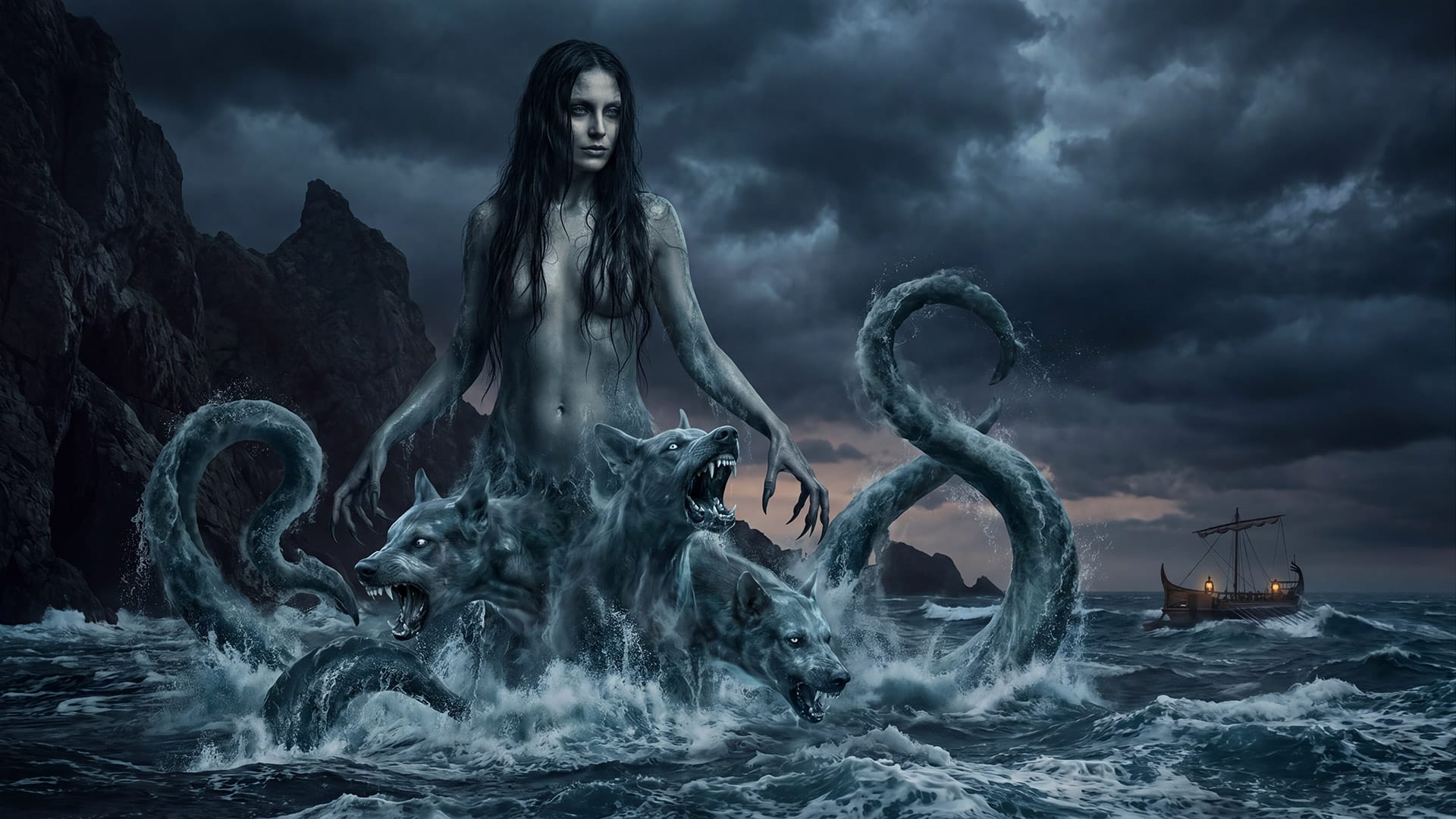
Ancient authors described the monster in different ways, although several elements remained constant. Homer portrayed her as a monstrous hybrid creature with twelve feet, six long necks, and six heads filled with sharp teeth arranged in multiple rows.
Each head acted independently, allowing the creature to capture several victims at the same time. According to the Odyssey, no sailor who approached her cave could escape completely unharmed.
Later authors expanded the description. In some traditions, the upper part of her body resembled a woman, while the lower part consisted of dogs, serpents, or fish tails. This hybrid appearance became common in ancient Greek and Roman art.
The Transformation of Scylla
Several ancient myths describe Scylla not as a monster from birth, but as a beautiful sea nymph who underwent a tragic transformation.
One of the most famous versions appears in Ovid’s Metamorphoses. According to the Roman poet, she was originally a young and extraordinarily beautiful maiden loved by many gods and sea creatures.
The sea god Glaucus fell deeply in love with her and sought magical help from the sorceress Circe. However, Circe herself became attracted to Glaucus. When he rejected her advances, Circe grew jealous of Scylla.
In revenge, Circe poisoned the waters where Scylla used to bathe. As soon as Scylla entered the water, monstrous creatures emerged from her body. Dogs and serpents surrounded her waist, transforming her into a horrifying being.
Terrified by her new appearance, Scylla fled to the cliffs overlooking the sea, where she eventually became the legendary monster feared by sailors.
Variations of the Myth
Ancient mythology rarely existed in a single fixed version. Different Greek and Roman authors offered alternative explanations for Scylla’s origin.
Some traditions described her as the daughter of sea deities such as Phorcys and Hecate. Others connected her with marine gods linked to chaos and destruction.
Despite these differences, the central idea remained unchanged: Scylla became a terrifying creature associated with death and danger at sea.
Scylla and Charybdis
Scylla is almost always associated with Charybdis, another sea monster located on the opposite side of the Strait of Messina.
While Scylla attacked sailors directly, Charybdis generated gigantic whirlpools capable of dragging ships underwater. Ancient writers imagined the two monsters positioned close enough that avoiding one often meant approaching the other.
This geographical arrangement reflected the actual dangers of the strait. Navigating ancient ships through narrow waters with unpredictable currents required extreme precision.
The myth became a metaphor for impossible decisions. The expression between Scylla and Charybdis entered many European languages as a symbol of choosing between two dangers.
Symbolism of the Monster
Scylla represented more than a simple mythical beast. For ancient Mediterranean sailors, she embodied the natural dangers of navigation.
The Strait of Messina is characterized by strong currents, hidden rocks, sudden winds, and turbulent waters. Ancient ships, especially those powered by sails and oars, faced serious risks while crossing the narrow channel.
The monster therefore served as a mythological explanation for real maritime hazards. Greek mythology frequently transformed dangerous natural phenomena into supernatural beings, making the unknown easier to understand.
Scilla and the Myth of Scylla
The Strait of Messina separates Calabria from northeastern Sicily. At its narrowest point, the distance between the two coasts is only a few kilometers.
The area has always been difficult to navigate because of strong tidal currents, sudden changes in water movement, dangerous rocks, unpredictable winds, and the formation of whirlpools.
The waters near Scilla and Cariddi became associated with supernatural dangers. Over time, oral traditions transformed geographical hazards into legendary monsters.
The Town of Scilla
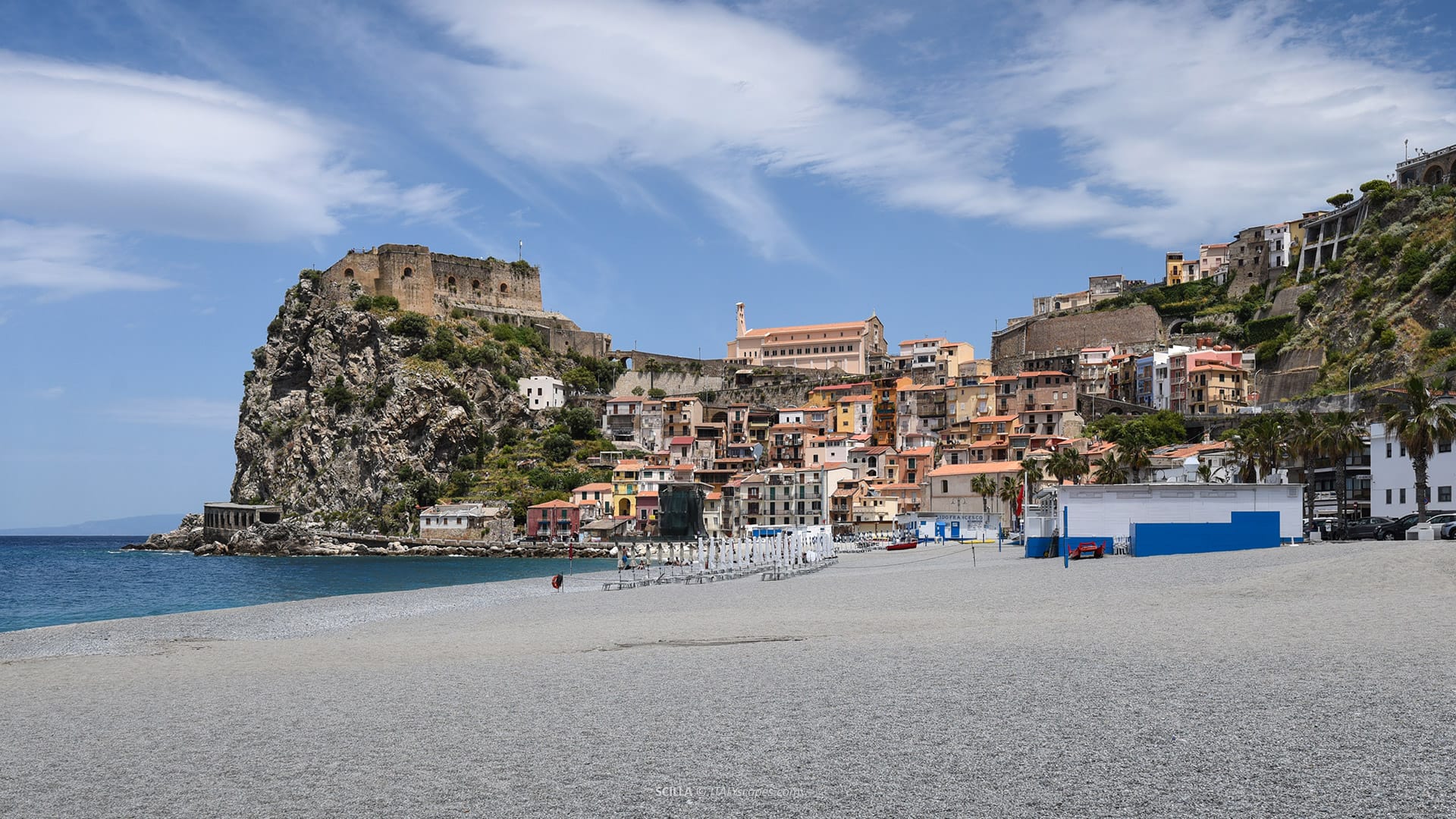
The modern Calabrian town of Scilla is directly linked to the mythological monster. Located on the Tyrrhenian coast of Calabria, the town occupies a strategic position overlooking the Strait of Messina.
Ancient traditions identified the rocky cliffs near Scilla as the location of the monster’s cave. The connection between the place and the legend survived throughout antiquity and continued into modern times.
Scilla became one of the most famous mythological locations in southern Italy.
The Enduring Legacy of Scylla
The myth of Scylla combines mythology, geography, navigation, and literature into one of the most enduring legends of the ancient Mediterranean.
Originally associated with the dangerous waters of the Strait of Messina, the monster evolved from a terrifying maritime threat into a complex mythological figure appearing in some of the greatest works of classical literature.
The story reflects the fears of ancient sailors confronting unpredictable seas and narrow coastal passages. Through Homer, Ovid, and later authors, the creature became a permanent symbol of danger, transformation, and impossible choices.
Today, the Calabrian town of Scilla preserves the memory of this ancient legend. Its cliffs, sea, and historic landscape continue to evoke the mythology that shaped the cultural imagination of the Mediterranean world for more than two thousand years.
Featured image generated with Nano Banana Pro / Google AI Studio