-
About
Table of Contents
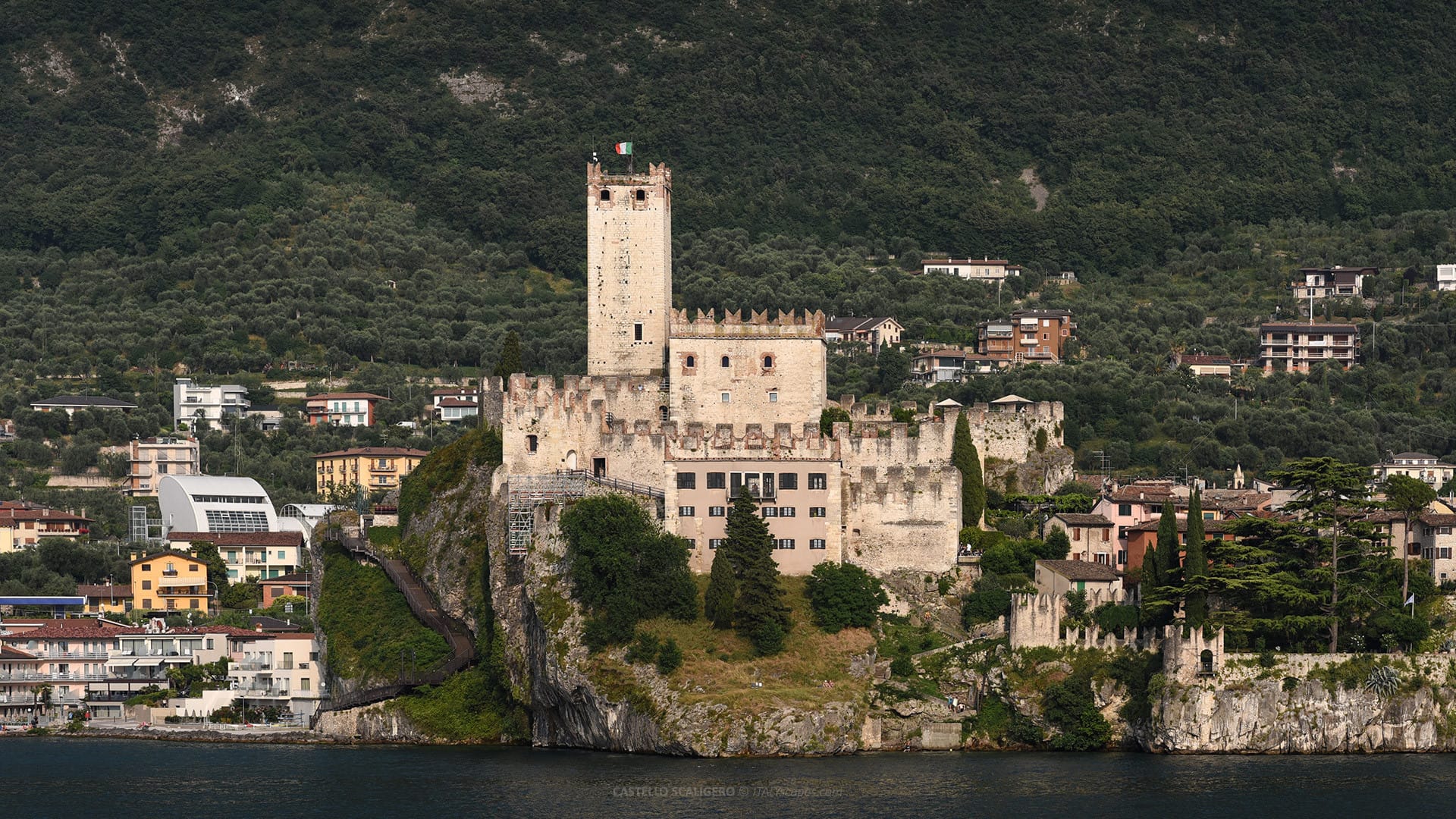
Perched dramatically on a rocky promontory at the edge of Lake Garda, Castello Scaligero stands as the defining symbol of the town of Malcesine.
The fortress – with its towers, lakeside walls and history-laden corridors – dominates both the skyline of the town and the panorama of the lake.
Over centuries, it has witnessed invasions, political turnover, architectural renewals, and now serves as a window into the layered history of the Garda region.
For visitors to Malcesine, Castello Scaligero is not only a monument – it is a journey through time, tracing Lombard origins, medieval power struggles, Venetian rule, Austrian fortifications – and ultimately a cherished heritage site offering stunning views over lake and mountains.
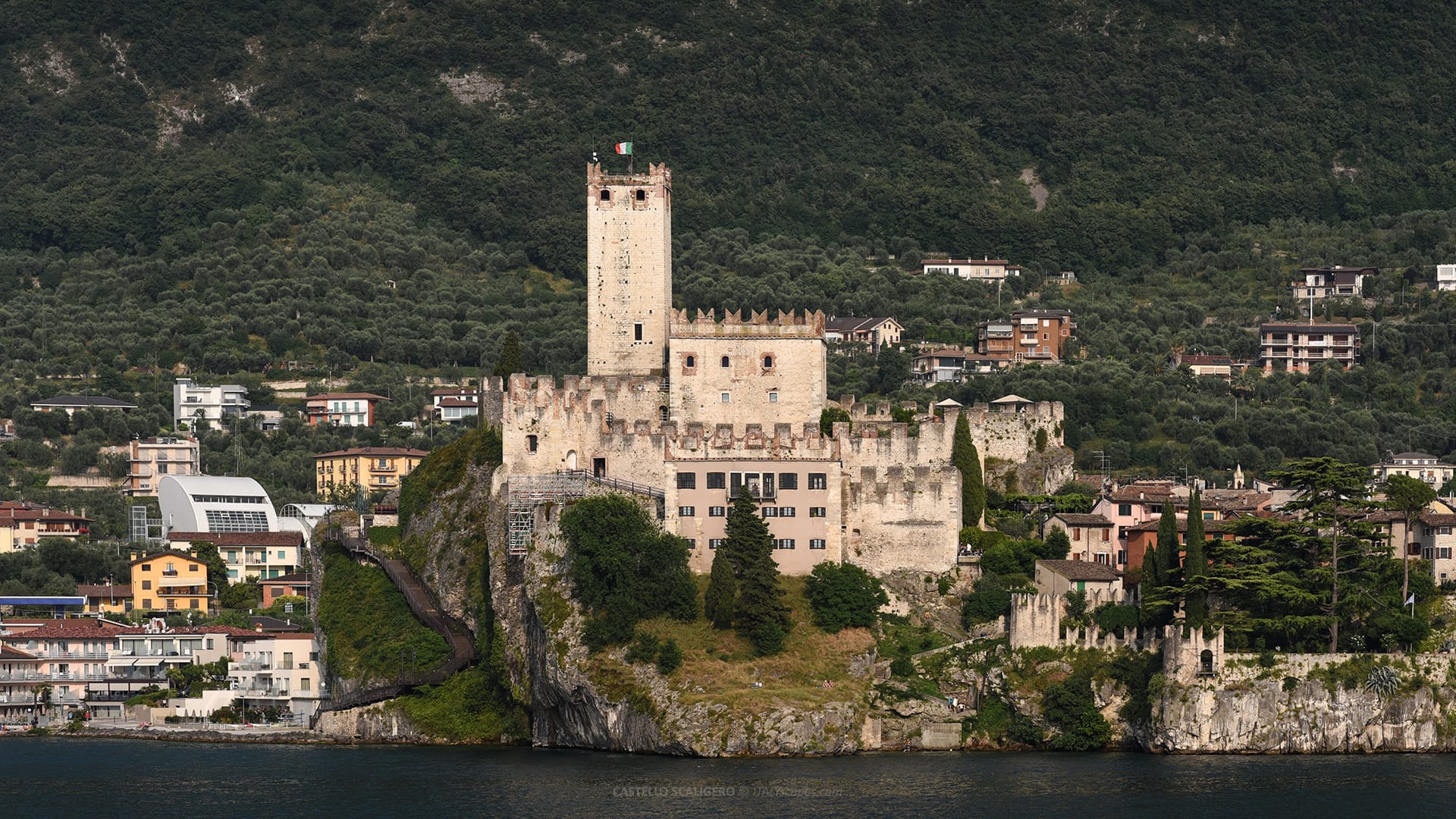
Castello Scaligero, seen from the water
Short History of Castello Scaligero
The location of Castello Scaligero has been significant for centuries. Archaeological evidence suggests that the rocky hill where it stands was in use since ancient times, possibly as early as the late 1st millennium B.C. – even before Roman dominion.
However, the fortress as it began to take recognizable shape was constructed by the Lombards (Longobardi) in the early Middle Ages, around the 5th–6th century A.D.
Subsequently, in the year 590, the castle suffered destruction at the hands of the Franks, only to be rebuilt thereafter.
Legend holds that in 806 the castle hosted Pipin of Italy (Pepin), visiting the hermits Saints Benigno and Caro – a testimony to the strategic and symbolic importance of the fortress even in early medieval times.
As centuries passed and political powers shifted across northern Italy, the castle became a fief of the Bishopric of Verona. But its defining transformation came in 1277, when the fortress was granted to Alberto della Scala, lord of Verona.
Under his rule and that of his successors – the noble family known as the Scaligeri (or della Scala) – the castle underwent major restructuring. From that moment, the fortress came to be known as Castello Scaligero.
Between 1277 and 1387, the castle served as the residence and strategic stronghold of the Scaligeri.
With their decline, the property passed to the Visconti of Milan – until 1403 – and then was contested between powers before eventually becoming part of the dominion of the Republic of Venice in the early 15th century.
During its Venetian period, Castello Scaligero retained its defensive purpose. The fortress played a role especially in times of conflict; for example, in 1513 the castle was recaptured from imperial-aligned forces by Venetian condottieri, underscoring its strategic value.
Over time, as warfare and political boundaries evolved, the castle’s military value waned.
In the late 18th century, it passed briefly to French control after Napoleon’s campaigns, and then to the Austrian Empire. Under Austrian rule – until 1866 – the castle was militarized and renovated structurally, used as a garrison and munitions storage.
After Italian Unification, the relevance of the fortress diminished further as military technology and political contexts changed. Yet in 1902, Castello Scaligero was officially declared a national monument, recognizing its cultural, historical, and architectural value.
Since then, the castle has undergone restoration efforts aimed at preserving its structure and opening it to public visits.
In particular, restoration of the internal buildings and conversion into a museum – including the “Natural History Museum” dedicated to Lake Garda and its surrounding nature – has revived the castle as a living monument.
Architecture of Castello Scaligero
Architecturally, Castello Scaligero is remarkable for its adaptation to the terrain, its defensive design, and the layering of modifications over centuries.
The fortress stands on a rocky promontory jutting into Lake Garda – a natural defensive advantage that magnified the effectiveness of its stone walls and towers.
The castle is structured on three successive levels or courtyards, each accessed by drawbridges and steep stairs anchored in the rock. This tiered layout made it possible to isolate and defend each section independently in case of attack.
One of the most striking features is the tall keep – a 31-meter-high tower (or “mastio”) which was added after the original medieval structures.
From its top, visitors enjoy an unmatched panorama: views over the lake, the village of Malcesine, and the mountain backdrop of Monte Baldo.
Walls and ramparts enclose the courtyards and the tower, built in rough natural stone and reinforced over time through additions by successive powers – Lombards, Scaligeri, Venetians, Austrians.
This layering gives the castle a complex architectural identity: medieval core foundations, gothic-Venetian crenellations, and early modern military adaptations.
Inside, Castello Scaligero today stands a museum complex: among its rooms is the “Goethe Room”, dedicated to the famous German writer Johann Wolfgang von Goethe, who visited Malcesine in 1786 and was briefly detained under suspicion of espionage when he sketched the castle.
Other rooms are devoted to the natural history of the region: the flora and fauna of Lake Garda and nearby Monte Baldo are displayed, making the fortress not just a monument of stone and history, but also a center of cultural and environmental education.

How to Get to Castello Scaligero
Visiting Castello Scaligero is straightforward, thanks to its central position within the village of Malcesine and good transport connections to Lake Garda.
- By Car: If you are coming by car, you can reach Malcesine via the panoramic state road that skirts Lake Garda. Once in Malcesine, parking is usually outside the historic centre – then it’s a short walk to the castle.
- By Public Transport + Ferry or Bus: If you arrive by train, you can get off at stations such as Peschiera del Garda, then catch a regional bus (APT lines) that serves towns on the Upper Lake Garda. Alternatively – and very attractively – you may choose to reach Malcesine by boat from other lake towns. Arriving on the lake gives you a stunning first view of Castello Scaligero rising above the waters.
- On Foot (within Malcesine): Once in town, the castle is visible from many vantage points – from lakefront streets, from the village centre, or from the harbor. A pleasant lakeside promenade leads you to the foot of the rocky spur. From there, the castle entrance (via a gate called the “Siresina”) can be reached on foot; inside, a series of stairs and drawbridges leads upward through the courtyards to the keep and ramparts.
Sources: -
Photos
-
Map
-
Reviews