


-
About
Table of Contents
Buy tickets & tours:GetYourGuideThe Colosseum, also known as the Flavian Amphitheater, is the most famous ancient monument in Rome and one of the best-known archaeological landmarks in the world. It stands in the historical center of the city, close to the Roman Forum, the Palatine Hill, and the Arch of Constantine.
Built during the Roman Empire, the Colosseum was designed for public spectacles, including gladiatorial combats, wild animal hunts, executions, mythological performances, and imperial celebrations. Its size, engineering, and symbolic value made it the greatest amphitheater of ancient Rome and a lasting image of Roman power.
The monument is located in Piazza del Colosseo, in the archaeological heart of Rome. Its position is historically significant because it was built on land previously occupied by the artificial lake of Nero’s Domus Aurea, transforming a private imperial area into a public entertainment space.
The Colosseum is the largest amphitheater ever built in the Roman world. Its elliptical structure measures about 189 meters in length and 156 meters in width, with an original perimeter of around 545 meters. The surviving outer wall reaches approximately 48 to 50 meters in height.
Today, the Colosseum is one of the most visited attractions in Rome and Italy. It is also one of the most recognizable symbols of the city, representing Roman engineering, imperial propaganda, public entertainment, and the long historical transformation of Rome from antiquity to the modern age.

Short History of the Colosseum
The Flavian Dynasty and the Beginning of Construction
The construction of the Colosseum began under Emperor Vespasian, founder of the Flavian dynasty, around 70-72 AD. The project was part of a wider political strategy to restore public confidence after the reign of Nero and the civil conflicts that followed his death.
The site chosen for the amphitheater was highly symbolic. Nero had used the area for his luxurious Domus Aurea, including an artificial lake. Vespasian drained the lake and replaced part of Nero’s private palace complex with a public building dedicated to Roman citizens.
By the time Vespasian died in 79 AD, the amphitheater had already reached an advanced stage of construction. The upper levels were completed under his son Titus, who succeeded him as emperor and inaugurated the building shortly afterwards.
Inauguration Under Titus
The Colosseum was inaugurated by Emperor Titus in 80 AD, although some ancient sources place the inauguration in 80 or 81 AD. The opening celebrations were exceptionally large and included games, animal hunts, and spectacles organized to impress the Roman population.
Ancient accounts describe the inaugural games as lasting for many days. The events included gladiatorial combats and venationes, the Roman spectacles involving wild animals. These celebrations presented the new amphitheater as a central stage of imperial generosity and public entertainment.
The inauguration also reinforced the connection between the Colosseum and the Flavian emperors. For this reason, the monument’s ancient name was the “Flavian Amphitheater”, derived from the family name of Vespasian, Titus, and Domitian.
Completion and Modifications Under Domitian
The amphitheater was further completed and modified under Emperor Domitian, the younger brother of Titus. Domitian added important structural elements, including parts of the underground system known as the hypogeum, which transformed the functioning of the arena.
The hypogeum was a complex network of underground corridors, rooms, cages, and service areas beneath the arena floor. It allowed animals, gladiators, stage machinery, and scenery to be prepared before appearing in front of the spectators.
Domitian also added or modified upper seating areas, increasing the building’s capacity and improving the organization of the audience. These interventions made the Colosseum more technically advanced and better suited for elaborate imperial spectacles.
Fire, Earthquakes, and Ancient Restorations
In 217 AD, the Colosseum was seriously damaged by a major fire, traditionally attributed to lightning. The fire affected the wooden structures in the upper parts of the amphitheater and interrupted its full use for several years.
After this fire, restoration works were carried out over a long period. During the repairs, some spectacles were moved to other venues, including the Circus Maximus. The amphitheater was gradually restored and continued to be used in the following centuries.
Further repairs took place during the 3rd, 4th, and 5th centuries. Inscriptions record restoration works under later emperors, especially after damage caused by earthquakes. These interventions show that the Colosseum remained important long after the Flavian period.
The End of Gladiatorial Games
Gladiatorial combats declined gradually in late antiquity. The last recorded gladiatorial fights in the Colosseum are usually placed around 435 AD, although the exact end of these events remains debated by historians.
Animal hunts continued for a longer period. The last recorded spectacle involving wild animals took place in 523 AD, during the rule of the Ostrogothic king Theodoric the Great. This marked one of the final phases of the amphitheater’s ancient public function.
After the 6th century, the Colosseum no longer functioned as the great entertainment venue of imperial Rome. Its role changed completely, and the building entered a long period of adaptation, reuse, damage, and partial abandonment.
Medieval Reuse of the Colosseum
During the Middle Ages, the Colosseum was reused in several ways. Parts of the amphitheater became a burial area, while other spaces were occupied by workshops, dwellings, storage rooms, and small religious structures.
In the 13th century, the powerful Frangipani family fortified part of the Colosseum and used it as a stronghold. This transformation reflected the political instability of medieval Rome, where noble families often controlled fortified ruins and strategic sites.
The amphitheater also suffered from the removal of building materials. Travertine blocks, marble, iron clamps, and decorative elements were taken from the structure and reused in other buildings. This spoliation contributed to the partial collapse and disappearance of large sections.
The Name “Colosseum”
The ancient name of the monument was the “Flavian Amphitheater”. The name “Colosseum” appeared later, probably during the early Middle Ages, and is generally connected to the colossal statue that once stood near the building.
The Colossus of Nero was originally part of Nero’s palace complex. After Nero’s death, the statue was modified and reinterpreted under later emperors. Its presence near the amphitheater likely influenced the popular name of the monument.
Over time, the word “Colosseum” became the standard name of the amphitheater. It survived in medieval and modern usage and eventually became one of the most famous place names in the world.
Modern Protection and Restoration
From the modern period onward, the Colosseum became the object of archaeological, architectural, and conservation interest. Its historical value was increasingly recognized, and restoration works began to stabilize the monument and prevent further collapse.
Important consolidation works were carried out after damage caused by earthquakes. One of the significant early modern interventions followed the earthquake of 1803, when structural reinforcement became necessary to preserve the surviving walls.
During the 19th century, archaeological excavations and restoration campaigns changed the way the monument was understood. The Colosseum was no longer treated mainly as a source of reusable materials, but as a major historical and cultural monument.
Architecture of the Colosseum
General Structure and Dimensions
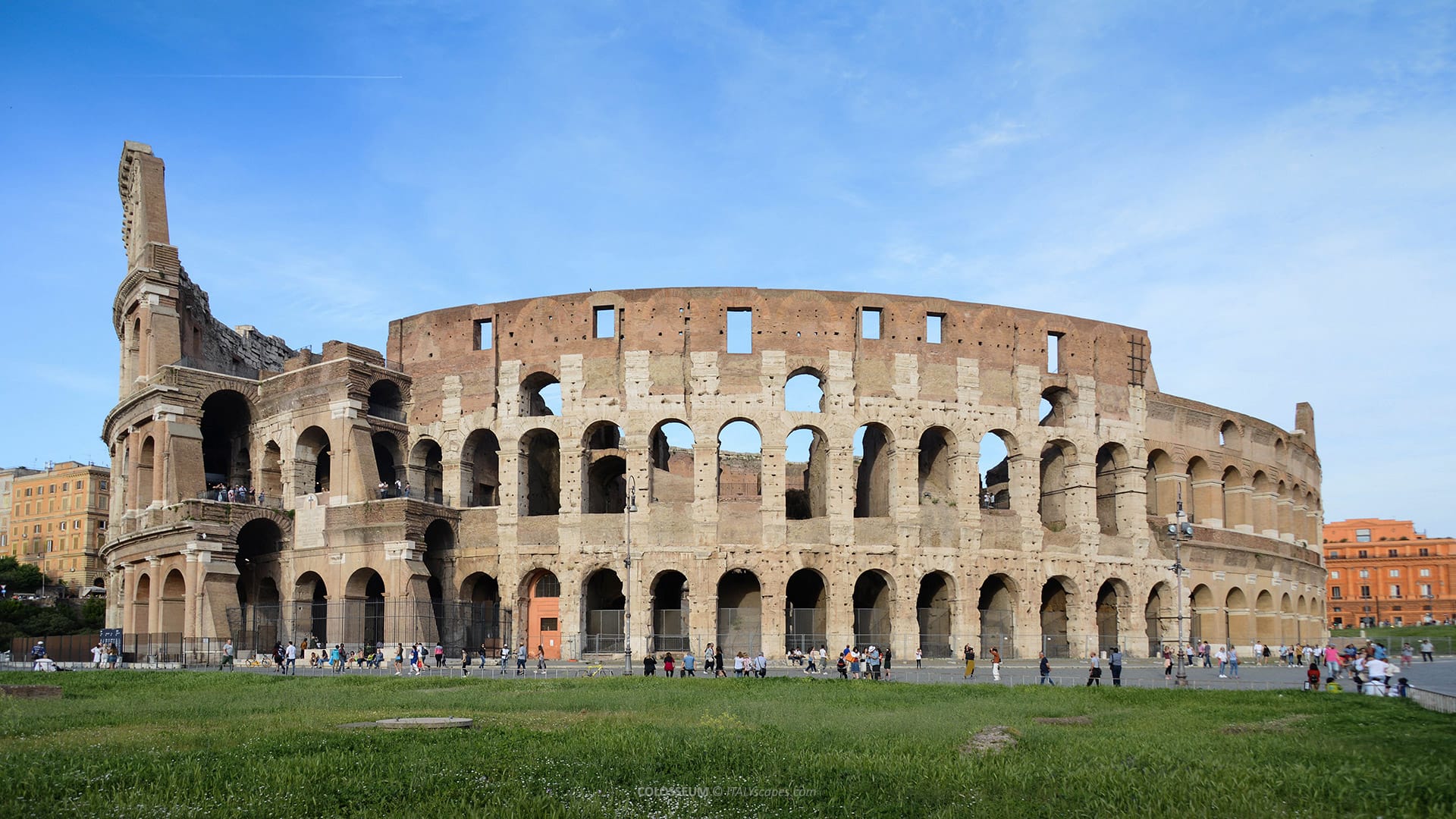
The Colosseum has an elliptical plan, typical of Roman amphitheaters but monumental in scale. The long axis measures about 189 meters, while the short axis measures about 156 meters. Its original perimeter was approximately 545 meters.
The building covers a large area in the center of Rome and rises to about 48-50 meters at its highest surviving point. In antiquity, its massive outer wall made it one of the most imposing architectural structures in the Roman Empire.
The amphitheater was constructed mainly from travertine limestone, tuff, brick-faced concrete, wood, and mortar. Travertine blocks formed the external structure, while lighter materials and Roman concrete were used in internal walls, vaults, and service areas.
Its engineering depended on arches, vaults, radial walls, and concentric corridors. These elements distributed weight efficiently and allowed tens of thousands of spectators to enter, circulate, sit, and leave the monument in an organized way.
Exterior Facade
The exterior of the Colosseum was divided into four main levels. The lower three levels consisted of large arcades, while the upper level, or attic, had a more solid wall surface decorated with pilasters and rectangular openings.
The architectural orders followed a vertical decorative system. The first level used Tuscan-style engaged columns, the second level used Ionic columns, and the third level used Corinthian columns. The attic level was decorated with Corinthian pilasters.
The facade was originally richer than it appears today. It included decorative elements, statues placed in the arches, and metal fittings. Many of these details disappeared over the centuries because of damage, collapse, and the reuse of materials.
Entrances and Circulation
The Colosseum had 80 entrances around its perimeter. Most of these entrances were used by spectators, while special entrances were reserved for the emperor, senators, magistrates, priests, and participants in the spectacles.
The entrance system allowed rapid movement into and out of the building. Numbered access points, stairways, corridors, and internal passages guided spectators to their assigned areas according to social class and status.
The Romans used a highly organized circulation system known through corridors and passageways often called vomitoria. These routes connected the exterior entrances with the seating areas and made crowd management possible on a very large scale.
Four main entrances were placed on the axes of the amphitheater. The entrances on the short axis led to important ceremonial routes and privileged areas, including the imperial box and spaces reserved for the highest authorities of Roman society.
Seating and Social Hierarchy
The seating area, known as the cavea, reflected the social order of ancient Rome. Spectators were not seated randomly. Their position inside the Colosseum depended on rank, gender, citizenship, and political status.
The best seats were located close to the arena. These lower areas were reserved for the emperor, senators, magistrates, priests, and other elite members of Roman society. Their proximity to the spectacle also displayed their public importance.
Above them were seating sectors for equestrians, citizens, and other social groups. The higher levels were assigned to lower-status spectators, while the uppermost areas offered more distant views of the arena.
The Arena
At the center of the Colosseum was the arena, the performance space where combats and spectacles took place. The arena was elliptical and measured approximately 86 meters in length and 54 meters in width, according to traditional measurements.
The arena floor was originally made of wood and covered with sand. The Latin word harena means sand, and this surface helped absorb blood, improve traction, and make the performance space easier to clean after events.
The wooden floor no longer survives. Today, visitors can see the exposed underground structures beneath the arena, especially the hypogeum. A partial reconstruction of the arena floor helps show how the ancient performance surface once covered the underground system.
The Hypogeum
The hypogeum was the underground system beneath the arena floor. It included corridors, rooms, cages, lifts, trapdoors, and service spaces used to prepare spectacles before they appeared in front of the public.
This underground area was not part of the earliest phase of the amphitheater in its final form. It was developed especially under Domitian, who transformed the technical possibilities of the building and made more complex spectacles possible.
The hypogeum allowed animals and fighters to be moved into position before entering the arena. Vertical shafts and lifting mechanisms could raise cages, scenery, or performers to the surface, creating sudden dramatic appearances during events.
The system was connected to external points through tunnels. These routes helped move animals, equipment, and personnel into the amphitheater without exposing the backstage operations to the spectators seated above.
Materials and Building Techniques
The Colosseum was built with several materials chosen for strength, flexibility, and availability. The main external structure used travertine, a durable limestone quarried near Tivoli and widely used in Roman monumental architecture.
Inside the building, Roman builders used tuff, brick, and concrete. Roman concrete made it possible to create vaults, corridors, and internal structures with great efficiency. The combination of materials reduced weight while maintaining stability.
Iron clamps were originally used to join many travertine blocks. In later centuries, these metal elements were often removed, leaving visible holes in the stone surface. These marks are still visible on many parts of the monument today.
The Velarium
The Colosseum was equipped with a large awning system known as the velarium. This fabric covering was designed to protect spectators from direct sun and improve comfort during events held in the open-air amphitheater.
The velarium was supported by masts fixed around the upper part of the building. Holes and supports in the attic level are connected to this system, which required skilled handling and careful coordination.
Ancient sources and archaeological evidence suggest that sailors, probably from the Roman fleet, were involved in operating the awning. Their experience with ropes, sails, and rigging made them suitable for managing such a complex fabric structure.
Capacity
The exact capacity of the Colosseum is debated, but it probably held tens of thousands of spectators, often estimated at around 50,000 or more. Some estimates are higher, depending on the interpretation of ancient seating arrangements.
The amphitheater was designed to manage large crowds efficiently. Its entrances, staircases, corridors, and seating sectors allowed spectators to be distributed according to status and moved through the structure with remarkable speed.
How to Get to the Colosseum
The Colosseum is located in Piazza del Colosseo, in the center of Rome. It stands beside the Roman Forum and near the Palatine Hill, making it part of the most important archaeological area of the ancient city.
The monument is also close to the Arch of Constantine, which stands only a short walk from the amphitheater. This area can easily be combined with visits to the Roman Forum, Palatine Hill, Imperial Forums, and Via dei Fori Imperiali.
Because of its central location, the Colosseum is accessible by metro, bus, tram, taxi, and on foot. Walking is often practical for visitors already in the historical center, especially from Piazza Venezia, Monti, or the Roman Forum area.
Getting to the Colosseum on foot
Walking to the Colosseum is one of the best ways to understand its urban context. The monument is connected to many central landmarks by historic streets, archaeological routes, and scenic viewpoints.
The distance from Piazza Venezia to the Colosseum is about 1 kilometer, usually a 10 to 15-minute walk along Via dei Fori Imperiali. From the Trevi Fountain, the distance is about 1.7 kilometers, depending on the walking route.
From Piazza Venezia, the walk along Via dei Fori Imperiali offers direct views of the Imperial Forums and the Colosseum. This route is one of the most impressive approaches to the monument, especially in the morning or late afternoon.
From the Roman Forum, the Colosseum is only a few minutes away on foot. From the Palatine Hill, visitors can also reach the amphitheater easily, depending on the exit used from the archaeological area.
Getting to the Colosseum by metro
The easiest way to reach the Colosseum by public transport is by metro. The closest station is Colosseo, served by Metro Line B and the newer Metro Line C connection in the archaeological area.
The metro stop is located next to Piazza del Colosseo, only a very short walk from the amphitheater. When exiting the station, visitors arrive directly in front of the archaeological area, with the Colosseum clearly visible.
From Roma Termini, the journey is simple. Take Metro Line B toward Laurentina and get off at Colosseo. The ride usually takes only a few minutes, making this the most direct public transport option from the main railway station.
Getting to the Colosseum by bus
Several city buses stop near the Colosseum and the surrounding archaeological area. Commonly listed routes include 51, 75, 85, 87, 117, and 118, depending on the current transport schedule and route changes.
Bus stops around Piazza del Colosseo, Via dei Fori Imperiali, and nearby streets provide access to the amphitheater. Some routes connect the area with Termini, San Giovanni, Piazza Venezia, and other central districts of Rome.
Getting to the Colosseum by tram
The Colosseum area can also be reached by tram, especially using Tram Line 3, which serves districts connected with the eastern and southern parts of Rome. The tram stop is within walking distance of Piazza del Colosseo.
Tram Line 3 can be useful for visitors coming from areas such as San Giovanni, Porta Maggiore, or Trastevere connections, depending on the route and current service. It provides an alternative to buses and metro transfers.
Frequently Asked Questions about the Colosseum
What is the Colosseum?
The Colosseum is an ancient Roman amphitheater in central Rome, built for gladiatorial combats, animal hunts, executions, public spectacles, and imperial celebrations.
When was the Colosseum built?
Construction began under Emperor Vespasian around 70-72 AD. The amphitheater was inaugurated by Titus in 80 AD and completed under Domitian.
Why is it called the Colosseum?
The name “Colosseum” probably comes from the nearby Colossus of Nero, a huge bronze statue that once stood close to the amphitheater.
How big is the Colosseum?
The Colosseum measures about 189 meters long and 156 meters wide. Its original perimeter was around 545 meters, and its height reached about 50 meters.
How many people could the Colosseum hold?
The exact capacity is debated, but the Colosseum probably held around 50,000 spectators, possibly more, depending on seating arrangements and historical interpretation.
What happened inside the Colosseum?
The Colosseum hosted gladiatorial combats, wild animal hunts, executions, mythological performances, public ceremonies, and imperial spectacles designed to entertain and impress Roman citizens.
How do you get to the Colosseum?
The easiest way is by metro, using Colosseo station on Line B. Several buses and Tram Line 3 also stop near the monument.
How much does it cost to visit the Colosseum?
A standard ticket costs €18 and includes the Roman Forum and Palatine Hill. Reduced tickets cost €2 for eligible EU citizens aged 18-24; under-18s enter free.
Sources:Buy tickets & tours:GetYourGuide -
Photos
-
Map
-
Reviews

