


-
About
Table of Contents
Buy tickets & tours:GetYourGuideCastel Sant’Angelo, also known as the Mausoleum of Hadrian or Mole Adrianorum, is one of the most important monuments in Rome. It stands on the right bank of the River Tiber, in the Borgo district, between the historic center and Vatican City.
The monument was originally built as a Roman imperial tomb, but its role changed many times over the centuries. Castel Sant’Angelo became a fortress, a papal refuge, a prison, a military stronghold and, eventually, the National Museum of Castel Sant’Angelo.
Few buildings in Rome preserve such a visible continuity between ancient, medieval, Renaissance and modern history. The massive cylindrical structure still reflects its Roman origin, while the bastions, papal apartments, prison cells and terraces show later transformations connected with the city’s political and religious history.

Short History of Castel Sant’Angelo
The Mausoleum of Hadrian
The history of Castel Sant’Angelo began in 135 AD, when Emperor Hadrian commissioned a monumental mausoleum for himself and his family. The building was designed to be a dynastic tomb worthy of the imperial family and comparable in importance to the Mausoleum of Augustus.
The works were completed in 139 AD under Emperor Antoninus Pius, Hadrian’s successor. The mausoleum received the ashes of Hadrian and later those of several emperors and members of the imperial families, including Antoninus Pius, Marcus Aurelius, Commodus, Septimius Severus and Caracalla.
Hadrian also ordered the construction of Pons Aelius to connect the mausoleum with the Campus Martius area on the opposite bank of the Tiber. This Roman bridge is now known as Ponte Sant’Angelo and remains one of the most scenic approaches to Castel Sant’Angelo.
The original monument was not a castle, but an imperial funerary building. It had a square base, a large cylindrical drum and an upper mound probably decorated with trees, statues and a bronze quadriga. Its monumental form expressed imperial power, continuity and dynastic memory.
From Imperial Tomb to Fortress
In the early 5th century, the mausoleum lost its original funerary function. Between 403 and 409 AD, under Emperor Honorius, the monument was incorporated into the defensive system of Rome. From that moment, the former tomb began its long transformation into a fortress.
Its thick walls, elevated position and strategic location near the Tiber made it suitable for military use. During the late antique invasions, Castel Sant’Angelo was involved in the defense of the city, including the turbulent years marked by Alaric’s Visigoths and Genseric’s Vandals.
The transformation of the mausoleum into a fortress changed both its function and appearance. Decorative marble elements were gradually lost, removed or reused, while the ancient structure was adapted for defense.
The Legend of the Archangel Michael
The name Castel Sant’Angelo is connected with a famous medieval legend. In 590, during a severe plague in Rome, Pope Gregory the Great is said to have seen the Archangel Michael above the monument, sheathing his sword as a sign that the epidemic was ending.
This vision gave the building its Christian identity and replaced the memory of the pagan imperial tomb with a new religious meaning. The angel became the symbolic guardian of the monument, and the castle gradually became associated with divine protection over Rome.
Several statues of the Archangel Michael stood on top of Castel Sant’Angelo over time. The current bronze statue was created in the 18th century by the Flemish sculptor Peter Anton von Verschaffelt. It shows the angel placing his sword back into its sheath.
An earlier marble statue of the angel, made by Raffaello da Montelupo in the 16th century, is preserved inside the castle.
Castel Sant’Angelo in the Middle Ages
During the Middle Ages, Castel Sant’Angelo became one of the most contested fortresses in Rome. In the first half of the 10th century, it was controlled by Senator Theophylact and his family. The castle also began to be used as a prison.
In the following centuries, the fortress passed through the hands of powerful Roman families. The Crescenzi controlled it for a long period, which explains the medieval name Castellum Crescentii. Later, it was linked to the Pierleoni family and then to the Orsini family.
These noble families understood the strategic value of the monument. Whoever controlled Castel Sant’Angelo controlled a key point near the Tiber, the Vatican area and the northern approaches to central Rome. For this reason, the castle was repeatedly involved in local conflicts.
The Papal Fortress and the Passetto di Borgo
From the 14th century onward, Castel Sant’Angelo became increasingly connected with the papacy. The popes used it as a fortress, a protected residence, a prison, a treasury and a place where important documents could be kept during periods of danger.
Its position near Saint Peter’s Basilica made it especially valuable. A fortified corridor known as the Passetto di Borgo connected the Vatican area with Castel Sant’Angelo. This elevated passage allowed the pope to escape from the Vatican to the castle in moments of crisis.
The Passetto became famous during the Sack of Rome in 1527. Pope Clement VII used the corridor to reach Castel Sant’Angelo while imperial troops attacked the city.
Because of this function, Castel Sant’Angelo became more than a military building. It was a last line of defense for the pope and a secure place for the Vatican Archives and Treasury.
The Reconstruction after 1379
In 1379, Castel Sant’Angelo was badly damaged by the Roman population, angered by the French garrison left inside the fortress by Pope Urban V. The monument was almost destroyed, and its military importance forced the papacy to begin a major reconstruction.
The reconstruction started in 1395 under Pope Boniface IX. He commissioned the military architect Niccolò Lamberti to strengthen the castle and adapt it to the defensive needs of the time.
The reconstruction improved the defensive organization of the building. Access routes, walls and military structures were adapted to make the castle more effective in times of siege. The ancient mausoleum was increasingly hidden behind medieval and papal fortifications.
Renaissance Transformations
In the 15th century, Pope Nicholas V transformed parts of Castel Sant’Angelo into a papal residence and reinforced the fortress with new bastions. These works reflected the double function of the building, which had to be both defensible and suitable for papal use.
At the end of the 15th century, Pope Alexander VI Borgia ordered further fortification works. The architect Antonio da Sangallo the Elder designed four bastions and a cylindrical tower between the castle and Ponte Sant’Angelo.
In the 16th century, Pope Paul III transformed Castel Sant’Angelo into a more refined Renaissance residence. He commissioned important works from architects including Raffaello da Montelupo and Antonio da Sangallo the Younger. The interior decoration was entrusted to Perino del Vaga and Luzio Luzi.
Paul III’s works created elegant papal apartments inside a military fortress. This contrast is one of the most fascinating aspects of Castel Sant’Angelo. Behind the massive exterior walls, the popes built frescoed rooms, ceremonial spaces and refined interiors suitable for representation and residence.
Prisons, Fortifications and Later Papal Use
Castel Sant’Angelo was also used for centuries as a prison by the Papal States. Among the people imprisoned there were Benvenuto Cellini, Giordano Bruno, Beatrice Cenci, Platina and Pomponio Leto. The castle’s prison function became one of its most feared aspects.
Some cells were extremely harsh. The cell known as Sammalò, or San Marocco, was especially notorious because it was narrow, dark and uncomfortable. It was reportedly so small that a prisoner could not stand upright or lie down properly inside it.
In the 16th century, the defensive system around Castel Sant’Angelo was further strengthened. Under Pope Paul IV, work began on the great pentagonal wall surrounding the castle. The project is associated with Francesco Laparelli and reflected the military requirements of the age of artillery.
In 1630, Pope Urban VIII changed the defensive arrangement again. He destroyed earlier fortifications, including the Borgia tower between the bridge and the castle, and moved the main entrance to the right side.
From Military Prison to National Museum
In the 19th century, Castel Sant’Angelo was used mainly as a political prison. During this period, it was often known as Forte Sant’Angelo. Many people connected with opposition to papal rule and with the political movements of the Risorgimento were imprisoned there.
After the Unification of Italy, the castle passed to the Italian state. Its military and prison roles gradually disappeared, and the monument began to be studied, restored and presented as a historical site.
In 1906, Castel Sant’Angelo was officially opened as a museum. Over time, the museum became dedicated to the complex history of the monument, displaying weapons, paintings, sculptures, documents, ceramics, furnishings and works connected with the castle’s many functions.
Today, the National Museum of Castel Sant’Angelo allows visitors to follow the building’s transformation from imperial tomb to papal fortress. Its route includes ancient Roman spaces, medieval structures, Renaissance apartments, prison areas, military rooms and terraces overlooking the city of Rome.
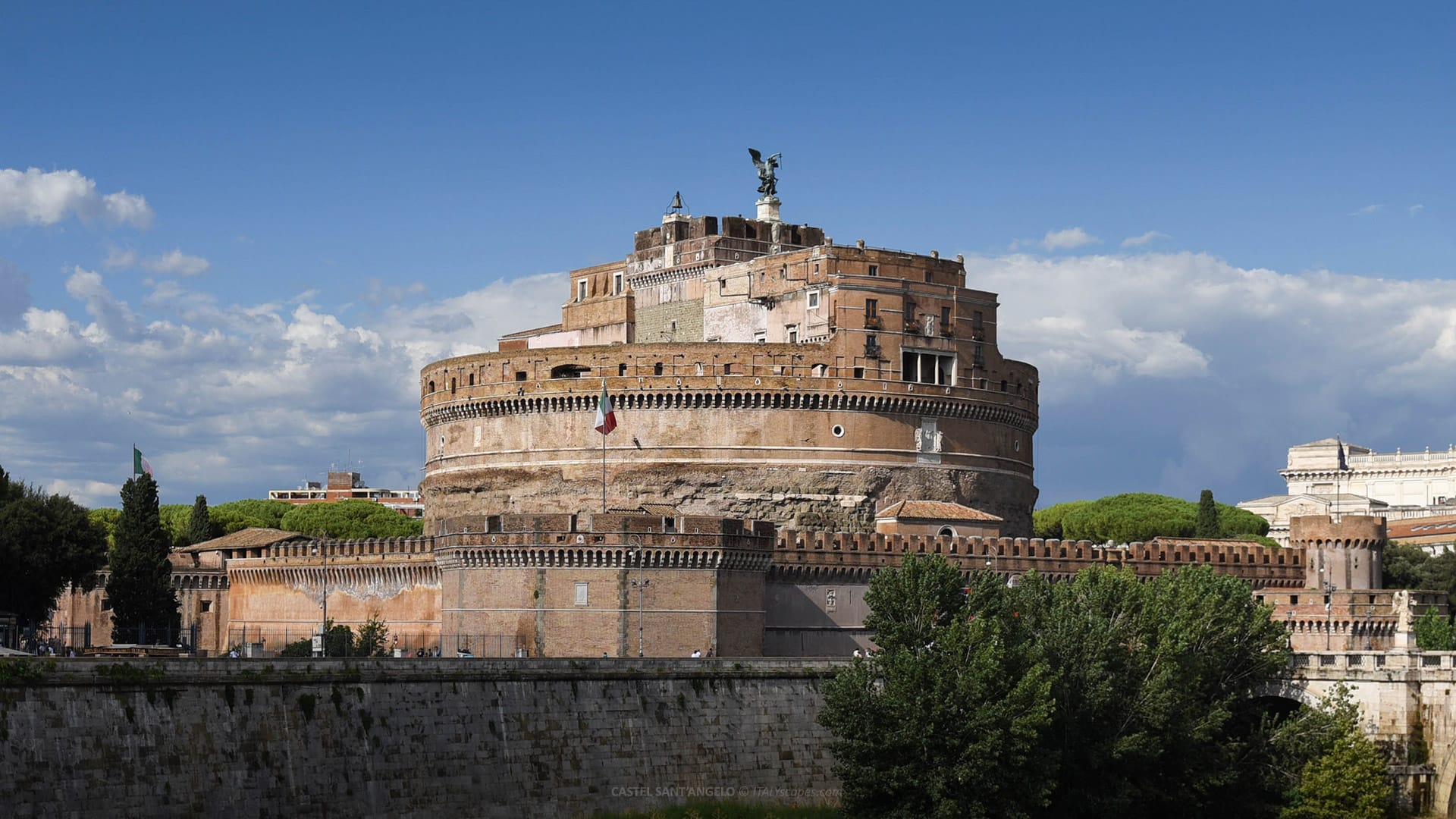
Architecture of Castel Sant’Angelo
The Original Roman Mausoleum
The architecture of Castel Sant’Angelo is based on the ancient Mausoleum of Hadrian. The original Roman structure had a square base measuring about 84 meters on each side. Above it rose a large cylindrical drum with a diameter of about 64 meters.
The cylindrical body was approximately 20 to 21 meters high, while the total height of the monument, including the present angel statue, reaches about 48 meters.
The Roman mausoleum was built with strong materials, including concrete, peperino stone, travertine and marble facing. Much of the original marble decoration disappeared during the Middle Ages, when the monument was transformed into a fortress.
The upper part of the ancient mausoleum was probably designed as a landscaped mound, planted with trees and decorated with statues. At the summit stood a bronze quadriga with Hadrian, an image that emphasized imperial glory and the dynastic purpose of the monument.
The Burial Chamber and Internal Ramp
Inside Castel Sant’Angelo, one of the most important ancient features is the long internal ramp. This passage was part of the original Roman design and led toward the burial chamber. It created a ceremonial route into the heart of the mausoleum.
The burial chamber was the symbolic center of the mausoleum. It contained the urns of Hadrian and other emperors, although the original funerary objects and imperial urns have been lost.
Medieval and Renaissance Fortifications
When the mausoleum became a fortress, its architecture changed dramatically. Defensive walls, battlements, towers, guard spaces and military routes were added over the ancient structure. The circular Roman drum became a strong defensive platform because of its height and thick masonry.
During the Renaissance, the castle was adapted to new forms of warfare. The addition of bastions made the fortress more suitable for artillery defense. The angular bastions contrast with the round Roman drum and create the distinctive outline visible from the river today.
The great pentagonal defensive wall added under papal authority further strengthened the monument. This system shows how Castel Sant’Angelo was continuously updated, even though its original core belonged to the 2nd century AD.
The Papal Apartments
The papal apartments are among the most refined parts of Castel Sant’Angelo. They were created inside a fortress, but they were decorated as spaces of prestige and authority.
The most important rooms were developed especially during the Renaissance. Pope Paul III transformed several interiors into elegant apartments with frescoes and ceremonial decoration.
The Sala Paolina is one of the most significant rooms in the castle. Its decoration includes Renaissance frescoes linked with the image and authority of Pope Paul III. The room served as a ceremonial environment inside a building otherwise dominated by military functions.
The Sala del Tesoro, or Treasury Room, had a practical and symbolic role. It was used to protect valuable objects, documents and money. The Vatican Archives and Treasury were kept in Castel Sant’Angelo because the fortress was considered one of the safest places in Rome.
The Angel Statues and Upper Terrace
The upper terrace is one of the most famous parts of Castel Sant’Angelo. From here, visitors can see the River Tiber, Ponte Sant’Angelo, Saint Peter’s Basilica, the Vatican area and the historic center of Rome. The view is one of the best in the city.
The bronze statue of the Archangel Michael stands at the top of the monument. It was created by Peter Anton von Verschaffelt in the 18th century and represents the angel sheathing his sword, in memory of the legendary vision of Pope Gregory the Great.
Inside the castle, visitors can also see the earlier marble statue by Raffaello da Montelupo. This Renaissance sculpture once stood on the summit of the monument before being replaced.
How to Get to Castel Sant’Angelo
Getting to Castel Sant’Angelo on foot
Castel Sant’Angelo is located at Lungotevere Castello, 50, in central Rome. Its position makes it easy to include in an itinerary with Vatican City, Saint Peter’s Basilica, Piazza Navona, Campo de’ Fiori and the streets of the historic center.
Walking is one of the best ways to reach Castel Sant’Angelo. From Saint Peter’s Square, the distance is about 700 to 800 meters, depending on the exact route. The walk usually takes around 10 to 12 minutes.
From Piazza Navona, Castel Sant’Angelo is about 700 meters away. The walk takes approximately 10 minutes through the historic center and toward the River Tiber.
From Campo de’ Fiori, the distance is about 1 kilometer, and the walk usually takes around 15 minutes. From the Trevi Fountain, Castel Sant’Angelo is about 1.8 kilometers away, with a walking time of approximately 25 minutes.
Getting to Castel Sant’Angelo by metro
The closest metro station to Castel Sant’Angelo is Lepanto, on Metro Line A. It is located about 1.2 kilometers from the monument. From the station, the walk to the castle usually takes around 15 minutes through the Prati district.
Another useful station is Ottaviano, also on Metro Line A. Ottaviano is convenient for visitors who want to combine Castel Sant’Angelo with the Vatican Museums and Saint Peter’s Basilica. The distance from Ottaviano to the castle is approximately 1.3 kilometers.
Getting to Castel Sant’Angelo by bus
The closest bus stop is Castel Sant’Angelo, located near Piazza Pia and the entrance area of the monument. The stop is about 200 meters from the castle, making the bus one of the most convenient public transport options.
Several bus lines serve the area around Castel Sant’Angelo, including routes such as 23, 40, 62, 64, 280, 290 and 982. Bus line 40 is especially useful because it connects Termini Station with the Vatican area and stops close to Castel Sant’Angelo.
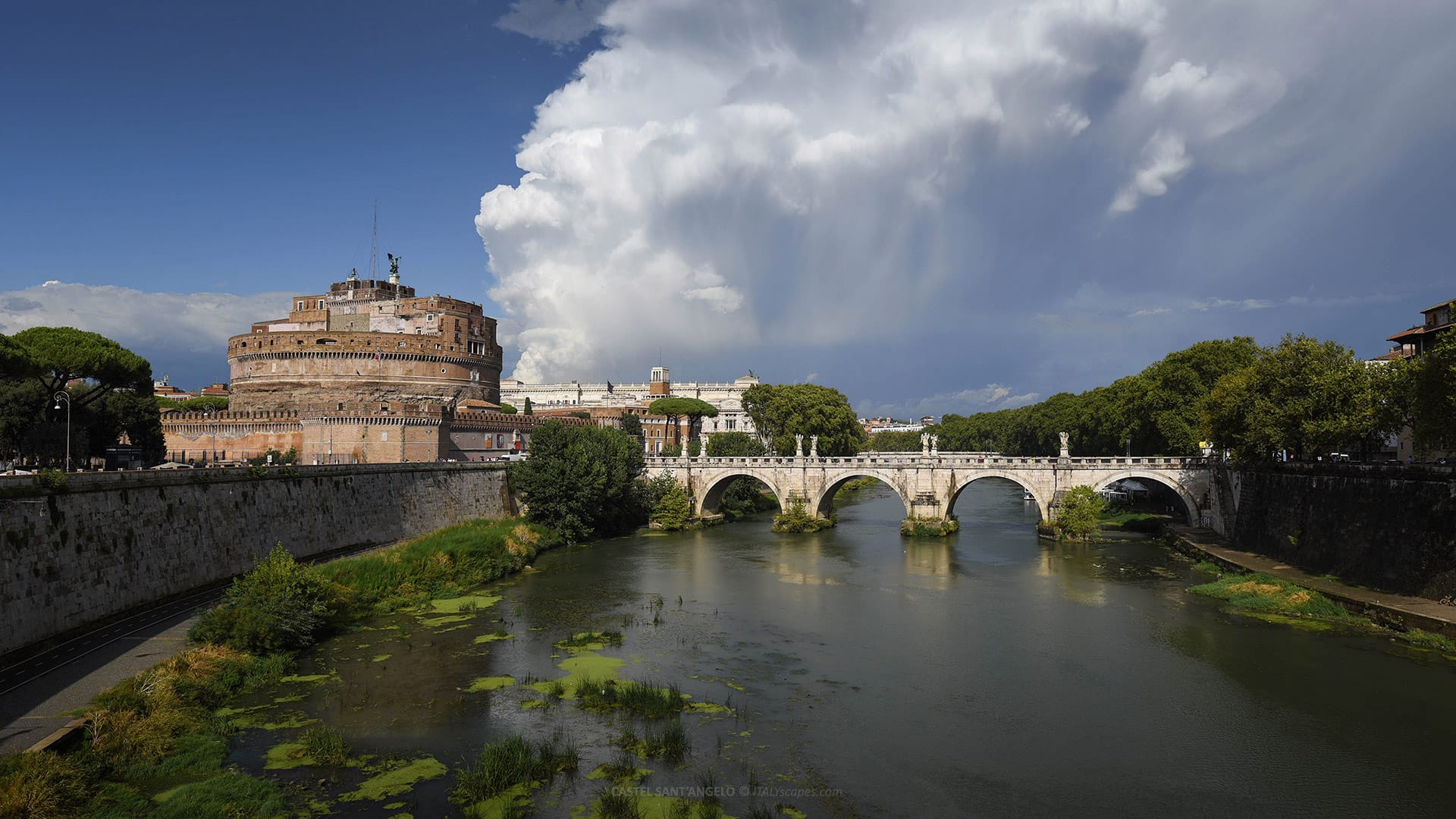
Castel Sant’Angelo and Ponte Sant’Angelo
Frequently Asked Questions about Castel Sant’Angelo
Where is Castel Sant’Angelo located?
Castel Sant’Angelo is located on the right bank of the River Tiber, near Vatican City. It stands beside Ponte Sant’Angelo, one of Rome’s most scenic bridges.
Who built Castel Sant’Angelo?
Castel Sant’Angelo was commissioned by Emperor Hadrian in 135 AD as a mausoleum for himself and his family. The works were completed under Antoninus Pius in 139 AD.
Why is it called Castel Sant’Angelo?
The name comes from a legend involving Archangel Michael. In 590, Pope Gregory the Great reportedly saw the angel above the monument, signaling the end of a plague.
Is Castel Sant’Angelo worth visiting?
Yes, Castel Sant’Angelo is worth visiting for its long history, unusual architecture, papal rooms, prison areas and excellent views over Rome, the Tiber and Vatican City.
How much does it cost to visit Castel Sant’Angelo?
A standard ticket to Castel Sant’Angelo costs €16. Reduced tickets for eligible EU citizens aged 18-25 cost €2, while some visitors qualify for free admission.
How do you get to Castel Sant’Angelo?
You can reach Castel Sant’Angelo on foot from Vatican City, Piazza Navona or the historic center. The closest metro stations are Lepanto and Ottaviano, both on Line A.
Sources:Buy tickets & tours:GetYourGuide -
Photos
-
Map
-
Reviews


