


-
About
Table of Contents
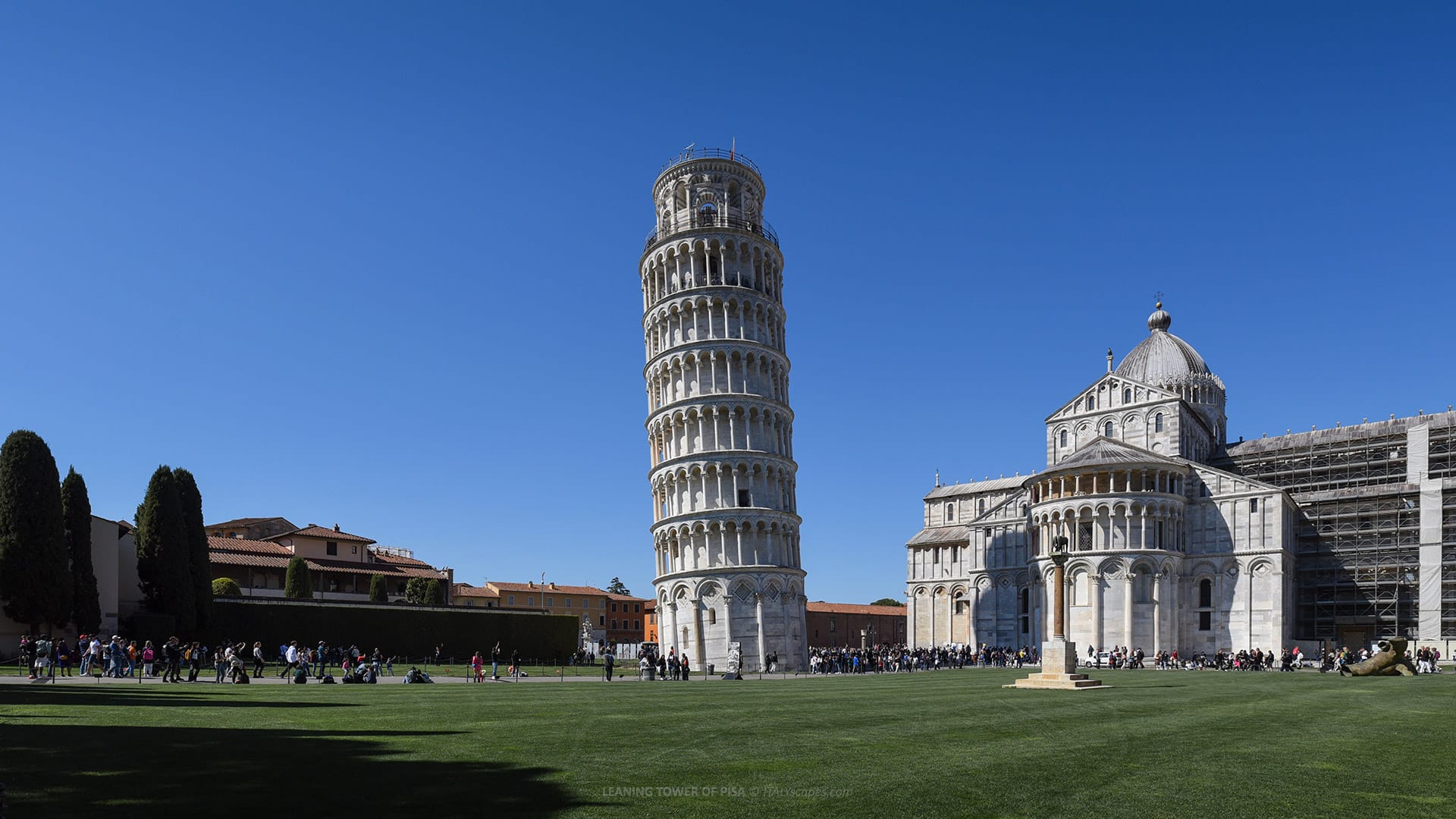
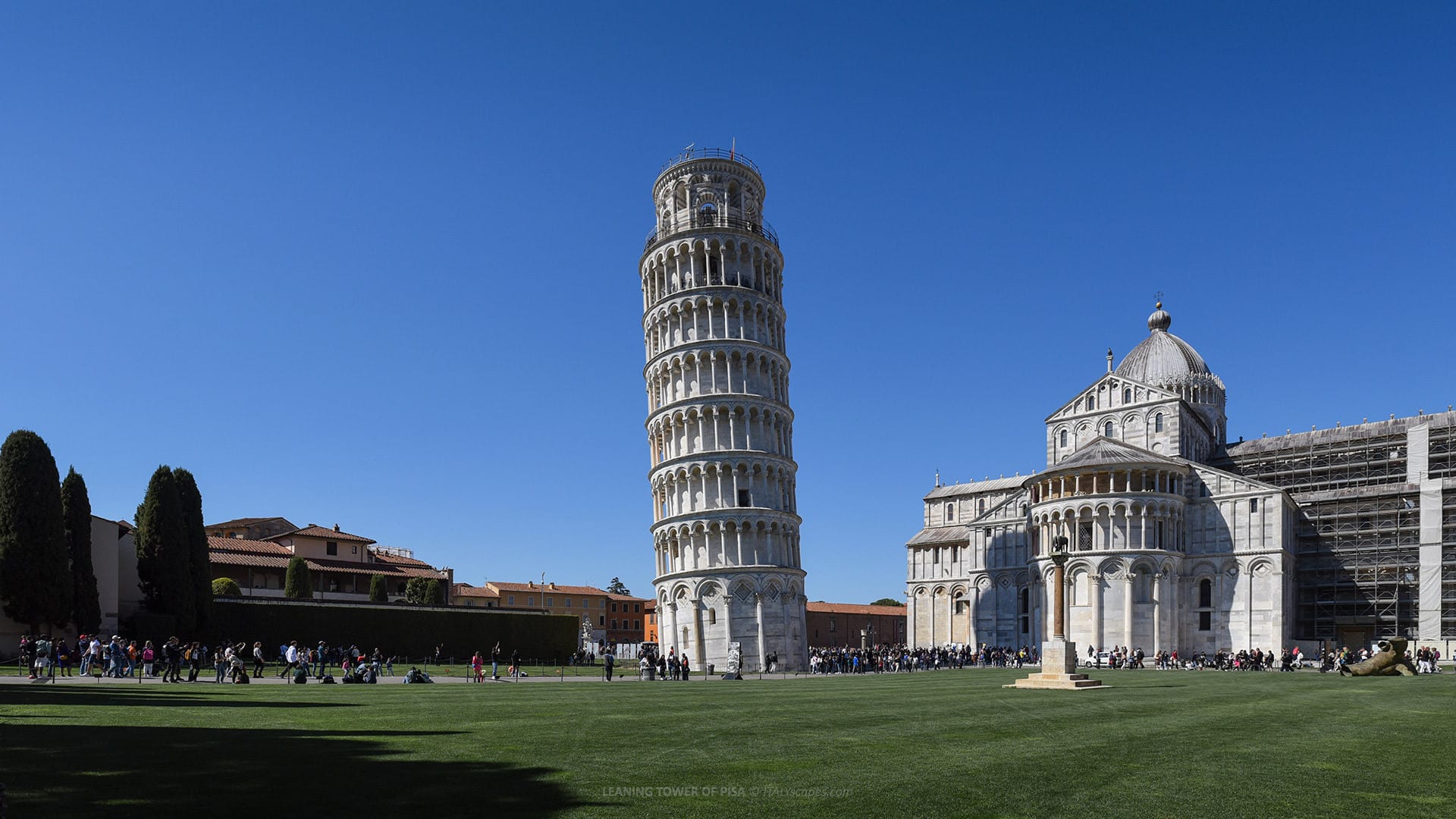
Buy tickets & tours:GetYourGuideThe Leaning Tower of Pisa is the freestanding bell tower of the Cathedral of Santa Maria Assunta in Pisa. It stands in Piazza del Duomo, the monumental religious square also known as Piazza dei Miracoli. The tower is famous worldwide for its unintended tilt, caused by unstable ground beneath its foundation.
Although it is usually treated as an independent monument, the Leaning Tower of Pisa was built as part of the cathedral complex. Its function was religious and practical, not defensive. The seven bells at the top marked liturgical moments, public time, and ceremonies connected with the life of the cathedral and the city.
Piazza del Duomo has been a UNESCO World Heritage Site since 1987. The square includes the cathedral, the Baptistery of San Giovanni, the Camposanto, the Opera del Duomo Museum, the Sinopie Museum, and the Leaning Tower of Pisa. Together, these monuments form one of the most important medieval architectural ensembles in Italy.
Today, the Leaning Tower is not only a symbol of Pisa, but also a major example of medieval engineering, structural risk, and modern conservation. Its survival is the result of long construction pauses, later corrections, and major stabilization works carried out between the late 20th and early 21st centuries.
TIP: Tickets for the Leaning Tower of Pisa are timed and limited in number. Visitors must choose a specific time slot when purchasing the ticket. Arriving late means losing the visit without a refund, so it is best to book in advance and reach the entrance early.
Short History of the Leaning Tower of Pisa
The Beginning of Construction
Construction began on August 9, 1173, when the foundations were laid. The work belonged to the wider building campaign of Pisa’s cathedral complex, already one of the most ambitious religious projects in medieval Tuscany. The tower was intended to serve as the cathedral’s campanile.
The identity of the first architect is still debated. Traditional accounts connect the project with Bonanno Pisano, while other studies have suggested Diotisalvi, the architect linked to important Pisan works such as the Baptistery. Because the evidence is not definitive, the authorship should be treated with caution.
The first building phase advanced through the lower levels, but the problem appeared early. The tower began to sink unevenly because the foundation rested on weak soil. This was not a planned inclination, but a structural defect that became visible while the building was still incomplete.
The first phase stopped around the middle of the third level. This interruption proved crucial. The long pause allowed part of the soil to settle and probably helped prevent the unfinished tower from collapsing during the earliest and most dangerous stage of its construction.
The Long Pause and the Return to Work
Work resumed in the second half of the 13th century, traditionally around 1275, under the guidance of Giovanni di Simone and Giovanni Pisano. By then, the builders had to continue a structure that was already visibly inclined, making the next stages technically difficult.
To compensate for the tilt, the upper floors were built with subtle corrections. The new levels curve slightly in the opposite direction of the lean. For this reason, the tower is not only inclined; it is also slightly curved, a detail that can be noticed from certain angles.
The construction progressed in stages, interrupted by Pisa’s political and military conflicts. The city was often involved in wars with rival powers such as Genoa, Lucca, and Florence. These interruptions delayed the tower, but they also gave the ground more time to consolidate.
The bell chamber was added in the 14th century, completing the structure after almost two centuries of work. The tower therefore represents several phases of medieval construction rather than a single uninterrupted project. Its final appearance combines Romanesque continuity with late medieval adjustments.
The Lean and the 19th-Century Restorations
Over the centuries, the tower’s inclination changed. At times, the lean increased; during other periods, the structure remained relatively stable. The problem was always connected to the same cause: the soil below the foundations, made unstable by clay, sand, and underground water.
In the 19th century, restoration works were carried out under the direction of Alessandro Gherardesca. These works included interventions around the base of the tower. Investigations confirmed that underground water contributed to the weakness of the soil and to the structural instability.
Some 19th-century interventions unintentionally worsened the situation. Attempts to remove water from the ground increased subsidence, allowing the tower to lean further. These works also helped disprove the old theory that the bell tower had been intentionally designed to lean from the beginning.
The 20th-Century Risk of Collapse
During the 20th century, monitoring became more systematic. The tower’s movement was measured repeatedly, and the increase in inclination became a serious concern. By the late 20th century, experts considered the danger of collapse real enough to require an international conservation campaign.
In 1990, the Leaning Tower of Pisa was closed to visitors. The closure marked the beginning of a long stabilization project designed to reduce the risk while preserving the monument’s famous appearance. The goal was not to make the tower vertical, but to make it safe.
An international committee was created for the protection of the tower. Among the leading experts involved were Michele Jamiolkowski, Carlo Viggiani, and John Burland. The project combined geotechnical engineering, structural monitoring, and conservation methods adapted to a medieval monument.
Before stabilization, the Leaning Tower of Pisa had reached an inclination of about 5.5 degrees. Its top was displaced by several meters from the vertical axis. This did not mean immediate collapse, but it placed dangerous stress on the masonry and foundations.
Stabilization and Reopening
The stabilization works took place between 1990 and 2001. Early measures included structural reinforcement, safety cables, and large lead counterweights placed on the north side. These counterweights helped stop the progressive movement toward the south before deeper interventions began.
The decisive method was under-excavation. Engineers carefully removed small quantities of soil from beneath the higher side of the foundation. This allowed the tower to settle slightly in the opposite direction, reducing the tilt without forcing the structure upright.
The project reduced the inclination to a safer level, close to the lean the tower had centuries earlier. After the works, experts considered the monument stable for at least several more centuries, provided that monitoring and maintenance continue.
The Leaning Tower of Pisa reopened to visitors on December 15, 2001. The reopening was a major event for Pisa, because the tower is central to the city’s identity and tourism.
Further restoration continued after the stabilization campaign. From 2004 onward, works focused on stone surfaces, external masonry, and internal spaces. These stone restorations ended in 2011, improving both the conservation condition and the visitor experience inside the tower.
Architecture of the Leaning Tower of Pisa
General Structure and Measurements
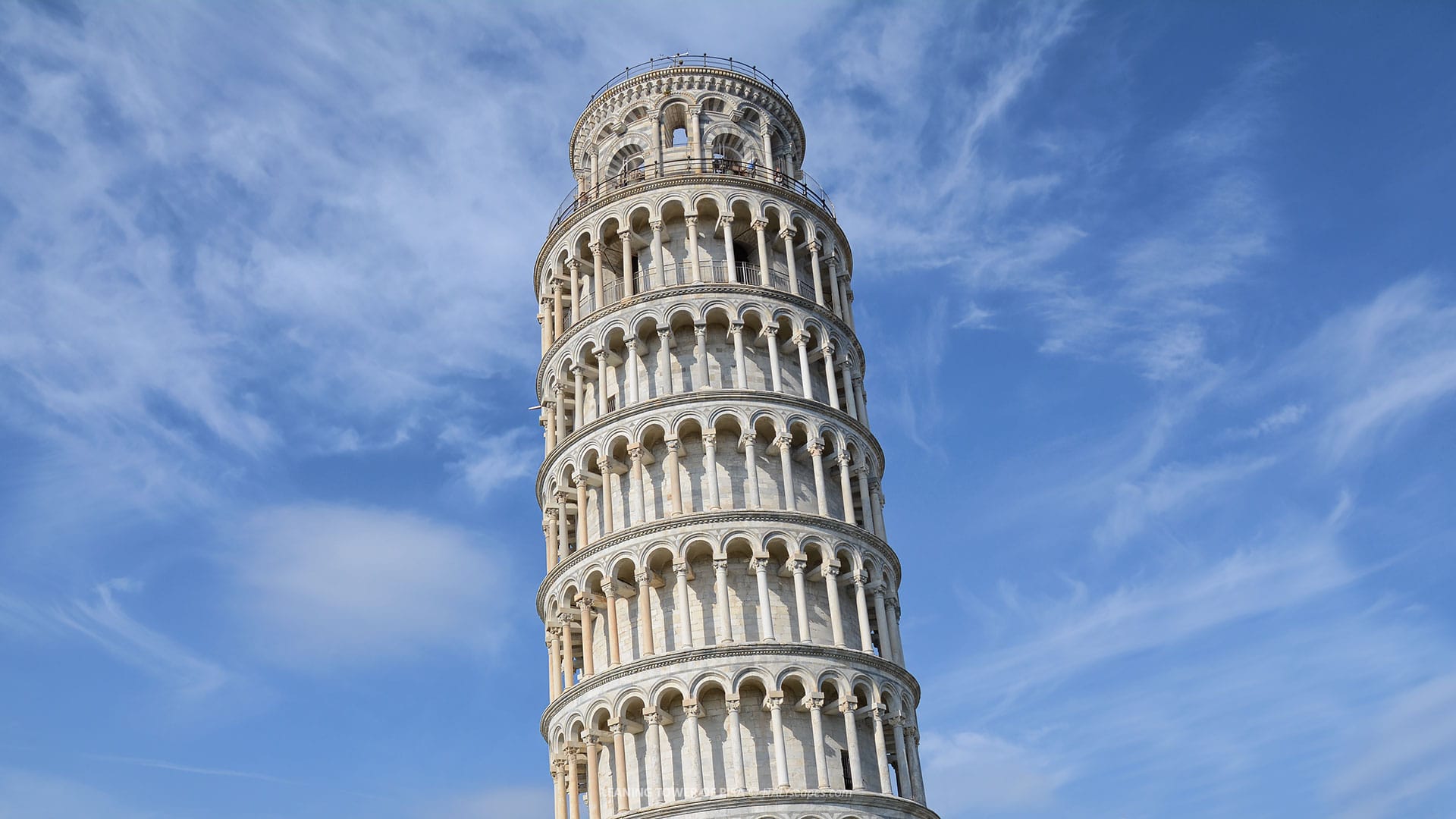
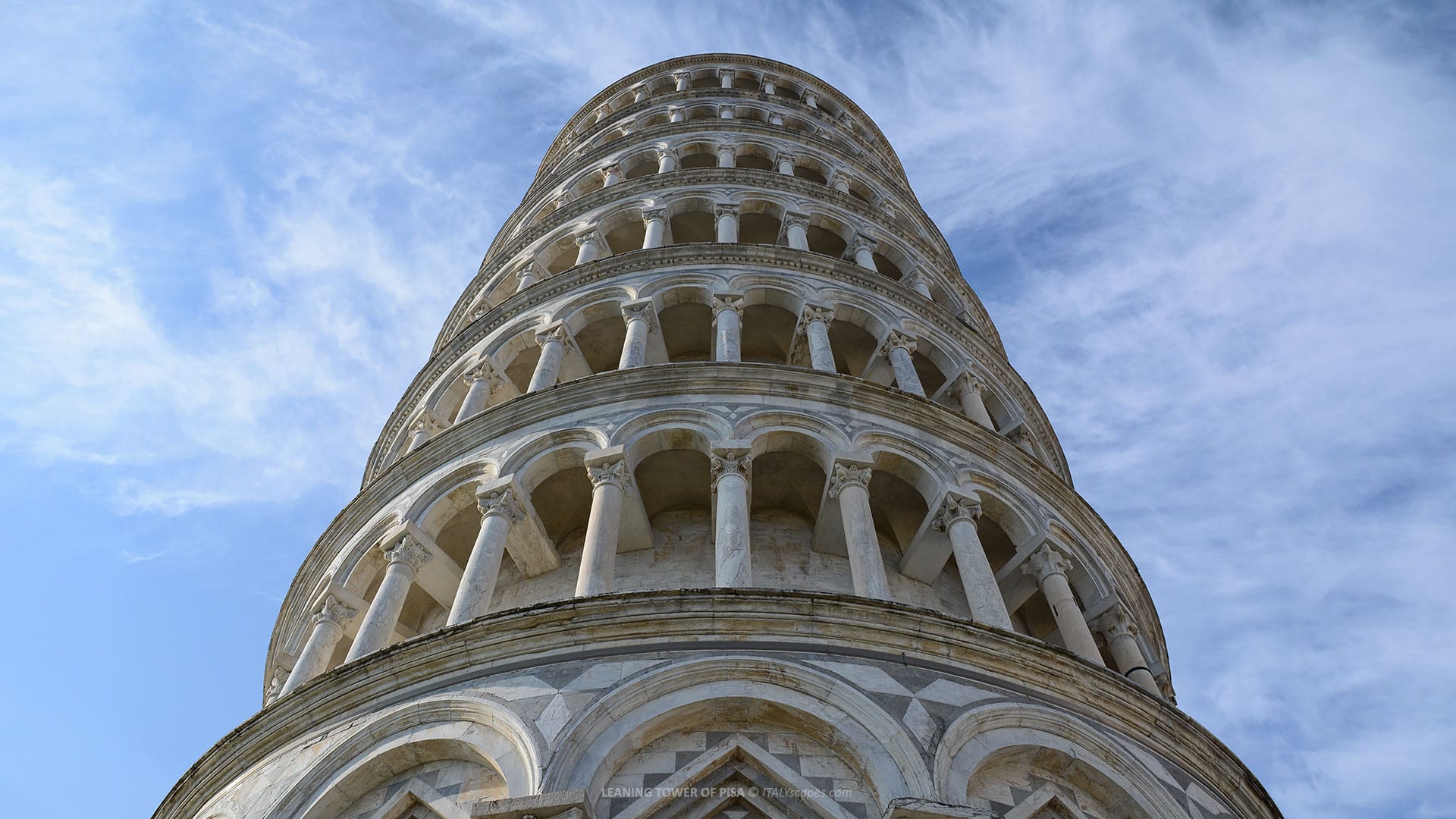
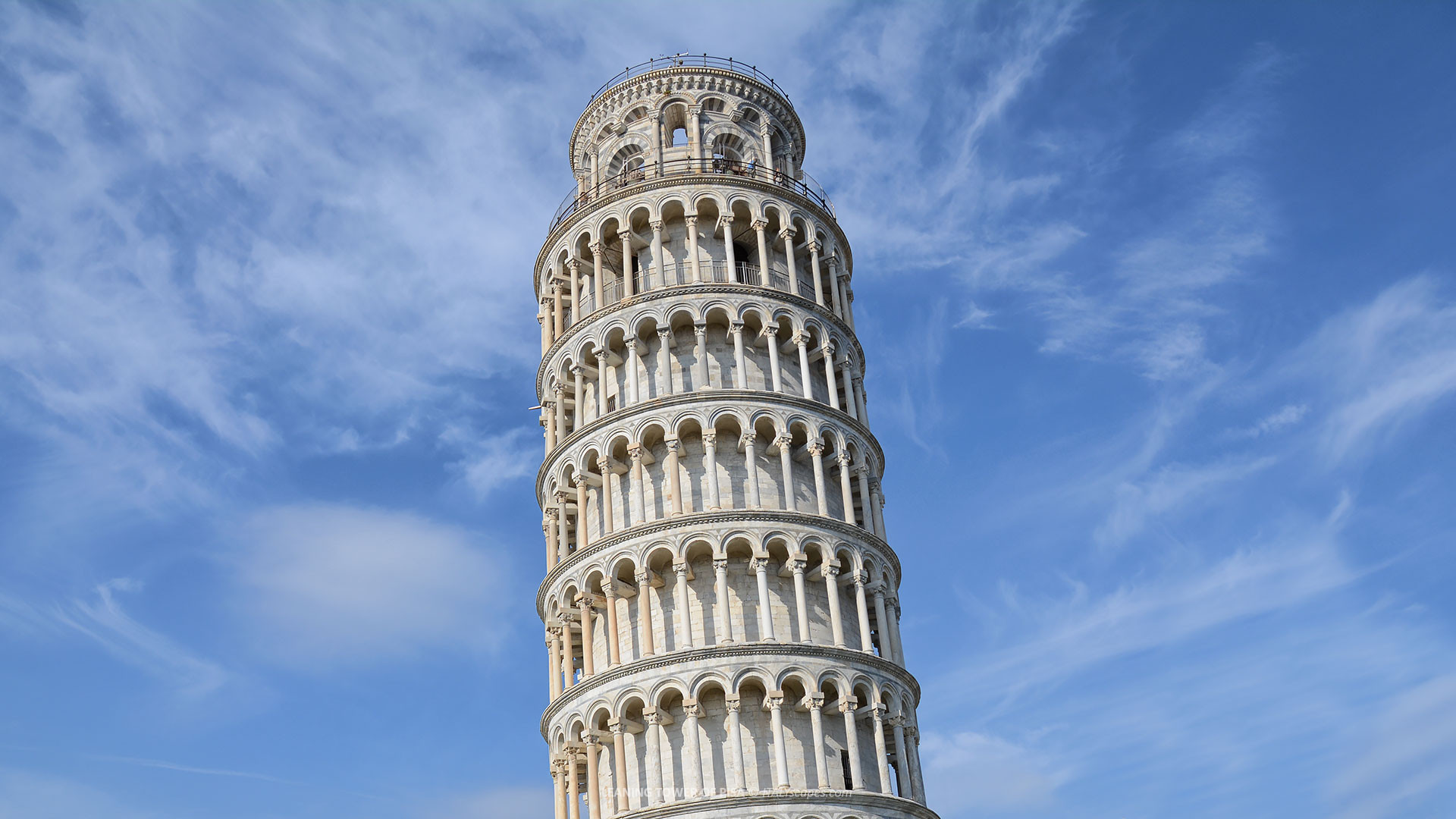
The Leaning Tower of Pisa is a cylindrical freestanding bell tower in Pisan Romanesque style. It is built mainly of light-colored stone and marble, with circular arcades repeated across several levels. Its curved profile, open galleries, and rhythmic columns give the structure its distinctive visual identity.
The Leaning Tower of Pisa is about 58.36 meters high when measured from the foundation level. From the ground, its height varies because of the lean: about 55.86 meters on the lower side and about 56.70 meters on the higher side.
Its estimated mass is around 14,453 tonnes. The external diameter at the base is about 15.484 meters, while the internal diameter at the base is about 7.368 meters. The foundation diameter is wider, measuring about 19.58 meters.
The circumference at the base is about 48.67 meters. The tower contains 29,424 stone blocks, around 7,735 square meters of stone surface, and more than 200 capitals. These figures show the scale of the monument beyond its famous visual tilt.
Exterior Design
The lower level has blind arcades, while the upper levels are surrounded by open loggias. These repeated arcades create the impression of lightness, even though the tower is extremely heavy. The contrast between structural mass and visual elegance is one of its most important architectural qualities.
The Leaning Tower of Pisa has six levels of open galleries above the lower arcade, followed by the bell chamber. The columns and arches repeat around the circular body, creating a strong rhythm. This design connects the tower visually with the cathedral and baptistery nearby.
The tower’s decoration belongs to the Romanesque language of medieval Pisa. Its marble surfaces, round arches, small columns, carved capitals, and blind arcades are closely related to the broader architecture of Piazza del Duomo. The result is harmonious, even though the tower itself is structurally irregular.
The lean affects the way visitors perceive the architecture. From some sides, the tower seems to curve as well as tilt. This is the result of medieval attempts to correct the inclination while continuing construction, especially in the upper levels added after the first long pause.
Interior Rooms and Staircases
Inside, the structure includes two main rooms. The first is located at the base and is known as the Sala del Pesce, or Fish Hall, because of a bas-relief depicting a fish. This space is open upward, forming part of the hollow interior.
The second main space is the bell chamber at the top. It is open to the sky and enclosed by the upper walkway walls. From this level, visitors can look across Piazza del Duomo, the cathedral roof, the Baptistery, the Camposanto, and the city of Pisa.
The internal route includes spiral staircases. Official visitor information states that the climb involves 251 steps and takes about 30 minutes. Other technical counts may include different parts of the tower, which explains why step numbers can vary in descriptions.
The floor inside the tower is uneven and can be slippery. The climb is not recommended for people with cardiovascular or motor disorders. The narrow stairs and the sensation of leaning make the ascent unusual compared with other medieval towers.
The Lean as a Structural Feature
The tower’s inclination is the result of ground failure, not architectural intention. The foundation was too shallow for the unstable subsoil, and the ground settled unevenly beneath the structure. The same fragile soil also affects other buildings in Pisa, though usually less dramatically.
After stabilization, the tower’s lean is commonly described as close to four degrees from the vertical axis. This reduced inclination preserves the monument’s identity while keeping the structure safer. The aim of modern conservation was stability, not complete straightening.
The Leaning Tower of Pisa is sometimes called a “miracle of statics” because it remained standing despite the weakness of its foundation. Its survival was made possible by slow construction, soil consolidation, later corrections, and modern geotechnical intervention.
Pisa also has other leaning bell towers, including the campanile of San Nicola and the bell tower of San Michele degli Scalzi. These examples confirm that the soil of the city is a key factor in the structural history of local architecture.
The Bells of the Leaning Tower of Pisa
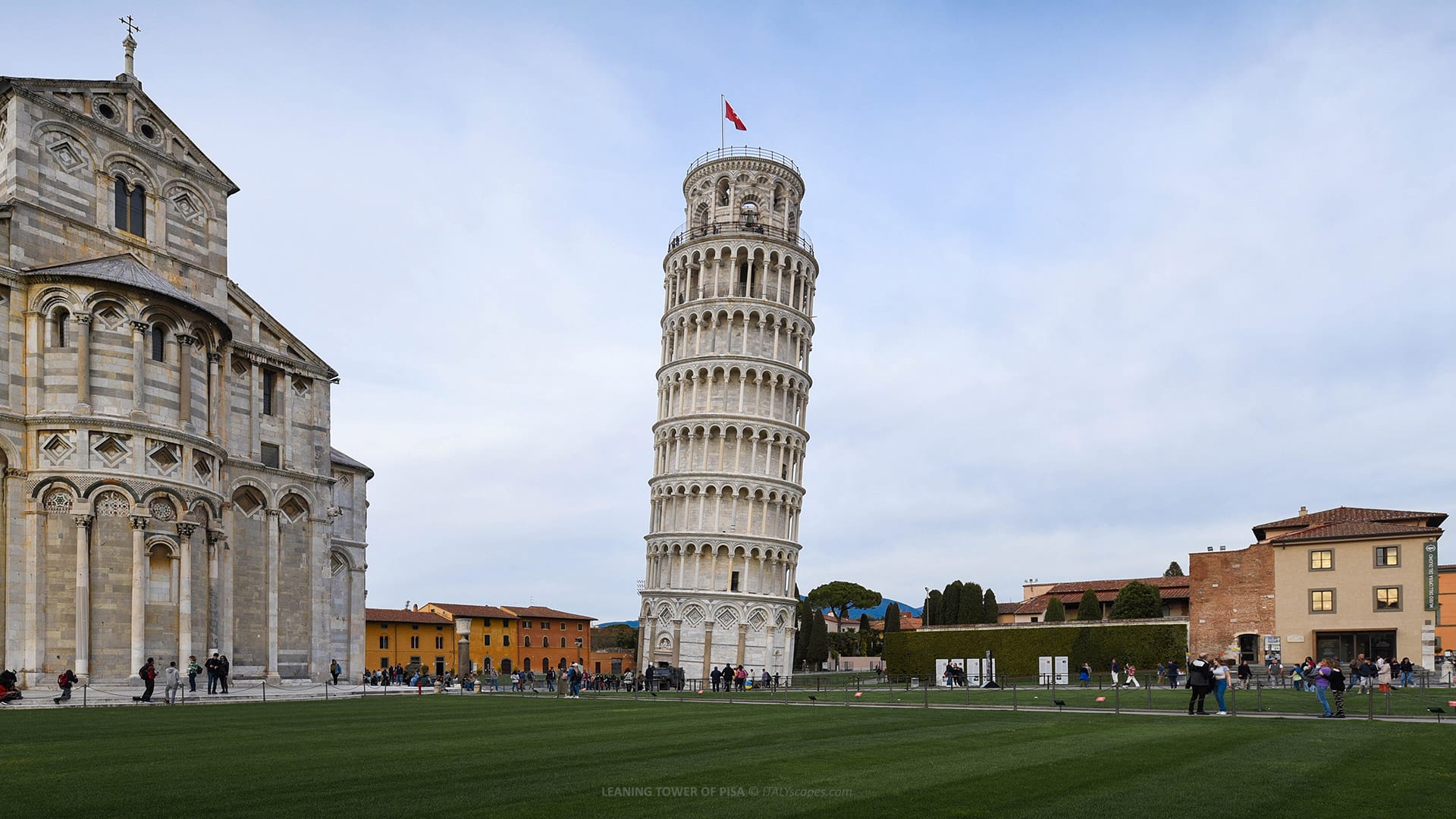
The Leaning Tower of Pisa contains seven bells, traditionally connected with musical notes and liturgical functions. They were not decorative objects alone. They marked religious services, hours of prayer, civic moments, and special events in the life of the cathedral and the city.
The largest bell is Assunta, weighing about 2,600 kilograms. It was cast in 1654 by Giovanni Pietro Orlandi. Because of its size and position, it is the most important bell in the tower’s sound system and one of the main features of the bell chamber.
The bell called Crocifisso weighs about 1,850 kilograms. It was originally cast in 1572 by Vincenzo Possenti and later recast in 1818 by Santi Gualandi. The bell of San Ranieri weighs about 1,150 kilograms and was cast in 1735 by Pier Francesco Berti.
The bell called Dal Pozzo was cast in 1606. It was damaged during World War II and later replaced by a copy made in 2004 by the Marinelli foundry of Agnone. The original damaged bell was preserved rather than simply discarded.
The oldest bell is Pasquereccia, cast in 1262 and weighing about 1,014 kilograms. Its name is linked with Easter. In the past, this bell rang for Easter celebrations, making it one of the most historically important bells in the tower.
The bell called Di Terza was cast in 1473 and weighs about 330 kilograms. Its name refers to the third hour of the day, around 9:00 am. The smallest bell, Vespruccio, weighs about 120 kilograms and is connected with vespers, around 6:00 pm.
The bell of San Ranieri was once known as Giustizia, or Justice. It was associated with the deaths of traitors and with the civic memory of punishment. Tradition connects it with the tragic story of Count Ugolino della Gherardesca, one of Pisa’s most famous medieval episodes.
Today, the bells ring before Masses in the cathedral and at noon through an electromechanical system. On the feast of San Ranieri, Pisa’s patron saint, bell ringers may perform traditional manual ringing, preserving a historic practice linked with the religious life of the city.
How to Get to the Leaning Tower of Pisa
Getting to the Leaning Tower on foot
The Leaning Tower of Pisa is located in Piazza del Duomo, northwest of Pisa’s historic center. From Pisa Centrale railway station, the distance is about 1.8 kilometers. The walk usually takes around 25 minutes, depending on pace, crowds, and the chosen route through the city.
Walking from Pisa Centrale is a good option for visitors who want to see more of the city. The route crosses central streets and leads gradually toward the monumental square. Comfortable shoes are useful, especially if the visit also includes climbing the tower.
The closer station is Pisa San Rossore, which is much nearer to Piazza del Duomo. However, many regional and long-distance trains arrive at Pisa Centrale, so most visitors still use the central station as their starting point.
Getting to the Leaning Tower by bus
From Pisa Centrale, visitors can use local buses toward Piazza del Duomo. Official visitor information lists Line 1+ from the Stazione 1 stop toward Park Pietrasantina, with service to the Torre 1 stop. This is one of the most direct public transport options.
Another option is Line 4 from the Stazione 8 stop to Del Parlascio. At night, Line 21 connects the Stazione 5 stop with Torre 1. Services and schedules can change, so checking the current timetable before traveling is recommended.
From the Sesta Porta bus station in Via Battisti, lines 60, 70, 80, 120, and 130 serve the Torre 1 stop. From Pisa Airport, the official route is to take the PisaMover to Pisa Centrale and then continue by bus or on foot.
Getting to the Leaning Tower by taxi
A taxi is the simplest option for visitors with limited time, luggage, or mobility concerns. From Pisa Centrale, the journey to Piazza del Duomo is short, although traffic and pedestrian restrictions near the square can affect the final drop-off point.
From Pisa Airport, a taxi can take visitors directly toward the monumental area. The alternative is the PisaMover to Pisa Centrale, followed by a bus, taxi, or walk. For a quick visit, especially between train or flight connections, a taxi may save valuable time.
Frequently Asked Questions about the Leaning Tower of Pisa
What is the Leaning Tower of Pisa?
The Leaning Tower of Pisa is the freestanding bell tower of Pisa Cathedral. It stands in Piazza del Duomo, also called Piazza dei Miracoli, and is famous for its unintended tilt.
Why does the tower lean?
The tower leans because its foundation was built on soft, unstable ground. Clay, sand, and underground water caused one side to settle more than the other.
When was the Leaning Tower of Pisa built?
Construction began on August 9, 1173, and continued in several phases. The tower was completed in the 14th century, after almost two hundred years of work.
Who built the Leaning Tower of Pisa?
The architect is not known with certainty. Traditional accounts mention Bonanno Pisano, while some studies suggest Diotisalvi. Later construction involved Giovanni di Simone and Giovanni Pisano.
How tall is the Leaning Tower of Pisa?
The Leaning Tower of Pisa measures about 58.36 meters from the foundation level. From the ground, the height varies slightly because one side is lower than the other.
Can visitors climb the Leaning Tower of Pisa?
Yes, visitors can climb the tower with a timed ticket. The visit lasts about 30 minutes, and official visitor information states that the climb includes 251 steps.
Are children allowed inside the Leaning Tower of Pisa?
Children under 8 are not allowed inside for safety reasons. Visitors under 18 must be accompanied by an adult, and identification may be requested to verify age.
Do visitors need to book tickets in advance?
Advance booking is strongly recommended because tower tickets are timed and limited. Online tickets can be purchased subject to availability, and late arrival means no refund.
Is the Leaning Tower of Pisa safe today?
Yes, the Leaning Tower of Pisa was stabilized between 1990 and 2001. Engineers reduced the tilt and reinforced the structure, while preserving the famous inclination that defines the monument.
What else can visitors see nearby?
Visitors can also see Pisa Cathedral, the Baptistery, the Camposanto, the Opera del Duomo Museum, and the Sinopie Museum, all located in Piazza del Duomo.
How much does it cost to visit the Leaning Tower of Pisa?
A standard ticket to climb the Leaning Tower of Pisa currently costs €20. There are no reduced-price tickets for the tower, while admission is free only for disabled visitors with a helper, subject to availability.
Sources:Buy tickets & tours:GetYourGuide -
Photos
-
Video
Table of Contents
-
Map
-
Reviews

1 Review on “Leaning Tower of Pisa”
Leave a Review



The tower, the cathedral and the baptistery all look amazing, but the area is too crowded all the time. The best time to admire the tower is, after all, at night.