


-
About
Table of Contents
Buy tickets & tours:GetYourGuideThe Baptistery of San Giovanni is one of the main religious monuments in Pisa‘s Piazza dei Miracoli, officially known as Piazza del Duomo. It stands in front of the western façade of the Cathedral of Santa Maria Assunta, south of the Camposanto Monumentale, and close to the Leaning Tower of Pisa.
The Baptistery of San Giovanni belongs to the monumental complex that defines medieval Pisa: Cathedral, Baptistery, Bell Tower, and Camposanto. Its position is not accidental. The baptistery was placed opposite the Cathedral because baptism marked the beginning of Christian life, before the faithful entered the cathedral community.
The Baptistery of San Giovanni is also one of the clearest examples of Pisa’s long medieval building history. Its lower structure is Romanesque, while its upper levels show Gothic additions. The monument therefore records more than two centuries of construction, artistic change, technical ambition, and civic identity.
Unlike the Leaning Tower, the Baptistery is often admired quietly rather than theatrically. Yet it is one of the most important monuments in the square. It is the largest baptistery in the world, a major work of medieval architecture, and home to one of the most influential pulpits in Italian sculpture.

Short History of the Baptistery of San Giovanni
The Foundation in 1152
The construction of the Baptistery of San Giovanni began on 15 August 1152. An inscription records the foundation according to the Pisan calendar, where the year appeared as 1153. In the modern calendar, however, that date corresponds to 1152, which is the correct chronological reference for the beginning of the building.
The new monument replaced an older and smaller baptistery. That earlier building stood to the north-east of the Cathedral, in the area where the Camposanto Monumentale was later built. The new baptistery was planned on a much larger scale, worthy of Pisa’s cathedral and maritime power.
The first architect was Diotisalvi, whose authorship is confirmed by an inscription inside the building. The inscription, placed on an internal pillar, identifies him as the master of the work. He designed the basic circular form and directed the first phase of construction until around 1180.
The Medieval Building Site
By 1185, the building was already important enough to host solemn ceremonies, including the investiture of the Operaio del Duomo. This confirms that the Baptistery of San Giovanni was not only an architectural project, but also a civic and religious space used while construction was still developing.
During the mid-13th century, work resumed with new intensity. Inside, Guido Bigarelli da Como created the large baptismal font. Outside, construction continued under Nicola Pisano, assisted by his son Giovanni Pisano, who introduced important changes to Diotisalvi’s original Romanesque structure.
Nicola Pisano was both an architect and a sculptor. His intervention changed the artistic direction of the monument. The second order of the exterior, the sculptural decoration, and especially the pulpit inside the Baptistery turned the building site into a decisive place for Italian medieval art.
The works continued into the 14th century. Later phases involved masters such as Cellino di Nese and other sculptors and builders active on the upper parts of the structure. The small dome and the bronze statue of Saint John the Baptist were added much later, completing the monument’s vertical silhouette.
The 19th-Century Restoration
In the 19th century, the Baptistery of San Giovanni was involved in a wider restoration campaign that affected the monuments of Piazza del Duomo. The architect Alessandro Gherardesca directed a radical restoration, which included the reconstruction of several portals and a large part of the decorative apparatus.
These works remain controversial because they changed the medieval appearance of the monument. Under the direction of master builder Giovanni Storni, many sculptures by Nicola and Giovanni Pisano were removed from their original positions. Several original sculptures were lost, while some surviving pieces are now kept in the Opera del Duomo Museum.
The restoration also aimed to simplify the interior by removing non-medieval furnishings. A larger decorative project, including frescoes in the central space, was planned but never completed. As a result, the Baptistery of San Giovanni kept the austere interior appearance that visitors still see today.
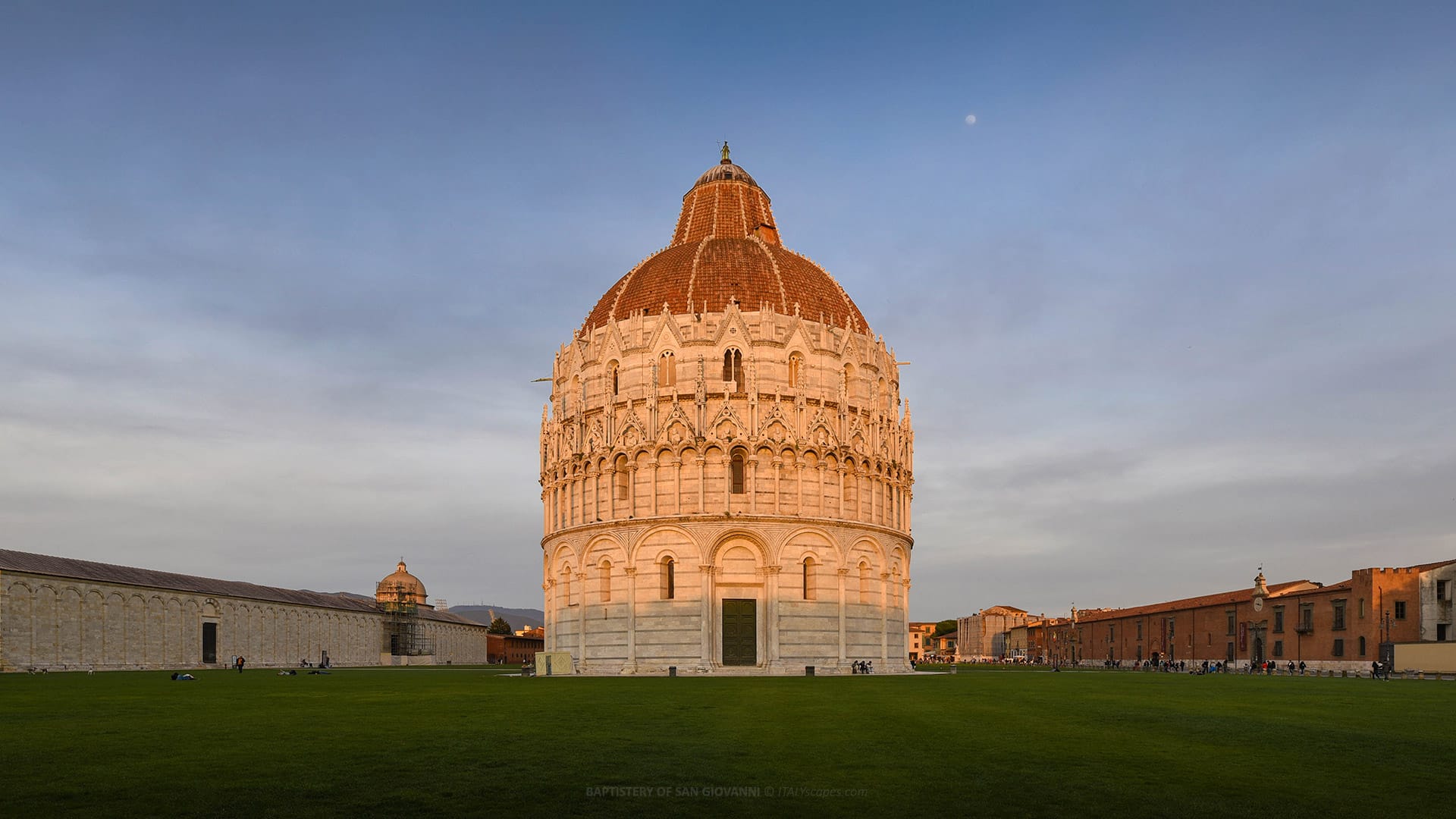
Architecture of the Baptistery of San Giovanni
Position, Shape, and Dimensions
The Baptistery of San Giovanni has a circular plan, a form linked to baptismal symbolism and to important models from Christian architecture. Its design also recalls the Holy Sepulchre in Jerusalem, a reference that appears in other works associated with Diotisalvi, including the Church of the Santo Sepolcro in Pisa.
The monument’s size is exceptional. Its circumference measures 107.24 meters, while the masonry at the base is 2.63 meters thick. Its total height reaches 54.86 meters, making it the largest baptistery in the world and one of the most imposing medieval circular buildings in Italy.
The dome has a diameter of about 30.49 meters. This dimension helps explain both the visual power of the structure and its unusual acoustic behavior.
Like several monuments in Pisa, the Baptistery of San Giovanni is slightly tilted. Its inclination is much less famous than that of the Leaning Tower, but it is real. The tilt is directed eastward, toward the Cathedral, and reflects the complex ground conditions of the area.
Romanesque Lower Level
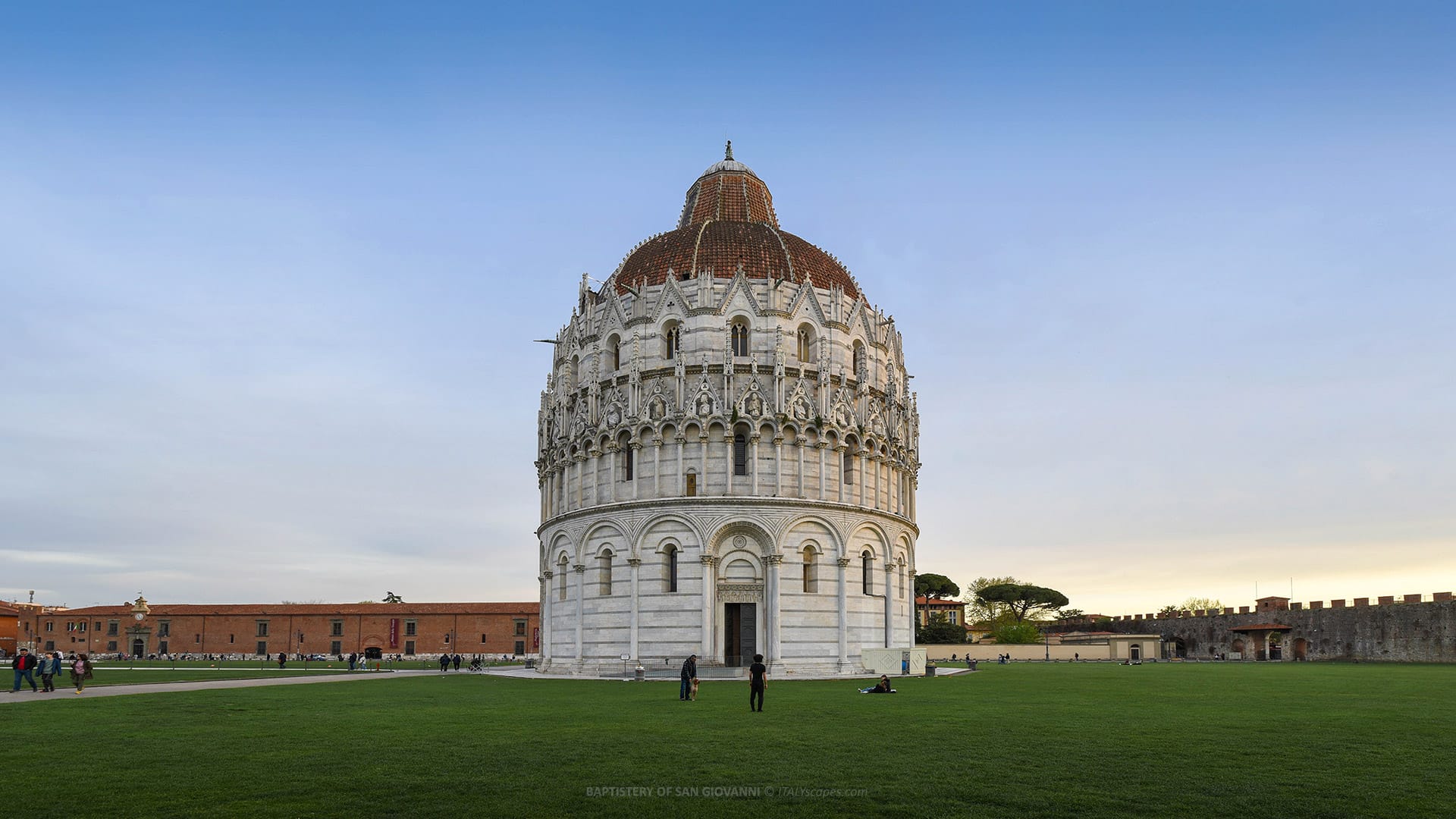
The lower part of the Baptistery of San Giovanni belongs to the Romanesque phase designed by Diotisalvi. It is marked by blind arches, solid masonry, and a strong rhythm of columns and openings. The surface uses the same visual language that connects the monument to the Cathedral.
The exterior is built with alternating bands of light and darker stone, often described as a zebra-like marble effect. This polychrome treatment belongs to the Pisan Romanesque tradition and links the Baptistery visually with the other monuments of the square.
The lower order is sober, massive, and geometrical. It gives the building stability and ceremonial weight. The circular wall is interrupted by portals aligned with the main directions, strengthening the impression that the Baptistery of San Giovanni was conceived as a complete and symbolic architectural body.
Gothic Upper Levels
The upper levels were transformed during later phases, especially under Nicola and Giovanni Pisano. Here, the Romanesque solidity gives way to Gothic verticality, pointed forms, sculptural pinnacles, and a more elaborate decorative system. This contrast is one of the monument’s defining features.
The second order includes an open gallery with columns and arches. Above it, the upper level introduces more complex Gothic decoration. The result is not a stylistic contradiction, but a visible record of construction over time, from the 12th century to the later Middle Ages.
The building therefore shows a rare transition from Pisan Romanesque to Gothic architecture. Instead of hiding the difference, the Baptistery of San Giovanni preserves it clearly.
The Dome and Its Covering
The Baptistery of San Giovanni has a distinctive double-dome structure. The internal dome is a truncated cone, while the external dome is hemispherical. This unusual solution hides one form inside another and gives the monument both its exterior profile and its remarkable sound effects.
The exterior dome is covered differently on different sides. Toward the sea, it has red roof tiles. Toward the east, it is covered with lead plates. This contrast is one of the most recognizable details of the building when seen from above or from elevated viewpoints.
The small dome at the top, with the statue of Saint John the Baptist, was added later. The bronze statue was made by Turino di Sano da Siena in 1395. It gives the monument a final vertical accent and identifies the building’s dedication to Saint John.
Originally, the roof had an opening through which light entered the interior and illuminated the baptismal font. In some older baptisteries, similar openings also related to rainwater collection, but in Pisa the font does not appear to have been designed for that function.
The Interior Space
The interior is surprisingly simple compared with the decorated exterior. The central circular hall is surrounded by an ambulatory, with round arches resting on pillars. Above it runs the women’s gallery, or matroneum, reached by staircases built within the thickness of the outer wall.
Inside, eight monolithic columns alternate with four pilasters, creating a powerful architectural rhythm. These supports compete in height and dignity with those of the Cathedral. Their arrangement gives the central space an ordered, solemn, and almost mathematical clarity.
The upper gallery offers a view down into the circular hall and across the internal geometry of the monument. From there, visitors can better understand the relationship between the baptismal font, the pulpit, the ambulatory, the presbytery, and the enclosing wall.
Art of the Baptistery of San Giovanni
The Baptismal Font
The baptismal font stands at the center of the building, exactly where it belongs symbolically and liturgically. It was made in 1246 by Guido Bigarelli da Como. Its central position emphasizes the sacramental purpose of the entire monument.
The font is octagonal and rests on three steps. Its shape connects it to early Christian symbolism, where the number eight often referred to renewal, rebirth, and the beginning of a new life. This made the octagon a particularly suitable form for baptismal architecture.
The large basin was designed for baptismal rites in a period when immersion remained connected to the symbolism of the sacrament. In Pisa, the font also had smaller basins along the edge, consistent with baptismal practices closer to those still used today.
At the center of the font stands a bronze statue of Saint John the Baptist. This is a modern work by Italo Griselli, dated 1938. It replaced the empty center of the medieval basin with a direct visual reference to the saint to whom the Baptistery is dedicated.
The Presbytery and Floor
Behind the font is the presbytery area, marked by a sculpted enclosure and an inlaid floor. The floor has geometric decoration with strong ornamental precision. Its design has been linked to Arabic-inspired patterns, showing how medieval Pisa absorbed influences from the wider Mediterranean world.
The presbytery confirms that the Baptistery of San Giovanni was not an empty architectural shell. It was conceived as a liturgical building with a functional ritual center, an altar area, a font, and spaces for ceremony. Every major element supports the religious purpose of the monument.
Nicola Pisano’s Pulpit
The pulpit was sculpted by Nicola Pisano between 1255 and 1260 and is signed and dated 1260. It is one of the most important works of 13th-century Italian sculpture and one of the artistic highlights of the entire Piazza dei Miracoli.
The pulpit is hexagonal and rises on columns, some supported by sculpted lions. Its relief panels show episodes from the Life of Christ, including scenes connected to the Nativity, the Presentation, the Crucifixion, and the Last Judgment. Other figures represent Virtues and Prophets.
Nicola Pisano’s work is famous because it introduced a strong classical influence into medieval sculpture. The figures have weight, volume, and dignity inspired by Roman sarcophagi. This makes the pulpit a decisive step toward the renewed naturalism later associated with the Renaissance.
The figure of Fortitude, often compared with ancient heroic models, is one of the clearest examples of this classical revival. Nicola did not simply decorate the Baptistery. He created a sculptural language that changed the direction of Italian art.
External Sculpture and Portals
The exterior decoration also reflects the work of Nicola and Giovanni Pisano. Busts, figures, small statues, and Gothic details were added to the upper parts of the monument. Some original medieval sculptures were later removed during the 19th-century restoration, which explains why several originals are now preserved in the museum.
The current entrance is on the eastern side. In the medieval arrangement, this doorway was connected to the direction of the Cathedral. Its sculptural decoration includes biblical subjects and scenes related to Saint John the Baptist, reinforcing the dedication of the building.
Near the portal, the decoration also includes scenes of the months. These represent seasonal activities, a common medieval theme linking human labor, time, nature, and divine order. In Pisa, September and October are joined in a single grape-harvest scene.
The portal facing the Cathedral includes reused columns and a decorated architrave. The lower level of the architrave shows episodes from the life of the Baptist, while the upper level presents Christ with the Virgin, Saint John, angels, and evangelists.
How to Get to the Baptistery of San Giovanni
Getting to the Baptistery of San Giovanni on foot
The Baptistery of San Giovanni stands in Piazza del Duomo, in the north-western part of Pisa’s historic center. From Pisa Centrale railway station, the walk is about 2 kilometers and usually takes around 20 to 25 minutes, depending on pace and stops along the route.
The simplest walking route from Pisa Centrale follows the historic center toward the Arno, crosses the river, and continues through the streets leading to Piazza dei Miracoli. The approach is easy, but visitors should allow extra time if they plan to stop for photographs or visit nearby streets.
Pisa San Rossore station is closer to Piazza dei Miracoli than Pisa Centrale. It is useful for some regional connections, especially from Lucca or nearby Tuscan towns. From there, the Baptistery of San Giovanni can be reached on foot in a shorter walk.
Getting to the Baptistery of San Giovanni by bus
From Pisa Centrale, official transport information lists several bus options toward the monument area. Line 1+, in the direction of Park Pietrasantina, runs from Stazione 1 to the Torre 1 stop. This is one of the most useful public transport options for visitors.
Line 4 runs from Stazione 8 to the Del Parlascio stop, while night Line 21 runs from Stazione 5 to Torre 1. From the Sesta Porta bus station, on Via Battisti, lines 60, 70, 80, 120, and 130 also serve the Torre 1 stop.
The nearest practical bus stop for the Baptistery of San Giovanni is Torre 1, close to the entrance area of Piazza dei Miracoli. From there, the Baptistery is only a short walk across the square.
Getting to the Baptistery of San Giovanni by taxi
A taxi from Pisa Centrale to Piazza dei Miracoli is the fastest option, especially for visitors with luggage, limited time, or mobility concerns. The drive usually takes only a few minutes, depending on traffic and access conditions around the monument area.
Taxis normally stop near the pedestrian access points to the square rather than directly in front of the Baptistery. Piazza dei Miracoli is a protected monumental area, so the final approach is made on foot. The walking distance from the drop-off point is short.
Visitors arriving at Pisa Airport can use the PisaMover to reach Pisa Centrale, then continue by bus, taxi, or on foot. A direct taxi from the airport is also possible and is often convenient for travelers who want to go straight to the monuments.
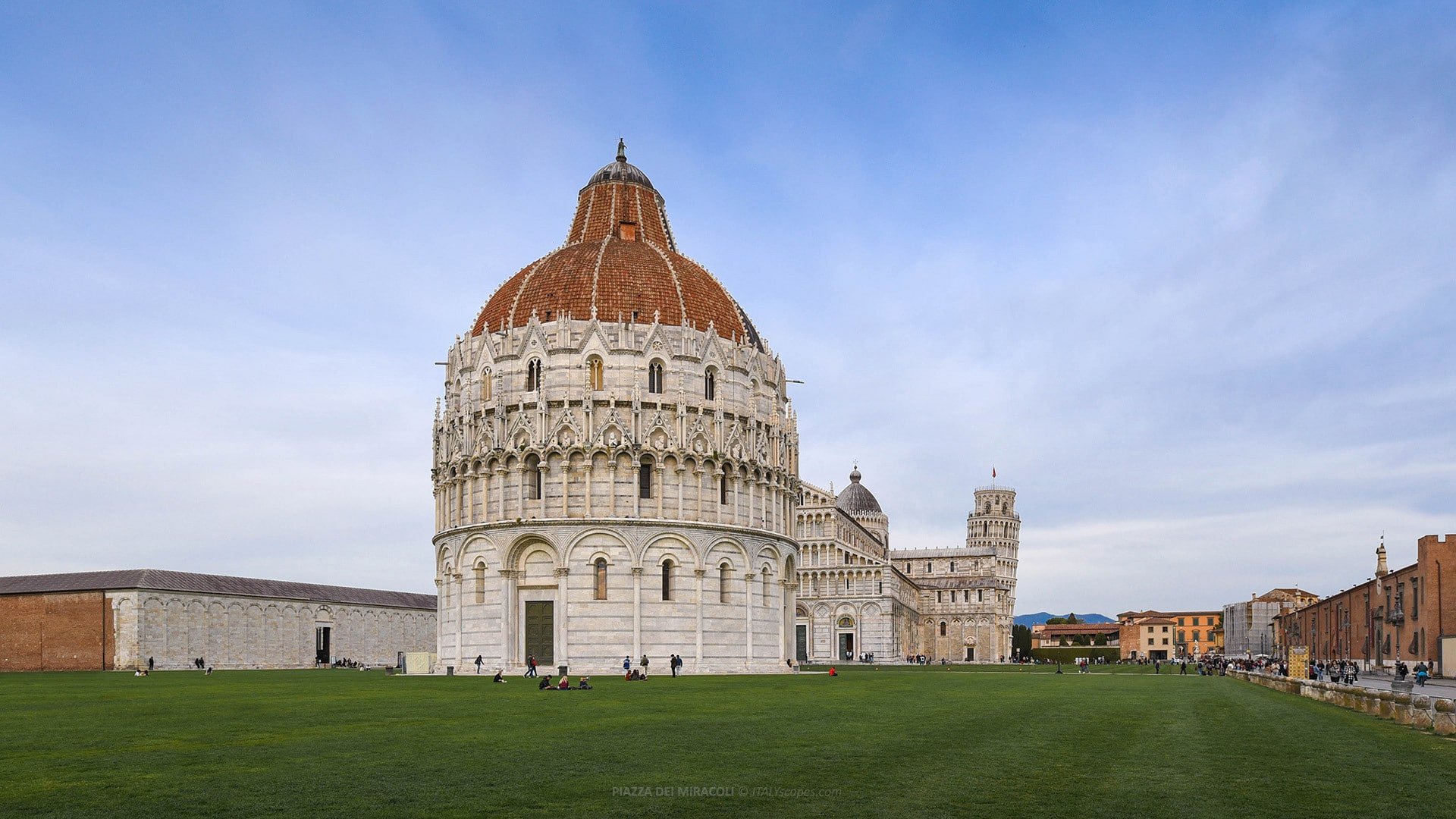
Piazza dei Miracoli, with the Baptistery of San Giovanni in the foreground
Frequently Asked Questions about the Baptistery of San Giovanni
Where is the Baptistery of San Giovanni located?
The Baptistery is located in Piazza dei Miracoli, or Piazza del Duomo, in Pisa. It stands directly in front of Pisa Cathedral, south of the Camposanto Monumentale, and near the Leaning Tower.
Is the Baptistery of San Giovanni the largest baptistery in the world?
Yes. The monument is considered the largest baptistery in the world. It has a circumference of 107.24 meters, walls 2.63 meters thick at the base, and a height of 54.86 meters.
When was the Baptistery of San Giovanni built?
Construction began on 15 August 1152. The lower Romanesque structure belongs to Diotisalvi’s phase, while later Gothic additions were developed by Nicola Pisano, Giovanni Pisano, and other medieval masters.
What are the most important artworks inside?
The main artworks are the 1246 octagonal baptismal font by Guido Bigarelli da Como and the 1260 pulpit by Nicola Pisano, one of the most important sculptures of 13th-century Italy.
Is the Baptistery of San Giovanni tilted?
Yes, the Baptistery is slightly tilted, like several other buildings in Pisa. Its inclination is much less famous than the Leaning Tower’s and is directed eastward, toward the Cathedral.
How much does it cost to visit the Baptistery of San Giovanni?
The cheapest option is the ticket for one monument, which allows access to the Baptistery and includes a free pass for Pisa Cathedral. The standard price is usually €8, but visitors should check the official ticket page before visiting, as prices can change.
Sources:Buy tickets & tours:GetYourGuide -
Photos
-
Video
Table of Contents
-
Map
-
Reviews


